
What Your DRAM Power Models Are Not Telling

![Methodology Details § Soft. MC: an FPGA-based memory controller [Hassan+ HPCA ’ 17] •](https://slidetodoc.com/presentation_image_h/8e42142491e394e076f692b001bf7dfd/image-7.jpg "Methodology Details § Soft. MC: an FPGA-based memory controller [Hassan+ HPCA ’ 17] •")


- Slides: 43
What Your DRAM Power Models Are Not Telling You: Lessons from a Detailed Experimental Study Saugata Ghose, A. Giray Yağlıkçı, Raghav Gupta, Donghyuk Lee, Kais Kudrolli, William X. Liu, Hasan Hassan, Kevin K. Chang, Niladrish Chatterjee, Aditya Agrawal, Mike O’Connor, Onur Mutlu June 21, 2018
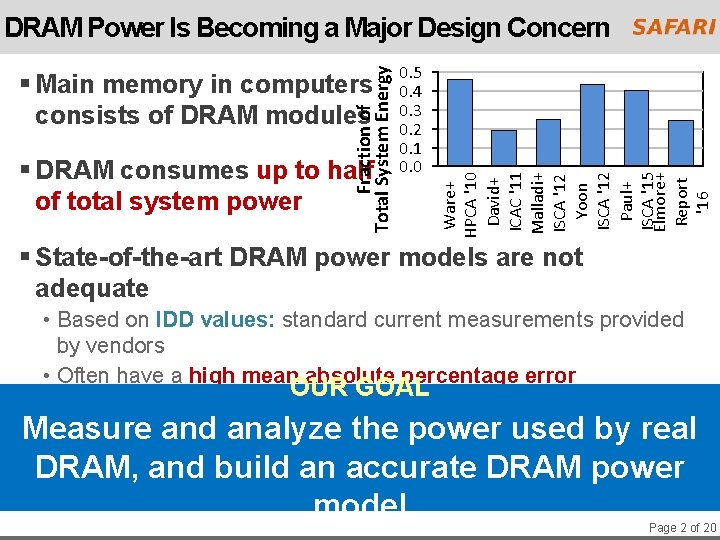
§ Main memory in computers consists of DRAM modules § DRAM consumes up to half of total system power 0. 5 0. 4 0. 3 0. 2 0. 1 0. 0 Ware+ HPCA '10 David+ ICAC '11 Malladi+ ISCA '12 Yoon ISCA '12 Paul+ ISCA '15 Elmore+ Report '16 Fraction of Total System Energy DRAM Power Is Becoming a Major Design Concern § State-of-the-art DRAM power models are not adequate • Based on IDD values: standard current measurements provided by vendors • Often have a high mean absolute percentage error OUR GOAL » 32% for DRAMPower » 161% forand Micronanalyze power modelthe Measure power used by real DRAM, and build an accurate DRAM power model Page 2 of 20
Outline Background: DRAM Organization & Operation Characterization Methodology New Findings on DRAM Power Consumption VAMPIRE: A Variation-Aware DRAM Power Model Conclusion Page 3 of 20
Simplified DRAM Organization and Operation DRAM Chip Processor Chip Core . . . Core Shared Last-Level Cache Bank 0 DRAM Cell Array . . . Bank 7 activation Row Buffer Column Select . . . Memory Controller Bank Select I/O Drivers memory channel § Fundamental DRAM commands: activate, read, write, precharge § One row of DRAM: 8 k. B Page 4 of 20
Outline Background: DRAM Organization & Operation Characterization Methodology New Findings on DRAM Power Consumption VAMPIRE: A Variation-Aware DRAM Power Model Conclusion Page 5 of 20
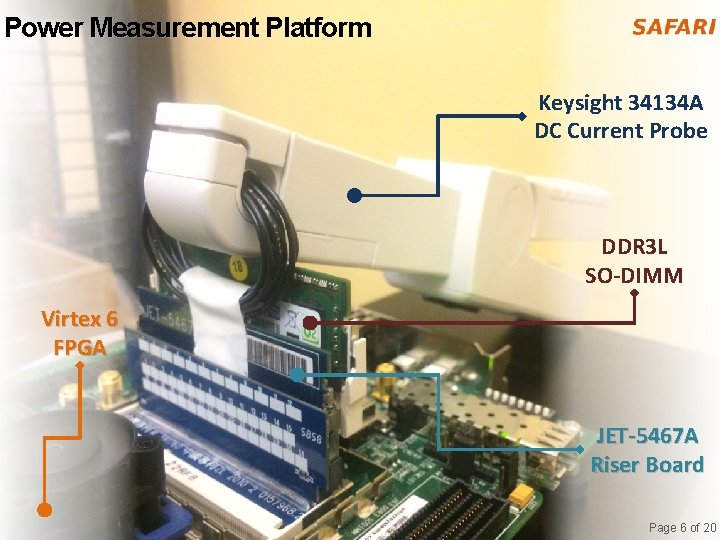
Power Measurement Platform Keysight 34134 A DC Current Probe DDR 3 L SO-DIMM Virtex 6 FPGA JET-5467 A Riser Board Page 6 of 20
Methodology Details § Soft. MC: an FPGA-based memory controller [Hassan+ HPCA ’ 17] • Modified to repeatedly loop commands • Open-source: https: //github. com/CMU-SAFARI/Soft. MC § Measure current consumed by a module during a Soft. MC test § Tested 50 DDR 3 L DRAM modules (200 DRAM chips) • Supply voltage: 1. 35 V • Three major vendors: A, B, C • Manufactured between 2014 and 2016 § For each experimental test that we perform • 10 runs of each test per module Page 7 of 20
Outline Background: DRAM Organization & Operation Characterization Methodology New Findings on DRAM Power Consumption VAMPIRE: A Variation-Aware DRAM Power Model Conclusion Page 8 of 20
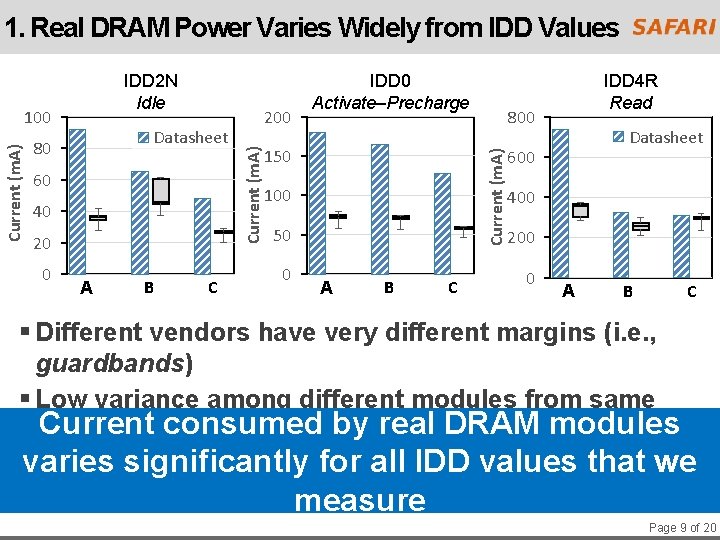
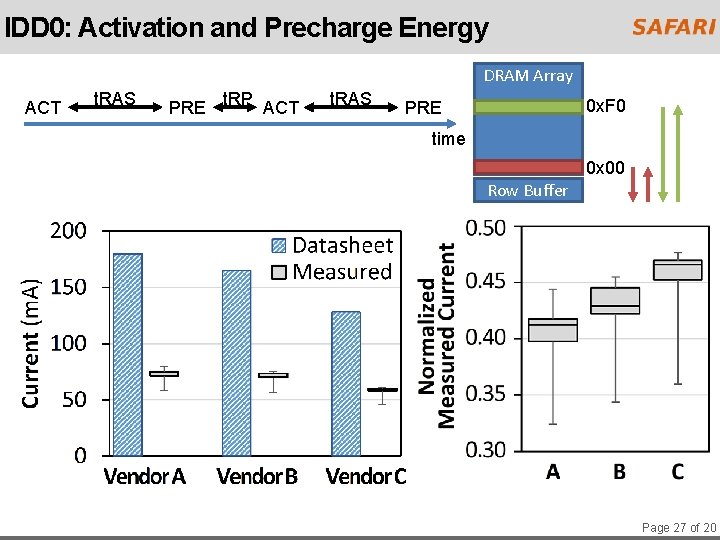
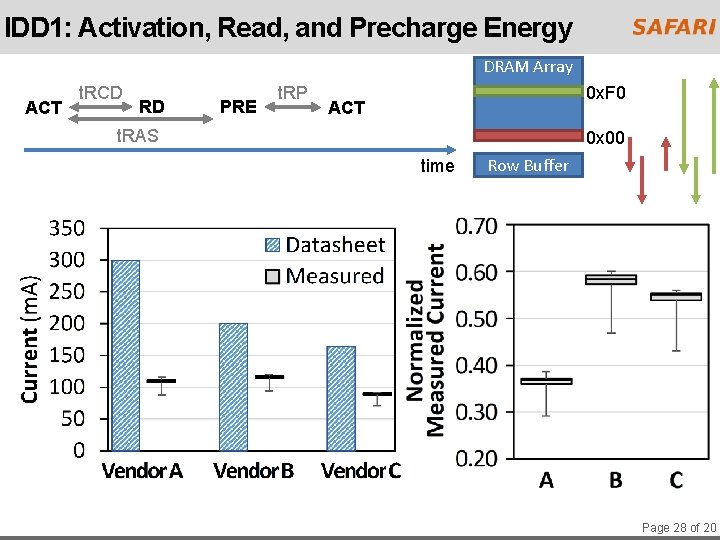
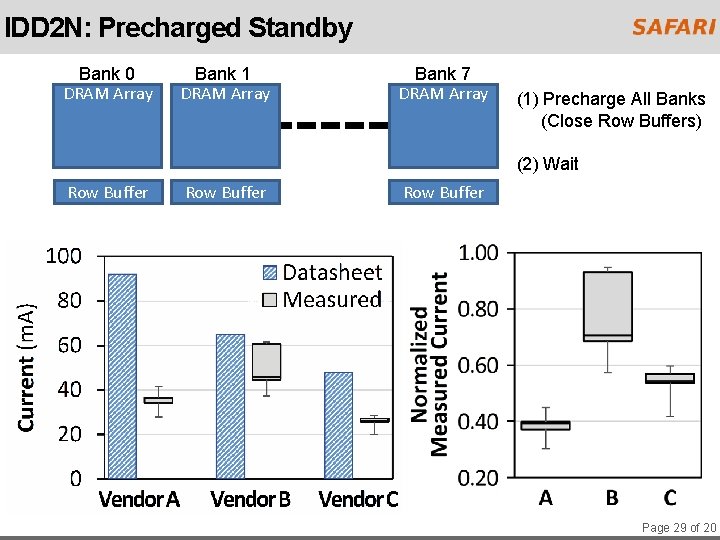
1. Real DRAM Power Varies Widely from IDD Values Datasheet 80 60 40 20 0 A B C 200 Current (m. A) 100 IDD 0 Activate–Precharge 150 100 50 0 A B C IDD 4 R Read 800 Current (m. A) IDD 2 N Idle Datasheet 600 400 200 0 A B C § Different vendors have very different margins (i. e. , guardbands) § Low variance among different modules from same Current consumed by real DRAM modules vendor varies significantly for all IDD values that we measure Page 9 of 20
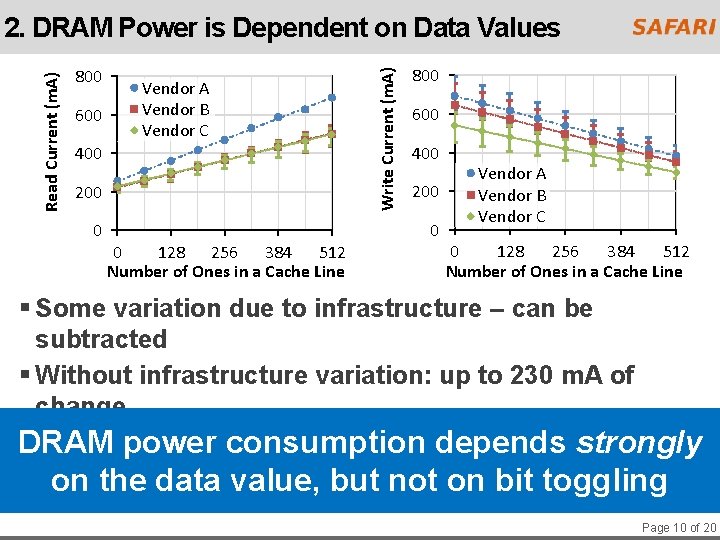
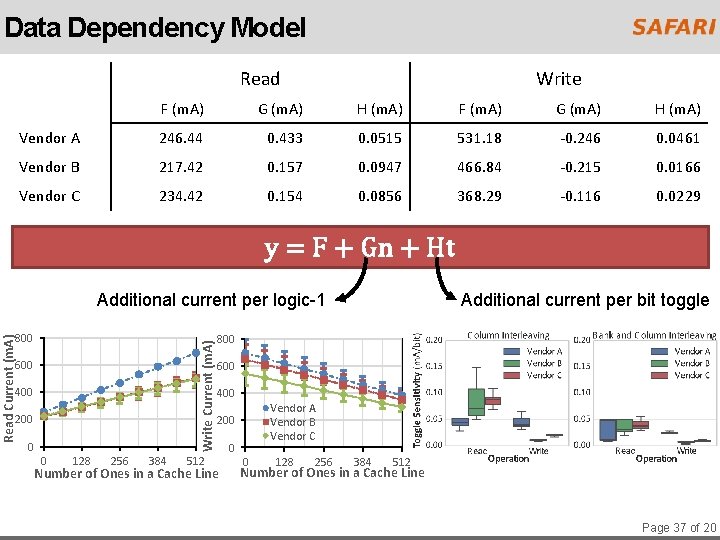
800 600 Vendor A Vendor B Vendor C 400 200 0 Write Current (m. A) Read Current (m. A) 2. DRAM Power is Dependent on Data Values 800 600 400 200 0 0 128 256 384 512 Number of Ones in a Cache Line Vendor A Vendor B Vendor C 0 128 256 384 512 Number of Ones in a Cache Line § Some variation due to infrastructure – can be subtracted § Without infrastructure variation: up to 230 m. A of change § Toggle power affects power consumption, but < 0. 15 m. A per DRAM consumption depends strongly bit on the data value, but not on bit toggling Page 10 of 20
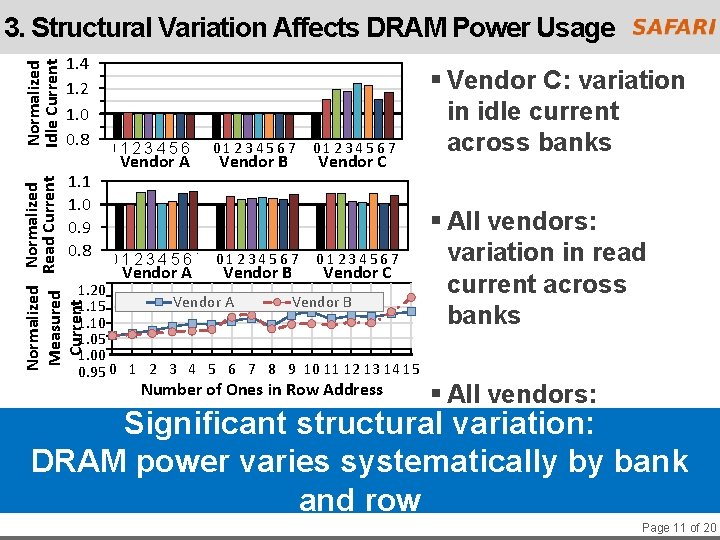
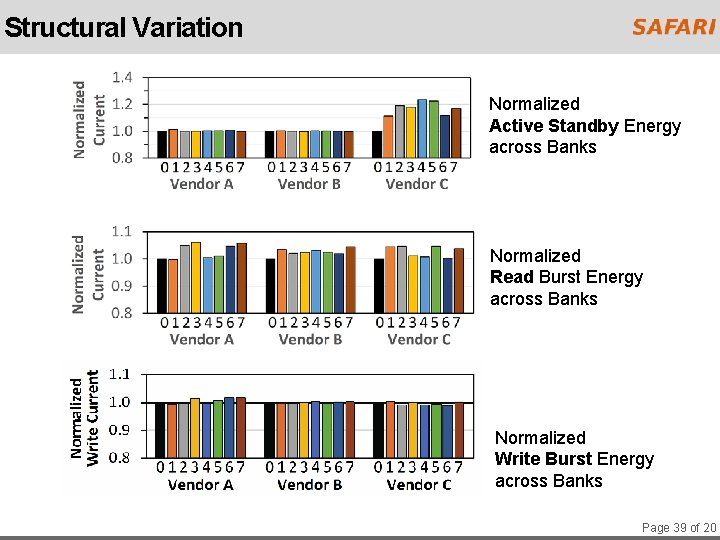
Normalized Idle Current 3. Structural Variation Affects DRAM Power Usage 1. 4 1. 2 1. 0 0. 8 Normalized Measured Read Current 1. 1 1. 0 0. 9 0. 8 0 1 2 3 4 5 6 7 01234567 Vendor A 01234567 Vendor B Vendor C 0 1 2 3 4 5 6 7 01234567 Vendor A Vendor B 01234567 Vendor C 1. 20 Vendor A Vendor B 1. 15 1. 10 1. 05 1. 00 0. 95 0 1 2 3 4 5 6 7 8 9 10 11 12 13 14 15 § Vendor C: variation in idle current across banks § All vendors: variation in read current across banks Number of Ones in Row Address § All vendors: in Significant structural variation: activationby based on DRAM power varies systematically bank row address and row Page 11 of 20
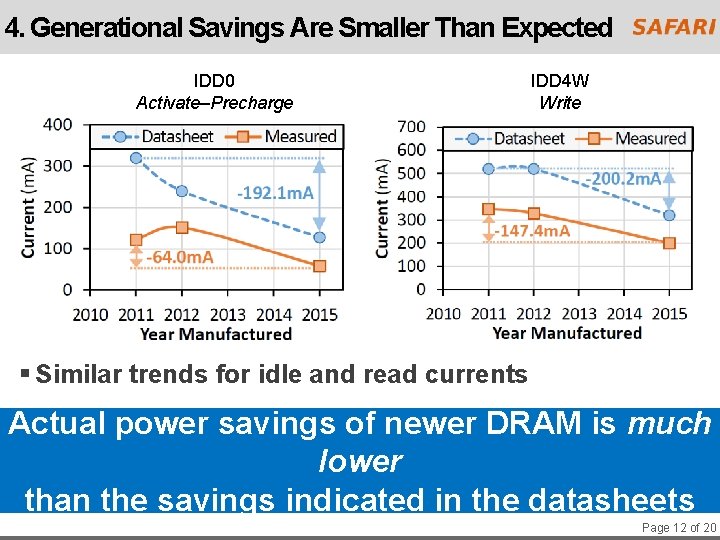
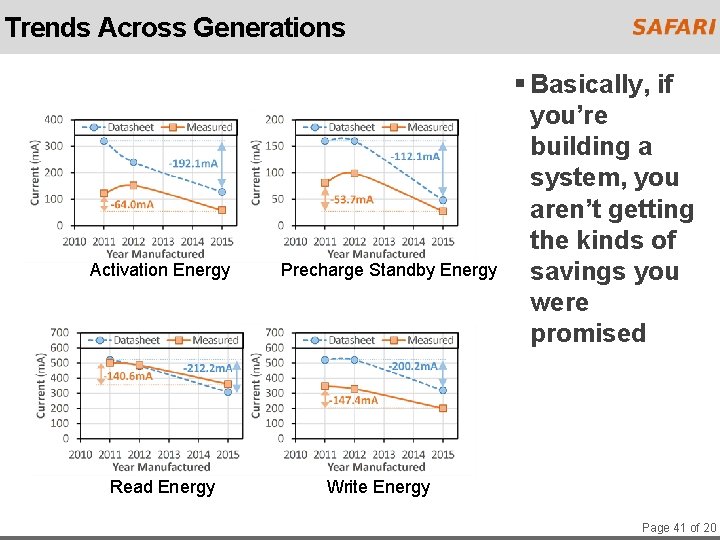
4. Generational Savings Are Smaller Than Expected IDD 0 Activate–Precharge IDD 4 W Write § Similar trends for idle and read currents Actual power savings of newer DRAM is much lower than the savings indicated in the datasheets Page 12 of 20
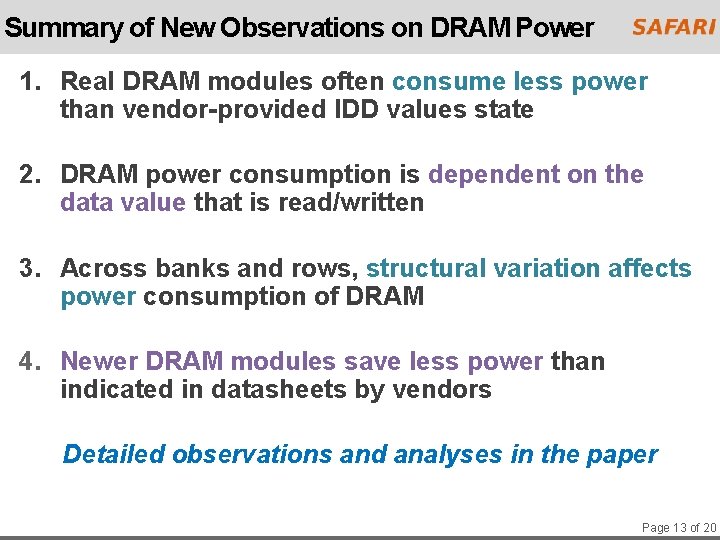
Summary of New Observations on DRAM Power 1. Real DRAM modules often consume less power than vendor-provided IDD values state 2. DRAM power consumption is dependent on the data value that is read/written 3. Across banks and rows, structural variation affects power consumption of DRAM 4. Newer DRAM modules save less power than indicated in datasheets by vendors Detailed observations and analyses in the paper Page 13 of 20
Outline Background: DRAM Organization & Operation Characterization Methodology New Findings on DRAM Power Consumption VAMPIRE: A Variation-Aware DRAM Power Model Conclusion Page 14 of 20
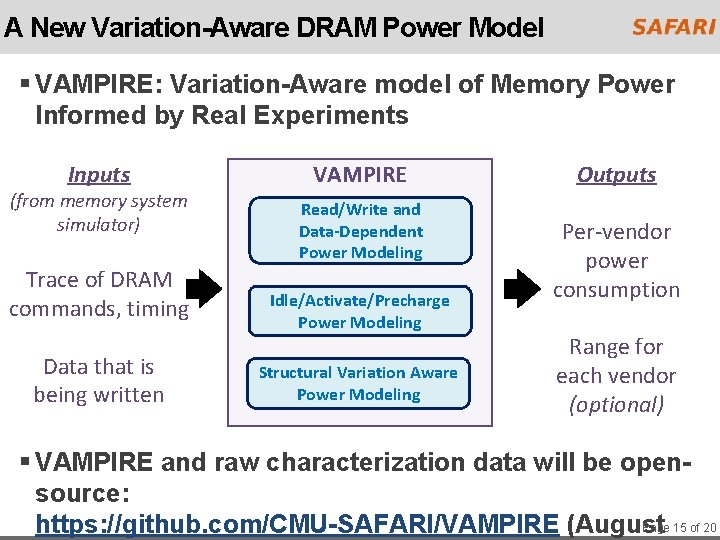
A New Variation-Aware DRAM Power Model § VAMPIRE: Variation-Aware model of Memory Power Informed by Real Experiments Inputs (from memory system simulator) Trace of DRAM commands, timing Data that is being written VAMPIRE Read/Write and Data-Dependent Power Modeling Idle/Activate/Precharge Power Modeling Structural Variation Aware Power Modeling Outputs Per-vendor power consumption Range for each vendor (optional) § VAMPIRE and raw characterization data will be opensource: Page 15 of 20 https: //github. com/CMU-SAFARI/VAMPIRE (August
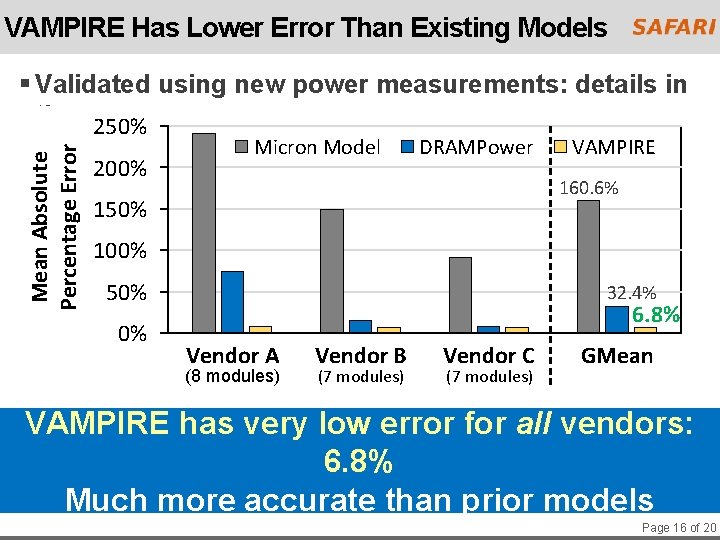
VAMPIRE Has Lower Error Than Existing Models Mean Absolute Percentage Error § Validated using new power measurements: details in the paper 250% 200% Micron Model DRAMPower VAMPIRE 160. 6% 150% 100% 50% 0% 32. 4% 6. 8% Vendor A (8 modules) Vendor B (7 modules) Vendor C (7 modules) GMean VAMPIRE has very low error for all vendors: 6. 8% Much more accurate than prior models Page 16 of 20
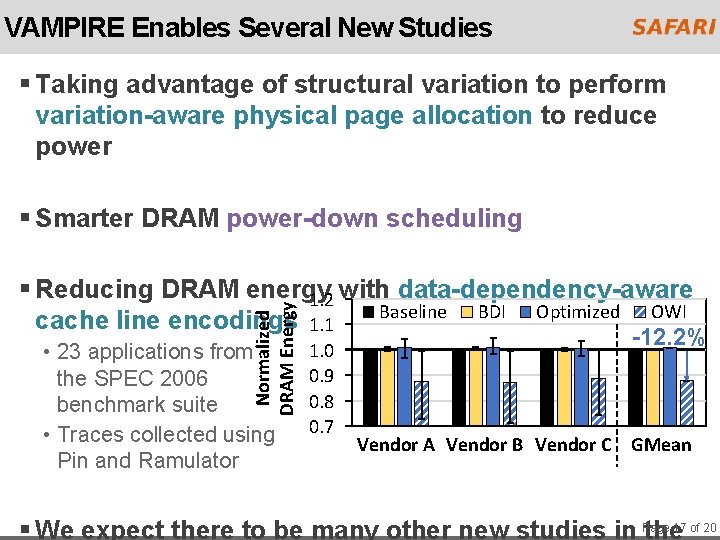
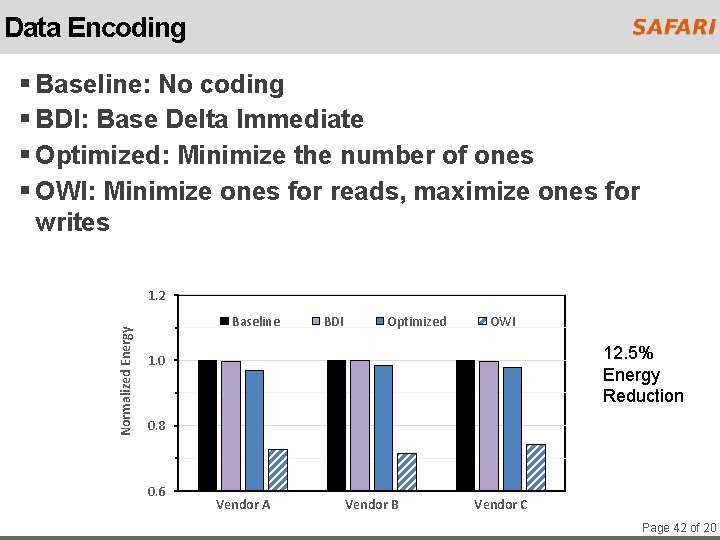
VAMPIRE Enables Several New Studies § Taking advantage of structural variation to perform variation-aware physical page allocation to reduce power § Smarter DRAM power-down scheduling Normalized DRAM Energy § Reducing DRAM energy 1. 2 with data-dependency-aware Baseline BDI Optimized OWI cache line encodings 1. 1 • 23 applications from the SPEC 2006 benchmark suite • Traces collected using Pin and Ramulator 1. 0 0. 9 0. 8 0. 7 -12. 2% Vendor A Vendor B Vendor C GMean § We expect there to be many other new studies in Page the 17 of 20
Outline Background: DRAM Organization & Operation Characterization Methodology New Findings on DRAM Power Consumption VAMPIRE: A Variation-Aware DRAM Power Model Conclusion Page 18 of 20
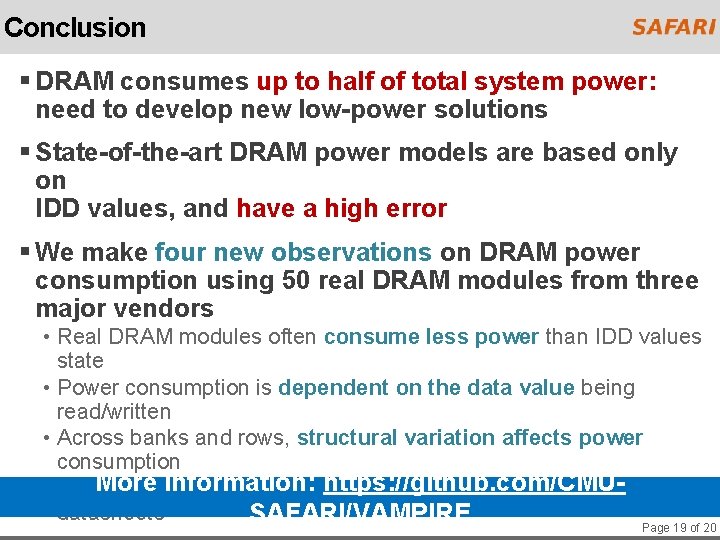
Conclusion § DRAM consumes up to half of total system power: need to develop new low-power solutions § State-of-the-art DRAM power models are based only on IDD values, and have a high error § We make four new observations on DRAM power consumption using 50 real DRAM modules from three major vendors • Real DRAM modules often consume less power than IDD values state • Power consumption is dependent on the data value being read/written • Across banks and rows, structural variation affects power consumption More information: https: //github. com/CMU • Newer DRAM modules save less power than indicated in datasheets SAFARI/VAMPIRE Page 19 of 20
What Your DRAM Power Models Are Not Telling You: Lessons from a Detailed Experimental Study Saugata Ghose, A. Giray Yağlıkçı, Raghav Gupta, Donghyuk Lee, Kais Kudrolli, William X. Liu, Hasan Hassan, Kevin K. Chang, Niladrish Chatterjee, Aditya Agrawal, Mike O’Connor, Onur Mutlu More information: https: //github. com/CMUSAFARI/VAMPIRE
Backup Slides Page 21 of 20
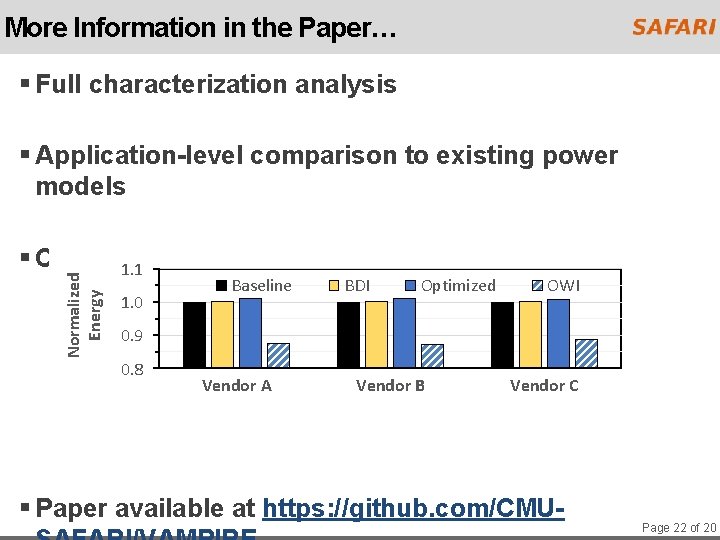
More Information in the Paper… § Full characterization analysis § Application-level comparison to existing power models Normalized Energy § Case study: dependency-aware data encoding 1. 1 1. 0 Baseline BDI Optimized OWI 0. 9 0. 8 Vendor A Vendor B Vendor C § Paper available at https: //github. com/CMU- Page 22 of 20
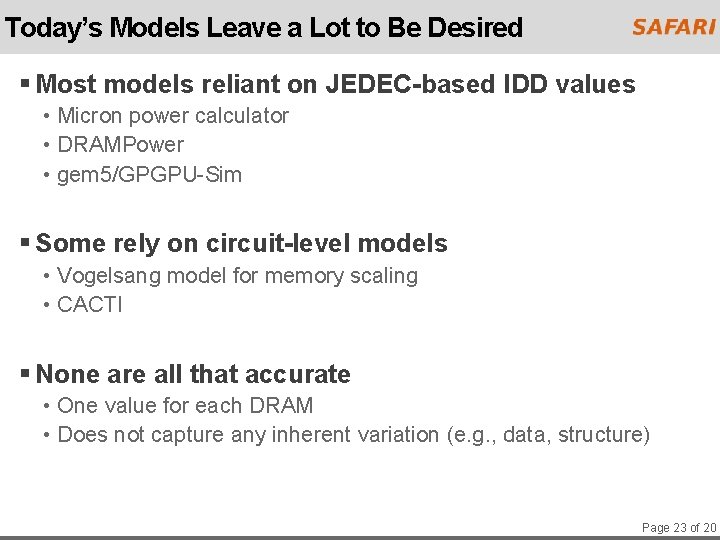
Today’s Models Leave a Lot to Be Desired § Most models reliant on JEDEC-based IDD values • Micron power calculator • DRAMPower • gem 5/GPGPU-Sim § Some rely on circuit-level models • Vogelsang model for memory scaling • CACTI § None are all that accurate • One value for each DRAM • Does not capture any inherent variation (e. g. , data, structure) Page 23 of 20
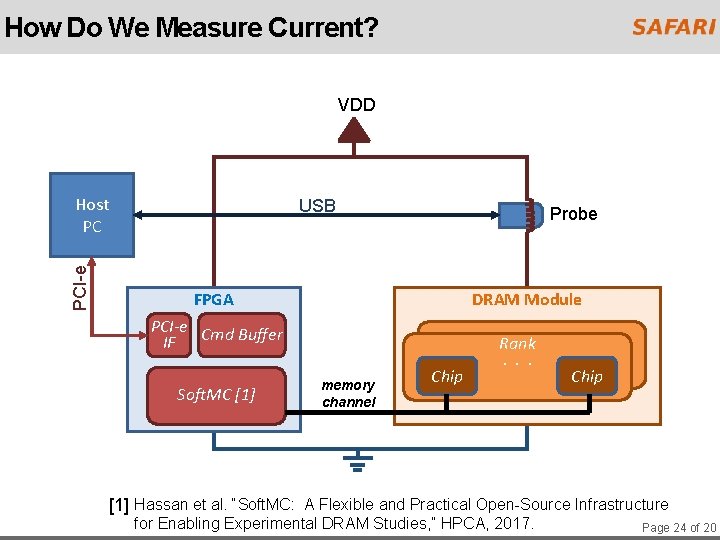
How Do We Measure Current? VDD PCI-e Host PC USB Probe FPGA DRAM Module PCI-e Cmd Buffer IF Soft. MC [1] memory channel Chip Rank. . . Chip [1] Hassan et al. “Soft. MC: A Flexible and Practical Open-Source Infrastructure for Enabling Experimental DRAM Studies, ” HPCA, 2017. Page 24 of 20
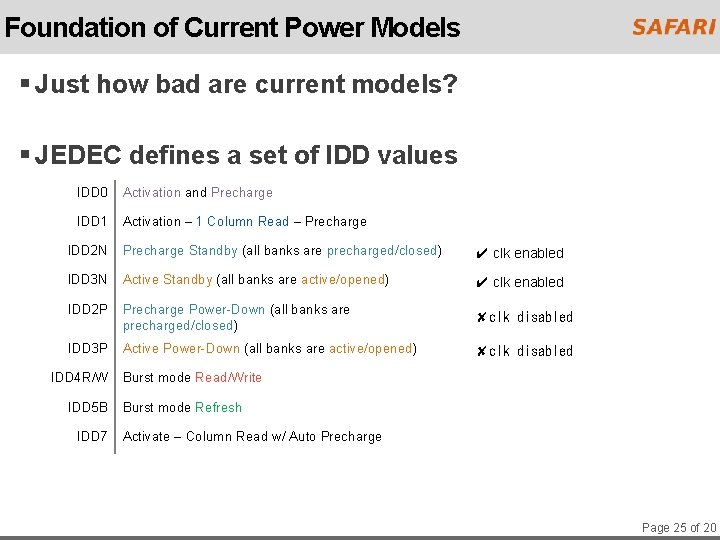
Foundation of Current Power Models § Just how bad are current models? § JEDEC defines a set of IDD values IDD 0 Activation and Precharge IDD 1 Activation – 1 Column Read – Precharge IDD 2 N Precharge Standby (all banks are precharged/closed) ✔ clk enabled IDD 3 N Active Standby (all banks are active/opened) ✔ clk enabled IDD 2 P Precharge Power-Down (all banks are precharged/closed) ✘clk disabled IDD 3 P Active Power-Down (all banks are active/opened) ✘clk disabled IDD 4 R/W IDD 5 B IDD 7 Burst mode Read/Write Burst mode Refresh Activate – Column Read w/ Auto Precharge Page 25 of 20
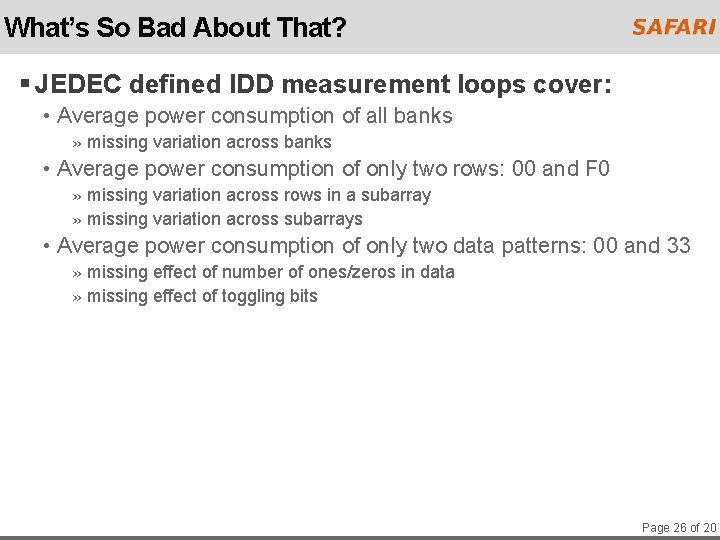
What’s So Bad About That? § JEDEC defined IDD measurement loops cover: • Average power consumption of all banks » missing variation across banks • Average power consumption of only two rows: 00 and F 0 » missing variation across rows in a subarray » missing variation across subarrays • Average power consumption of only two data patterns: 00 and 33 » missing effect of number of ones/zeros in data » missing effect of toggling bits Page 26 of 20
IDD 0: Activation and Precharge Energy DRAM Array ACT t. RAS PRE t. RP ACT t. RAS 0 x. F 0 PRE time 0 x 00 Row Buffer Page 27 of 20
IDD 1: Activation, Read, and Precharge Energy DRAM Array ACT t. RCD RD PRE t. RP 0 x. F 0 ACT t. RAS 0 x 00 time Row Buffer Page 28 of 20
IDD 2 N: Precharged Standby Bank 0 DRAM Array Bank 1 DRAM Array Bank 7 DRAM Array (1) Precharge All Banks (Close Row Buffers) (2) Wait Row Buffer Page 29 of 20
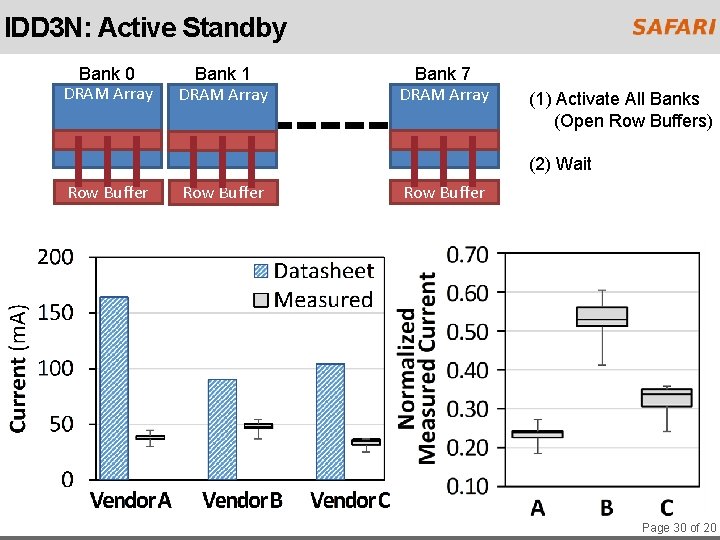
IDD 3 N: Active Standby Bank 0 DRAM Array Bank 1 DRAM Array Bank 7 DRAM Array (1) Activate All Banks (Open Row Buffers) (2) Wait Row Buffer Page 30 of 20
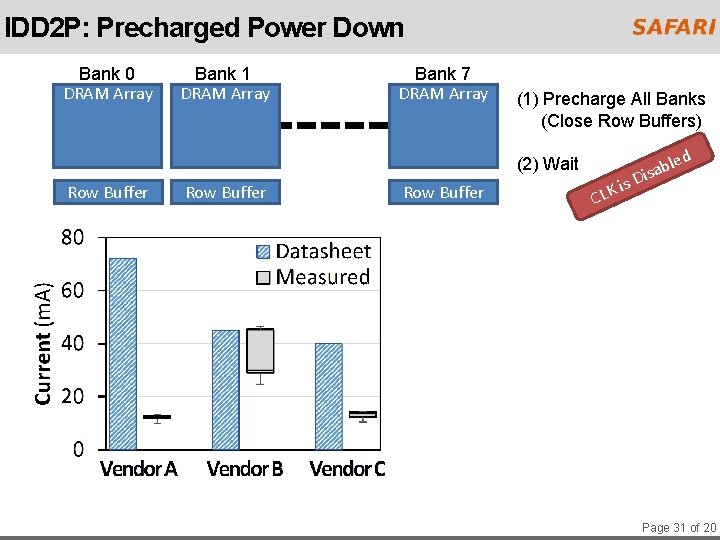
IDD 2 P: Precharged Power Down Bank 0 DRAM Array Bank 1 DRAM Array Bank 7 DRAM Array (1) Precharge All Banks (Close Row Buffers) (2) Wait Row Buffer d is K L C le b a s i D Page 31 of 20
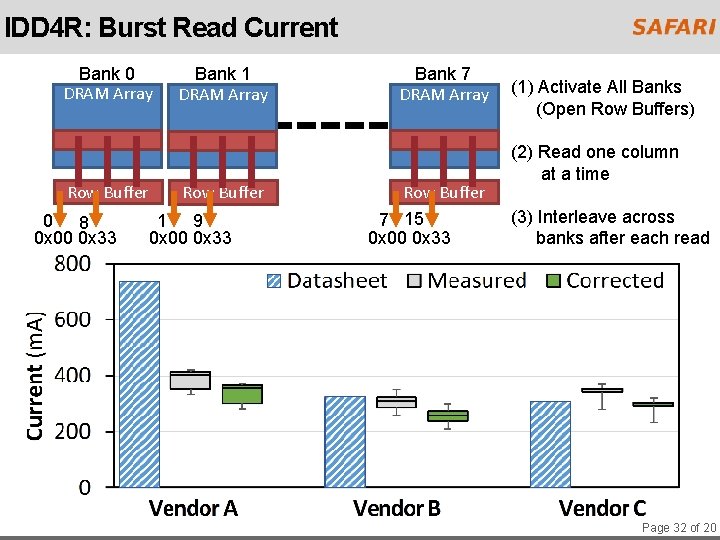
IDD 4 R: Burst Read Current Bank 0 DRAM Array Row Buffer 0 8 0 x 00 0 x 33 Bank 1 DRAM Array Row Buffer 1 9 0 x 00 0 x 33 Bank 7 DRAM Array Row Buffer 7 15 0 x 00 0 x 33 (1) Activate All Banks (Open Row Buffers) (2) Read one column at a time (3) Interleave across banks after each read Page 32 of 20
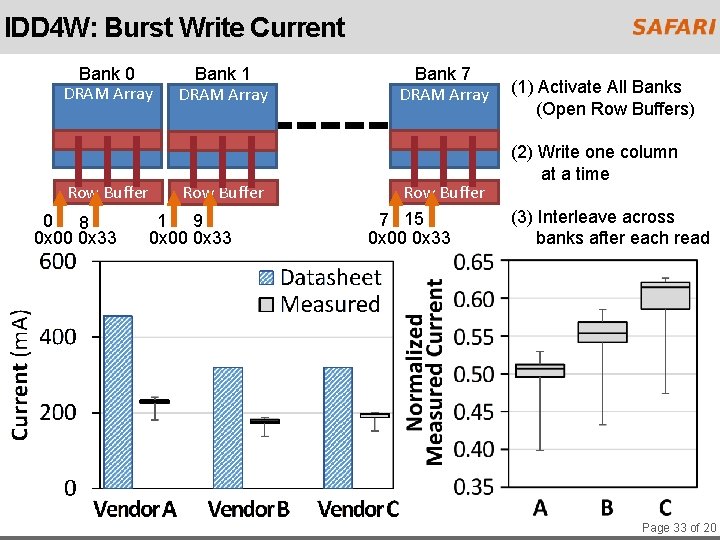
IDD 4 W: Burst Write Current Bank 0 DRAM Array Row Buffer 0 8 0 x 00 0 x 33 Bank 1 DRAM Array Row Buffer 1 9 0 x 00 0 x 33 Bank 7 DRAM Array Row Buffer 7 15 0 x 00 0 x 33 (1) Activate All Banks (Open Row Buffers) (2) Write one column at a time (3) Interleave across banks after each read Page 33 of 20
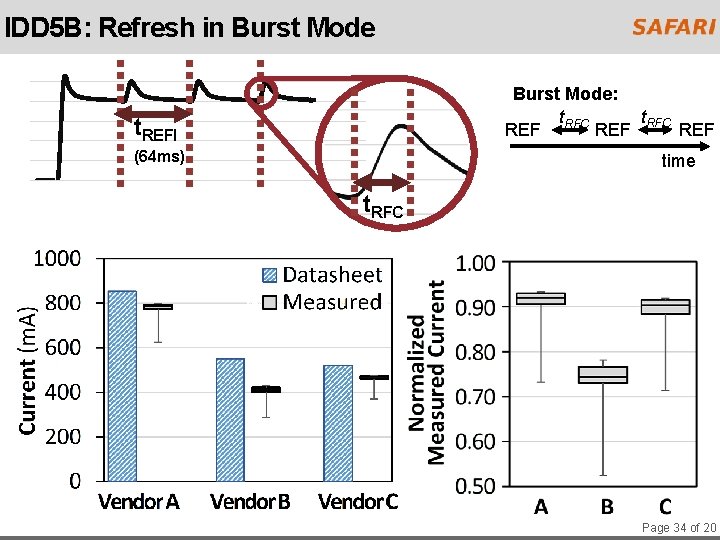
IDD 5 B: Refresh in Burst Mode: t. RFC REF REF t. REFI (64 ms) time t. RFC Page 34 of 20
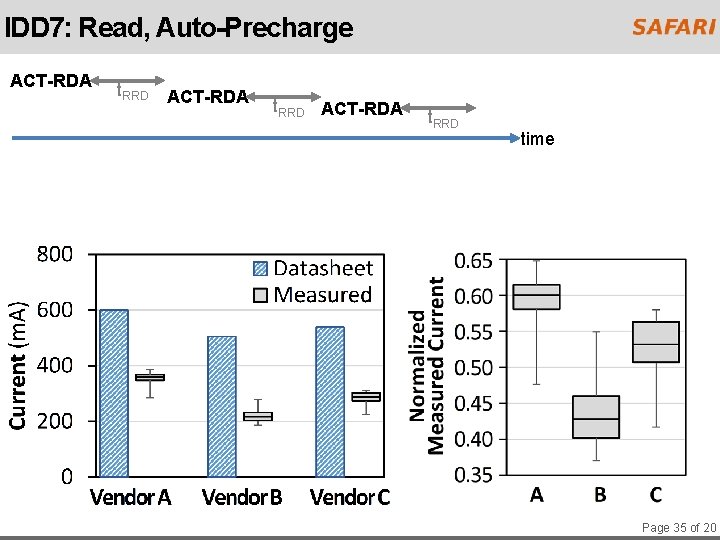
IDD 7: Read, Auto-Precharge ACT-RDA t. RRD time Page 35 of 20
Impact of Bit Toggling on DRAM Power column number 0 1 2 . . . 1011 0010 1011 … 0110 . . . c– 1 0000 1010 1111 … 0011 1 Bank 1 Row Buffer Bank 0 Row Buffer 0 1 2 c– 1 . . . Column Select. . . global bitlines 2 0 Bank 7 Row Buffer 1 2 c– 1 1011 0010 1011 … 0110. . . Column Select global bitlines Bank Select peripheral bus to I/O drivers Page 36 of 20
Data Dependency Model Read Write F (m. A) G (m. A) H (m. A) Vendor A 246. 44 0. 433 0. 0515 531. 18 -0. 246 0. 0461 Vendor B 217. 42 0. 157 0. 0947 466. 84 -0. 215 0. 0166 Vendor C 234. 42 0. 154 0. 0856 368. 29 -0. 116 0. 0229 y = F + Gn + Ht Additional current per logic-1 Write Current (m. A) Read Current (m. A) 800 600 400 200 0 0 128 256 384 512 Additional current per bit toggle 800 600 400 Vendor A Vendor B Vendor C 200 Number of Ones in a Cache Line 0 0 128 256 384 512 Number of Ones in a Cache Line Page 37 of 20
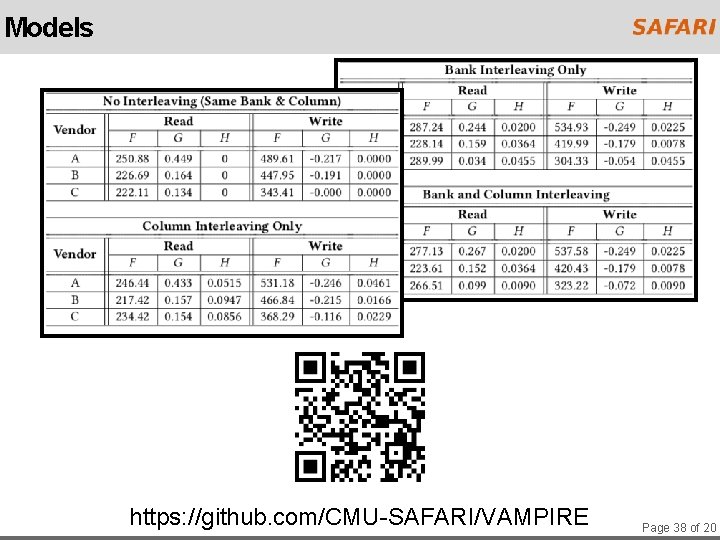
Models https: //github. com/CMU-SAFARI/VAMPIRE Page 38 of 20
Structural Variation Normalized Active Standby Energy across Banks Normalized Read Burst Energy across Banks Normalized Write Burst Energy across Banks Page 39 of 20
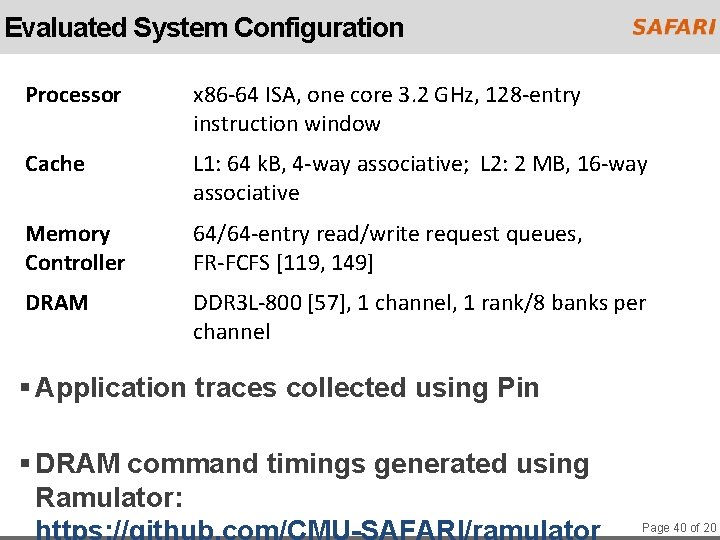
Evaluated System Configuration Processor x 86 -64 ISA, one core 3. 2 GHz, 128 -entry instruction window Cache L 1: 64 k. B, 4 -way associative; L 2: 2 MB, 16 -way associative Memory Controller 64/64 -entry read/write request queues, FR-FCFS [119, 149] DRAM DDR 3 L-800 [57], 1 channel, 1 rank/8 banks per channel § Application traces collected using Pin § DRAM command timings generated using Ramulator: Page 40 of 20
Trends Across Generations Activation Energy Read Energy Precharge Standby Energy § Basically, if you’re building a system, you aren’t getting the kinds of savings you were promised Write Energy Page 41 of 20
Data Encoding § Baseline: No coding § BDI: Base Delta Immediate § Optimized: Minimize the number of ones § OWI: Minimize ones for reads, maximize ones for writes Normalized Energy 1. 2 Baseline BDI Optimized OWI 12. 5% Energy Reduction 1. 0 0. 8 0. 6 Vendor A Vendor B Vendor C Page 42 of 20
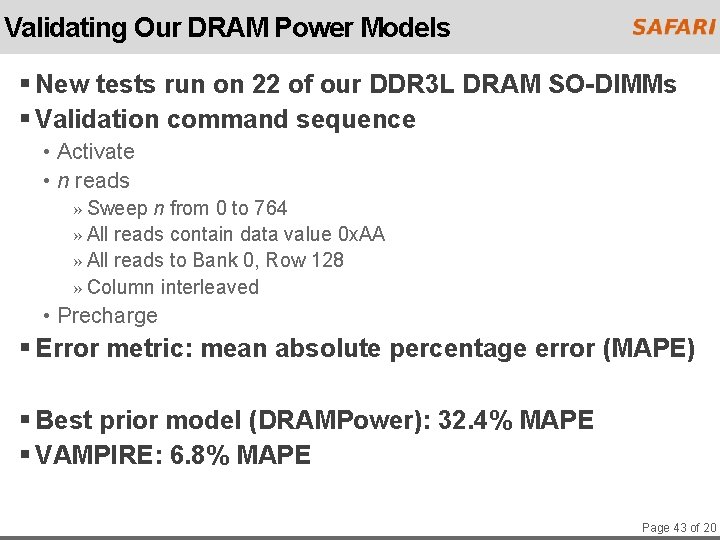
Validating Our DRAM Power Models § New tests run on 22 of our DDR 3 L DRAM SO-DIMMs § Validation command sequence • Activate • n reads » Sweep n from 0 to 764 » All reads contain data value 0 x. AA » All reads to Bank 0, Row 128 » Column interleaved • Precharge § Error metric: mean absolute percentage error (MAPE) § Best prior model (DRAMPower): 32. 4% MAPE § VAMPIRE: 6. 8% MAPE Page 43 of 20