
WHAT YOUR CHILDREN WANT YOU TO UNDERSTAND Jill






- Slides: 35
WHAT YOUR CHILDREN WANT YOU TO UNDERSTAND Jill Weissberg-Benchell, Ph. D. , CDE
Diabetes is not a Do It Yourself Disease Need a team n Need cheerleaders n Need a helping hand n Need support from loved ones n Diabetes is cared for within a family n
DEVELOPMENTAL ISSUES FOR PRESCHOOLERS Learning and Discovering n Magical Thinking and Creativity n Want to have Control over their world n “NO’S” n Limited Self-Awareness n Picky Eating, Unpredictable Behavior n
EMOTIONAL ISSUES THAT MAY ARISE FOR PRESCHOOLERS n Emotions are not well-regulated n Communication skills are still developing. n May develop fears around blood sugar checks, insulin injections site changes.
PARENTS AND PRESCHOOLERS n Not allowing diabetes-specific tasks to become the primary source of attention n Offering Choices When Possible n Using Clear, Simple Language n Use Distraction During Regimen Tasks n IF more than one parent, share tasks
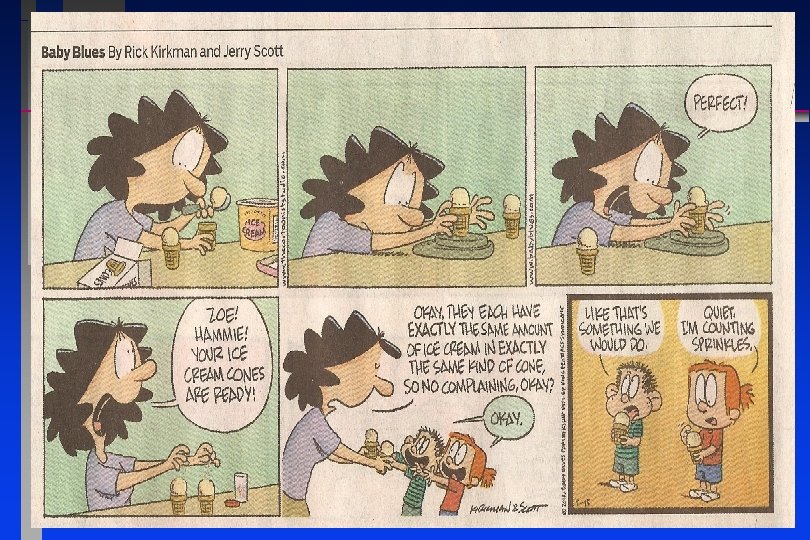
DEVELOPMENTAL ISSUES FOR SCHOOL-AGE CHILDREN n Time Away From Parent Supervision n Expanding “Known World” n Learning Self-Control n Recognizing Differences Among Peers n Issues of Fairness
EMOTIONAL ISSUES FOR SCHOOL AGE CHILDREN n Roots of Self-Esteem Begin to Grow n Pitfalls of Blame and Shame n Miscarried n Peer Helping May Begin teasing may begin
PARENTS AND SCHOOL AGE CHILDREN n Separating Normative Independence Goals From The Non-Normative Task of Managing Diabetes n Providing Routines and Consistency is Critical n Important to Include Child in Family Discussions and Problem Solving. . “Think Aloud”
DEVELOPMENTAL ISSUES FOR EARLY ADOLESCENTS (10 -13 YEARS OF AGE) PHYSICAL: Puberty begins. Rapid growth begins. n COGNITIVE: Tends to still be fairly concrete. n Emergence of more sophisticated thinking. n EMOTIONAL: Peer teasing/Bullying. Sense of belonging n SOCIAL: Interested in forming intimate relationships with peers. n FAMILY: Increased need for privacy, push for independence/beginning to detach from parents
PARENTS AND PRE-TEENS Match Expectations for independence and responsibility with Ability n Continue to oversee/monitor/support n Take over any time AND when needed n Encourage your child to recruit their friends for support and reminders n Collaborate to develop strategies for communications. . Texts? Emojis? Photos of meters? n
DEVELOPMENTAL ISSUES FOR MIDDLE ADOLESCENTS (14 -17 YEARS OF AGE) n PHYSICAL: Puberty is ending. Girls are ending their growth spurt. Boys may be just starting. n COGNITIVE: Emergence of more sophisticated thinking. n EMOTIONAL: Identity development. Thinking about leaving home. n SOCIAL: Peers, sexuality, dating. n FAMILY: Interdependence?
ZITS © ZITS Partnership, King Features Syndicate.
DEVELOPMENTAL ISSUES FOR ADOLESCENTS Wanting to be the same as peers n Increased problem-solving and abstract thinking skills n Ability to understand goals of treatment regimen n Frustration that adherence doesn’t always lead to improved outcomes, and poor adherence doesn’t always lead to worse outcomes. n Desire for increased independence and responsibility n
DEVELOPMENTAL ISSUES FOR ADOLESCENTS Increasing independence often results in decreasing supervision. n Schedules are more erratic than younger peers. n Puberty may play a role in diabetes outcomes. n Experimenting in Sex, Drugs, Alcohol. n Sense of invulnerability in this age group. n
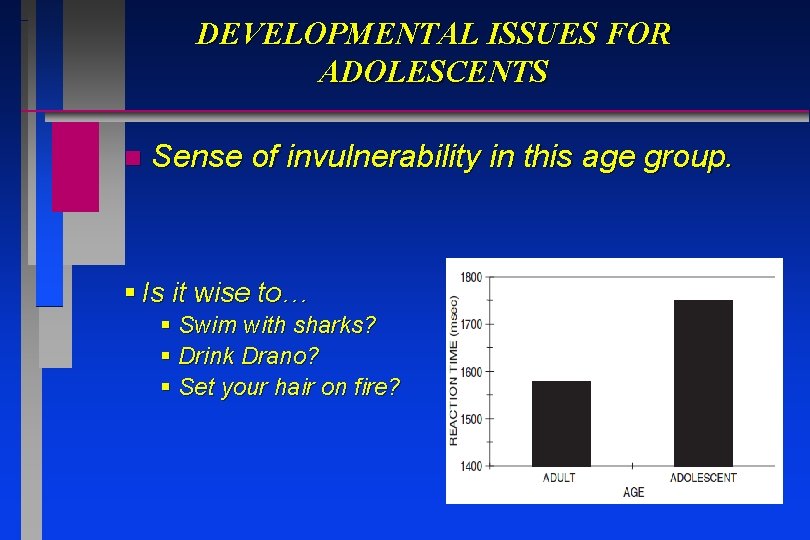
DEVELOPMENTAL ISSUES FOR ADOLESCENTS n Sense of invulnerability in this age group. § Is it wise to… § Swim with sharks? § Drink Drano? § Set your hair on fire?
DEVELOPMENTAL ISSUES FOR ADOLESCENTS n Understand Sarcasm. n Understand – keenly aware of – Hypocrisy n Sometimes will not pay attention to the risks or consequences of what they do
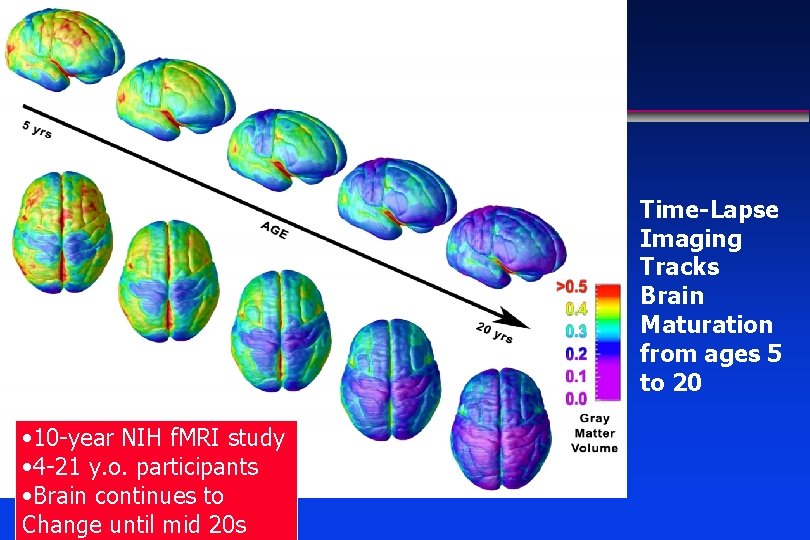
Time-Lapse Imaging Tracks Brain Maturation from ages 5 to 20 • 10 -year NIH f. MRI study • 4 -21 y. o. participants • Brain continues to Change until mid 20 s
EMOTIONAL ISSUES FOR TEENAGERS n Pubertal changes n Managing moods n Increased risk for emotional distress and/or depression n Miscarried helping may lead to increased conflict
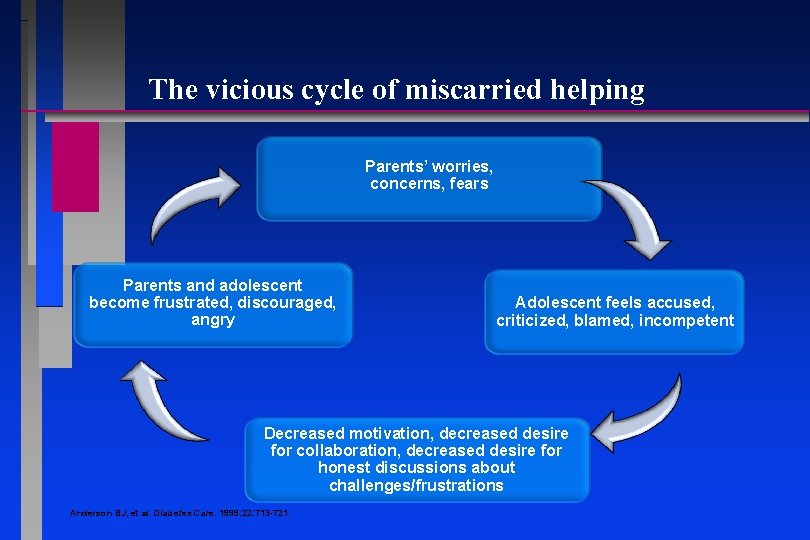
The vicious cycle of miscarried helping Parents’ worries, concerns, fears Parents and adolescent become frustrated, discouraged, angry Adolescent feels accused, criticized, blamed, incompetent Decreased motivation, decreased desire for collaboration, decreased desire for honest discussions about challenges/frustrations Anderson BJ, et al. Diabetes Care. 1999; 22: 713 -721.
PARENTS AND TEENAGERS n Matching self-care responsibility with level of skill n Promoting family discussions and family problem-solving n Does your tone of voice change when talking about diabetes? n Balancing nagging with monitoring
Why Nagging Does Not Work
PARENTS AND TEENAGERS n Separating developmentally typical responsibilities from diabetes-specific responsibilities n Encouraging success in sports, friends, school, extracurriculars n Normalize burn out and plan for it n Discuss who is responsible for what and review periodically so everyone’s on the same page
Interdependence is Key n No one is truly independent. n Isolation leads to poor psychosocial and medical outcomes n Support, Collaboration and Teamwork is the Magic Sauce n Minimize Judgment and Shame
Interdependence is Key n The hallmark of being an adult is knowing when you need help, and asking for it. n Normalize feelings of “burn-out” and plan for them. This is not a failure. • Schedule times when responsibility is turned back to parents and then back to teen.
SURVIVAL ADVICE n Sharing Responsibility • Avoid Excessive Self-Care Autonomy • Facilitate Interdependence • Separate Knowledge from Judgment and Maturity • Avoid Vicious Cycle of Miscarried Helping
CONSIDER, DISCUSS, PROBLEM-SOLVE How do you communicate as a family? n How do you problem-solve as a family? n How do you resolve disagreements as a family? n How do these things change as your child grows and develops? n How do you balance their development and push for independence with supervision and supportive monitoring? n
LEARN TO LISTEN n n n Limit distractions. Silence technology Pay attention to what is being said, not what you want to say. Repeat the last sentence the other person says. This keeps your attention on each statement. Be OK with silence. You don’t have to always reply or have a comment. Encourage your child to offer ideas and solutions before you give yours. Listen 80 percent of the time, talk 20 percent. Restate the key points you heard and ask whether they are accurate. “Let me see whether I heard you correctly…” is an easy way to clarify any confusion Being a strong, attentive listener will help you be a better parent.
ENCOURAGE POSITIVE BEHAVIORS n PRAISE, DON’T PUNISH • Catch your child doing well with diabetes tasks • Celebrate every day diabetes successes n FOCUS ON BEHAVIORS, NOT NUMBERS • BG values are data, not report cards, not good and not bad • Praise behaviors you want to see more of n PROBLEM-SOLVE TOGETHER • Avoid commands. Avoid unsolicited advice • Encourage others ideas/solutions.
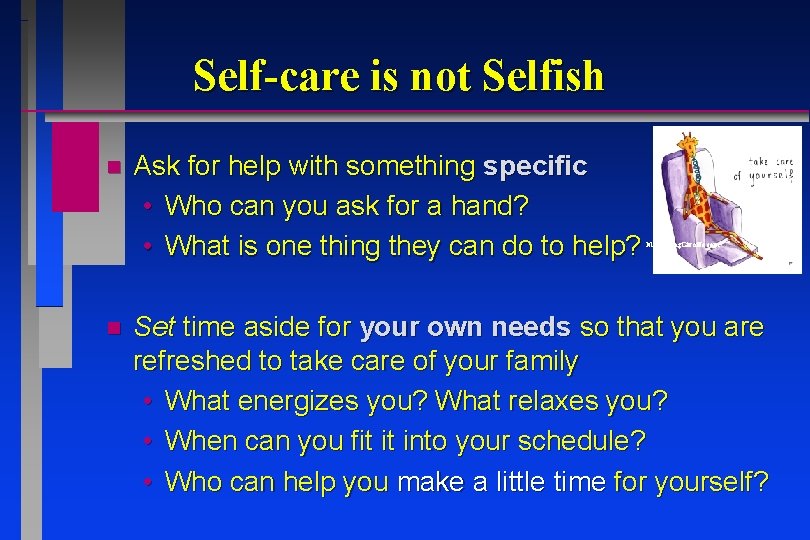
Self-care is not Selfish n n Ask for help with something specific • Who can you ask for a hand? • What is one thing they can do to help? Motivating. Giraffe. com Set time aside for your own needs so that you are refreshed to take care of your family • What energizes you? What relaxes you? • When can you fit it into your schedule? • Who can help you make a little time for yourself?
A little laughter goes a long way. Diabetes is serious business. n Also, funny stuff happens. n Finding humor in stressful situations can be a useful (and fun) way to get through it. n Great model for your children for managing diabetes challenges. n