
What You Need to Know About Your Credit
What You Need to Know About Your Credit Report and Credit Score Layne R. Mc. Daniel, CPA, CGMA President/CEO Noesis Data, an Equifax Sales Agent
Agenda § What is a credit report? § How do I get a copy of my credit report? § What’s on my credit report? § What’s NOT on my credit report? § How long does information stay on my credit report? § Who can see my credit report? § What is a credit score § About FICO Scores § Correcting Errors
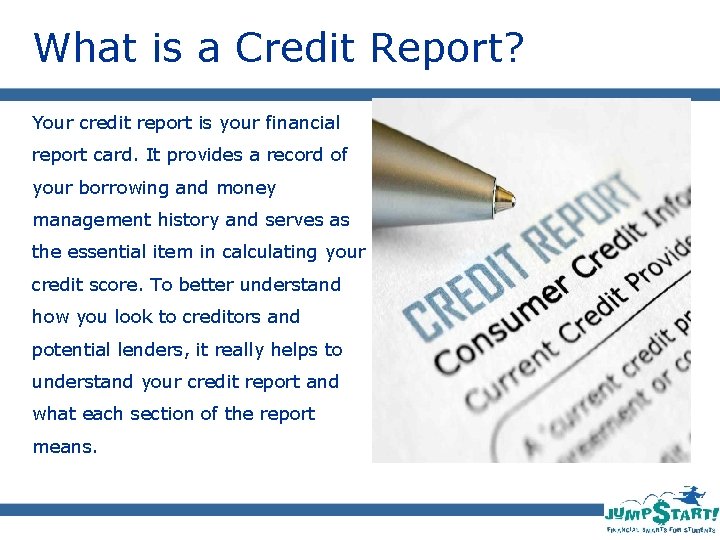
What is a Credit Report? Your credit report is your financial report card. It provides a record of your borrowing and money management history and serves as the essential item in calculating your credit score. To better understand how you look to creditors and potential lenders, it really helps to understand your credit report and what each section of the report means.
How do I Get a Copy of my Credit Report? Under federal law you are entitled to a free credit report from each of the three nationwide credit reporting agencies (Equifax, Experian, and Trans. Union) once every 12 months. You can request all three reports at once, or space them out throughout the year. • Online: Visit Annual. Credit. Report. com • By Phone: Call 1 -877 -322 -8228. Deaf and hard of hearing consumers can access the TTY service by calling 711 and referring the Relay Operator to 1 -800 -821 -7232. • By Mail: Complete the Annual Credit Report Request Form and mail it to: Annual Credit Report Request Service PO Box 105281 Atlanta, GA 30348 -5281
How do I Get a Copy of my Credit Report? You can get additional free reports if any of the following apply to you: • If a person has taken adverse action against you because of information in your credit report; • If you are the victim of identity theft and place a fraud alert in your file; • If your file contains inaccurate information as a result of fraud; • If you are on public assistance; or • If you are unemployed but expect to apply for employment within 60 days.
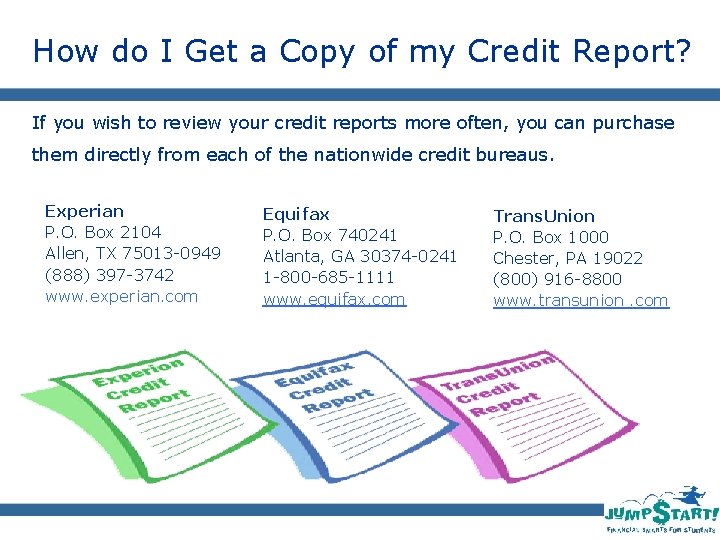
How do I Get a Copy of my Credit Report? If you wish to review your credit reports more often, you can purchase them directly from each of the nationwide credit bureaus. Experian P. O. Box 2104 Allen, TX 75013 -0949 (888) 397 -3742 www. experian. com Equifax P. O. Box 740241 Atlanta, GA 30374 -0241 1 -800 -685 -1111 www. equifax. com Trans. Union P. O. Box 1000 Chester, PA 19022 (800) 916 -8800 www. transunion. com

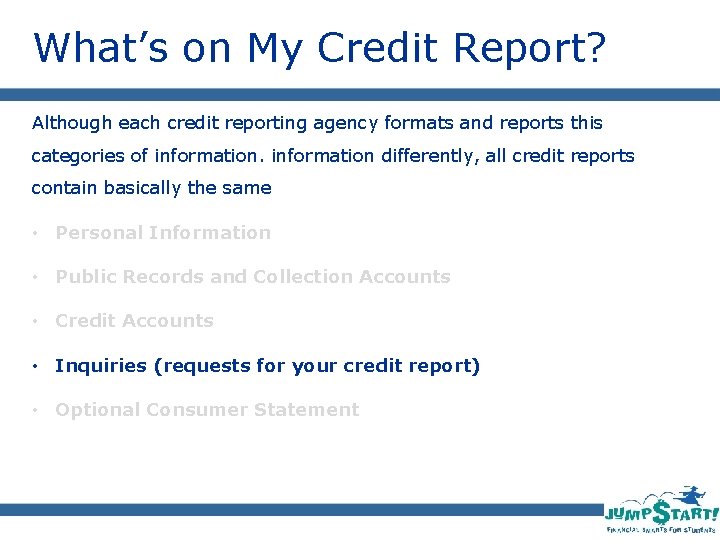
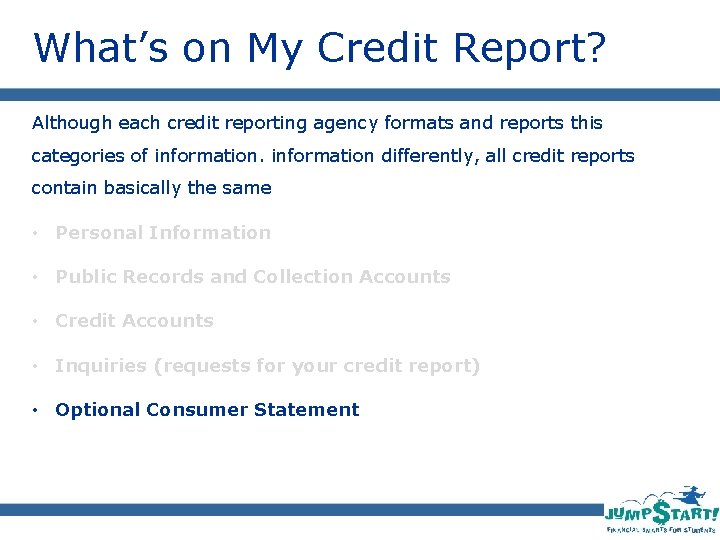
What’s on My Credit Report? Although each credit reporting agency formats and reports this categories of information differently, all credit reports contain basically the same • Personal Information • Public Records and Collection Accounts • Credit Accounts • Inquiries (requests for your credit report) • Optional Consumer Statement
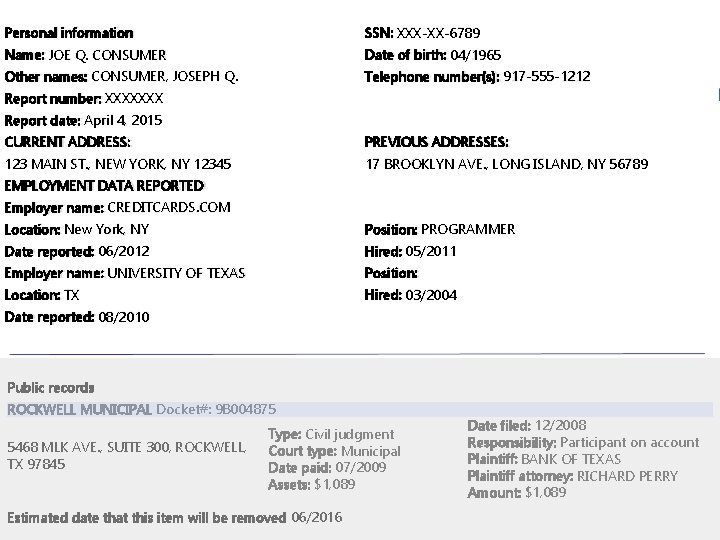
Personal information SSN: XXX-XX-6789 Name: JOE Q. CONSUMER Date of birth: 04/1965 Other names: CONSUMER, JOSEPH Q. Telephone number(s): 917 -555 -1212 Report number: XXXXXXX Report date: April 4, 2015 CURRENT ADDRESS: PREVIOUS ADDRESSES: 123 MAIN ST. , NEW YORK, NY 12345 17 BROOKLYN AVE. , LONG ISLAND, NY 56789 EMPLOYMENT DATA REPORTED Employer name: CREDITCARDS. COM Location: New York, NY Position: PROGRAMMER Date reported: 06/2012 Hired: 05/2011 Employer name: UNIVERSITY OF TEXAS Position: Location: TX Hired: 03/2004 Date reported: 08/2010 Public records ROCKWELL MUNICIPAL Docket#: 9 B 004875 5468 MLK AVE. , SUITE 300, ROCKWELL, TX 97845 Type: Civil judgment Court type: Municipal Date paid: 07/2009 Assets: $1, 089 Estimated date that this item will be removed 06/2016 Date filed: 12/2008 Responsibility: Participant on account Plaintiff: BANK OF TEXAS Plaintiff attorney: RICHARD PERRY Amount: $1, 089
What’s on My Credit Report? Although each credit reporting agency formats and reports this categories of information differently, all credit reports contain basically the same • Personal Information • Public Records and Collection Accounts • Credit Accounts • Inquiries (requests for your credit report) • Optional Consumer Statement
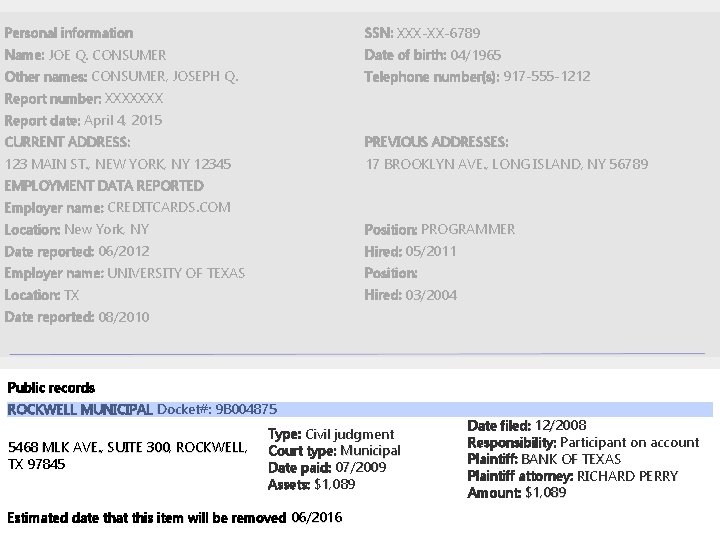
Personal information SSN: XXX-XX-6789 Name: JOE Q. CONSUMER Date of birth: 04/1965 Other names: CONSUMER, JOSEPH Q. Telephone number(s): 917 -555 -1212 Report number: XXXXXXX Report date: April 4, 2015 CURRENT ADDRESS: PREVIOUS ADDRESSES: 123 MAIN ST. , NEW YORK, NY 12345 17 BROOKLYN AVE. , LONG ISLAND, NY 56789 EMPLOYMENT DATA REPORTED Employer name: CREDITCARDS. COM Location: New York, NY Position: PROGRAMMER Date reported: 06/2012 Hired: 05/2011 Employer name: UNIVERSITY OF TEXAS Position: Location: TX Hired: 03/2004 Date reported: 08/2010 Public records ROCKWELL MUNICIPAL Docket#: 9 B 004875 5468 MLK AVE. , SUITE 300, ROCKWELL, TX 97845 Type: Civil judgment Court type: Municipal Date paid: 07/2009 Assets: $1, 089 Estimated date that this item will be removed 06/2016 Date filed: 12/2008 Responsibility: Participant on account Plaintiff: BANK OF TEXAS Plaintiff attorney: RICHARD PERRY Amount: $1, 089
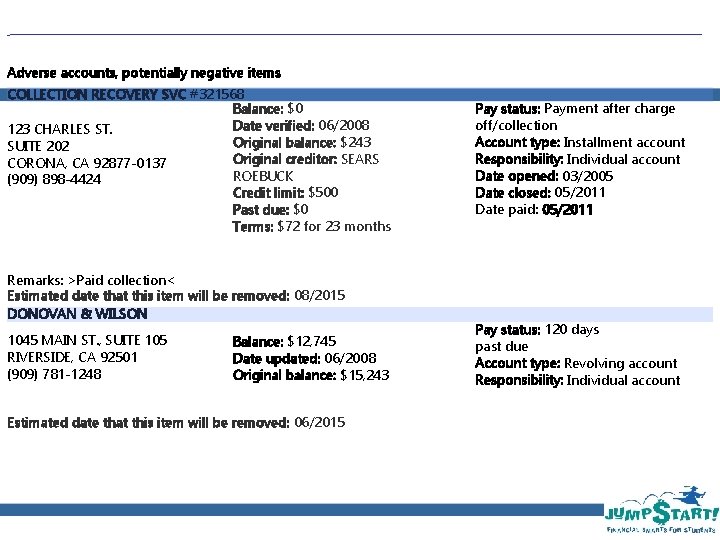
Adverse accounts, potentially negative items COLLECTION RECOVERY SVC #321568 Balance: $0 Date verified: 06/2008 123 CHARLES ST. Original balance: $243 SUITE 202 Original creditor: SEARS CORONA, CA 92877 -0137 ROEBUCK (909) 898 -4424 Credit limit: $500 Past due: $0 Terms: $72 for 23 months Remarks: >Paid collection< Estimated date that this item will be removed: 08/2015 DONOVAN & WILSON 1045 MAIN ST. , SUITE 105 RIVERSIDE, CA 92501 (909) 781 -1248 Balance: $12, 745 Date updated: 06/2008 Original balance: $15, 243 Estimated date that this item will be removed: 06/2015 Pay status: Payment after charge off/collection Account type: Installment account Responsibility: Individual account Date opened: 03/2005 Date closed: 05/2011 Date paid: 05/2011 Pay status: 120 days past due Account type: Revolving account Responsibility: Individual account
What’s on My Credit Report? Although each credit reporting agency formats and reports this categories of information differently, all credit reports contain basically the same • Personal Information • Public Records and Collection Accounts • Credit Accounts • Inquiries (requests for your credit report) • Optional Consumer Statement
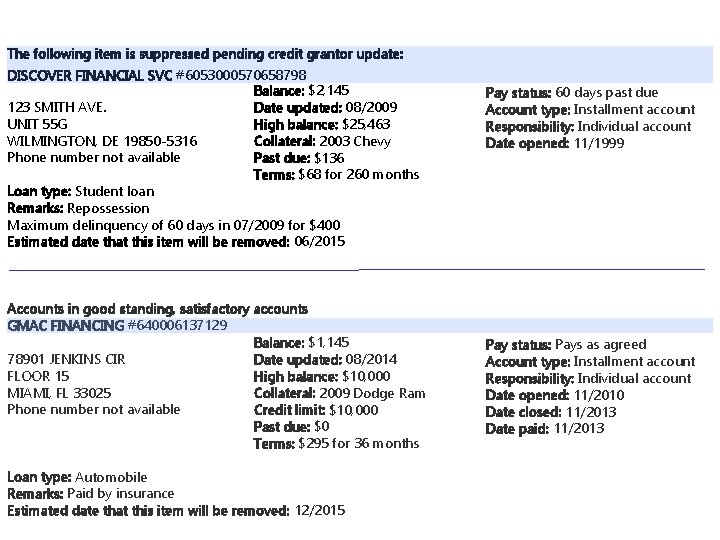
The following item is suppressed pending credit grantor update: DISCOVER FINANCIAL SVC #6053000570658798 Balance: $2, 145 123 SMITH AVE. Date updated: 08/2009 UNIT 55 G High balance: $25, 463 WILMINGTON, DE 19850 -5316 Collateral: 2003 Chevy Phone number not available Past due: $136 Terms: $68 for 260 months Loan type: Student loan Remarks: Repossession Maximum delinquency of 60 days in 07/2009 for $400 Estimated date that this item will be removed: 06/2015 Accounts in good standing, satisfactory accounts GMAC FINANCING #640006137129 Balance: $1, 145 78901 JENKINS CIR Date updated: 08/2014 FLOOR 15 High balance: $10, 000 MIAMI, FL 33025 Collateral: 2009 Dodge Ram Phone number not available Credit limit: $10, 000 Past due: $0 Terms: $295 for 36 months Loan type: Automobile Remarks: Paid by insurance Estimated date that this item will be removed: 12/2015 Pay status: 60 days past due Account type: Installment account Responsibility: Individual account Date opened: 11/1999 Pay status: Pays as agreed Account type: Installment account Responsibility: Individual account Date opened: 11/2010 Date closed: 11/2013 Date paid: 11/2013
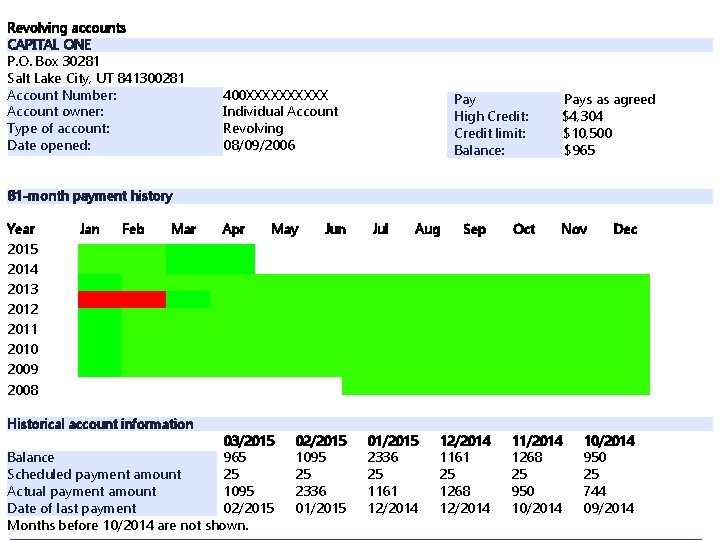
Revolving accounts CAPITAL ONE P. O. Box 30281 Salt Lake City, UT 841300281 Account Number: Account owner: Type of account: Date opened: 400 XXXXX Individual Account Revolving 08/09/2006 Pay High Credit: Credit limit: Balance: Pays as agreed $4, 304 $10, 500 $965 81 -month payment history Year 2015 2014 2013 2012 2011 2010 2009 2008 Jan Feb Mar Historical account information Apr May 03/2015 Balance 965 Scheduled payment amount 25 Actual payment amount 1095 Date of last payment 02/2015 Months before 10/2014 are not shown. Jun 02/2015 1095 25 2336 01/2015 Jul Aug 01/2015 2336 25 1161 12/2014 Sep 12/2014 1161 25 1268 12/2014 Oct Nov 11/2014 1268 25 950 10/2014 Dec 10/2014 950 25 744 09/2014
What’s on My Credit Report? Although each credit reporting agency formats and reports this categories of information differently, all credit reports contain basically the same • Personal Information • Public Records and Collection Accounts • Credit Accounts • Inquiries (requests for your credit report) • Optional Consumer Statement
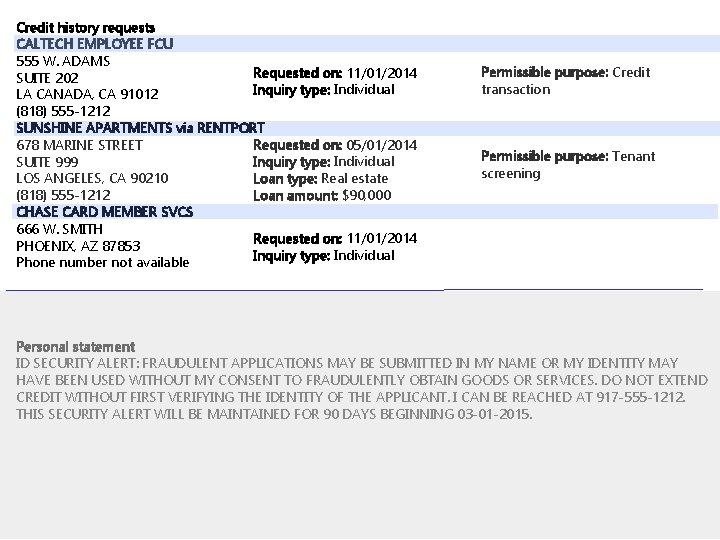
Credit history requests CALTECH EMPLOYEE FCU 555 W. ADAMS Requested on: 11/01/2014 SUITE 202 Inquiry type: Individual LA CANADA, CA 91012 (818) 555 -1212 SUNSHINE APARTMENTS via RENTPORT Requested on: 05/01/2014 678 MARINE STREET Inquiry type: Individual SUITE 999 Loan type: Real estate LOS ANGELES, CA 90210 Loan amount: $90, 000 (818) 555 -1212 CHASE CARD MEMBER SVCS 666 W. SMITH Requested on: 11/01/2014 PHOENIX, AZ 87853 Inquiry type: Individual Phone number not available Permissible purpose: Credit transaction Permissible purpose: Tenant screening Personal statement ID SECURITY ALERT: FRAUDULENT APPLICATIONS MAY BE SUBMITTED IN MY NAME OR MY IDENTITY MAY HAVE BEEN USED WITHOUT MY CONSENT TO FRAUDULENTLY OBTAIN GOODS OR SERVICES. DO NOT EXTEND CREDIT WITHOUT FIRST VERIFYING THE IDENTITY OF THE APPLICANT. I CAN BE REACHED AT 917 -555 -1212. THIS SECURITY ALERT WILL BE MAINTAINED FOR 90 DAYS BEGINNING 03 -01 -2015.
What’s on My Credit Report? Although each credit reporting agency formats and reports this categories of information differently, all credit reports contain basically the same • Personal Information • Public Records and Collection Accounts • Credit Accounts • Inquiries (requests for your credit report) • Optional Consumer Statement
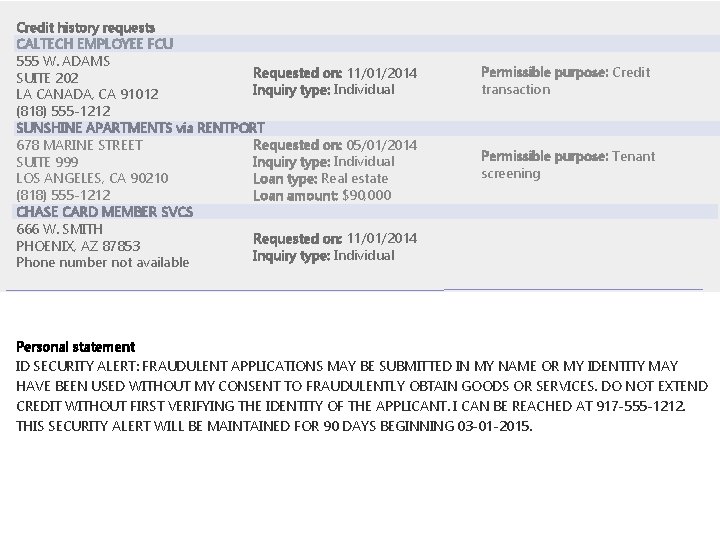
Credit history requests CALTECH EMPLOYEE FCU 555 W. ADAMS Requested on: 11/01/2014 SUITE 202 Inquiry type: Individual LA CANADA, CA 91012 (818) 555 -1212 SUNSHINE APARTMENTS via RENTPORT Requested on: 05/01/2014 678 MARINE STREET Inquiry type: Individual SUITE 999 Loan type: Real estate LOS ANGELES, CA 90210 Loan amount: $90, 000 (818) 555 -1212 CHASE CARD MEMBER SVCS 666 W. SMITH Requested on: 11/01/2014 PHOENIX, AZ 87853 Inquiry type: Individual Phone number not available Permissible purpose: Credit transaction Permissible purpose: Tenant screening Personal statement ID SECURITY ALERT: FRAUDULENT APPLICATIONS MAY BE SUBMITTED IN MY NAME OR MY IDENTITY MAY HAVE BEEN USED WITHOUT MY CONSENT TO FRAUDULENTLY OBTAIN GOODS OR SERVICES. DO NOT EXTEND CREDIT WITHOUT FIRST VERIFYING THE IDENTITY OF THE APPLICANT. I CAN BE REACHED AT 917 -555 -1212. THIS SECURITY ALERT WILL BE MAINTAINED FOR 90 DAYS BEGINNING 03 -01 -2015.
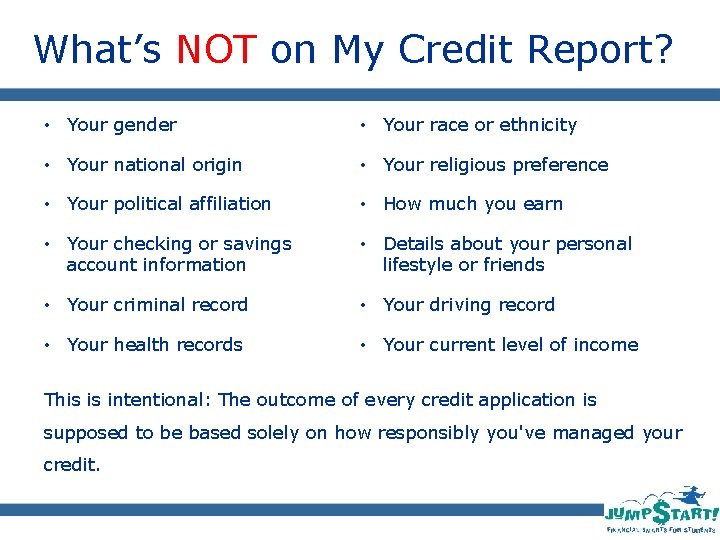
What’s NOT on My Credit Report? • Your gender • Your race or ethnicity • Your national origin • Your religious preference • Your political affiliation • How much you earn • Your checking or savings account information • Details about your personal lifestyle or friends • Your criminal record • Your driving record • Your health records • Your current level of income This is intentional: The outcome of every credit application is supposed to be based solely on how responsibly you've managed your credit.
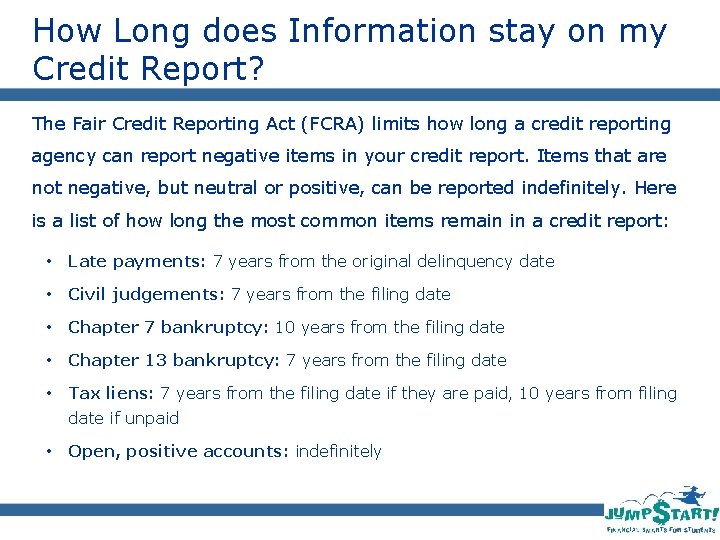
How Long does Information stay on my Credit Report? The Fair Credit Reporting Act (FCRA) limits how long a credit reporting agency can report negative items in your credit report. Items that are not negative, but neutral or positive, can be reported indefinitely. Here is a list of how long the most common items remain in a credit report: • Late payments: 7 years from the original delinquency date • Civil judgements: 7 years from the filing date • Chapter 7 bankruptcy: 10 years from the filing date • Chapter 13 bankruptcy: 7 years from the filing date • Tax liens: 7 years from the filing date if they are paid, 10 years from filing date if unpaid • Open, positive accounts: indefinitely
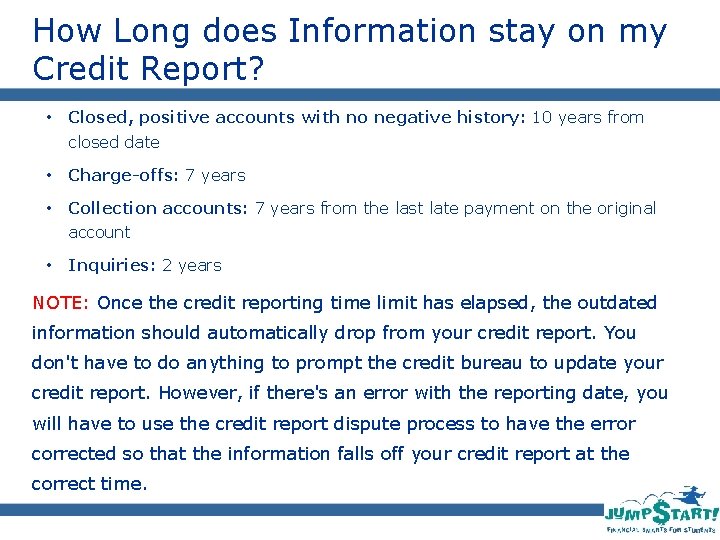
How Long does Information stay on my Credit Report? • Closed, positive accounts with no negative history: 10 years from closed date • Charge-offs: 7 years • Collection accounts: 7 years from the last late payment on the original account • Inquiries: 2 years NOTE: Once the credit reporting time limit has elapsed, the outdated information should automatically drop from your credit report. You don't have to do anything to prompt the credit bureau to update your credit report. However, if there's an error with the reporting date, you will have to use the credit report dispute process to have the error corrected so that the information falls off your credit report at the correct time.
Who can see My Credit Report? The Fair Credit Reporting Act (FCRA) specifies who can see your credit report. Businesses must have a "permissible purpose, " as defined in the FCRA, to obtain your credit report. Otherwise, only you and those you give written permission to can access your credit report. Your neighbors, friends, co-workers or family members cannot access your credit report unless you authorize it. If an individual does use your personal information to obtain your credit history, you can sue him or her for the actual damages or $1, 000 — whichever is greater.
Who Can See My Credit Report? Section 604 of the FCRA (Permissible Purposes) sets forth the purposes that permit a business or other person to gain access to your credit report. Credit bureaus are only allowed to disclose a credit report to a person who has a permissible purpose. The permissible purposes include: • A court order or Federal grand jury subpoena • In accordance with written instructions from a consumer to whom the file relates • As part of a credit transaction involving the consumer • To review and collect the consumer's account • For employment purposes (only with the consumer's written consent)
Who Can See My Credit Report? • Underwriting of insurance for personal, family or household purposes • Government agencies for determination of consumer's eligibility for a license or other governmental benefit • In connection with a valuation of, or an assessment of the credit or prepayment risks associated with, an existing credit obligation • In connection with a legitimate business need relating to a business transaction initiated by the consumer • To review an account to determine whether the consumer continues to meet the terms of the account
Who Can See My Credit Report? Your credit reports (and credit scores) can be obtained by several kinds of organizations. As a general rule, assume that if an entity has a legitimate business need, it can access your credit. Here are some of the companies and individuals that may be able to pull your reports or a score: • Banks/Credit Unions • Employers • Creditors • Collection agencies • Utility companies • Government agencies • Insurance companies • Any entity with a court order • Landlords
Who Can See My Credit Report? In some cases, your credit history may be considered for student loans: • When parents apply for PLUS loans, their creditworthiness will be determined. If you have a federal loan in default, you won’t be able to obtain another federal loan unless a payment plan for the original loan has been arranged. • When you apply for private student loans — those not issued by the federal government — your credit may also be pulled.
Employment An employer must provide a statement that the consumer reporting agency did not make the decision to take the adverse action and is unable to provide the consumer the specific reasons why the adverse action was taken. Employees have the right to contact the credit reporting agency providing the employee's credit report and attempt to correct any negative information. Employees may re-apply for the job if negative information is corrected and there were no other grounds for being denied employment.
Employment Federal law allows potential and current employers to view a modified version of your credit report for employment purposes such as hiring and promoting. Before You Get a Credit Report • Tell the applicant or employee that you might use information in their credit report for decisions related to their employment. This notice must be in writing and in a stand-alone format. The notice cannot be in an employment application. You can include some minor additional information in the notice, like a brief description of the nature of credit reports, but only if it does not confuse or detract from the notice.
Employment • Get written permission from the applicant or employee. This can be part of the document you use to notify the person that you will get a credit report. If you want the authorization to allow you to get credit reports throughout the person's employment, make sure you say so clearly and conspicuously. • Certify compliance to the company from which you are getting the applicant or employee's information. You must certify that you: + notified the applicant or employee and got their permission to get a credit report; + complied with all of the FCRA requirements; and + will not discriminate against the applicant or employee or otherwise misuse the information, as provided by any applicable federal or state equal opportunity laws or regulations.
Employment • It's a good idea to review applicable laws of your state related to credit reports. Some states restrict the use of credit reports for employment purposes. Before You Take an Adverse Action: Before you reject a job application, reassign or terminate an employee, deny a promotion, or take any other adverse employment action based on information in a credit report, you must give the applicant or employee: • a notice that includes a copy of the credit report you relied on to make your decision; and • a copy of A Summary of Your Rights Under the Fair Credit Reporting Act, which the company that gave you the report should have given to you.
Employment • Giving the person the notice in advance gives the person the opportunity to review the report and tell you if it is correct. After You Take an Adverse Action If you take an adverse action based on information in a credit report, you must give the applicant or employee a notice of that fact – orally, in writing, or electronically. An adverse action notice tells people about their rights to see information being reported about them and to correct inaccurate information. The notice must include: • the name, address, and phone number of the consumer reporting company that supplied the report;
Employment • a statement that the company that supplied the report did not make the decision to take the unfavorable action and can't give specific reasons for it; and • a notice of the person's right to dispute the accuracy or completeness of any information the consumer reporting company furnished, and to get an additional free report from the company if the person asks for it within 60 days. Employees may re-apply for the job if negative information is corrected and there were no other grounds for being denied employment.
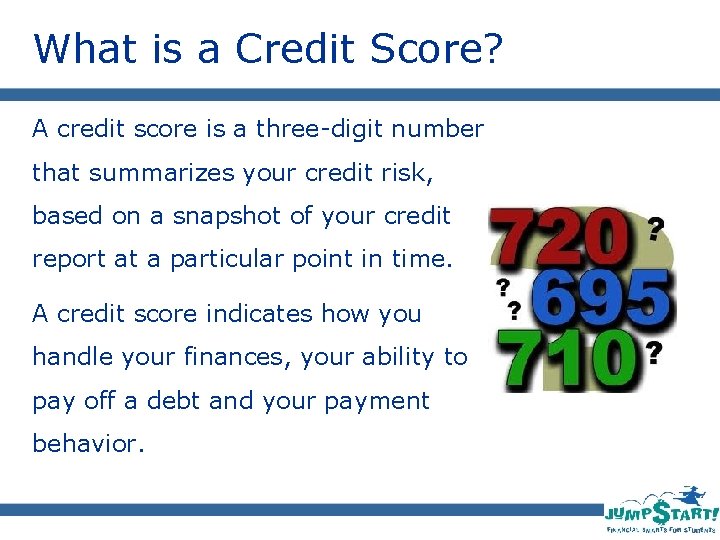
What is a Credit Score? A credit score is a three-digit number that summarizes your credit risk, based on a snapshot of your credit report at a particular point in time. A credit score indicates how you handle your finances, your ability to pay off a debt and your payment behavior.
What is a Credit Score? A credit score looks at both the positive and negative aspects of your credit data. • Even if you have a lot of debts, it is possible for you to have a high score – at least if you are good and diligent with your payments. • Also, if you have no credit cards or accounts (thus you have no debts), you will most likely have a low score. This is because there is no data supporting how well you can pay a debt or not – thus making you a high risk borrower.
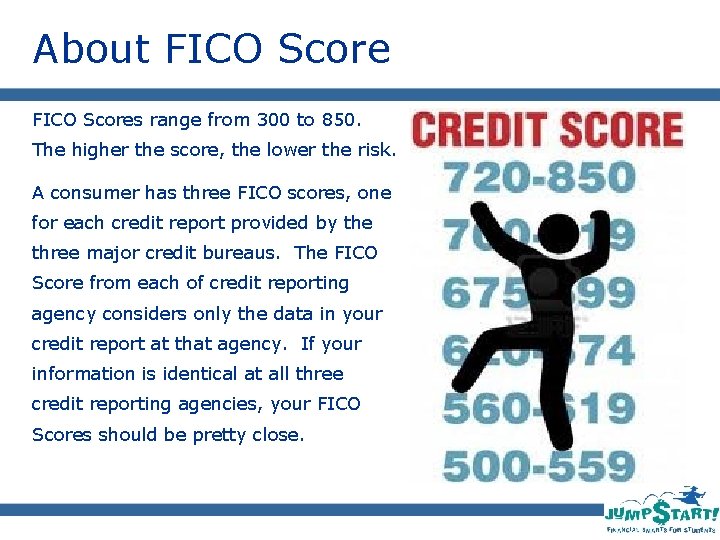
About FICO Scores range from 300 to 850. The higher the score, the lower the risk. A consumer has three FICO scores, one for each credit report provided by the three major credit bureaus. The FICO Score from each of credit reporting agency considers only the data in your credit report at that agency. If your information is identical at all three credit reporting agencies, your FICO Scores should be pretty close.
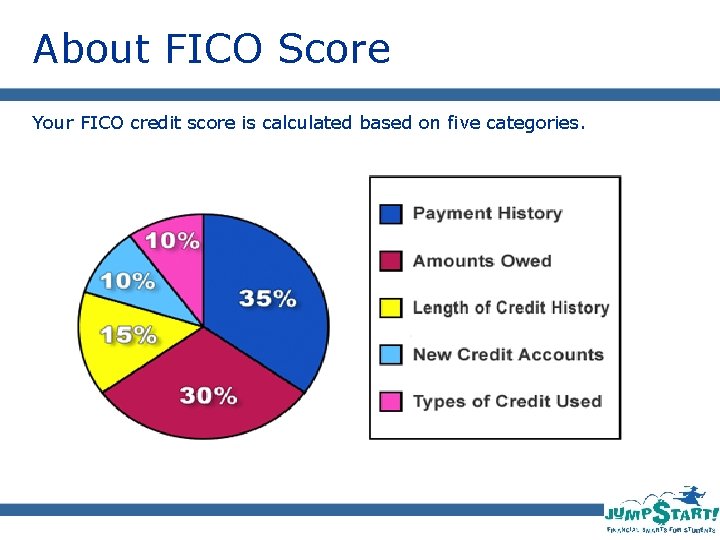
About FICO Score Your FICO credit score is calculated based on five categories.
Payment History The first and the most influential is your payment history. It constitutes 35% of your credit score. It will look into your behavior in paying for credit cards, mortgage loans and other installment accounts. This also includes your retail accounts – if any. A late payment or two will not drag your score down – even if it is the most recent payments. It will take into account your payment behavior as a whole. Negative factors that can have drastic effects on this figure includes lawsuits, bankruptcies and foreclosures. It may be important to note that this considers the number of accounts that you have no late payments. So if you were delinquent in only one account and good in the others, your score will not be too low.
Amount Owed The next factor affecting your credit score is the total amount of debt that you have. This credit score factor comes in at 30% of your score. The thing is, even if you have a lot of debts with other lenders, that does not automatically make you a high risk borrower. This system takes into account your ability to pay off your debts. As long are your credit cards are not maxed out or overtaken by the amount of what you owe, then your credit score should be in good shape. The software examines not only the total amount of debt but the amount for each type of account (e. g. credit card, loan, etc. ). It also determines the number of accounts with low balances and those who have been paid completely.
Amount Owed For some groups, the importance of these categories may vary; for example, people who have not been using credit long will be factored differently than those with a longer credit history. The importance of any one factor in your credit score calculation depends on the overall information in your credit report. For some people, one factor may have a larger impact than it would for someone with a much different credit history. In addition, as the information in your credit report changes, so does the importance of any factor in determining your FICO Score.
Amount Owed Therefore, it’s impossible to measure the exact impact of a single factor in how your credit score is calculated without looking at your entire report. Even the levels of importance shown in the FICO Score chart are for the general population, and will be different for different credit profiles.
Length of Credit History The rule for this factor is, the longer you have an account, the better it is for your score. This amounts to 15% of your overall credit score. Bottom line is, age matters. It counts the number of accounts that you have, how long you have had them under your name and the average that your accounts have been active. Your score will also be affected by how often you use certain accounts like your credit cards. If they show that you use it often and yet your balance is low, then that will reflect a high score. On the other hand, if you are not using your card much and yet you have a high balance, then that does not bode well for you.
New Credit Separate from your total debt, the FICO score checks the new accounts that you have opened. Having a lot of accounts with a short credit history will not give you a good score – at least for 10% of your credit score. It is best not to open too many accounts at the same time as it shows that you are a risky borrower. Remember that the average of your accounts is computed. A new account will lower that age significantly. For instance, if you used to have 3 accounts that are active for 5, 7 and 9 years respectively, you should have an average of 7 years. But if you suddenly open 3 new accounts simultaneously, that will lower your average to 4 years – almost half of what you used to have.
New Credit Another important note is the inquiries on your credit report. This is also examined by the FICO score but it is weighed in terms of what affects your creditworthiness. It is not necessarily true that if a lot of lenders inquired about your credit report, your score will go down.
Types of Credit in Use The last factor completes the final 10% of your FICO score. The software checks the credit mix in your history. Do you have both revolving and installment accounts? It does not necessarily have to be one of each but the important element here is how many of them you are using. Also, it has to be noted that a person with no credit card is considered a higher risk than someone with multiple credit cards yet low balances. This is also where closed credit cards affect your overall score. Basically, if your credit card is deep in debt, do not close that account immediately. That reflects badly on your score.
About FICO Scores do NOT consider the following information: • Your gender, race, nationality, religion or marital status. • Your age • Your salary, occupation, title, employer, date employed, or employment history • Where you live • Any interest rate being charged on a particular credit card or other account • Certain types of inquiries (such as promotional, account review, insurance or employment-related inquiries) • Credit counseling • Any information not found in your credit report • Any information that is not proven to be predictive of future credit performance
Correcting Errors How Errors Occur: • Mixed Files. If someone with the same name or a similar name applies for credit, a piece of their file may become mixed with yours. A consumer with a common name like “John A. Smith, ” for example, could see his file mixed with a John B. Smith or a John A. Smith, Jr. • Identity theft. If someone has stolen your Social Security number, for example, they could open a new account in your name. This information could appear on your credit report and can be especially difficult to remove. • Furnisher Errors. There are three big players when it comes to credit report accuracy: credit bureaus, consumers and “data furnishers. ” That last one is important — it’s the banks, lenders, debt collectors, and rental companies that supply (aka “furnish”) the data that appears on your credit reports to the credit bureaus. Often, a furnisher can report something inaccurately, like a missed payment or a collection account that actually belongs to someone else.
Correcting Errors How Errors Occur (Cont’d): • Re-Aging of Old Debts. Certain debts have a ticking clock of sorts when it comes to your credit report. A collection account, for example, is supposed to age off of your credit report after seven years and 180 days from when it was first delinquent. (You can see our guide to the statutes of limitations on debts in each state across the U. S. here. ) However, sometimes “re-aging” occurs, often when a debt is sold to a third-party collector and the start date on that clock is muddied, causing your credit to take a hit much longer than it should under the law.
Correcting Errors Under the FCRA, both the credit reporting company and the information provider are responsible for correcting inaccurate or incomplete information in your credit report. When disputing an item in your credit file, you should contact both the credit reporting company and the information provider. However, there are certain types of disputes that information providers are not required to investigate.
Correcting Errors The dispute process can be done online or via the mail with each of the credit reporting agencies. You are now able to upload supporting documentation to each of the credit bureaus to challenge an error, but you can also include that information in your snail-mail letter if you decide to do so. If sending your dispute by mail… • Write a dispute letter. • Send it via certified mail so you can track when it was received. • Include copies of any supporting documentation. Do not send originals! • You will hear back from the bureau regarding your dispute via U. S. mail, possibly after the 30 -day window depending on how long it takes the letter to arrive at your address.
Correcting Errors If you submit a dispute by mail, your dispute letter should include your: • Complete name • Address • Telephone number • Report confirmation number, if available • Account number for any account you may be disputing
Correcting Errors If sending your dispute online via one of the credit bureau portals… • You don’t need to write a formal letter, but you will need to explain what the error is and where it appears on your report. • You can submit it instantly to the bureau and can check the progress of your dispute online via a dispute portal. • The bureaus allow you to upload supporting documentation, which some people may prefer for security reasons versus sending sensitive information through the mail. • You will be notified of the results via email.
Correcting Errors When filing your dispute, make sure to clearly identify each mistake, articulate the facts and explain your reason for disputing the information. You may consider enclosing a copy of your credit report with your claim. Remember, the more evidence you have, the better your case may be. In some instances, it can be hard to determine what kinds of evidence are needed. For example, an identity theft victim may not know what they need to provide to show they didn’t open an account in their name. After all, they never signed up for it! If you suspect that the error on your report is a result of identity theft warning signs include mysterious addresses and accounts you never signed up for - visit the Federal Trade Commission’s Fighting Back Against Identity Theft website for information about identity theft and steps to take if you have been victimized. This will include filing a fraud alert and possibly filing a security freeze.
Correcting Errors When the investigation is complete, the credit reporting company must give you the results in writing and a free copy of your report if the dispute results in a change. This free report does not count as your annual free report. If an item is changed or deleted, the credit reporting company cannot put the disputed information back in your file unless the information provider verifies that it is accurate and complete. The credit reporting company also must send you written notice that includes the name, address, and phone number of the information provider. If you ask, the credit reporting company must send notices of any corrections to anyone who received your report in the past six months. You can have a corrected copy of your report sent to anyone who received a copy during the past two years for employment purposes.
Correcting Errors If an investigation doesn’t resolve your dispute with the credit reporting company, you can ask that a statement of the dispute be included in your file and in future reports. You also can ask the credit reporting company to provide your statement to anyone who received a copy of your report in the recent past. You can expect to pay a fee for this service.
Correcting Errors If the information provider corrects your information as a result of your dispute, it must notify all of the credit reporting companies to which it provided the inaccurate information, so they can update their reports with the correct information. If the information provider continues to report the item you disputed to a credit reporting company, it must let the credit reporting company know about your dispute. And if you are correct — that is, if the information you dispute is found to be inaccurate or incomplete — the information provider must tell the credit reporting company to update or delete the item.
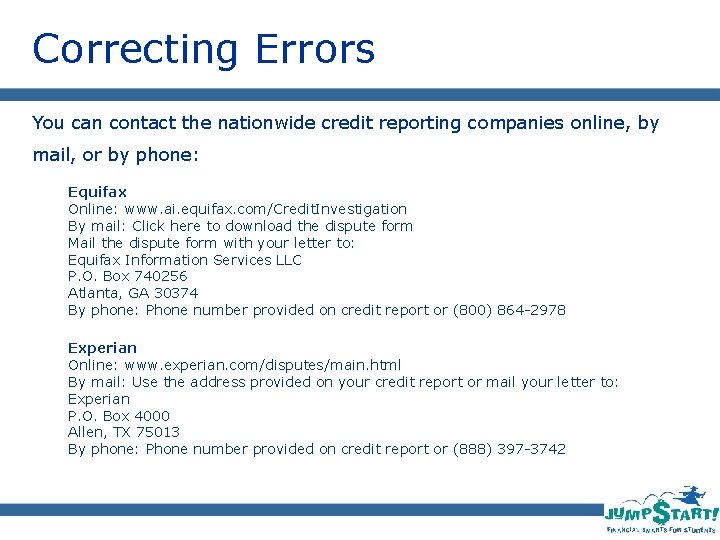
Correcting Errors You can contact the nationwide credit reporting companies online, by mail, or by phone: Equifax Online: www. ai. equifax. com/Credit. Investigation By mail: Click here to download the dispute form Mail the dispute form with your letter to: Equifax Information Services LLC P. O. Box 740256 Atlanta, GA 30374 By phone: Phone number provided on credit report or (800) 864 -2978 Experian Online: www. experian. com/disputes/main. html By mail: Use the address provided on your credit report or mail your letter to: Experian P. O. Box 4000 Allen, TX 75013 By phone: Phone number provided on credit report or (888) 397 -3742
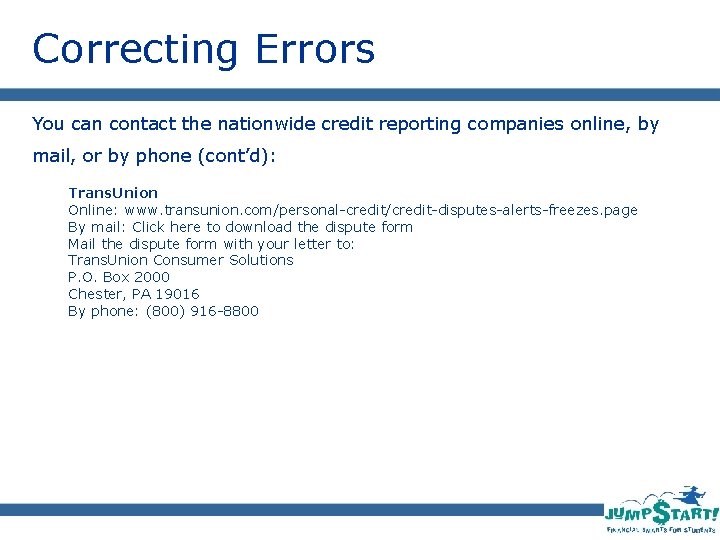
Correcting Errors You can contact the nationwide credit reporting companies online, by mail, or by phone (cont’d): Trans. Union Online: www. transunion. com/personal-credit/credit-disputes-alerts-freezes. page By mail: Click here to download the dispute form Mail the dispute form with your letter to: Trans. Union Consumer Solutions P. O. Box 2000 Chester, PA 19016 By phone: (800) 916 -8800
Contact Information Layne R. Mc. Daniel, CPA, CGMA Noesis Data 11606 Southfork Ave Suite 100 Baton Rouge, LA 70816 (225) 922 -4746 layne@noesisdata. com
- Slides: 58