
What You Need to Know About EPAs ENERGY

What You Need to Know About EPA’s ENERGY STAR Certified Homes Program 1 Learn more at energystar. gov
Agenda • • The Basics Certification Process and Key Roles More About the Program Guidelines Resources
The Basics
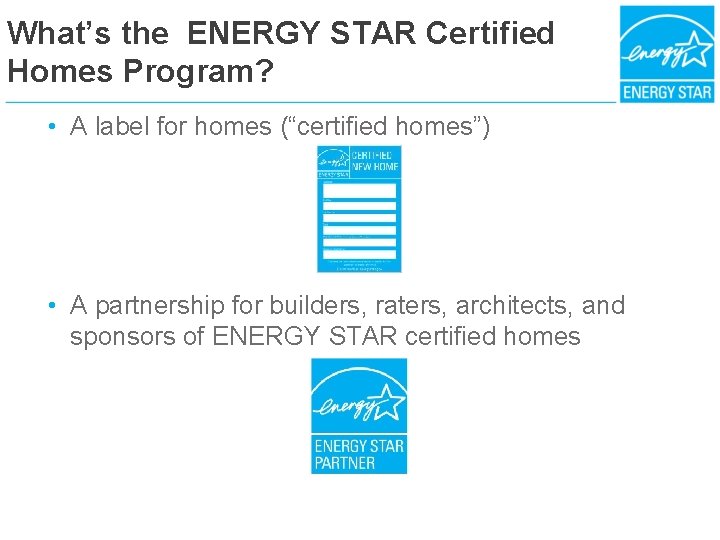
What’s the ENERGY STAR Certified Homes Program? • A label for homes (“certified homes”) • A partnership for builders, raters, architects, and sponsors of ENERGY STAR certified homes
Program Requirements • Each ENERGY STAR certified home is independently verified to be at least 15% more energy efficient than a home built to the 2009 International Energy Conservation Code (IECC), and includes additional measures that deliver a total energy efficiency improvement of 20 -30% compared to a typical new home. A full list of program requirements is listed at: www. energystar. gov/newhomesguidelines
Who Can Partner? • Builders and developers • Home Energy Raters and Providers (3 rd party verifiers) • Energy Efficiency Program Sponsors (EEPS: utilities, state energy offices, local governments, etc. ) • Manufacturers of modular/manufactured homes • Architects Sign your partnership agreement at: www. energystar. gov/homes. PA
Who Cannot Partner? • HVAC contractors* • Other contractors (insulation, dry-wallers, etc. ) • Real estate agents Resources for these stakeholders are available at: www. energystar. gov/newhomespartners *HVAC contractors still play an important role in the ENERGY STAR certification process as discussed in the next section
Program Benefits • Builders: market differentiation, increased energy efficiency, value, comfort, and durability, process & quality control • Raters: process & quality control • HVAC contractors: market differentiation, expanded market offering, process & quality control • EEPS: achieve demand side management goals, meet regulatory obligations, environmental protection • Homeowners: lower utility bills, comfort & durable home

Training Requirements • Builders: hour-long online orientation course • Raters: ENERGY STAR Rater Training through an Accredited Training Provider • HVAC contractors: proper credentialing through a third party oversight organization More information at www. energystar. gov/newhomestraining
Certification Process and Key Roles

Certification Process Overview Prescriptive Path Performance Path 1. Build the home using the ENERGY STAR Reference Design. 2. Complete the inspection checklists. 3. Have Rater Verify Home 4. Place ENERGY STAR certification label on breaker box and provide homeowner with ENERGY STAR certificate. 1. Model the home and find the ENERGY STAR HERS Index Target. 2. Select upgrades that achieve a HERS Index ≤ ENERGY STAR HERS Index Target and meet other program requirements. 3. Complete the inspection checklists. 4. Have Rater Verify Home 5. Place ENERGY STAR certification label on breaker box and provide homeowner with ENERGY STAR certificate.

Home Energy Rater’s Role Raters provide: • Third party verification • Quality assurance • A deep knowledge of building science Raters are trained to: • Evaluate energy efficiency features and construction techniques • Take key measurements • Perform inspections • Provide answers to common questions
HVAC Contractor’s Role • Builders must work with a credentialed HVAC contractor to gain the ENERGY STAR certification. A builder’s current HVAC contractor can go through the credentialing process, or the builder can search for credentialed contractors in their area. Visit www. energystar. gov/newhomeshvac for more information.
EEPS’ Role • ENERGY STAR as a platform for energy efficiency programs • Energy Efficiency Program Sponsors (EEPS) can provide financial incentives, technical support, training, outreach, and marketing • Include utilities, electric cooperatives, state agencies, municipal governments, home builders associations, and other organizations More information at: www. energystar. gov/newhomessponsors
More About the Program Guidelines
Recent Changes • • • More stringent core efficiency measures New inspection checklists Move from features to systems Additional Quality Assurance New marketing platform: “Better is Better”
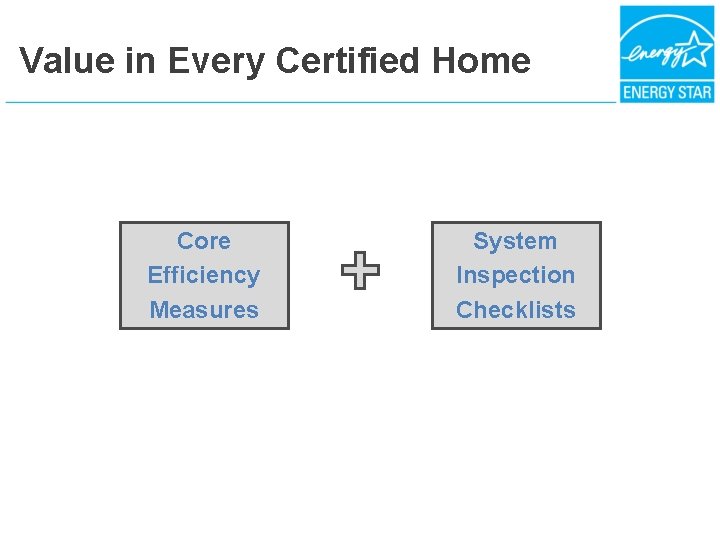
Value in Every Certified Home Core Efficiency Measures System Inspection Checklists
Value in Every Certified Home Core Efficiency Measures • Guarantees that efficiency measures are included in every certified home
Value in Every Certified Home System Inspection Checklists • Sets standards for oftenoverlooked details that have a critical impact on efficiency, comfort, quality, & durability • Reflects 15 years of experience from EPA, researchers, industry, and thousands of partners like you
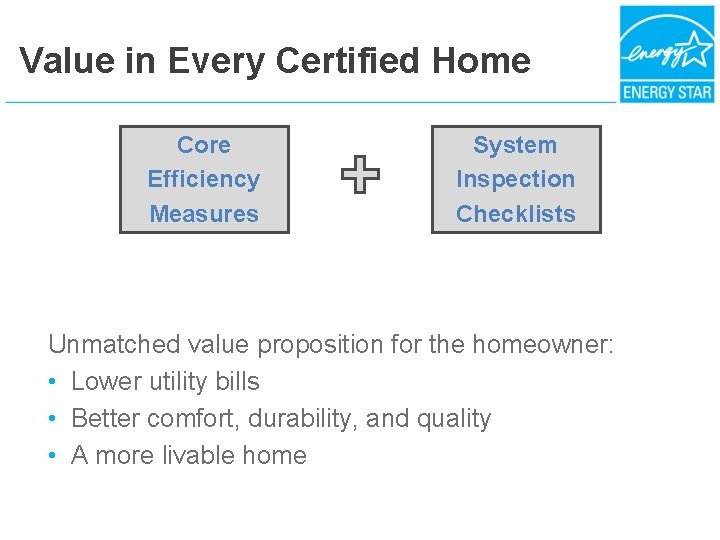
Value in Every Certified Home Core Efficiency Measures System Inspection Checklists Unmatched value proposition for the homeowner: • Lower utility bills • Better comfort, durability, and quality • A more livable home
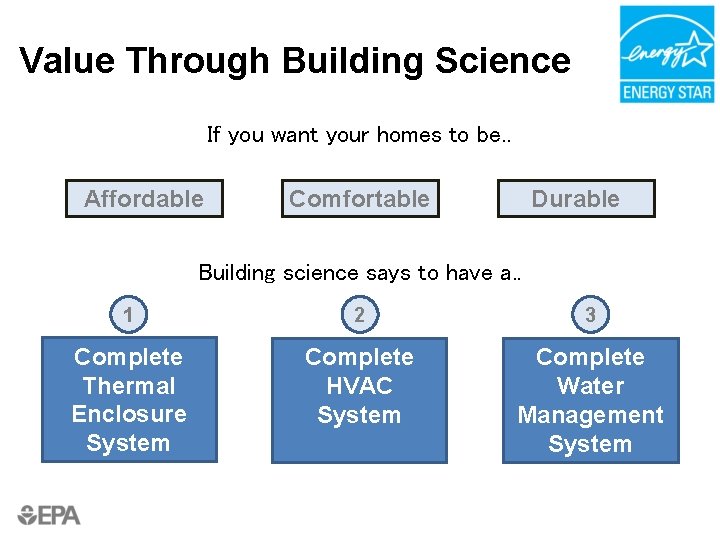
Value Through Building Science If you want your homes to be. . Affordable Durable Comfortable Building science says to have a. . 1 2 3 Complete Thermal Enclosure System Complete HVAC System Complete Water Management System
Thermal Enclosure System 1 Thermal Enclosure System Checklist • Features – High-quality insulation installation – High-performance windows & doors – Tightly sealed home – Reduced thermal bridging in walls
Thermal Enclosure System 1 Thermal Enclosure System Checklist • Why is this important? – A well-insulated and air-sealed home, with good windows and doors, reduces the amount of energy needed to keep the home comfortable.
Complete HVAC System 2 HVAC System QI Checklists • Features – A right-sized and properly installed heating, cooling, and duct system – A ventilation system that meets the industry standard – Reduced safety and air quality risks from combustion appliances
Complete HVAC System 2 HVAC System QI Checklists • Why is this important? – Improved airflow & efficiency maintain comfort with less energy – Proper sizing costs less and better manages humidity levels – Ventilation systems remove indoor air pollutants, provide outdoor air, and filter dust and particles
Water Management System 3 Water Management System Checklist • Features – Water-managed roof, walls, foundation, site, and building materials
Water Management System 3 Water Management System Checklist • Why is this important? – Prolonged moisture in walls, floors, and ceilings can cause rot and mold, hurting durability. – Wet walls, floors, and ceilings in airsealed homes don’t dry as quickly; therefore, it’s more important to not let them get wet.
Resources
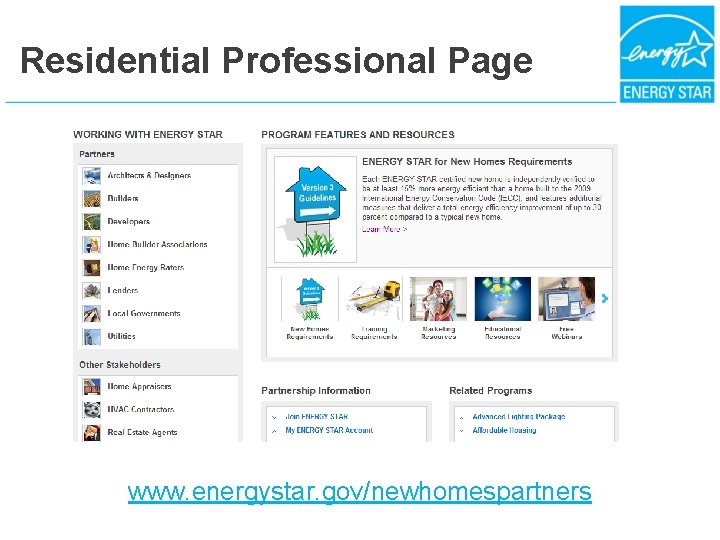
Residential Professional Page www. energystar. gov/newhomespartners
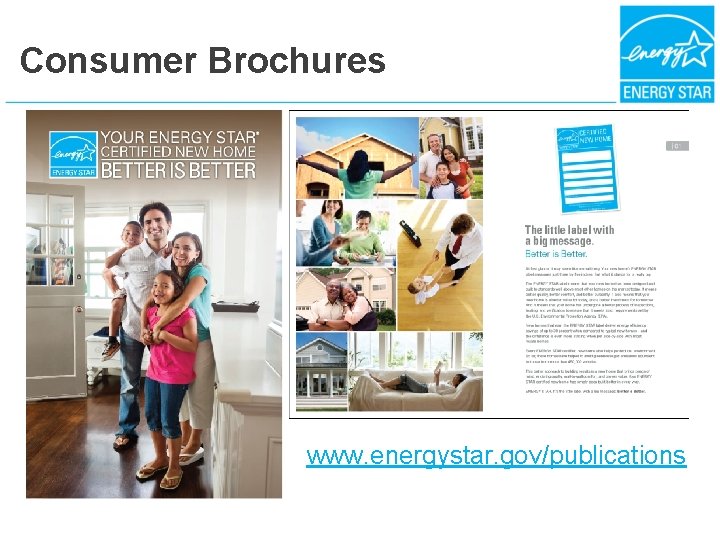
Consumer Brochures www. energystar. gov/publications
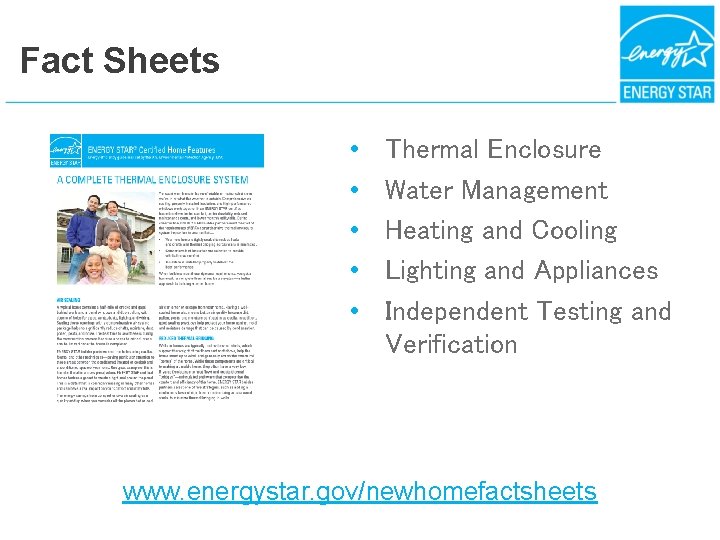
Fact Sheets • • • Thermal Enclosure Water Management Heating and Cooling Lighting and Appliances Independent Testing and Verification www. energystar. gov/newhomefactsheets
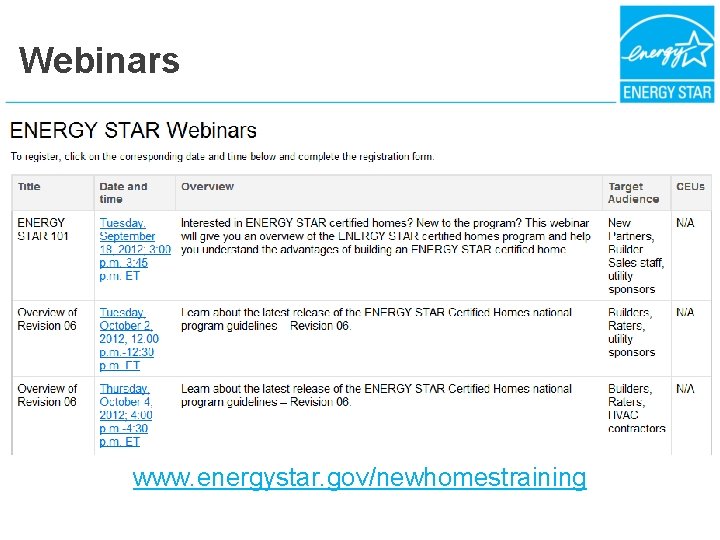
Webinars www. energystar. gov/newhomestraining
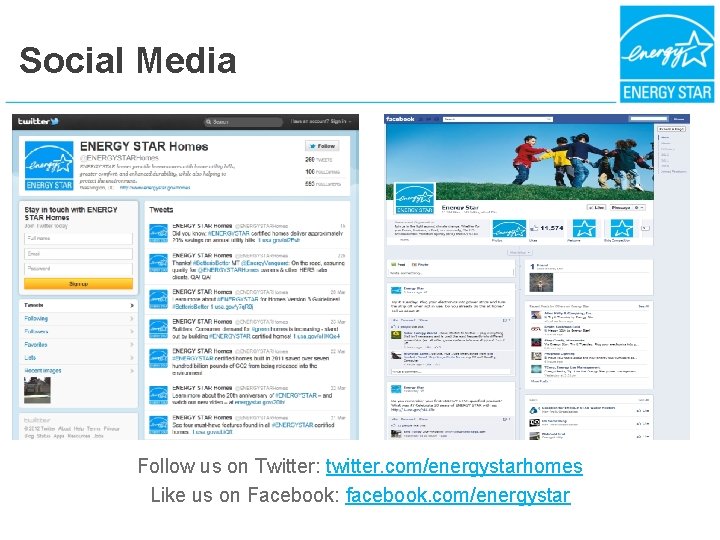
Social Media Follow us on Twitter: twitter. com/energystarhomes Like us on Facebook: facebook. com/energystar
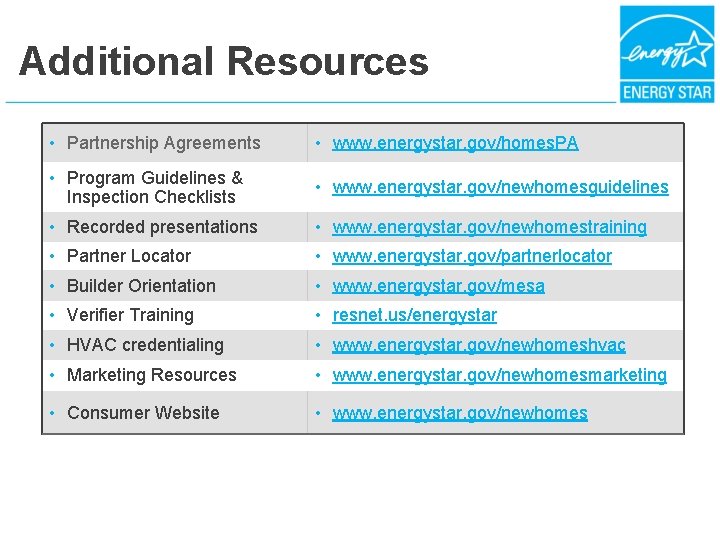
Additional Resources • Partnership Agreements • www. energystar. gov/homes. PA • Program Guidelines & Inspection Checklists • www. energystar. gov/newhomesguidelines • Recorded presentations • www. energystar. gov/newhomestraining • Partner Locator • www. energystar. gov/partnerlocator • Builder Orientation • www. energystar. gov/mesa • Verifier Training • resnet. us/energystar • HVAC credentialing • www. energystar. gov/newhomeshvac • Marketing Resources • www. energystar. gov/newhomesmarketing • Consumer Website • www. energystar. gov/newhomes
- Slides: 34