
WHAT YOU DO Posters can be viewed on

WHAT YOU DO Posters can be viewed on Tuesday 11 th February 12: 30 to 1: 30 pm in FWB 1. 60 TO TAKE PART send an email to l. sankaran@kcl. ac. uk before 5 th February, giving: The title of the poster Name(s) of participant(s) Type of poster (digital or printed) Create a dynamic and informative poster reflecting any area of linguistics PRIZES For each year group: 1 st prize of £ 125 and 2020 BA ELL Poster Competition 2 nd prize of £ 75 Individual and group entries are welcome If you produce a printed poster you will be reimbursed for your printing costs. You can submit a poster even if you cannot attend the poster competition itself.
5 SSEL 026 – Language Construction Lecture 4 Grammar 2
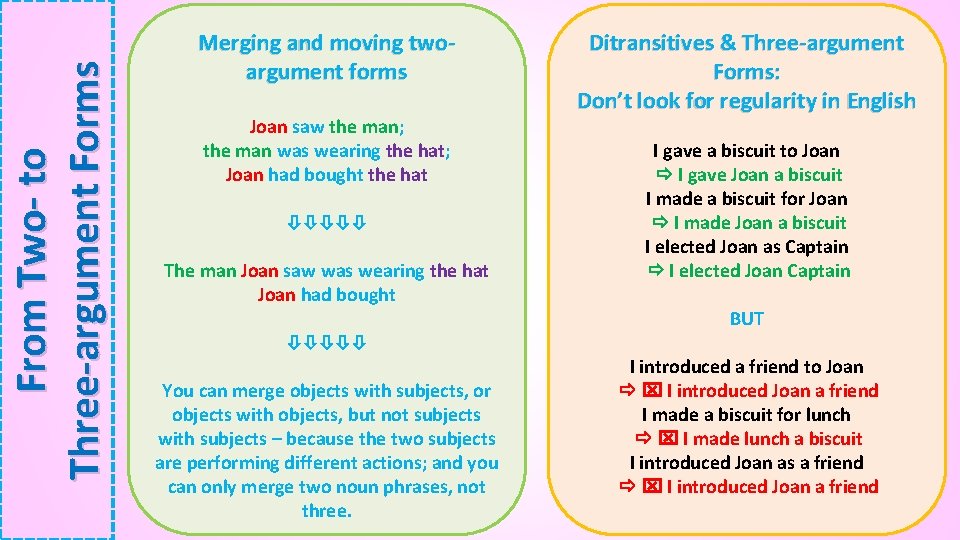
From Two- to Three-argument Forms Merging and moving twoargument forms Joan saw the man; the man was wearing the hat; Joan had bought the hat The man Joan saw was wearing the hat Joan had bought Ditransitives & Three-argument Forms: Don’t look for regularity in English I gave a biscuit to Joan I gave Joan a biscuit I made a biscuit for Joan I made Joan a biscuit I elected Joan as Captain I elected Joan Captain BUT You can merge objects with subjects, or objects with objects, but not subjects with subjects – because the two subjects are performing different actions; and you can only merge two noun phrases, not three. I introduced a friend to Joan I introduced Joan a friend I made a biscuit for lunch I made lunch a biscuit I introduced Joan as a friend I introduced Joan a friend
![The Obligatory Three-argument Form Joan [Event] put Subject Verb the book Direct Object [Event]](http://slidetodoc.com/presentation_image_h2/e8dba1a5580341a636f3b6627e8eeb68/image-4.jpg "The Obligatory Three-argument Form Joan [Event] put Subject Verb the book Direct Object [Event]")
The Obligatory Three-argument Form Joan [Event] put Subject Verb the book Direct Object [Event] on the table Adposition Indirect Object
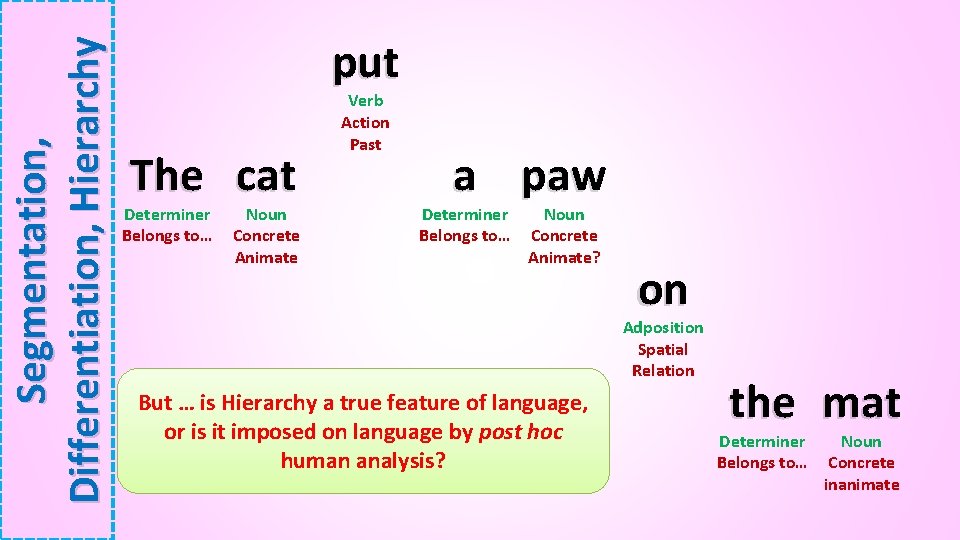
Segmentation, Differentiation, Hierarchy put The cat Determiner Belongs to… Noun Concrete Animate Verb Action Past a paw Determiner Belongs to… Noun Concrete Animate? on Adposition Spatial Relation But … is Hierarchy a true feature of language, or is it imposed on language by post hoc human analysis? the mat Determiner Belongs to… Noun Concrete inanimate
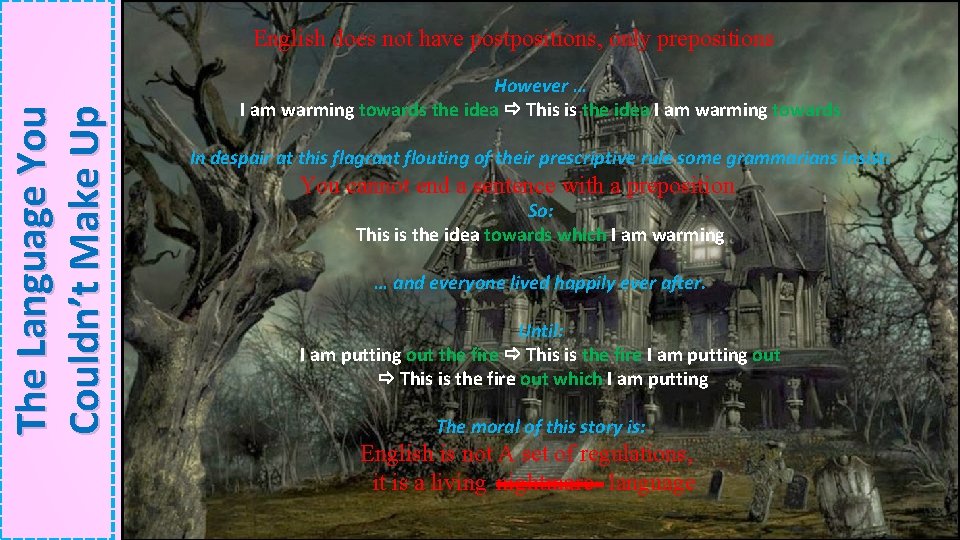
The Language You Couldn’t Make Up English does not have postpositions, only prepositions However … I am warming towards the idea This is the idea I am warming towards In despair at this flagrant flouting of their prescriptive rule some grammarians insist: You cannot end a sentence with a preposition So: This is the idea towards which I am warming … and everyone lived happily ever after. Until: I am putting out the fire This is the fire I am putting out This is the fire out which I am putting The moral of this story is: English is not A set of regulations, it is a living nightmare language
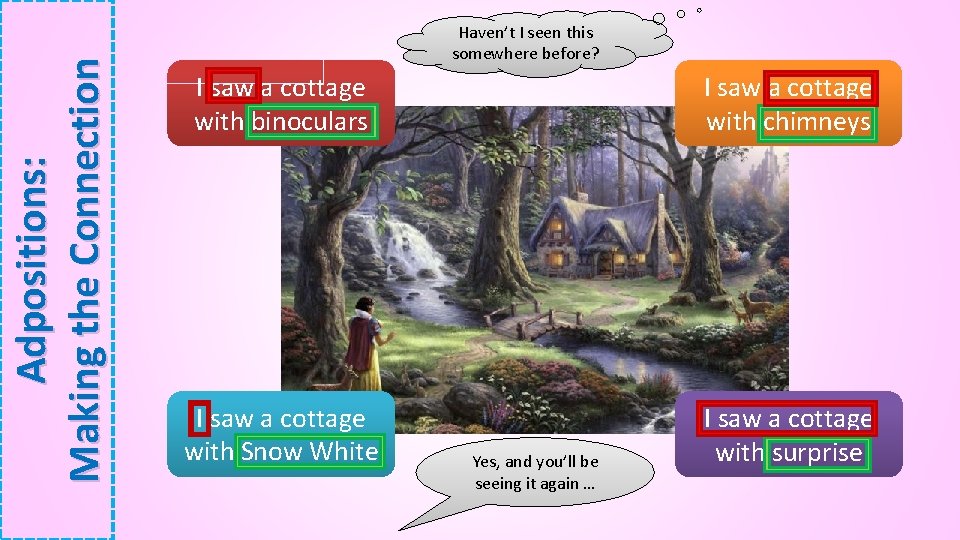
Adpositions: Making the Connection Haven’t I seen this somewhere before? I saw a cottage with binoculars I saw a cottage with chimneys I saw a cottage with Snow White I saw a cottage with surprise Yes, and you’ll be seeing it again …
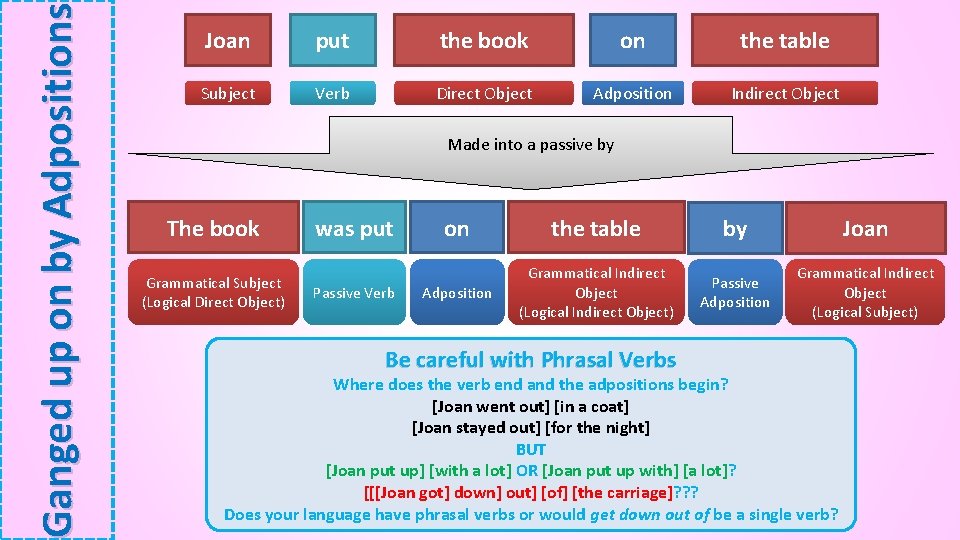
Ganged up on by Adpositions Joan put the book on the table Subject Verb Direct Object Adposition Indirect Object Made into a passive by The book Grammatical Subject (Logical Direct Object) was put Passive Verb on the table by Joan Adposition Grammatical Indirect Object (Logical Indirect Object) Passive Adposition Grammatical Indirect Object (Logical Subject) Be careful with Phrasal Verbs Where does the verb end and the adpositions begin? [Joan went out] [in a coat] [Joan stayed out] [for the night] BUT [Joan put up] [with a lot] OR [Joan put up with] [a lot]? [[[Joan got] down] out] [of] [the carriage]? ? ? Does your language have phrasal verbs or would get down out of be a single verb?
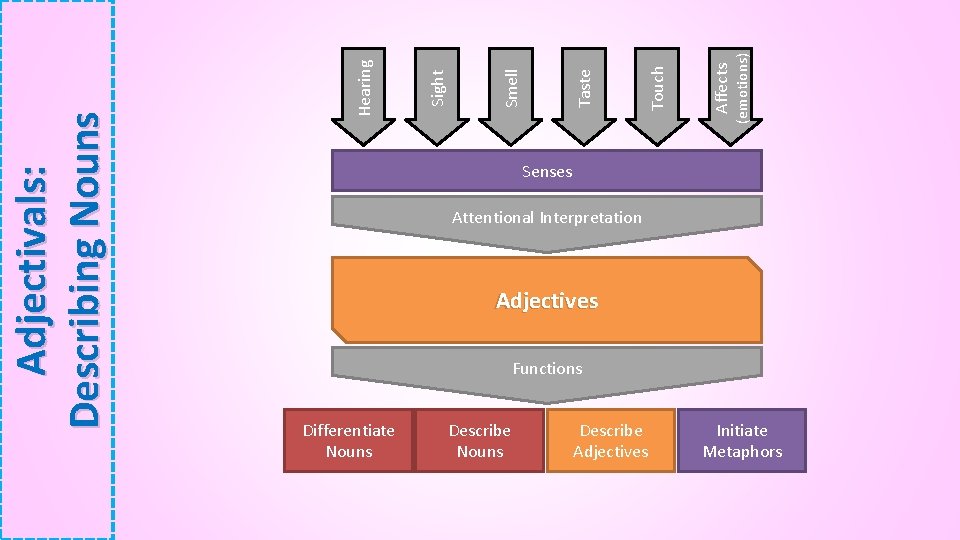
(emotions) Affects Touch Taste Smell Sight Hearing Adjectivals: Describing Nouns Senses Attentional Interpretation Adjectives Functions Differentiate Nouns Describe Adjectives Initiate Metaphors
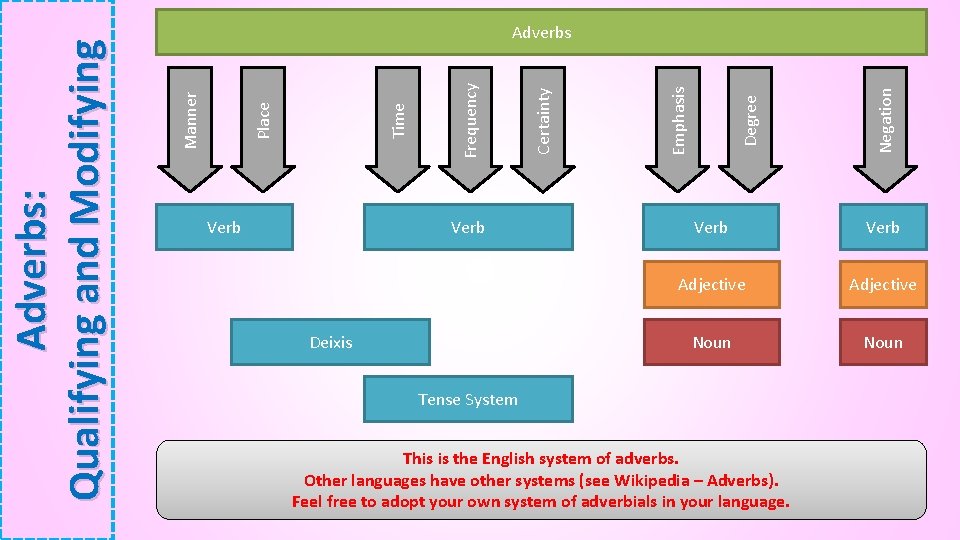
Verb Deixis Negation Degree Emphasis Certainty Frequency Time Place Manner Adverbs: Qualifying and Modifying Adverbs Verb Adjective Noun Tense System This is the English system of adverbs. Other languages have other systems (see Wikipedia – Adverbs). Feel free to adopt your own system of adverbials in your language.
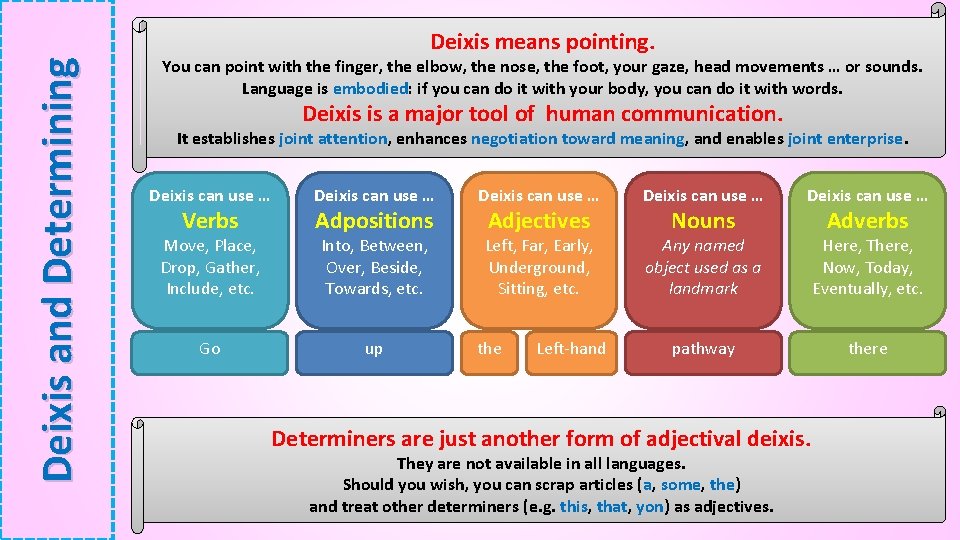
Deixis and Determining Deixis means pointing. You can point with the finger, the elbow, the nose, the foot, your gaze, head movements … or sounds. Language is embodied: if you can do it with your body, you can do it with words. Deixis is a major tool of human communication. It establishes joint attention, enhances negotiation toward meaning, and enables joint enterprise. Deixis can use … Deixis can use … Move, Place, Drop, Gather, Include, etc. Into, Between, Over, Beside, Towards, etc. Left, Far, Early, Underground, Sitting, etc. Any named object used as a landmark Here, There, Now, Today, Eventually, etc. pathway there Verbs Go Adpositions up Adjectives the Left-hand Nouns Determiners are just another form of adjectival deixis. They are not available in all languages. Should you wish, you can scrap articles (a, some, the) and treat other determiners (e. g. this, that, yon) as adjectives. Adverbs
![A Simpler System really incredibly sweet blackberries [really [incredibly [sweet [blackberries]]]] [adverb [adjective [noun]]]]](http://slidetodoc.com/presentation_image_h2/e8dba1a5580341a636f3b6627e8eeb68/image-12.jpg "A Simpler System really incredibly sweet blackberries [really [incredibly [sweet [blackberries]]]] [adverb [adjective [noun]]]]")
A Simpler System really incredibly sweet blackberries [really [incredibly [sweet [blackberries]]]] [adverb [adjective [noun]]]] really incredibly sweet blackberries Sweetness-a blackberries Becomes Reality-c [thing not believed]-b All qualifiers are nouns It is extensible: Really very incredibly sweet and juicy blackberries Becomes Reality-c [large set]-c [thing not believed]-b Sweetness-a juiciness-a blackberries

And finally. . .
- Slides: 13