
What Works for Work Chaining and Prompting Complete

- Slides: 63
“What Works for Work” Chaining and Prompting
Complete Chaining Pre-Assessment First • See Chaining Mini Assessment Handout #1. • Answer the 6 questions in the pre-assessment column. • At the end of this session the post assessment column of this handout will be completed. You will be prompted when to complete this. • This activity has two purposes: a. To become aware of your change in knowledge after engaging in the content of this section. b. An opportunity to reflect on the value of base line information, progress monitoring and classroom practices.
Chaining Includes Task Analysis and Prompting • Chaining Strategies teach a sequence of defined steps in order for the learner to preform a larger task/skill. 1. Task analysis. The job coach, teacher or trainer analyzes the task to be performed, identifying each defined step necessary to complete the task. 2. Instruct. The teacher or trainer then guides the youth to learn each step. 3. Goal. The youth successfully/accurately completes the entire activity.
Using Chaining to Teach • Backwards Chaining Approach – Support person completes all the steps identified except for the final step which the person learning completes and is reinforced. – Then the next-to-last step or skill is introduced • Forward Chaining Approach – Steps or skills taught in their naturally occurring order and reinforcement is delivered when the person completes the first step in the sequence – Then the next time the skill is taught, the second step is reinforced
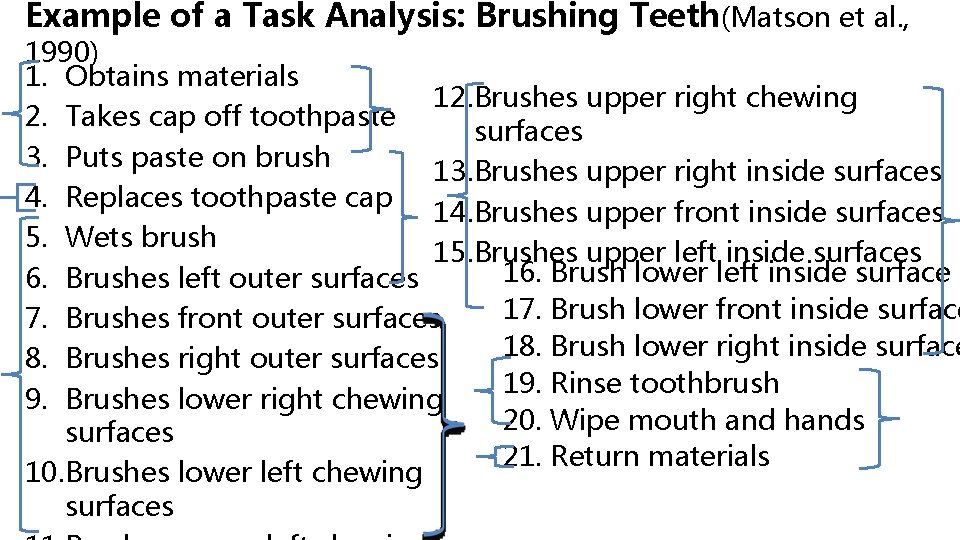
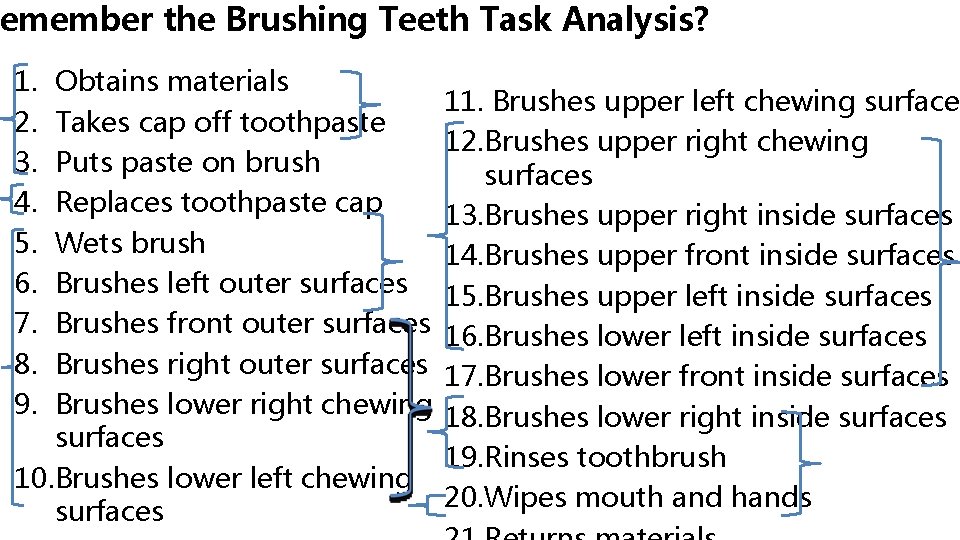
Example of a Task Analysis: Brushing Teeth(Matson et al. , 1990) 1. Obtains materials 12. Brushes upper right chewing 2. Takes cap off toothpaste surfaces 3. Puts paste on brush 13. Brushes upper right inside surfaces 4. Replaces toothpaste cap 14. Brushes upper front inside surfaces 5. Wets brush 15. Brushes upper left inside surfaces 16. Brush lower left inside surface 6. Brushes left outer surfaces 17. Brush lower front inside surface 7. Brushes front outer surfaces 18. Brush lower right inside surface 8. Brushes right outer surfaces 19. Rinse toothbrush 9. Brushes lower right chewing 20. Wipe mouth and hands surfaces 21. Return materials 10. Brushes lower left chewing surfaces
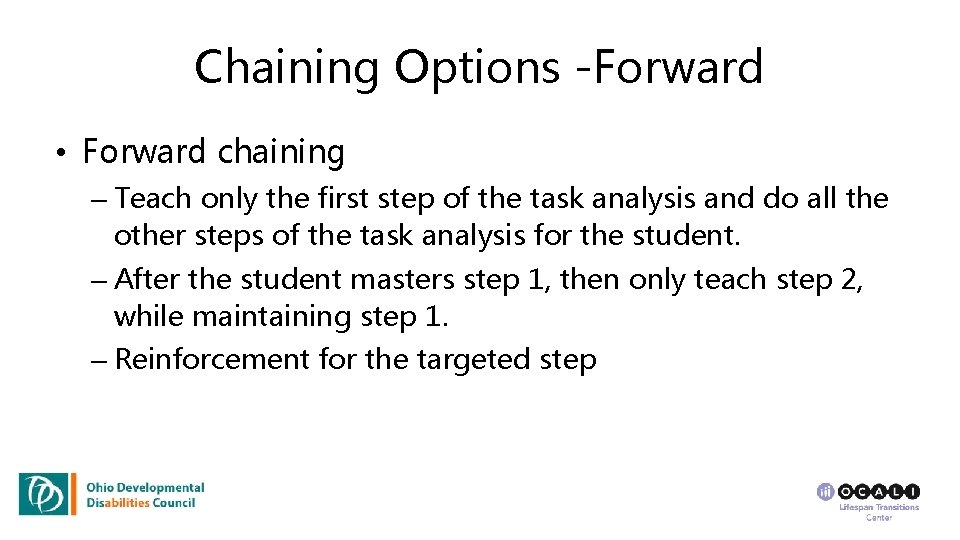
Chaining Options -Forward • Forward chaining – Teach only the first step of the task analysis and do all the other steps of the task analysis for the student. – After the student masters step 1, then only teach step 2, while maintaining step 1. – Reinforcement for the targeted step
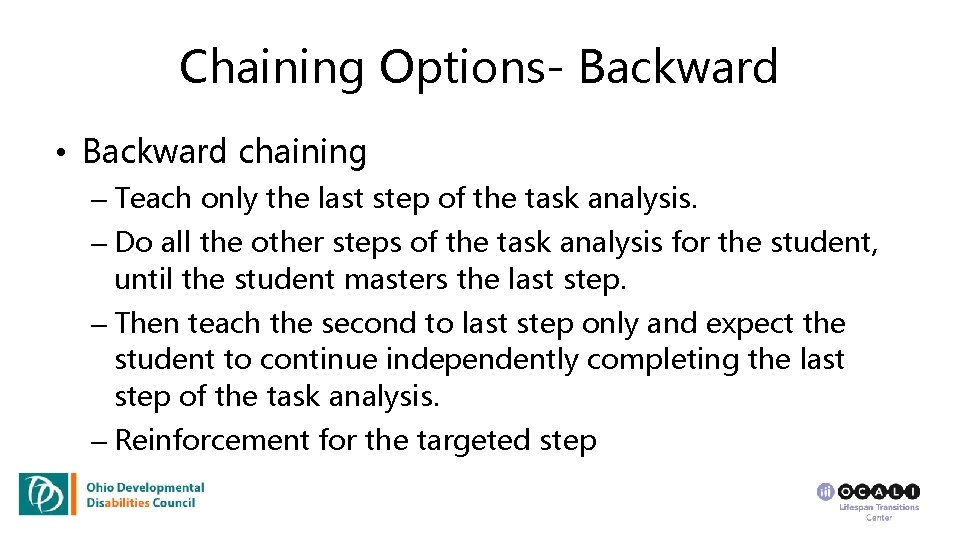
Chaining Options- Backward • Backward chaining – Teach only the last step of the task analysis. – Do all the other steps of the task analysis for the student, until the student masters the last step. – Then teach the second to last step only and expect the student to continue independently completing the last step of the task analysis. – Reinforcement for the targeted step
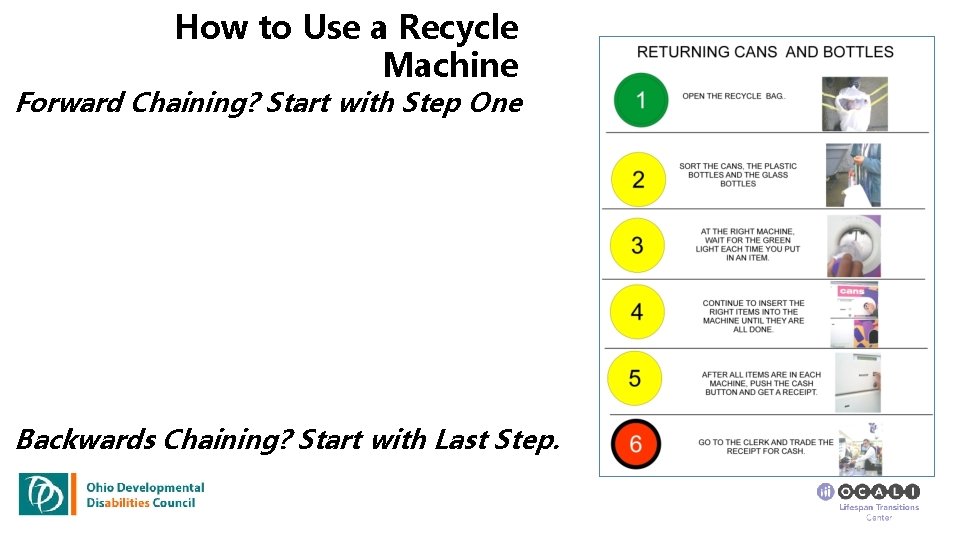
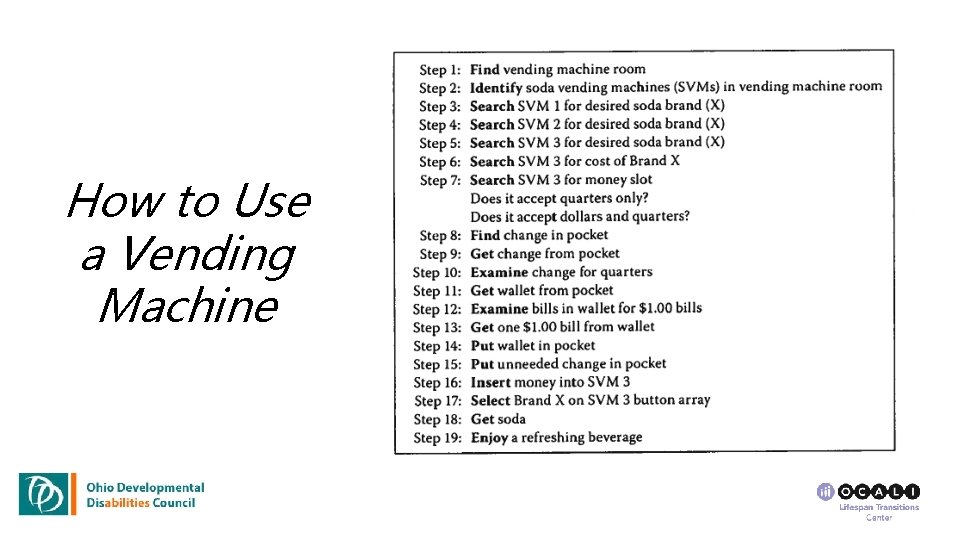
How to Use a Recycle Machine Forward Chaining? Start with Step One Backwards Chaining? Start with Last Step.
How to Use a Vending Machine
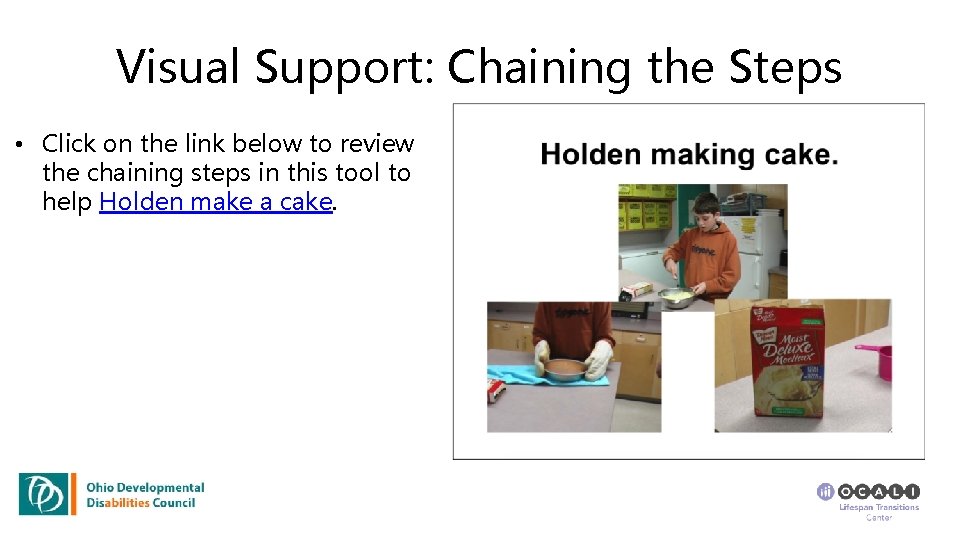
Visual Support: Chaining the Steps • Click on the link below to review the chaining steps in this tool to help Holden make a cake.
Chaining Options • Total Task Chaining – Student is given opportunity to perform each step every time opportunity. – For example: When putting on pants, the student has the opportunity to perform each step EVERY time he/she puts on pants. – Reinforcement as needed
Forward Chaining/Total Task Example (1) • Crystal needs to learn to do a car oil change. She has no prior experience in this area and even though she has watched videos and others do it, she is concerned she will make a mistake that will ruin the car. • The coach decides to use a combination of total task and forward chaining process to help Crystal be successful. • Initially, the job coach prompts Crystal through each specific step, pausing for her to complete the step. This helps assess how well Crystal is able to do each step.
Forward Chaining/Total Task Example (2) • Additionally, to motivate and build confidence, the coach praises her, provides an ‘elbow bump’, and other positive reinforcement for each step completed. Before she realizes it, Crystal has completed her first oil change and is ready to try again with less prompts. • On her next try, Crystal completed the first 2 steps of the oil change before being given praise. On the next try… the job coach waited for Crystal to complete 3 steps and then gave thumbs up.
When to Choose Chaining • For tasks with an established, predictable sequence of steps that do not change. • For a person that learns best when presented with small chunks of information at one time to master a skill or concept. • For a person that desires structured learning environments. • After a Task Analysis is complete and the instructor/coach has tried it out herself.
Backward Chaining For a student who: • needs to see the big picture. • is anxious gets flustered with a lot of steps. • you want to get comfortable, productive early on. • Backward chaining may be superior in developing speed, accuracy, fluency, and skill maintenance. • Learning takes place faster, learners develop greater confidence, and performance is generally better on the job.
Backward Chaining Example (1) • Connie is learning to make double-sided, color copies on her job site. • A task analysis is completed that identifies multiple steps that include loading paper in the correct drawer, loading staples, and putting in a password to access the copier. • The job coach begins by showing Connie how to do all the steps of the task using a checklist. • The coach then completes each step until the last step, which is pushing the print button. The job coach prompts Connie to complete the chain by pointing to the print button, which she then pushes.
Backward Chaining Example (2) • The coach provides verbal praise for Connie’s success and then begins the process again, only this time, the coach does not do the last two steps. • Connie successful completes both and is again reinforced. The backwards-chaining process continues in this manner until Connie is completing all of the steps independently, accurately and consistently.
Backward Chaining Example: Shoe Tying • Watch the Backward chaining: Tying a shoe the video. (Note: there is no sound) • The steps shown on the video include: – Cross Laces – Put one lace under the other lace and pull tight – Make a loop in one hand – Using the opposite hand, wrap the free lace around the loop – Using the index finger, push the lace through the hole – Hold both loops and pull tight.
Start with the Task Analysis
emember the Brushing Teeth Task Analysis? 1. 2. 3. 4. 5. 6. 7. 8. 9. Obtains materials Takes cap off toothpaste Puts paste on brush Replaces toothpaste cap Wets brush Brushes left outer surfaces Brushes front outer surfaces Brushes right outer surfaces Brushes lower right chewing surfaces 10. Brushes lower left chewing surfaces 11. Brushes upper left chewing surfaces 12. Brushes upper right chewing surfaces 13. Brushes upper right inside surfaces 14. Brushes upper front inside surfaces 15. Brushes upper left inside surfaces 16. Brushes lower left inside surfaces 17. Brushes lower front inside surfaces 18. Brushes lower right inside surfaces 19. Rinses toothbrush 20. Wipes mouth and hands
Considerations Beyond the Specific Steps • Steps for preparation. Example: gathering materials • Location. Does the location of the task change the steps? • Prerequisites Skills. Is there a set of precursor-skills/ knowledge that are required to be able to complete the target task/ activity? Example: – Oil Change. Do I know how to pick the correct oil? – Greeting co-workers. Do I know who is my co-worker? – Completing an Academic Assignment. Do I know how to remain focused on the assignment. – What if things do not go as planned? Do I know how to ask for help when I find myself unsure about part of the process?
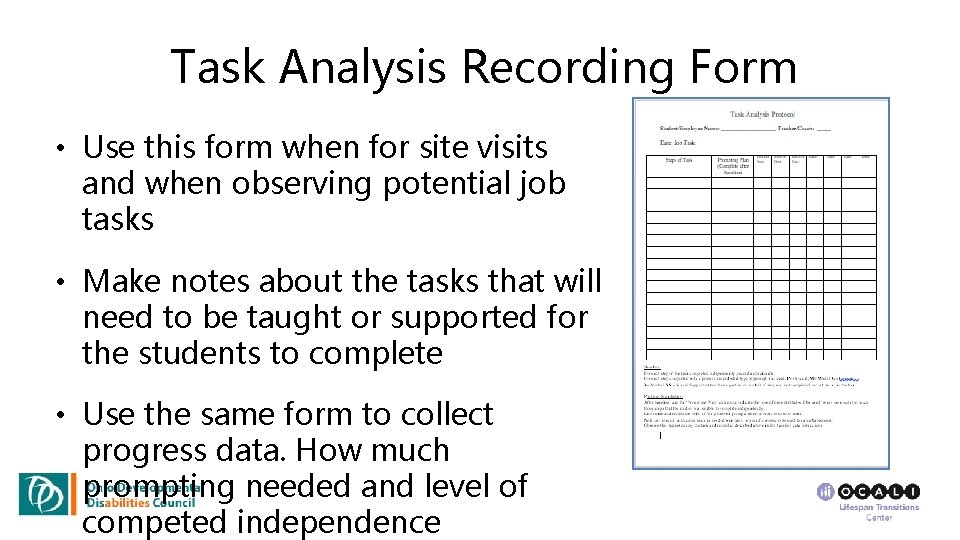
Task Analysis Recording Form • Use this form when for site visits and when observing potential job tasks • Make notes about the tasks that will need to be taught or supported for the students to complete • Use the same form to collect progress data. How much prompting needed and level of competed independence
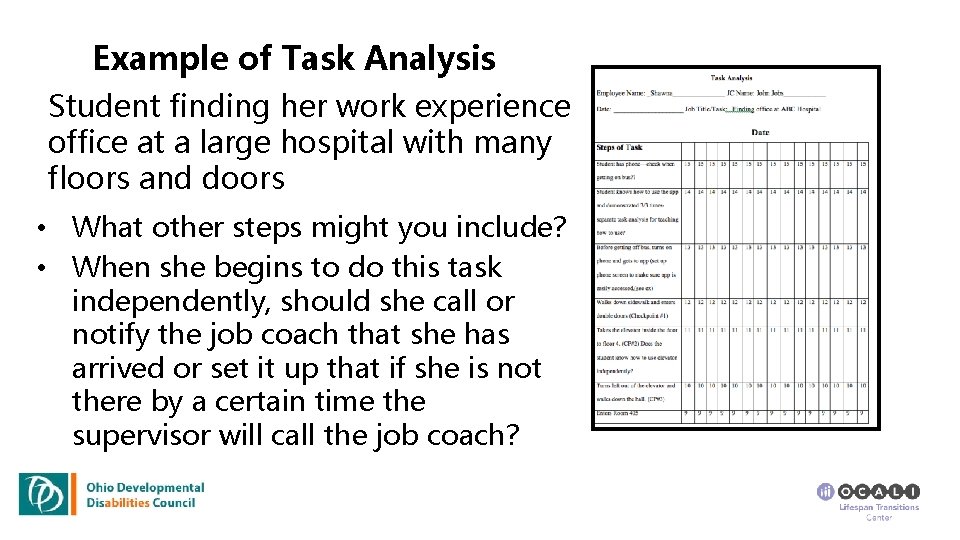
Example of Task Analysis Student finding her work experience office at a large hospital with many floors and doors • What other steps might you include? • When she begins to do this task independently, should she call or notify the job coach that she has arrived or set it up that if she is not there by a certain time the supervisor will call the job coach?
Activity Hands on with Chaining 1. Do a Task Analysis for one of the five skills on this slide • Use Handout #2, the task analysis form. 2. Choose Forward or Backward Chaining 3. Practice teaching with a partner on your team. SELECT ONE OF THE FOLLOWING: 1. Cleaning table after a meal 2. Setting table 3. Academic-your choice or-Teach multiplication of 2 digit numbers (the process). Assume knowledge of multiplication tables 4. Packing/Bag groceries 5. Academic--Write sentence with an article, noun, action verb
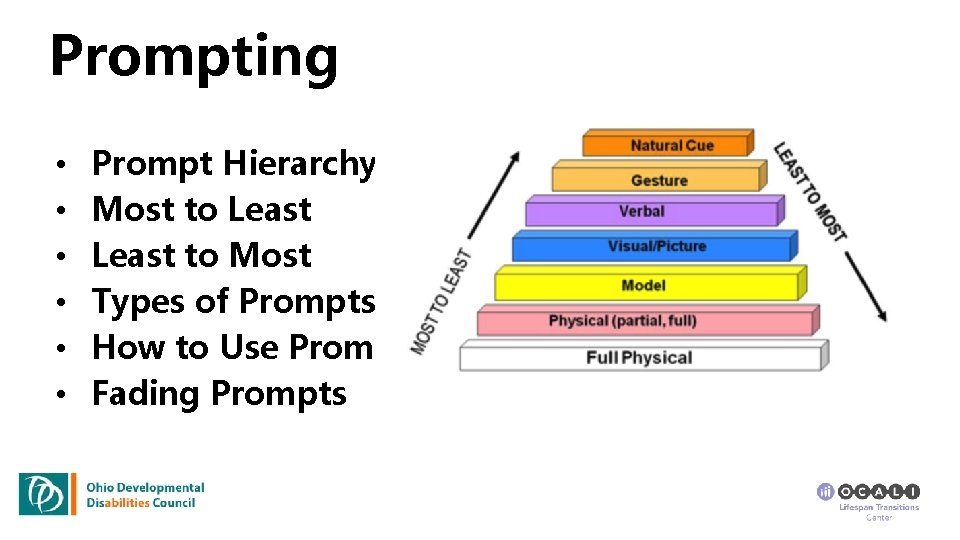
Prompting • • • Prompt Hierarchy Most to Least to Most Types of Prompts How to Use Prompts Fading Prompts
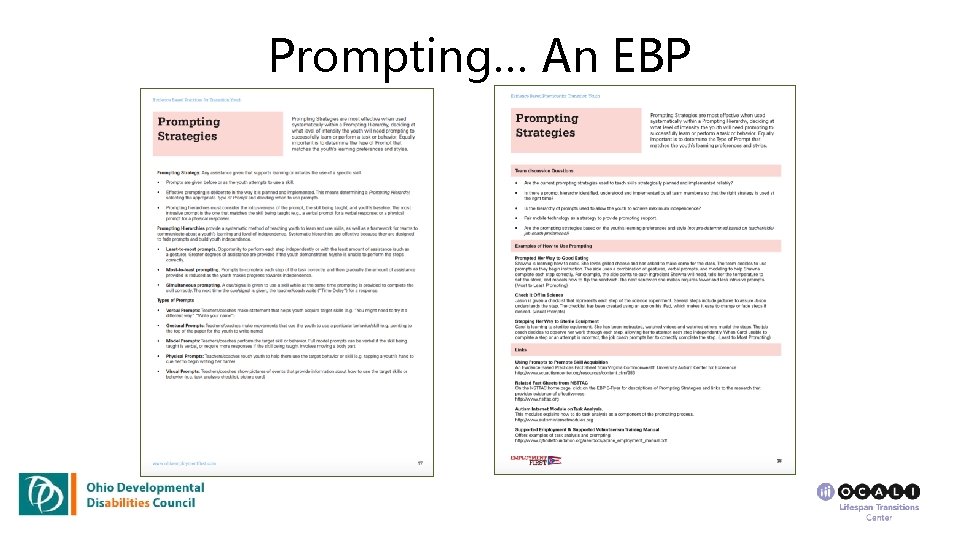
Prompting… An EBP
Prompting is a Teaching Strategy Prompting Any assistance given that supports learning or initiates the use of a specific skill
Prompting Used by Everyone! All the Time! Very Effective! But often issues or concerns arise. What issue/concerns have you seen related to prompting?
Prompting Errors • Over prompting… student does not try • Inconsistent prompting… team not on the same page • Lack of fading …. . poor planning of the level of prompts to use and how to fade • Lack of data …. . collected or reviewed
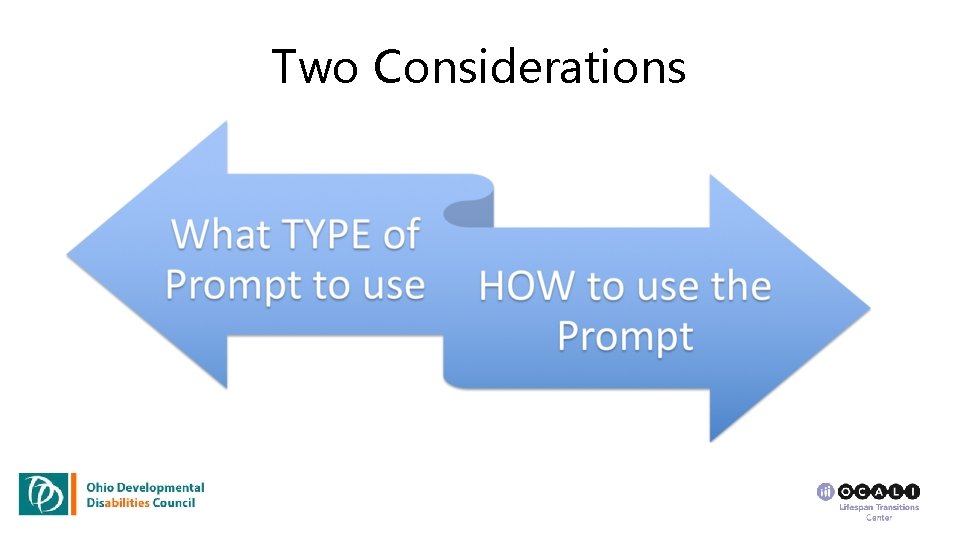
Two Considerations
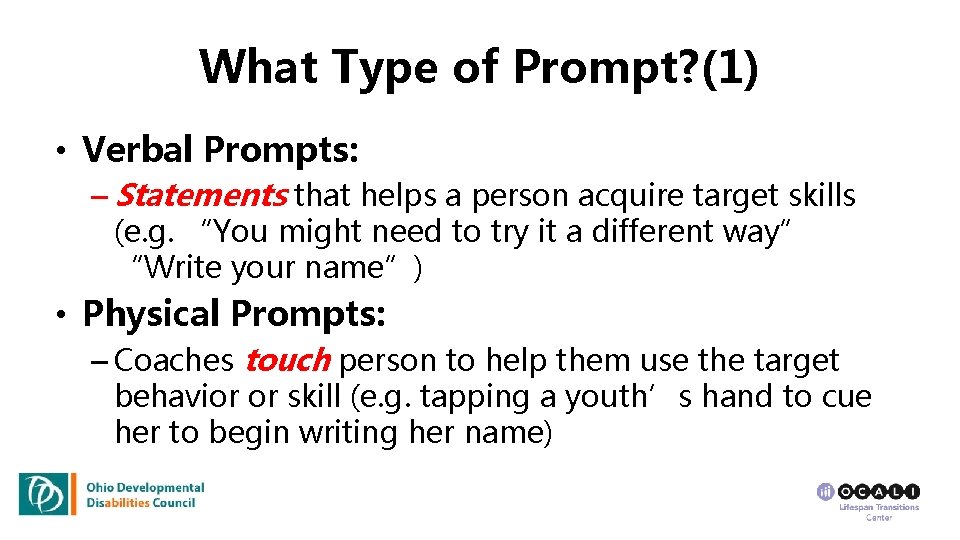
What Type of Prompt? (1) • Verbal Prompts: – Statements that helps a person acquire target skills (e. g. “You might need to try it a different way” “Write your name”) • Physical Prompts: – Coaches touch person to help them use the target behavior or skill (e. g. tapping a youth’s hand to cue her to begin writing her name)
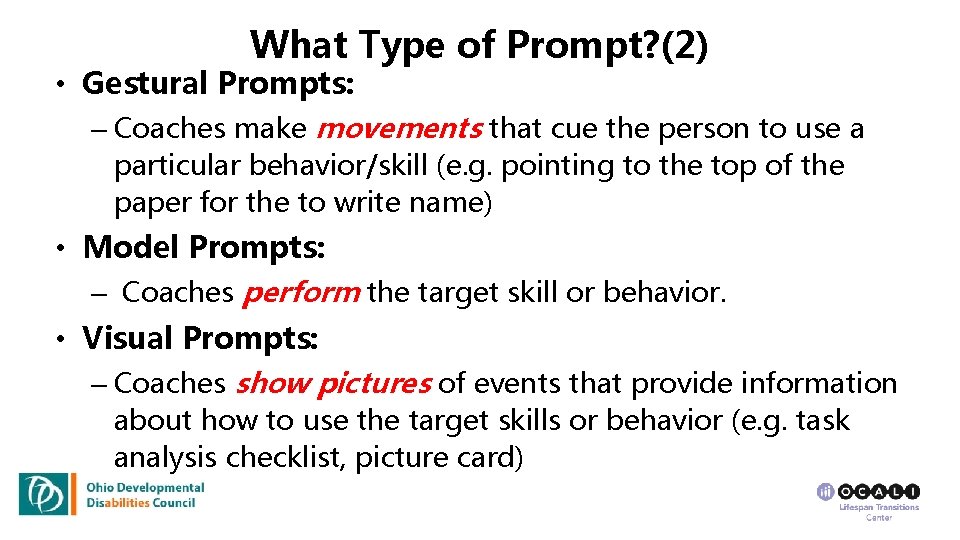
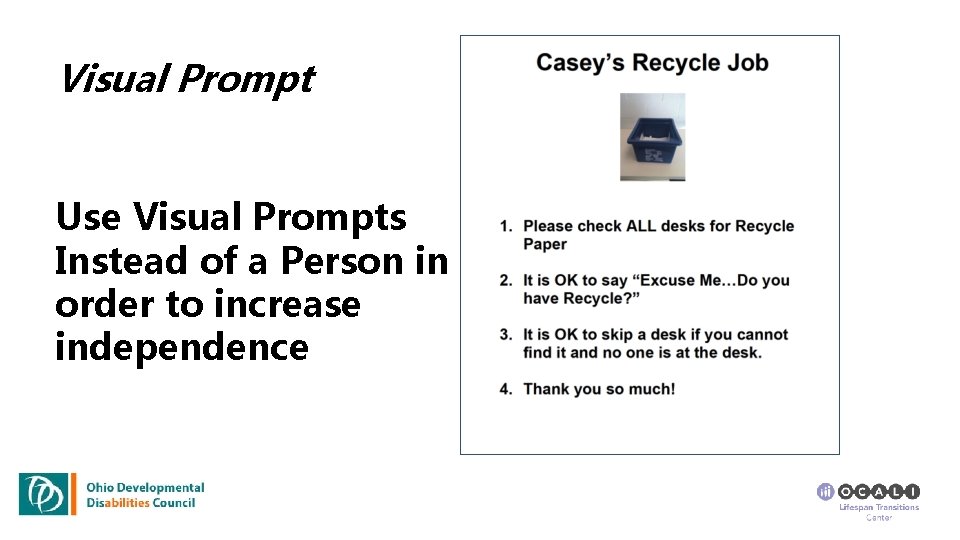
What Type of Prompt? (2) • Gestural Prompts: – Coaches make movements that cue the person to use a particular behavior/skill (e. g. pointing to the top of the paper for the to write name) • Model Prompts: – Coaches perform the target skill or behavior. • Visual Prompts: – Coaches show pictures of events that provide information about how to use the target skills or behavior (e. g. task analysis checklist, picture card)
Visual Prompt Use Visual Prompts Instead of a Person in order to increase independence
Defining Verbal Prompt • Review the short verbal prompt video • Defines and provides video examples • Video modules available at the Autism Certification Center
Which Prompt to Use and When • “How do I determine which prompt is the right prompt for the person? ” • “Does the task make a difference on which prompt I should use? ” • “When do I change prompts? ” • Consider defining a ‘prompt hierarchy’ as you develop the instructional plan
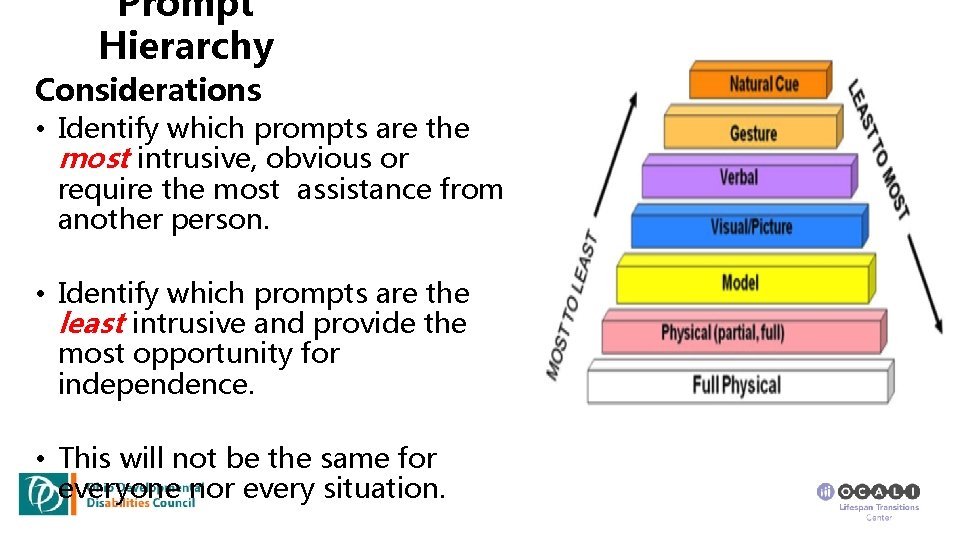
Prompt Hierarchy Considerations • Identify which prompts are the most intrusive, obvious or require the most assistance from another person. • Identify which prompts are the least intrusive and provide the most opportunity for independence. • This will not be the same for everyone nor every situation.
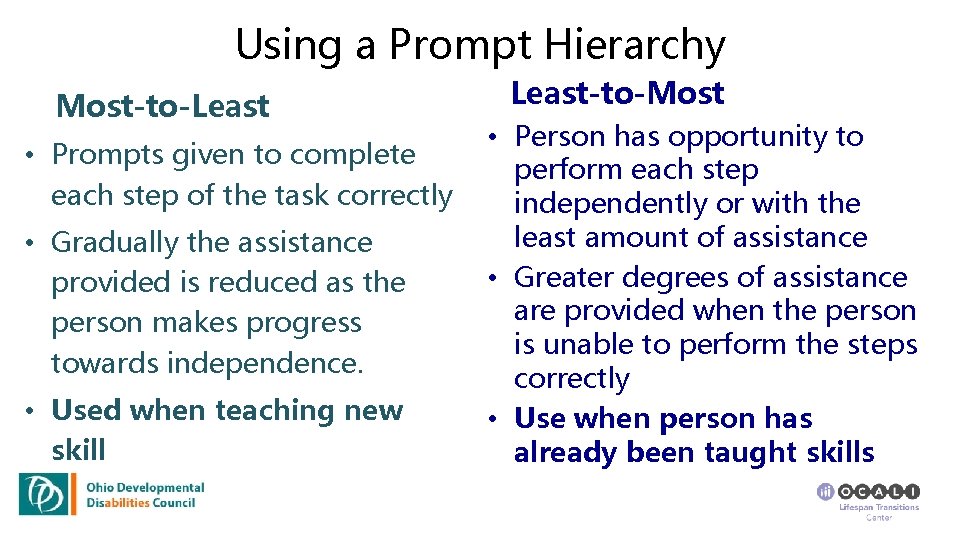
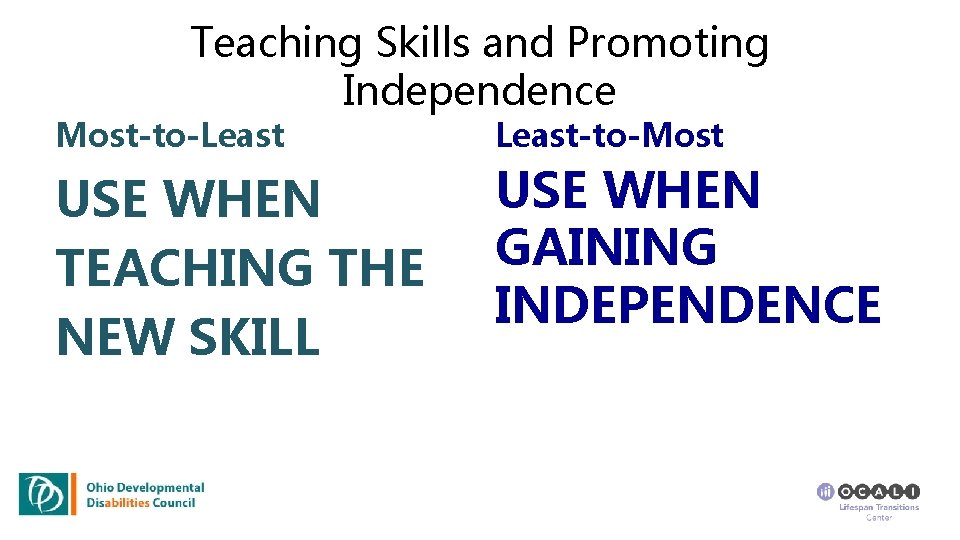
Using a Prompt Hierarchy Most-to-Least • Prompts given to complete each step of the task correctly • Gradually the assistance provided is reduced as the person makes progress towards independence. • Used when teaching new skill Least-to-Most • Person has opportunity to perform each step independently or with the least amount of assistance • Greater degrees of assistance are provided when the person is unable to perform the steps correctly • Use when person has already been taught skills
Teaching Skills and Promoting Independence Most-to-Least-to-Most USE WHEN TEACHING THE NEW SKILL USE WHEN GAINING INDEPENDENCE
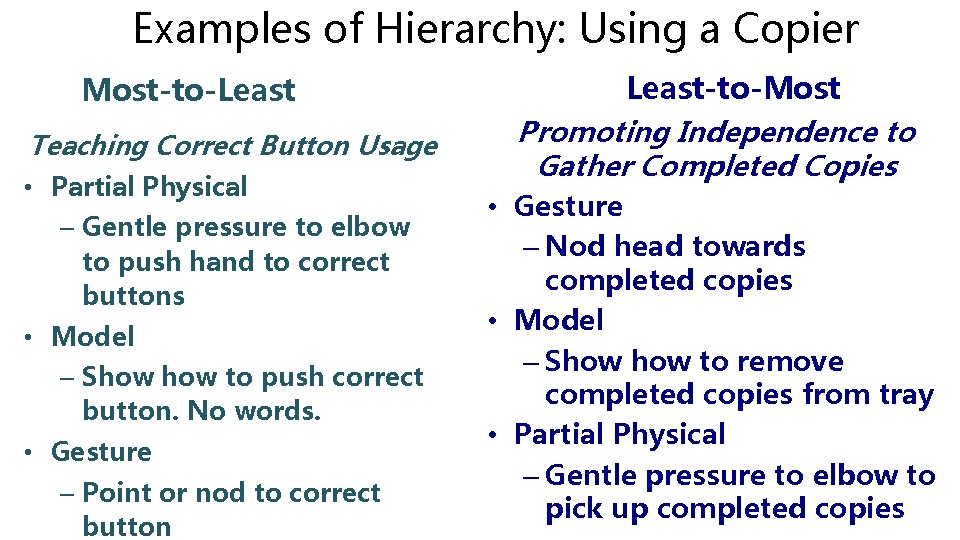
Examples of Hierarchy: Using a Copier Most-to-Least Teaching Correct Button Usage • Partial Physical – Gentle pressure to elbow to push hand to correct buttons • Model – Show to push correct button. No words. • Gesture – Point or nod to correct button Least-to-Most Promoting Independence to Gather Completed Copies • Gesture – Nod head towards completed copies • Model – Show to remove completed copies from tray • Partial Physical – Gentle pressure to elbow to pick up completed copies
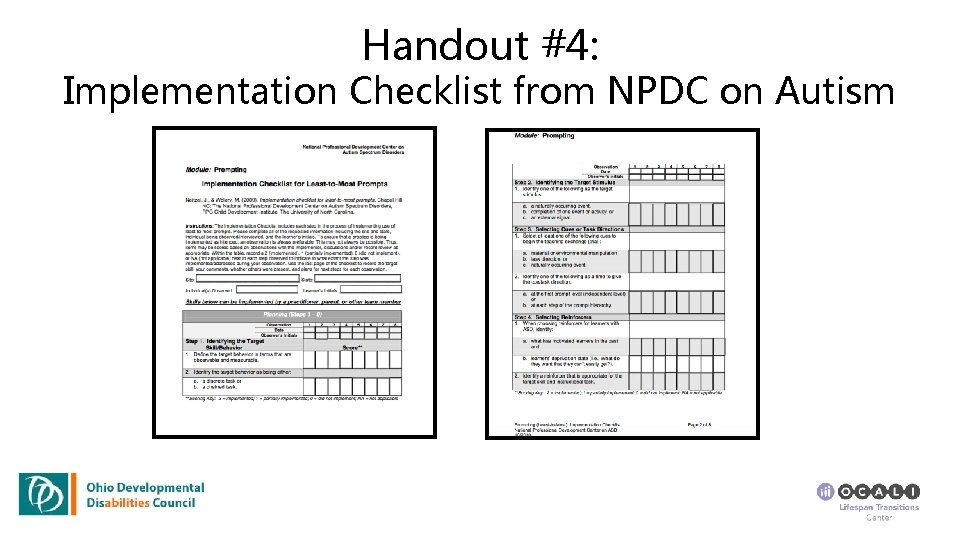
Handout #4: Implementation Checklist from NPDC on Autism
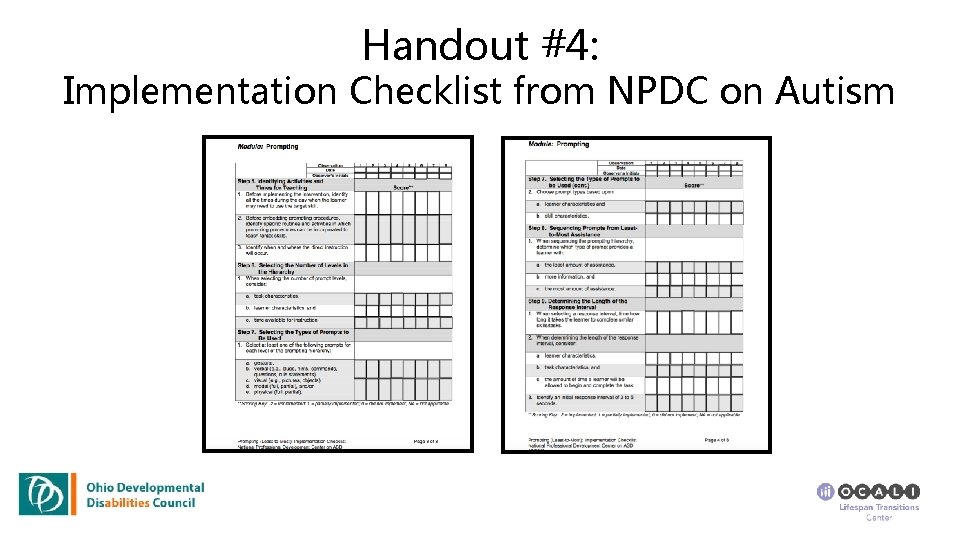
Handout #4: Implementation Checklist from NPDC on Autism
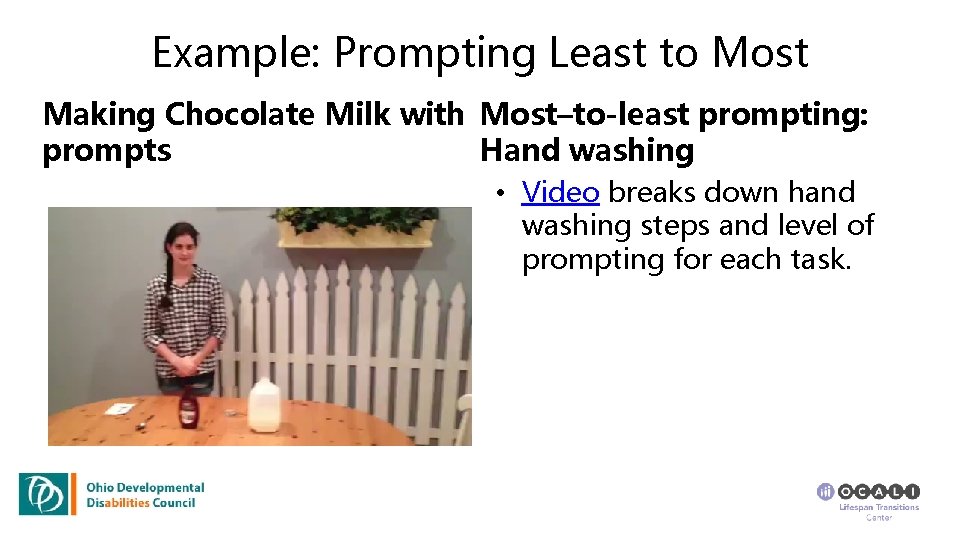
Example: Prompting Least to Most Making Chocolate Milk with Most–to-least prompting: prompts Hand washing • Video breaks down hand washing steps and level of prompting for each task.
Tips for Fading Prompts • PLAN. Create the fading plan early • GRADUAL. Fade prompts gradually • REINFORCE INDEPENDENCE – Reinforce more independent responses during fading – Provide heavier reinforcement for unprompted (independent) skill responses • REPLACE VERBAL. Verbal prompts are one of the most difficult prompts to fade. Replace verbal cues with a different type of prompt (visual, gestural, positional), so the verbal prompts can be removed more easily
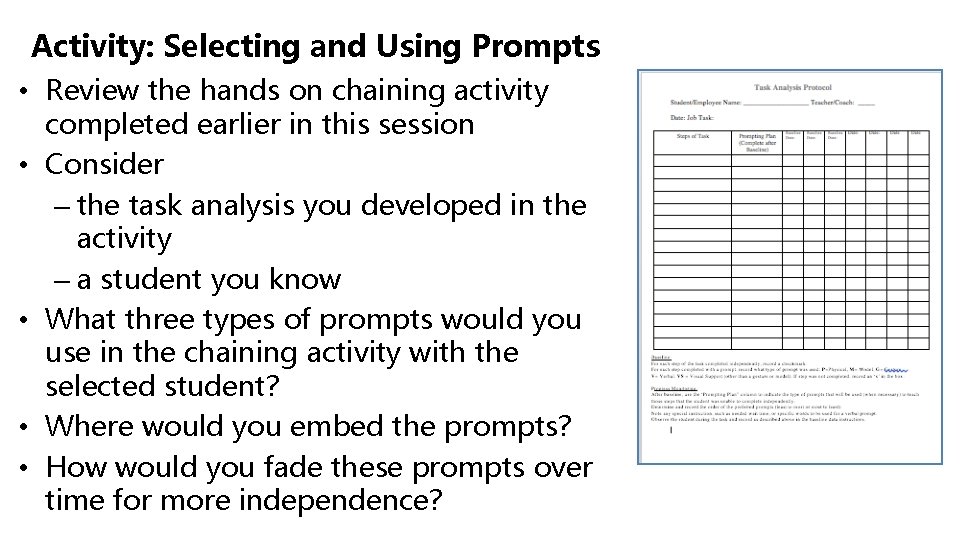
Activity: Selecting and Using Prompts • Review the hands on chaining activity completed earlier in this session • Consider – the task analysis you developed in the activity – a student you know • What three types of prompts would you use in the chaining activity with the selected student? • Where would you embed the prompts? • How would you fade these prompts over time for more independence?
What if a Prompt is an Ongoing Need for a Person?
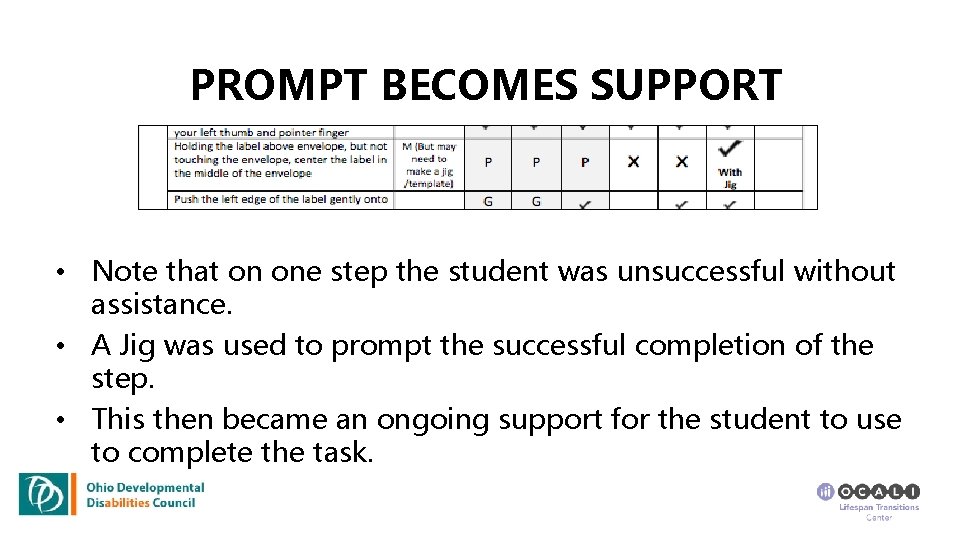
Is it a Prompt or Support? • Prompt may be needed for student to learn and complete a task • Some prompts may eventually become a support to be independent as they are not able to be totally faded • Use the least intrusive prompt – Example: verbal prompt replaced with a visual schedule as an ongoing support.
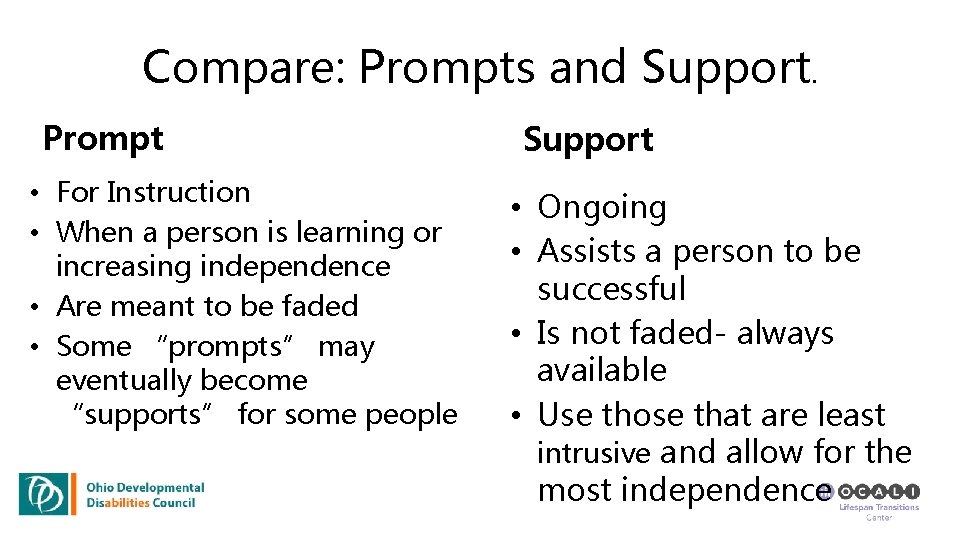
Compare: Prompts and Support. Prompt • For Instruction • When a person is learning or increasing independence • Are meant to be faded • Some “prompts” may eventually become “supports” for some people Support • Ongoing • Assists a person to be successful • Is not faded- always available • Use those that are least intrusive and allow for the most independence
Collecting and Recording Data • Components necessary when planning and implementing include a way to collect and record data on prompting, independence and progress – Complete task analysis of skill to be taught – Identify the prompts that will be used – Create the prompt hierarchy – Collect baseline data of current skills – Identify which prompts are necessary and when
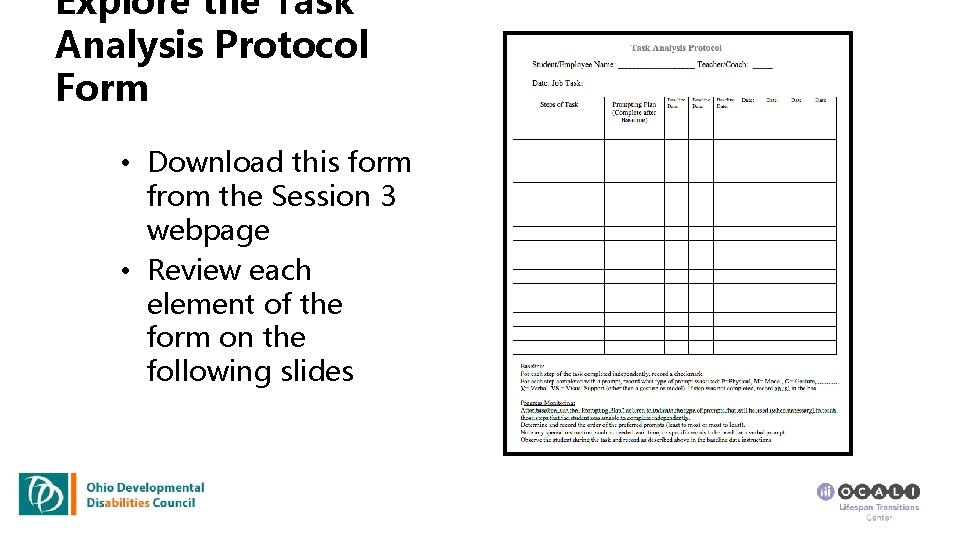
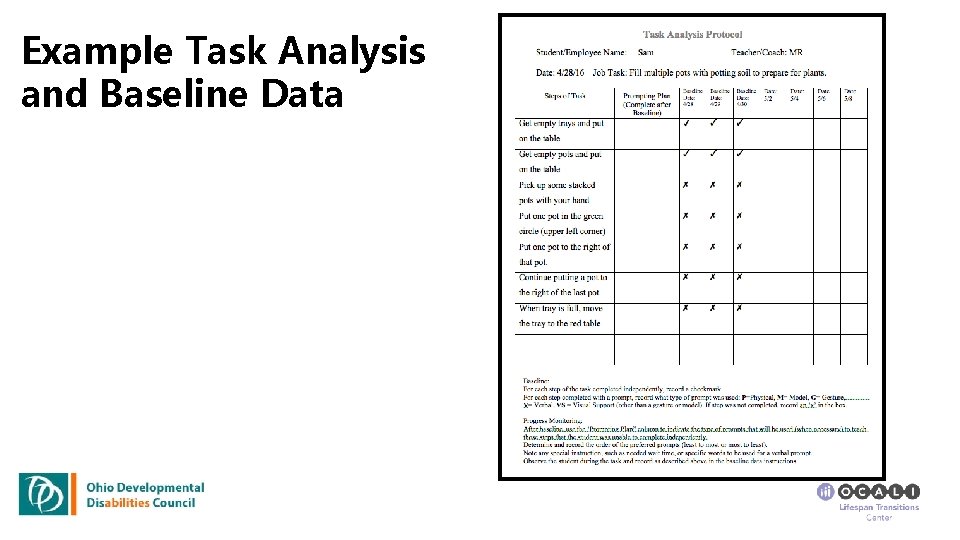
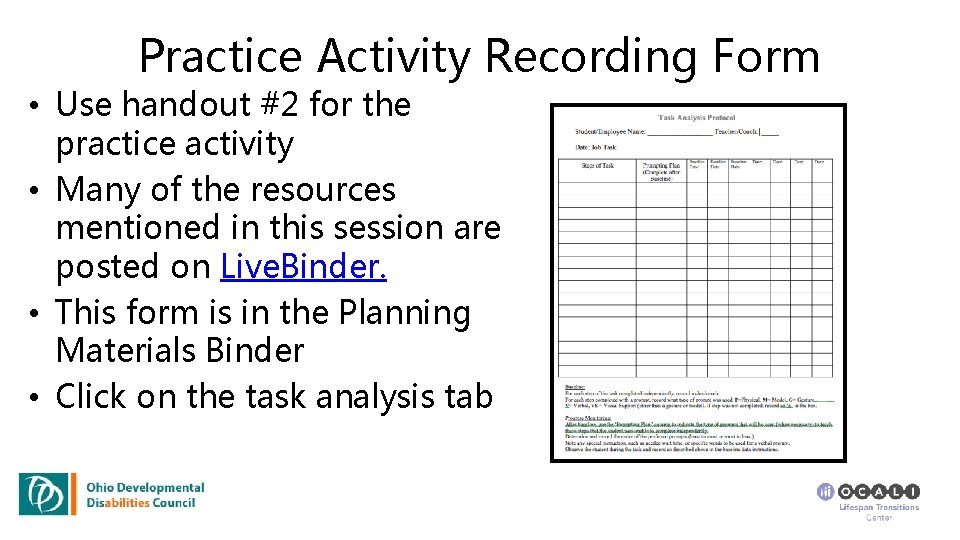
Explore the Task Analysis Protocol Form • Download this form from the Session 3 webpage • Review each element of the form on the following slides
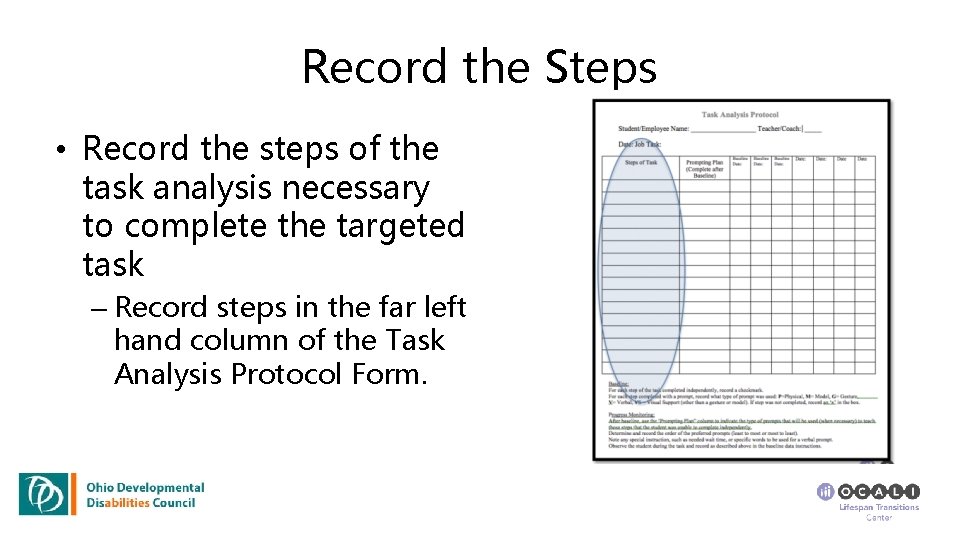
Record the Steps • Record the steps of the task analysis necessary to complete the targeted task – Record steps in the far left hand column of the Task Analysis Protocol Form.
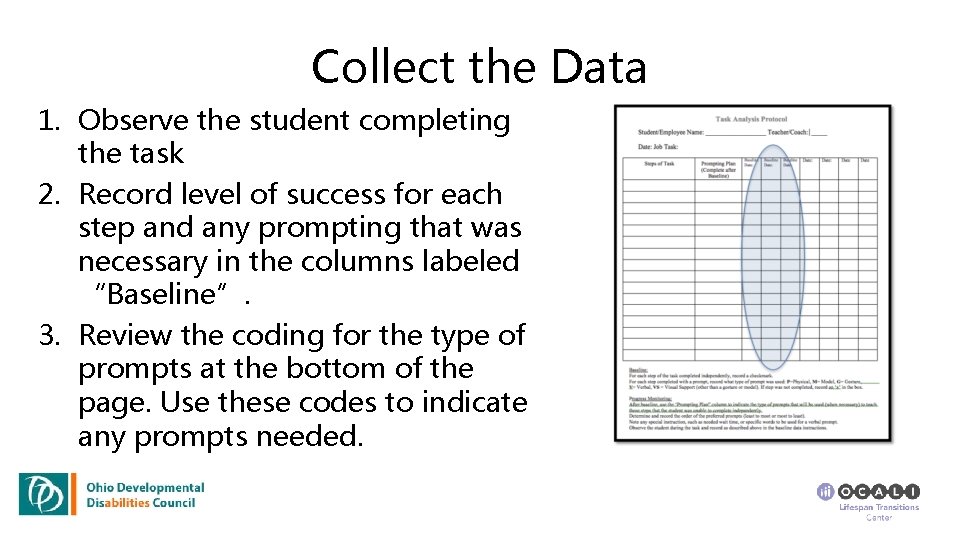
Collect the Data 1. Observe the student completing the task 2. Record level of success for each step and any prompting that was necessary in the columns labeled “Baseline”. 3. Review the coding for the type of prompts at the bottom of the page. Use these codes to indicate any prompts needed.
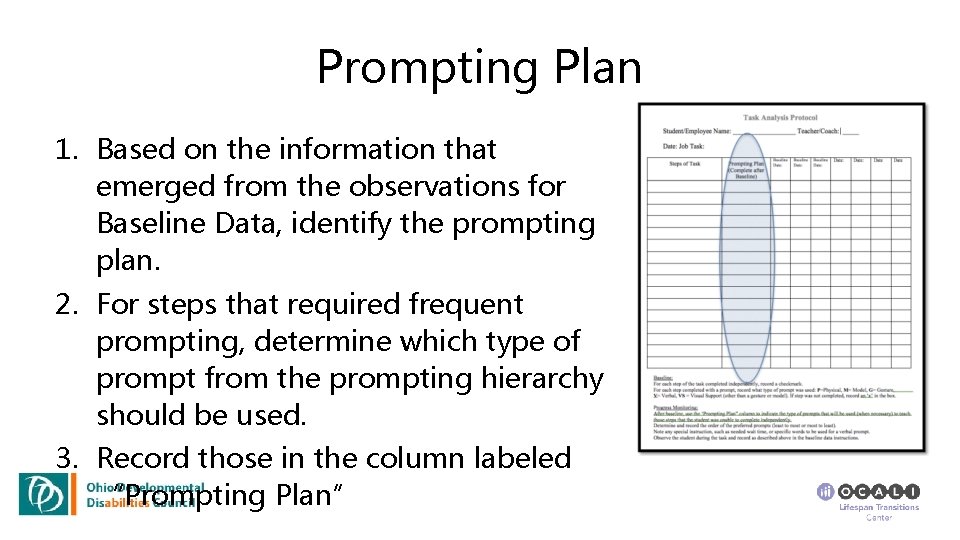
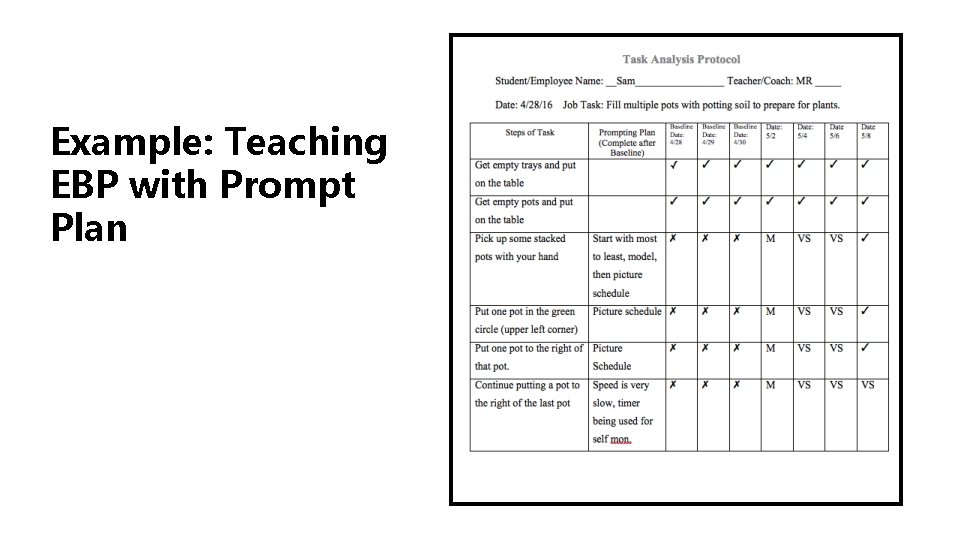
Prompting Plan 1. Based on the information that emerged from the observations for Baseline Data, identify the prompting plan. 2. For steps that required frequent prompting, determine which type of prompt from the prompting hierarchy should be used. 3. Record those in the column labeled “Prompting Plan”
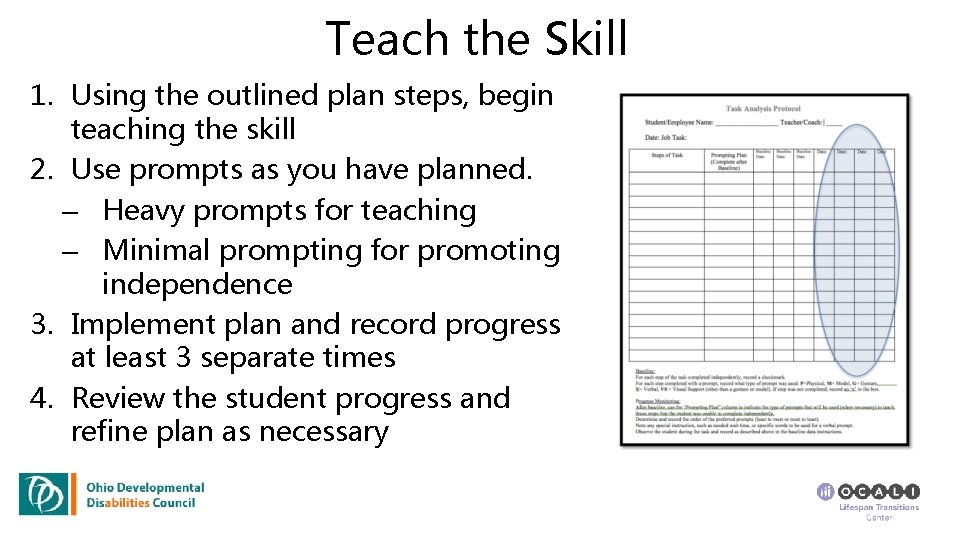
Teach the Skill 1. Using the outlined plan steps, begin teaching the skill 2. Use prompts as you have planned. – Heavy prompts for teaching – Minimal prompting for promoting independence 3. Implement plan and record progress at least 3 separate times 4. Review the student progress and refine plan as necessary
Example Task Analysis and Baseline Data
Example: Teaching EBP with Prompt Plan
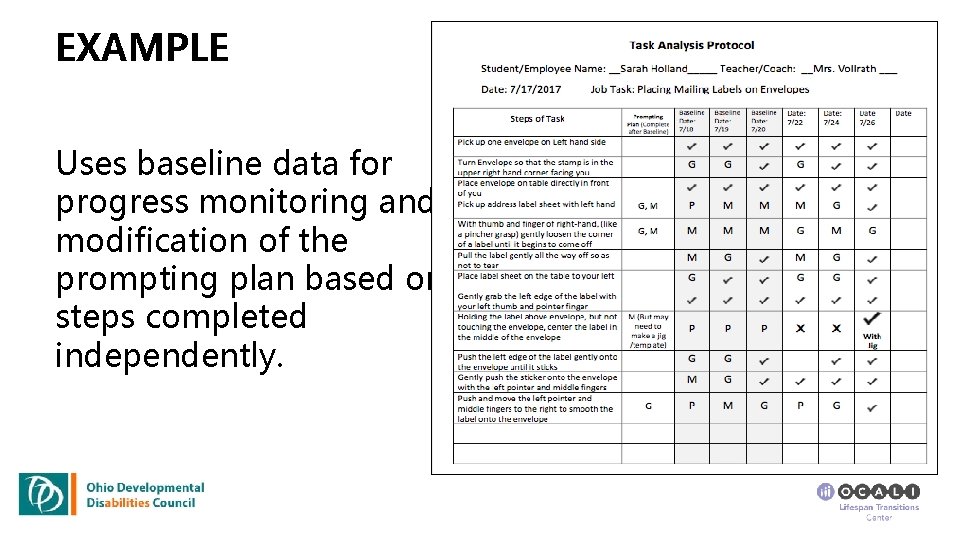
EXAMPLE Uses baseline data for progress monitoring and modification of the prompting plan based on steps completed independently.
PROMPT BECOMES SUPPORT • Note that on one step the student was unsuccessful without assistance. • A Jig was used to prompt the successful completion of the step. • This then became an ongoing support for the student to use to complete the task.
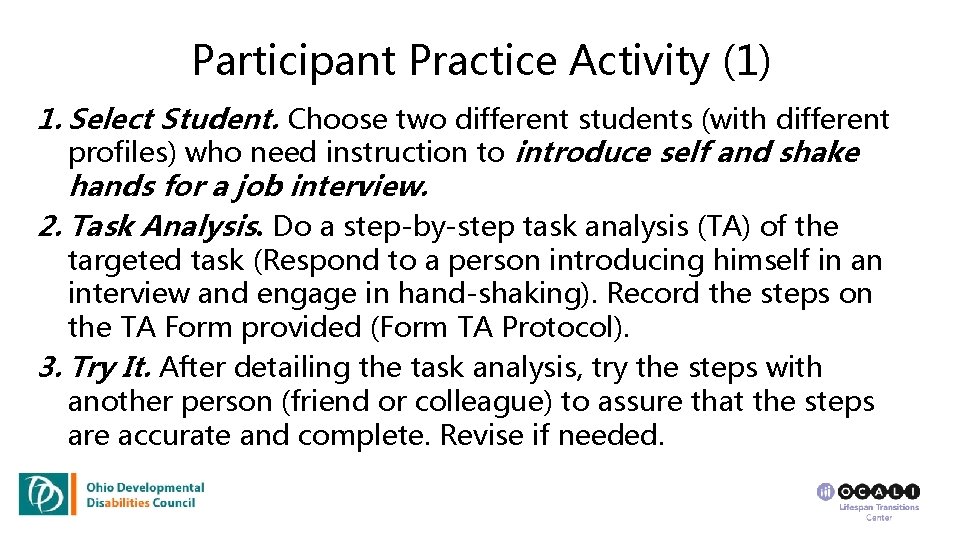
Participant Practice Activity (1) 1. Select Student. Choose two different students (with different profiles) who need instruction to introduce self and shake hands for a job interview. 2. Task Analysis. Do a step-by-step task analysis (TA) of the targeted task (Respond to a person introducing himself in an interview and engage in hand-shaking). Record the steps on the TA Form provided (Form TA Protocol). 3. Try It. After detailing the task analysis, try the steps with another person (friend or colleague) to assure that the steps are accurate and complete. Revise if needed.
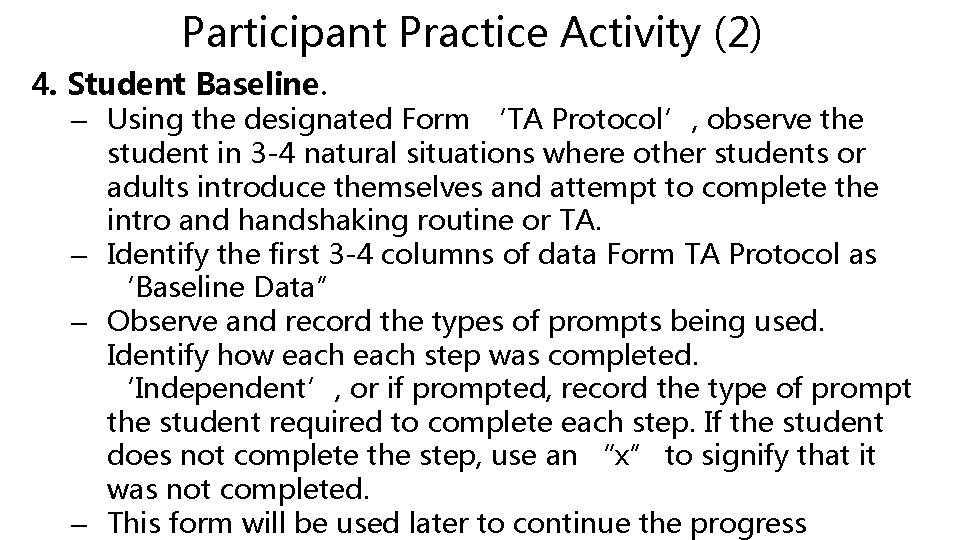
Participant Practice Activity (2) 4. Student Baseline. – Using the designated Form ‘TA Protocol’, observe the student in 3 -4 natural situations where other students or adults introduce themselves and attempt to complete the intro and handshaking routine or TA. – Identify the first 3 -4 columns of data Form TA Protocol as ‘Baseline Data” – Observe and record the types of prompts being used. Identify how each step was completed. ‘Independent’, or if prompted, record the type of prompt the student required to complete each step. If the student does not complete the step, use an “x” to signify that it was not completed. – This form will be used later to continue the progress
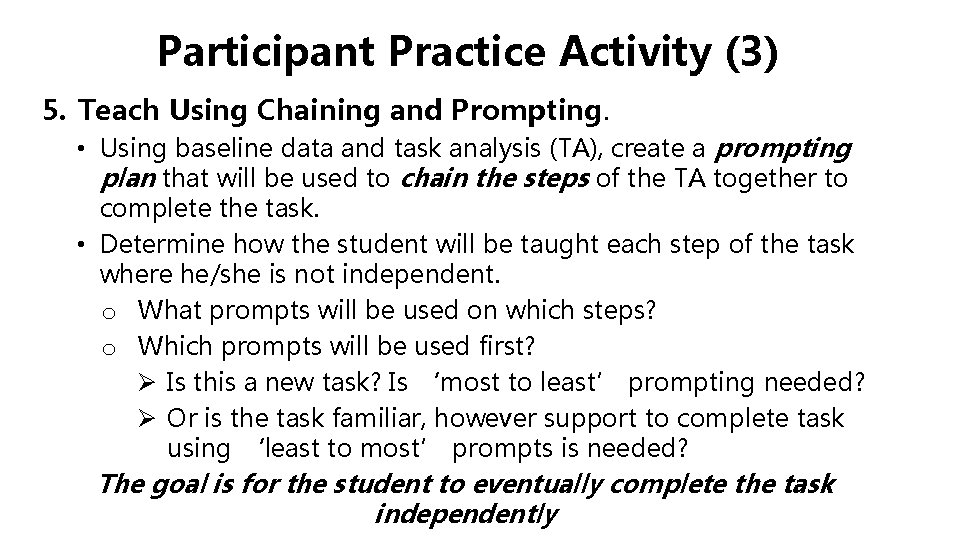
Participant Practice Activity (3) 5. Teach Using Chaining and Prompting. • Using baseline data and task analysis (TA), create a prompting plan that will be used to chain the steps of the TA together to complete the task. • Determine how the student will be taught each step of the task where he/she is not independent. o What prompts will be used on which steps? o Which prompts will be used first? Ø Is this a new task? Is ‘most to least’ prompting needed? Ø Or is the task familiar, however support to complete task using ‘least to most’ prompts is needed? The goal is for the student to eventually complete the task independently
Practice Activity Recording Form • Use handout #2 for the practice activity • Many of the resources mentioned in this session are posted on Live. Binder. • This form is in the Planning Materials Binder • Click on the task analysis tab
Resource for Practice Activity • Additional resource on Ohio. Means. Jobs – Interviewing tutorials for students to save to watch themselves interviewed by a variety of employers as well as watch their video after completing the interview and saving in their backpack. • Student/client will be required to log in
Complete Chaining Post Assessment • Put your answers in the post assessment column of Handout #1. • Open handout #3 Chaining Pre and Post Answers. Correct your answers in the pre and post columns. • Did your scores improve from pre and post tests? Were you surprised by your results from either pre or post? • Any reflections on the value of this activity in terms of collecting base line information, its role in progress monitoring and your practice in the classroom?