
What works and What Doesnt in Reducing Recidivism


- Slides: 29
What works and What Doesn’t in Reducing Recidivism: Some Lessons Learned from Evaluating Correctional Programs By: Edward Latessa School of Criminal Justice University of Cincinnati Edward. Latessa@uc. eu
Lesson #1 • Everyone says they are Evidence Based
Evidence Based – What does it mean? There are different forms of evidence: – The lowest form is anecdotal evidence; stories, opinions, testimonials, case studies, etc - but it often makes us feel good – The highest form is empirical evidence – research, data, results from controlled studies, etc. - but sometimes it doesn’t make us feel good
Evidence Based Decision Making Requires 1. Assessment information 2. Relevant research 3. Available programming 4. Evaluation 5. Professionalism and knowledge from staff
Lesson 2 • Some things don’t work
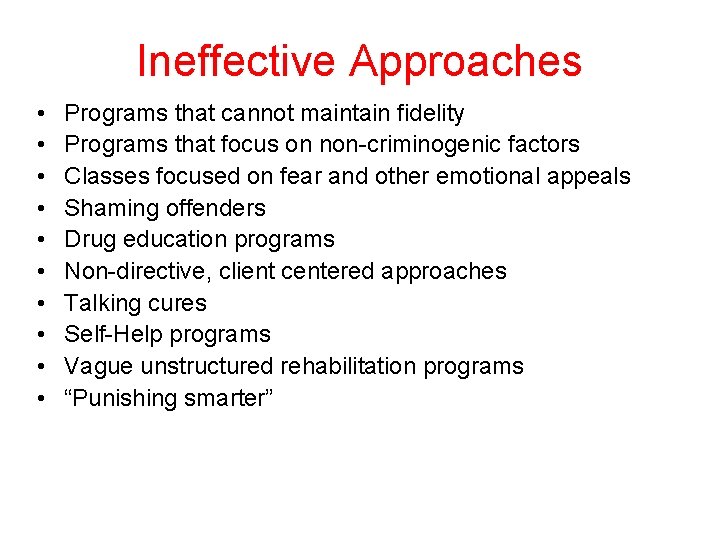
Ineffective Approaches • • • Programs that cannot maintain fidelity Programs that focus on non-criminogenic factors Classes focused on fear and other emotional appeals Shaming offenders Drug education programs Non-directive, client centered approaches Talking cures Self-Help programs Vague unstructured rehabilitation programs “Punishing smarter”
Lesson 3 • Almost anything you want to fix starts with assessment
Assessment helps us… • Meet the risk and need principles – “who” to target and “what” to target • Can help reduce bias • Helps us know if interventions have worked
Lesson 5 • Some times we fail because we provide intensive programs to the wrong offenders
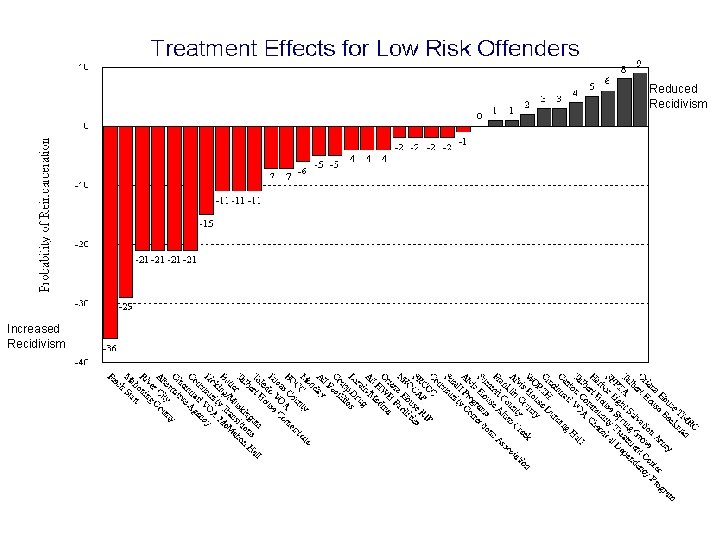
Risk Principle As a general rule treatment effects are stronger if we target higher risk offenders, and harm can be done to low risk offenders
Intensive Treatment for Low Risk Offenders will Often Increase Failure Rates • Low risk offenders will learn anti social behavior from higher risk • Disrupts pro-social networks • Increased reporting/surveillance leads to more violations/revocations
STUDY OF COMMUNITY CORRECTIONAL PROGRAMS IN OHIO • Largest study of community based correctional treatment facilities ever done up to that time • Total of 13, 221 offenders – 37 Halfway Houses and 15 Community Based Correctional Facilities (CBCFs) were included in the study. • Two-year follow-up conducted on all offenders • Recidivism measures included new arrests & incarceration in a state penal institution Lowenkamp, C. and E. J. Latessa (2002). Evaluation of Ohio’s Community Based Correctional Facilities and Halfway Houses. Center for Criminal Justice Research, University of Cincinnati.
Reduced Recidivism Increased Recidivism
Lesson 6 • Sometimes we fail because we do not provide enough treatment
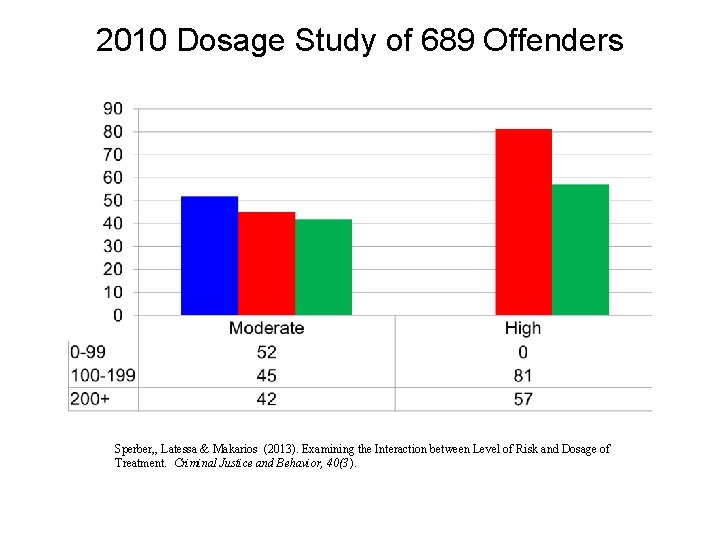
The question is: What does more “intensive” treatment mean in practice? • Most studies show that the longer someone is in treatment the great the effects, however: • Effects tend to diminish if treatment goes too long
2010 Dosage Study of 689 Offenders Sperber, , Latessa & Makarios (2013). Examining the Interaction between Level of Risk and Dosage of Treatment. Criminal Justice and Behavior, 40(3).
Lesson 7 • Everyone thinks they are an expert in criminal behavior
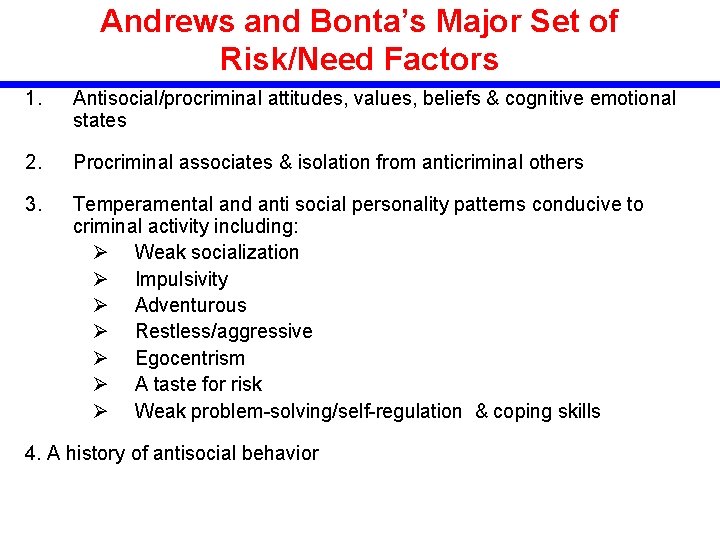
Andrews and Bonta’s Major Set of Risk/Need Factors 1. Antisocial/procriminal attitudes, values, beliefs & cognitive emotional states 2. Procriminal associates & isolation from anticriminal others 3. Temperamental and anti social personality patterns conducive to criminal activity including: Ø Weak socialization Ø Impulsivity Ø Adventurous Ø Restless/aggressive Ø Egocentrism Ø A taste for risk Ø Weak problem-solving/self-regulation & coping skills 4. A history of antisocial behavior
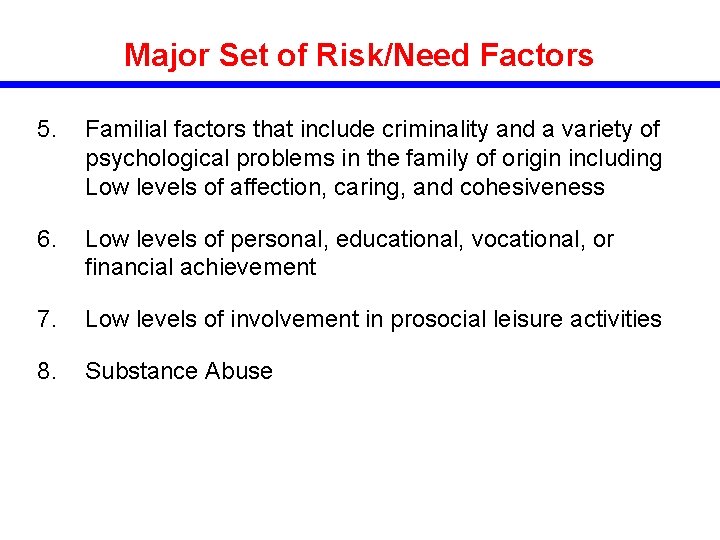
Major Set of Risk/Need Factors 5. Familial factors that include criminality and a variety of psychological problems in the family of origin including Low levels of affection, caring, and cohesiveness 6. Low levels of personal, educational, vocational, or financial achievement 7. Low levels of involvement in prosocial leisure activities 8. Substance Abuse
Lesson 8 Offenders are not usually higher risk because they have a risk factor… they have multiple risk factors
Targeting Criminogenic Need: Results from Meta-Analyses Reduction in Recidivism Increase in Recidivism Source: Gendreau, P. , French, S. A. , and A. Taylor (2002). What Works (What Doesn’t Work) Revised 2002. Invited Submission to the International Community Corrections Association Monograph Series Project
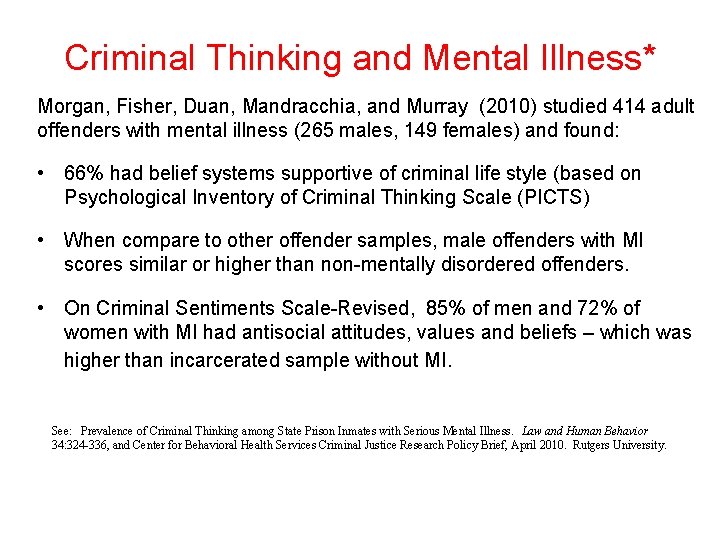
Criminal Thinking and Mental Illness* Morgan, Fisher, Duan, Mandracchia, and Murray (2010) studied 414 adult offenders with mental illness (265 males, 149 females) and found: • 66% had belief systems supportive of criminal life style (based on Psychological Inventory of Criminal Thinking Scale (PICTS) • When compare to other offender samples, male offenders with MI scores similar or higher than non-mentally disordered offenders. • On Criminal Sentiments Scale-Revised, 85% of men and 72% of women with MI had antisocial attitudes, values and beliefs – which was higher than incarcerated sample without MI. See: Prevalence of Criminal Thinking among State Prison Inmates with Serious Mental Illness. Law and Human Behavior 34: 324 -336, and Center for Behavioral Health Services Criminal Justice Research Policy Brief, April 2010. Rutgers University.
Conclusion • Criminal Thinking styles differentiate people who commit crimes from those who do not independent of mental illness • Incarcerated persons with mental illness are often mentally ill and criminal • Needs to be treated as co-occurring problems
Lesson 9 • We can change offender behavior – we just need to go about it the right way
Effective Correctional Interventions § Use behavioral approaches: Structured social learning with cognitive behavioral treatment § Focus on current risk factors § Action oriented § Staff follow Core Correctional Practices
Lesson 10 Professional Staff make a Difference
Successful Staff • Successful staff are modeling appropriate behavior, qualified, well trained, well supervised, and committed • Staff should be trained, coached, and evaluated regularly in key service delivery skills
Thank you