
What Why and How to refer Imran Jawaid





- Slides: 34
What? , Why? , and How? to refer Imran Jawaid
What? , Why? and How? To refer INTRODUCTION
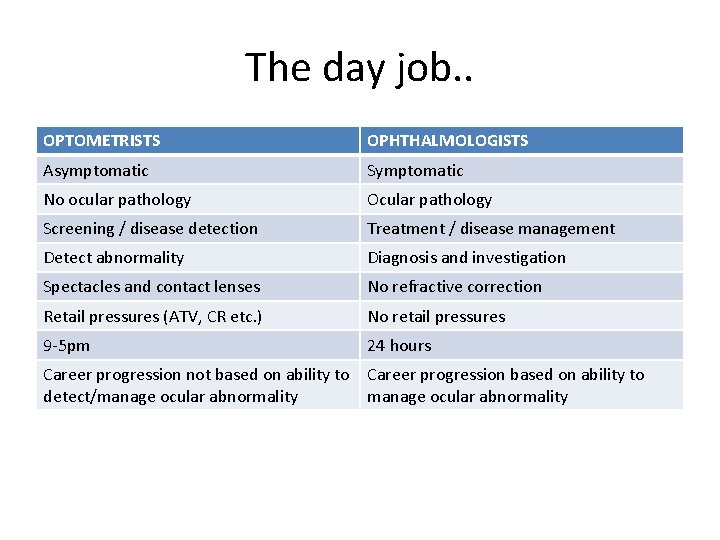
The day job. . OPTOMETRISTS OPHTHALMOLOGISTS Asymptomatic Symptomatic No ocular pathology Ocular pathology Screening / disease detection Treatment / disease management Detect abnormality Diagnosis and investigation Spectacles and contact lenses No refractive correction Retail pressures (ATV, CR etc. ) No retail pressures 9 -5 pm 24 hours Career progression not based on ability to Career progression based on ability to detect/manage ocular abnormality
What? Why? and How ? to refer CHANGING TIMES
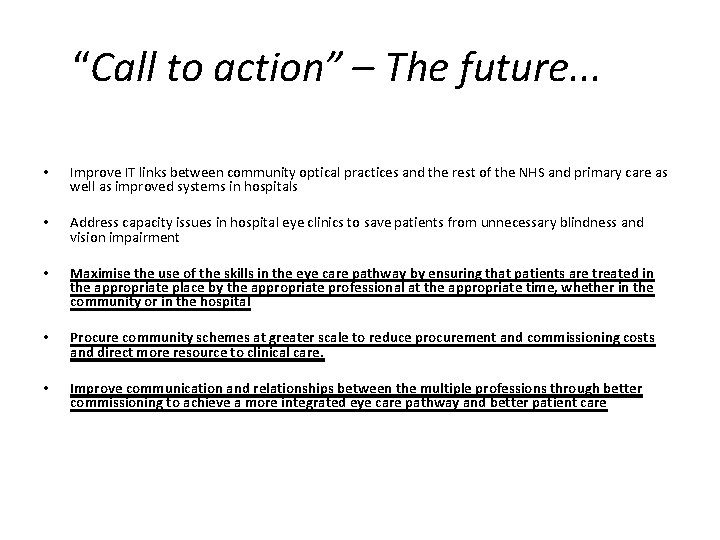
“Call to action” – The future. . . • Improve IT links between community optical practices and the rest of the NHS and primary care as well as improved systems in hospitals • Address capacity issues in hospital eye clinics to save patients from unnecessary blindness and vision impairment • Maximise the use of the skills in the eye care pathway by ensuring that patients are treated in the appropriate place by the appropriate professional at the appropriate time, whether in the community or in the hospital • Procure community schemes at greater scale to reduce procurement and commissioning costs and direct more resource to clinical care. • Improve communication and relationships between the multiple professions through better commissioning to achieve a more integrated eye care pathway and better patient care
What? , Why? , and How to refer ARE WE READY FOR THE CHANGE?
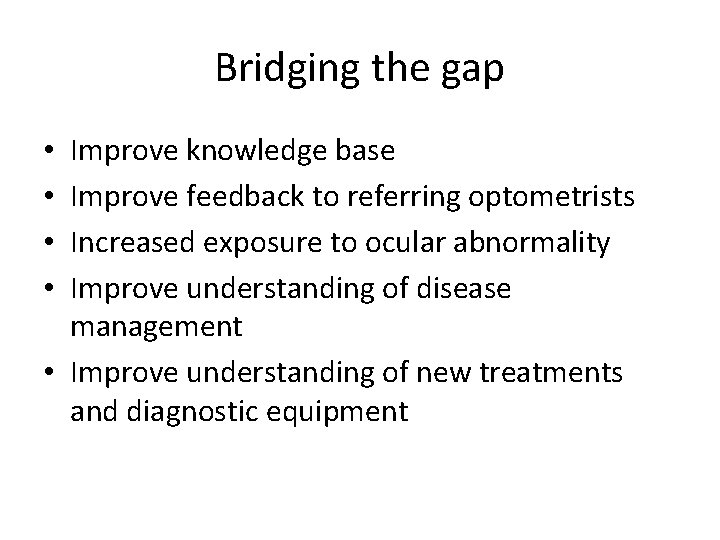
Bridging the gap Improve knowledge base Improve feedback to referring optometrists Increased exposure to ocular abnormality Improve understanding of disease management • Improve understanding of new treatments and diagnostic equipment • •
Common problems • • Raised IOP Flashes and floaters Retinal haemorrhages Red eye
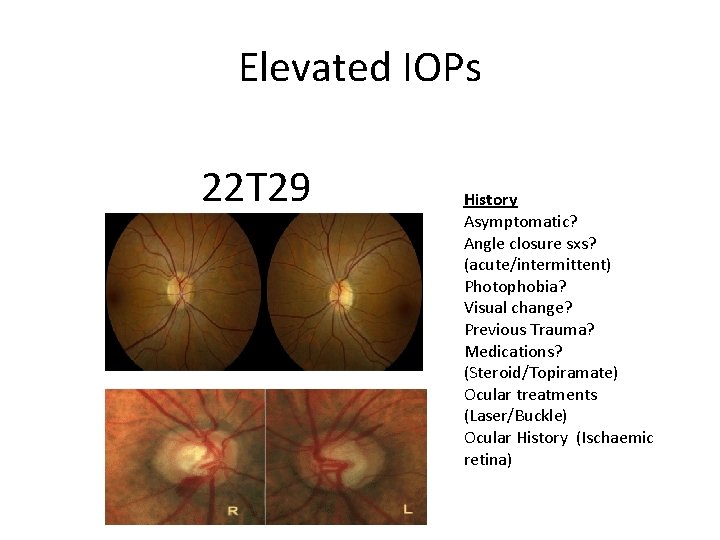
Elevated IOPs 22 T 29 History Asymptomatic? Angle closure sxs? (acute/intermittent) Photophobia? Visual change? Previous Trauma? Medications? (Steroid/Topiramate) Ocular treatments (Laser/Buckle) Ocular History (Ischaemic retina)
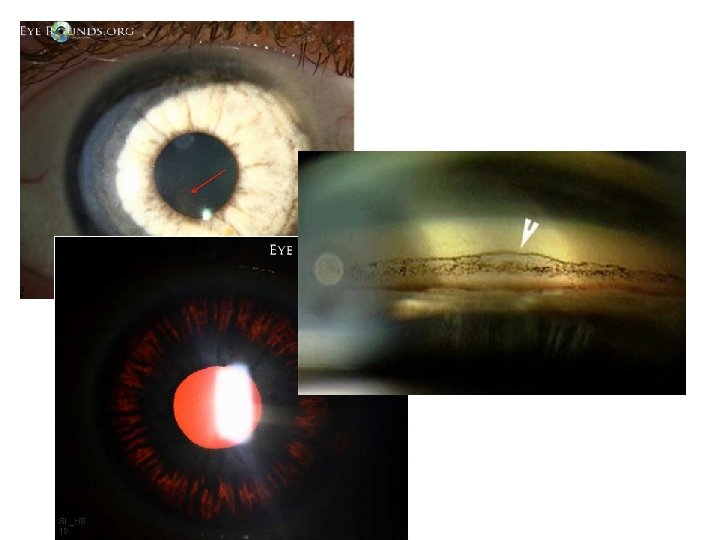
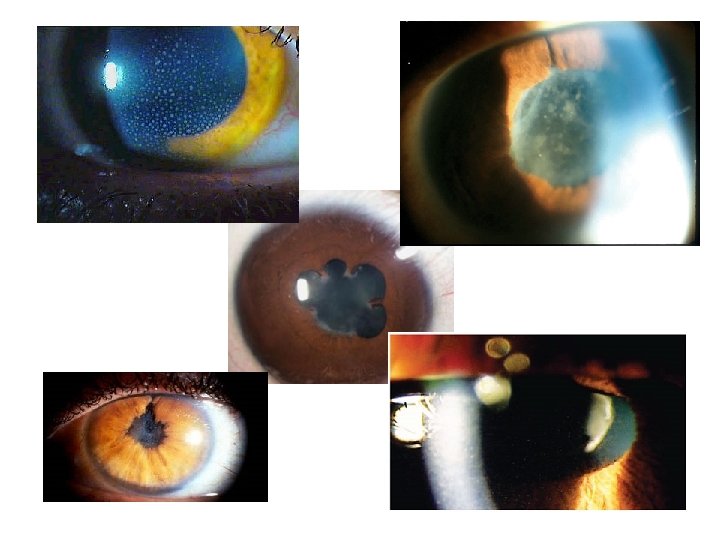
Pressure. . • History – Symptomatic vs Asymptomatic • Anterior Segment signs – Red eye – KS, KPs and corneal pathology – AC activity and depth – Iris atrophy / TIDs / NVI – Significant cataract
Pressure. . • Gonioscopy • www. gonioscopy. org • Redmond-Smith Index • Van Herrick
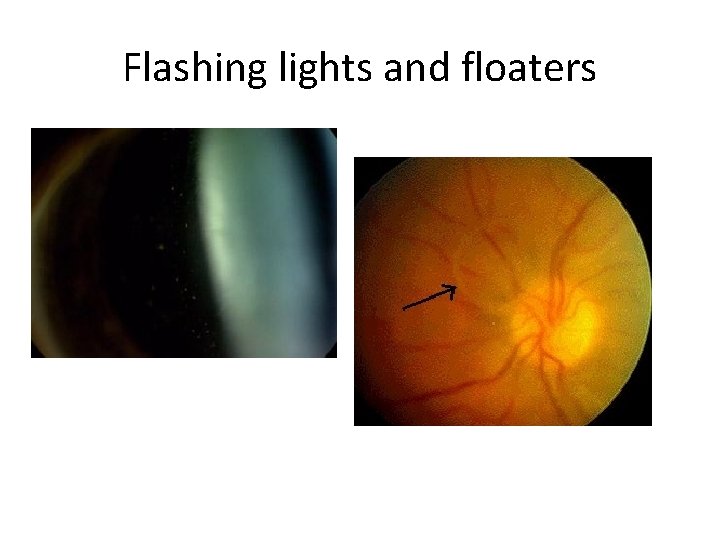
Flashing lights and floaters
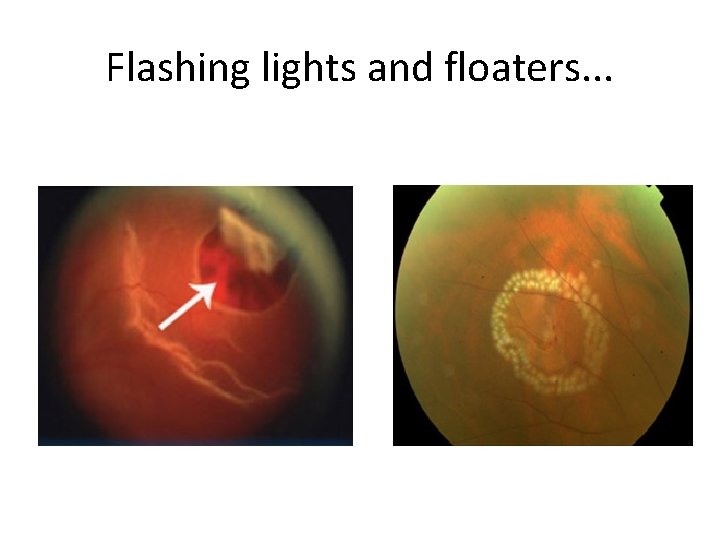
Flashing lights and floaters. . .
Flashing lights and floaters. . . • History – Myopia – Family history – Visual field defect – Fellow eye status • Age – 6% under 50, 53% over 50, 67% over 65
Examination • • IOP AC activity Vitreous – tobacco dust? , RBC? , vitritis? Fundus – Weiss ring – Vitreous or pre-retinal hge – Peripheral retina • Tear/break +/- SRF • Peripheral degeneration - Lattice
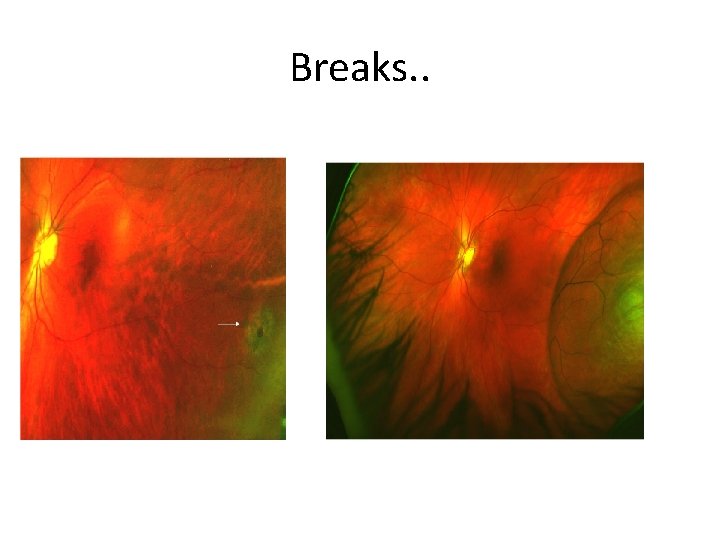
Breaks. .
Retinal Haemorrhage • Anatomy – Inner 2/3 - CRA – Outer 1/3 - Choroidal circulation – CRA divides into superior and inferior branches which each divide into nasal and temporal branches – Functionally these are end-arteries – Central foveal avascular zone contains outer retinal layers only. Blood supply to this area is derived from the underlying choroidal circulation. – Post arteriole retinal capillaries - NFL – Pre-venular capillaries - INL
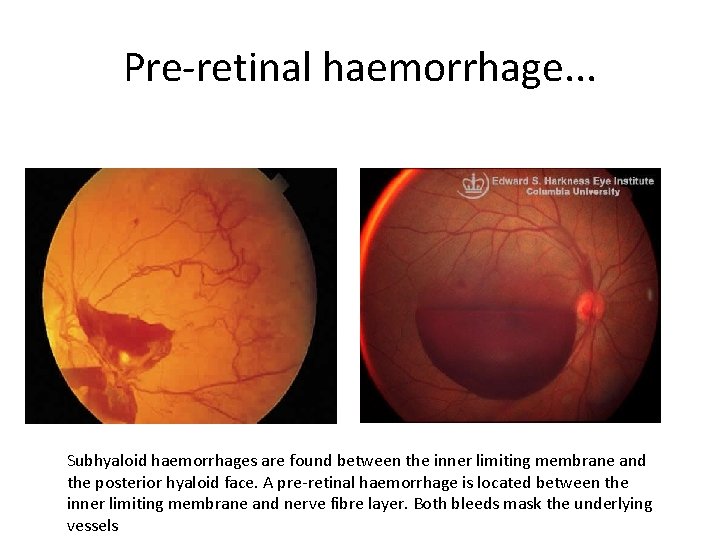
Pre-retinal haemorrhage. . . Subhyaloid haemorrhages are found between the inner limiting membrane and the posterior hyaloid face. A pre-retinal haemorrhage is located between the inner limiting membrane and nerve fibre layer. Both bleeds mask the underlying vessels
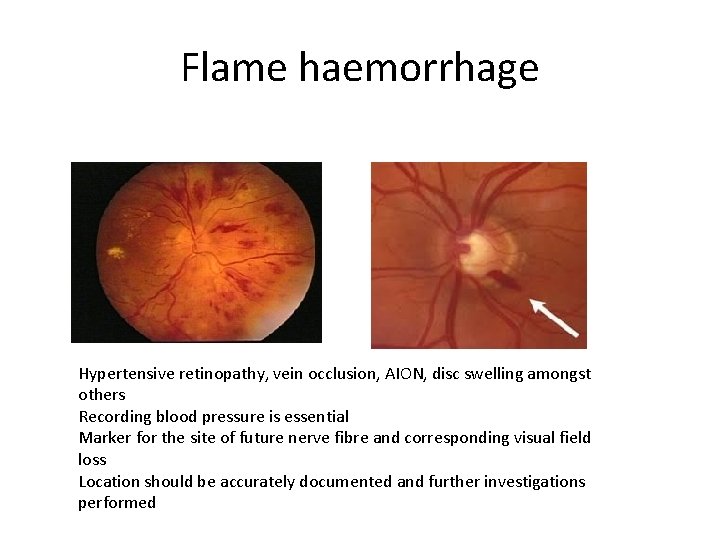
Flame haemorrhage Hypertensive retinopathy, vein occlusion, AION, disc swelling amongst others Recording blood pressure is essential Marker for the site of future nerve fibre and corresponding visual field loss Location should be accurately documented and further investigations performed
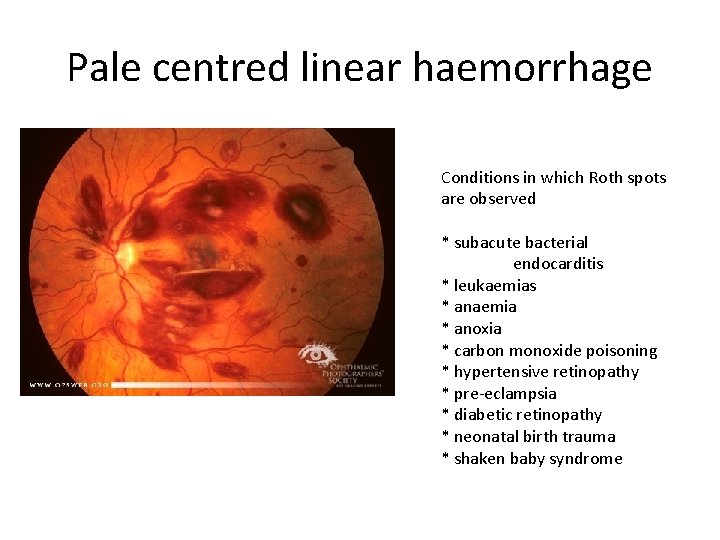
Pale centred linear haemorrhage Conditions in which Roth spots are observed * subacute bacterial endocarditis * leukaemias * anaemia * anoxia * carbon monoxide poisoning * hypertensive retinopathy * pre-eclampsia * diabetic retinopathy * neonatal birth trauma * shaken baby syndrome
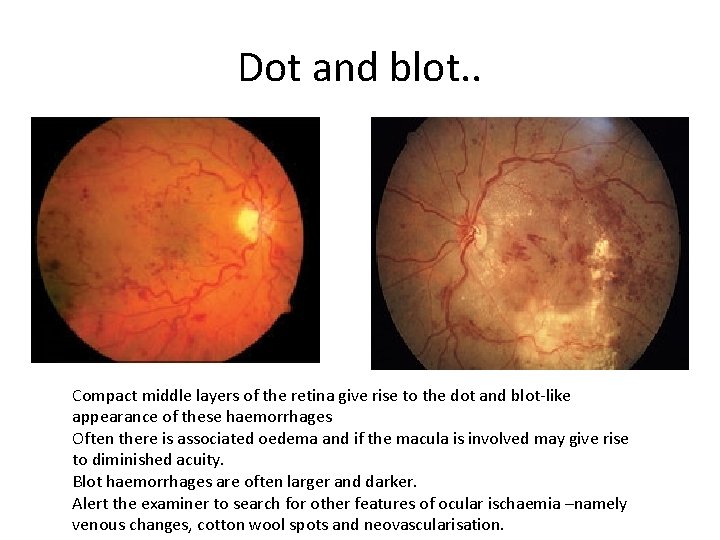
Dot and blot. . Compact middle layers of the retina give rise to the dot and blot-like appearance of these haemorrhages Often there is associated oedema and if the macula is involved may give rise to diminished acuity. Blot haemorrhages are often larger and darker. Alert the examiner to search for other features of ocular ischaemia –namely venous changes, cotton wool spots and neovascularisation.
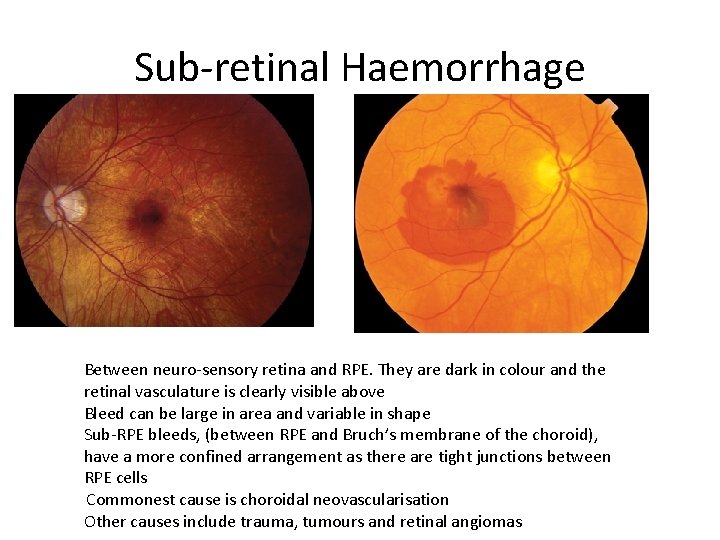
Sub-retinal Haemorrhage Between neuro-sensory retina and RPE. They are dark in colour and the retinal vasculature is clearly visible above Bleed can be large in area and variable in shape Sub-RPE bleeds, (between RPE and Bruch’s membrane of the choroid), have a more confined arrangement as there are tight junctions between RPE cells Commonest cause is choroidal neovascularisation Other causes include trauma, tumours and retinal angiomas
Red eye • History – Pain • FB sensation/ache/ deep pain – Photophobia – V/A – Lacrimation / discharge – Associated symptoms • Nausea and vomiting/ frontal headache – C/L wear
Examination • Pattern of redness – Diffuse and superficial – Diffuse and deep – Circum-corneal – Sectoral • Reduced vision • Pupils • Na. Fl
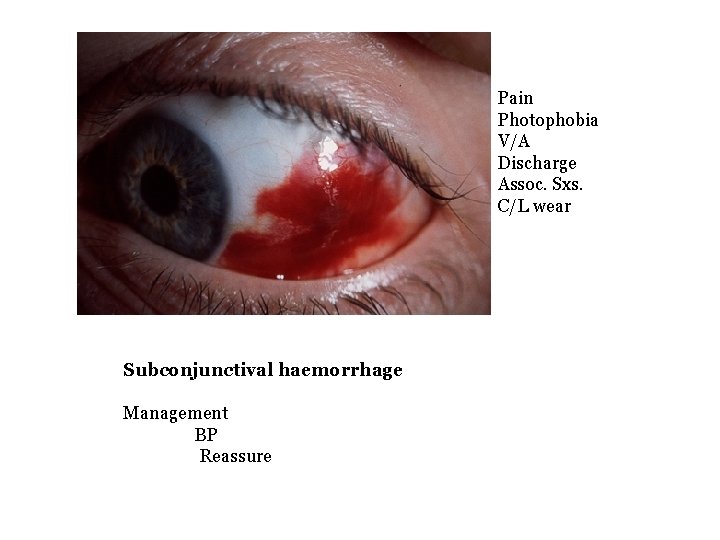
Pain Photophobia V/A Discharge Assoc. Sxs. C/L wear Subconjunctival haemorrhage Management BP Reassure
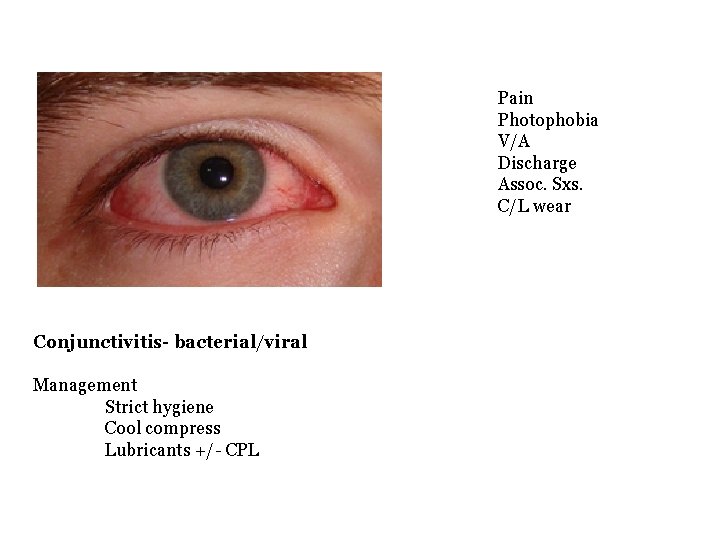
Pain Photophobia V/A Discharge Assoc. Sxs. C/L wear Conjunctivitis- bacterial/viral Management Strict hygiene Cool compress Lubricants +/- CPL
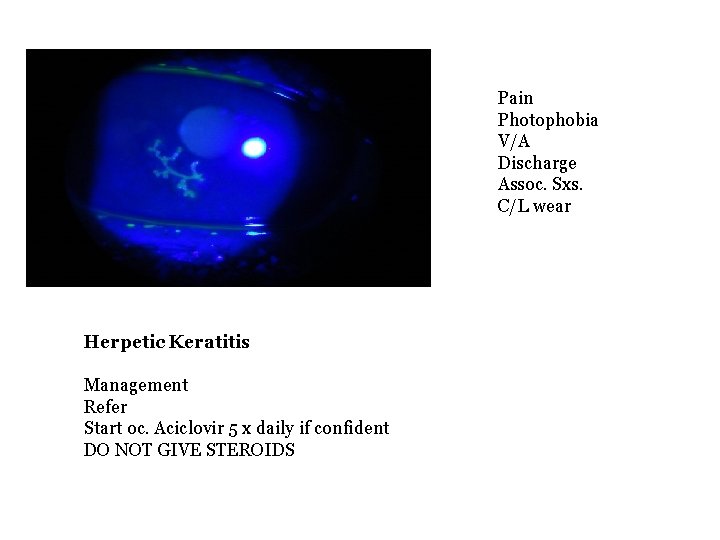
Pain Photophobia V/A Discharge Assoc. Sxs. C/L wear Herpetic Keratitis Management Refer Start oc. Aciclovir 5 x daily if confident DO NOT GIVE STEROIDS
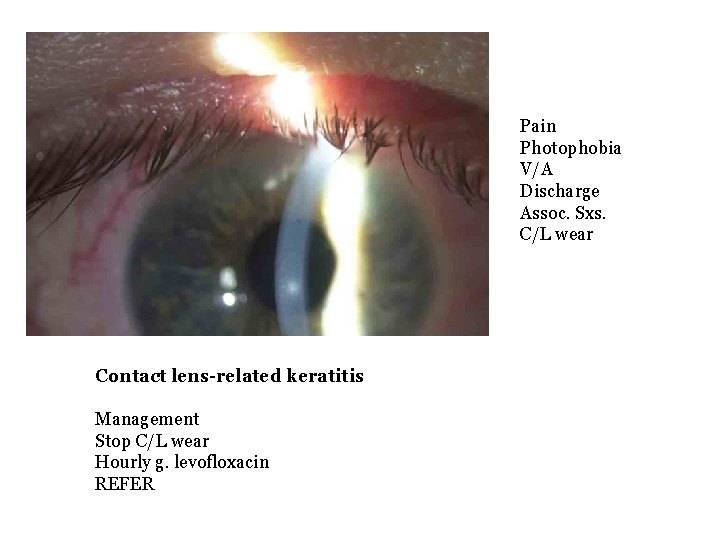
Pain Photophobia V/A Discharge Assoc. Sxs. C/L wear Contact lens-related keratitis Management Stop C/L wear Hourly g. levofloxacin REFER
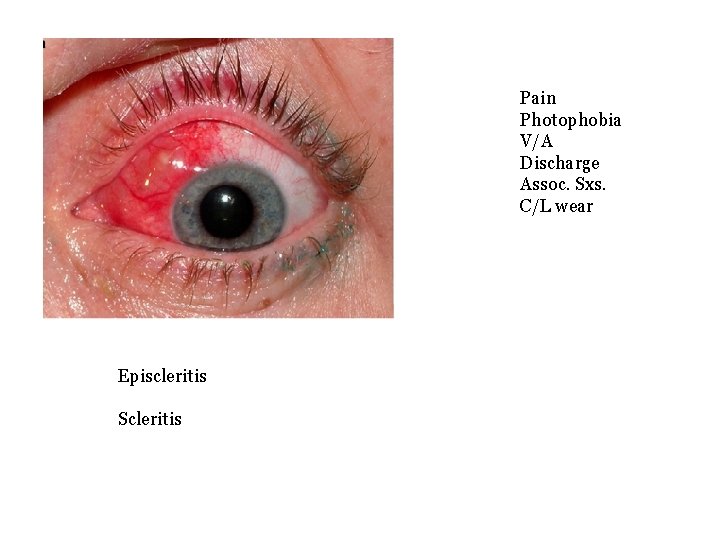
Pain Photophobia V/A Discharge Assoc. Sxs. C/L wear Episcleritis Scleritis
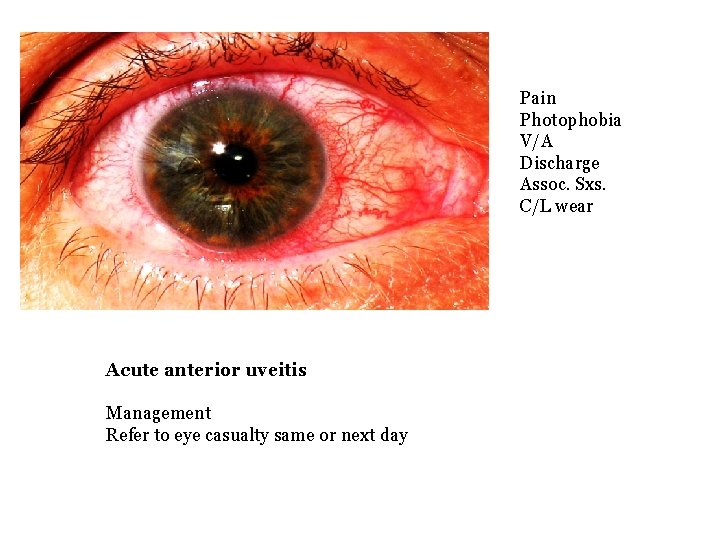
Pain Photophobia V/A Discharge Assoc. Sxs. C/L wear Acute anterior uveitis Management Refer to eye casualty same or next day
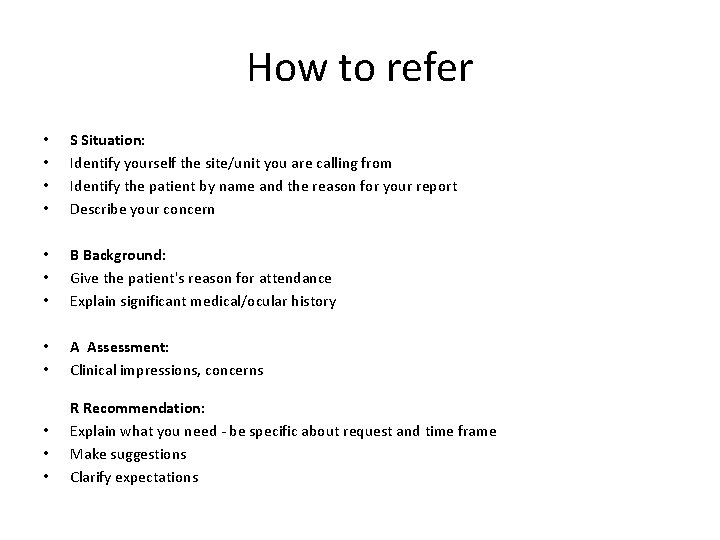
How to refer • • S Situation: Identify yourself the site/unit you are calling from Identify the patient by name and the reason for your report Describe your concern • • • B Background: Give the patient's reason for attendance Explain significant medical/ocular history • • A Assessment: Clinical impressions, concerns • • • R Recommendation: Explain what you need - be specific about request and time frame Make suggestions Clarify expectations
What? , why? and how to refer THANK YOU QUESTIONS?