
What were they like Denise Levertov The poem
- Slides: 7
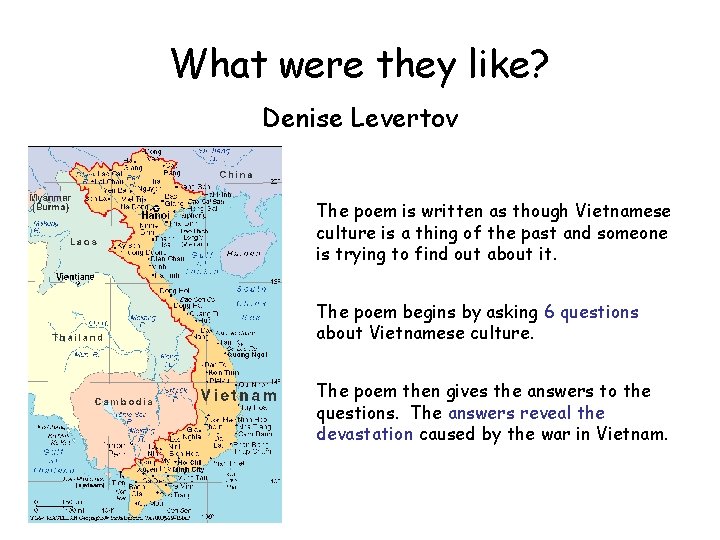
What were they like? Denise Levertov The poem is written as though Vietnamese culture is a thing of the past and someone is trying to find out about it. The poem begins by asking 6 questions about Vietnamese culture. The poem then gives the answers to the questions. The answers reveal the devastation caused by the war in Vietnam.
1) Did the people of Viet Nam use lanterns of stone? 2) Did they hold ceremonies to reverence the opening of buds? 3) Were they inclined to quiet laughter? 4) Did they use bone and ivory, jade and silver, for ornament? 5) Had they an epic poem? 6) Did they distinguish between speech and singing? The poem starts by asking six questions about Vietnamese culture. The questions are in the past tense which suggests that the Vietnamese way of life has changed. The questions are about the Vietnamese way of life, their culture, their behaviour and their language.
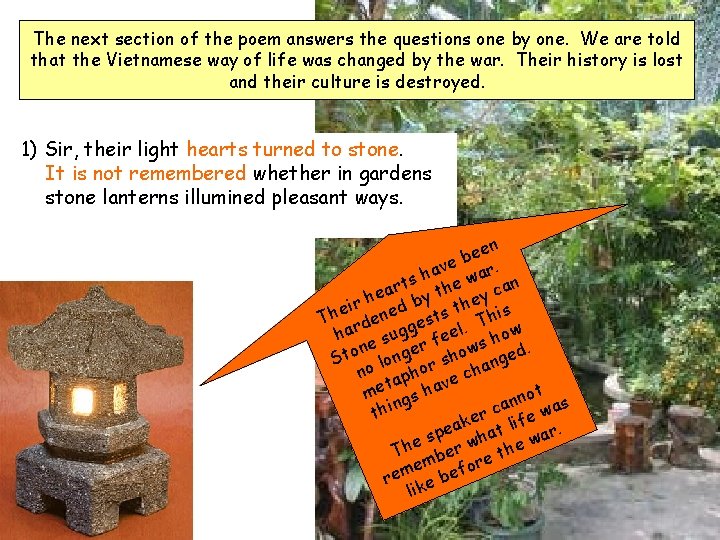
The next section of the poem answers the questions one by one. We are told that the Vietnamese way of life was changed by the war. Their history is lost and their culture is destroyed. 1) Sir, their light hearts turned to stone. It is not remembered whether in gardens stone lanterns illumined pleasant ways. een b ave war. h ts the r an a c e y ir h ed by s the is e h T rden st. Th e g ow ha ug feel s h s e. n w er Sto o long r sho anged n ho e ch p a v t me gs ha ot n n n a c e was thi r ake at lif r. e p s h wa e w e h r T be re th m e o rem e bef lik
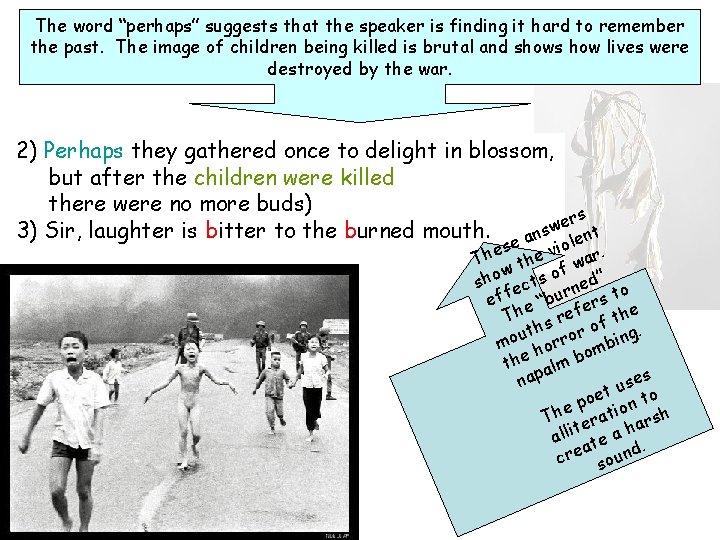
The word “perhaps” suggests that the speaker is finding it hard to remember the past. The image of children being killed is brutal and shows how lives were destroyed by the war. 2) Perhaps they gathered once to delight in blossom, but after the children were killed there were no more buds) rs e w 3) Sir, laughter is bitter to the burned mouth. ans lent se io r. v e h e T th f wa w sho ects o ned” o eff e “bur ers t Th s ref f the uth rror o ing. o m ho mb o e b th alm nap ses u oet n to p o The erati arsh t alli te a h. a cre sound
Their old life is like a dream. Maybe it doesn’t feel real. 4) A dream ago, perhaps. Ornament is for joy. All the bones were charred. The charred bones could refer to the burnt bodies from the bombings. The war and its destruction is shown again here.
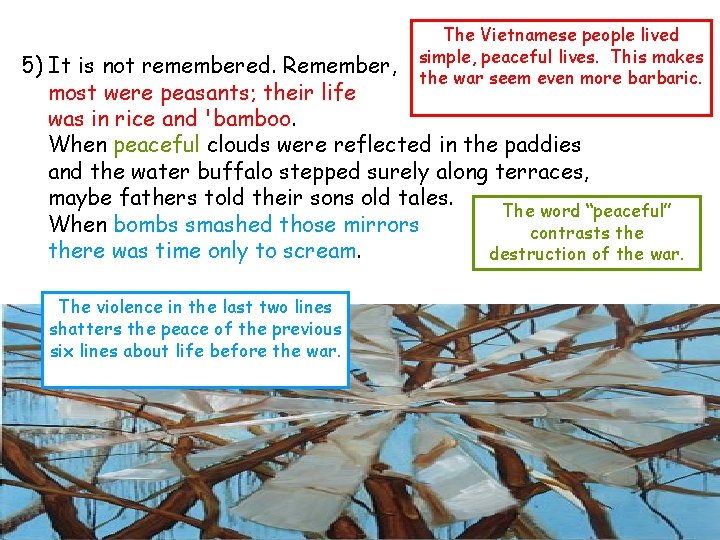
The Vietnamese people lived simple, peaceful lives. This makes the war seem even more barbaric. 5) It is not remembered. Remember, most were peasants; their life was in rice and 'bamboo. When peaceful clouds were reflected in the paddies and the water buffalo stepped surely along terraces, maybe fathers told their sons old tales. The word “peaceful” When bombs smashed those mirrors contrasts there was time only to scream. destruction of the war. The violence in the last two lines shatters the peace of the previous six lines about life before the war.
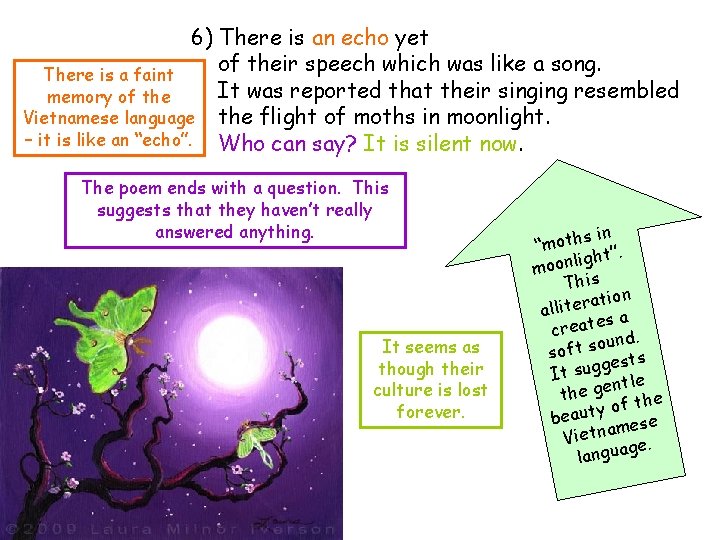
6) There is an echo yet of their speech which was like a song. There is a faint It was reported that their singing resembled memory of the Vietnamese language the flight of moths in moonlight. – it is like an “echo”. Who can say? It is silent now. The poem ends with a question. This suggests that they haven’t really answered anything. It seems as though their culture is lost forever. s in “moth t”. igh moonl This ation r e t i l l a sa e t a e r c und. o s t f so gests g u s t I ntle e g e h t f the o y t u bea mese a n t e i V ge. langua