
What We Will Talk About Health Risks Why
What We Will Talk About Health Risks Why It’s So Hard to Quit Potential Benefits From Quitting Preparing to Quit Staying Quit
What We Will Talk About Health Risks Why It’s So Hard to Quit Potential Benefits From Quitting Preparing to Quit Staying Quit
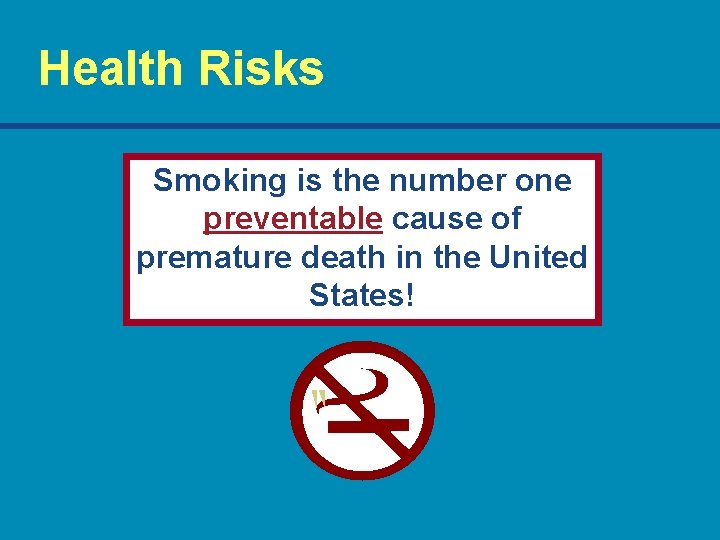
Health Risks Smoking is the number one preventable cause of premature death in the United States!
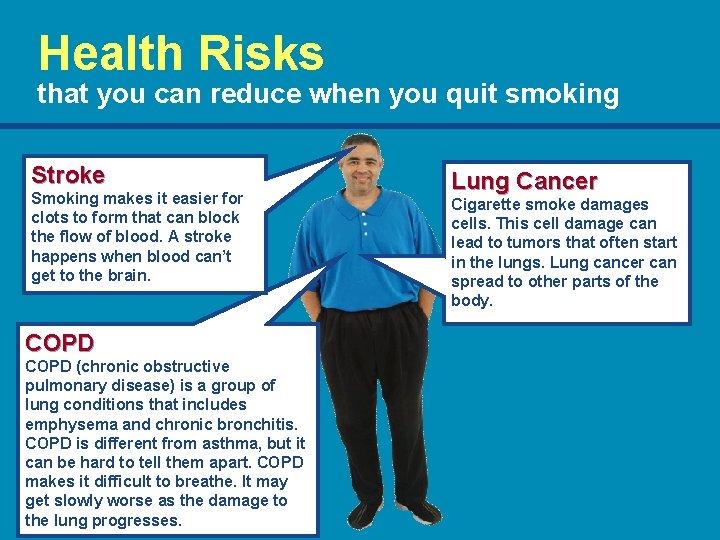
Health Risks that you can reduce when you quit smoking Stroke Smoking makes it easier for clots to form that can block the flow of blood. A stroke happens when blood can’t get to the brain. COPD (chronic obstructive pulmonary disease) is a group of lung conditions that includes emphysema and chronic bronchitis. COPD is different from asthma, but it can be hard to tell them apart. COPD makes it difficult to breathe. It may get slowly worse as the damage to the lung progresses. Lung Cancer Cigarette smoke damages cells. This cell damage can lead to tumors that often start in the lungs. Lung cancer can spread to other parts of the body.
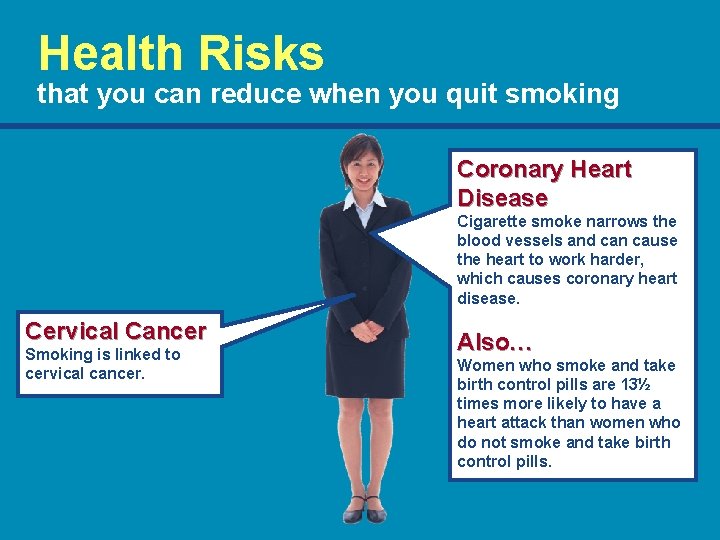
Health Risks that you can reduce when you quit smoking Coronary Heart Disease Cigarette smoke narrows the blood vessels and can cause the heart to work harder, which causes coronary heart disease. Cervical Cancer Smoking is linked to cervical cancer. Also… Women who smoke and take birth control pills are 13½ times more likely to have a heart attack than women who do not smoke and take birth control pills.
Besides Health Risks… As of 2006, at least…. • 46 states have laws restricting smoking in public places • 31 states have laws restricting smoking in private work places • 48 states have laws restricting smoking in government buildings
What We Will Talk About Health Risks Why It’s So Hard to Quit Potential Benefits From Quitting Preparing to Quit Staying Quit
Why It’s So Hard to Quit For many people, smoking is 2 things at the same time: • Craving – having a very strong want or need for a cigarette (and feeling unsettled when you don’t have one) • Habit – doing things the same way over and over when you smoke
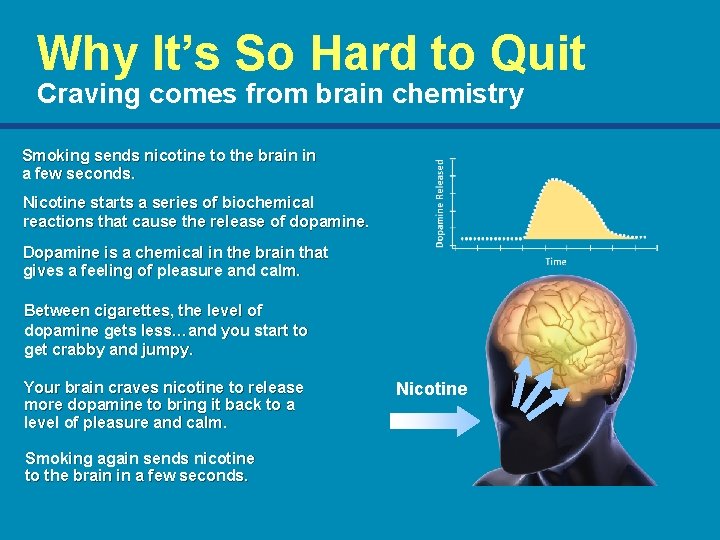
Why It’s So Hard to Quit Craving comes from brain chemistry Smoking sends nicotine to the brain in a few seconds. Nicotine starts a series of biochemical reactions that cause the release of dopamine. Dopamine is a chemical in the brain that gives a feeling of pleasure and calm. Between cigarettes, the level of dopamine gets less…and you start to get crabby and jumpy. Your brain craves nicotine to release more dopamine to bring it back to a level of pleasure and calm. Smoking again sends nicotine to the brain in a few seconds. Nicotine
Why It’s So Hard to Quit Effects of nicotine from cigarette smoking • Nicotine has the potential to be addictive • Has a stimulating and calming effect at the same time • Depresses appetite, which may interfere with good nutrition
Why It’s So Hard to Quit Withdrawal effects You might feel bad at first when you stop smoking: • Constipation • Coughing or sore throat • Cravings • Disturbed sleep • Headaches • Dizziness or tingling • Hunger • Crabby or short-tempered These effects can lessen over time as your body adjusts to the lack of nicotine.
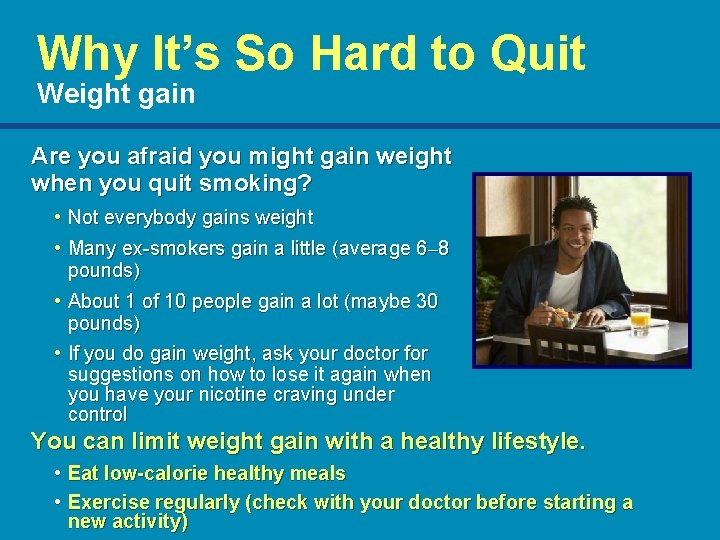
Why It’s So Hard to Quit Weight gain Are you afraid you might gain weight when you quit smoking? • Not everybody gains weight • Many ex-smokers gain a little (average 6– 8 pounds) • About 1 of 10 people gain a lot (maybe 30 pounds) • If you do gain weight, ask your doctor for suggestions on how to lose it again when you have your nicotine craving under control You can limit weight gain with a healthy lifestyle. • Eat low-calorie healthy meals • Exercise regularly (check with your doctor before starting a new activity)
Why It’s So Hard to Quit Most habits are hard to break “Every time I make a phone call, I have a smoke. ” “I smoke with my coffee in the morning. ” “I smoke when I’m waiting at the bus stop. ” “I don’t know what to do with my hands if I’m not holding a cigarette. ” Most habits can trigger a desire for a smoke.
What We Will Talk About Health Risks Why It’s So Hard to Quit Potential Benefits From Quitting Preparing to Quit Staying Quit
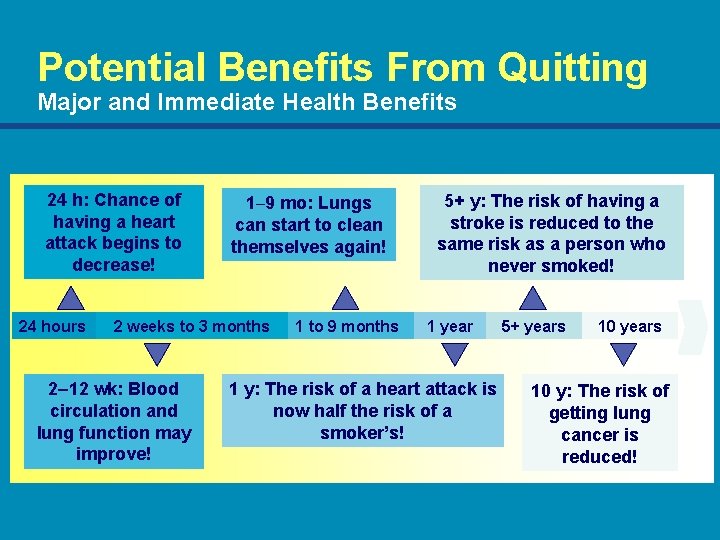
Potential Benefits From Quitting Major and Immediate Health Benefits 24 h: Chance of having a heart attack begins to decrease! 24 hours 1– 9 mo: Lungs can start to clean themselves again! 2 weeks to 3 months 2– 12 wk: Blood circulation and lung function may improve! 1 to 9 months 5+ y: The risk of having a stroke is reduced to the same risk as a person who never smoked! 1 year 1 y: The risk of a heart attack is now half the risk of a smoker’s! 5+ years 10 y: The risk of getting lung cancer is reduced!
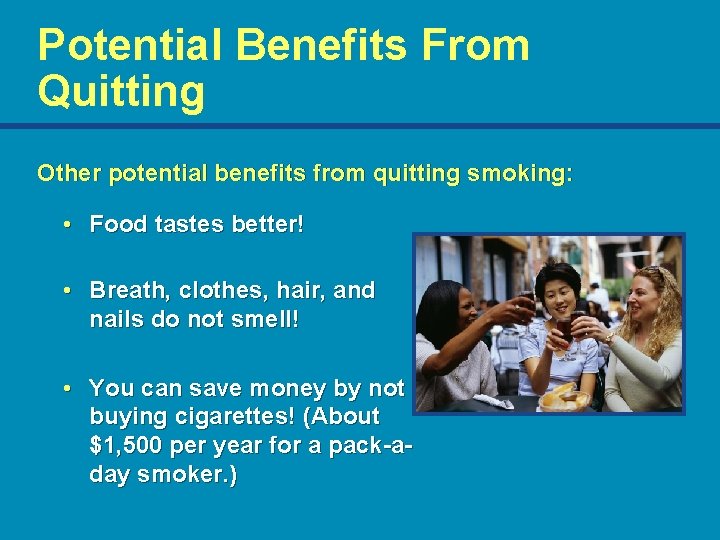
Potential Benefits From Quitting Other potential benefits from quitting smoking: • Food tastes better! • Breath, clothes, hair, and nails do not smell! • You can save money by not buying cigarettes! (About $1, 500 per year for a pack-aday smoker. )
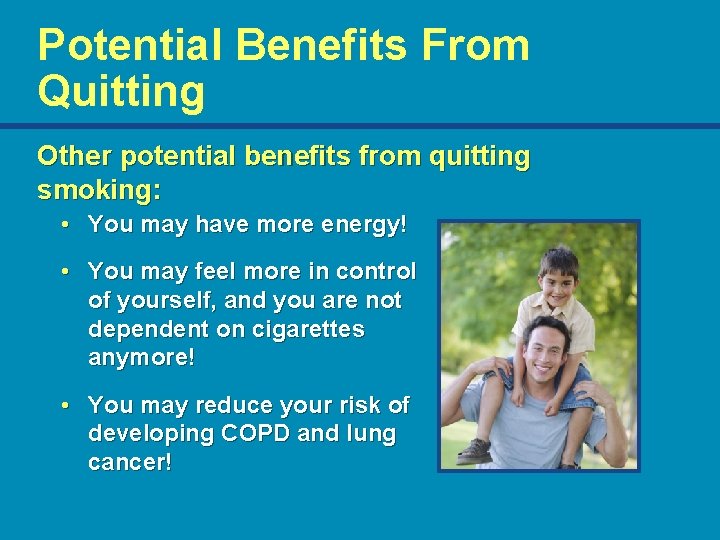
Potential Benefits From Quitting Other potential benefits from quitting smoking: • You may have more energy! • You may feel more in control of yourself, and you are not dependent on cigarettes anymore! • You may reduce your risk of developing COPD and lung cancer!
What We Will Talk About Health Risks Why It’s So Hard to Quit Potential Benefits From Quitting Preparing to Quit Staying Quit
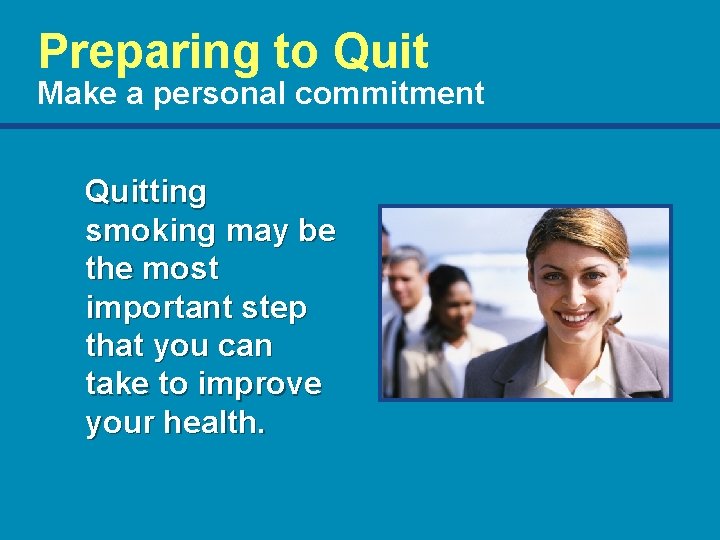
Preparing to Quit Make a personal commitment Quitting smoking may be the most important step that you can take to improve your health.
Preparing to Quit Mind and body You may have the best chance of quitting if you prepare your mind and body to quit. • Think about why you want to quit • Find out how your doctor can help you overcome nicotine cravings when you quit smoking • Figure out what changes you can make in your own habits to help you avoid smoking
Preparing to Quit Reasons to quit Make a list of some reasons to quit smoking. “I want to stay healthy for my family. ” “I want to reduce my risk of getting cancer. ” “I want to set a good example for my children. ” “I want to be in control of my life again. ” What other reasons can you think of?
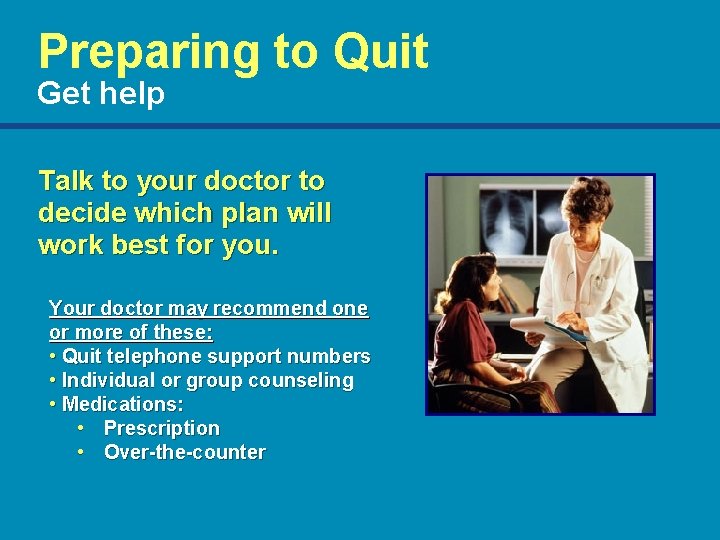
Preparing to Quit Get help Talk to your doctor to decide which plan will work best for you. Your doctor may recommend one or more of these: • Quit telephone support numbers • Individual or group counseling • Medications: • Prescription • Over-the-counter
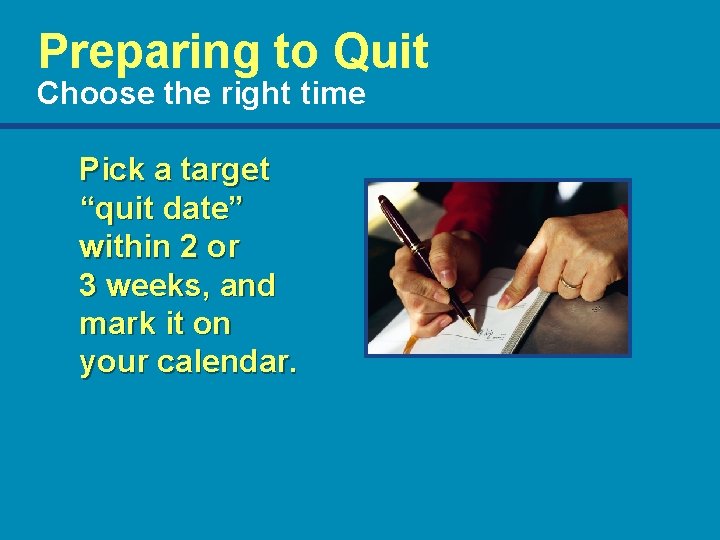
Preparing to Quit Choose the right time Pick a target “quit date” within 2 or 3 weeks, and mark it on your calendar.
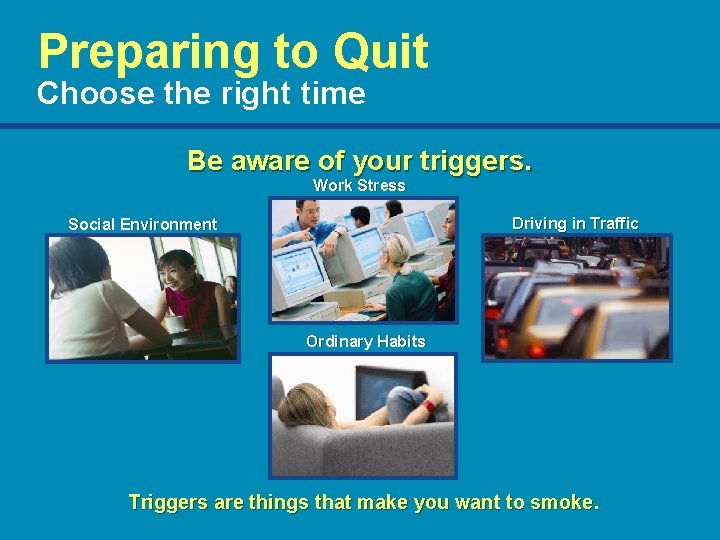
Preparing to Quit Choose the right time Be aware of your triggers. Work Stress Driving in Traffic Social Environment Ordinary Habits Triggers are things that make you want to smoke.
Preparing to Quit State your intention • Tell your friends and family about your quit date • Ask them to understand that you need to change your habits • Ask them to be understanding if you are not your best after quitting, or if you slip • Quitting is a journey, not an event
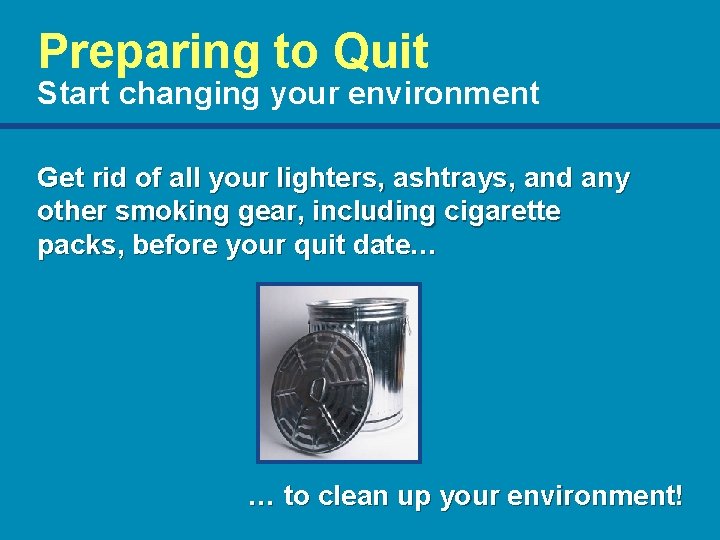
Preparing to Quit Start changing your environment Get rid of all your lighters, ashtrays, and any other smoking gear, including cigarette packs, before your quit date… … to clean up your environment!
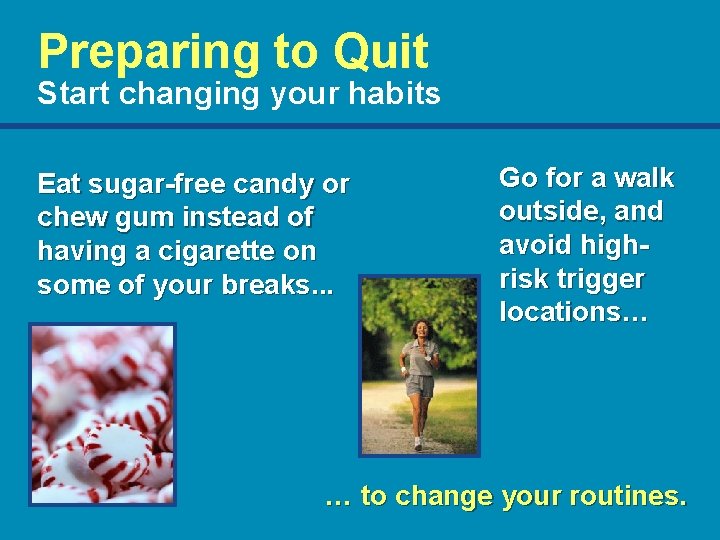
Preparing to Quit Start changing your habits Eat sugar-free candy or chew gum instead of having a cigarette on some of your breaks. . . Go for a walk outside, and avoid highrisk trigger locations… … to change your routines.
What We Will Talk About Health Risks Why It’s So Hard to Quit Potential Benefits From Quitting Preparing to Quit Staying Quit
Quitting smoking is not easy, but it can be done.
Quit This is the day you have prepared for.
Quit ü Throw out your cigarettes the night before – get them out of the house and truly gone ü Be sure to follow your doctor’s treatment advice ü Practice the changes in your routine: drink water, chew gum, eat sugar-free candy, exercise, go to nonsmoking areas – do anything to avoid the smell and routine of smoking ü Just get through each moment of craving
What We Will Talk About Health Risks Why It’s So Hard to Quit Potential Benefits From Quitting Preparing to Quit Staying Quit
Staying Quit Maintenance, or “staying quit, ” may be your final and most important step to a healthier lifestyle.
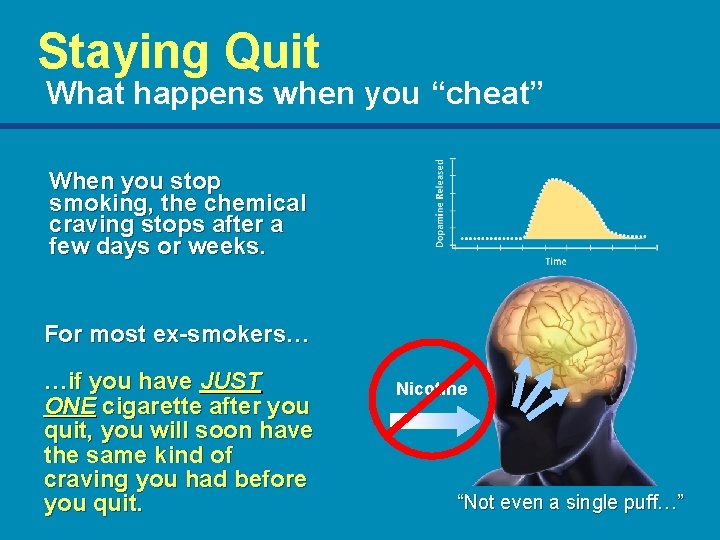
Staying Quit What happens when you “cheat” When you stop smoking, the chemical craving stops after a few days or weeks. For most ex-smokers… …if you have JUST ONE cigarette after you quit, you will soon have the same kind of craving you had before you quit. Nicotine “Not even a single puff…”
Staying Quit If you have a craving, try to: • Drink plenty of water • Eat a light snack or chew gum • Exercise or do hobbies (check with your doctor before starting a new activity) • Breathe deeply and hold for 5 seconds • Refer to your list of reasons to quit
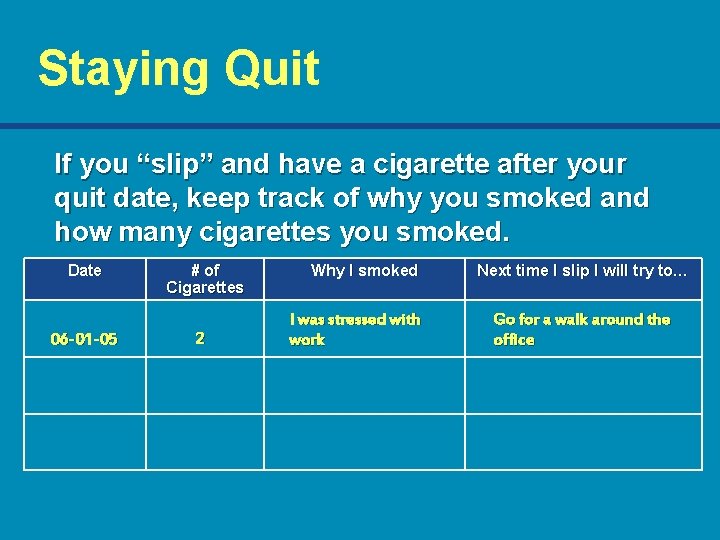
Staying Quit If you “slip” and have a cigarette after your quit date, keep track of why you smoked and how many cigarettes you smoked. Date 06 -01 -05 # of Cigarettes 2 Why I smoked I was stressed with work Next time I slip I will try to… Go for a walk around the office
Staying Quit Don’t be discouraged. Quit again. These “slips” are situations to prepare for. If you can’t avoid them, then remember: • Drink plenty of water • Eat a light snack or chew gum • Exercise or do hobbies (check with your doctor before starting a new activity) • Breathe deeply and hold for 5 seconds • Refer to your list of reasons to quit …just like you did before.
Go Ahead and Quit A New Look at Why I Smoke and How to Quit is a tool to remind you what you learned today, and to help you keep track of your progress. Use it to get on the road to quitting! AWARENESS PREPARATION QUITTING MAINTENANCE
Questions and Answers
- Slides: 40