
What we need for the LHC Roger Barlow
What we need for the LHC Roger Barlow Terascale Physics Statistics School DESY, March 25 th 2010 March 25, 2010 Roger Barlow 1
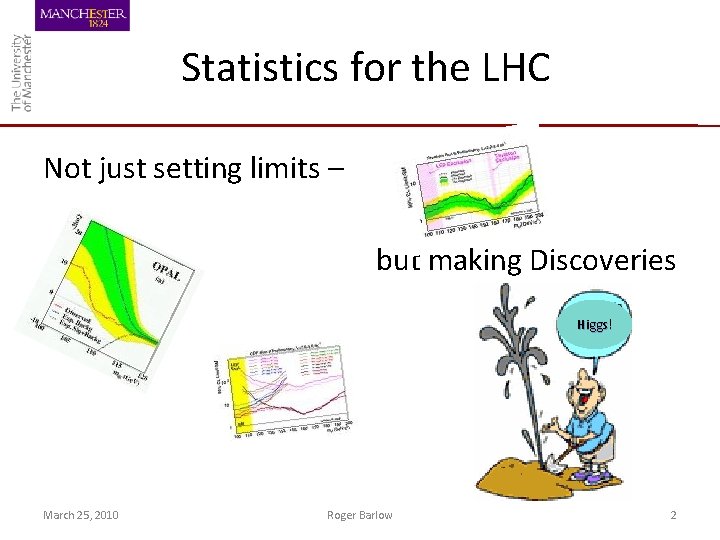
Statistics for the LHC Not just setting limits – but making Discoveries Higgs! March 25, 2010 Roger Barlow 2
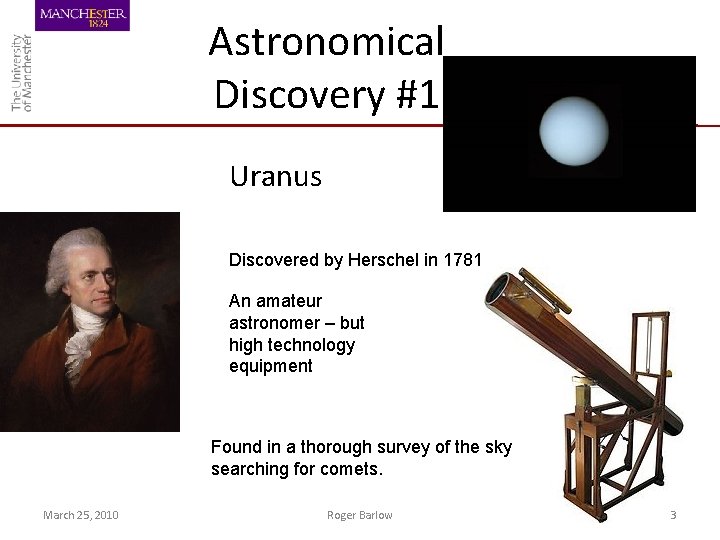
Astronomical Discovery #1 Uranus Discovered by Herschel in 1781 An amateur astronomer – but high technology equipment Found in a thorough survey of the sky searching for comets. March 25, 2010 Roger Barlow 3
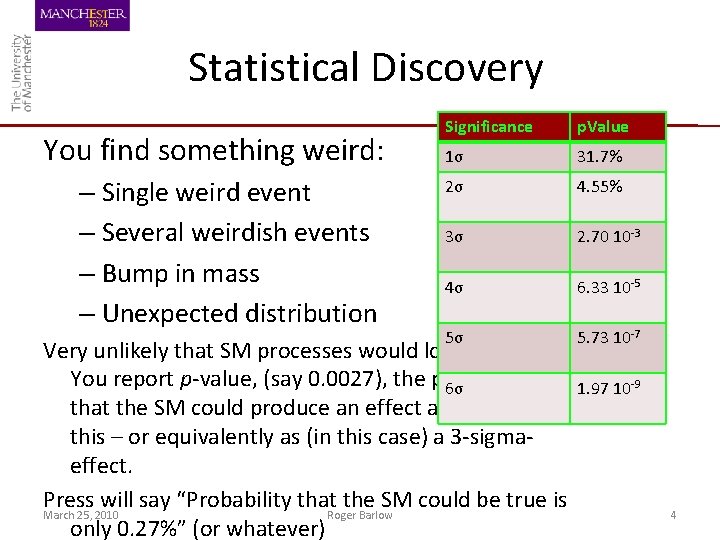
Statistical Discovery You find something weird: – Single weird event – Several weirdish events – Bump in mass – Unexpected distribution Significance p. Value 1σ 31. 7% 2σ 4. 55% 3σ 2. 70 10 -3 4σ 6. 33 10 -5 5σ 5. 73 10 -7 Very unlikely that SM processes would look like this. You report p-value, (say 0. 0027), the probability 6σ that the SM could produce an effect as weird as this – or equivalently as (in this case) a 3 -sigmaeffect. Press will say “Probability that. Roger the SM could be true is March 25, 2010 Barlow only 0. 27%” (or whatever) 1. 97 10 -9 4
w at BA YE or S k “Probability that the Standard Model is true” P(SM) – probability that the SM is effectively true for this energy/environment X = your favourite BSM theory. P(Data|SM) ~ p. Value. Presumably P(SM)≈1, P(Data|X)~1 P(X) is limited by 1 -P(SM) and there are many other BSM theories. If P(SM)=99. 9% then maybe P(X)=10 -4 and P(SM|Data)=27/28=96% To knock a hole in the Standard Model, need REALLY small p-value March 25, 2010 Roger Barlow 5
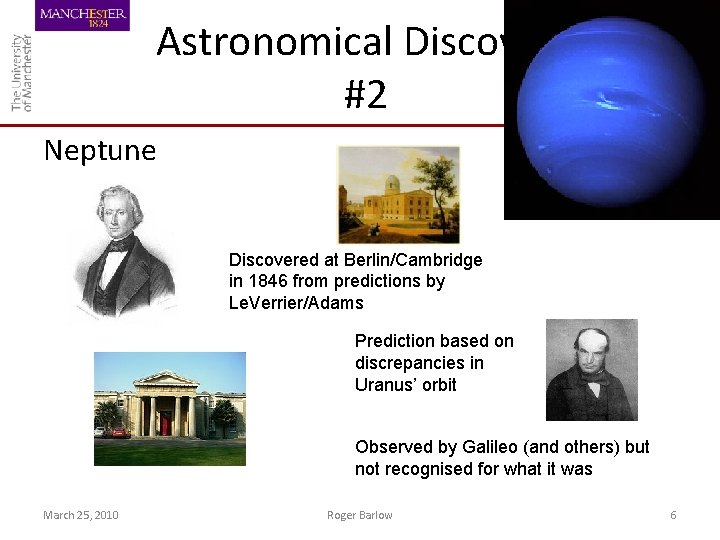
Astronomical Discovery #2 Neptune Discovered at Berlin/Cambridge in 1846 from predictions by Le. Verrier/Adams Prediction based on discrepancies in Uranus’ orbit Observed by Galileo (and others) but not recognised for what it was March 25, 2010 Roger Barlow 6
Evaluating the p Value Option 1: Simulate the SM processes using Monte Carlo and count how many times this measure-of-weirdness is exceeded. This is correct by construction (if you trust your MC). Not good for probing low-probability tails, unless you do something clever weighting events Option 2: For measure-of-weirdness use a statistic with well-established mathematical properties, e. g. χ2 distribution March 25, 2010 Roger Barlow 7
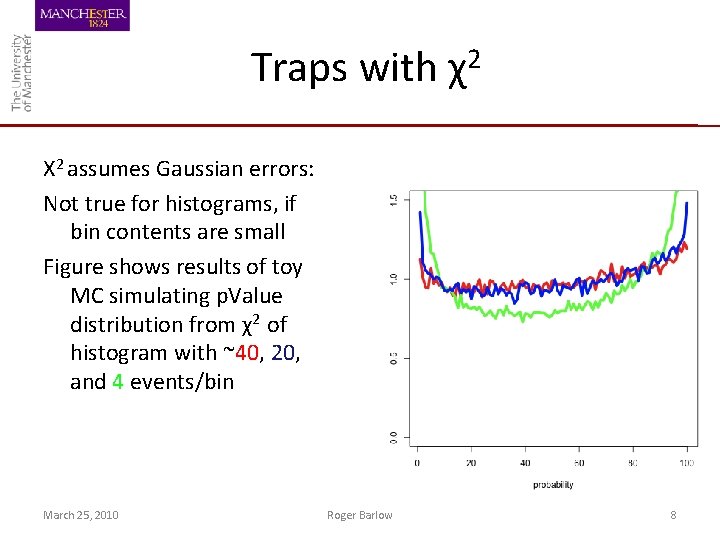
Traps with χ2 Χ 2 assumes Gaussian errors: Not true for histograms, if bin contents are small Figure shows results of toy MC simulating p. Value distribution from χ2 of histogram with ~40, 20, and 4 events/bin March 25, 2010 Roger Barlow 8
χ2 and fitting N data points, M fitted parameters, gives χ2 with distribution N-M ‘Degrees of freedom’ Strictly speaking – only true if fitting is linear, and errors do not depend on fitted parameters. Care! Difference of two χ2 distributions is χ2 If you add parameters the improvement in χ2 tells you whether they are giving a significantly better fit (through its p. Value) But … March 25, 2010 Roger Barlow 9
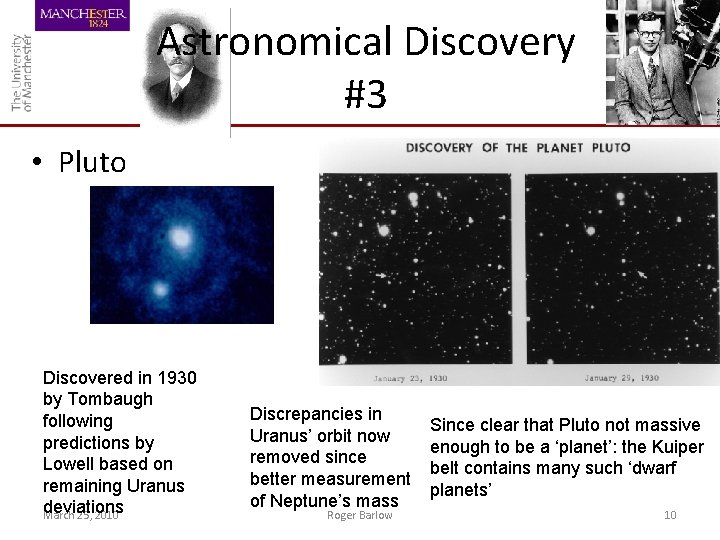
Astronomical Discovery #3 • Pluto Discovered in 1930 by Tombaugh following predictions by Lowell based on remaining Uranus deviations March 25, 2010 Discrepancies in Uranus’ orbit now removed since better measurement of Neptune’s mass Roger Barlow Since clear that Pluto not massive enough to be a ‘planet’: the Kuiper belt contains many such ‘dwarf planets’ 10
Statistics tools: another use for Maximum Likelihood Used for parameter estimation & errors. Not for goodness-of-fit Can be used for model comparison For two nested models P 0(x; a 1, a 2…an) and P 1(x; a 1, a 2…an+m) , twice the improvement in Ln L is given by a χ2 distribution with m-n degrees of freedom. • Hard to show, but reverse obvious as Prob α exp(-χ2/2) • Sometimes called Wilks’ Theorem • Sometime called Likelihood Ratio Test • Subject to legal small print, e. g. samples must be large… March 25, 2010 Roger Barlow 11
![Example Generate x in [-0. 5, 0. 5] according to uniform distribution. P(x)=1 Try](http://slidetodoc.com/presentation_image_h/111f6091a3df94286793ea95c0fe0fbf/image-12.jpg "Example Generate x in [-0. 5, 0. 5] according to uniform distribution. P(x)=1 Try")
Example Generate x in [-0. 5, 0. 5] according to uniform distribution. P(x)=1 Try P(x; a)=1+ax Find â using Max Likelihood and improvement in Likelihood and pvalue from Prob(2 Δ ln L; 1) Plot shows p-value distribution for 100 and for 10 x values March 25, 2010 Roger Barlow 12
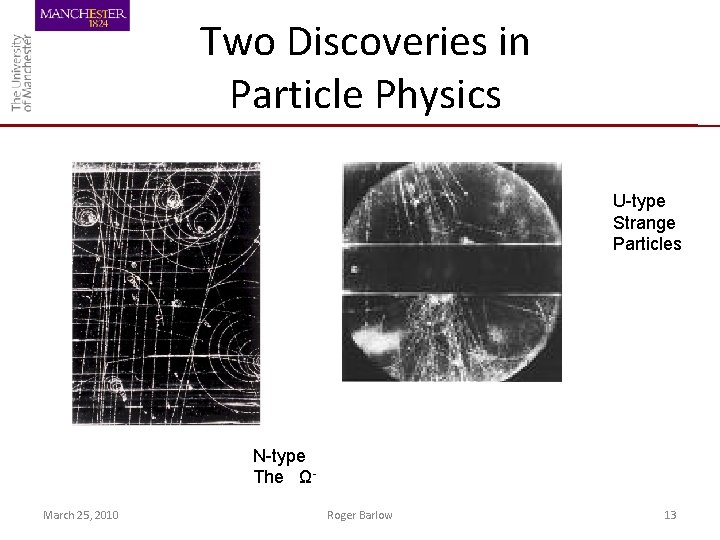
Two Discoveries in Particle Physics U-type Strange Particles N-type The ΩMarch 25, 2010 Roger Barlow 13
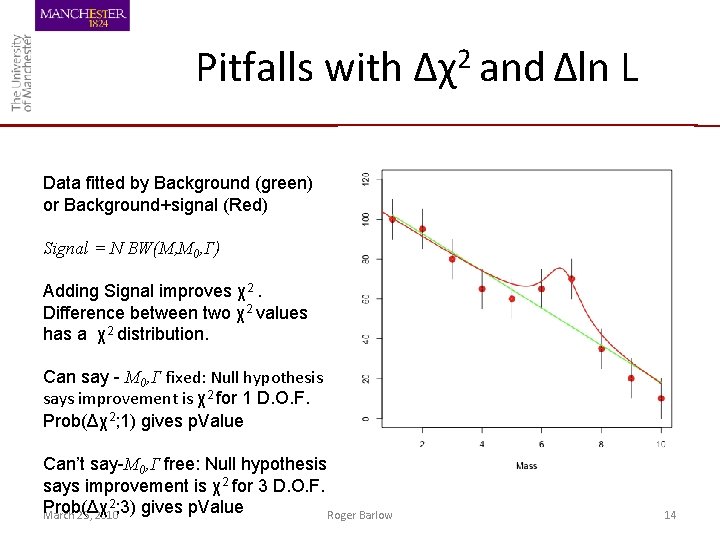
Pitfalls with Δχ2 and Δln L Data fitted by Background (green) or Background+signal (Red) Signal = N BW(M, M 0, Γ) Adding Signal improves χ2. Difference between two χ2 values has a χ2 distribution. Can say - M 0, Γ fixed: Null hypothesis says improvement is χ2 for 1 D. O. F. Prob(Δχ2; 1) gives p. Value Can’t say-M 0, Γ free: Null hypothesis says improvement is χ2 for 3 D. O. F. 2 Prob(Δχ March 25, 2010; 3) gives p. Value Roger Barlow 14
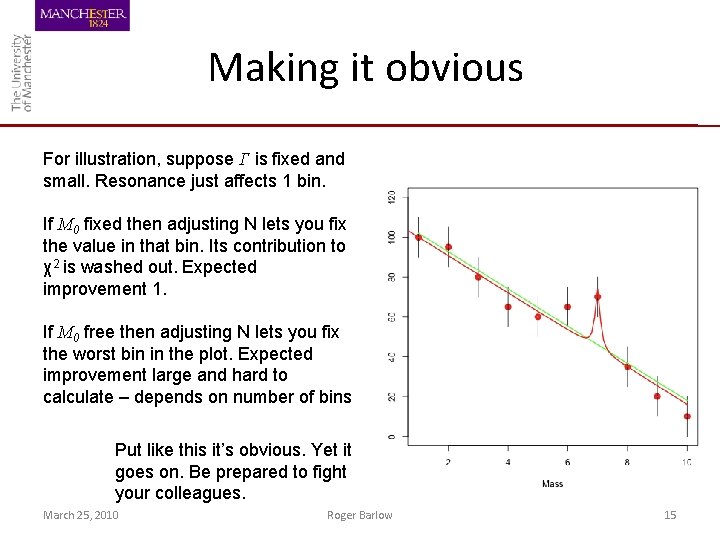
Making it obvious For illustration, suppose Γ is fixed and small. Resonance just affects 1 bin. If M 0 fixed then adjusting N lets you fix the value in that bin. Its contribution to χ2 is washed out. Expected improvement 1. If M 0 free then adjusting N lets you fix the worst bin in the plot. Expected improvement large and hard to calculate – depends on number of bins Put like this it’s obvious. Yet it goes on. Be prepared to fight your colleagues. March 25, 2010 Roger Barlow 15
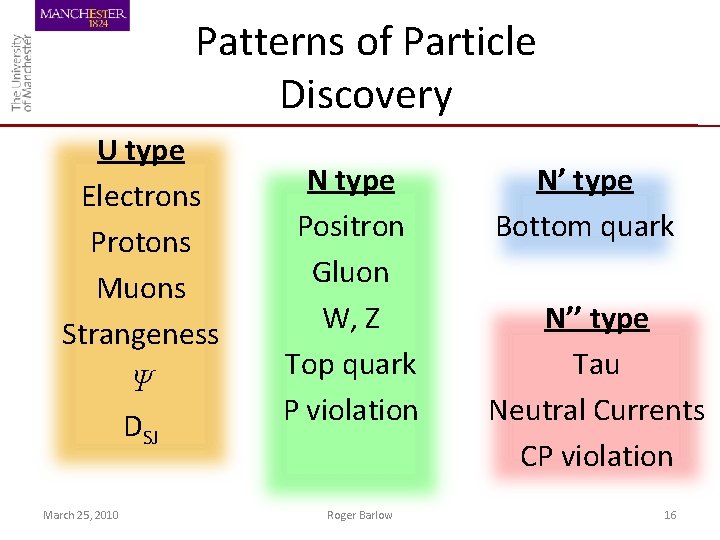
Patterns of Particle Discovery U type Electrons Protons Muons Strangeness Ψ DSJ March 25, 2010 N type Positron Gluon W, Z Top quark P violation Roger Barlow N’ type Bottom quark N’’ type Tau Neutral Currents CP violation 16
Dangerous Dummy Parameters “Hypothesis testing when a nuisance parameter is present only under the alternative” - R. B. Davies Biometrika 64 p 247 (1977) and 74 p 33 (1987) If the alternative ‘improved’ model contains parameters which are meaningless under the background-only null hypothesis then the Δχ2 test (etc) does not work. Model Background(x, a) and Background(x, a)+N Signal(x, a) Does a contains parameters which do not affect Background ? March 25, 2010 Roger Barlow 17
Conclusions • You will not find something unless you look • What you find may not be what you’re looking for. • You need either a new technology or a prediction. Or both. • Discovery will need hard work and perseverance • Statistical tools will be essential, and they can be tricky Good luck! March 25, 2010 Roger Barlow 18
- Slides: 18