
What we know about the prevalence and consequences
What we know about the prevalence and consequences of distracted driving Simon Washington Professor and TMR Chair CRICOS No. 00213 J
Talking Points • Types of distraction whilst driving • Cognitive distraction, inattention blindness, and multi-tasking • Prevalence of distraction whilst driving • What we have yet to learn • What are promising approaches
Types of Distraction • Intentional shift of attention from driving • Changing radio station/cd/ipod/etc. • Conversation with passenger • Attending to children • Talking on phone, texting, etc. • Fighting with partner, etc. • Unintentional shift of attention from driving • Roadside event • Fatigue • Driving confusion (signage, etc. ) • Advertising, signage, etc.
Cognitive Distraction A distraction that occupies the cognitive processes of the brain Compare the following: – Recite the alphabet while driving – Name all of the cities you have lived in during your lifetime (while driving) – Estimate the amount of money you spend on groceries in a year (while driving)
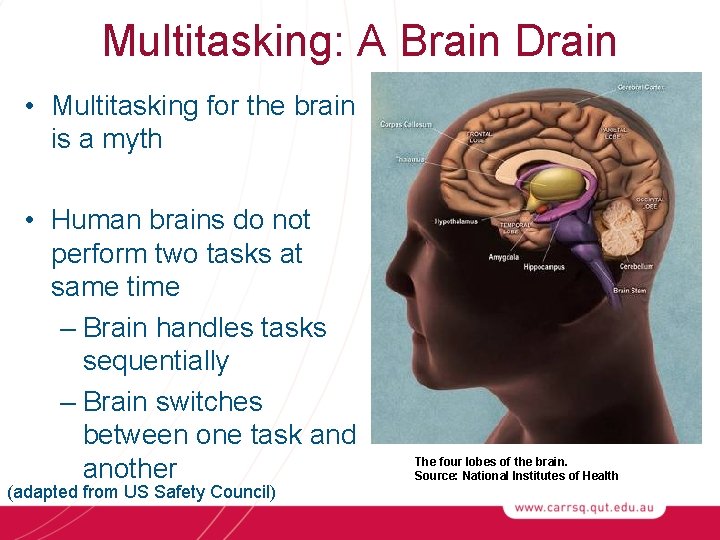
Multitasking: A Brain Drain • Multitasking for the brain is a myth • Human brains do not perform two tasks at same time – Brain handles tasks sequentially – Brain switches between one task and another (adapted from US Safety Council) The four lobes of the brain. Source: National Institutes of Health
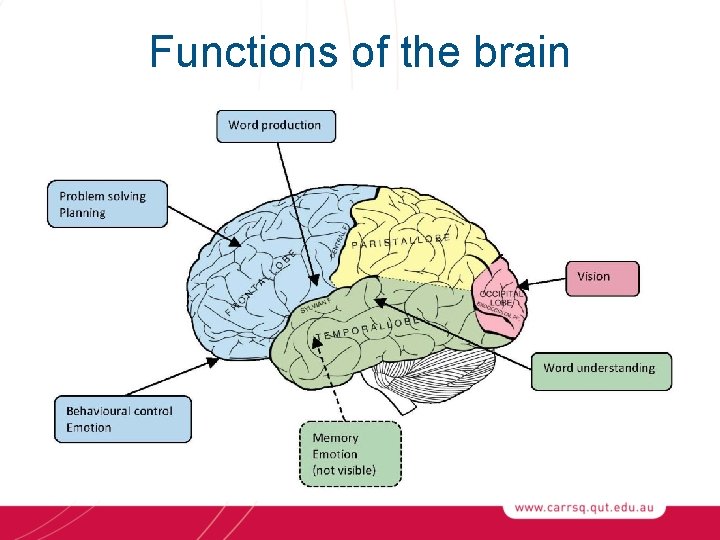
Functions of the brain
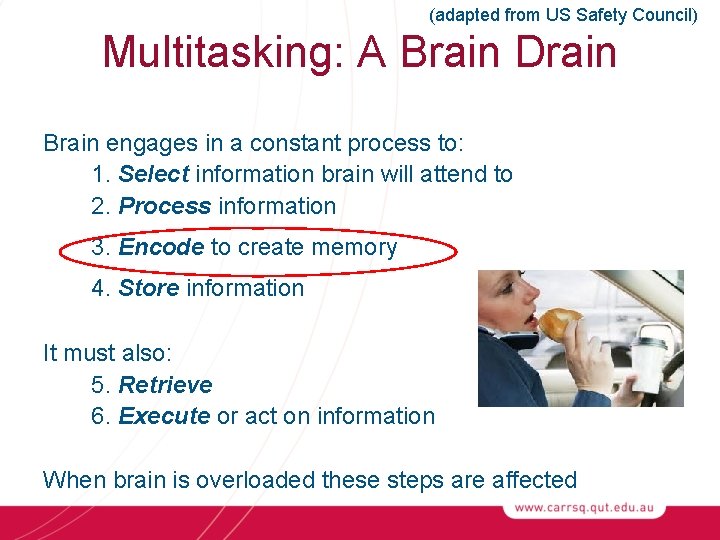
(adapted from US Safety Council) Multitasking: A Brain Drain Brain engages in a constant process to: 1. Select information brain will attend to 2. Process information 3. Encode to create memory 4. Store information It must also: 5. Retrieve 6. Execute or act on information When brain is overloaded these steps are affected
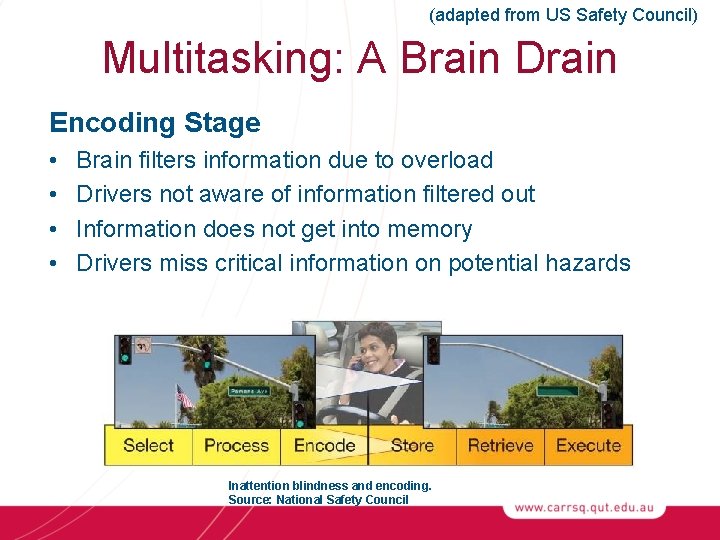
(adapted from US Safety Council) Multitasking: A Brain Drain Encoding Stage • • Brain filters information due to overload Drivers not aware of information filtered out Information does not get into memory Drivers miss critical information on potential hazards Inattention blindness and encoding. Source: National Safety Council
(adapted from US Safety Council) Multitasking: A Brain Drain • Brain juggles tasks, focus and attention • Brain switches between primary and secondary tasks • Inattention blindness – When people do 2 cognitively complex tasks (driving and using a cell phone), causing brain to shift focus • Bottleneck – Different regions of brain must pull from a shared and limited resource for unrelated tasks
(adapted from US Safety Council) Inattention Blindness • A type of cognitive distraction – “looking” but not “seeing” • Hands-free drivers less likely to see: – High and low relevant objects – Visual cues – Exits, red lights and stop signs – Navigational signage – Content of objects
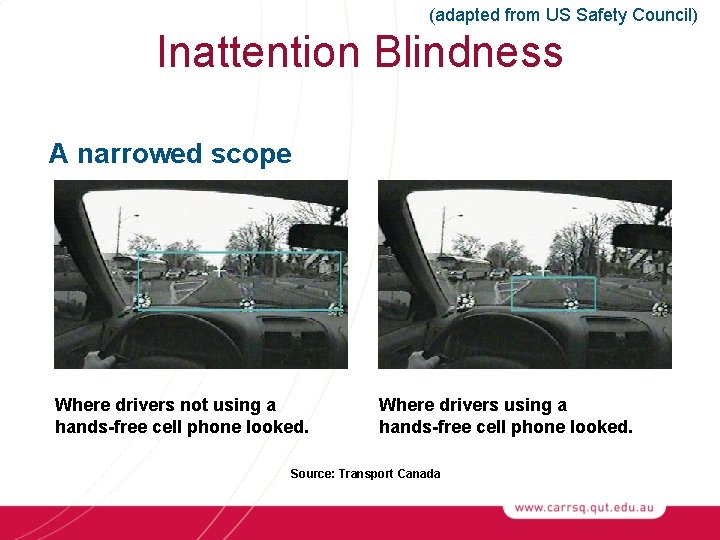
(adapted from US Safety Council) Inattention Blindness A narrowed scope Where drivers not using a hands-free cell phone looked. Where drivers using a hands-free cell phone looked. Source: Transport Canada
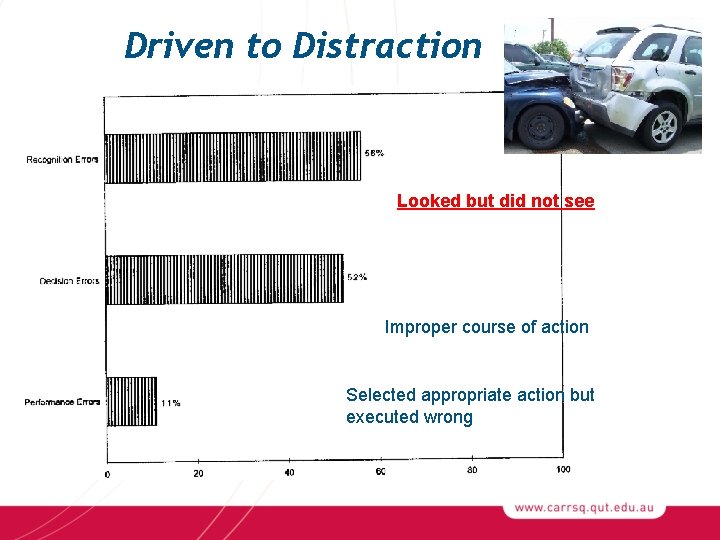
Driven to Distraction Looked but did not see Improper course of action Selected appropriate action but executed wrong
(adapted from US Safety Council) Multitasking: Impairs Performance • Carnegie Mellon University Study (2008) • Took f. MRI pictures of brain while drivers listened to sentences and drove simulator • Literally see the results…
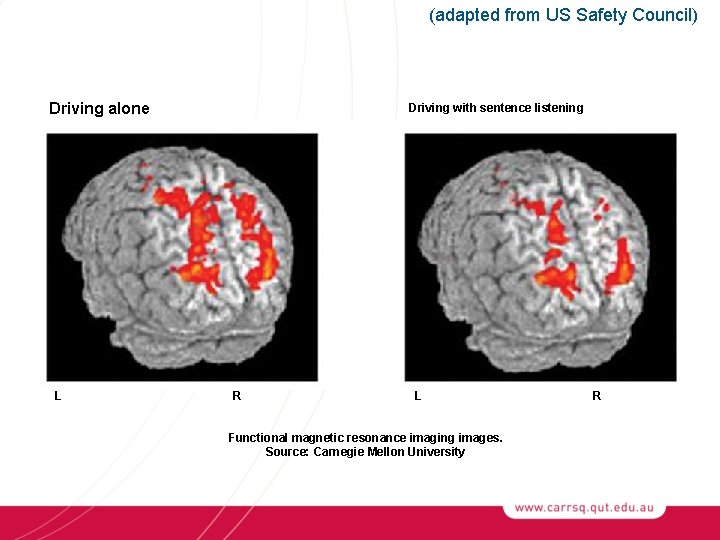
(adapted from US Safety Council) Driving alone L Driving with sentence listening R L Functional magnetic resonance imaging images. Source: Carnegie Mellon University R
(adapted from US Safety Council) Multitasking: Impairs Performance • Just listening to sentences on cell phones decreased activity by 37% in the brain’s parietal lobe which perceives movement, integrates sensory information and also has importance for language processing • Listening and language comprehension drew cognitive resources away from driving • Also decreased activity in brain’s occipital lobe which processes visual information
(adapted from US Safety Council) Multitasking: Impairs Performance • We can walk and chew gum safely because it is not a cognitively-demanding task • But even cell phone-using pedestrians act unsafely. They are less likely to: – Look for traffic before stepping into street – Look at traffic while crossing street – Notice unusual objects placed along path
(adapted from US Safety Council) Multitasking: Impairs Performance • Driving involves a more complex set of tasks than walking: – Visual – Manual – Cognitive – Auditory • A driver’s job is to watch for hazards, but this cannot be done when brain is overloaded
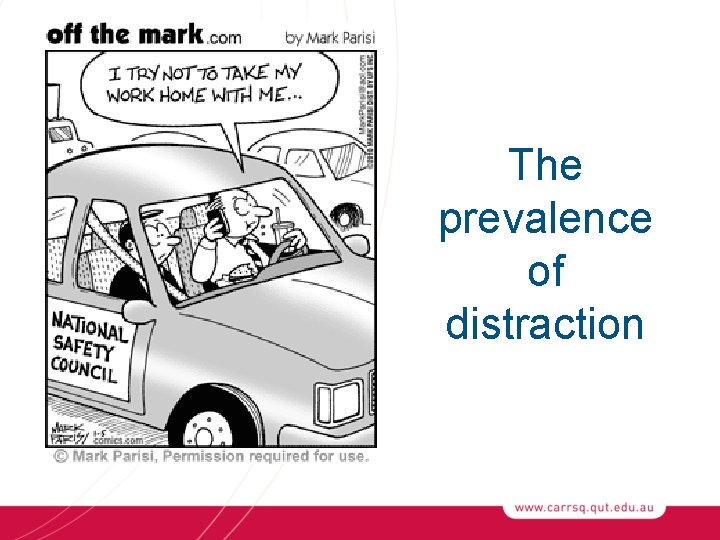
The prevalence of distraction
Prevalence of distraction • Driver distraction is identified as one of the main causes of road crashes, estimated to account for 25% of all vehicle crashes. (1) • Using a mobile phone while driving (especially texting), is highly distracting. • A person using a hand-held or hands free mobile phone while driving is four times more likely to have a serious crash resulting in hospital attendance. (2) 1. Nemme, H. And White, K. M. (2010). Texting while driving: Psychosocial influences on young people’s texting intentions and behaviour. Accident Analysis and Prevention, 42(4). pp. 1257 - 1265. 2. Nemme, H. And White, K. M. (2010). Texting while driving: Psychosocial influences on young people’s texting intentions and behaviour. Accident. Analysis and Prevention, 42(4). pp. 1257 -1265.
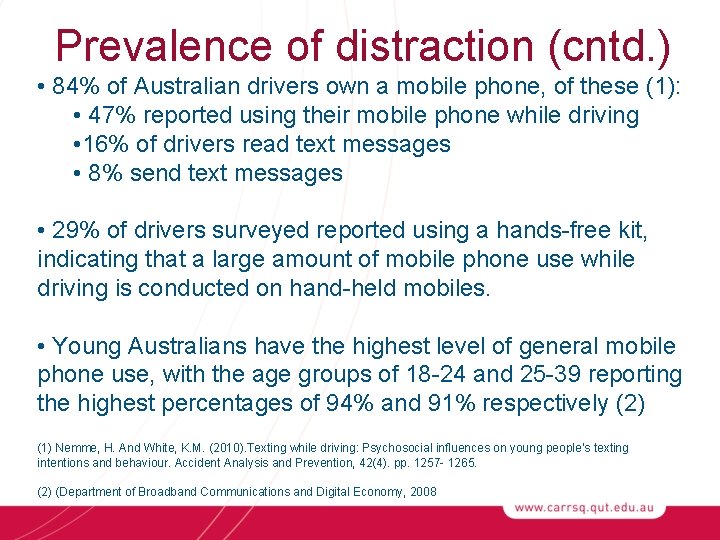
Prevalence of distraction (cntd. ) • 84% of Australian drivers own a mobile phone, of these (1): • 47% reported using their mobile phone while driving • 16% of drivers read text messages • 8% send text messages • 29% of drivers surveyed reported using a hands-free kit, indicating that a large amount of mobile phone use while driving is conducted on hand-held mobiles. • Young Australians have the highest level of general mobile phone use, with the age groups of 18 -24 and 25 -39 reporting the highest percentages of 94% and 91% respectively (2) (1) Nemme, H. And White, K. M. (2010). Texting while driving: Psychosocial influences on young people’s texting intentions and behaviour. Accident Analysis and Prevention, 42(4). pp. 1257 - 1265. (2) (Department of Broadband Communications and Digital Economy, 2008
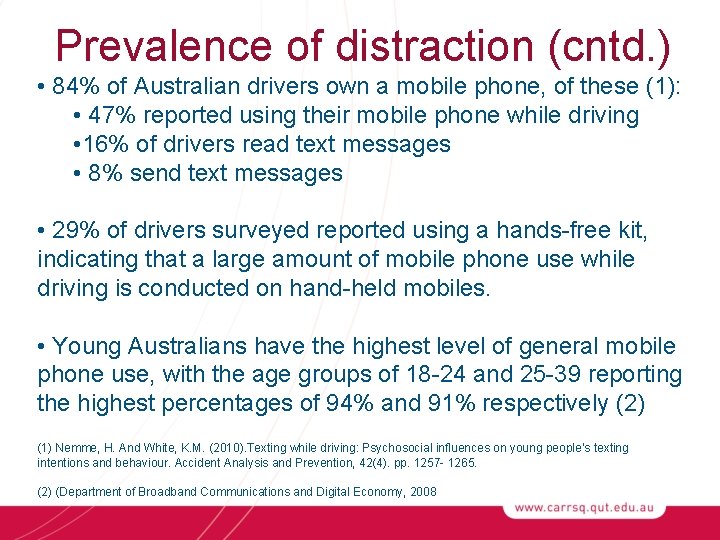
Prevalence of distraction (cntd. ) • 84% of Australian drivers own a mobile phone, of these (1): • 47% reported using their mobile phone while driving • 16% of drivers read text messages • 8% send text messages • 29% of drivers surveyed reported using a hands-free kit, indicating that a large amount of mobile phone use while driving is conducted on hand-held mobiles. • Young Australians have the highest level of general mobile phone use, with the age groups of 18 -24 and 25 -39 reporting the highest percentages of 94% and 91% respectively (2) (1) Nemme, H. And White, K. M. (2010). Texting while driving: Psychosocial influences on young people’s texting intentions and behaviour. Accident Analysis and Prevention, 42(4). pp. 1257 - 1265. (2) (Department of Broadband Communications and Digital Economy, 2008
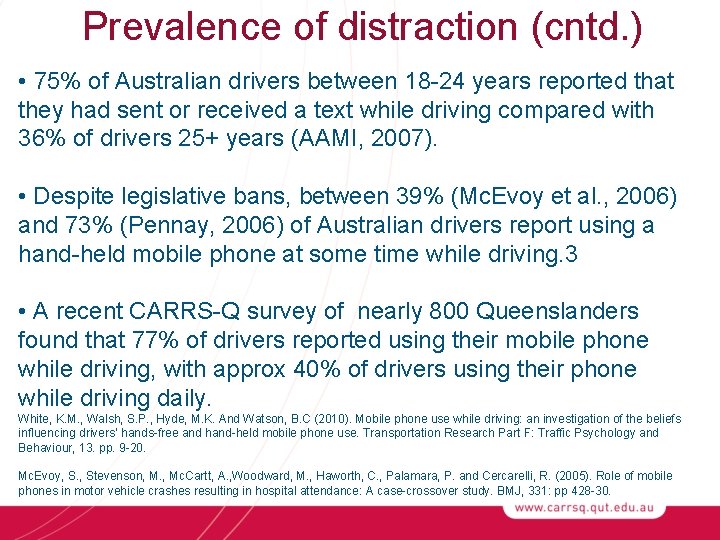
Prevalence of distraction (cntd. ) • 75% of Australian drivers between 18 -24 years reported that they had sent or received a text while driving compared with 36% of drivers 25+ years (AAMI, 2007). • Despite legislative bans, between 39% (Mc. Evoy et al. , 2006) and 73% (Pennay, 2006) of Australian drivers report using a hand-held mobile phone at some time while driving. 3 • A recent CARRS-Q survey of nearly 800 Queenslanders found that 77% of drivers reported using their mobile phone while driving, with approx 40% of drivers using their phone while driving daily. White, K. M. , Walsh, S. P. , Hyde, M. K. And Watson, B. C (2010). Mobile phone use while driving: an investigation of the beliefs influencing drivers’ hands-free and hand-held mobile phone use. Transportation Research Part F: Traffic Psychology and Behaviour, 13. pp. 9 -20. Mc. Evoy, S. , Stevenson, M. , Mc. Cartt, A. , Woodward, M. , Haworth, C. , Palamara, P. and Cercarelli, R. (2005). Role of mobile phones in motor vehicle crashes resulting in hospital attendance: A case-crossover study. BMJ, 331: pp 428 -30.
What the research tells us
What we do know…… • Hands free devices are not safer than hand held devices • Cognitive distraction (load) is the important aspect in assessing the driving risk • The human brain cannot multi-task (it is not a dual processor) • Conversations, reading, and texting occupy resources in the brain • Many drivers purposely engage in distraction • Current laws (and levels of enforcement) are not discouraging widespread use
What we have yet to learn…. . • How effective are education campaigns and driver training (seem to be only moderately effective) • What are the best mechanisms for detecting distraction of a driver? • What technologies will have the greatest impact in mitigating distraction? • Do some drivers compensate for increased crash risk when using phones or while being purposely distracted?
Promising approaches • In vehicle devices that detect distraction (audible and tactile warnings) • In vehicle devices that limit use of technologies • Roadway-vehicle communication devices (e. g. alert of pedestrian in crosswalk) • Improved enforcement • Larger penalties • Automated enforcement
Thanks. . .
- Slides: 28