
What was the Marshall Plan also known as
- Slides: 12
What was the Marshall Plan? (also known as Marshall Aid)
Your task Read your textbooks (p. 48 -9) and try to answer these questions: n Why did the US see the need for Marshall Aid? n What were its main aims? n How successful was Marshall Aid? n
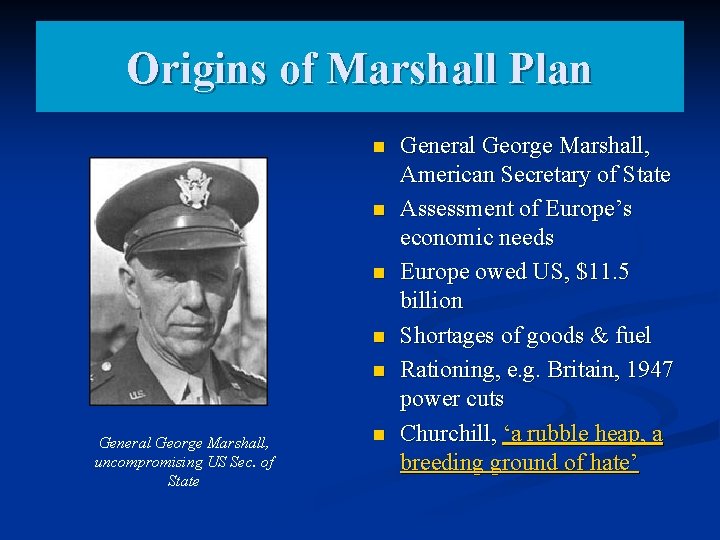
Origins of Marshall Plan n n General George Marshall, uncompromising US Sec. of State n General George Marshall, American Secretary of State Assessment of Europe’s economic needs Europe owed US, $11. 5 billion Shortages of goods & fuel Rationing, e. g. Britain, 1947 power cuts Churchill, ‘a rubble heap, a breeding ground of hate’
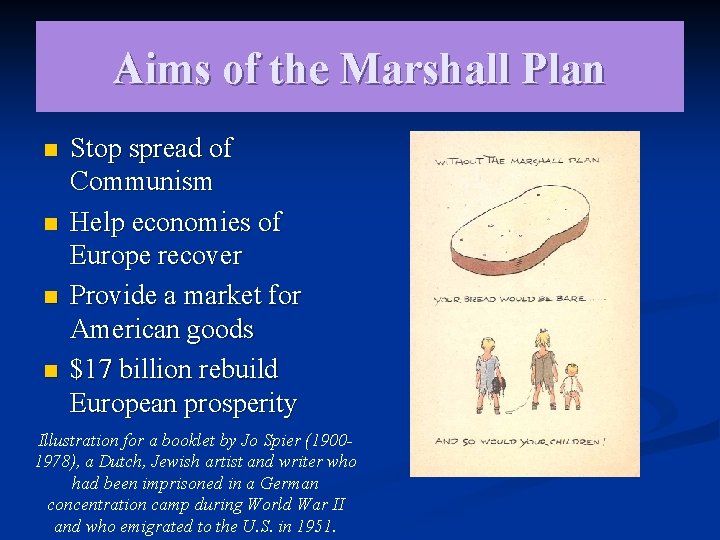
Aims of the Marshall Plan n n Stop spread of Communism Help economies of Europe recover Provide a market for American goods $17 billion rebuild European prosperity Illustration for a booklet by Jo Spier (19001978), a Dutch, Jewish artist and writer who had been imprisoned in a German concentration camp during World War II and who emigrated to the U. S. in 1951.
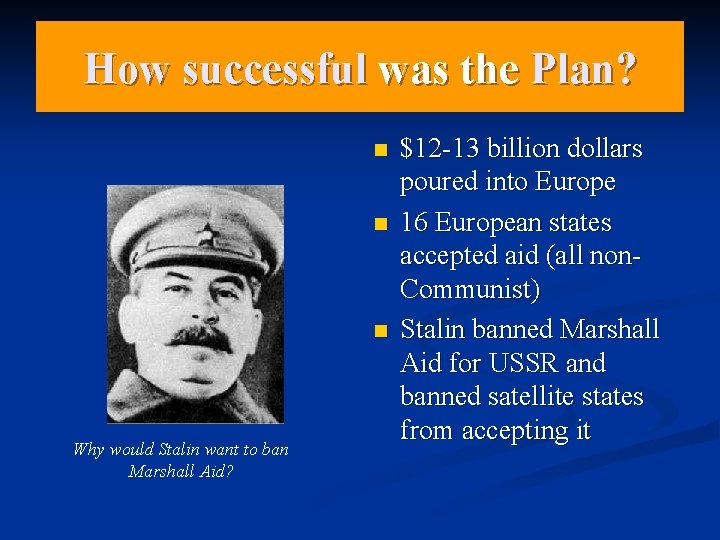
How successful was the Plan? n n n Why would Stalin want to ban Marshall Aid? $12 -13 billion dollars poured into Europe 16 European states accepted aid (all non. Communist) Stalin banned Marshall Aid for USSR and banned satellite states from accepting it
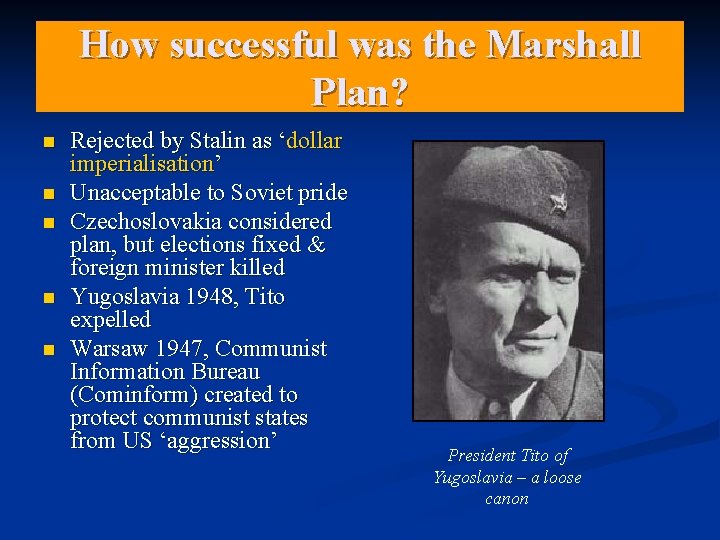
How successful was the Marshall Plan? n n n Rejected by Stalin as ‘dollar imperialisation’ Unacceptable to Soviet pride Czechoslovakia considered plan, but elections fixed & foreign minister killed Yugoslavia 1948, Tito expelled Warsaw 1947, Communist Information Bureau (Cominform) created to protect communist states from US ‘aggression’ President Tito of Yugoslavia – a loose canon
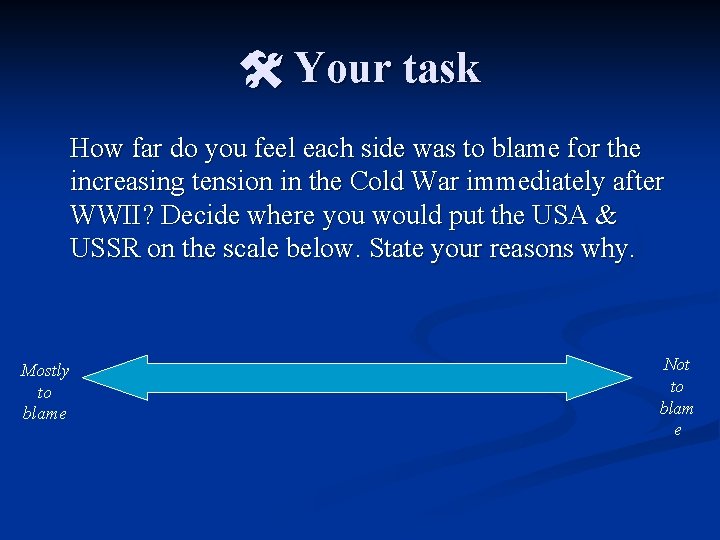
Your task How far do you feel each side was to blame for the increasing tension in the Cold War immediately after WWII? Decide where you would put the USA & USSR on the scale below. State your reasons why. Mostly to blame Not to blam e
You are going to hold a debate over the issue who was to blame for increasing tensions during the early stages of the Cold War? One side will argue the case that it was the USSR the other that it was the Americans?
US blame Support for anti-Communists during Civil War n Anti-Communist stance of Truman n Development of atomic bomb n Iron curtain speech n Truman Doctrine & Marshall Aid n Ideological differences (US capitalist democracy) n
USSR blame Historic tensions, e. g. Hitler Stalin pact, 1939 n Soviet expansion into Eastern Europe & setting up of Communist governments n Rejection of Marshall Aid n Formation of Cominform n Red army, development of own nuclear weapons n
Your task Work in pairs. Prepare two statements. One which Truman could give to Congress explaining why he is supporting the Marshall Plan and one from Stalin to the Politburo condemning the Plan and outlining his response to it. n Compare the differences in interpretation in your two speeches n
Extra help n You might want to consider the following points The background to the Marshall Plan (Greece & fear of Communist take-over) n Marshall’s assessment of Europe’s needs n The public & hidden agenda (economic & political support) n The growing tensions during the Cold War (spread of Communism, arms race, Iron Curtain speech) n