
What was the impact of Britains penal colony
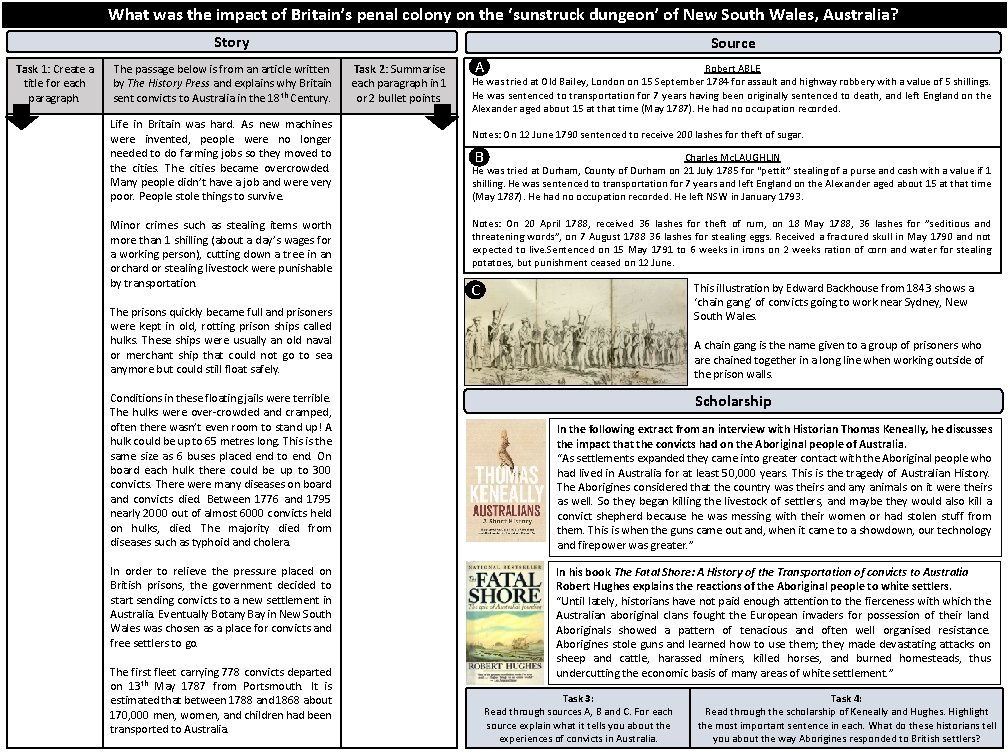
What was the impact of Britain’s penal colony on the ‘sunstruck dungeon’ of New South Wales, Australia? Story Task 1: Create a title for each paragraph. The passage below is from an article written by The History Press and explains why Britain sent convicts to Australia in the 18 th Century. Life in Britain was hard. As new machines were invented, people were no longer needed to do farming jobs so they moved to the cities. The cities became overcrowded. Many people didn’t have a job and were very poor. People stole things to survive. Minor crimes such as stealing items worth more than 1 shilling (about a day’s wages for a working person), cutting down a tree in an orchard or stealing livestock were punishable by transportation. Source Task 2: Summarise each paragraph in 1 or 2 bullet points. A Robert ABLE He was tried at Old Bailey, London on 15 September 1784 for assault and highway robbery with a value of 5 shillings. He was sentenced to transportation for 7 years having been originally sentenced to death, and left England on the Alexander aged about 15 at that time (May 1787). He had no occupation recorded. Notes: On 12 June 1790 sentenced to receive 200 lashes for theft of sugar. Charles Mc. LAUGHLIN B He was tried at Durham, County of Durham on 21 July 1785 for “pettit” stealing of a purse and cash with a value if 1 shilling. He was sentenced to transportation for 7 years and left England on the Alexander aged about 15 at that time (May 1787). He had no occupation recorded. He left NSW in January 1793. Notes: On 20 April 1788, received 36 lashes for theft of rum, on 18 May 1788, 36 lashes for ”seditious and threatening words”, on 7 August 1788 36 lashes for stealing eggs. Received a fractured skull in May 1790 and not expected to live. Sentenced on 15 May 1791 to 6 weeks in irons on 2 weeks ration of corn and water for stealing potatoes, but punishment ceased on 12 June. C This illustration by Edward Backhouse from 1843 shows a ‘chain gang’ of convicts going to work near Sydney, New South Wales. The prisons quickly became full and prisoners were kept in old, rotting prison ships called hulks. These ships were usually an old naval or merchant ship that could not go to sea anymore but could still float safely. Conditions in these floating jails were terrible. The hulks were over-crowded and cramped, often there wasn’t even room to stand up! A hulk could be up to 65 metres long. This is the same size as 6 buses placed end to end. On board each hulk there could be up to 300 convicts. There were many diseases on board and convicts died. Between 1776 and 1795 nearly 2000 out of almost 6000 convicts held on hulks, died. The majority died from diseases such as typhoid and cholera. In order to relieve the pressure placed on British prisons, the government decided to start sending convicts to a new settlement in Australia. Eventually Botany Bay in New South Wales was chosen as a place for convicts and free settlers to go. The first fleet carrying 778 convicts departed on 13 th May 1787 from Portsmouth. It is estimated that between 1788 and 1868 about 170, 000 men, women, and children had been transported to Australia. A chain gang is the name given to a group of prisoners who are chained together in a long line when working outside of the prison walls. Scholarship In the following extract from an interview with Historian Thomas Keneally, he discusses the impact that the convicts had on the Aboriginal people of Australia. “As settlements expanded they came into greater contact with the Aboriginal people who had lived in Australia for at least 50, 000 years. This is the tragedy of Australian History. The Aborigines considered that the country was theirs and any animals on it were theirs as well. So they began killing the livestock of settlers, and maybe they would also kill a convict shepherd because he was messing with their women or had stolen stuff from them. This is when the guns came out and, when it came to a showdown, our technology and firepower was greater. ” In his book The Fatal Shore: A History of the Transportation of convicts to Australia Robert Hughes explains the reactions of the Aboriginal people to white settlers. “Until lately, historians have not paid enough attention to the fierceness with which the Australian aboriginal clans fought the European invaders for possession of their land. Aboriginals showed a pattern of tenacious and often well organised resistance. Aborigines stole guns and learned how to use them; they made devastating attacks on sheep and cattle, harassed miners, killed horses, and burned homesteads, thus undercutting the economic basis of many areas of white settlement. ” Task 3: Read through sources A, B and C. For each source explain what it tells you about the experiences of convicts in Australia. Task 4: Read through the scholarship of Keneally and Hughes. Highlight the most important sentence in each. What do these historians tell you about the way Aborigines responded to British settlers?

What was the impact of Britain’s penal colony on the ‘sunstruck dungeon’ of New South Wales, Australia? Story Task 1: Create a title for each paragraph. The passage below is from an article written by The History Press and explains why Britain sent convicts to Australia in the 18 th Century. Life in Britain was hard. As new machines were invented, people were no longer needed to do farming jobs so they moved to the cities. The cities became overcrowded. Many people didn’t have a job and were very poor. People stole things to survive. Minor crimes such as stealing items worth more than 1 shilling (about a day’s wages for a working person), cutting down a tree in an orchard or stealing livestock were punishable by transportation. Source Task 2: Summarise each paragraph in 1 or 2 bullet points. A Robert ABLE He was tried at Old Bailey, London on 15 September 1784 for assault and highway robbery with a value of 5 shillings. He was sentenced to transportation for 7 years having been originally sentenced to death, and left England on the Alexander aged about 15 at that time (May 1787). He had no occupation recorded. B Charles Mc. LAUGHLIN He was tried at Durham, County of Durham on 21 July 1785 for “pettit” stealing of a purse and cash with a value if 1 shilling. He was sentenced to transportation for 7 years and left England on the Alexander aged about 15 at that time (May 1787). He had no occupation recorded. He left NSW in January 1793. C This illustration by Edward Backhouse from 1843 shows a ‘chain gang’ of convicts going to work near Sydney, New South Wales. A chain gang is the name given to a group of prisoners who are chained together in a long line when working outside of the prison walls. The prisons quickly became full and prisoners were kept in old, rotting prison ships called hulks. Conditions in these floating jails were terrible. The hulks were over-crowded and cramped, often there wasn’t even room to stand up! On board each hulk there could be up to 300 convicts. There were many diseases on board and convicts died. In order to relieve the pressure placed on British prisons, the government decided to start sending convicts to a new settlement in Australia. The first fleet carrying 778 convicts departed on 13 th May 1787 from Portsmouth. It is estimated that between 1788 and 1868 about 170, 000 men, women, and children had been transported to Australia. Scholarship In the following extract from an interview with Historian Thomas Keneally, he discusses the impact that the convicts had on the Aboriginal people of Australia. “As settlements expanded they came into greater contact with the Aboriginal people who had lived in Australia for at least 50, 000 years. This is the tragedy of Australian History. The Aborigines considered that the country was theirs and any animals on it were theirs as well. So they began killing the livestock of settlers, and maybe they would also kill a convict shepherd because he was messing with their women or had stolen stuff from them. This is when the guns came out and, when it came to a showdown, our technology and firepower was greater. ” Task 3: Read through sources A, B and C. For each source explain what it tells you about the experiences of convicts in Australia. Task 4: Read through the scholarship of Keneally. Highlight the most important sentence. What does this historian tell you about the way Aborigines responded to British settlers?
- Slides: 2