
What typical models approaches or frameworks are used
- Slides: 9
What typical models, approaches or frameworks are used in Germany for supporting and delivering ICT for disabled students in post compulsory education and how successful are they? Christian Bühler Rehabilitation Technology, School of Rehabilitation Sciences, TU Dortmund University Research Institute Technology and Disability of ESV Foundation
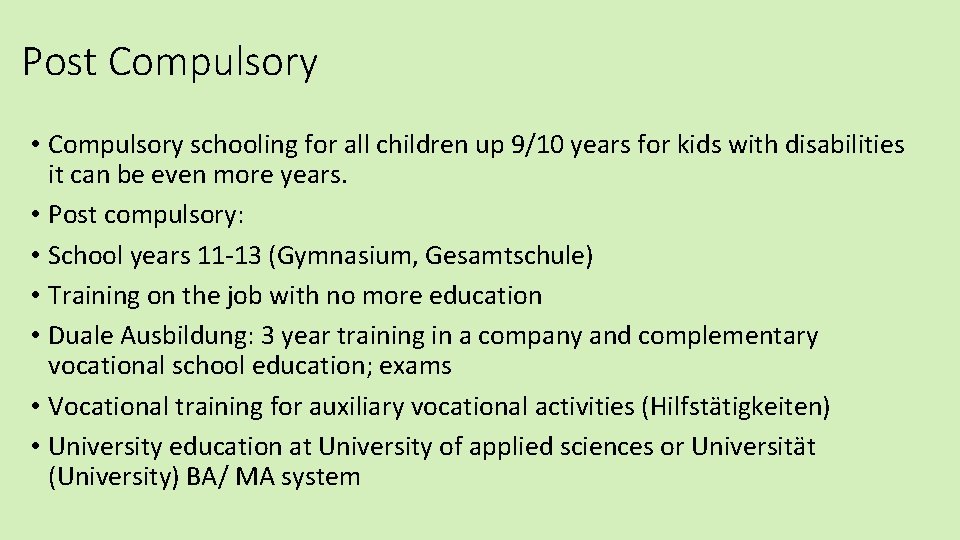
Post Compulsory • Compulsory schooling for all children up 9/10 years for kids with disabilities it can be even more years. • Post compulsory: • School years 11 -13 (Gymnasium, Gesamtschule) • Training on the job with no more education • Duale Ausbildung: 3 year training in a company and complementary vocational school education; exams • Vocational training for auxiliary vocational activities (Hilfstätigkeiten) • University education at University of applied sciences or Universität (University) BA/ MA system
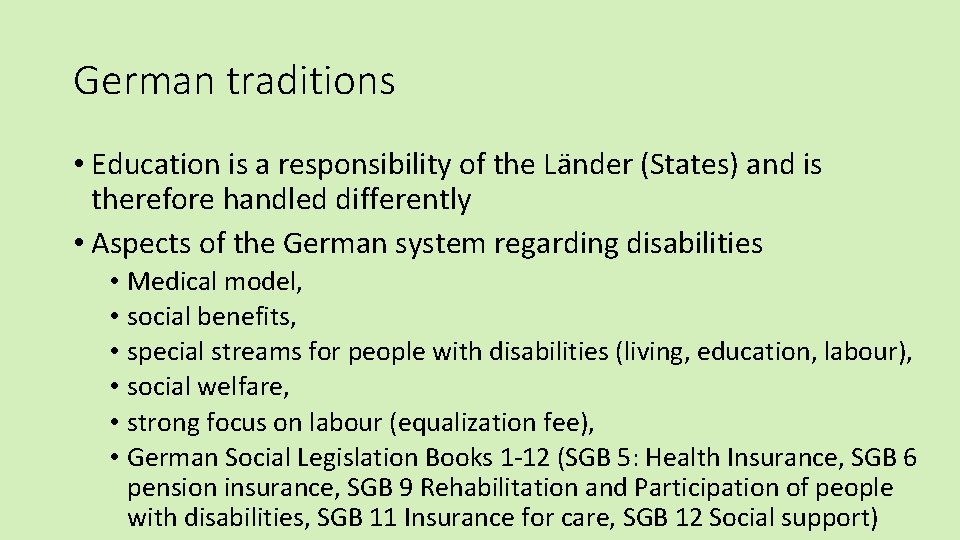
German traditions • Education is a responsibility of the Länder (States) and is therefore handled differently • Aspects of the German system regarding disabilities • Medical model, • social benefits, • special streams for people with disabilities (living, education, labour), • social welfare, • strong focus on labour (equalization fee), • German Social Legislation Books 1 -12 (SGB 5: Health Insurance, SGB 6 pension insurance, SGB 9 Rehabilitation and Participation of people with disabilities, SGB 11 Insurance for care, SGB 12 Social support)
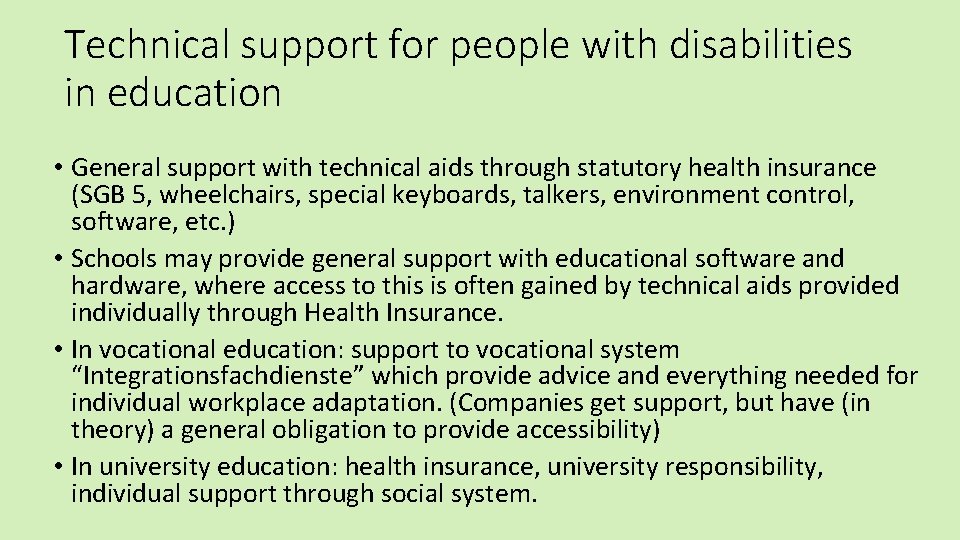
Technical support for people with disabilities in education • General support with technical aids through statutory health insurance (SGB 5, wheelchairs, special keyboards, talkers, environment control, software, etc. ) • Schools may provide general support with educational software and hardware, where access to this is often gained by technical aids provided individually through Health Insurance. • In vocational education: support to vocational system “Integrationsfachdienste” which provide advice and everything needed for individual workplace adaptation. (Companies get support, but have (in theory) a general obligation to provide accessibility) • In university education: health insurance, university responsibility, individual support through social system.
Concepts: 1 Barrierefreiheit As defined by German Legislation: Infrastructures are considered as barrier free accessible if they are • in a general manner, • without special difficulty, • principally without external help findable, accessible and usable by people with disabilities • Infrastructures include Information and communication and services
Concepts 2: Design for all (Df. A) used as a concept to overcome a focus on special users and special solutions (better for all, diversity as a strength): “a principle which aims to encourage the design of products and services in such a way that they become accessible to and usable by as large a grouping of users feasible, including disabled and older persons. Df. A principal strategies: • Design of (IST) products, services and applications which are demonstrably suitable for most of the potential users without any modification. • Design of products which are easily adaptable to different users (e. g. by incorporating adaptable or customisable user interfaces). • Design of products which have standardised interfaces, capable of being accessed by specialised user interaction devices.
Universities • Obligation under state law to provide “Barrierefreiheit” • In Practice • Behindertenbeauftragte: Person to deal with affairs of people with disabilities • Psychological advice and support services • Offices for advice, support, adaptation of materials and courses, adapted work places, and sometimes provision of technical equipment • Often individual bargaining with lecturers • Compensation of disability disadvantages (Form and timing of exams, provision of adapted material, assistance, provision of technical equipment for taking the exams)
General remarks • German system traditionally is very oriented on the individual requirements in the concrete case. • General obligation exist, but are still not implemented widely : schools, companies, universities have often still (partly) inaccessible buildings and (partly) inaccessible ICT infrastructures. • Depending on the awareness level of leadership, but also the faculty members • General problem is also the workload already present for many faculty members
Examples • Do. Bu. S (Dortmund Center for Disabilities and Academic Studies) • ELOQ training in logistics (auxiliary jobs) • Via 4 all (media based training on the job)