
What to Study Unit 2 Cell containing only
- Slides: 31
What to Study Unit 2
Cell containing only one chromosome from each homologous pair. Haploid
A cell containing a complete set of homologous chromosomes pairs. Diploid
A type of reproduction that combines genetic material from two different cells to produce offspring. Sexual reproduction
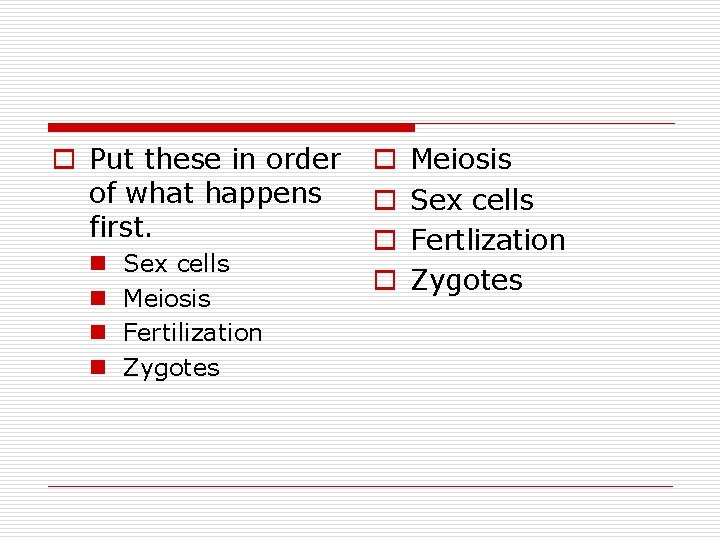
o Put these in order of what happens first. n n Sex cells Meiosis Fertilization Zygotes o o Meiosis Sex cells Fertlization Zygotes
A process of cell division that produces egg & sperm cells (sex cells). meiosis
o Non-living things Abiotic
Diploid cell formed by the fusion of one egg and one sperm cell; develops into a new organism. zygote
o A organism with a nucleus. o Can be single celled or multicelled. Eukaryote
Why is Meiosis Important? o It is important because it produces egg & sperm cells (sex cells) which are haploids. o Since it makes haploid cells each new generation starts off with the same number of chromosomes as the parent.
A type of reproduction that ONLY requires one parent. Asexual reproduction
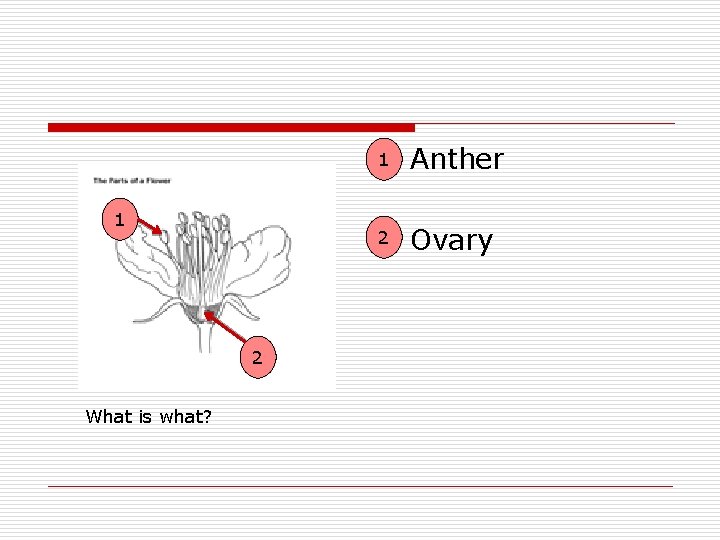
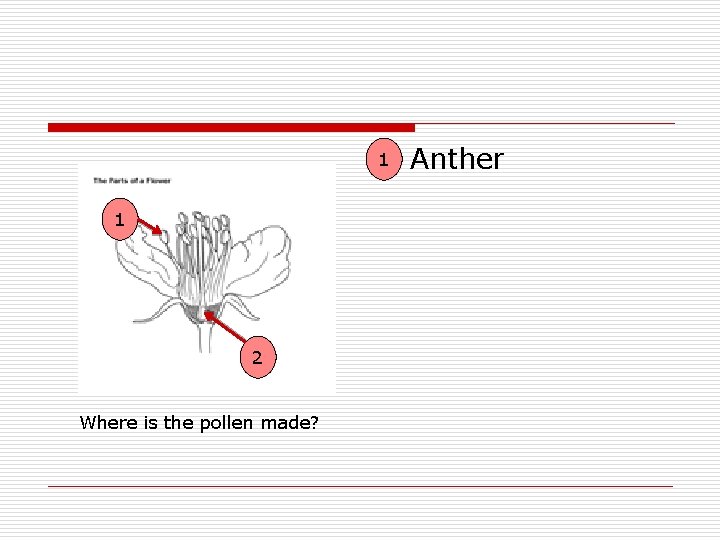
1 2 What is what? 1 Anther 2 Ovary
1 1 2 Where is the pollen made? Anther
Each form of a o alleles gene with different information (the “choices”)
o DNA What is the genetic material for all living things?
Where is pollen produced. anther
What comes first the fruit or the flower
o A living thing without a nucleus o Also called bacteria Prokaryote
o Asexual reproduction in bacteria Fission
In plants, what turns into the fruit? ovary
Genetic variation is an advantage for which type of reproduction? Sexual
o dominant A genetic factor that blocks another genetic factor.
Alleles that are o homozygous the same. For example: AA or aa
The observable o phenotype trait, your appearance. For example: blue or brown eyes.
A genetic factor that is hidden and blocked by another factor. o recessive
Alleles that are o heterozygous different. For example: Aa
Not needing o asexual waste time and energy to find a mate is an advantage which type of reproduction
The passing of traits from parent to offspring o heredity
The combination of specific alleles that make up an organism is that organism’s o genotype
o What determines gender in humans n Male n Female o Male XY o Female XX
Note: o There will be Punnett square questions on the test.