
What to look for when reviewing a Mixing

- Slides: 34
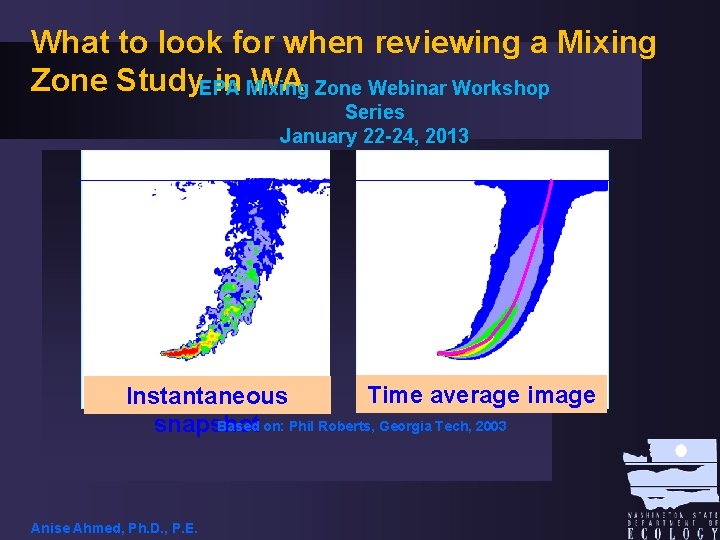
What to look for when reviewing a Mixing Zone Study. EPA in Mixing WA Zone Webinar Workshop Series January 22 -24, 2013 Time average image Instantaneous Based on: Phil Roberts, Georgia Tech, 2003 snapshot Anise Ahmed, Ph. D. , P. E.
How dilution is defined in WA? n Volumetric Dilution factor: n Concentration based dilution factor:
Mixing Zones in WA (WAC-173 -201 A 400) • • • Apply AKART prior to mixing zone authorization Maximum size of mixing zone Minimize mixing zones Must prove no environmental harm Consider critical conditions
Other Mixing zone regulations n n Overlapping mixing zones Extended mixing zones Mixing zones for stormwater Mixing zones for CSOs
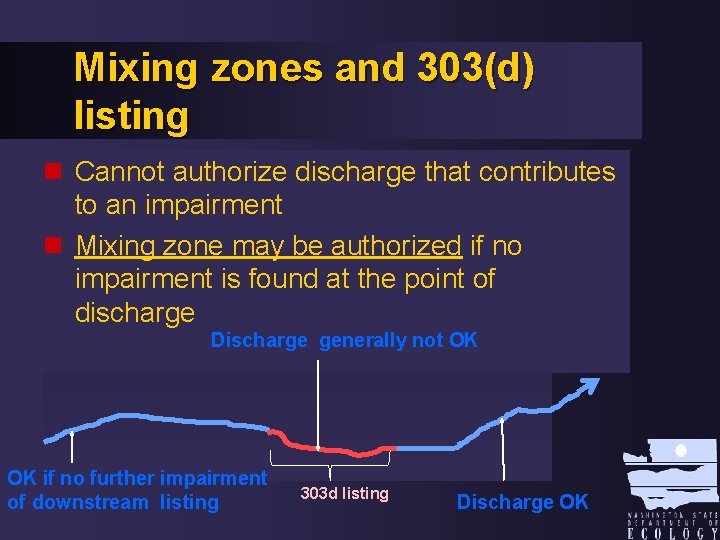
Mixing zones and 303(d) listing n Cannot authorize discharge that contributes to an impairment n Mixing zone may be authorized if no impairment is found at the point of discharge Discharge generally not OK OK if no further impairment of downstream listing 303 d listing Discharge OK
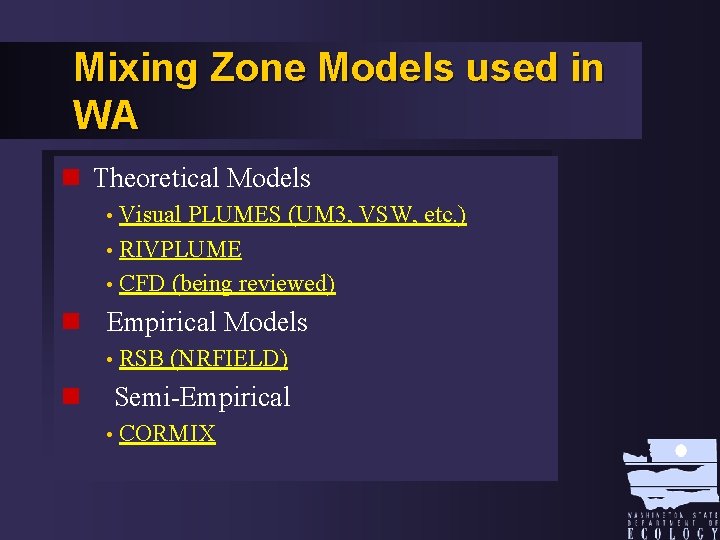
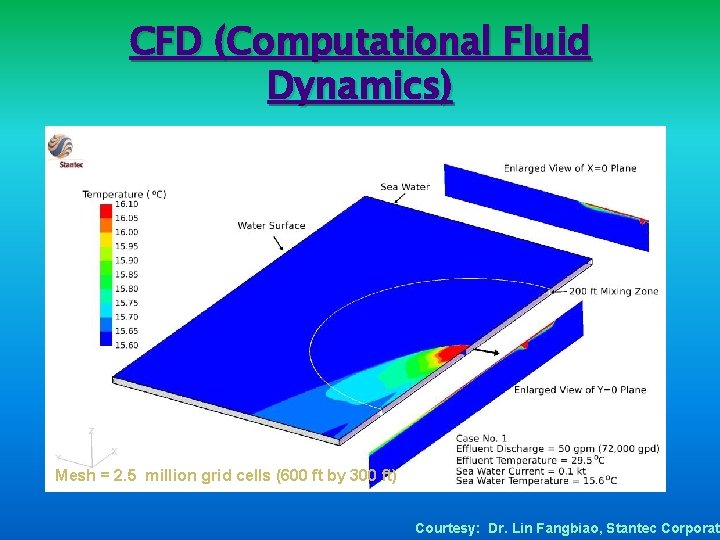
Mixing Zone Models used in WA n Theoretical Models Visual PLUMES (UM 3, VSW, etc. ) • RIVPLUME • CFD (being reviewed) • n Empirical Models • n RSB (NRFIELD) Semi-Empirical • CORMIX
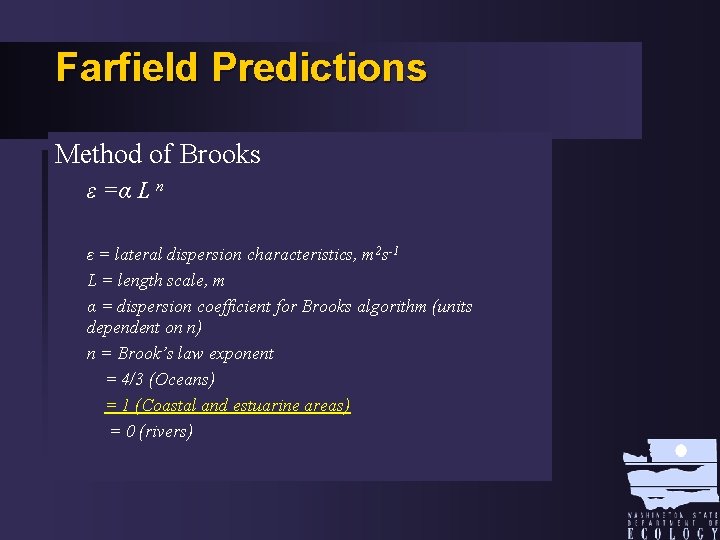
Farfield Predictions Method of Brooks ε =α L n ε = lateral dispersion characteristics, m 2 s-1 L = length scale, m α = dispersion coefficient for Brooks algorithm (units dependent on n) n = Brook’s law exponent = 4/3 (Oceans) = 1 (Coastal and estuarine areas) = 0 (rivers)
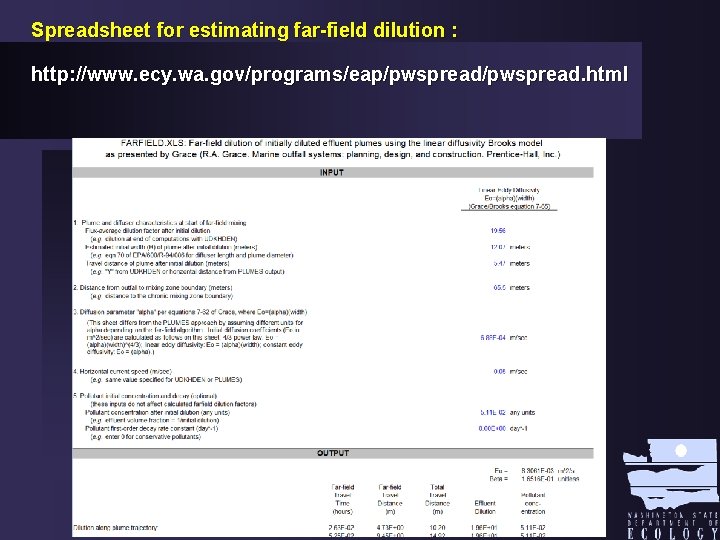
Spreadsheet for estimating far-field dilution : http: //www. ecy. wa. gov/programs/eap/pwspread. html
Mixing Zones Guidance in WA http: //www. ecy. wa. gov/programs/eap/mixzone. html The End
AKART n All known, available, and reasonable treatment n Similar to BAT but more restrictive, i. e. requires current reasonable technology n Dilution only allowed after AKART
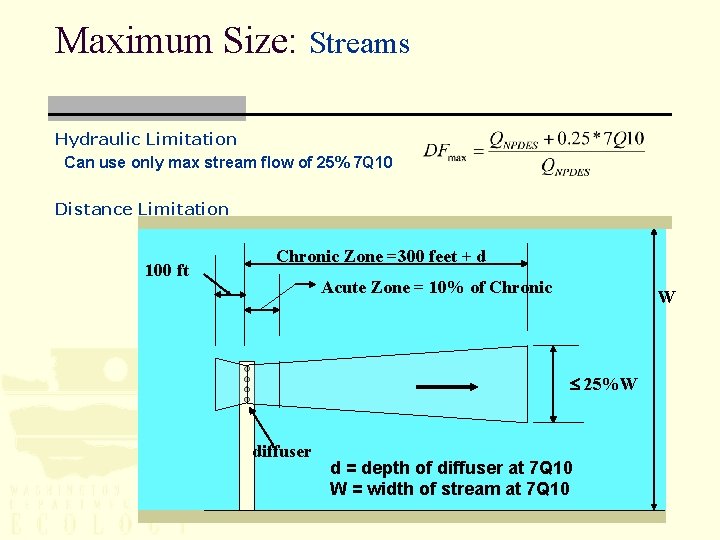
Maximum Size: Streams Hydraulic Limitation Can use only max stream flow of 25% 7 Q 10 Distance Limitation 100 ft Chronic Zone =300 feet + d Acute Zone = 10% of Chronic W 25%W diffuser d = depth of diffuser at 7 Q 10 W = width of stream at 7 Q 10
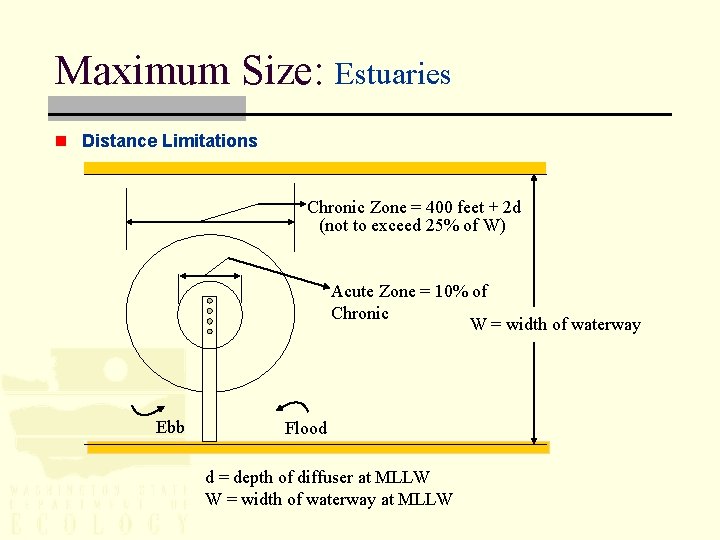
Maximum Size: Estuaries n Distance Limitations Chronic Zone = 400 feet + 2 d (not to exceed 25% of W) Acute Zone = 10% of Chronic W = width of waterway Ebb Flood d = depth of diffuser at MLLW W = width of waterway at MLLW
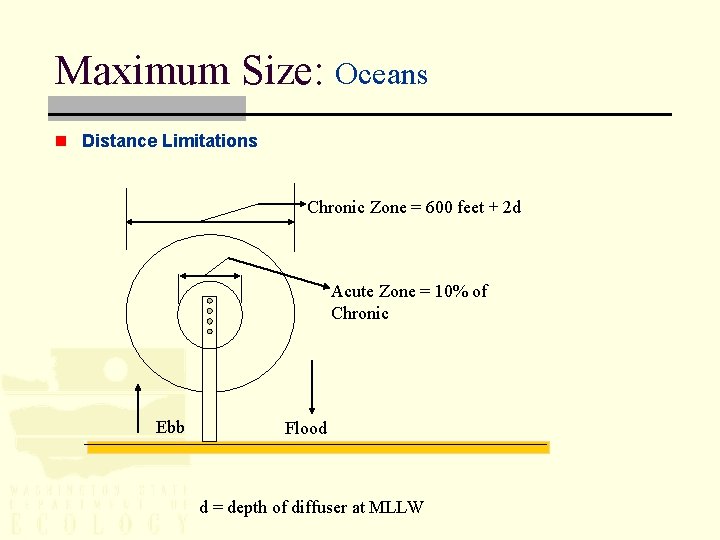
Maximum Size: Oceans n Distance Limitations Chronic Zone = 600 feet + 2 d Acute Zone = 10% of Chronic Ebb Flood d = depth of diffuser at MLLW
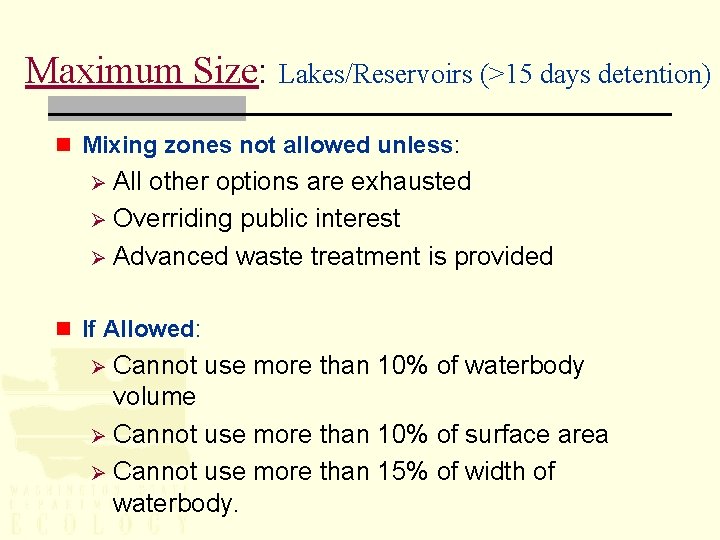
Maximum Size: Lakes/Reservoirs (>15 days detention) n Mixing zones not allowed unless: All other options are exhausted Ø Overriding public interest Ø Advanced waste treatment is provided Ø n If Allowed: Cannot use more than 10% of waterbody volume Ø Cannot use more than 10% of surface area Ø Cannot use more than 15% of width of waterbody. Ø
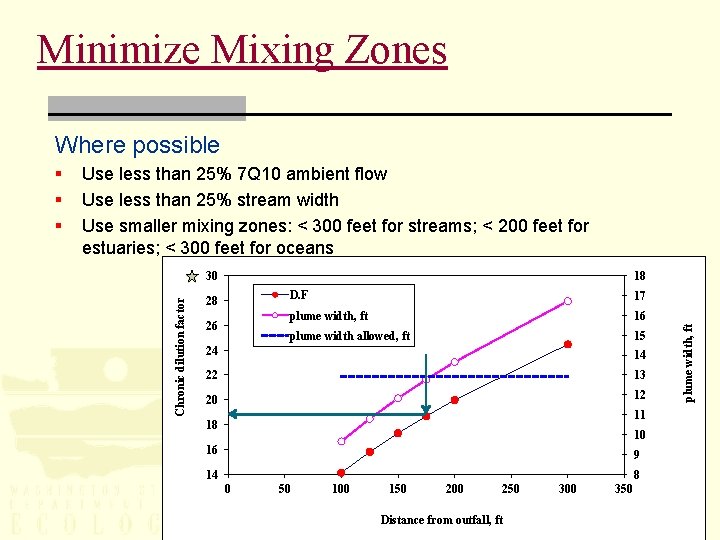
Minimize Mixing Zones Where possible § 30 18 28 26 D. F 17 plume width, ft 16 plume width allowed, ft 15 24 14 22 13 20 12 11 18 10 16 9 14 8 0 50 100 150 200 250 Distance from outfall, ft 300 350 plume width, ft § Use less than 25% 7 Q 10 ambient flow Use less than 25% stream width Use smaller mixing zones: < 300 feet for streams; < 200 feet for estuaries; < 300 feet for oceans Chronic dilution factor §
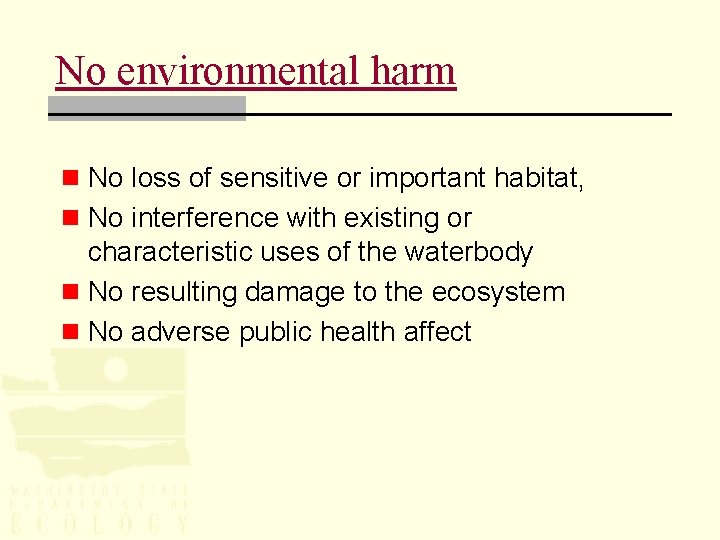
No environmental harm n No loss of sensitive or important habitat, n No interference with existing or characteristic uses of the waterbody n No resulting damage to the ecosystem n No adverse public health affect
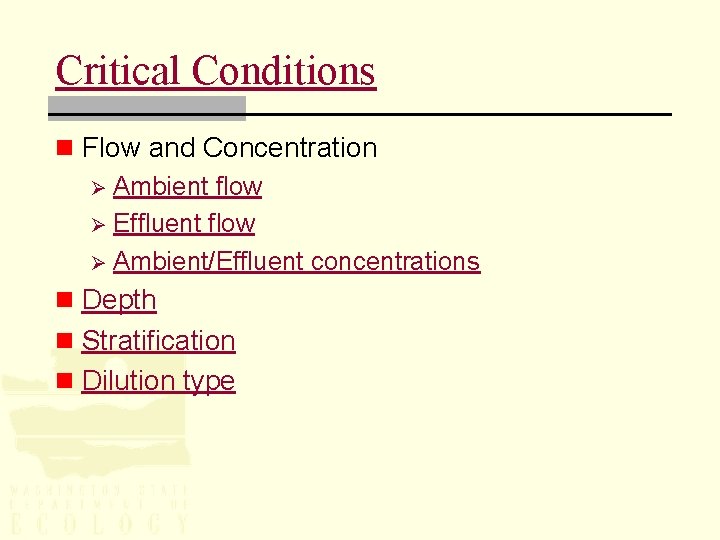
Critical Conditions n Flow and Concentration Ø Ambient flow Ø Effluent flow Ø Ambient/Effluent concentrations n Depth n Stratification n Dilution type
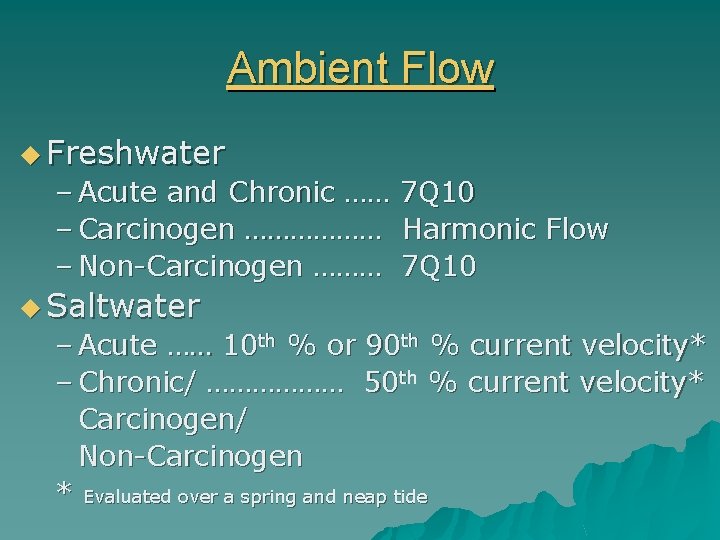
Ambient Flow u Freshwater – Acute and Chronic …… – Carcinogen ……………… – Non-Carcinogen ……… 7 Q 10 Harmonic Flow 7 Q 10 u Saltwater – Acute …… 10 th % or 90 th % current velocity* – Chronic/ ……………… 50 th % current velocity* Carcinogen/ Non-Carcinogen * Evaluated over a spring and neap tide
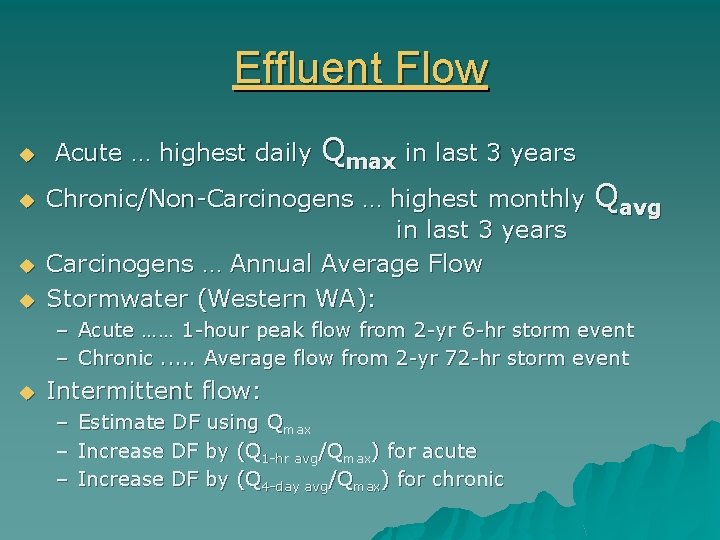
Effluent Flow u u Acute … highest daily Qmax in last 3 years Chronic/Non-Carcinogens … highest monthly in last 3 years Carcinogens … Annual Average Flow Stormwater (Western WA): Qavg – Acute …… 1 -hour peak flow from 2 -yr 6 -hr storm event – Chronic. . . Average flow from 2 -yr 72 -hr storm event u Intermittent flow: – Estimate DF using Qmax – Increase DF by (Q 1 -hr avg/Qmax) for acute – Increase DF by (Q 4 -day avg/Qmax) for chronic
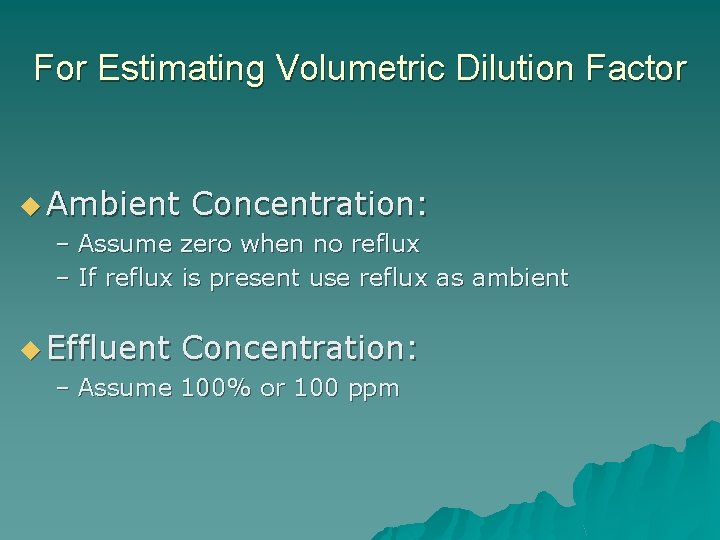
For Estimating Volumetric Dilution Factor u Ambient Concentration: – Assume zero when no reflux – If reflux is present use reflux as ambient u Effluent Concentration: – Assume 100% or 100 ppm
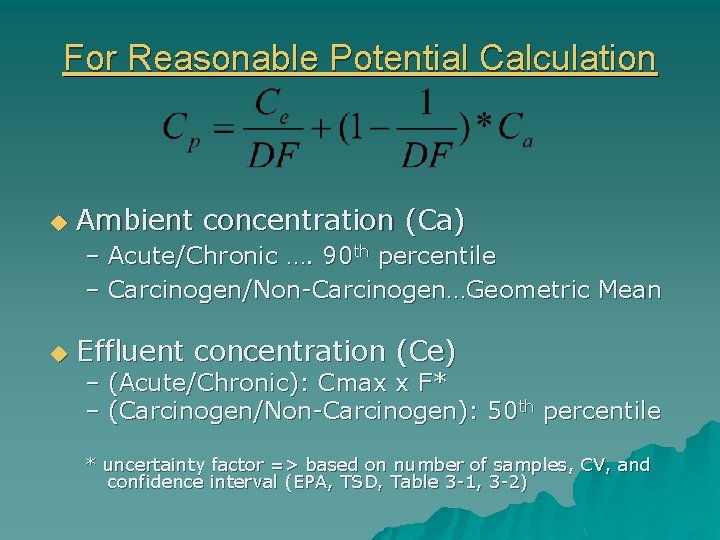
For Reasonable Potential Calculation u Ambient concentration (Ca) – Acute/Chronic …. 90 th percentile – Carcinogen/Non-Carcinogen…Geometric Mean u Effluent concentration (Ce) – (Acute/Chronic): Cmax x F* – (Carcinogen/Non-Carcinogen): 50 th percentile * uncertainty factor => based on number of samples, CV, and confidence interval (EPA, TSD, Table 3 -1, 3 -2)
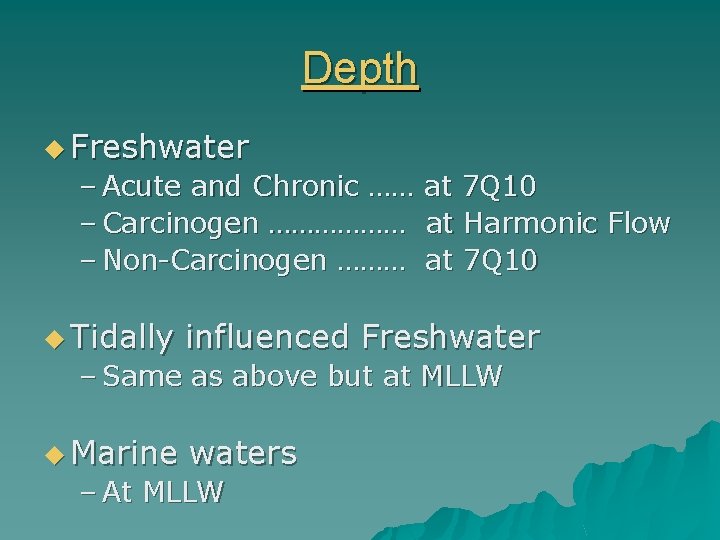
Depth u Freshwater – Acute and Chronic …… – Carcinogen ……………… – Non-Carcinogen ……… u Tidally at 7 Q 10 at Harmonic Flow at 7 Q 10 influenced Freshwater – Same as above but at MLLW u Marine waters – At MLLW
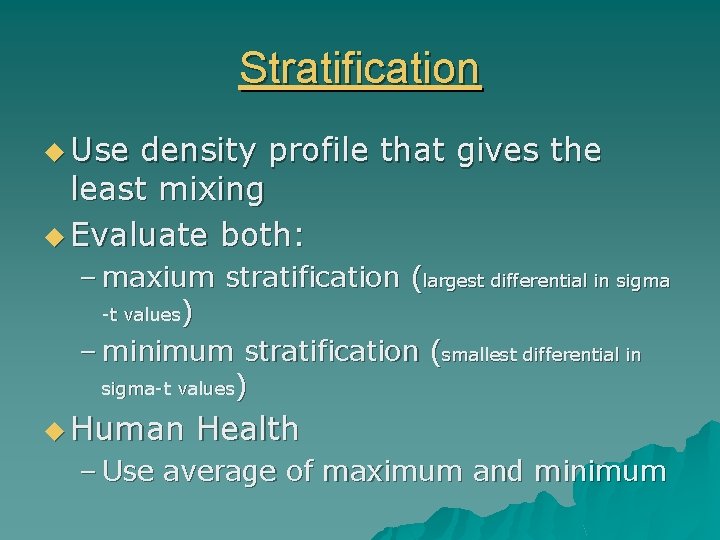
Stratification u Use density profile that gives the least mixing u Evaluate both: – maxium stratification (largest differential in sigma -t values) – minimum stratification (smallest differential in sigma-t values) u Human Health – Use average of maximum and minimum
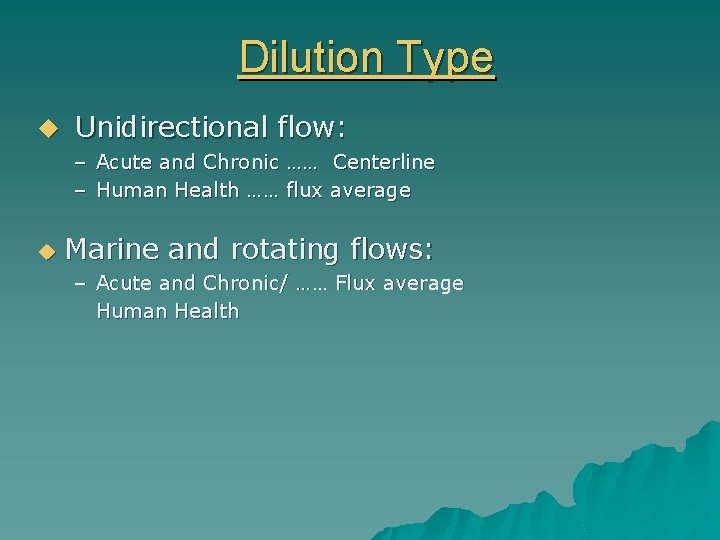
Dilution Type u Unidirectional flow: – Acute and Chronic …… Centerline – Human Health …… flux average u Marine and rotating flows: – Acute and Chronic/ …… Flux average Human Health
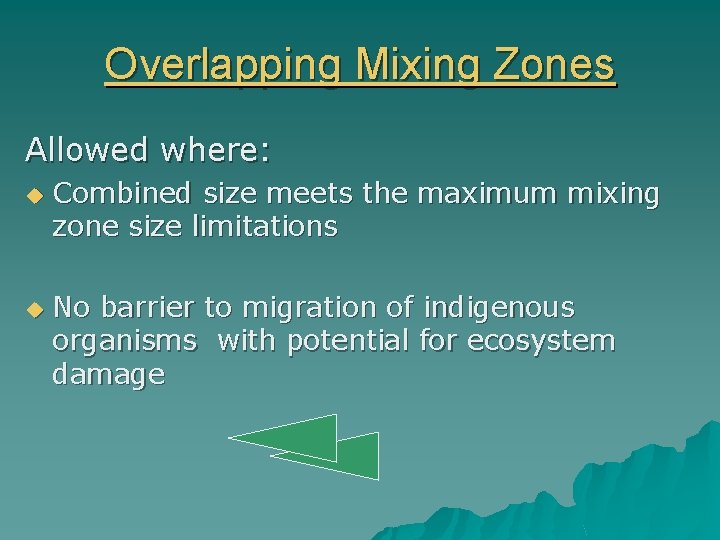
Overlapping Mixing Zones Allowed where: u u Combined size meets the maximum mixing zone size limitations No barrier to migration of indigenous organisms with potential for ecosystem damage
EXTENDED MIXING ZONES May be considered for: u Discharges existing prior to 1992 u Where altering the size increases protection u Where volume of effluent is more beneficial than removing the discharge. u Necessary for social or economic development in the area.
Mixing zones for Stormwater Maybe granted exemption from size limitations if: u All BMP’S have been applied u No potential threat to – Sensitive habitat and ecosystem – Public health – Beneficial uses u No barrier to migration of indigenous organisms with potential for ecosystem damage
Mixing zones for CSO’s • Must comply with all mixing zone requirements • But, exempt from size criteria once a year provided “no environmental harm” clause is fulfilled
UM 3 • • Simulates 3 D plume trajectory Predicts centerline based on 3/2 power (~gaussian) profile and top-hat (average) concentrations Multiport plume merging simulated with reflection technique Does not directly resolve lateral or bottom boundary constraints
VSW � � Same as UM 3 but applied to very shallow waters Resolves bottom constraint (bottom hit) by reflection technique
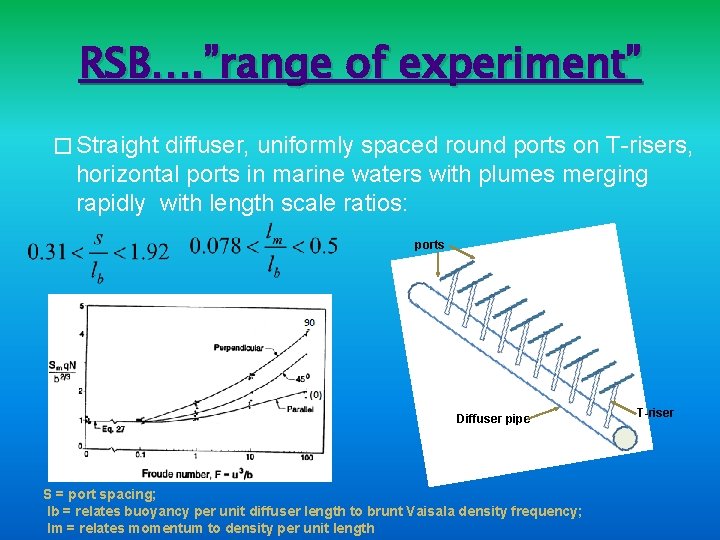
RSB…. ”range of experiment” � Straight diffuser, uniformly spaced round ports on T-risers, horizontal ports in marine waters with plumes merging rapidly with length scale ratios: ports Diffuser pipe S = port spacing; lb = relates buoyancy per unit diffuser length to brunt Vaisala density frequency; lm = relates momentum to density per unit length T-riser
CORMIX � CORMIX 1 single port positive/neutral buoyant discharges � CORMIX 2 multiport positive/neutral buoyant discharges � Uses “equivalent slot diffuser” � May need CORMIX 1 if plume details near each port are desired � CORMIX 3 buoyant surface discharge
RIVPLUME (based on Fischer et al. 1979) � Single port, short diffuser, or bank discharge � Plume completely and rapidly vertically mixed within the acute zone. So a 2 -D model � Uses mean cross-sectional velocity � It incorporates boundary effects of shoreline through superposition � Cannot model ambient density stratification, dense plumes or tidal buildup Available at the following site: http: //www. ecy. wa. gov/programs/eap/pwspread. html �
CFD (Computational Fluid Dynamics) Mesh = 2. 5 million grid cells (600 ft by 300 ft) Courtesy: Dr. Lin Fangbiao, Stantec Corporati