
What to learn from Mc Kinsey Background Strategic

What to learn from Mc. Kinsey
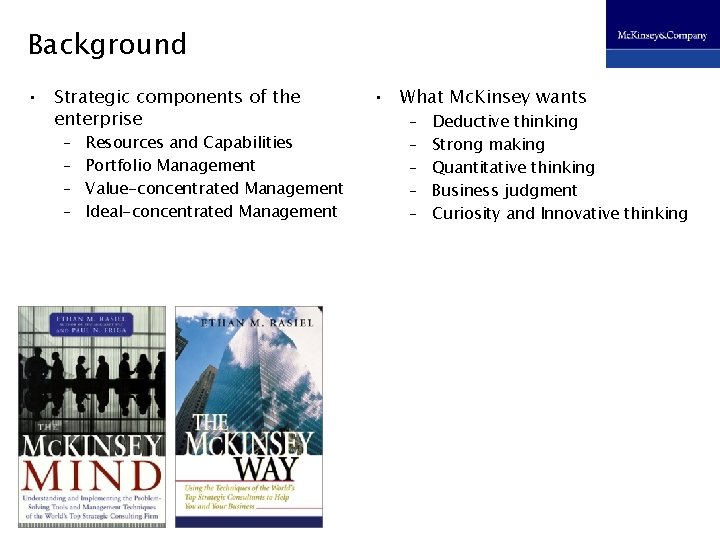
Background • Strategic components of the enterprise – – Resources and Capabilities Portfolio Management Value-concentrated Management Ideal-concentrated Management • What Mc. Kinsey wants – – – Deductive thinking Strong making Quantitative thinking Business judgment Curiosity and Innovative thinking
Too much is as bad as too little • How should we approach? – Deductive thinking • Confocal room / LM room / EM room / Histology room… – Strong making • 32 RJ 45 sockets / 20 Power outlets…. – Quantitative thinking • For each person, 2 PC x (15 faculty + 5 visiting) + 5 redundancy…. – Business judgment • Windows. PC with i. MAC and Sun SPARC for compatibility test…. – Curiosity and Innovative thinking • OCR on writing / voice command…
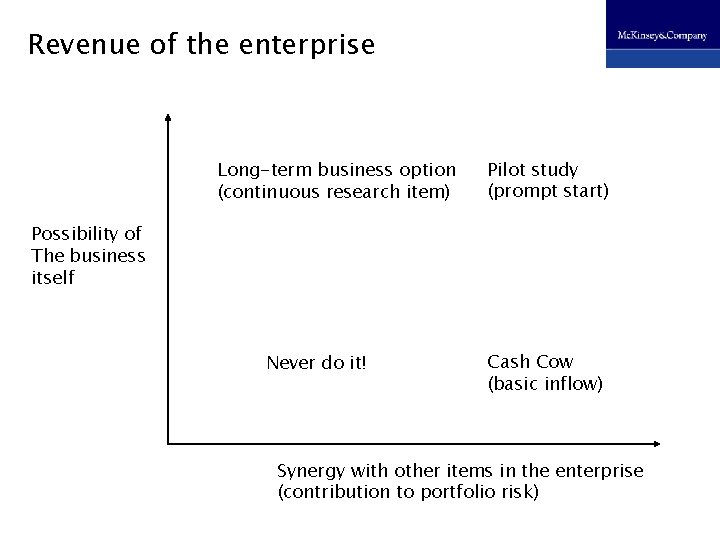
Revenue of the enterprise Long-term business option (continuous research item) Pilot study (prompt start) Possibility of The business itself Never do it! Cash Cow (basic inflow) Synergy with other items in the enterprise (contribution to portfolio risk)
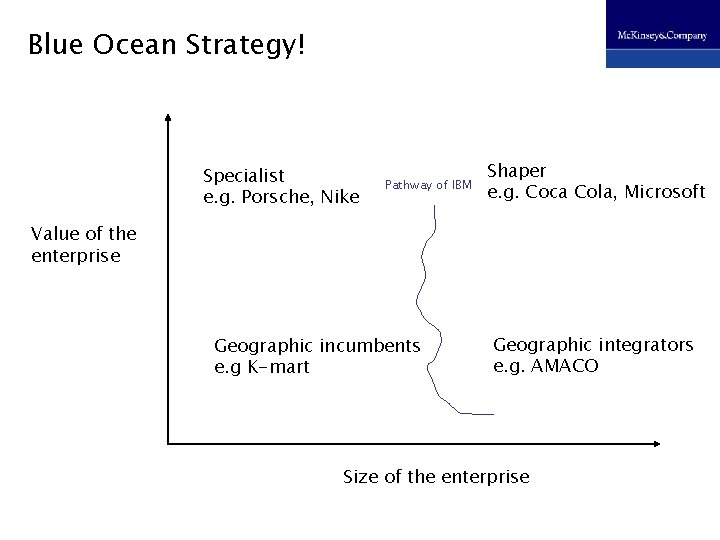
Blue Ocean Strategy! Specialist e. g. Porsche, Nike Pathway of IBM Shaper e. g. Coca Cola, Microsoft Value of the enterprise Geographic incumbents e. g K-mart Geographic integrators e. g. AMACO Size of the enterprise
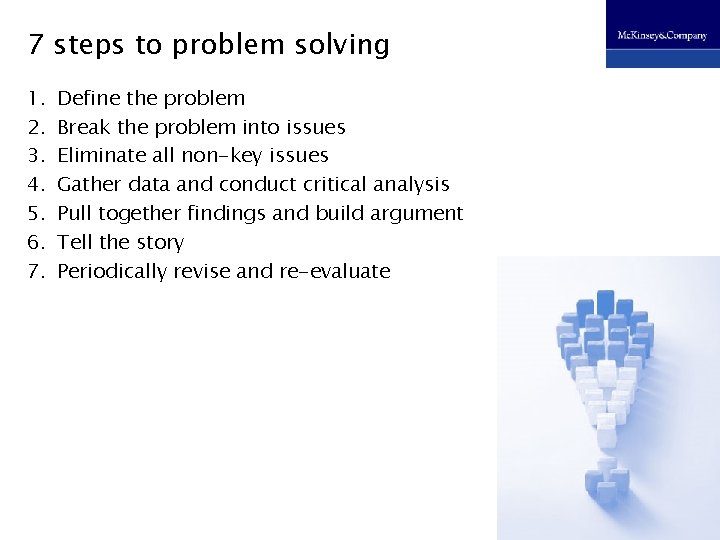
7 steps to problem solving 1. 2. 3. 4. 5. 6. 7. Define the problem Break the problem into issues Eliminate all non-key issues Gather data and conduct critical analysis Pull together findings and build argument Tell the story Periodically revise and re-evaluate
Problem solving approach • • • > Impact-driven Focused Fact-based Logical problem solving > IMPACT

Characteristics of good problem statement • A thought-provoking question, not a fact • Keep SMART – – – specific, not general measurable actionable relevant, keep on focusing time-bound • focused on what the decision makers need to move forward • debatable (not a statement of fact or non-disputable assertion)
Characteristics of good problem statement • Always keep ‘SMART’ – specific, not general • All OS should be upgraded to Windows Vista – measurable • Measure all the cell size and calculate the variance – actionable • Clean bench on the 2 nd floor – relevant, keep on focusing • Filtered water in each room – time-bound • Figure database for image archiving
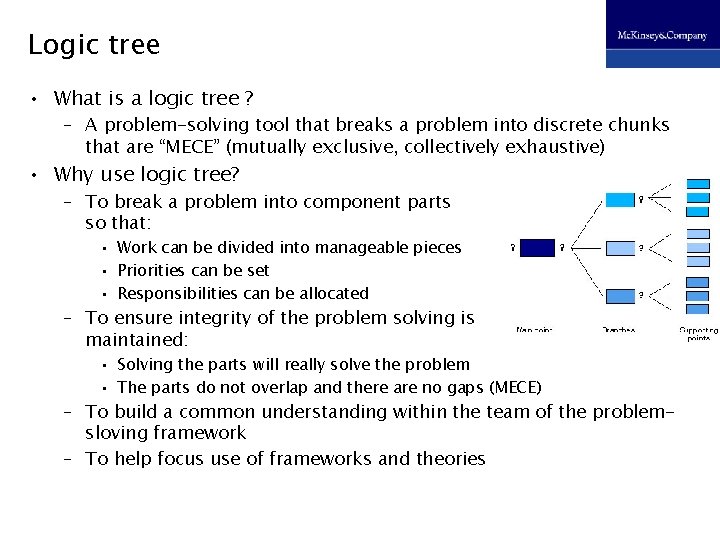
Logic tree • What is a logic tree ? – A problem-solving tool that breaks a problem into discrete chunks that are “MECE” (mutually exclusive, collectively exhaustive) • Why use logic tree? – To break a problem into component parts so that: • Work can be divided into manageable pieces • Priorities can be set • Responsibilities can be allocated – To ensure integrity of the problem solving is maintained: • Solving the parts will really solve the problem • The parts do not overlap and there are no gaps (MECE) – To build a common understanding within the team of the problemsloving framework – To help focus use of frameworks and theories
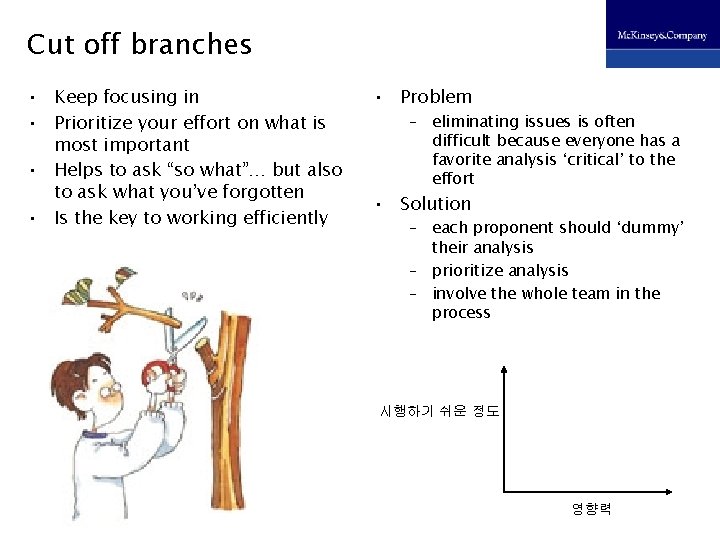
Cut off branches • Keep focusing in • Prioritize your effort on what is most important • Helps to ask “so what”… but also to ask what you’ve forgotten • Is the key to working efficiently • Problem – eliminating issues is often difficult because everyone has a favorite analysis ‘critical’ to the effort • Solution – each proponent should ‘dummy’ their analysis – prioritize analysis – involve the whole team in the process 시행하기 쉬운 정도 영향력
Collect data and do analysis • • Always do deep analysis on selected samples Documentation Clarify duty and director Continuous conversation for sharing vision
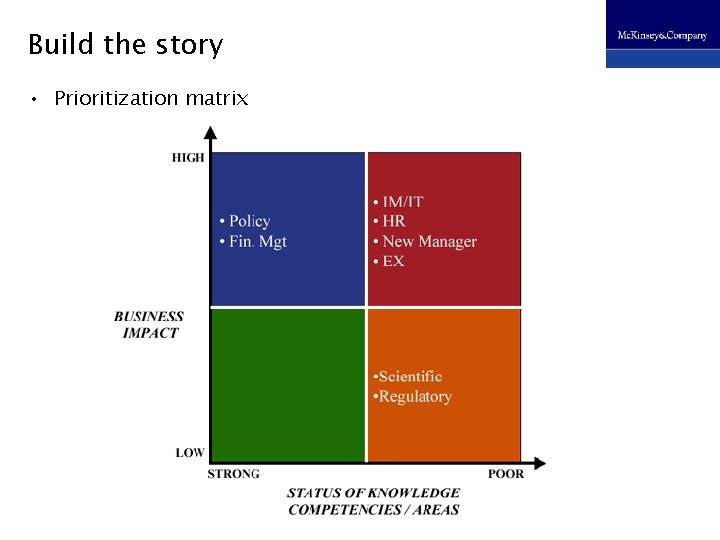
Build the story • Prioritization matrix
What Mc. Kinsey looks for • Solving problems – thinking logically, conceptually – demonstrate curiosity, creativity, business judgement, tolerance for ambiguity, feel for numbers • Driving for excellence – Set high aspirations and performance standards – overcome challenges with perseverance – are willing to take risks • Impacting others – – Proactively build relationship influence others’ thoughts and decisions take leadership collaborate with others to achieve goals • Personal value – Have positive, “can do” attitude, maturity, and integrity to function as a reliable and trustworthy professional
- Slides: 14