
What to Expect When Expecting ESL Students Practical
- Slides: 17
What to Expect When Expecting ESL Students: Practical Suggestions for Accommodating English Language Learners in the Regular Classroom Created by Jenny Shickley
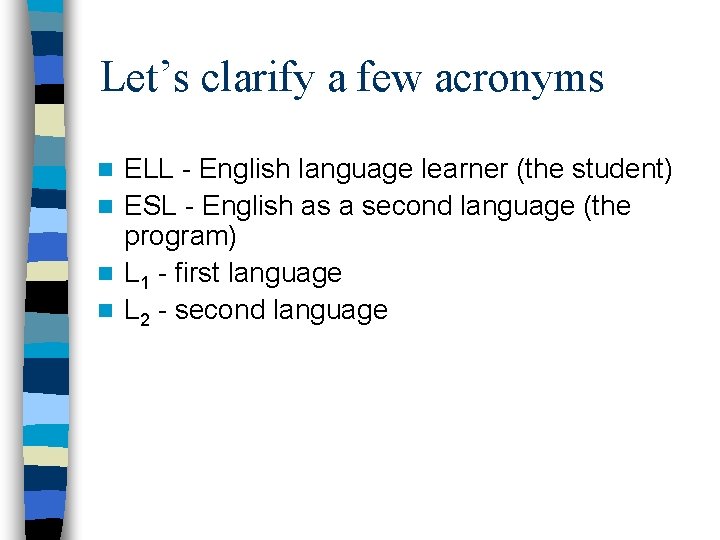
Let’s clarify a few acronyms ELL - English language learner (the student) n ESL - English as a second language (the program) n L 1 - first language n L 2 - second language n
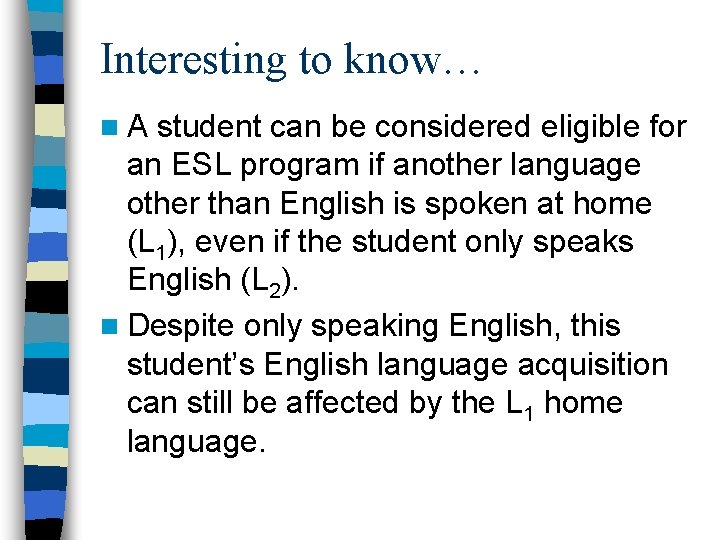
Interesting to know… n. A student can be considered eligible for an ESL program if another language other than English is spoken at home (L 1), even if the student only speaks English (L 2). n Despite only speaking English, this student’s English language acquisition can still be affected by the L 1 home language.
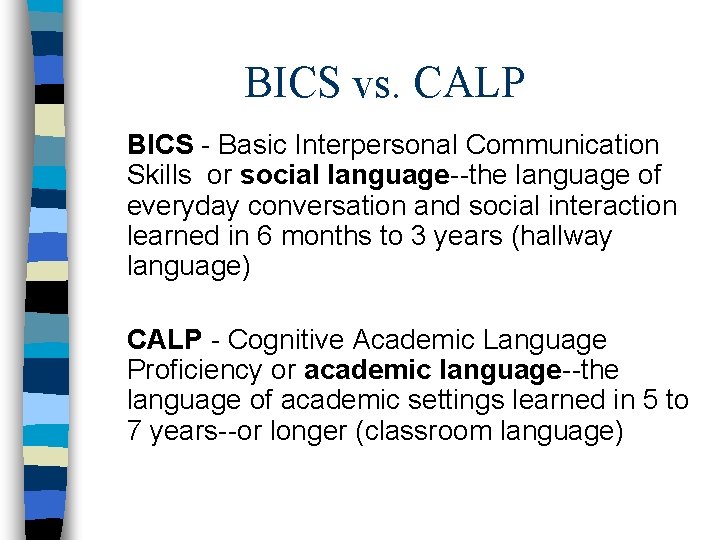
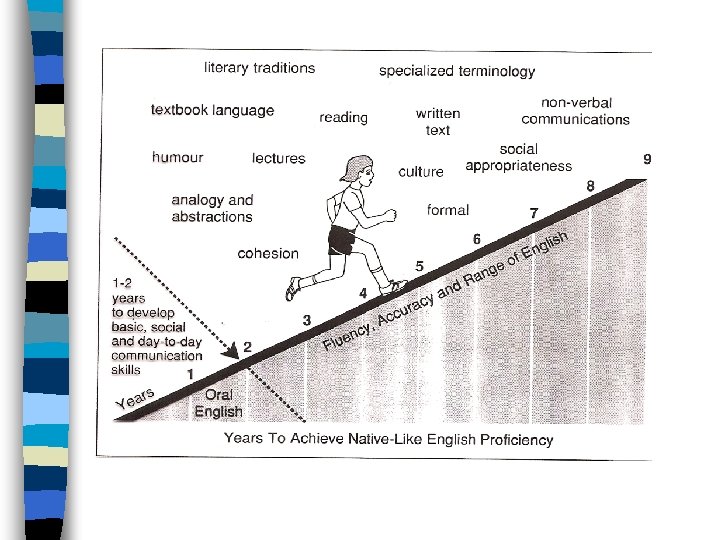
BICS vs. CALP BICS - Basic Interpersonal Communication Skills or social language--the language of everyday conversation and social interaction learned in 6 months to 3 years (hallway language) CALP - Cognitive Academic Language Proficiency or academic language--the language of academic settings learned in 5 to 7 years--or longer (classroom language)
Can Do Descriptors (ESL Levels): n Teachers should use the “Can-Do” descriptor chart when planning activities and assessments for ELLs. n Level I – Entering n Level II – Beginning n Level III – Developing n Level IV – Expanding n Level V – Bridging
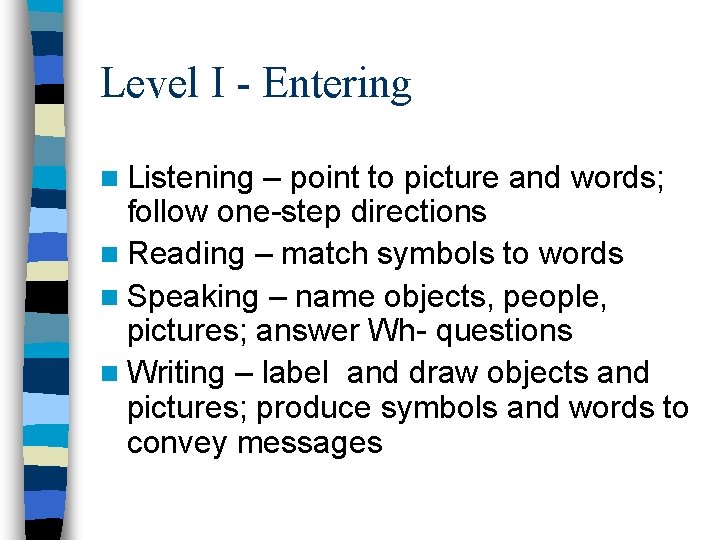
Level I - Entering n Listening – point to picture and words; follow one-step directions n Reading – match symbols to words n Speaking – name objects, people, pictures; answer Wh- questions n Writing – label and draw objects and pictures; produce symbols and words to convey messages
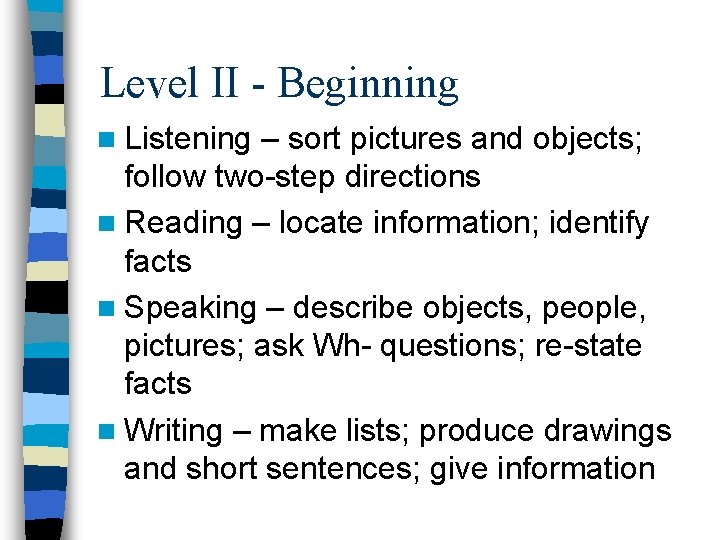
Level II - Beginning n Listening – sort pictures and objects; follow two-step directions n Reading – locate information; identify facts n Speaking – describe objects, people, pictures; ask Wh- questions; re-state facts n Writing – make lists; produce drawings and short sentences; give information
Level III - Developing n Listening – locate/sequence information; follow multi-step directions n Speaking – make predictions; describe process and retell stories n Reading – Identify main ideas; use context clues to determine meaning n Writing – simple compare/contrast; simple descriptions and narratives
Level IV - Expanding n Listening – compare/contrast relationships, analyze, and identify information from oral instruction n Speaking – discuss class topics; give speeches; offer solutions n Reading – Find supporting details; interpret information; identify figures of speech n Writing – summarize notes; edit and revise; create original ideas.
Level V - Bridging n Listening – make connections and draw conclusions from class discussion n Speaking – Debate; give examples; express point of view n Reading – acquire information from many texts; infer. n Writing – author multiple forms of writing
What can teachers to do to help ELLs succeed in the classroom?
Checking for Comprehension Avoid simple “yes/no” comprehension questions like, “Do you understand? ” n Pay attention to non-verbal cues (confusion/attention/action). n Ask open-ended questions regarding comprehension. - Ask them to complete the sentence. - Ask them to show you. - Ask them to repeat/explain your instructions. n End with review. Repeating your instructions can reinforce the student’s comprehension. n
Testing Accommodations Use MULTIPLE accommodations! n Highlight key words n Use old tests for review n Reduce length of test as appropriate n Provide review sheet with answers n Reduce language complexity n Reduce number of choices (no less than PSSA) n Provide a word bank for fill-in-the-blank
Reduce essay requirements or assign a specific writing topic prior to the test n Divide essays into separate parts n Read the test aloud to students with more basic English proficiency n Provide extended time to complete the test n Give the option of writing or speaking answers rather than multiple choice n Provide students with a language dictionary n
Modifying the Language for Assignments n Provide a word bank n Assign fewer questions n Choose questions that get at the “big idea” n Evaluate for content only - the message and not the means n Provide models, examples, and outlines
Strategies for Grading Assessments n Highlighter Method – identify areas affected by language acquisition and limit your deductions to non-highlighted areas n Talk-it-out – when language interferes with teacher comprehension initiate a conference and ask the student to explain themselves; make needed corrections and continue n Make allotments for effort and participation