
What the Composition of Galactic Cosmic Rays Tells
- Slides: 22
What the Composition of Galactic Cosmic Rays Tells us About the Origin of GCRs M. E. Wiedenbeck Jet Propulsion Laboratory, California Institute of Technology with thanks to the ACE/CRIS and Super. TIGER instrument teams 12 Oct 2017 Cosmic Ray Anisotropy Workshop 2017 1
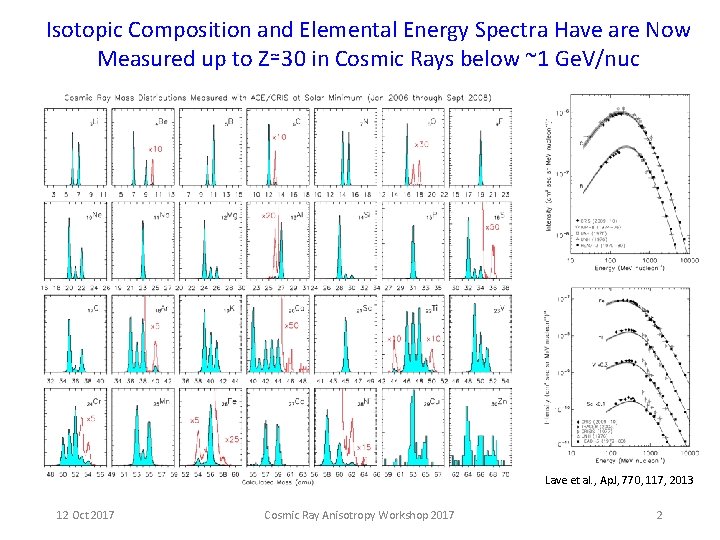
Isotopic Composition and Elemental Energy Spectra Have are Now Measured up to Z≃30 in Cosmic Rays below ~1 Ge. V/nuc Lave et al. , Ap. J, 770, 117, 2013 12 Oct 2017 Cosmic Ray Anisotropy Workshop 2017 2
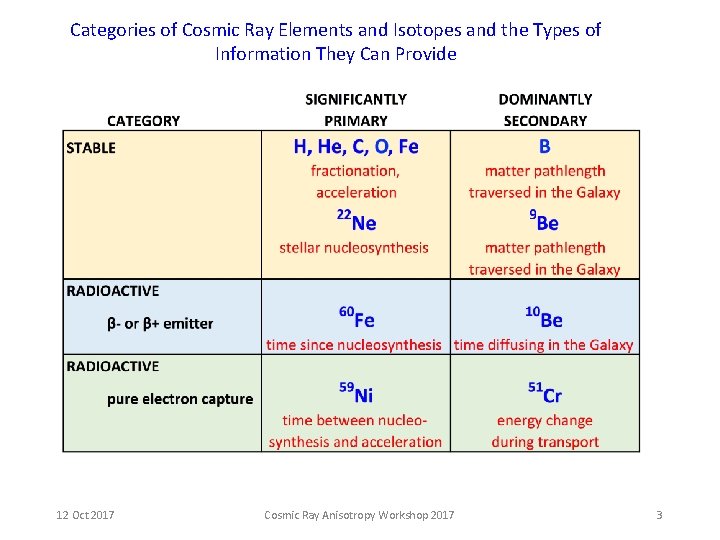
Categories of Cosmic Ray Elements and Isotopes and the Types of Information They Can Provide 12 Oct 2017 Cosmic Ray Anisotropy Workshop 2017 3
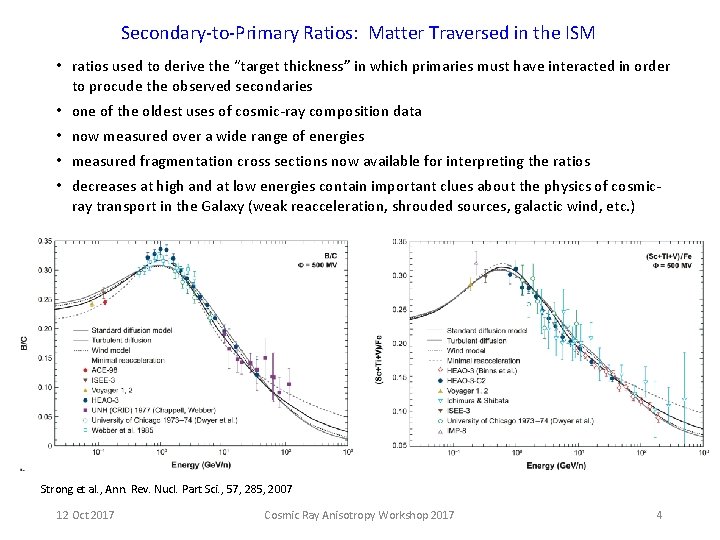
Secondary-to-Primary Ratios: Matter Traversed in the ISM • ratios used to derive the “target thickness” in which primaries must have interacted in order to procude the observed secondaries • one of the oldest uses of cosmic-ray composition data • now measured over a wide range of energies • measured fragmentation cross sections now available for interpreting the ratios • decreases at high and at low energies contain important clues about the physics of cosmicray transport in the Galaxy (weak reacceleration, shrouded sources, galactic wind, etc. ) Strong et al. , Ann. Rev. Nucl. Part Sci. , 57, 285, 2007 12 Oct 2017 Cosmic Ray Anisotropy Workshop 2017 4
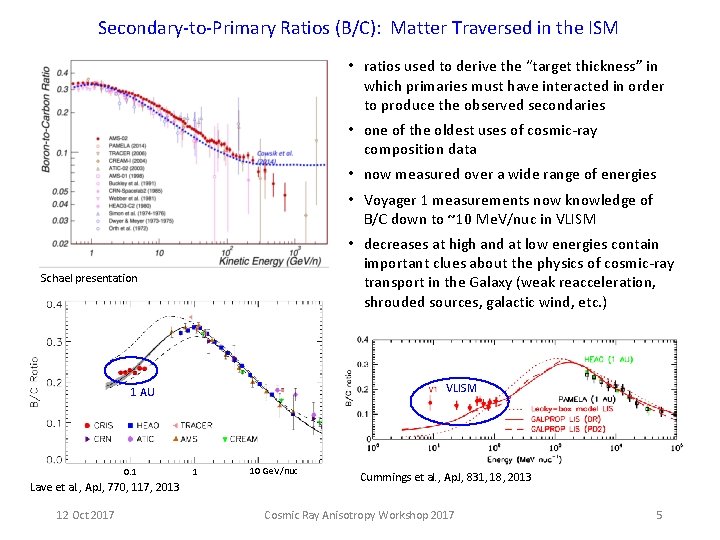
Secondary-to-Primary Ratios (B/C): Matter Traversed in the ISM • ratios used to derive the “target thickness” in which primaries must have interacted in order to produce the observed secondaries • one of the oldest uses of cosmic-ray composition data • now measured over a wide range of energies • Voyager 1 measurements now knowledge of B/C down to ~10 Me. V/nuc in VLISM • decreases at high and at low energies contain important clues about the physics of cosmic-ray transport in the Galaxy (weak reacceleration, shrouded sources, galactic wind, etc. ) Schael presentation VLISM 1 AU 0. 1 Lave et al. , Ap. J, 770, 117, 2013 12 Oct 2017 1 10 Ge. V/nuc Cummings et al. , Ap. J, 831, 18, 2013 Cosmic Ray Anisotropy Workshop 2017 5
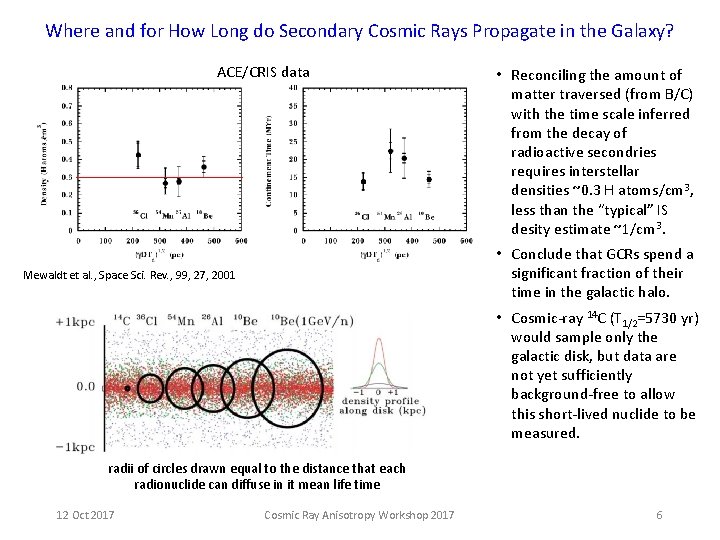
Where and for How Long do Secondary Cosmic Rays Propagate in the Galaxy? ACE/CRIS data • Reconciling the amount of matter traversed (from B/C) with the time scale inferred from the decay of radioactive secondries requires interstellar densities ~0. 3 H atoms/cm 3, less than the “typical” IS desity estimate ~1/cm 3. • Conclude that GCRs spend a significant fraction of their time in the galactic halo. Mewaldt et al. , Space Sci. Rev. , 99, 27, 2001 • Cosmic-ray 14 C (T 1/2=5730 yr) would sample only the galactic disk, but data are not yet sufficiently background-free to allow this short-lived nuclide to be measured. radii of circles drawn equal to the distance that each radionuclide can diffuse in it mean life time 12 Oct 2017 Cosmic Ray Anisotropy Workshop 2017 6
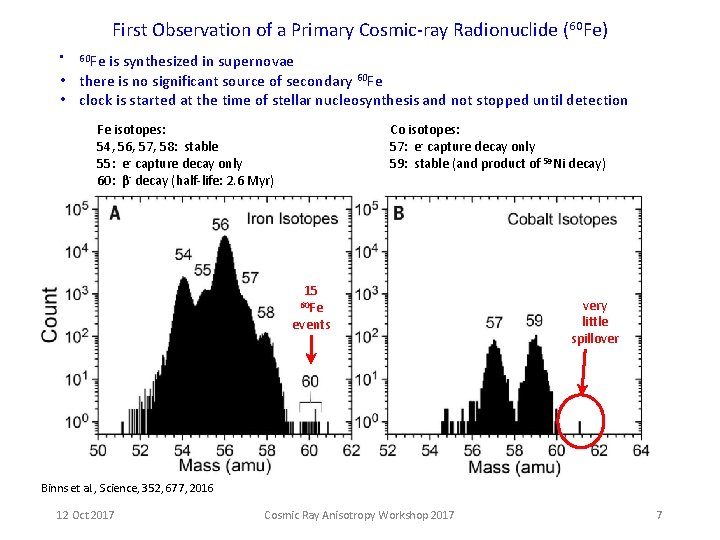
First Observation of a Primary Cosmic-ray Radionuclide (60 Fe) is synthesized in supernovae • there is no significant source of secondary 60 Fe • clock is started at the time of stellar nucleosynthesis and not stopped until detection • 60 Fe Co isotopes: 57: e- capture decay only 59: stable (and product of 59 Ni decay) Fe isotopes: 54, 56, 57, 58: stable 55: e- capture decay only 60: β- decay (half-life: 2. 6 Myr) 15 60 Fe events very little spillover Binns et al. , Science, 352, 677, 2016 12 Oct 2017 Cosmic Ray Anisotropy Workshop 2017 7
Significance of Surviving 60 Fe • the 60 Fe primary clock is sensitive to the time between when this nuclide was synthesized in a supernova explosion and when it is observed • the fundamental conclusions that can be drawn from the observation of live 60 Fe in the cosmic rays are: 1) the nucleosynthesis event did not occur significantly longer ago than the 2. 6 Myr half-life of 60 Fe 2) the nucleosynthesis event did not occur significantly farther away than cosmic rays can diffuse on this time scale, ~500 - 1000 pc • possible associations have been noted between the supernova that produced the GCR 60 Fe and events responsible for 60 Fe that has been found in samples from the ocean floor and from the lunar regolith indicating a nearby supernova ~2 Myr ago (reviewed by Fry et al. , Ap. J, 2016) • the derivation of the synthesized abundance of 60 Fe also depends on the propagation history of cosmic rays between their sources and Earth—several people have pointed out that our initial estimate of the 60 Fe/56 Fe ratio in the synthesized material using a simple leaky-box model significantly underestimates the source ratio as compared to a more realistic model in which the synthesis occurs in the galactic disk but cosmic rays diffuse throughout a larger halo 12 Oct 2017 Cosmic Ray Anisotropy Workshop 2017 8
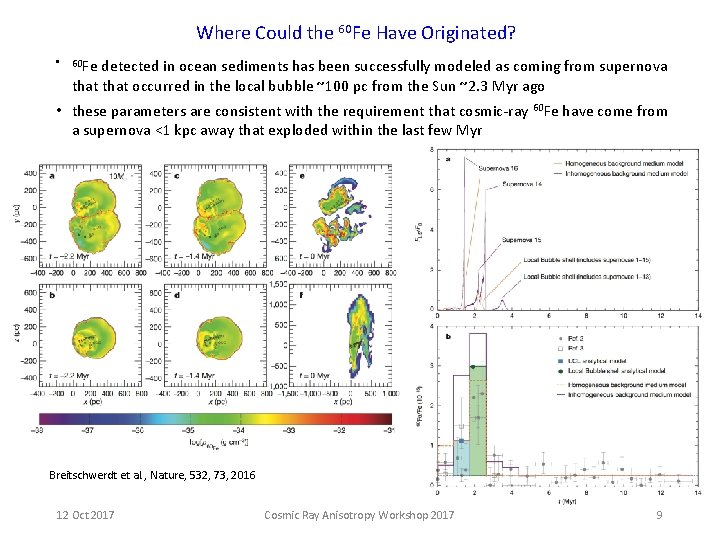
Where Could the 60 Fe Have Originated? • 60 Fe detected in ocean sediments has been successfully modeled as coming from supernova that occurred in the local bubble ~100 pc from the Sun ~2. 3 Myr ago • these parameters are consistent with the requirement that cosmic-ray 60 Fe have come from a supernova <1 kpc away that exploded within the last few Myr Breitschwerdt et al. , Nature, 532, 73, 2016 12 Oct 2017 Cosmic Ray Anisotropy Workshop 2017 9
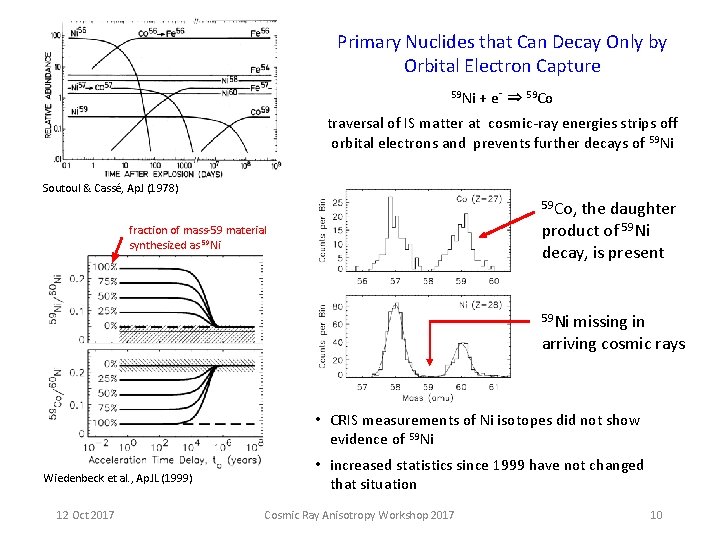
Primary Nuclides that Can Decay Only by Orbital Electron Capture 59 Ni + e- ⇒ 59 Co traversal of IS matter at cosmic-ray energies strips off orbital electrons and prevents further decays of 59 Ni Soutoul & Cassé, Ap. J (1978) 59 Co, the daughter product of 59 Ni decay, is present fraction of mass-59 material synthesized as 59 Ni missing in arriving cosmic rays • CRIS measurements of Ni isotopes did not show evidence of 59 Ni Wiedenbeck et al. , Ap. JL (1999) 12 Oct 2017 • increased statistics since 1999 have not changed that situation Cosmic Ray Anisotropy Workshop 2017 10
Interpretation of the Lack of 59 Ni in the Cosmic Rays • two possibilities: a. 59 Ni was present in supernova ejecta but it spent significantly longer than the halflife (76, 000 yr) in the interstellar medium with electrons attached before being accelerated b. the nucleosynthesis yield of 59 Ni was so low that the cosmic-ray measurements are not sensitive to the time between nucleosynthesis and acceleration • the early CRIS result (Wiedenbeck et al. , Ap. JL, 1999) was interpreted as evidence for >105 yr time delay between nucleosynthesis and acceleration (“possibility a”), based on nucleosynthesis yield calculations current at that time (Woosley & Weaver, Ap. JS, 1995) • recently, Neronov & Meynet (A&A 2016) pointed out that the more-recent supernova nucleosynthesis calculations of Chieffi & Limongi (Ap. J, 2013) found much lower yields of 59 Ni, supporting “possibility b” • the question of whether the lack of 59 Ni is attributable to a long time delay between nucleosynthesis and acceleration remains open • resolving this question is important—a long time delay excludes the possibility that a supernova’s nucleosynthesis products could be accelerated by a shock driven by the same supernova • the resolution depends on conclusively establishing how much 59 Ni is synthesized and ejected by supernovae 12 Oct 2017 Cosmic Ray Anisotropy Workshop 2017 11
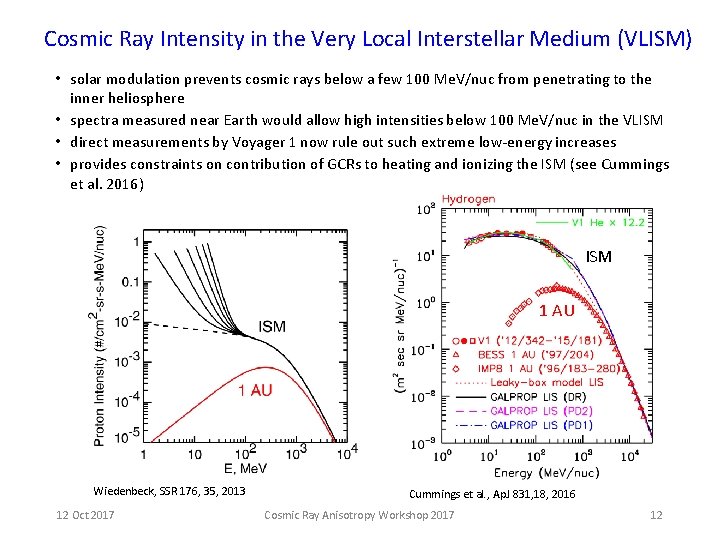
Cosmic Ray Intensity in the Very Local Interstellar Medium (VLISM) • solar modulation prevents cosmic rays below a few 100 Me. V/nuc from penetrating to the inner heliosphere • spectra measured near Earth would allow high intensities below 100 Me. V/nuc in the VLISM • direct measurements by Voyager 1 now rule out such extreme low-energy increases • provides constraints on contribution of GCRs to heating and ionizing the ISM (see Cummings et al. 2016) ISM 1 AU Wiedenbeck, SSR 176, 35, 2013 12 Oct 2017 Cummings et al. , Ap. J 831, 18, 2016 Cosmic Ray Anisotropy Workshop 2017 12
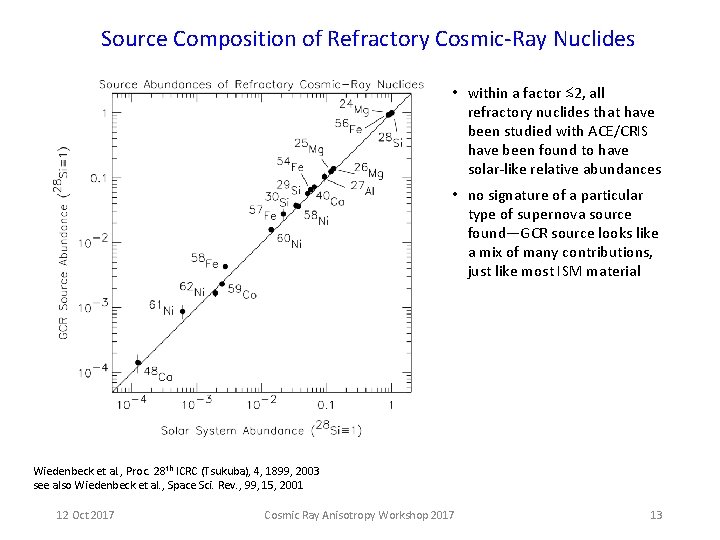
Source Composition of Refractory Cosmic-Ray Nuclides • within a factor ≲ 2, all refractory nuclides that have been studied with ACE/CRIS have been found to have solar-like relative abundances • no signature of a particular type of supernova source found—GCR source looks like a mix of many contributions, just like most ISM material Wiedenbeck et al. , Proc. 28 th ICRC (Tsukuba), 4, 1899, 2003 see also Wiedenbeck et al. , Space Sci. Rev. , 99, 15, 2001 12 Oct 2017 Cosmic Ray Anisotropy Workshop 2017 13
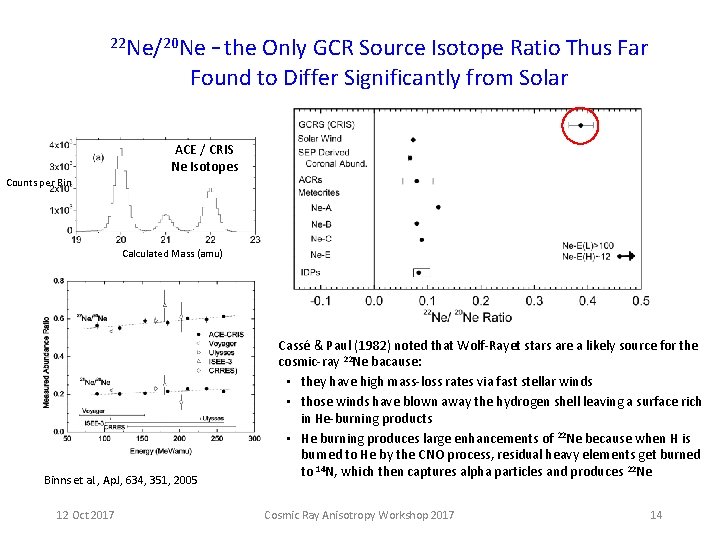
– the Only GCR Source Isotope Ratio Thus Far Found to Differ Significantly from Solar 22 Ne/20 Ne ACE / CRIS Ne Isotopes Counts per Bin Calculated Mass (amu) Binns et al. , Ap. J, 634, 351, 2005 12 Oct 2017 Cassé & Paul (1982) noted that Wolf-Rayet stars are a likely source for the cosmic-ray 22 Ne bacause: • they have high mass-loss rates via fast stellar winds • those winds have blown away the hydrogen shell leaving a surface rich in He-burning products • He burning produces large enhancements of 22 Ne because when H is burned to He by the CNO process, residual heavy elements get burned to 14 N, which then captures alpha particles and produces 22 Ne Cosmic Ray Anisotropy Workshop 2017 14
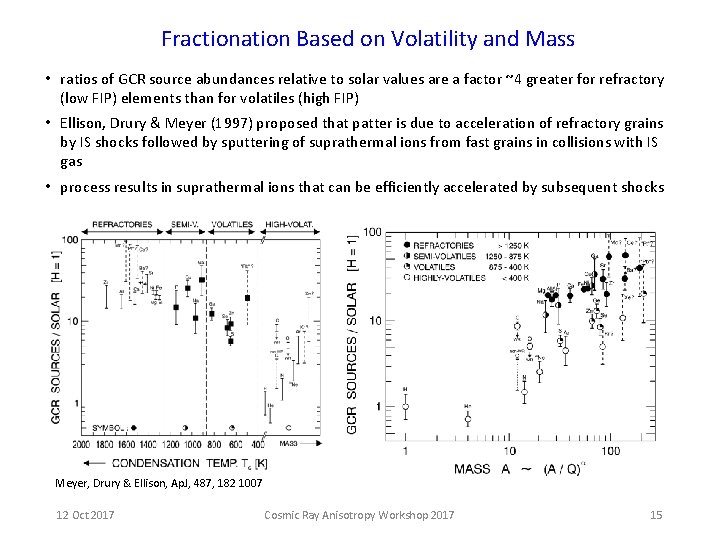
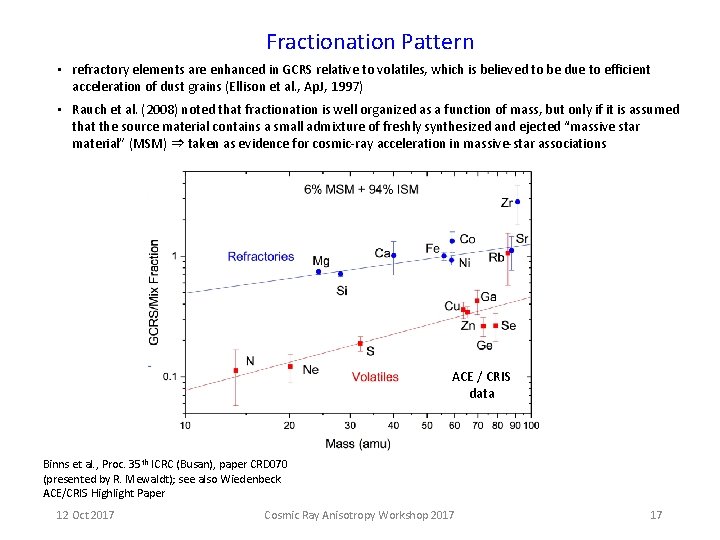
Fractionation Based on Volatility and Mass • ratios of GCR source abundances relative to solar values are a factor ~4 greater for refractory (low FIP) elements than for volatiles (high FIP) • Ellison, Drury & Meyer (1997) proposed that patter is due to acceleration of refractory grains by IS shocks followed by sputtering of suprathermal ions from fast grains in collisions with IS gas • process results in suprathermal ions that can be efficiently accelerated by subsequent shocks density of O and B stars in the solar neighborhood (artist’s impression) Meyer, Drury & Ellison, Ap. J, 487, 182 1007 12 Oct 2017 Cosmic Ray Anisotropy Workshop 2017 15
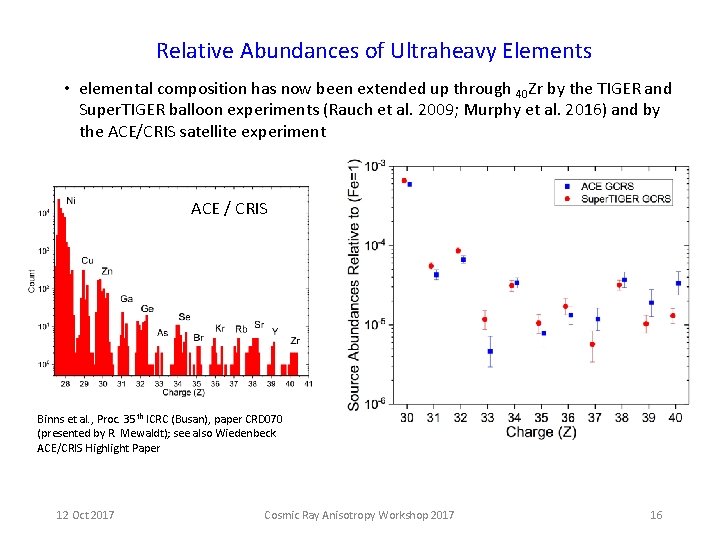
Relative Abundances of Ultraheavy Elements • elemental composition has now been extended up through 40 Zr by the TIGER and Super. TIGER balloon experiments (Rauch et al. 2009; Murphy et al. 2016) and by the ACE/CRIS satellite experiment ACE / CRIS Binns et al. , Proc. 35 th ICRC (Busan), paper CRD 070 (presented by R. Mewaldt); see also Wiedenbeck ACE/CRIS Highlight Paper 12 Oct 2017 Cosmic Ray Anisotropy Workshop 2017 16
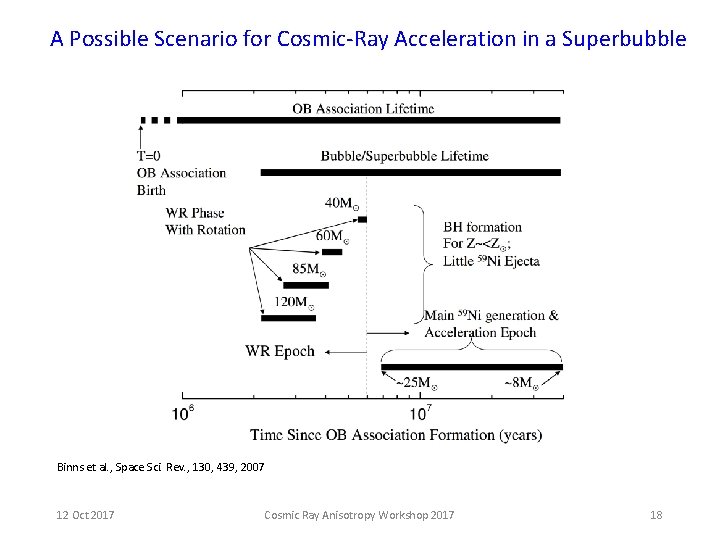
Fractionation Pattern • refractory elements are enhanced in GCRS relative to volatiles, which is believed to be due to efficient acceleration of dust grains (Ellison et al. , Ap. J, 1997) • Rauch et al. (2008) noted that fractionation is well organized as a function of mass, but only if it is assumed that the source material contains a small admixture of freshly synthesized and ejected “massive star material” (MSM) ⇒ taken as evidence for cosmic-ray acceleration in massive-star associations ACE / CRIS data Binns et al. , Proc. 35 th ICRC (Busan), paper CRD 070 (presented by R. Mewaldt); see also Wiedenbeck ACE/CRIS Highlight Paper 12 Oct 2017 Cosmic Ray Anisotropy Workshop 2017 17
A Possible Scenario for Cosmic-Ray Acceleration in a Superbubble Binns et al. , Space Sci. Rev. , 130, 439, 2007 12 Oct 2017 Cosmic Ray Anisotropy Workshop 2017 18
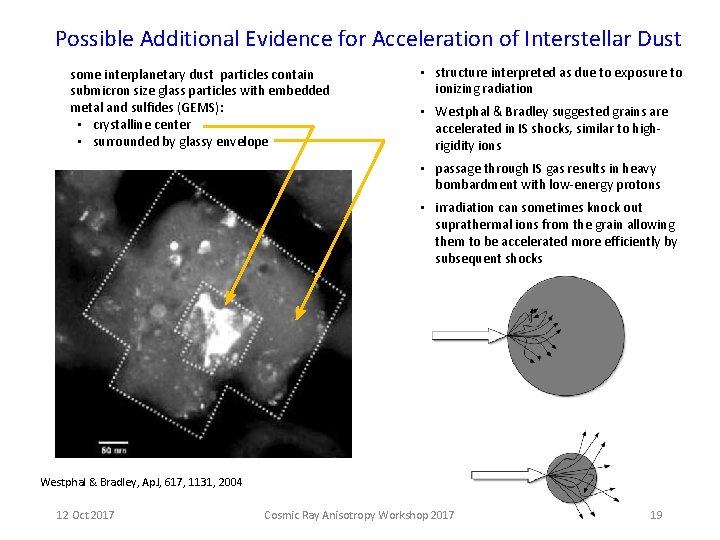
Possible Additional Evidence for Acceleration of Interstellar Dust some interplanetary dust particles contain submicron size glass particles with embedded metal and sulfides (GEMS): • crystalline center • surrounded by glassy envelope • structure interpreted as due to exposure to ionizing radiation • Westphal & Bradley suggested grains are accelerated in IS shocks, similar to highrigidity ions • passage through IS gas results in heavy bombardment with low-energy protons • irradiation can sometimes knock out suprathermal ions from the grain allowing them to be accelerated more efficiently by subsequent shocks Westphal & Bradley, Ap. J, 617, 1131, 2004 12 Oct 2017 Cosmic Ray Anisotropy Workshop 2017 19
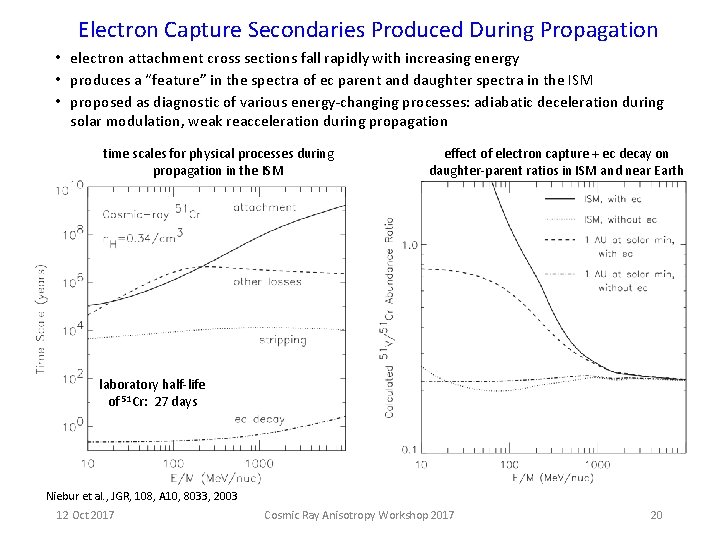
Electron Capture Secondaries Produced During Propagation • electron attachment cross sections fall rapidly with increasing energy • produces a “feature” in the spectra of ec parent and daughter spectra in the ISM • proposed as diagnostic of various energy-changing processes: adiabatic deceleration during solar modulation, weak reacceleration during propagation time scales for physical processes during propagation in the ISM effect of electron capture + ec decay on daughter-parent ratios in ISM and near Earth laboratory half-life of 51 Cr: 27 days Niebur et al. , JGR, 108, A 10, 8033, 2003 12 Oct 2017 Cosmic Ray Anisotropy Workshop 2017 20
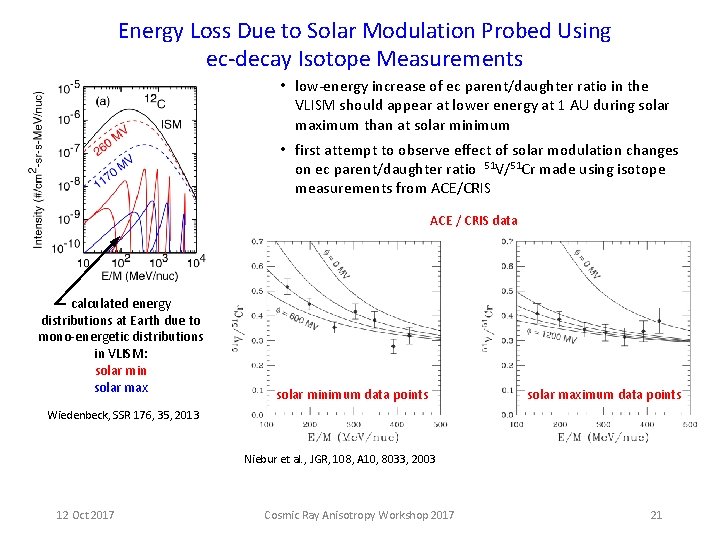
Energy Loss Due to Solar Modulation Probed Using ec-decay Isotope Measurements • low-energy increase of ec parent/daughter ratio in the VLISM should appear at lower energy at 1 AU during solar maximum than at solar minimum • first attempt to observe effect of solar modulation changes on ec parent/daughter ratio 51 V/51 Cr made using isotope measurements from ACE/CRIS ACE / CRIS data calculated energy distributions at Earth due to mono-energetic distributions in VLISM: solar min solar max solar minimum data points solar maximum data points Wiedenbeck, SSR 176, 35, 2013 Niebur et al. , JGR, 108, A 10, 8033, 2003 12 Oct 2017 Cosmic Ray Anisotropy Workshop 2017 21
Conclusions • measurements of elemental and isotopic composition and elemental energy spectra below ~1 Ge. V/nuc are providing important constraints on the origin of cosmic rays and the cosmic ray environment of the solar system: • amount of matter traversed in the Galaxy • time to escape and mean density in regions traversed • upper limits on the time and distance from the supernova that synthesized 60 Fe • the very low-energy part of the cosmic-ray spectrum in the VLISM (and its contributions to ionizing and heating the ISM) • fractionation and the possible role played by acceleration of interstellar dust • contributions from nucleosynthesis in special environments (22 Ne) • a model of cosmic ray origin that appears to be consistent with the observations has nucleosynthesis and acceleration occurring in associations of massive stars: • contribute an admixture of “massive start material” that gets accelerated along with old, solar-like interstellar matter • drive supernova shocks that are subsequently responsible for the acceleration • an interesting question to consider: can the low-energy cosmic rays we observe near the solar system have predominantly been accelerated and confined locally? • in the local bubble? (density ~0. 3 H/cm 3 is compatible with radioactive seconaries) • what additional tests could answer this question? 12 Oct 2017 Cosmic Ray Anisotropy Workshop 2017 22