
What the Blow Fly Saw Analyzing Entomological Evidence

What the Blow Fly Saw Analyzing Entomological Evidence to Solve Crimes
There are five questions posed during a death scene investigation • • • Who is the deceased? How did the death occur? Where did the death occur? When did the death occur? Is the death natural, accidental, or criminal? A forensic entomologist is primarily involved with the when and the where…

Why Use Insect Evidence? • Insects are generally the first to discover a corpse. In outdoor cases, blow flies arrive and lay eggs on the body within minutes of death. • Insects arrive in a somewhat predictable order. • The absence of insects when they should be present can provide evidence about the nature of the crime.
Do You Remember Your Classification System from Biology? • • Kingdom Phylum Class Order Family Genus species

Where do Insects Fit In? • • Animal Kingdom Arthropod Phylum Insect Class Order Odonata Orthoptera Mantidae Diptera Coleoptera Hemiptera Hymenoptera Lepidoptera
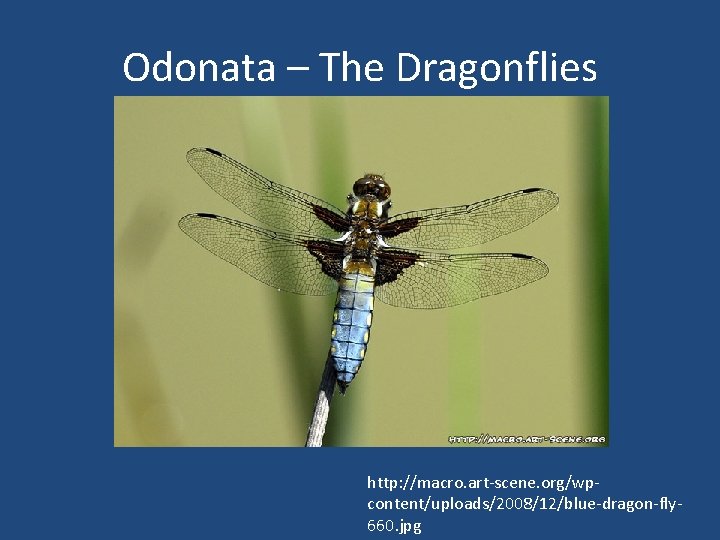
Odonata – The Dragonflies http: //macro. art-scene. org/wpcontent/uploads/2008/12/blue-dragon-fly 660. jpg
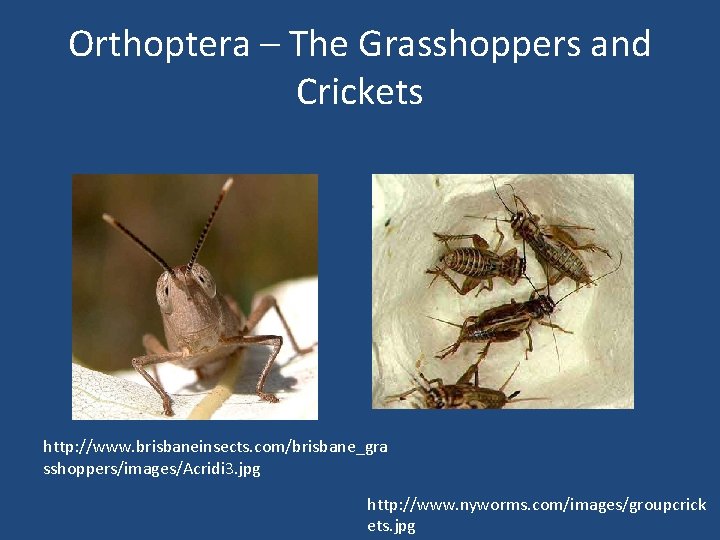
Orthoptera – The Grasshoppers and Crickets http: //www. brisbaneinsects. com/brisbane_gra sshoppers/images/Acridi 3. jpg http: //www. nyworms. com/images/groupcrick ets. jpg
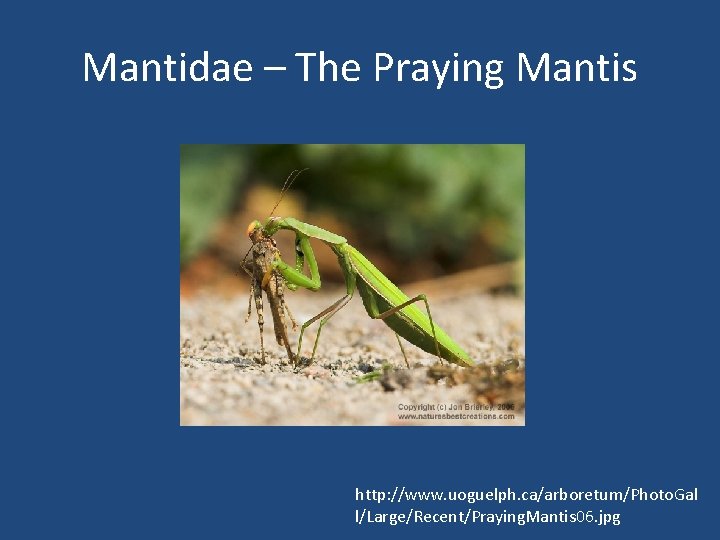
Mantidae – The Praying Mantis http: //www. uoguelph. ca/arboretum/Photo. Gal l/Large/Recent/Praying. Mantis 06. jpg
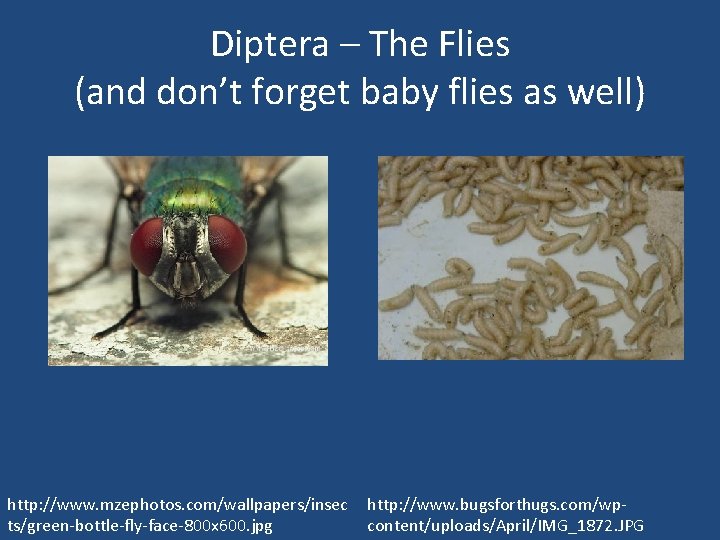
Diptera – The Flies (and don’t forget baby flies as well) http: //www. mzephotos. com/wallpapers/insec ts/green-bottle-fly-face-800 x 600. jpg http: //www. bugsforthugs. com/wpcontent/uploads/April/IMG_1872. JPG
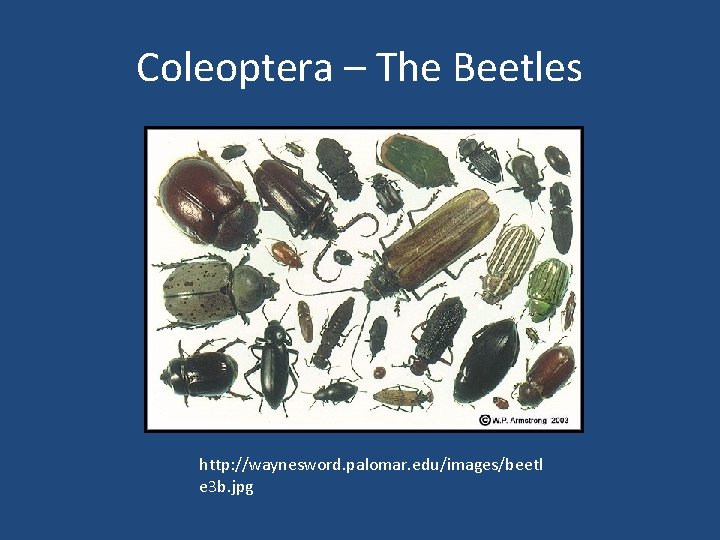
Coleoptera – The Beetles http: //waynesword. palomar. edu/images/beetl e 3 b. jpg
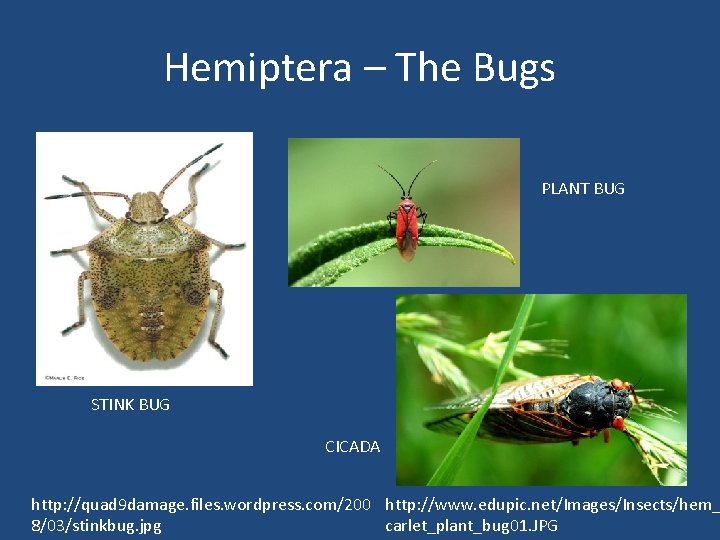
Hemiptera – The Bugs PLANT BUG STINK BUG CICADA http: //quad 9 damage. files. wordpress. com/200 http: //www. edupic. net/Images/Insects/hem_ 8/03/stinkbug. jpg carlet_plant_bug 01. JPG
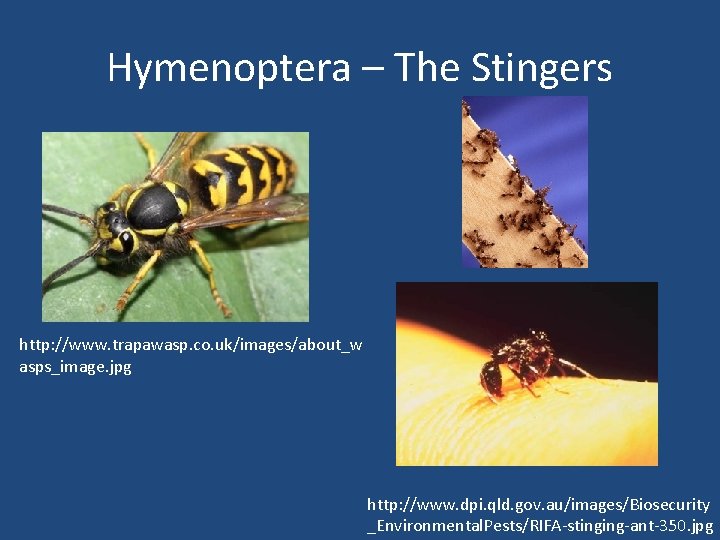
Hymenoptera – The Stingers http: //www. trapawasp. co. uk/images/about_w asps_image. jpg http: //www. dpi. qld. gov. au/images/Biosecurity _Environmental. Pests/RIFA-stinging-ant-350. jpg
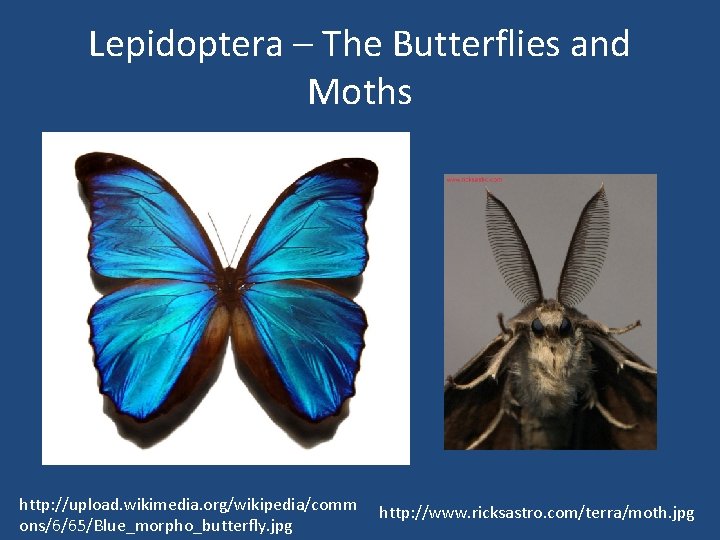
Lepidoptera – The Butterflies and Moths http: //upload. wikimedia. org/wikipedia/comm ons/6/65/Blue_morpho_butterfly. jpg http: //www. ricksastro. com/terra/moth. jpg
Two Orders of Insects that are Especially Useful to Forensic Entomologists: • Diptera (the flies) – Larva, the maggots, like to live in a semi-liquid medium. These insects are generally the first to move in on a corpse. They are responsible for most of the tissue loss. • Coleoptera (the beetles) – They like slightly dried out corpses and will come in later.
To Classify a Fly • • Kingdom – Animal Phylum – Arthropod Class – Insect Order – Diptera Family – Calliphoridae Genus - Calliphora Species - vomitoria
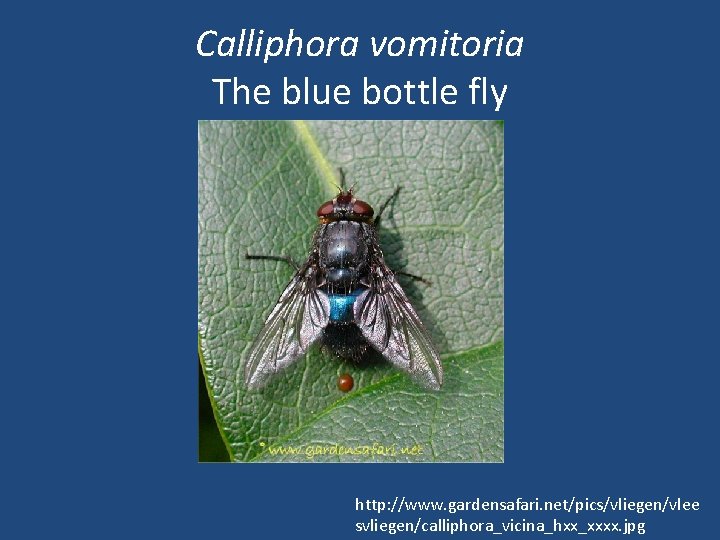
Calliphora vomitoria The blue bottle fly http: //www. gardensafari. net/pics/vliegen/vlee svliegen/calliphora_vicina_hxx_xxxx. jpg
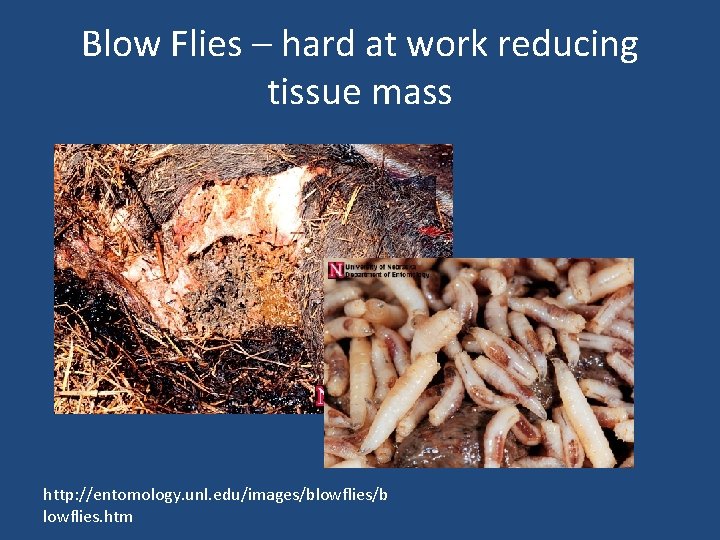
Blow Flies – hard at work reducing tissue mass http: //entomology. unl. edu/images/blowflies/b lowflies. htm
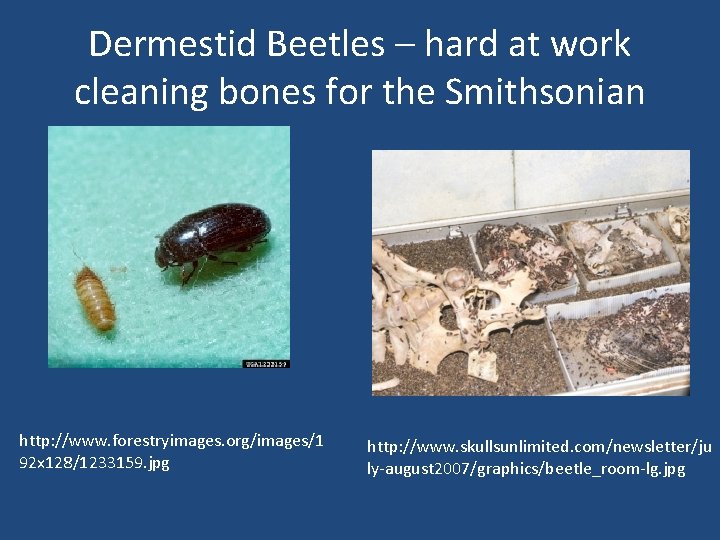
Dermestid Beetles – hard at work cleaning bones for the Smithsonian http: //www. forestryimages. org/images/1 92 x 128/1233159. jpg http: //www. skullsunlimited. com/newsletter/ju ly-august 2007/graphics/beetle_room-lg. jpg
Clues from Insects as to Where • Certain insects and mites live in sub corpse communities. If those animals are not present, it suggests that the corpse has been moved. • Insects like specific niches. If you find an insect on a body that doesn’t belong in the surrounding environment, the body may have been moved.
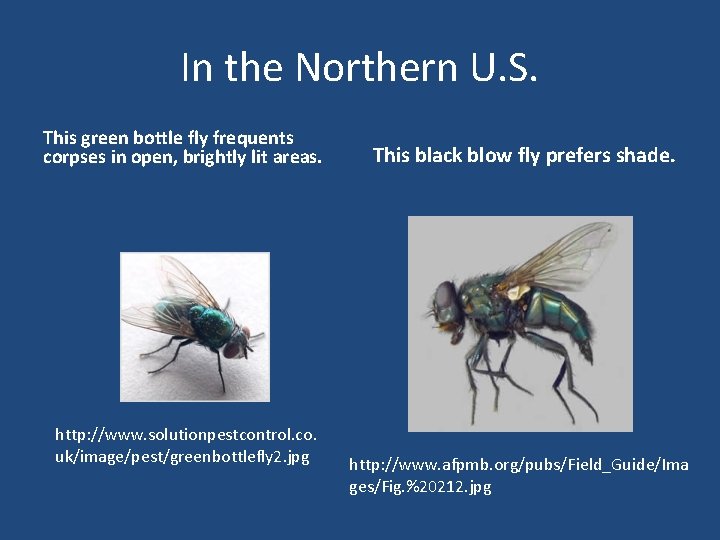
In the Northern U. S. This green bottle fly frequents corpses in open, brightly lit areas. http: //www. solutionpestcontrol. co. uk/image/pest/greenbottlefly 2. jpg This black blow fly prefers shade. http: //www. afpmb. org/pubs/Field_Guide/Ima ges/Fig. %20212. jpg
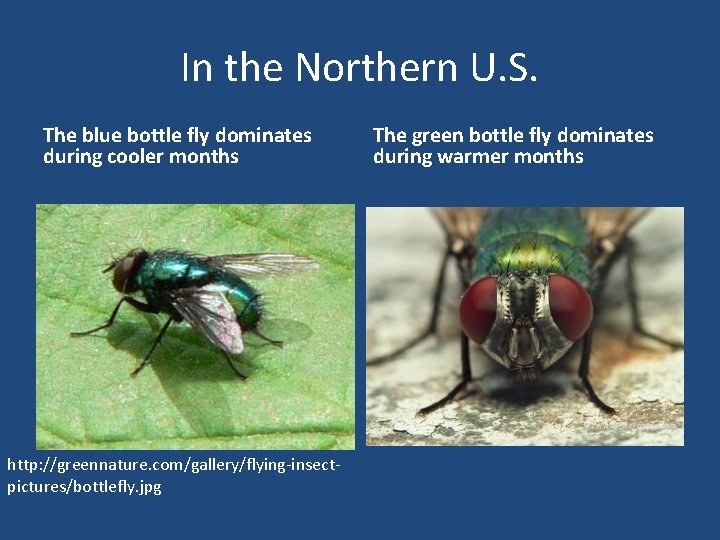
In the Northern U. S. The blue bottle fly dominates during cooler months http: //greennature. com/gallery/flying-insectpictures/bottlefly. jpg The green bottle fly dominates during warmer months
Clues from Insects as to How • If you find locations of concentrated insect activity on a corpse, that may suggest ante mortem (before death) injury. • For example, blow fly maggots concentrated on the neck of a victim are most likely there because a wound provided fresh blood.
Clues from Insects as to When The Concept of PMI stands for Post Mortem Interval. This is the time period between when the person died and when the body was discovered. PMI is important because it narrows the field of suspects and may help with the identification of the deceased if you look at a list of missing persons and when they went missing.

Video Clip - Forensic Entomology

Clues from Insects as to When Video Clip: Decay of a Fox Case Studies
Let’s Learn More about Determining PMI • Since insects are cold blooded, their rate of development is proportional to temperature. Cooler temperatures slow development. Warmer temperatures stimulate development.
Practice Question Suppose an insect species develops twice as fast at 20 ⁰C than at 10 ⁰C. Complete development takes 10 days at 20⁰C. Would it take more or less time at 10 ⁰C? How long would it take at 10 ⁰C? It would take 20 days, twice as long.
The Concept of ADH – Accumulated Degree Hours • Because insect development is so closely tied to temperature, entomologists have developed a system to help determine time of death by taking into account average daily temperatures and what is known about rearing insects in the lab. • The accumulated degree hour is calculated by multiplying the temperature times the hours it takes to go through a certain stage. ADH = temp x hours it takes to get to a stage

Blow Fly Life Cycle The clock starts at oviposition – the time the egg was laid. http: //www. cmnh. org/site/Img/Researchand. Col lections/Invert. Zoo/124_blowflylifecycle. RW. jpg Stage Calculation ADH Egg to 1 st Instar 70 x 23 1610 1 st Instar to 2 nd Instar 70 x 27 1890 2 nd Instar to 3 rd Instar 70 x 22 1540 3 rd Instar to Pupa 70 x 130 9100 Pupa to Adult 70 x 143 10010 Total from Egg to Adult 70 x 345 24150
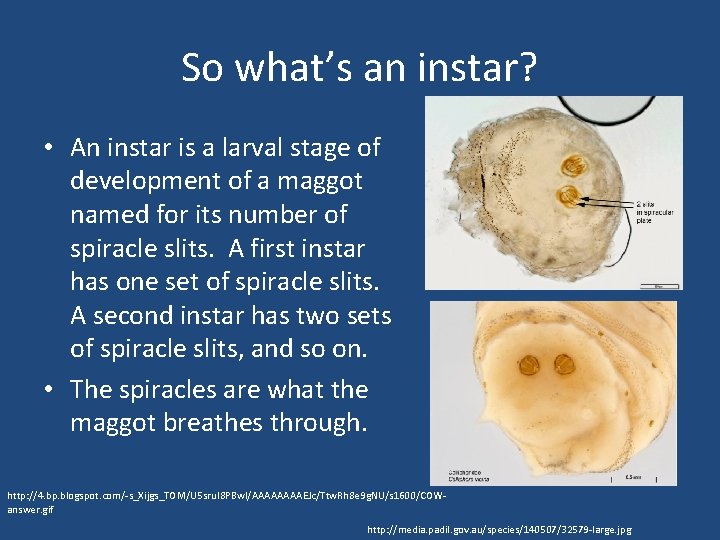
So what’s an instar? • An instar is a larval stage of development of a maggot named for its number of spiracle slits. A first instar has one set of spiracle slits. A second instar has two sets of spiracle slits, and so on. • The spiracles are what the maggot breathes through. http: //4. bp. blogspot. com/-s_Xijgs_TOM/U 5 sru. I 8 PBw. I/AAAAEJc/Ttw. Rh 8 e 9 g. NU/s 1600/COWanswer. gif http: //media. padil. gov. au/species/140507/32579 -large. jpg
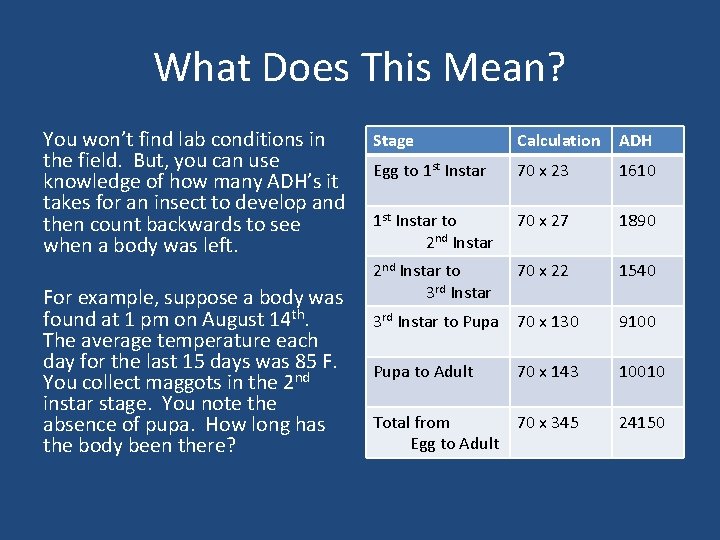
What Does This Mean? You won’t find lab conditions in the field. But, you can use knowledge of how many ADH’s it takes for an insect to develop and then count backwards to see when a body was left. For example, suppose a body was found at 1 pm on August 14 th. The average temperature each day for the last 15 days was 85 F. You collect maggots in the 2 nd instar stage. You note the absence of pupa. How long has the body been there? Stage Calculation ADH Egg to 1 st Instar 70 x 23 1610 1 st Instar to 2 nd Instar 70 x 27 1890 2 nd Instar to 3 rd Instar 70 x 22 1540 3 rd Instar to Pupa 70 x 130 9100 Pupa to Adult 70 x 143 10010 Total from Egg to Adult 70 x 345 24150
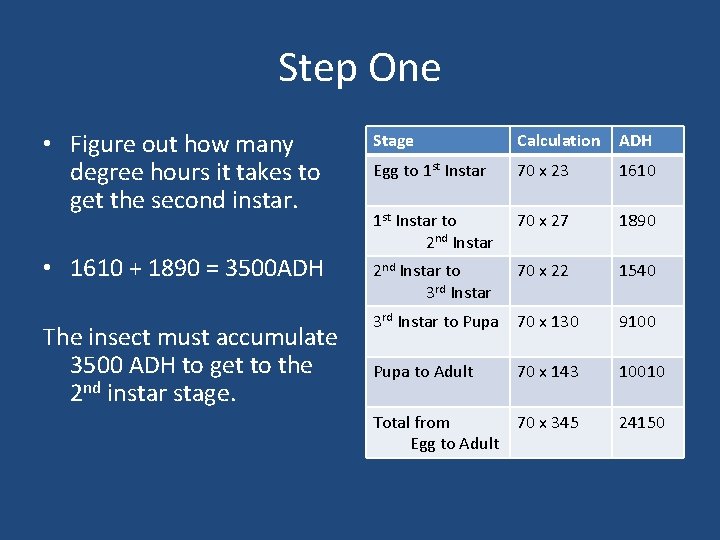
Step One • Figure out how many degree hours it takes to get the second instar. Stage Calculation ADH Egg to 1 st Instar 70 x 23 1610 70 x 27 1890 • 1610 + 1890 = 3500 ADH 1 st Instar to 2 nd Instar to 3 rd Instar 70 x 22 1540 3 rd Instar to Pupa 70 x 130 9100 Pupa to Adult 70 x 143 10010 Total from Egg to Adult 70 x 345 24150 The insect must accumulate 3500 ADH to get to the 2 nd instar stage.
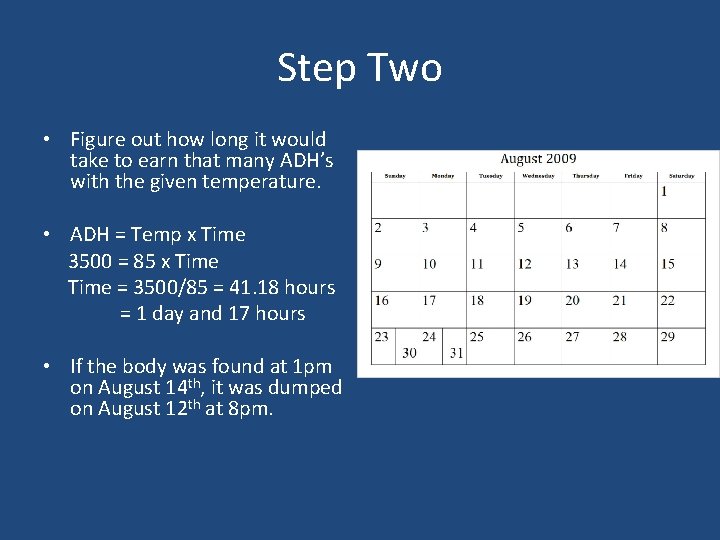
Step Two • Figure out how long it would take to earn that many ADH’s with the given temperature. • ADH = Temp x Time 3500 = 85 x Time = 3500/85 = 41. 18 hours = 1 day and 17 hours • If the body was found at 1 pm on August 14 th, it was dumped on August 12 th at 8 pm.
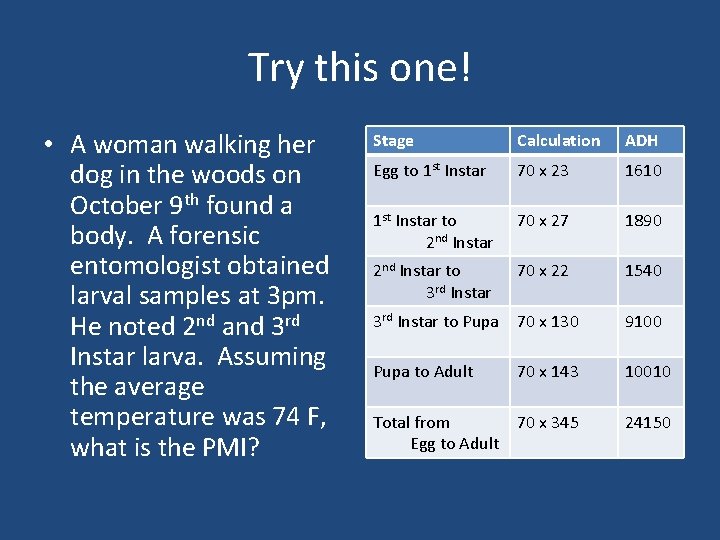
Try this one! • A woman walking her dog in the woods on October 9 th found a body. A forensic entomologist obtained larval samples at 3 pm. He noted 2 nd and 3 rd Instar larva. Assuming the average temperature was 74 F, what is the PMI? Stage Calculation ADH Egg to 1 st Instar 70 x 23 1610 1 st Instar to 2 nd Instar 70 x 27 1890 2 nd Instar to 3 rd Instar 70 x 22 1540 3 rd Instar to Pupa 70 x 130 9100 Pupa to Adult 70 x 143 10010 Total from Egg to Adult 70 x 345 24150
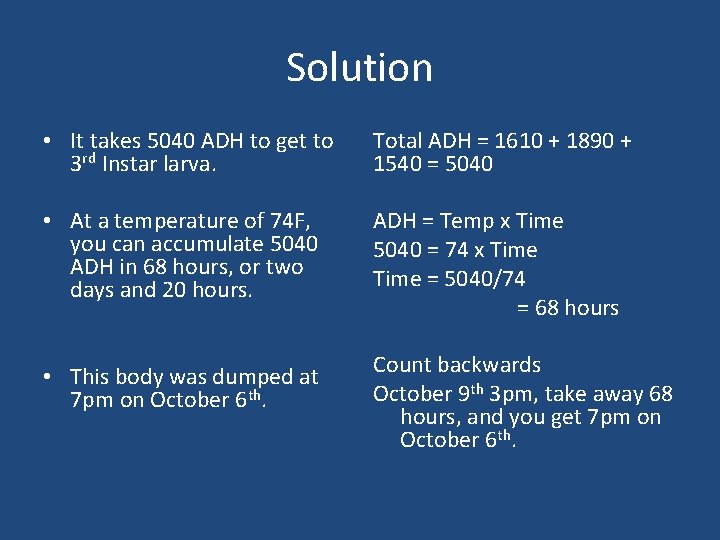
Solution • It takes 5040 ADH to get to 3 rd Instar larva. Total ADH = 1610 + 1890 + 1540 = 5040 • At a temperature of 74 F, you can accumulate 5040 ADH in 68 hours, or two days and 20 hours. ADH = Temp x Time 5040 = 74 x Time = 5040/74 = 68 hours • This body was dumped at 7 pm on October 6 th. Count backwards October 9 th 3 pm, take away 68 hours, and you get 7 pm on October 6 th.
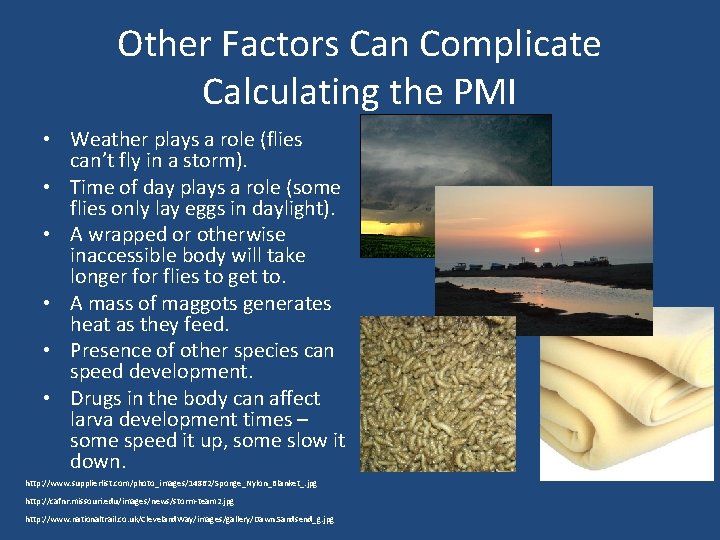
Other Factors Can Complicate Calculating the PMI • Weather plays a role (flies can’t fly in a storm). • Time of day plays a role (some flies only lay eggs in daylight). • A wrapped or otherwise inaccessible body will take longer for flies to get to. • A mass of maggots generates heat as they feed. • Presence of other species can speed development. • Drugs in the body can affect larva development times – some speed it up, some slow it down. http: //www. supplierlist. com/photo_images/14862/Sponge_Nylon_Blanket_. jpg http: //cafnr. missouri. edu/images/news/storm-team 2. jpg http: //www. nationaltrail. co. uk/Cleveland. Way/images/gallery/Dawn. Sandsend_g. jpg
Pig in a Blanket How a wrapped body throws off the time estimate
- Slides: 37