
What technology is used to study the oceans
- Slides: 26
What technology is used to study the oceans? l As early as 600 B. C. the Phoenicians were exploring the ocean surface by ship l In 1000 the Chinese discovered the compass so navigating the ocean became easier l 1825 SCUBA gear was invented so man could spend more time under the water exploring
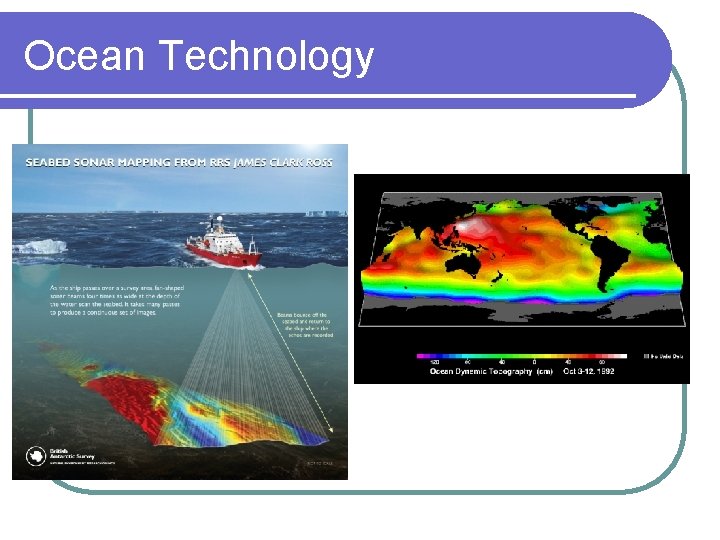
Ocean technology 1920’s SONAR (sound navigation and ranging) was invented due to a need to detect submarines. Another application is to use sound waves to map the ocean. l 1934 - 1 st Deep sea dive in a steel ball Now: submersible vehicles with humans; remotely operated vehicles from ship on the surface; Remote sensing- using satellites to photograph data from the ocean l
Ocean technology l What factors have limited man’s ability to learn and map the ocean completely? l Remote sensing is using satellites or aircraft to gather data from afar. Then when the scientist go to the site to verify it is called ground truthing. Ex. Mapping ocean surface temperatures
Ocean Technology
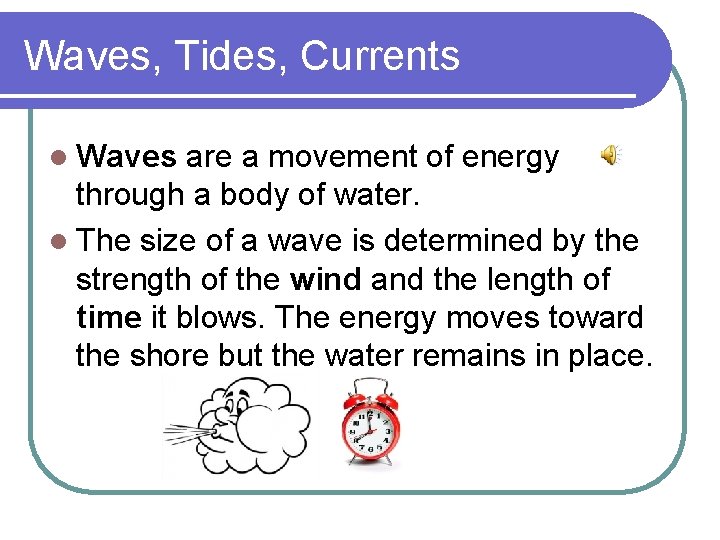
Waves, Tides, Currents l Waves are a movement of energy through a body of water. l The size of a wave is determined by the strength of the wind and the length of time it blows. The energy moves toward the shore but the water remains in place.
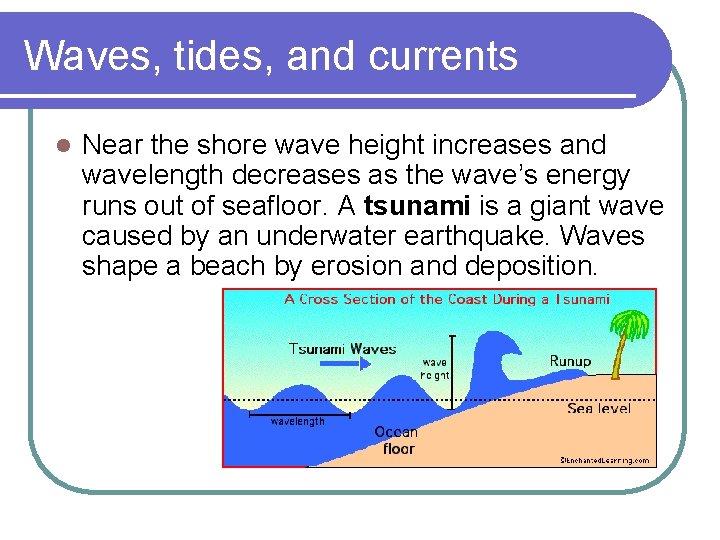
Waves, tides, and currents l Near the shore wave height increases and wavelength decreases as the wave’s energy runs out of seafloor. A tsunami is a giant wave caused by an underwater earthquake. Waves shape a beach by erosion and deposition.
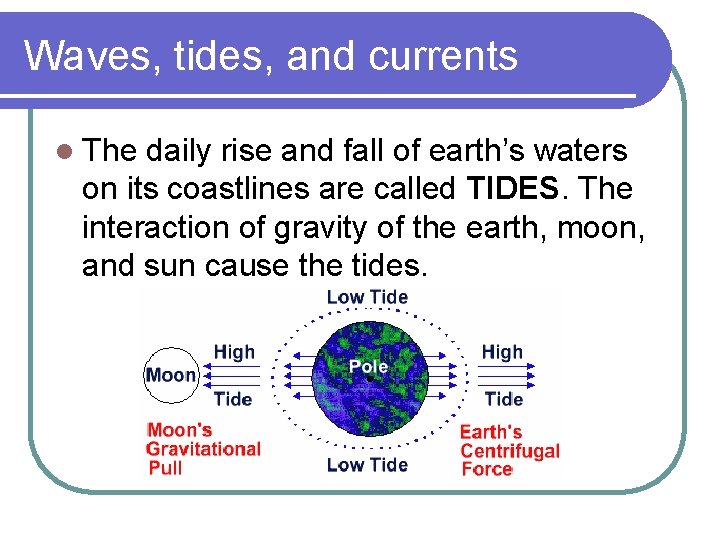
Waves, tides, and currents l The daily rise and fall of earth’s waters on its coastlines are called TIDES. The interaction of gravity of the earth, moon, and sun cause the tides.
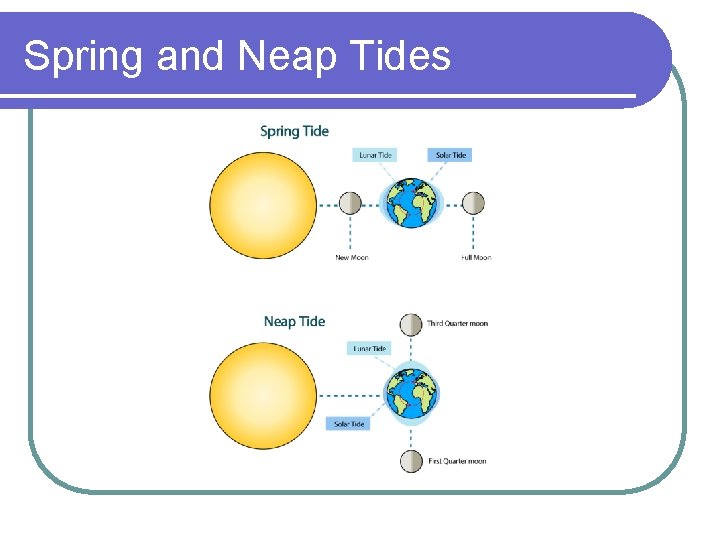
Waves, tides, and currents l The earth, moon, and sun change positions over the course of a lunar month thus affecting the tidal bulge in a month. A spring tide occurs when all three are in a horizontal alignment so the distance between high and low tide is at its greatest. A neap tide occurs when the sun, earth, and moon are at a right angle and there is the least difference between high and low tide.
Spring and Neap Tides
Waves, tides, and currents l Surface currents affect water to a depth of several hundred meters. They are driven by the wind. l Currents move in circular patterns due to the rotation of the Earth. It causes the winds and currents to curve. This is called the Coriolis Effect.
Waves, Tides, and Currents l The Gulf Stream in the Atlantic is the largest surface current carrying water from the Gulf of Mexico to the northeast. It warms the climate of many coastlines as it travels north. Ex. Norway is warmer than nearby countries due to the Gulf Stream
Waves, tides, and currents El Nino is an abnormal climate event that occurs every 2 -7 years in the Pacific. The unusual pattern of winds causes a large layer of warm water to move toward South America. It causes weather problems worldwide. l Deep water currents are caused by dense cold water that sinks to the bottom and moves toward the poles. It takes 1000 s of years for the deep water currents to circle from pole to equator and back. l
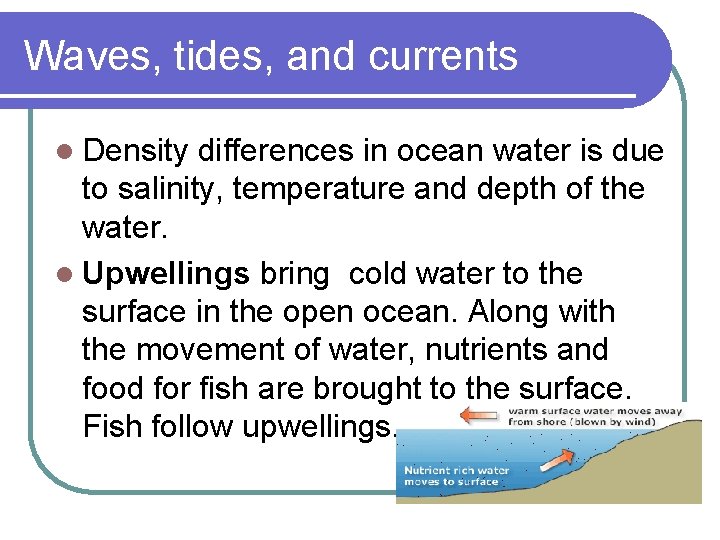
Waves, tides, and currents l Density differences in ocean water is due to salinity, temperature and depth of the water. l Upwellings bring cold water to the surface in the open ocean. Along with the movement of water, nutrients and food for fish are brought to the surface. Fish follow upwellings.
Ocean Chemistry l l l What caused the oceans to become salty? (pg. 155) Ocean averages 35 to 37 parts salt to parts water. Salinity is defined as the total amount of dissolved salts in water. Seawater has a higher density than freshwater and freezes at a lower temperature. Estuarine water is a mix of fresh & ocean water.
Ocean Chemistry l Surface water becomes diluted with freshwater after storms, rain, or where rivers dump into the sea. l Salinity is also affected by temperature and depth of the water. l Gases are found in ocean water. The CO 2 and O 2 cycle occurs to supply dissolved oxygen to animals and CO 2 to plants in the ocean.
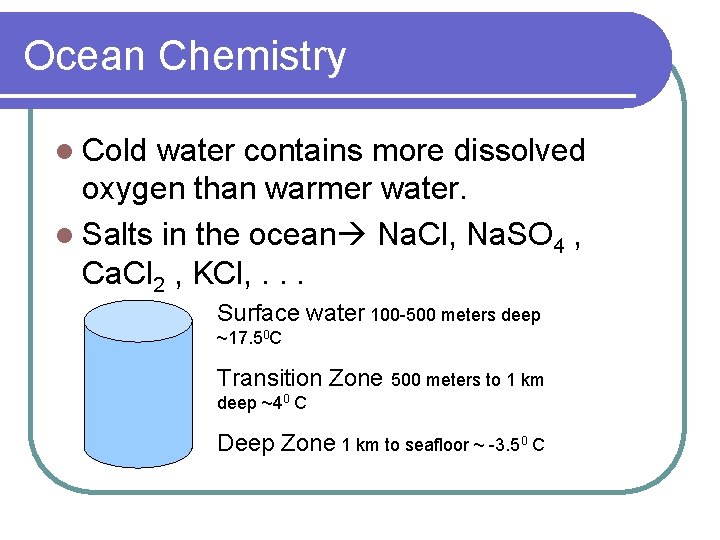
Ocean Chemistry l Cold water contains more dissolved oxygen than warmer water. l Salts in the ocean Na. Cl, Na. SO 4 , Ca. Cl 2 , KCl, . . . Surface water 100 -500 meters deep ~17. 50 C Transition Zone 500 meters to 1 km deep ~40 C Deep Zone 1 km to seafloor ~ -3. 50 C
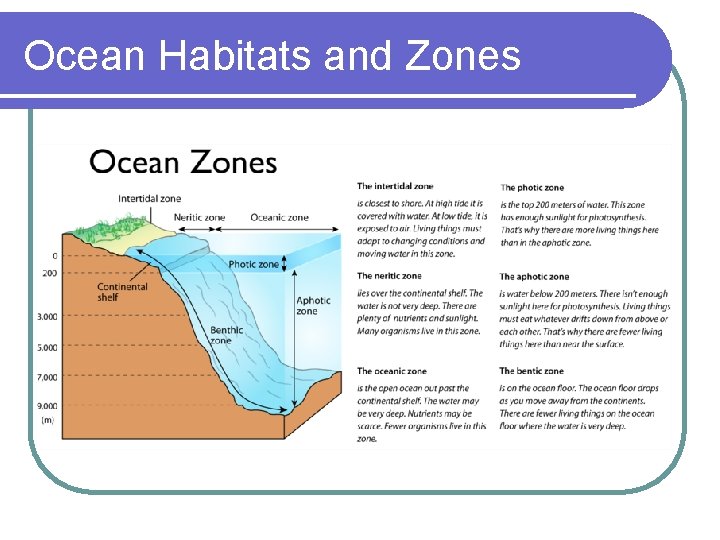
Ocean Habitats and Zones The ocean is a huge community of living and nonliving things. The habitat zones of the ocean are: Intertidal zone, Nertic zone, open ocean zone. l In each zone, there are distinct physical factors such as the amount of sunlight, temperature, and water pressure. These factors determine which organisms live where. Organisms in the ocean are classified by where they live & how they move! l
Ocean Habitats and Zones l Intertidal Zone – from highest tide line to lowest tide line l Organisms must be able to handle changes in salinity and temperature l Ex: hermit crabs, algae, sea anemones l Estuaries – coastal inlets where fresh water from rivers mix with salty water l “Brackish water” l Salt Marshes – ooze with smelly mud from plant and animal matter l Fish, crabs, shrimp, oysters all hatch and feed before going to ocean
Ocean Habitats and Zones l Neritic Zone – From low tide line to edge of continental shelf l Has more organisms than any other ocean zone. (most fishing is done here) l Has large amounts of plankton from upwelling & algae l Coral reefs – made of tiny animals that grow on top of each other l only in shallow tropical water, grow a few mm/yr l helps protect coastlines by breaking up surf during storms l Kelp Forests – need cold Neritic water with rocky floor (Pacific coast Alaska to Mexico)
Ocean Habitats and Zones l Open Ocean Zone – Begins at edge of continental shelf l Supports fewer organisms l Bioluminescence – production of light by living things l Ex: angler fish (Finding Nemo), vampire squid (Planet Earth video in class) l Hydrothermal vents – hot water through cracks in the ocean floor l Bacteria feed on chemical nutrients to make food l Clams eat bacteria
Ocean Habitats and Zones
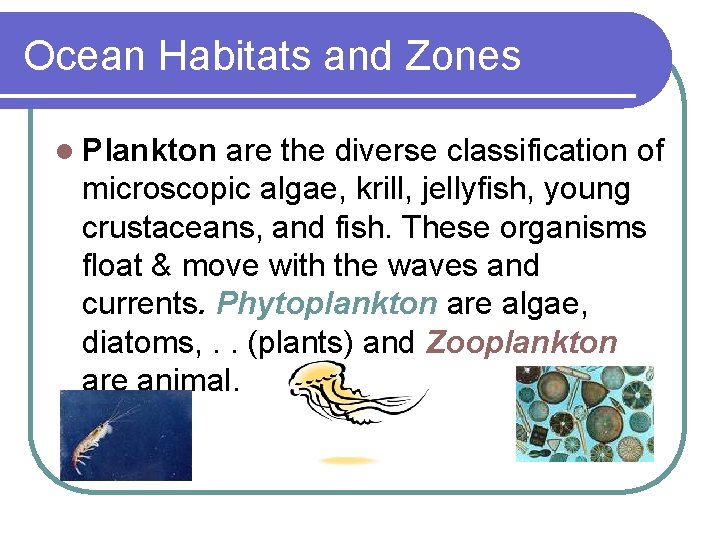
Ocean Habitats and Zones l Plankton are the diverse classification of microscopic algae, krill, jellyfish, young crustaceans, and fish. These organisms float & move with the waves and currents. Phytoplankton are algae, diatoms, . . (plants) and Zooplankton are animal.
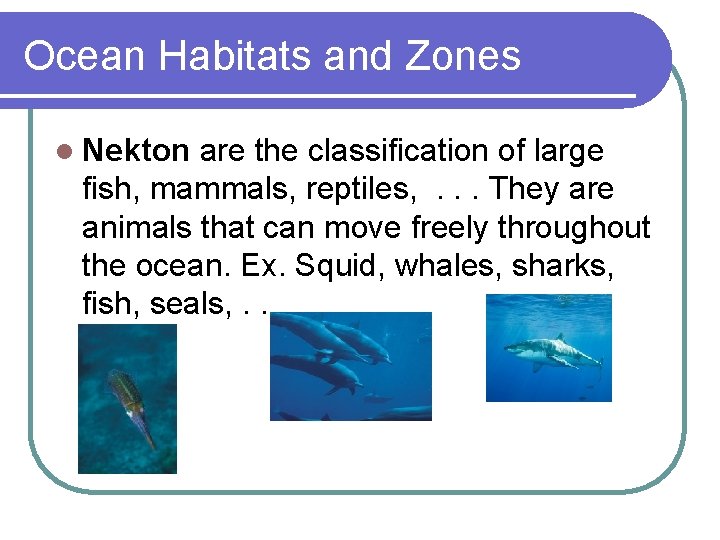
Ocean Habitats and Zones l Nekton are the classification of large fish, mammals, reptiles, . . . They are animals that can move freely throughout the ocean. Ex. Squid, whales, sharks, fish, seals, . .
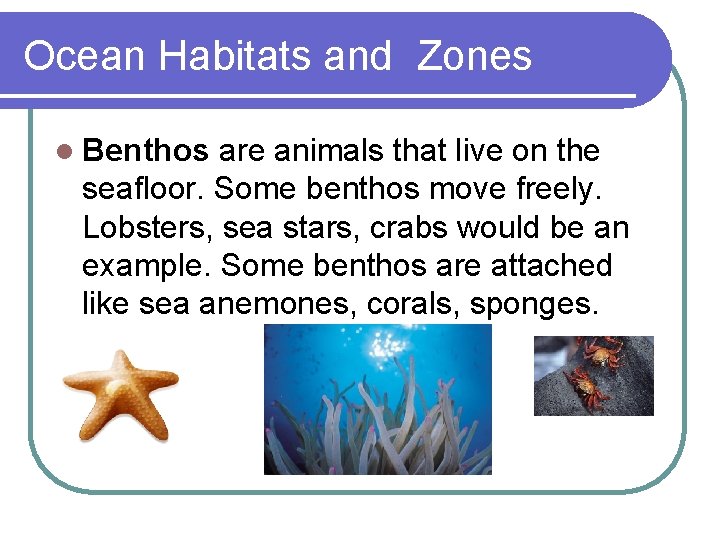
Ocean Habitats and Zones l Benthos are animals that live on the seafloor. Some benthos move freely. Lobsters, sea stars, crabs would be an example. Some benthos are attached like sea anemones, corals, sponges.
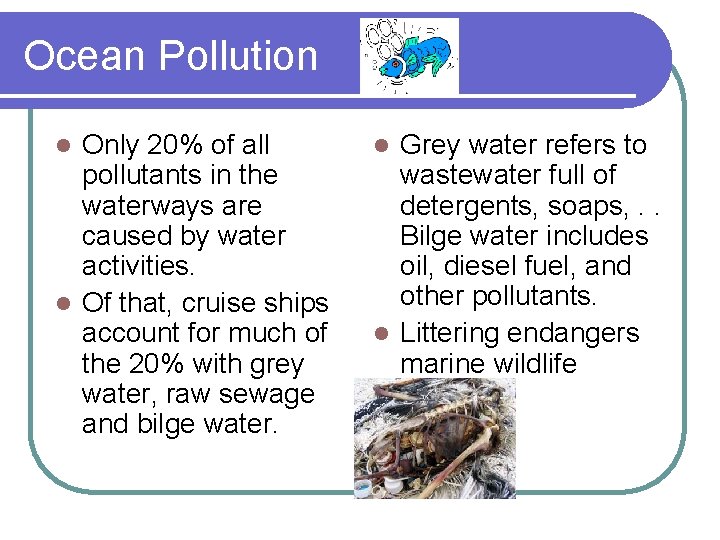
Ocean Pollution Only 20% of all pollutants in the waterways are caused by water activities. l Of that, cruise ships account for much of the 20% with grey water, raw sewage and bilge water. l Grey water refers to wastewater full of detergents, soaps, . . Bilge water includes oil, diesel fuel, and other pollutants. l Littering endangers marine wildlife l
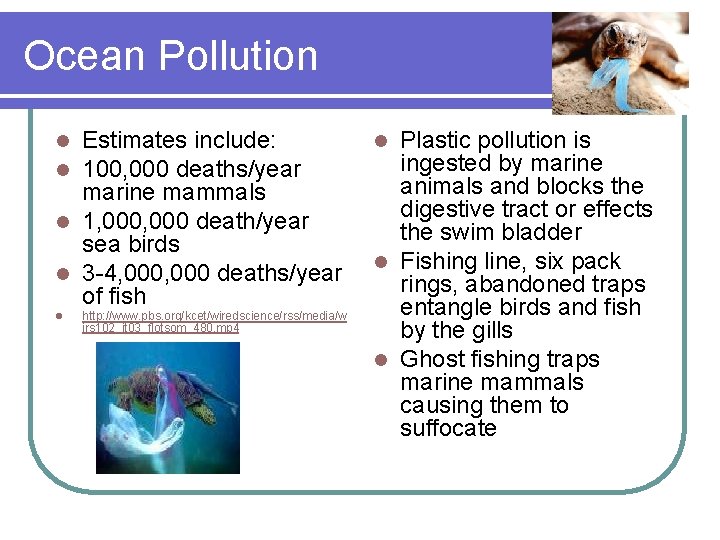
Ocean Pollution Estimates include: 100, 000 deaths/year marine mammals l 1, 000 death/year sea birds l 3 -4, 000 deaths/year of fish l l l http: //www. pbs. org/kcet/wiredscience/rss/media/w irs 102_it 03_flotsom_480. mp 4 Plastic pollution is ingested by marine animals and blocks the digestive tract or effects the swim bladder l Fishing line, six pack rings, abandoned traps entangle birds and fish by the gills l Ghost fishing traps marine mammals causing them to suffocate l