
What students say Is programming really that difficult
- Slides: 12
What students say: Is programming really that difficult? Jasna Hamzabegović University of Bihać Zagreb Pedagogical Faculty Engineering Damir Kalpić University of Faculty of Electrical Department of Mathematics and Informatics and Computing Bosnia and Herzegovina Croatia 15 th Workshop DAAD Bohinj, Slovenia, August 24 th – 29 th 2015
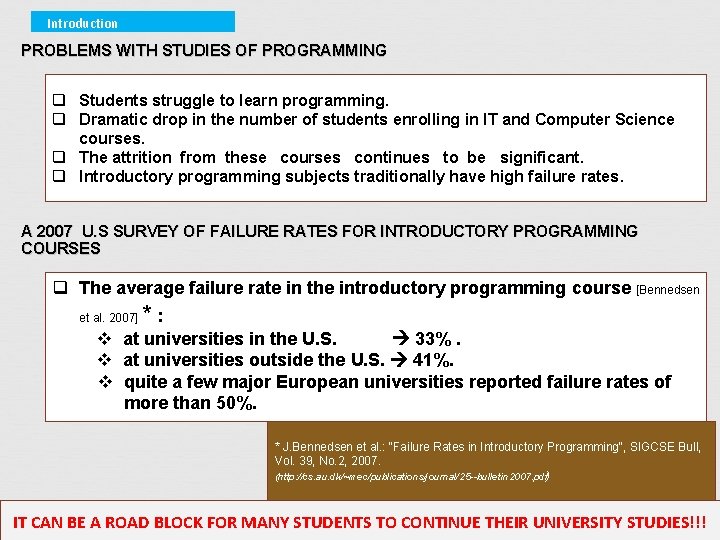
Introduction PROBLEMS WITH STUDIES OF PROGRAMMING q Students struggle to learn programming. q Dramatic drop in the number of students enrolling in IT and Computer Science courses. q The attrition from these courses continues to be significant. q Introductory programming subjects traditionally have high failure rates. A 2007 U. S SURVEY OF FAILURE RATES FOR INTRODUCTORY PROGRAMMING COURSES q The average failure rate in the introductory programming course [Bennedsen et al. 2007] * : v at universities in the U. S. 33%. v at universities outside the U. S. 41%. v quite a few major European universities reported failure rates of more than 50%. * J. Bennedsen et al. : "Failure Rates in Introductory Programming", SIGCSE Bull, Vol. 39, No. 2, 2007. (http: //cs. au. dk/~mec/publications/journal/25 --bulletin 2007. pdf) IT CAN BE A ROAD BLOCK FOR MANY STUDENTS TO CONTINUE THEIR UNIVERSITY STUDIES!!!
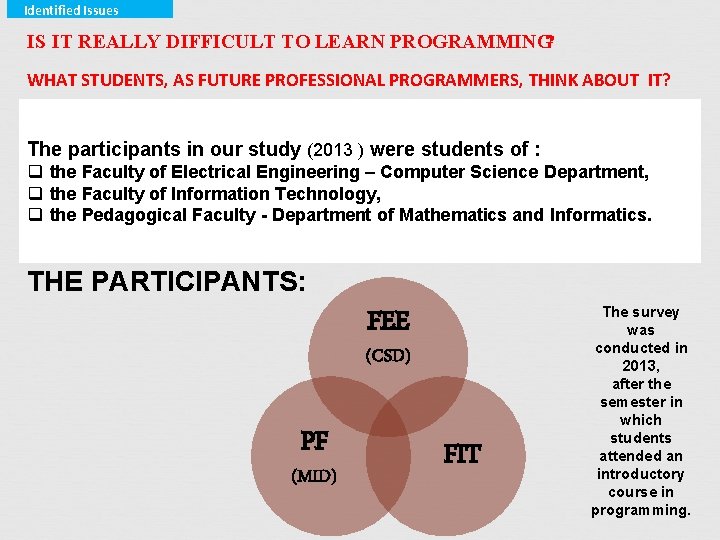
Identified Issues IS IT REALLY DIFFICULT TO LEARN PROGRAMMING? WHAT STUDENTS, AS FUTURE PROFESSIONAL PROGRAMMERS, THINK ABOUT IT? The participants in our study (2013 ) were students of : q the Faculty of Electrical Engineering – Computer Science Department, q the Faculty of Information Technology, q the Pedagogical Faculty - Department of Mathematics and Informatics. THE PARTICIPANTS: FEE (CSD) PF (MID) FIT The survey was conducted in 2013, after the semester in which students attended an introductory course in programming.
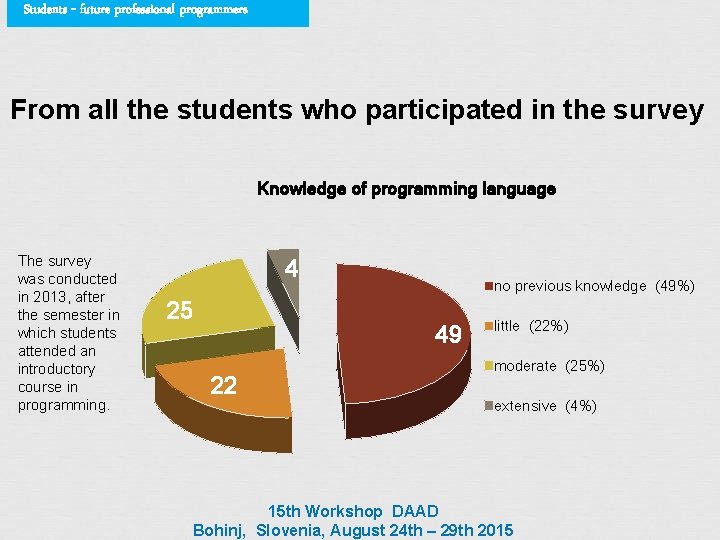
Students - future professional programmers From all the students who participated in the survey Knowledge of programming language The survey was conducted in 2013, after the semester in which students attended an introductory course in programming. 4 25 no previous knowledge (49%) 49 22 little (22%) moderate (25%) extensive (4%) 15 th Workshop DAAD Bohinj, Slovenia, August 24 th – 29 th 2015
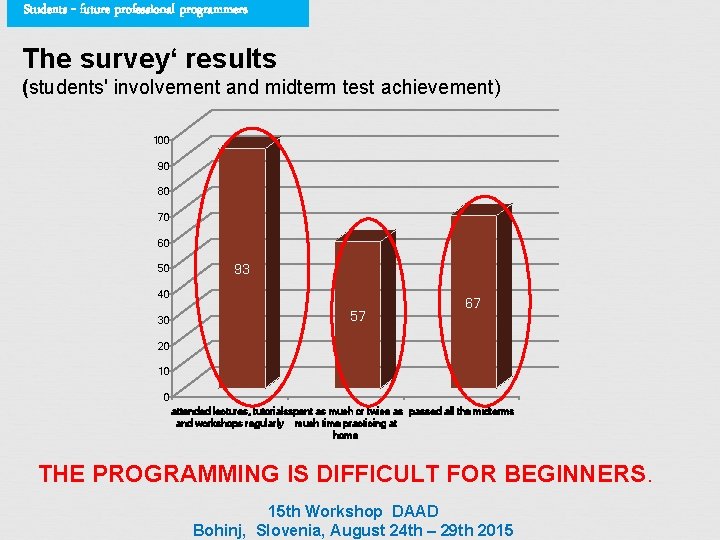
Students - future professional programmers The survey‘ results (students' involvement and midterm test achievement) 100 90 80 70 60 50 93 40 30 57 67 20 10 0 attended lectures, tutorialsspent as much or twice as passed all the midterms and workshops regularly much time practicing at home THE PROGRAMMING IS DIFFICULT FOR BEGINNERS. 15 th Workshop DAAD Bohinj, Slovenia, August 24 th – 29 th 2015
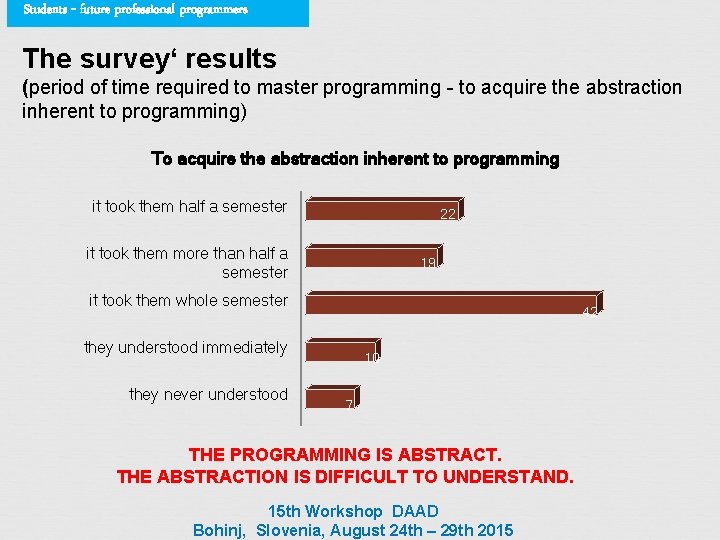
Students - future professional programmers The survey‘ results (period of time required to master programming - to acquire the abstraction inherent to programming) To acquire the abstraction inherent to programming it took them half a semester 22 it took them more than half a semester 19 it took them whole semester 42 they understood immediately they never understood 10 7 THE PROGRAMMING IS ABSTRACT. THE ABSTRACTION IS DIFFICULT TO UNDERSTAND. 15 th Workshop DAAD Bohinj, Slovenia, August 24 th – 29 th 2015
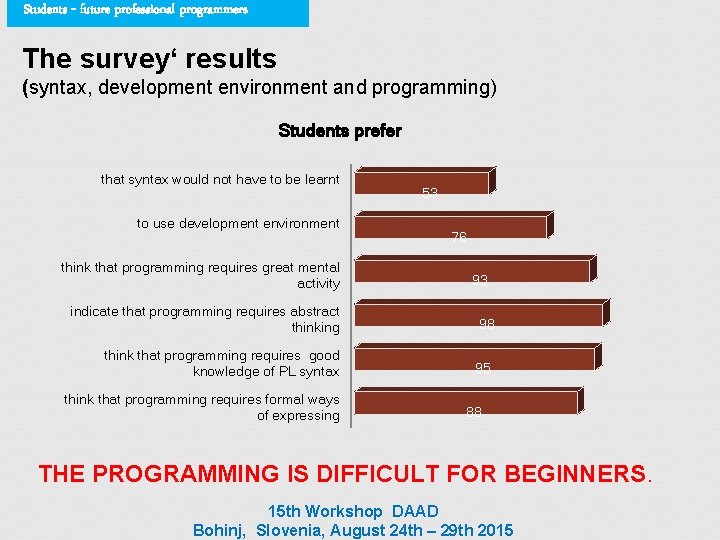
Students - future professional programmers The survey‘ results (syntax, development environment and programming) Students prefer that syntax would not have to be learnt to use development environment think that programming requires great mental activity 53 76 93 indicate that programming requires abstract thinking 98 think that programming requires good knowledge of PL syntax 95 think that programming requires formal ways of expressing 88 THE PROGRAMMING IS DIFFICULT FOR BEGINNERS. 15 th Workshop DAAD Bohinj, Slovenia, August 24 th – 29 th 2015
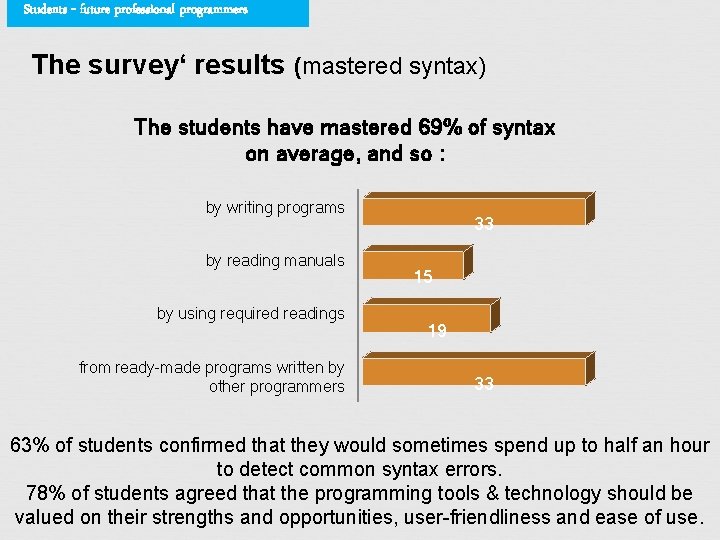
Students - future professional programmers The survey‘ results (mastered syntax) The students have mastered 69% of syntax on average, and so : by writing programs by reading manuals by using required readings from ready-made programs written by other programmers 33 15 19 33 63% of students confirmed that they would sometimes spend up to half an hour to detect common syntax errors. 78% of students agreed that the programming tools & technology should be valued on their strengths and opportunities, user-friendliness and ease of use.
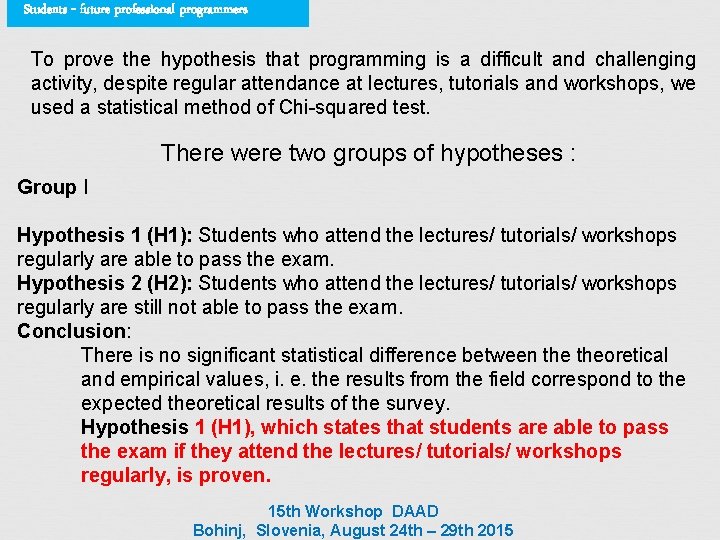
Students - future professional programmers To prove the hypothesis that programming is a difficult and challenging activity, despite regular attendance at lectures, tutorials and workshops, we used a statistical method of Chi-squared test. There were two groups of hypotheses : Group I Hypothesis 1 (H 1): Students who attend the lectures/ tutorials/ workshops regularly are able to pass the exam. Hypothesis 2 (H 2): Students who attend the lectures/ tutorials/ workshops regularly are still not able to pass the exam. Conclusion: There is no significant statistical difference between theoretical and empirical values, i. e. the results from the field correspond to the expected theoretical results of the survey. Hypothesis 1 (H 1), which states that students are able to pass the exam if they attend the lectures/ tutorials/ workshops regularly, is proven. 15 th Workshop DAAD Bohinj, Slovenia, August 24 th – 29 th 2015
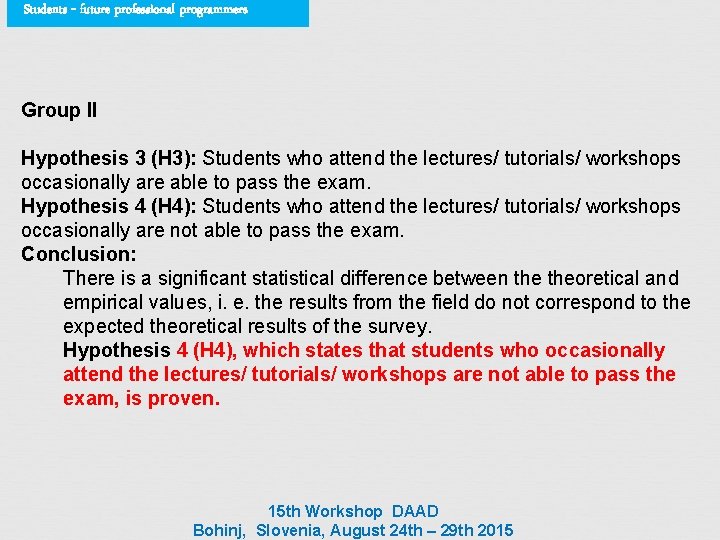
Students - future professional programmers Group II Hypothesis 3 (H 3): Students who attend the lectures/ tutorials/ workshops occasionally are able to pass the exam. Hypothesis 4 (H 4): Students who attend the lectures/ tutorials/ workshops occasionally are not able to pass the exam. Conclusion: There is a significant statistical difference between theoretical and empirical values, i. e. the results from the field do not correspond to the expected theoretical results of the survey. Hypothesis 4 (H 4), which states that students who occasionally attend the lectures/ tutorials/ workshops are not able to pass the exam, is proven. 15 th Workshop DAAD Bohinj, Slovenia, August 24 th – 29 th 2015
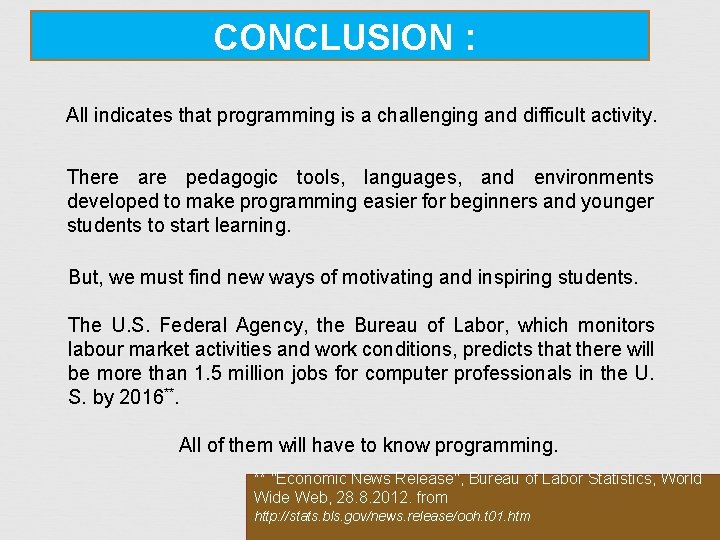
CONCLUSION : All indicates that programming is a challenging and difficult activity. There are pedagogic tools, languages, and environments developed to make programming easier for beginners and younger students to start learning. But, we must find new ways of motivating and inspiring students. The U. S. Federal Agency, the Bureau of Labor, which monitors labour market activities and work conditions, predicts that there will be more than 1. 5 million jobs for computer professionals in the U. S. by 2016**. All of them will have to know programming. ** "Economic News Release", Bureau of Labor Statistics, World Wide Web, 28. 8. 2012. from http: //stats. bls. gov/news. release/ooh. t 01. htm
Thank you for your attention! 15 th Workshop DAAD Bohinj, Slovenia, August 24 th – 29 th 2015