
What Role Does Cultural Background Play in Talent

What Role Does Cultural Background Play in Talent Development? Frank C. Worrell, Ph. D. University of California Berkeley frankc@berkeley. edu
Overview Z Personal versus Social Identities Z Identity-Based Theoretical Frameworks Related to Academic Achievement Z Cultural ecological theory Z Stereotype threat Z Identity Profiles Z Race-based rejection sensitivity Z Responses of Different Cultural Groups to Feedback Z Nature of Feedback Given to Different Cultural Groups
Types of Identity Z Personal Identity (individuality, personality) Z Who am I? Z Extraverted, intelligent, motivated, etc. Z Social Identity (Reference Group Orientation or Identification) Z To what group or groups do I belong? Z Does group membership affect how society views and values me?
Personal Identities Social Identities Z Self-concept/Selfesteem Z Intelligence Z Personality Z Motivation Z Self-efficacy Z Self-regulation Z Ethnic and/or racial group Z First language Z Gender Z Country of origin Z Sexual orientation Z Socioeconomic Status
Personal Social Z Both personal and social identity are shaped by our environment. Z Links between personal and social identity (e. g. , achievement possibilities) are determined, in part, by what others communicate to us. Z Minority group members actively interpret and respond to their situation.
CET Framework Z How did group become member of society? Z Voluntary versus involuntary Z How does mainstream society treat group members (SYSTEM)? Z Included, valued, traditions recognized and honored or excluded, devalued, denigrated, and discriminated against Z How do group members respond to mainstream society (INDIVIDUAL sociocultural adaptations)? Z Is relationship with society positive, neutral, or oppositional?
Cultural Models of Voluntary vs Involuntary Groups Z Positive vs. negative dual frame of reference. Z Effort-based vs. ambivalent folk theory of making it. Z Acculturated vs. rebels as role models Z Pragmatic trust vs distrust of White institutions. Z Additive vs subtractive interpretation of cultural mores. Z Unequivocal vs. ambivalent/negative/oppositional attitudes to schooling.
Oppositional Identity Z Those individuals who take an oppositional stance often engage in actions (low effort) incompatible with educational success: Z They do not trust schools or believe that education will result in the same payoffs as it does for others. Z They see doing well in school as acting White or betraying their cultural heritage (I can, but do I want to; Graham, 2004). Z Parents with these beliefs give mixed messages about benefits of education.
Support for CET ZLarge literature on cultural mistrust (including students, parents). ZGardner-Kitt’s (2005) study of racial identity attitudes. ZFord’s (2005) study on “acting White” and “acting Black. ”
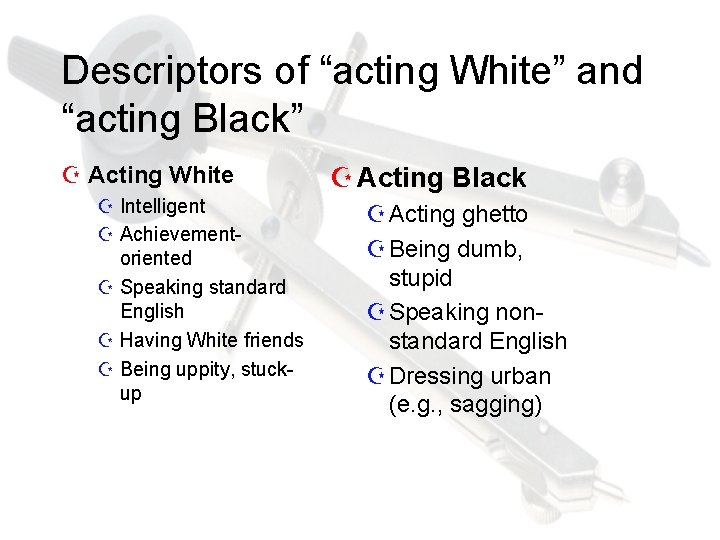
Descriptors of “acting White” and “acting Black” Z Acting White Z Intelligent Z Achievementoriented Z Speaking standard English Z Having White friends Z Being uppity, stuckup Z Acting Black Z Acting ghetto Z Being dumb, stupid Z Speaking nonstandard English Z Dressing urban (e. g. , sagging)
Steele’s Stereotype Threat Z Human beings classify variables and behaviors and develop stereotypes of individuals and groups. Z Societal stereotypes have a direct impact on performance, especially in situations where the stereotype is invoked. Z Steele has demonstrated stereotype threat in several studies involving college students, with effect sizes in the large range.
Initial ST Manipulation ZRandom assignment to three groups ZDiagnostic – Treatment ZTest of verbal ability ZNon-diagnostic – Control 1 ZVerbal problem solving task ZNon-diagnostic– Control 2 ZVerbal problem solving task ZDifficult because aimed at highly verbal individuals
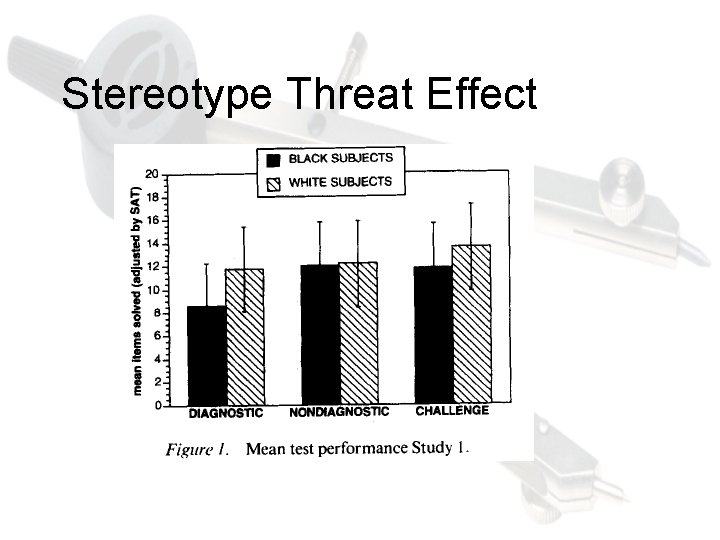
Stereotype Threat Effect
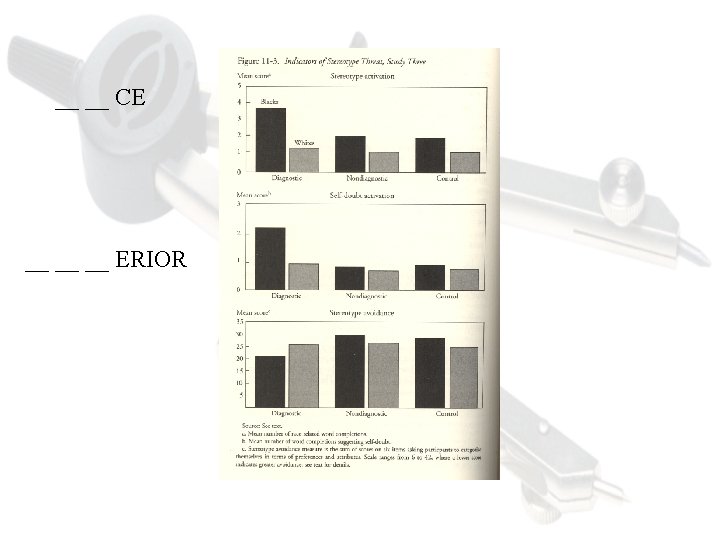
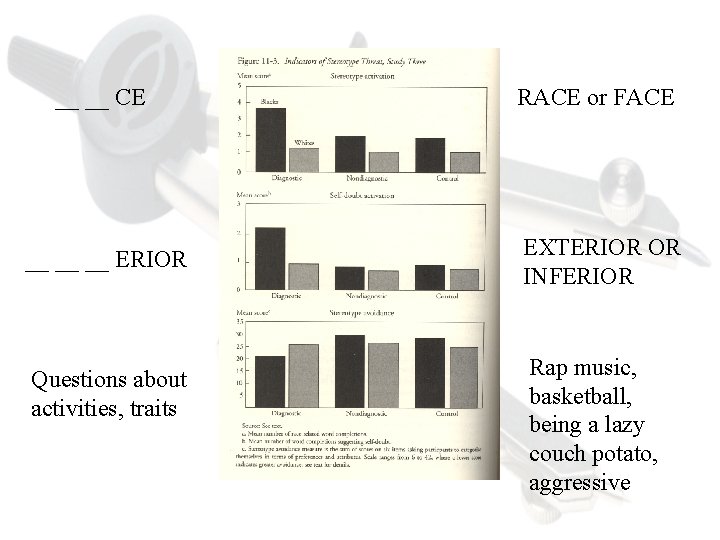
__ __ CE RACE or FACE __ __ __ ERIOR EXTERIOR OR INFERIOR Questions about activities, traits Rap music, basketball, being a lazy couch potato, aggressive
ST and Socioeconomic Status (Harrison et al. , 2006)
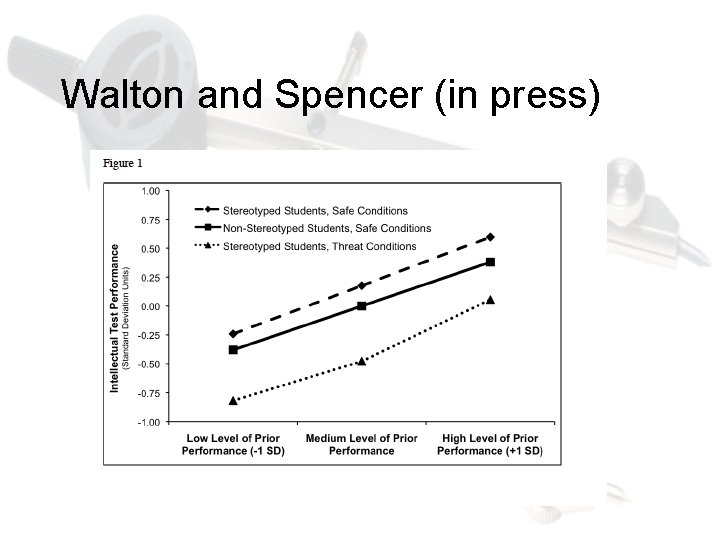
Walton and Spencer (in press)
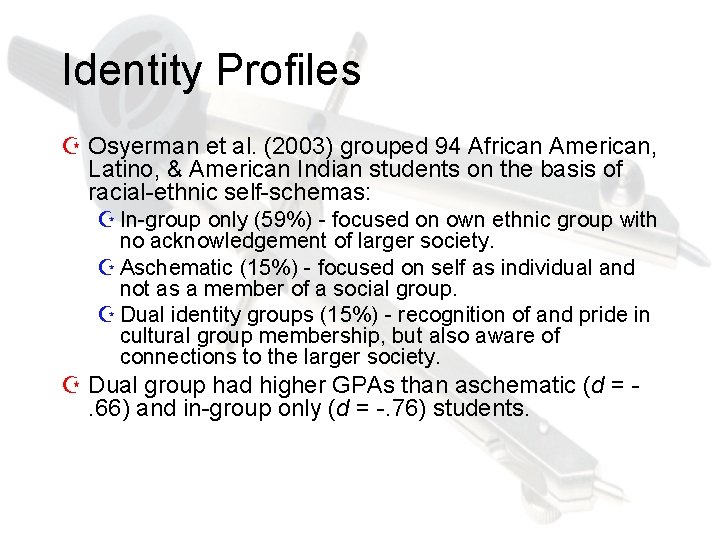
Identity Profiles Z Osyerman et al. (2003) grouped 94 African American, Latino, & American Indian students on the basis of racial-ethnic self-schemas: Z In-group only (59%) - focused on own ethnic group with no acknowledgement of larger society. Z Aschematic (15%) - focused on self as individual and not as a member of a social group. Z Dual identity groups (15%) - recognition of and pride in cultural group membership, but also aware of connections to the larger society. Z Dual group had higher GPAs than aschematic (d =. 66) and in-group only (d = -. 76) students.
Osyerman et al. II Z Replicated findings with experimental manipulation invoking stereotype in American Indian sample (N = 65). Z Dual group persisted longer than other two groups on mathematics task: d = -1. 21; -. 80. Z Youth with dual schemas were less vulnerable to stereotype threat.
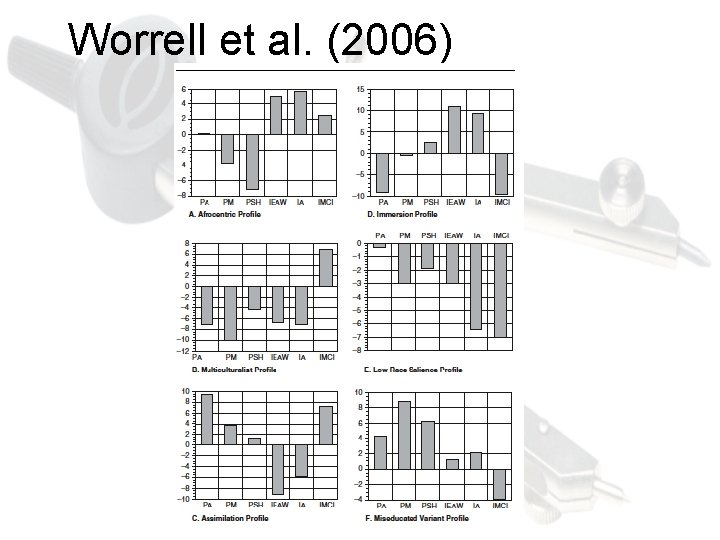
Worrell et al. (2006)
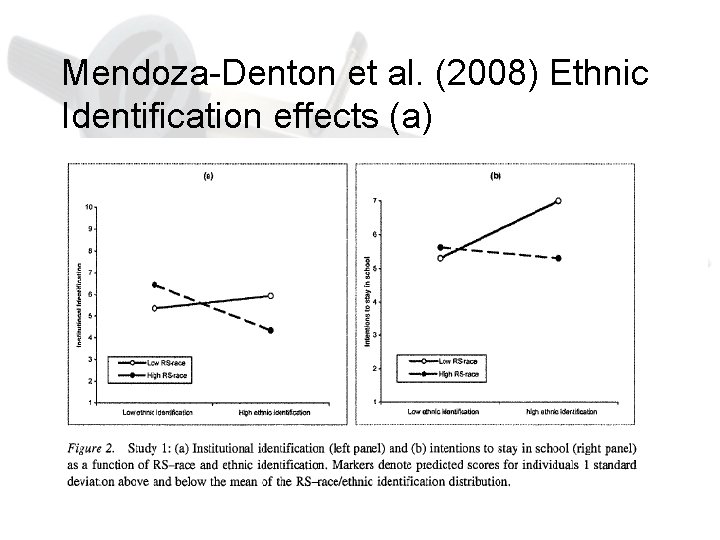
Mendoza-Denton et al. (2008) Ethnic Identification effects (a)
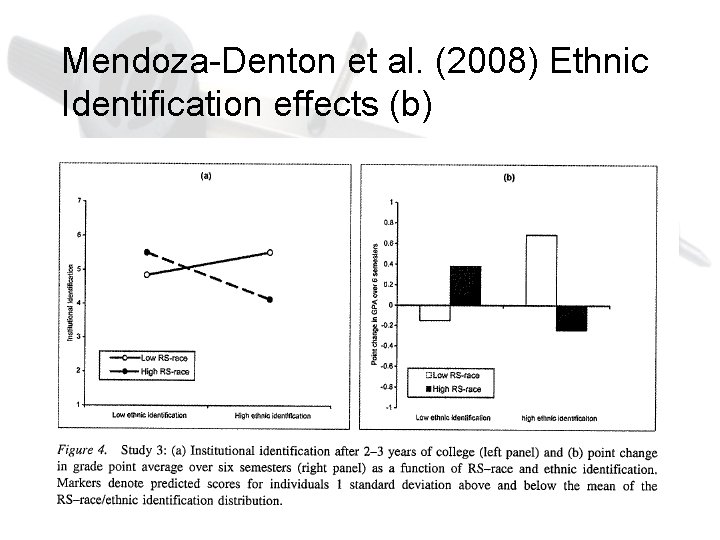
Mendoza-Denton et al. (2008) Ethnic Identification effects (b)
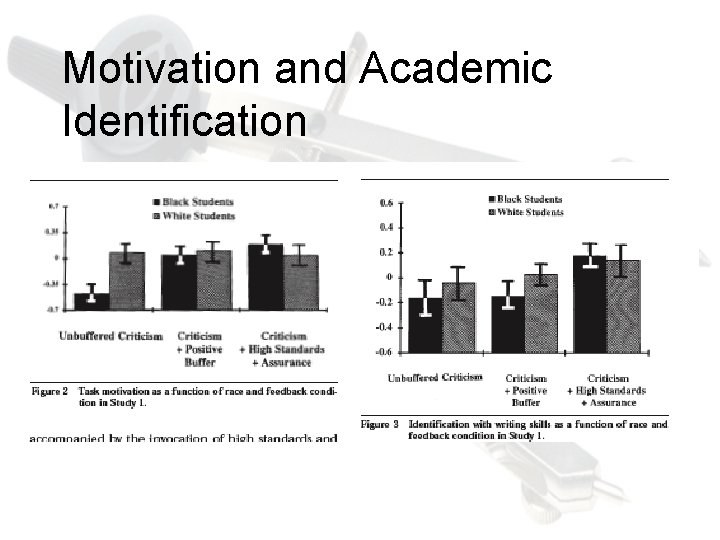
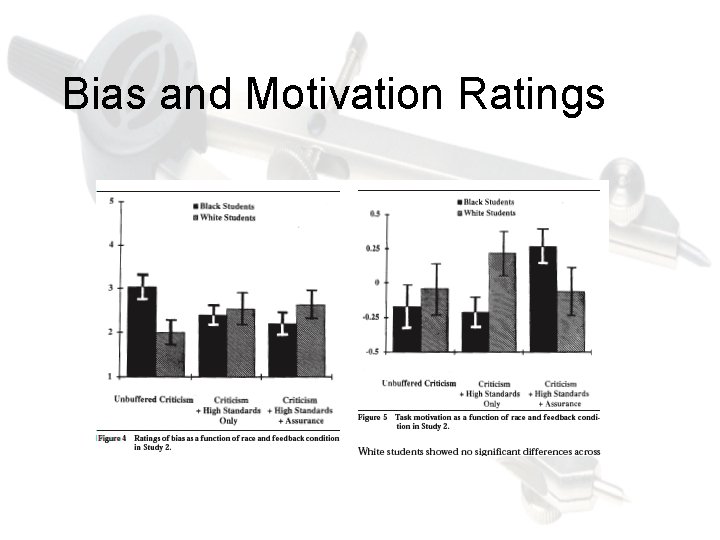
Feedback and Prejudice I: Cohen et al. (1999) Z Conducted an experimental study examining Black and White undergraduates’ response to criticism: Z Condition 1 (unbuffered criticism): critical feedback of performance with no other comment. Z Condition 2 (positive buffered criticism): same critical feedback with general praise of student’s performance. Z Condition 3 (wise criticism): same critical feedback with explicit invocation of high standards and assurance of student’s ability to meet standards.
Cohen et al. (1999) II ZDependent variables included the following: ZStudents’ perceptions of bias towards them. ZParticipants’ belief in their ability to improve their work and interest in doing revision. ZFeelings of identification with writing skills.
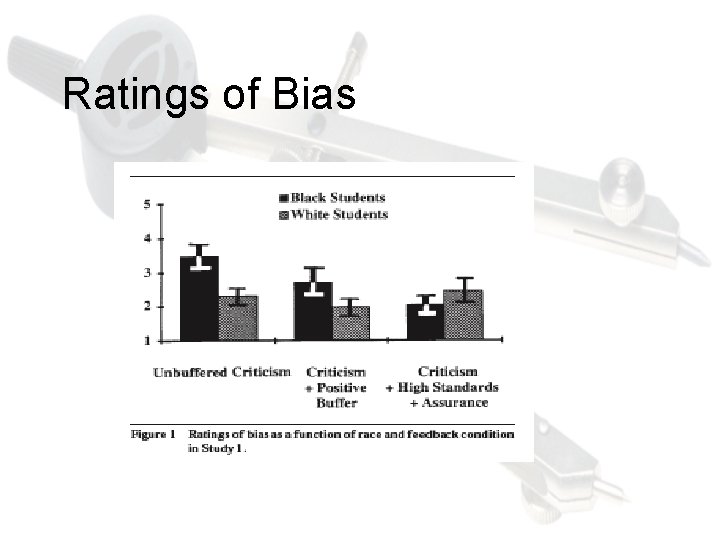
Ratings of Bias
Motivation and Academic Identification
Bias and Motivation Ratings
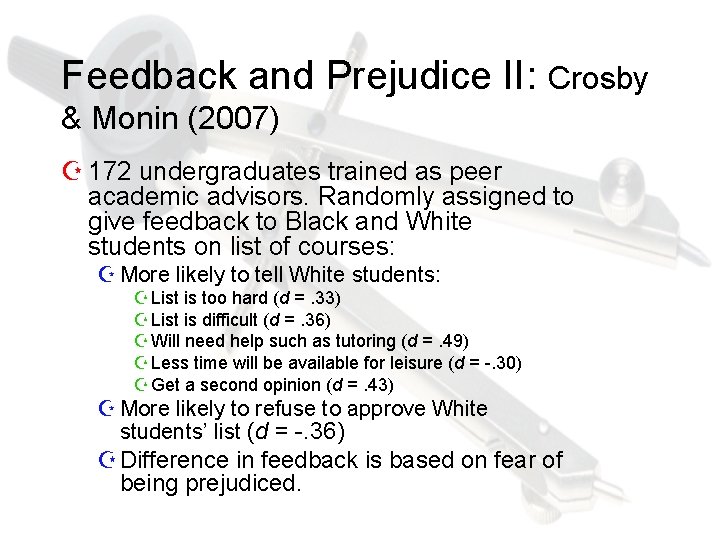
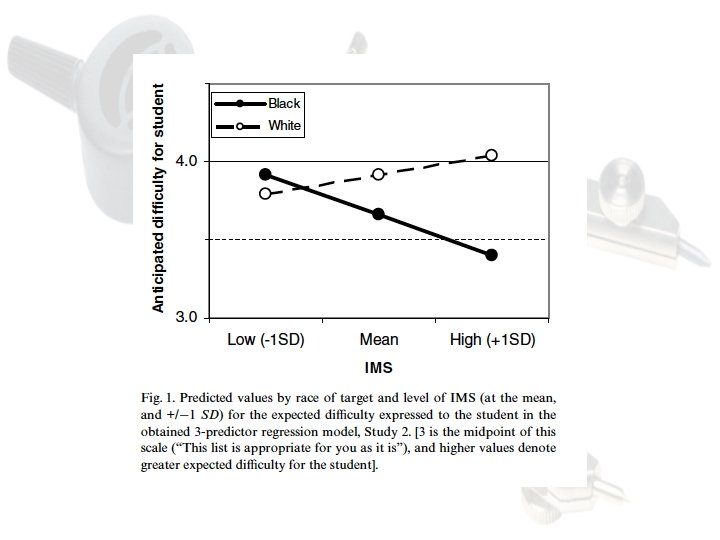
Feedback and Prejudice II: Crosby & Monin (2007) Z 172 undergraduates trained as peer academic advisors. Randomly assigned to give feedback to Black and White students on list of courses: Z More likely to tell White students: Z List is too hard (d =. 33) Z List is difficult (d =. 36) Z Will need help such as tutoring (d =. 49) Z Less time will be available for leisure (d = -. 30) Z Get a second opinion (d =. 43) Z More likely to refuse to approve White students’ list (d = -. 36) Z Difference in feedback is based on fear of being prejudiced.
Sum: Cultural Identity Matters Z CET suggests the development of an oppositional identity to school in some minority group members. Z ST suggests that negative stereotypes can depress stigmatized group’s performance and enhance that of nonstigmatized groups. Z Identity profiles indicate that some are more closely associated with academic success and engagement. Z Identity has independent effects on institutional identification and academic identification. Z Negatively stereotyped groups are more likely to interpret unbuffered critical feedback as an indication of bias and lose motivation and academic identification. Z Individuals who are concerned about not being racist are likely to provide less honest feedback to students from negatively stereotyped groups.
Implications for STEM Fields Z Students from negatively stereotyped groups less likely to think themselves able to complete STEM degrees. Z These students are also more likely to draw conclusions about bias and lack of competence in STEM gateway classes. Z Need for engaging students in STEM projects from elementary schools, with focus on low SES and minority districts. Z Need to have summer STEM offerings in low SES and minority districts.
- Slides: 31