
What reception programme for new migrants in Belgium
+ What reception programme for new migrants in Belgium? Current situation, future prospects and opinions from the field
+ Current situation of new migrants (NM) in Brussels (CBAI – UCL) n Important definition issues: who are we talking about? (and why? ), who are we not talking about? (and why? ) n Official definition : New migrants (‘recent arrivals’) : Min 18 years old, in Belgium for less than 3 years and in possession of a residence permit valid for more than 3 months a debatable definition !!
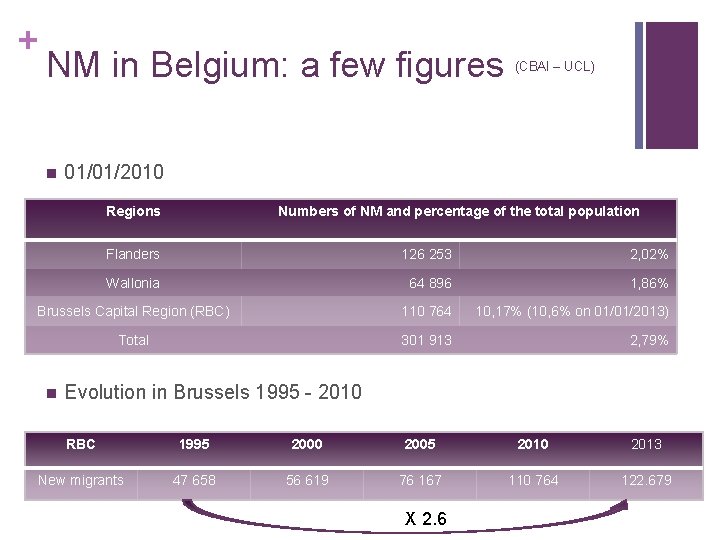
+ NM in Belgium: a few figures n (CBAI – UCL) 01/01/2010 Regions Numbers of NM and percentage of the total population Flanders 126 253 2, 02% Wallonia 64 896 1, 86% Brussels Capital Region (RBC) 110 764 10, 17% (10, 6% on 01/01/2013) Total 301 913 2, 79% n Evolution in Brussels 1995 - 2010 RBC 1995 2000 2005 2010 2013 New migrants 47 658 56 619 76 167 110 764 122. 679 X 2. 6
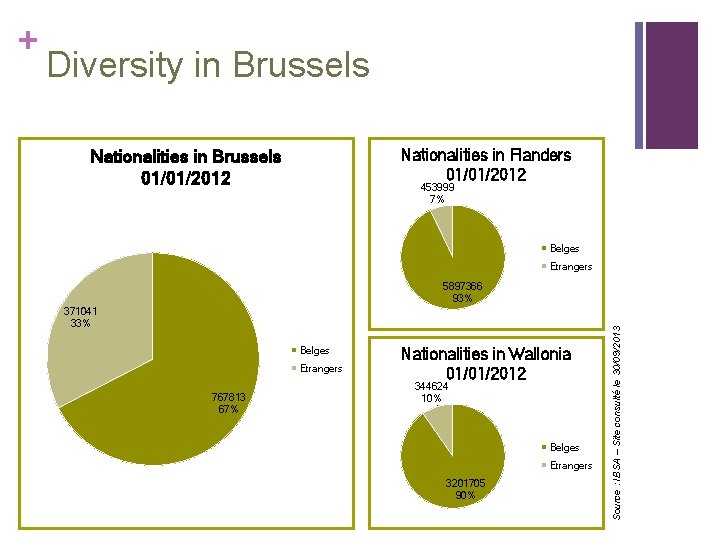
Diversity in Brussels Nationalities in Flanders 01/01/2012 Nationalities in Brussels 01/01/2012 453999 7% Belges Etrangers 5897366 93% 371041 33% Belges Etrangers 767813 67% Nationalities in Wallonia 01/01/2012 344624 10% Belges Etrangers 3201705 90% Source : IBSA – Site consulté le 30/09/2013 +
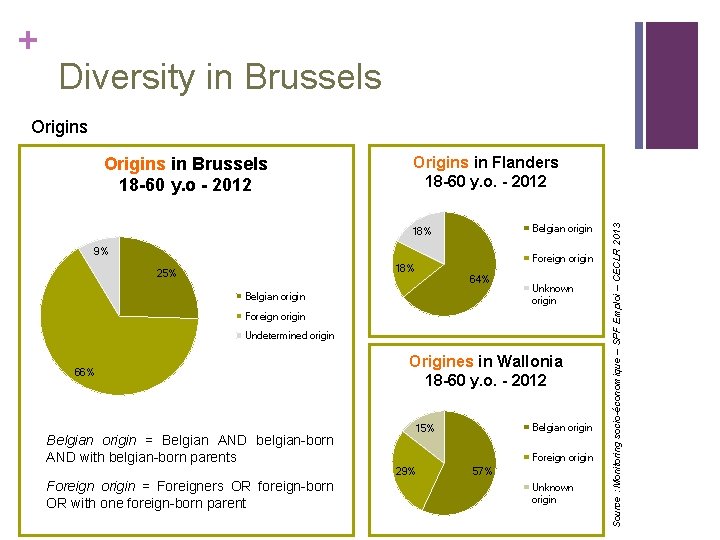
+ Diversity in Brussels Origins in Flanders 18 -60 y. o. - 2012 Belgian origin 18% 9% Foreign origin 18% 25% 64% Belgian origin Unknown origin Foreign origin Undetermined origin 66% Belgian origin = Belgian AND belgian-born AND with belgian-born parents Origines in Wallonia 18 -60 y. o. - 2012 Foreign origin 29% Foreign origin = Foreigners OR foreign-born OR with one foreign-born parent Belgian origin 15% 57% Unknown origin Source : Monitoring socio-économique – SPF Emploi – CECLR 2013 Origins in Brussels 18 -60 y. o - 2012
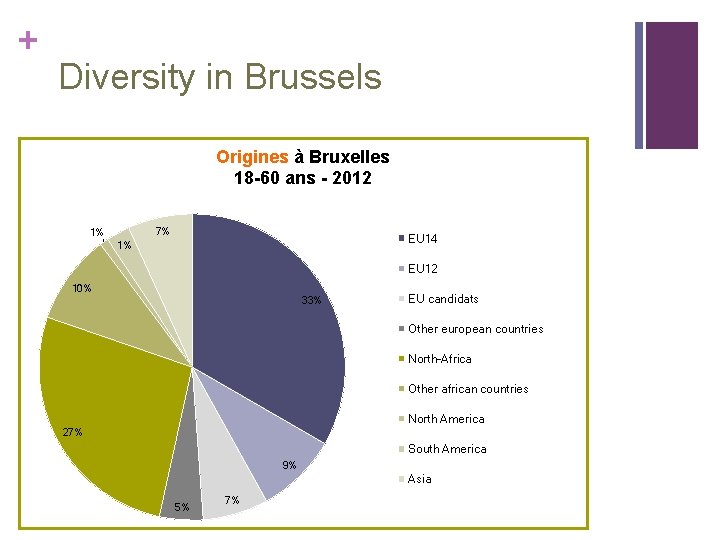
+ Diversity in Brussels Origines à Bruxelles 18 -60 ans - 2012 7% 1% EU 14 1% EU 12 10% 33% EU candidats Other european countries North-Africa Other african countries North America 27% South America 9% Asia 5% 7%
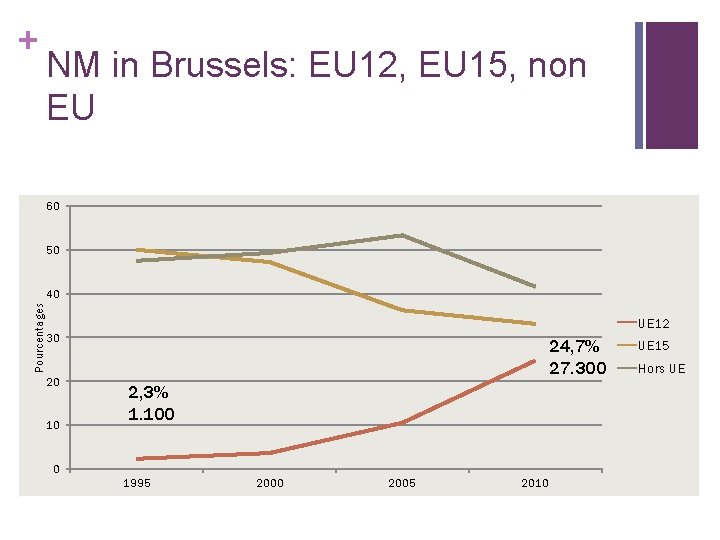
+ NM in Brussels: EU 12, EU 15, non EU 60 50 Pourcentages 40 UE 12 30 20 10 24, 7% 27. 300 2, 3% 1. 100 0 1995 2000 2005 2010 UE 15 Hors UE
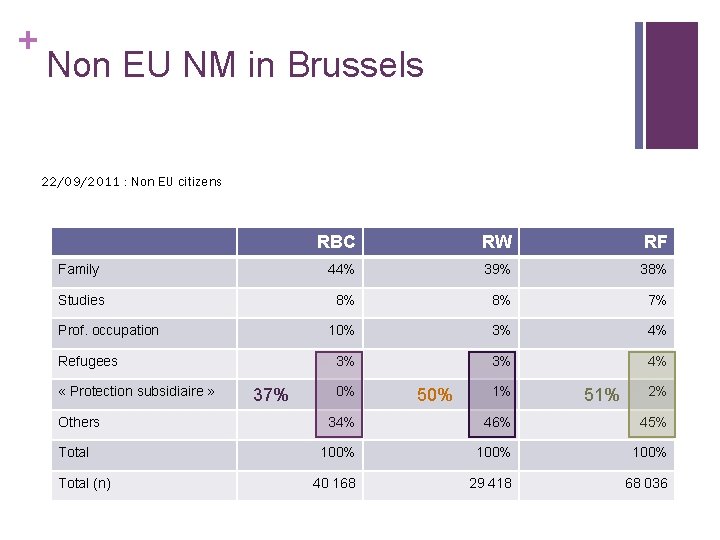
+ Non EU NM in Brussels 22/09/2011 : Non EU citizens RBC RW RF Family 44% 39% 38% Studies 8% 8% 7% 10% 3% 4% 3% 3% 4% Prof. occupation Refugees « Protection subsidiaire » Others Total (n) 37% 0% 50% 1% 51% 2% 34% 46% 45% 100% 40 168 29 418 68 036
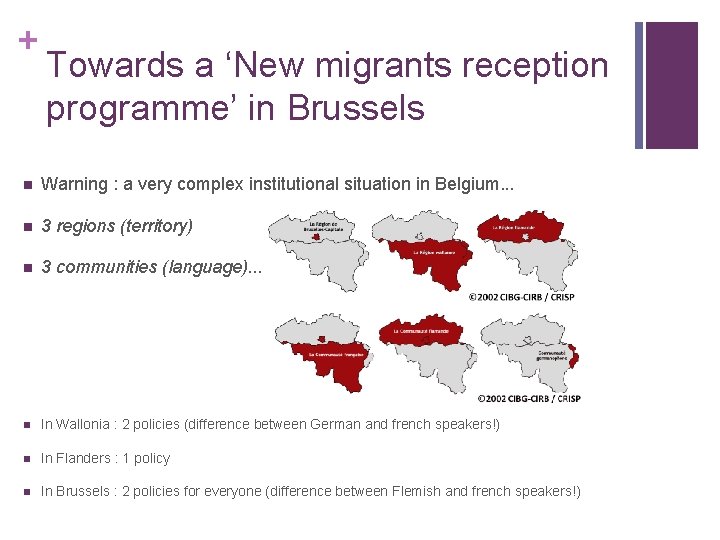
+ Towards a ‘New migrants reception programme’ in Brussels n Warning : a very complex institutional situation in Belgium. . . n 3 regions (territory) n 3 communities (language). . . n In Wallonia : 2 policies (difference between German and french speakers!) n In Flanders : 1 policy n In Brussels : 2 policies for everyone (difference between Flemish and french speakers!)
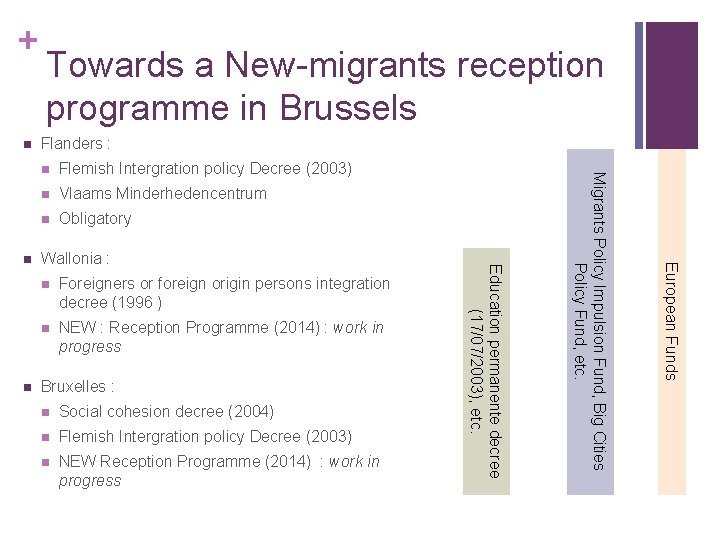
+ n n Flemish Intergration policy Decree (2003) n Vlaams Minderhedencentrum n Obligatory n Foreigners or foreign origin persons integration decree (1996 ) n NEW : Reception Programme (2014) : work in progress Bruxelles : n Social cohesion decree (2004) n Flemish Intergration policy Decree (2003) n NEW Reception Programme (2014) : work in progress European Funds Wallonia : Migrants Policy Impulsion Fund, Big Cities Policy Fund, etc. n Flanders : Education permanente decree (17/07/2003), etc. n Towards a New-migrants reception programme in Brussels
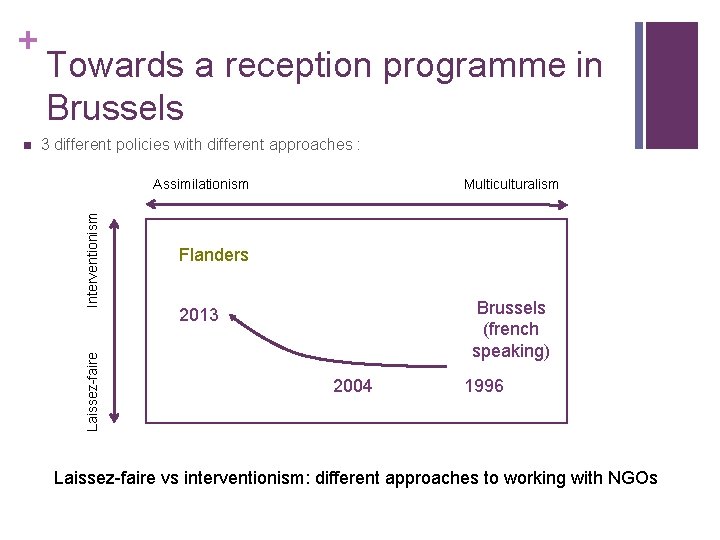
3 different policies with different approaches : Assimilationism Interventionism n Towards a reception programme in Brussels Laissez-faire + Multiculturalism Flanders Brussels (french speaking) 2013 2004 1996 Laissez-faire vs interventionism: different approaches to working with NGOs
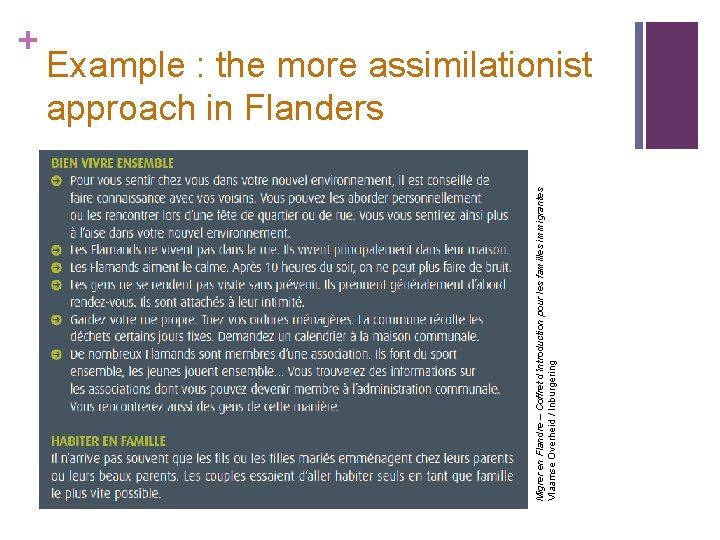
Migrer en Flandre – Coffret d’introduction pour les familles immigrantes Vlaamse Overheid / Inburgering + Example : the more assimilationist approach in Flanders
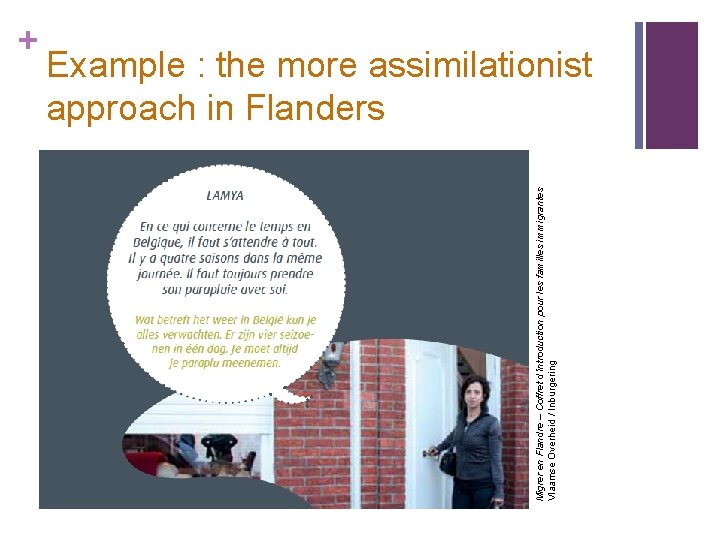
Migrer en Flandre – Coffret d’introduction pour les familles immigrantes Vlaamse Overheid / Inburgering + Example : the more assimilationist approach in Flanders
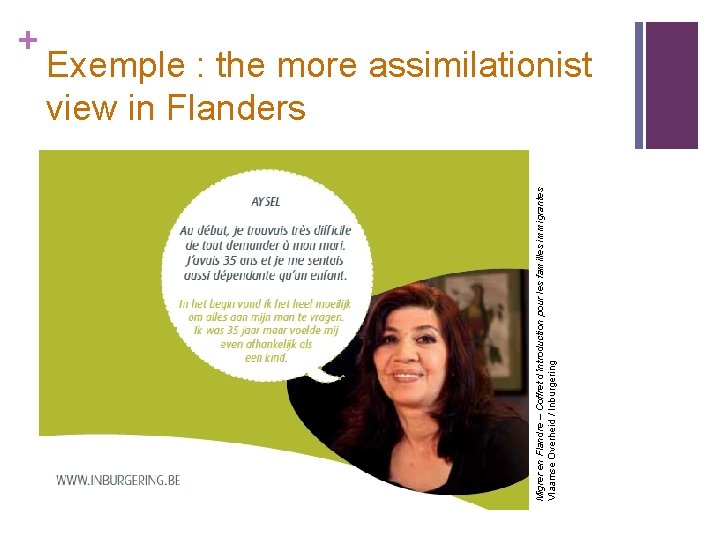
Migrer en Flandre – Coffret d’introduction pour les familles immigrantes Vlaamse Overheid / Inburgering + Exemple : the more assimilationist view in Flanders
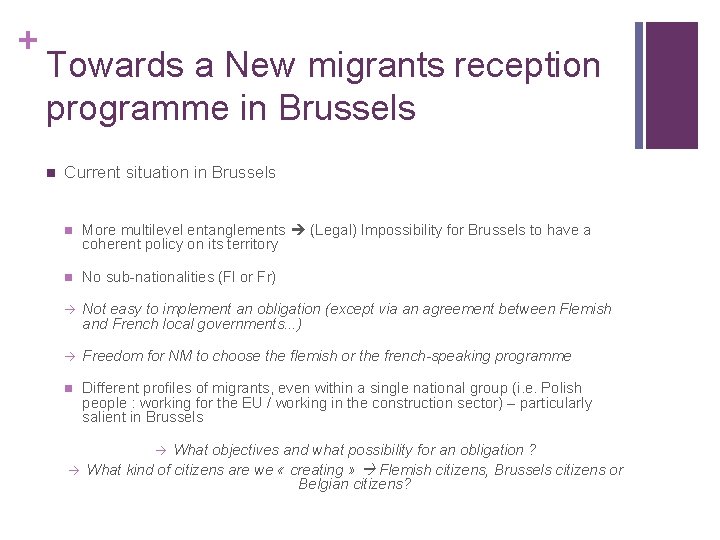
+ Towards a New migrants reception programme in Brussels n Current situation in Brussels n More multilevel entanglements (Legal) Impossibility for Brussels to have a coherent policy on its territory n No sub-nationalities (Fl or Fr) Not easy to implement an obligation (except via an agreement between Flemish and French local governments. . . ) Freedom for NM to choose the flemish or the french-speaking programme n Different profiles of migrants, even within a single national group (i. e. Polish people : working for the EU / working in the construction sector) – particularly salient in Brussels What objectives and what possibility for an obligation ? What kind of citizens are we « creating » Flemish citizens, Brussels citizens or Belgian citizens?
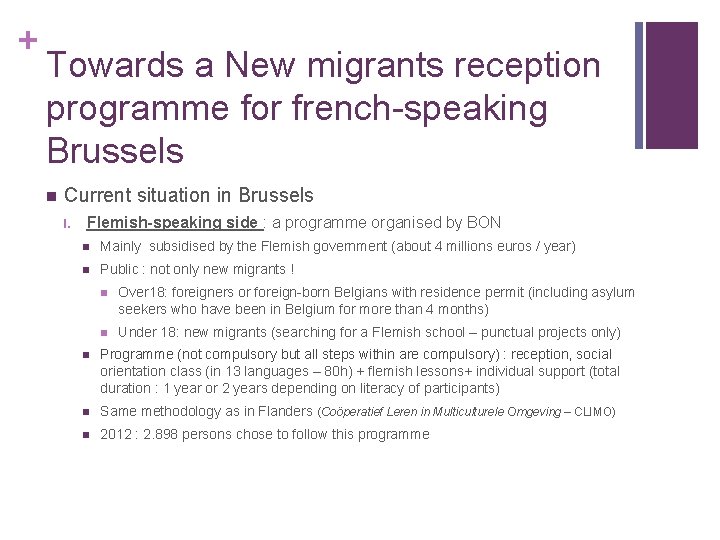
+ Towards a New migrants reception programme for french-speaking Brussels n Current situation in Brussels I. Flemish-speaking side : a programme organised by BON n Mainly subsidised by the Flemish government (about 4 millions euros / year) n Public : not only new migrants ! n Over 18: foreigners or foreign-born Belgians with residence permit (including asylum seekers who have been in Belgium for more than 4 months) n Under 18: new migrants (searching for a Flemish school – punctual projects only) n Programme (not compulsory but all steps within are compulsory) : reception, social orientation class (in 13 languages – 80 h) + flemish lessons+ individual support (total duration : 1 year or 2 years depending on literacy of participants) n Same methodology as in Flanders (Coöperatief Leren in Multiculturele Omgeving – CLIMO) n 2012 : 2. 898 persons chose to follow this programme
+ Towards a New migrants reception programme for french-speaking Brussels n Current situation (changing at the moment) French-speaking side : Social Cohesion Plan: various language and citizenship classes offered in different NGOs but rarely migrant-specific – reluctance to restrict public to migrants II. Multilevel policies in place: n No centralised information about various sessions available n Different possibilities in different municipalities n Rarely a ‘full package’ available in one organisation (language and citizenship classes for example) n Language classes often full with long waiting lists n No specific definition of public: different types of migrants involved n Different approaches/visions in different organisations (employment-oriented or not, etc. ) n Various levels of professionalisation All about to change for NM!! 05/07/2013 Decree Still waiting for implementation order
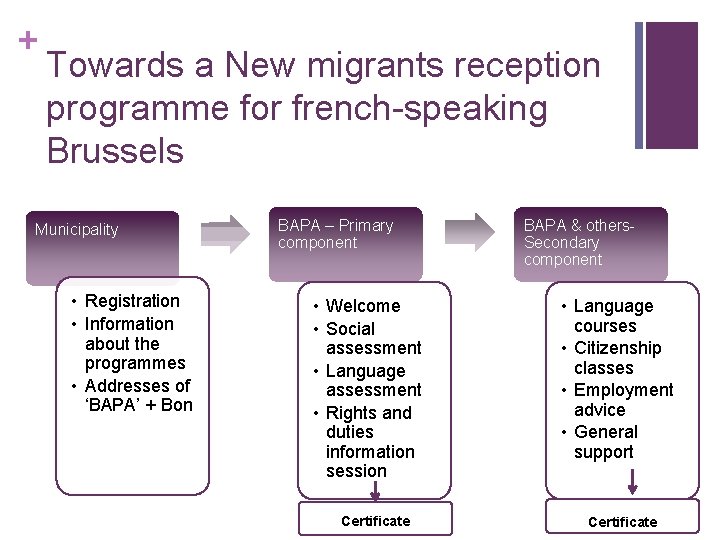
+ Towards a New migrants reception programme for french-speaking Brussels Municipality • Registration • Information about the programmes • Addresses of ‘BAPA’ + Bon BAPA – Primary component • Welcome • Social assessment • Language assessment • Rights and duties information session Certificate BAPA & others- Secondary component • Language courses • Citizenship classes • Employment advice • General support Certificate
+ Towards a New migrants reception programme for french-speaking Brussels n From the field (NGOs) : positive aspects. . . at first glance ! n n Hopes for a specific policy for NM for a long time: n Recognition of the existing expertise n No longer approaching children of immigrants as if they were new migrants (and vice versa) n Meeting specific needs Increase of their financial means (? ? ) BUT : no consensus about the relevance of the intention, and, least of all, about its implementation
+ Towards a New migrants reception programme for french-speaking Brussels n From the field: also fears / concerns enhanced by: n a european context of border reinforcment and suspicision towards migrants (Pacte européen sur l’immigration et l’asile (10/2008) n a tense national context regarding migration and integration issues (hardening of immigration and citizenship policies, etc. ) n a national context characterised by ‘activation-based’ social policies, excluding many from certain welfare rights such as unemployment benefits n local context characterised by a Flemish-French speaking competition in various fields (? ) n unfavourable media cover of migration and integration issues
+ Towards a New migrants reception programme for french-speaking Brussels From the field: fears / concerns about: n Own institutional stability (financial means, etc. ) n Their usual beneficiaries vs other beneficiaries n Irrespective of the content : control, obligation, instrumentalisation by the fed. Gov. ? (Citizenship policy) n Content related : what are we trying to do ? Assimilation vs Multiculturalism?
- Slides: 21