
WHAT PROGRESSIVE RESISTANCE TRAINING EXERCISES ARE MOST EFFECTIVE
- Slides: 1
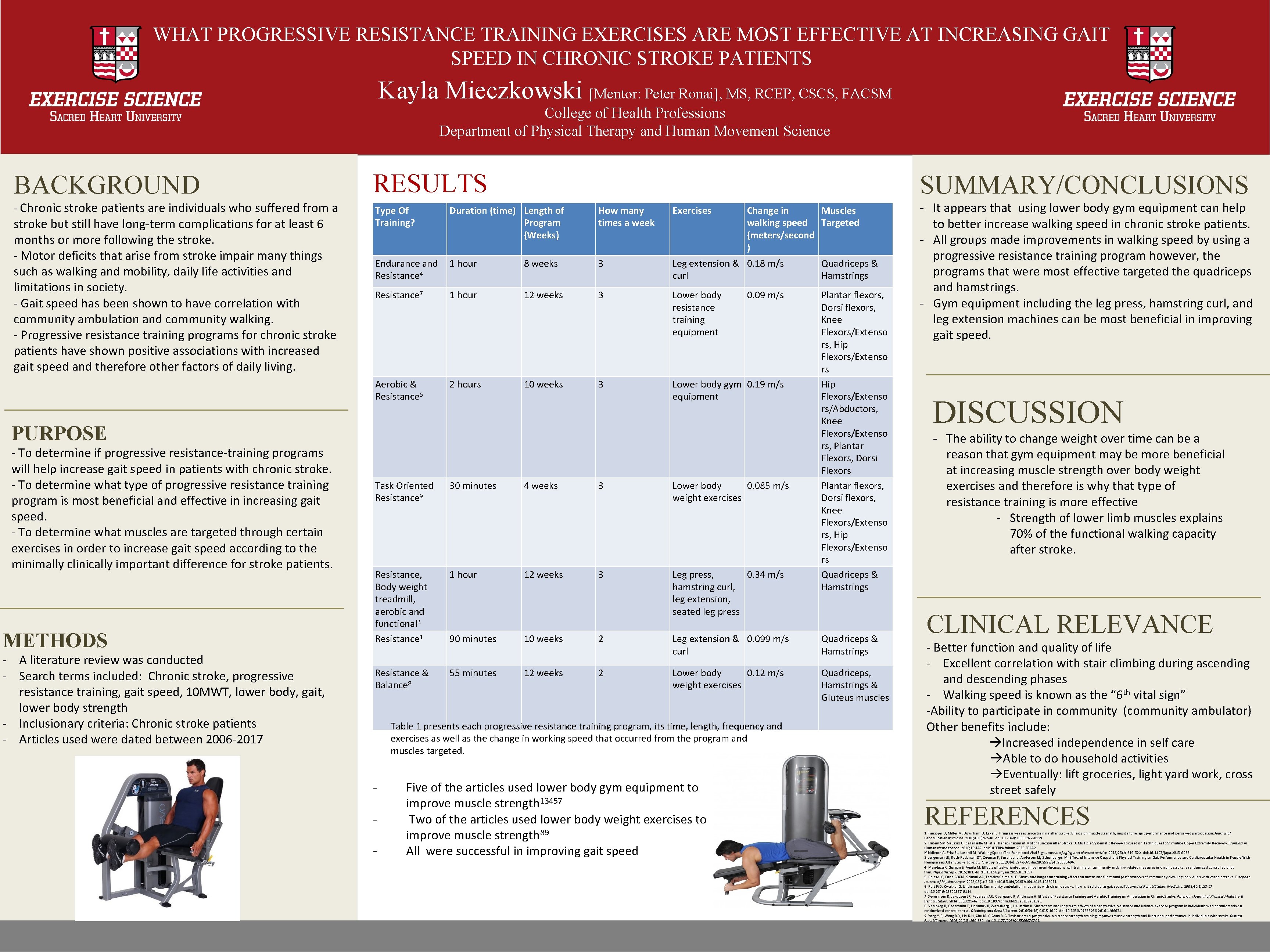
WHAT PROGRESSIVE RESISTANCE TRAINING EXERCISES ARE MOST EFFECTIVE AT INCREASING GAIT SPEED IN CHRONIC STROKE PATIENTS Kayla Mieczkowski [Mentor: Peter Ronai], MS, RCEP, CSCS, FACSM College of Health Professions Department of Physical Therapy and Human Movement Science BACKGROUND RESULTS - Chronic stroke patients are individuals who suffered from a Type Of Training? Duration (time) Length of Program (Weeks) How many times a week Exercises Endurance and Resistance 4 1 hour 8 weeks 3 Leg extension & 0. 18 m/s curl Quadriceps & Hamstrings Resistance 7 1 hour 12 weeks 3 Lower body resistance training equipment Aerobic & Resistance 5 2 hours 10 weeks 3 Lower body gym 0. 19 m/s equipment Plantar flexors, Dorsi flexors, Knee Flexors/Extenso rs, Hip Flexors/Extenso rs/Abductors, Knee Flexors/Extenso rs, Plantar Flexors, Dorsi Flexors Plantar flexors, Dorsi flexors, Knee Flexors/Extenso rs, Hip Flexors/Extenso rs Quadriceps & Hamstrings stroke but still have long-term complications for at least 6 months or more following the stroke. - Motor deficits that arise from stroke impair many things such as walking and mobility, daily life activities and limitations in society. - Gait speed has been shown to have correlation with community ambulation and community walking. - Progressive resistance training programs for chronic stroke patients have shown positive associations with increased gait speed and therefore other factors of daily living. SUMMARY/CONCLUSIONS Change in Muscles walking speed Targeted (meters/second ) 0. 09 m/s PURPOSE - To determine if progressive resistance-training programs will help increase gait speed in patients with chronic stroke. - To determine what type of progressive resistance training program is most beneficial and effective in increasing gait speed. - To determine what muscles are targeted through certain exercises in order to increase gait speed according to the minimally clinically important difference for stroke patients. METHODS - A literature review was conducted - Search terms included: Chronic stroke, progressive resistance training, gait speed, 10 MWT, lower body, gait, lower body strength - Inclusionary criteria: Chronic stroke patients - Articles used were dated between 2006 -2017 Task Oriented Resistance 9 30 minutes 4 weeks 3 Lower body 0. 085 m/s weight exercises Resistance, Body weight treadmill, aerobic and functional 3 Resistance 1 1 hour 12 weeks 3 Leg press, 0. 34 m/s hamstring curl, leg extension, seated leg press 90 minutes 10 weeks 2 Leg extension & 0. 099 m/s curl Quadriceps & Hamstrings Resistance & Balance 8 55 minutes 12 weeks 2 Lower body 0. 12 m/s weight exercises Quadriceps, Hamstrings & Gluteus muscles Table 1 presents each progressive resistance training program, its time, length, frequency and exercises as well as the change in working speed that occurred from the program and muscles targeted. - Five of the articles used lower body gym equipment to improve muscle strength 13457 Two of the articles used lower body weight exercises to improve muscle strength 89 All were successful in improving gait speed - It appears that using lower body gym equipment can help to better increase walking speed in chronic stroke patients. - All groups made improvements in walking speed by using a progressive resistance training program however, the programs that were most effective targeted the quadriceps and hamstrings. - Gym equipment including the leg press, hamstring curl, and leg extension machines can be most beneficial in improving gait speed. DISCUSSION - The ability to change weight over time can be a reason that gym equipment may be more beneficial at increasing muscle strength over body weight exercises and therefore is why that type of resistance training is more effective - Strength of lower limb muscles explains 70% of the functional walking capacity after stroke. CLINICAL RELEVANCE - Better function and quality of life - Excellent correlation with stair climbing during ascending and descending phases - Walking speed is known as the “ 6 th vital sign” -Ability to participate in community (community ambulator) Other benefits include: Increased independence in self care Able to do household activities Eventually: lift groceries, light yard work, cross street safely REFERENCES 1. Flansbjer U, Miller M, Downham D, Lexell J. Progressive resistance training after stroke: Effects on muscle strength, muscle tone, gait performance and perceived participation. Journal of Rehabilitation Medicine. 2008; 40(1): 42 -48. doi: 10. 2340/16501977 -0129. 2. Hatem SM, Saussez G, della Faille M, et al. Rehabilitation of Motor Function after Stroke: A Multiple Systematic Review Focused on Techniques to Stimulate Upper Extremity Recovery. Frontiers in Human Neuroscience. 2016; 10: 442. doi: 10. 3389/fnhum. 2016. 00442. Middleton A, Fritz SL, Lusardi M. Walking Speed: The Functional Vital Sign. Journal of aging and physical activity. 2015; 23(2): 314 -322. doi: 10. 1123/japa. 2013 -0236. 3. Jorgensen JR, Bech-Pedersen DT, Zeeman P, Sorensen J, Andersen LL, Schonberger M. Effect of Intensive Outpatient Physical Training on Gait Performance and Cardiovascular Health in People With Hemiparesis After Stroke. Physical Therapy. 2010; 90(4): 527 -537. doi: 10. 2522/ptj. 20080404. 4. Mendoza K, Gorgon E, Aguila M. Effects of task-oriented and impairment-focused circuit training on community mobility-related measures in chronic stroke: a randomized controlled pilot trial. Physiotherapy. 2015; 101. doi: 10. 1016/j. physio. 2015. 03. 1857. 5. Polese JC, Faria CDCM, Scianni AA, Teixeira-Salmela LF. Short- and long-term training effects on motor and functional performances of community-dwelling individuals with chronic stroke. European Journal of Physiotherapy. 2015; 18(1): 3 -10. doi: 10. 3109/21679169. 2015. 1085091. 6. Port IVD, Kwakkel G, Lindeman E. Community ambulation in patients with chronic stroke: how is it related to gait speed? Journal of Rehabilitation Medicine. 2008; 40(1): 23 -27. doi: 10. 2340/16501977 -0114. 7. Severinsen K, Jakobsen JK, Pedersen AR, Overgaard K, Andersen H. Effects of Resistance Training and Aerobic Training on Ambulation in Chronic Stroke. American Journal of Physical Medicine & Rehabilitation. 2014; 93(1): 29 -42. doi: 10. 1097/phm. 0 b 013 e 3182 a 518 e 1. 8. Vahlberg B, Cederholm T, Lindmark B, Zetterberg L, Hellström K. Short-term and long-term effects of a progressive resistance and balance exercise program in individuals with chronic stroke: a randomized controlled trial. Disability and Rehabilitation. 2016; 39(16): 1615 -1622. doi: 10. 1080/09638288. 2016. 1206631. 9. Yang Y-R, Wang R-Y, Lin K-H, Chu M-Y, Chan R-C. Task-oriented progressive resistance strength training improves muscle strength and functional performance in individuals with stroke. Clinical Rehabilitation. 2006; 20(10): 860 -870. doi: 10. 1177/0269215506070701.