
What produces a gravitational field A gravitational field
- Slides: 16
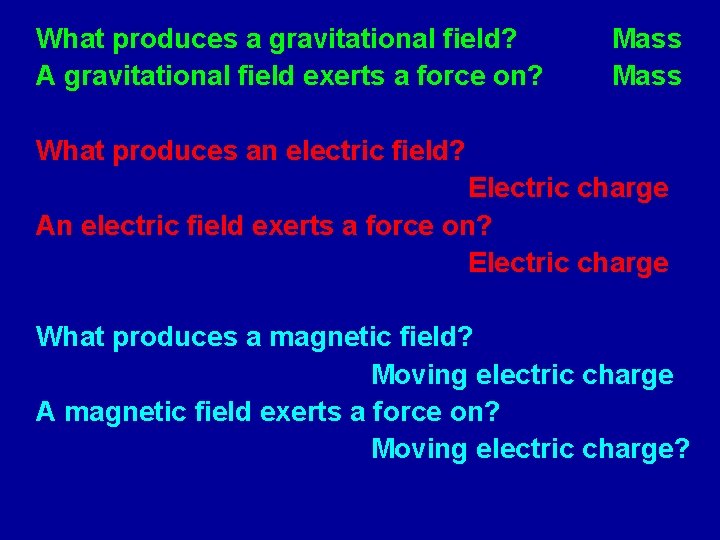
What produces a gravitational field? A gravitational field exerts a force on? Mass What produces an electric field? Electric charge An electric field exerts a force on? Electric charge What produces a magnetic field? Moving electric charge A magnetic field exerts a force on? Moving electric charge?
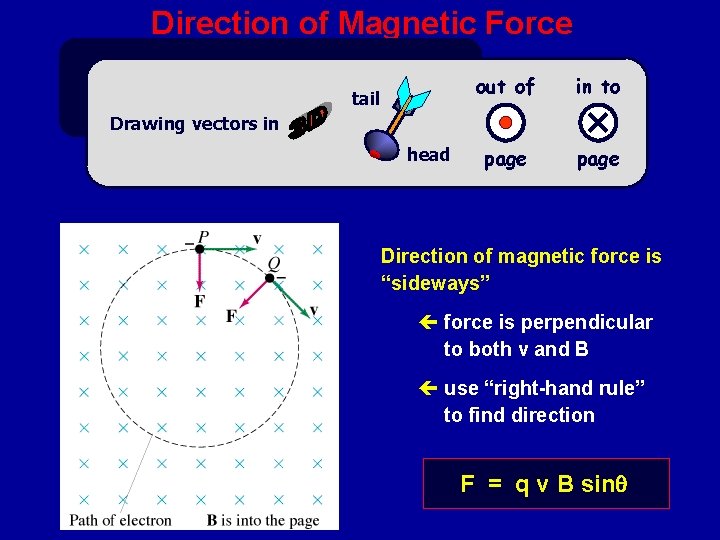
Direction of Magnetic Force tail out of in to page Drawing vectors in head Direction of magnetic force is “sideways” ç force is perpendicular to both v and B ç use “right-hand rule” to find direction F = q v B sinq
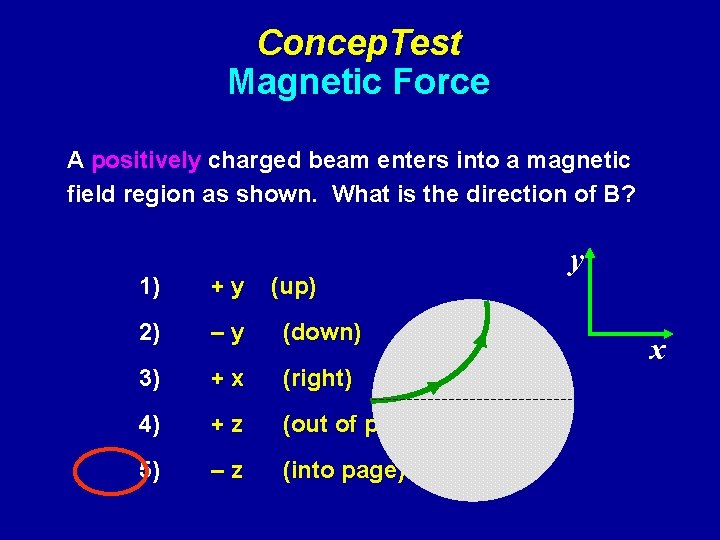
Concep. Test Magnetic Force A positively charged beam enters into a magnetic field region as shown. What is the direction of B? 1) +y (up) 2) –y (down) 3) +x (right) 4) +z (out of page) 5) –z (into page) y x
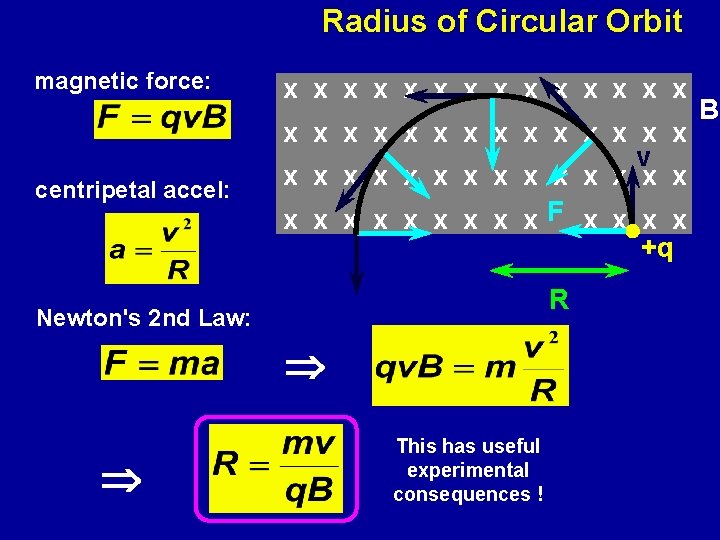
Radius of Circular Orbit magnetic force: centripetal accel: x x x x x x x v x x x x x x Fx x x +q R Newton's 2 nd Law: This has useful experimental consequences ! B
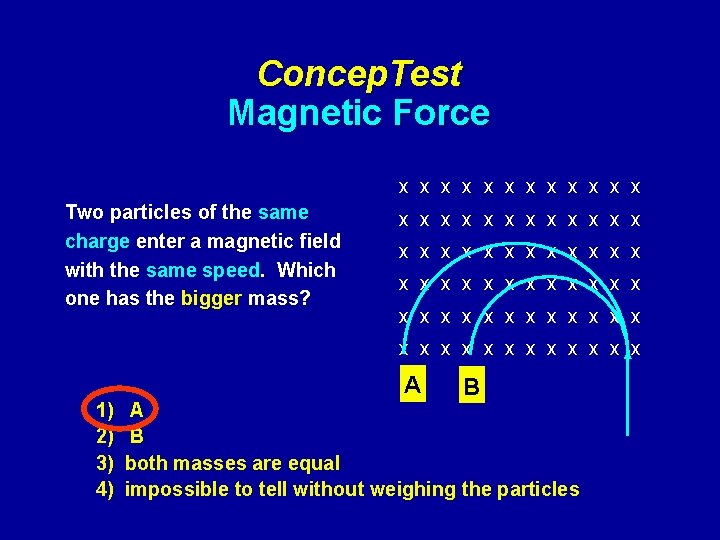
Concep. Test Magnetic Force x x x Two particles of the same charge enter a magnetic field with the same speed. Which one has the bigger mass? x x x x x x x x x x x x x x x A 1) 2) 3) 4) B A B both masses are equal impossible to tell without weighing the particles
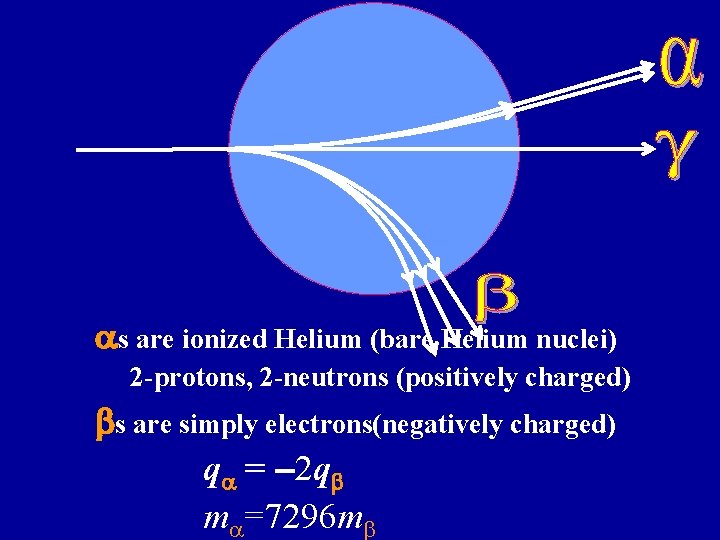
as are ionized Helium (bare Helium nuclei) 2 -protons, 2 -neutrons (positively charged) bs are simply electrons(negatively charged) qa = -2 qb ma=7296 mb
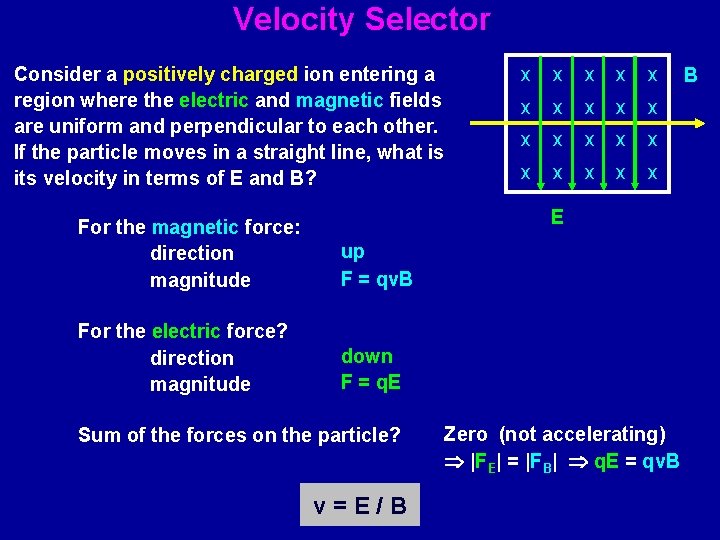
Velocity Selector Consider a positively charged ion entering a region where the electric and magnetic fields are uniform and perpendicular to each other. If the particle moves in a straight line, what is its velocity in terms of E and B? x x x x x E For the magnetic force: direction magnitude up F = qv. B For the electric force? direction magnitude down F = q. E Sum of the forces on the particle? v=E/B Zero (not accelerating) |FE| = |FB| q. E = qv. B B
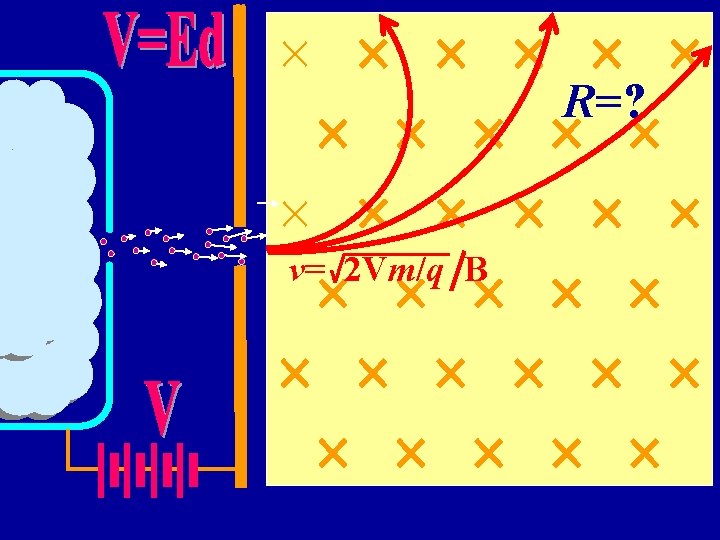
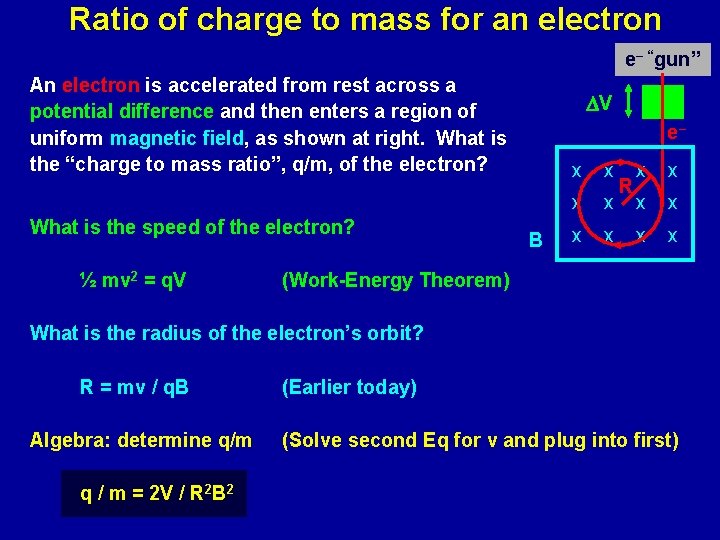
Ratio of charge to mass for an electron e– “gun” An electron is accelerated from rest across a potential difference and then enters a region of uniform magnetic field, as shown at right. What is the “charge to mass ratio”, q/m, of the electron? What is the speed of the electron? ½ mv 2 = q. V DV e– B x x x R x x x (Work-Energy Theorem) What is the radius of the electron’s orbit? R = mv / q. B Algebra: determine q/m q / m = 2 V / R 2 B 2 (Earlier today) (Solve second Eq for v and plug into first)
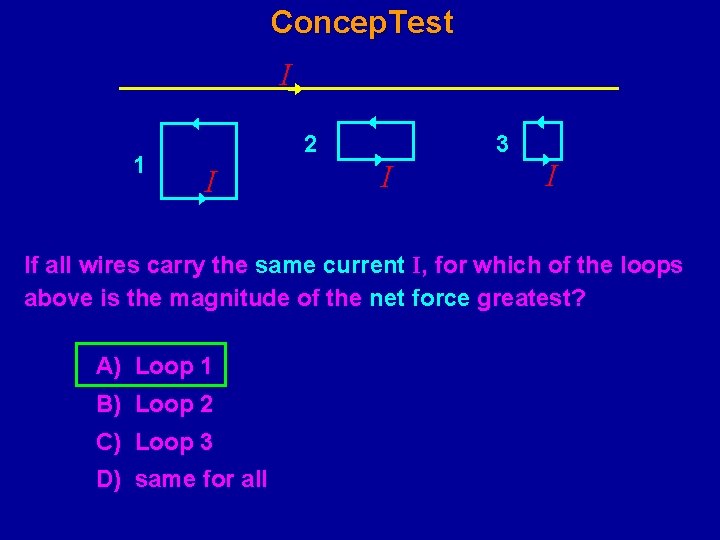
Concep. Test I 1 2 I 3 I I If all wires carry the same current I, for which of the loops above is the magnitude of the net force greatest? A) Loop 1 B) Loop 2 C) Loop 3 D) same for all
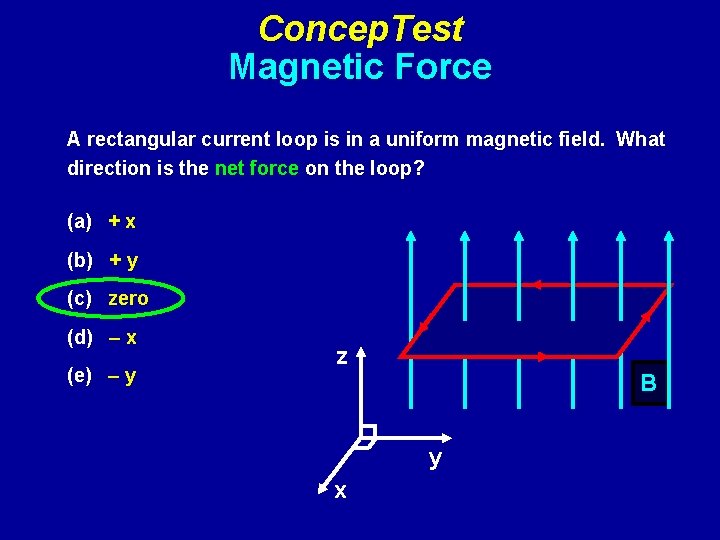
Concep. Test Magnetic Force A rectangular current loop is in a uniform magnetic field. What direction is the net force on the loop? (a) + x (b) + y (c) zero (d) – x (e) – y z B y x
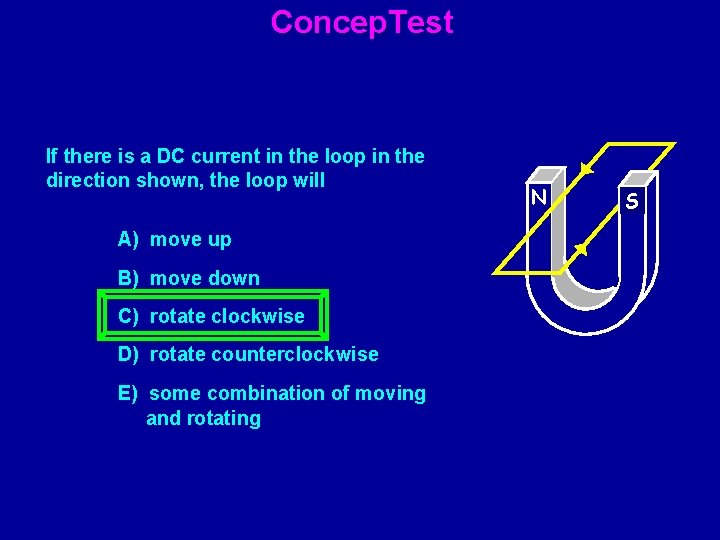
Concep. Test If there is a DC current in the loop in the direction shown, the loop will A) move up B) move down C) rotate clockwise D) rotate counterclockwise E) some combination of moving and rotating N S
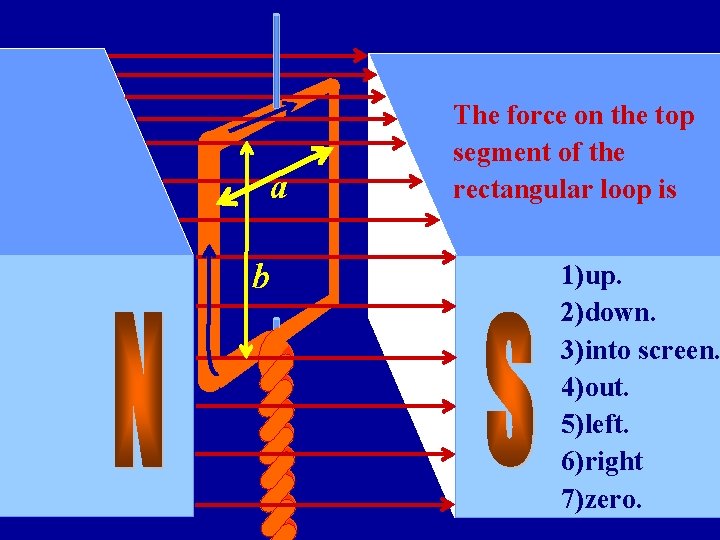
a b The force on the top segment of the rectangular loop is 1)up. 2)down. 3)into screen. 4)out. 5)left. 6)right 7)zero.
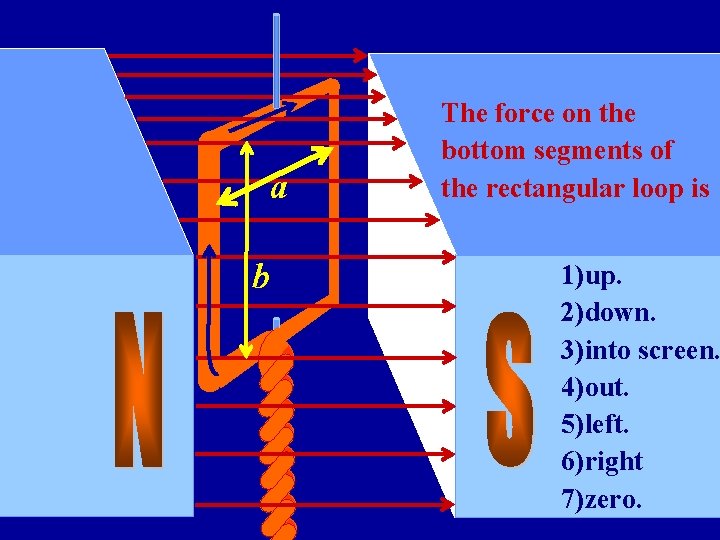
a b The force on the bottom segments of the rectangular loop is 1)up. 2)down. 3)into screen. 4)out. 5)left. 6)right 7)zero.
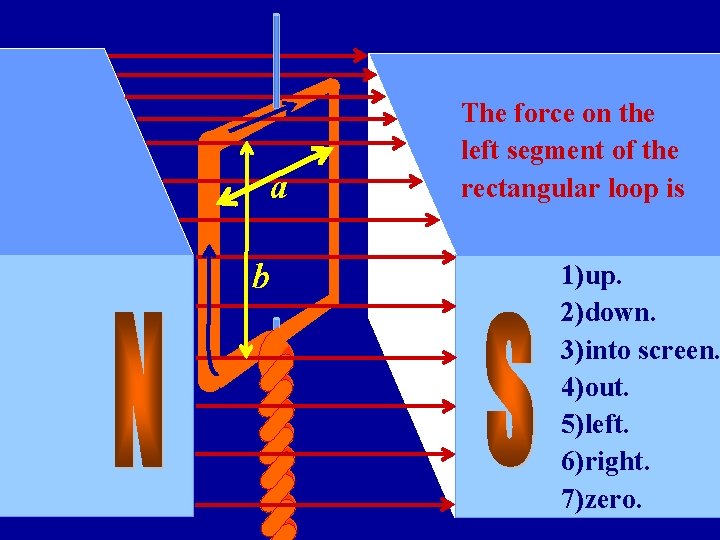
a b The force on the left segment of the rectangular loop is 1)up. 2)down. 3)into screen. 4)out. 5)left. 6)right. 7)zero.
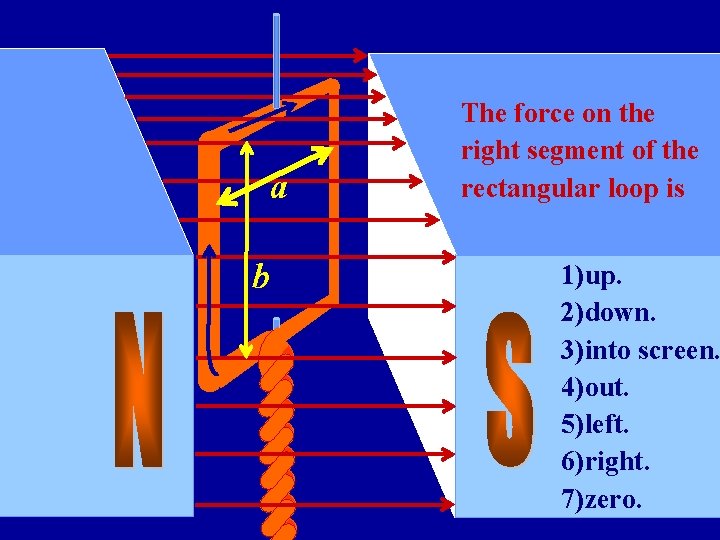
a b The force on the right segment of the rectangular loop is 1)up. 2)down. 3)into screen. 4)out. 5)left. 6)right. 7)zero.