
What Problems are We Trying to Solve The
What Problems are We Trying to Solve? The Motivating Forces behind Object. Oriented Programming and Design October 21 © 2003, Bryan J. Higgs
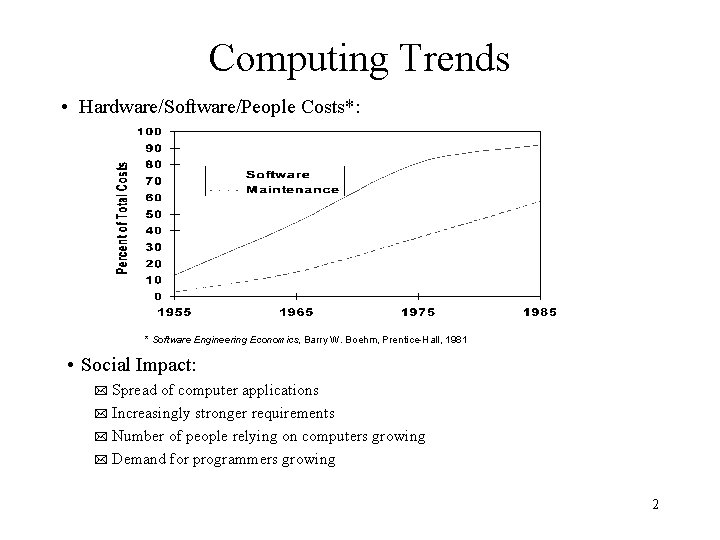
Computing Trends • Hardware/Software/People Costs*: * Software Engineering Economics, Barry W. Boehm, Prentice-Hall, 1981 • Social Impact: Spread of computer applications * Increasingly stronger requirements * Number of people relying on computers growing * Demand for programmers growing * 2
The ‘Software Crisis’ • Mostly 'Bottom line' concerns. • In some applications also impacts health, safety and social issues. • Schedule and cost estimates are often grossly inaccurate. – Cost overruns of an order of magnitude have been experienced. – Schedules slip by months or years. • Productivity of software people hasn't kept pace with the demand for their services. – Little has been done to improve the productivity of software practitioners. 3
The ‘Software Crisis’ • Quality of software is sometimes 'less than adequate'. – Error rates for new programs cause customer dissatisfaction and lack of confidence. • Existing software can be very difficult to maintain/enhance. – Software maintenance devours the majority of all software costs (estimates 70 -80%). – Considerable backlogs in developing new systems (5 years or more). – Maintainability is often not an important criterion for software acceptance in many situations (besides, how do you measure maintainability? ). 4

Causes for The ‘Software Crisis’ • The nature of software: – – – Software is logical, rather than physical. Software is developed or engineered, rather than being manufactured in the classical sense. Software costs are concentrated in engineering, and thus software projects cannot be managed as if they were manufacturing projects. Software doesn't 'wear out'. However, it can deteriorate if maintenance fixes introduce errors at a higher rate than errors are fixed. There are no software 'spare parts', unlike for hardware. Every software failure indicates an error in design or in the process through which design was translated into executable code. Software maintenance involves much greater complexity than does hardware maintenance. Most software is custom built, rather than assembled from existing components. With few exceptions, there are no catalogs of software components. "If architects designed buildings the way we design software, the first woodpecker to come along would destroy civilization!" 5
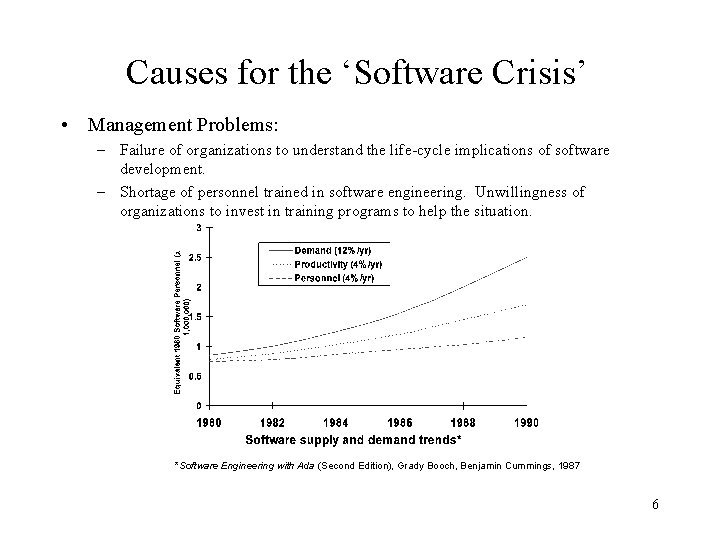
Causes for the ‘Software Crisis’ • Management Problems: – Failure of organizations to understand the life-cycle implications of software development. – Shortage of personnel trained in software engineering. Unwillingness of organizations to invest in training programs to help the situation. *Software Engineering with Ada (Second Edition), Grady Booch, Benjamin Cummings, 1987 6
Causes for the ‘Software Crisis’ • Management Problems: – Tendency of organizations to become entrenched in the use of archaic programming languages and practices. "No manager would want a first generation vacuum tube computer, yet few are willing to part with first generation programming languages, such as FORTRAN" 7
Causes for the ‘Software Crisis’ • Technical Problems: – Underlying Causes: • Complexity • Change "It is our human limitations, our inability to simultaneously deal with all the relations and ramifications of a complex situation, which lies at the root of our software problems. " [W. A. Wulf] "I have only a very small head and must live with it. " [E. Dijkstra] 8
The Problem and The Challenge • The Problem: – Software is expensive and getting more so. – We are being asked to build more complex and more flexible systems. – Costs are high because current techniques produce software that is: • hard to maintain • difficult to extend • not reusable • The Challenge: – How can we improve programmer productivity and cope with this increasing complexity and increasing rate of change? 9
![“The Answer” • There is no 'silver bullet'. [Brooks] • Object-Oriented programming attempts to](http://slidetodoc.com/presentation_image_h2/f7d0208f753b324445ed3b5800920c50/image-10.jpg "“The Answer” • There is no 'silver bullet'. [Brooks] • Object-Oriented programming attempts to")
“The Answer” • There is no 'silver bullet'. [Brooks] • Object-Oriented programming attempts to improve the way we design and build software. • To allow for reuse, change, and growth, code must be: – simple – understandable – well modularized • Object-Oriented programming: – – is an approach to accomplishing these goals. It is not a panacea; It is not always the right approach; It is applicable more times that you might perhaps think! 10
- Slides: 10