
What part of speech are these words all

- Slides: 19
What part of speech are these words? all this mine he neither who somebody his me some you these she they that whom ours its
The words on the previous slide are all pronouns. Answer the questions below. Write your answers in your notebook. Check your answers on the next slide. a) What do pronouns do? b) What can pronouns do?
a) Pronouns take the place of nouns, so the speaker/ writer doesn’t repeat him or herself and sound boring. e. g. Tom left Tom’s house in a hurry this morning. Tom left his house in a hurry this morning. b) Pronouns can do anything nouns can (e. g. the can be subjects or they can be objects).
The nouns that pronouns take the place of are called antecedents. Tom left his house in a hurry this morning. (‘His’ is the pronoun of the antecedent ‘Tom’, so ‘his’ takes the place of ‘Tom’. )
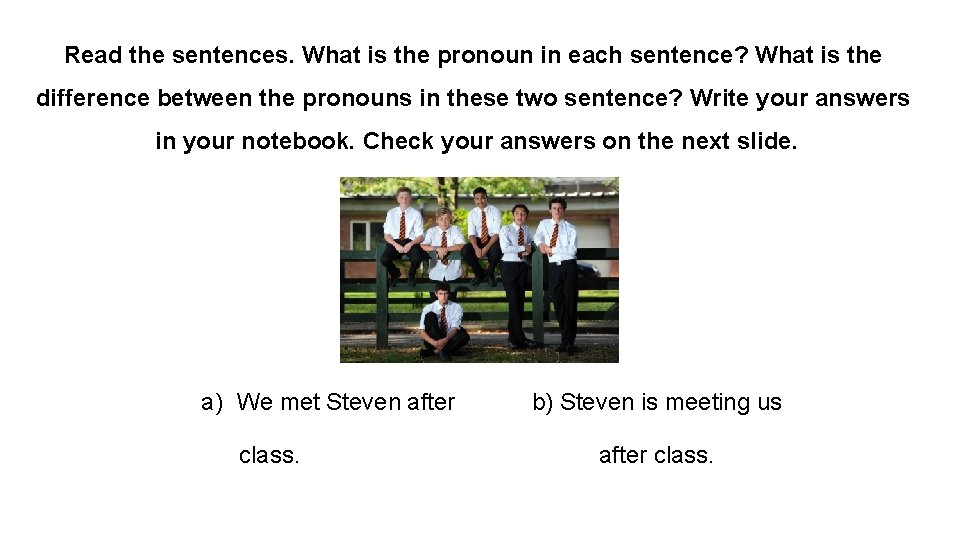
Read the sentences. What is the pronoun in each sentence? What is the difference between the pronouns in these two sentence? Write your answers in your notebook. Check your answers on the next slide. a) We met Steven after class. b) Steven is meeting us after class.
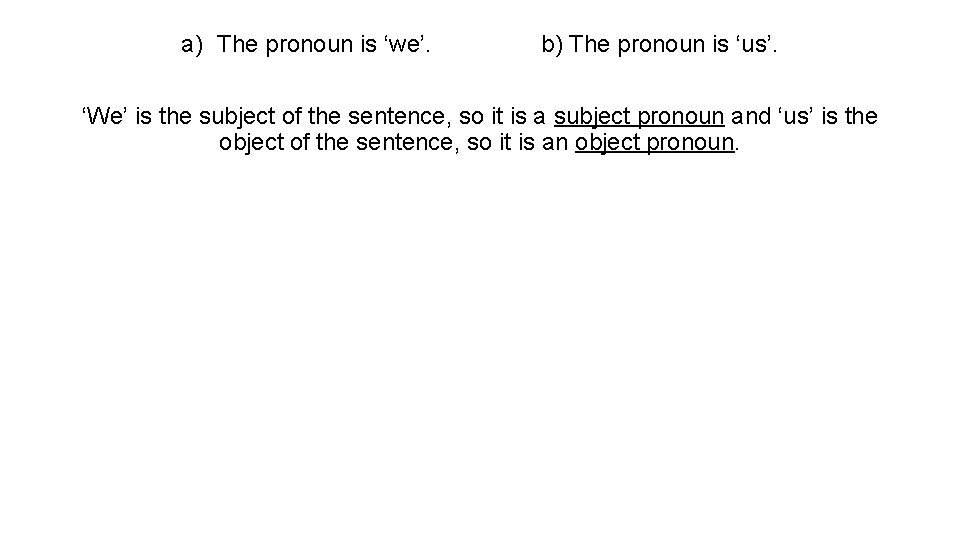
a) The pronoun is ‘we’. b) The pronoun is ‘us’. ‘We’ is the subject of the sentence, so it is a subject pronoun and ‘us’ is the object of the sentence, so it is an object pronoun.
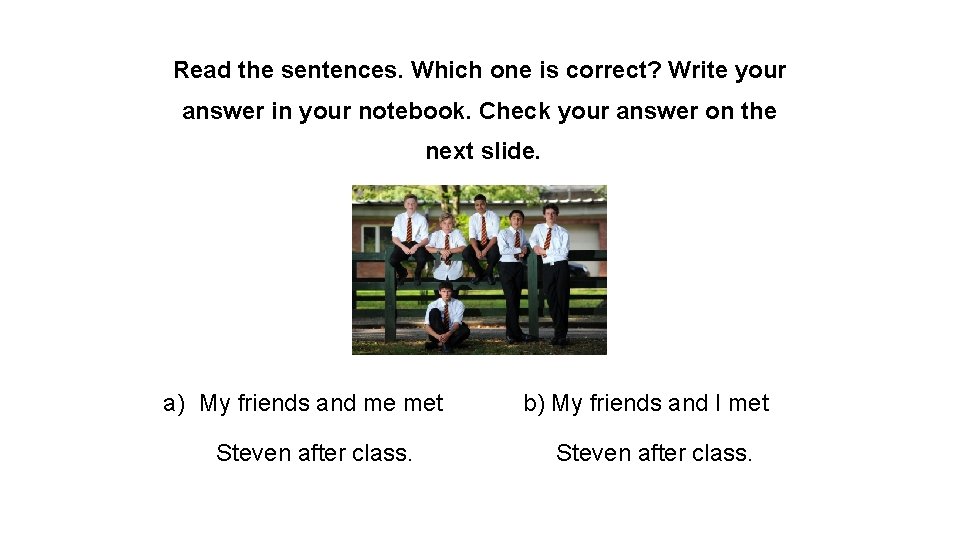
Read the sentences. Which one is correct? Write your answer in your notebook. Check your answer on the next slide. a) My friends and me met Steven after class. b) My friends and I met Steven after class.
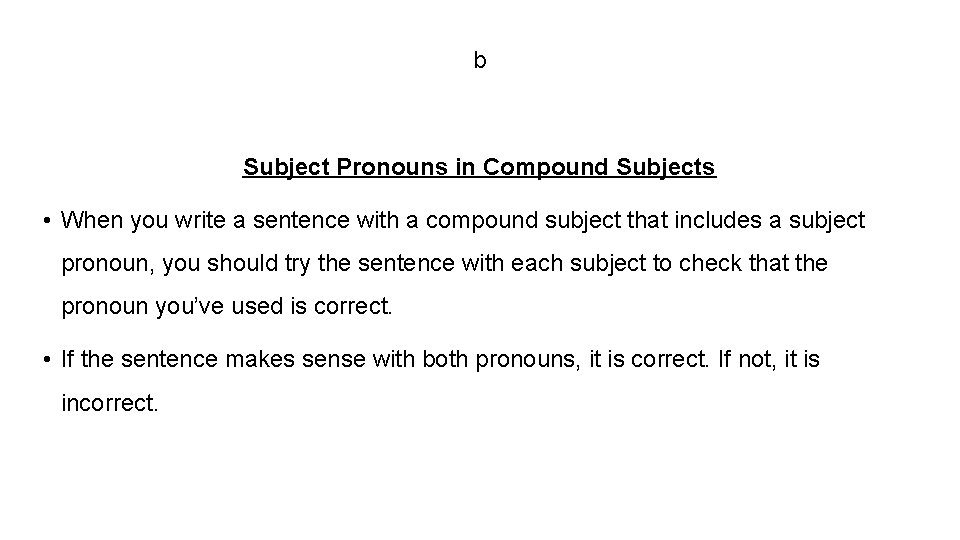
b Subject Pronouns in Compound Subjects • When you write a sentence with a compound subject that includes a subject pronoun, you should try the sentence with each subject to check that the pronoun you’ve used is correct. • If the sentence makes sense with both pronouns, it is correct. If not, it is incorrect.
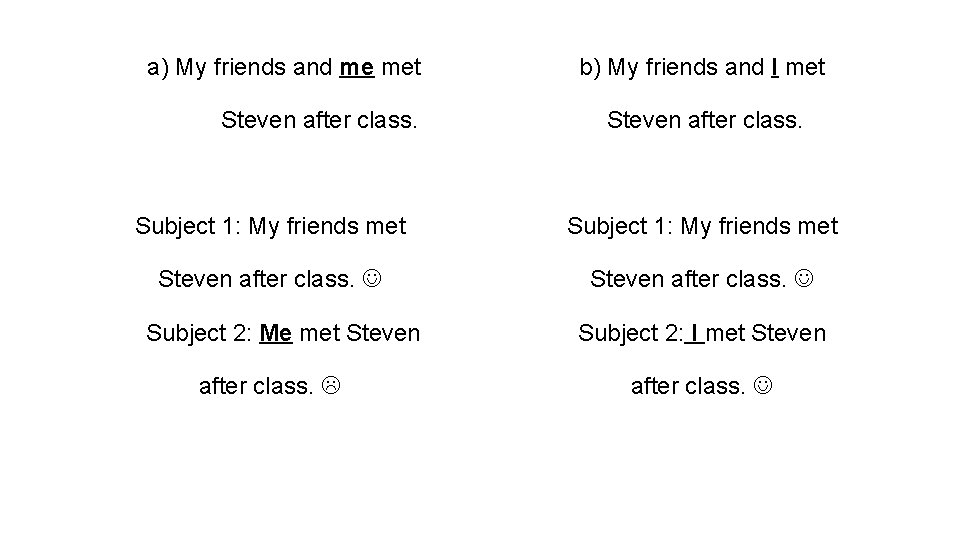
a) My friends and me met Steven after class. b) My friends and I met Steven after class. Subject 1: My friends met Steven after class. Subject 2: Me met Steven after class. Subject 2: I met Steven after class.
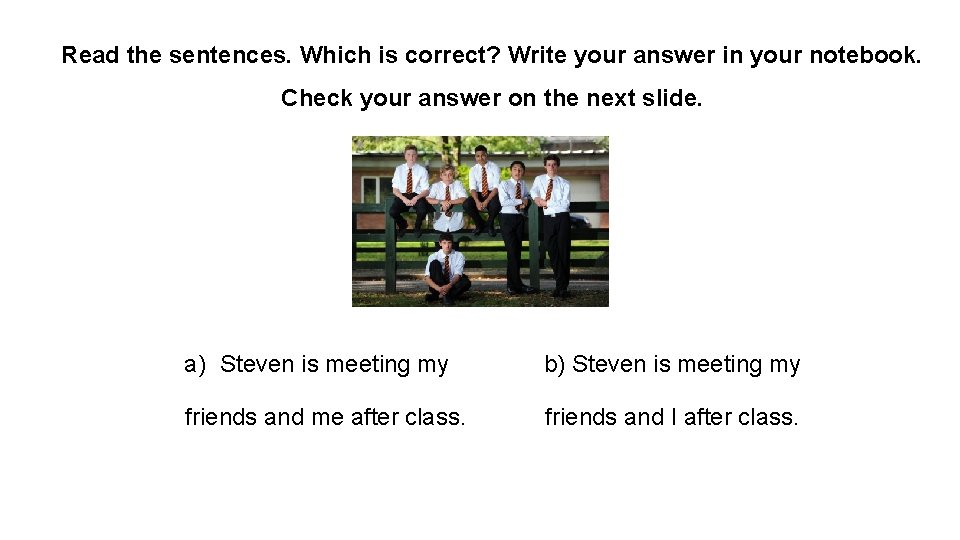
Read the sentences. Which is correct? Write your answer in your notebook. Check your answer on the next slide. a) Steven is meeting my b) Steven is meeting my friends and me after class. friends and I after class.
a Object Pronouns in Compound Objects • When you write a sentence with a compound object that has an object pronoun, you should try the sentence with each object to check that the pronoun you’ve used is correct. • If the sentence makes sense with both pronouns, it is correct. If not, it is incorrect.
a) Steven is meeting my b) Steven is meeting my friends and me after class. friends and I after class. Object 1: Steven is meeting Object 1: Steven is my friends after class. meeting my friends after class. Object 2: Steven is meeting me after class. Object 2: Steven is I after class.
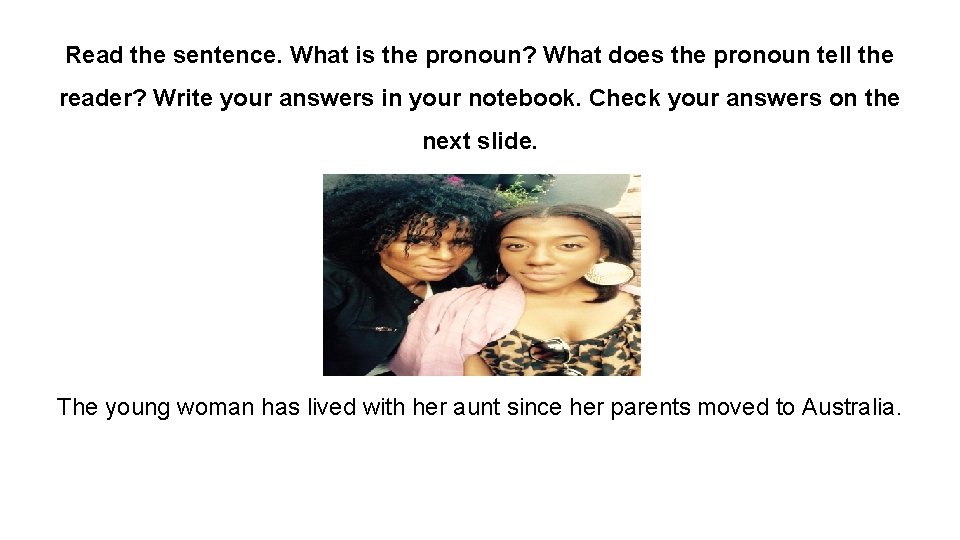
Read the sentence. What is the pronoun? What does the pronoun tell the reader? Write your answers in your notebook. Check your answers on the next slide. The young woman has lived with her aunt since her parents moved to Australia.
The pronoun is ‘her’. It is a possessive pronoun. Possessive Pronouns • Possessive pronouns show that something belongs to someone. • The possessive pronouns are: My, mine, yours, his, hers, its, ours, yours, theirs. • The structures for possessive pronouns are: 1. My, your, his, her, its, our, your, their + noun 2. + to be (in any tense) + mine, yours, his, hers, ours, yours, theirs • Possessive pronouns never have an apostrophe (‘).
Read the sentences. Which ones are correct? Write your answers in your notebook. Check your answers in your notebook. a) Sara dislikes tomatoes more than I. b) Sara dislikes tomatoes more than me. c) Sara dislikes him more than Sara dislikes I. d) Sara dislikes him more than Sara dislikes me.
The correct sentences are a and d. Subject Pronouns in Comparisons e. g. Sara dislikes tomatoes more than I. • In comparative sentences with a subject pronoun after ‘than’ or ‘as’, repeat the verb after this pronoun to check that you’ve used the correct type of pronoun. e. g. Sara dislikes tomatoes more than I (dislike tomatoes). • If it makes sense, the pronoun is correct. If not, it is incorrect.
Object Pronouns in Comparisons e. g. Sara dislikes him more than Sara dislikes me. • Some comparative sentences have a new clause after ‘than’ or ‘as’. You may need an object pronoun in this clause.
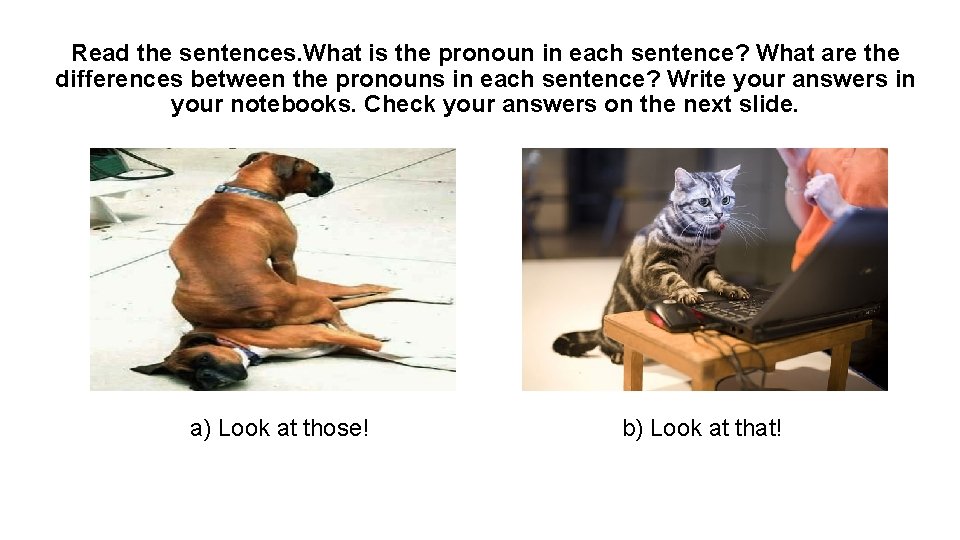
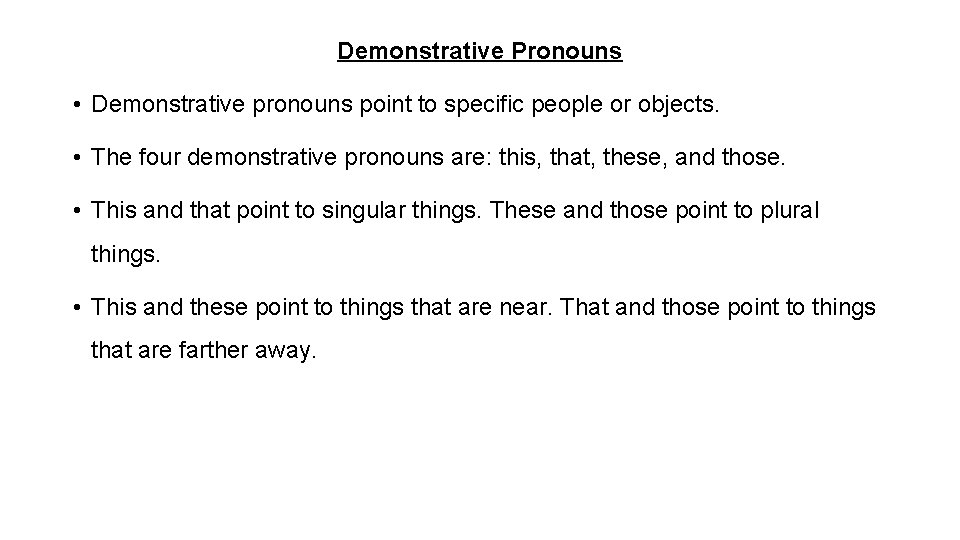
Read the sentences. What is the pronoun in each sentence? What are the differences between the pronouns in each sentence? Write your answers in your notebooks. Check your answers on the next slide. a) Look at those! b) Look at that!
Demonstrative Pronouns • Demonstrative pronouns point to specific people or objects. • The four demonstrative pronouns are: this, that, these, and those. • This and that point to singular things. These and those point to plural things. • This and these point to things that are near. That and those point to things that are farther away.