
What might your paper look like Introduction Grabs
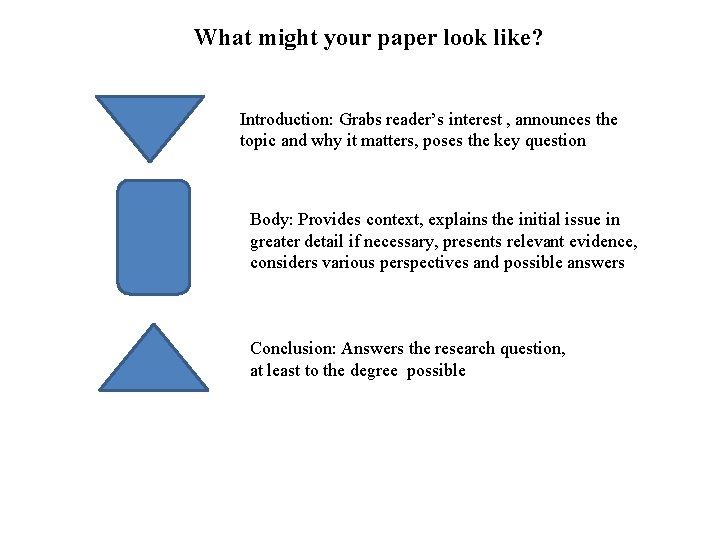
What might your paper look like? Introduction: Grabs reader’s interest , announces the topic and why it matters, poses the key question Body: Provides context, explains the initial issue in greater detail if necessary, presents relevant evidence, considers various perspectives and possible answers Conclusion: Answers the research question, at least to the degree possible
Opening paragraph: Introduction Opening lines are HUGELY important – they set the tone for the rest of the paper, and they set up expectations for the reader. *should be engaging *should have clear, precise diction *should be completely free of errors Final line should ask the research question. The middle section should move logically from the opening line to the question. (Show a clear progression of thought. )

Closing paragraph: Conclusion Signal that it’s the final paragraph: begin with “so, ” “therefore, ” “finally, ” “in conclusion, ” or some similar word or phrase. It might be helpful to repeat the question, or at least refer to it. You might review the various possible answers, especially if you offered several views or you offered competing views. Answer the question as clearly as possible. If you choose one answer from several possible ones, explain your reasoning. If possible, tie the conclusion back to the introduction to signal that the paper has come “full circle” and is therefore complete.
Body paragraphs Arrange them in a logical order – and be sure the order will be clear to the reader. *most likely to least likely *simplest to most complex *most widely believed to least widely believed * earliest to most recent (i. e. , chronological) Use signal words/phrases to show progression of though within and between paragraphs: first, next, but, in contrast, further, and, however, yet. You can also use parallel structure to show connections, similarities, or contrasts: “not with X, but with Y”; “the most obvious answer is X, but the most effective answer is Y. ”

Body paragraphs Use MLA conventions for in-text citations: include author (or title, if there’s no author) and page number for quoted material. NO “DROP QUOTES”! Every sentence must include some of your own words – preferably to identify authors, perhaps give their credentials, and connect the quoted material to other sentences. Use a variety of signal phrases. (“According to…” gets stale. ) Show each piece of evidence supports or explains a claim.

Looking Ahead Bring a complete draft – 800 words minimum, plus the Works Cited page, with an appropriate header and running header – to class Monday. We will use class time for final revisions and edits. Paper is due Wednesday. Use the rest of today’s class to work on your paper as needed.
- Slides: 6