
What makes fathers involved in their childrens care
- Slides: 15
What makes fathers involved in their children’s care? Analysing paternal involvement from nine months to seven years post-birth Dr Helen Norman University of Manchester 1 st November 2017 ‘Fathers, family and gender in the workplace: pursuing pathways to research impact and engagement’ Lancaster University Conference Centre
Presentation outline • • • The gender division of labour in the UK Research Questions Data and methods Results: which fathers are the most involved? Conclusions and policy implications Pathways to Impact?
The gender division of labour in the UK • Men do more childcare and housework, but still much less than women. • Normative ideas about what it is to be a ‘good’ father have shifted to include being involved in childcare, but being the (main) economic provider remains a central feature. • Women usually switch to part-time employment after having children. – 65% of mothers with dependent children (aged 3 -4) employed (2017); 59% = PT • Rare for mothers to work full-time if they have a pre-school child, more likely if she is a manager/senior professional • This ‘one-and-a-half earner’ family model is perpetuated by public policy and normative beliefs that children suffer if their mothers are employed full-time.
What is paternal involvement? • Defined as a father who participates in the nurturing tasks involved in the ‘taking care of’ children. Research Questions 1. To explore which socio-demographics, employment and attitudinal related variables are associated with paternal involvement when children are aged 9 months, 3, 5 and 7 years old? 2. Do the variables which influence fathers to be involved change as a child gets older? 3. Does a father’s childcare behaviour in the first year of a child’s life affect how involved he is when the child is older?
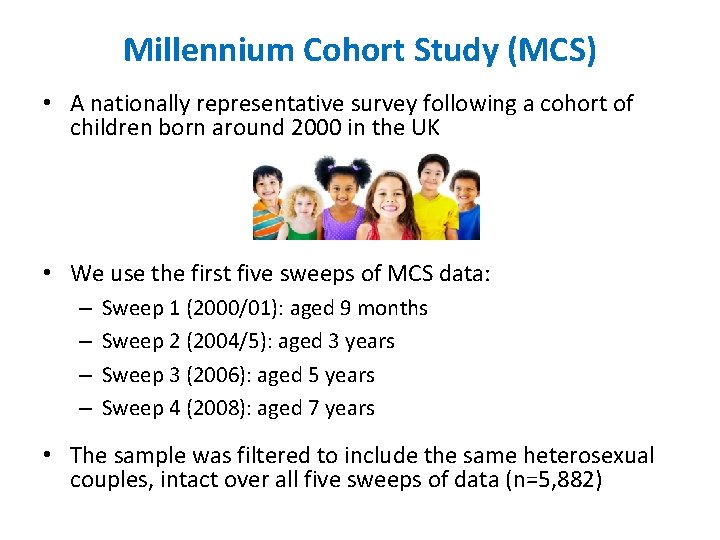
Millennium Cohort Study (MCS) • A nationally representative survey following a cohort of children born around 2000 in the UK • We use the first five sweeps of MCS data: – – Sweep 1 (2000/01): aged 9 months Sweep 2 (2004/5): aged 3 years Sweep 3 (2006): aged 5 years Sweep 4 (2008): aged 7 years • The sample was filtered to include the same heterosexual couples, intact over all five sweeps of data (n=5, 882)
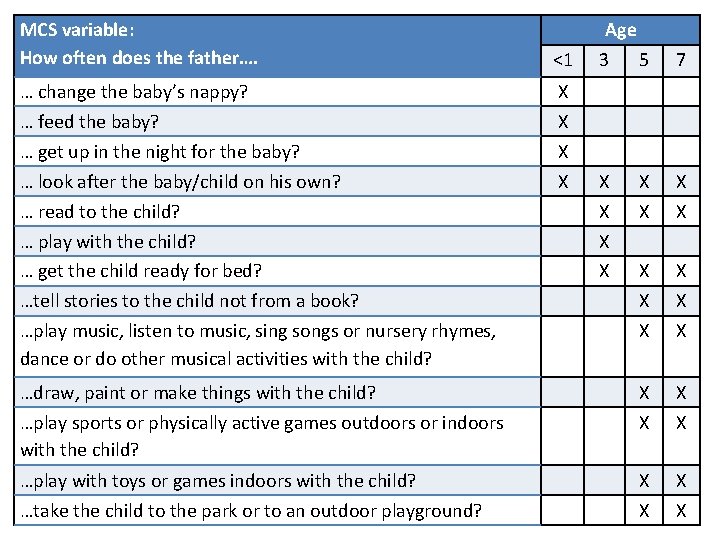
MCS variable: How often does the father…. <1 Age 3 5 7 … change the baby’s nappy? … feed the baby? … get up in the night for the baby? … look after the baby/child on his own? … read to the child? … play with the child? … get the child ready for bed? …tell stories to the child not from a book? …play music, listen to music, sing songs or nursery rhymes, dance or do other musical activities with the child? X X X X X X X …draw, paint or make things with the child? …play sports or physically active games outdoors or indoors with the child? X X …play with toys or games indoors with the child? …take the child to the park or to an outdoor playground? X X
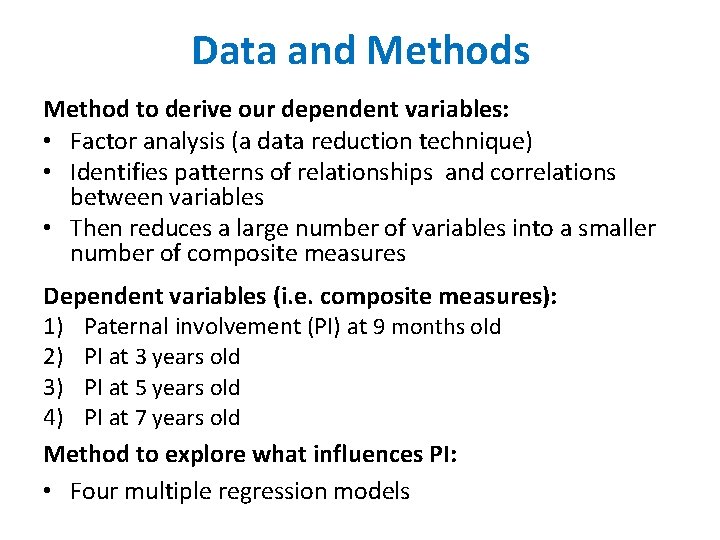
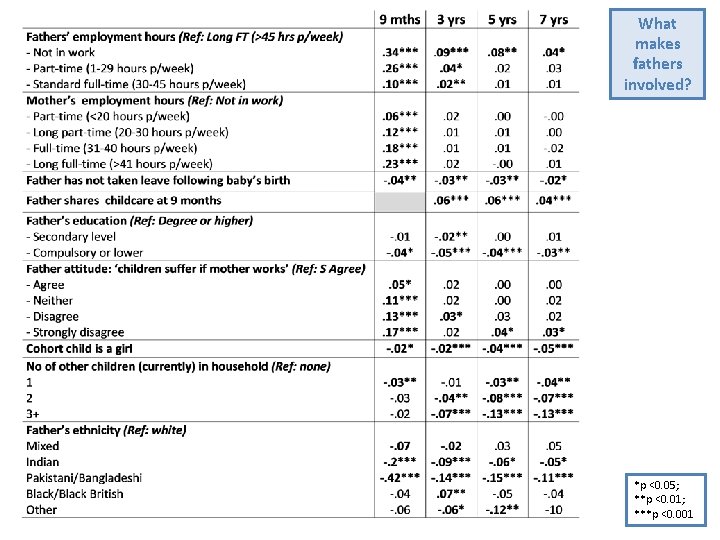
Data and Methods Method to derive our dependent variables: • Factor analysis (a data reduction technique) • Identifies patterns of relationships and correlations between variables • Then reduces a large number of variables into a smaller number of composite measures Dependent variables (i. e. composite measures): 1) Paternal involvement (PI) at 9 months old 2) PI at 3 years old 3) PI at 5 years old 4) PI at 7 years old Method to explore what influences PI: • Four multiple regression models
Results: What influences paternal involvement when the child is aged 9 months, 3, 5 and 7 years old?
What makes fathers involved? *p <0. 05; **p <0. 01; ***p <0. 001
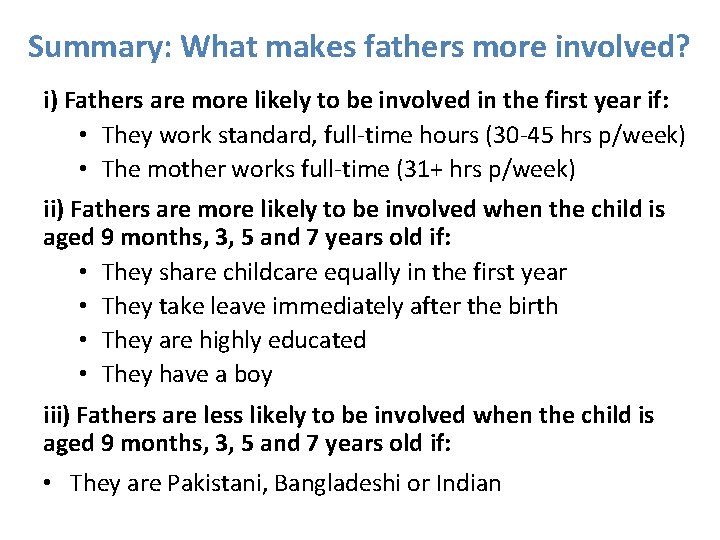
Summary: What makes fathers more involved? i) Fathers are more likely to be involved in the first year if: • They work standard, full-time hours (30 -45 hrs p/week) • The mother works full-time (31+ hrs p/week) ii) Fathers are more likely to be involved when the child is aged 9 months, 3, 5 and 7 years old if: • They share childcare equally in the first year • They take leave immediately after the birth • They are highly educated • They have a boy iii) Fathers are less likely to be involved when the child is aged 9 months, 3, 5 and 7 years old if: • They are Pakistani, Bangladeshi or Indian
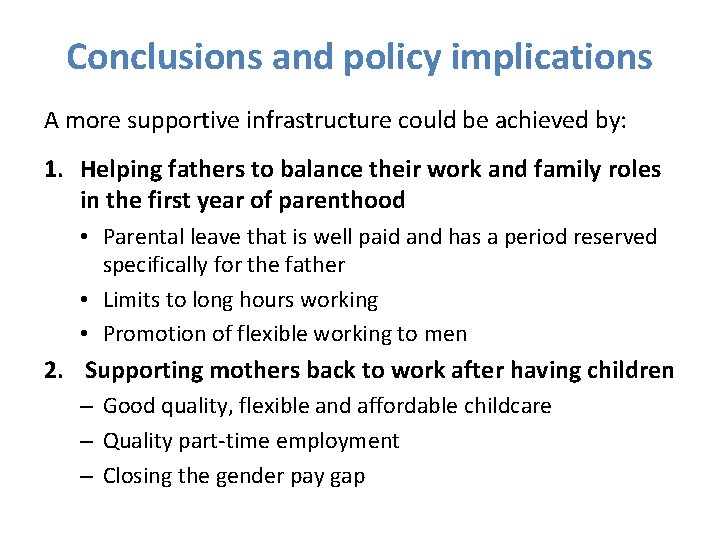
Conclusions and policy implications A more supportive infrastructure could be achieved by: 1. Helping fathers to balance their work and family roles in the first year of parenthood • Parental leave that is well paid and has a period reserved specifically for the father • Limits to long hours working • Promotion of flexible working to men 2. Supporting mothers back to work after having children – Good quality, flexible and affordable childcare – Quality part-time employment – Closing the gender pay gap
Which fathers are involved in looking after their children? Identifying the conditions associated with paternal involvement • Aim: To establish which employment and socio-demographic characteristics shape paternal involvement as children age from nine months to eleven years old. • Award: ESRC Secondary Data Analysis Initiative (Phase 3) • Dates: 1 February 2016 - 31 October 2017 • Award holders: Dr Helen Norman (PI), Professor Colette Fagan (Co-I), Professor Mark Elliot (Co-I). RA: Dr Laura Watt. University of Manchester, UK • Project partner: Working Families: https: //www. workingfamilies. org. uk/ • URL: http: //projects. socialsciences. manchester. ac. uk/involved-fathers/
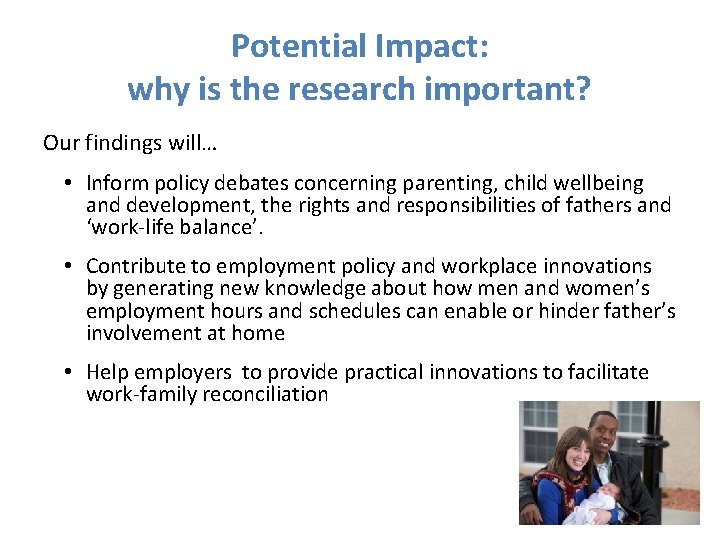
Potential Impact: why is the research important? Our findings will… • Inform policy debates concerning parenting, child wellbeing and development, the rights and responsibilities of fathers and ‘work-life balance’. • Contribute to employment policy and workplace innovations by generating new knowledge about how men and women’s employment hours and schedules can enable or hinder father’s involvement at home • Help employers to provide practical innovations to facilitate work-family reconciliation
Pathway to Impact: devised with Working Families • Policy briefings and blogs – Working Families and Policy@Manchester • Related briefings for WF that extend beyond the immediate project focus (profile building) • Planned presentations at non-academic events (as well as academic dissemination plans) – Working Families programme of employer-led and policy focused events (breakfast briefings, conferences, etc. ) • Dissemination beyond WF to other key organisations and our networks e. g. Equality and Human Rights Commission, TUC, European Commission’s European Network of Experts on Gender Equality, Eurofound • Press releases, with support from the University of Manchester’s Press Office • Articles for media (e. g. The Guardian? )
References • Project URL: http: //projects. socialsciences. manchester. ac. uk/involved-fathers/ • Fagan, C. , Norman, H. (2016): ‘What makes fathers involved? An exploration of the longitudinal influence of fathers’ and mothers’ employment on father’s involvement in looking after their pre-school children in the UK’ in Crespi, I. , Ruspini, E. (ed): Balancing work and family in a changing society: the father’s perspective, Palgrave Mac. Millan: Basingstoke • Norman, H. (2017): Paternal involvement in childcare: how can it be classified and what are the key influences, Families, Relationships and Societies. 6, 1, p. 89 -105 • Norman, H. and Fagan, C. (2017) What makes fathers involved in their children’s upbringing? Working Families Work Flex Blog, 20 January 2017: https: //www. workingfamilies. org. uk/workflex-blog/father-involvement/ • Norman, H. , Watt, L. , Fagan, C. (2017) What should mums and dads do? Changes in attitudes towards parenting, Working Families Work Flex Blog, 27 March 2017: https: //www. workingfamilies. org. uk/workflex-blog/what-should-mums-and-dads-dochanges-in-attitudes-towards-parenting/ • Norman, H. , Elliot, M. and Fagan, C. (2014) ‘Which fathers are the most involved in taking care of their toddlers in the UK? An investigation of the predictors of paternal involvement’, Community, Work & Family, 17: 2, 163 -180 • Fagan, C. and Norman, H. (2013) ‘Men and gender equality: tackling gender equality in family roles and in social care jobs’ in F. Bettio, J. Plantenga and M. Smith (Eds) Gender and the European Labour Market, Routledge: Oxon, UK.