
What makes a successful leader Which is more

- Slides: 29
What makes a successful leader? • Which is more important in measuring leadership-results or integrity? • Does a Leader have to be likeable in order to succeed?
Geography
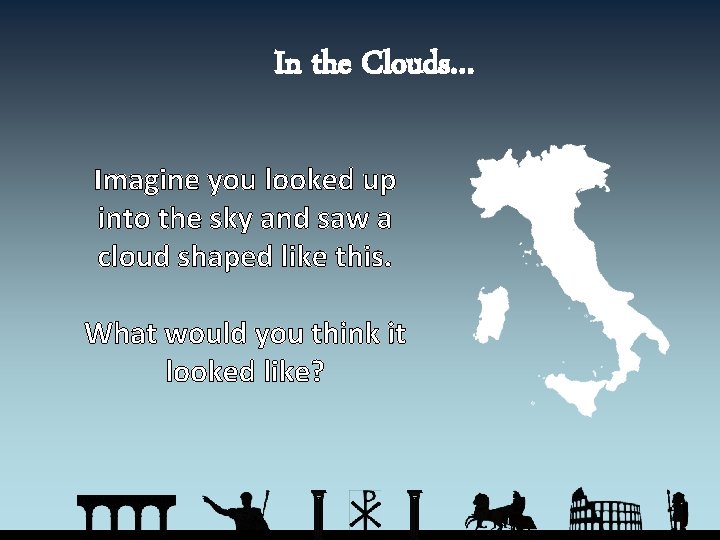
In the Clouds… Imagine you looked up into the sky and saw a cloud shaped like this. What would you think it looked like?
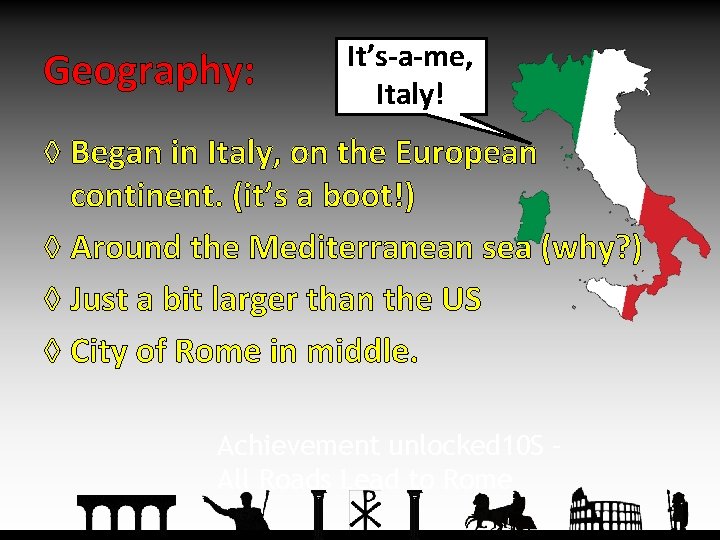
Geography: It’s-a-me, Italy! ◊ Began in Italy, on the European continent. (it’s a boot!) ◊ Around the Mediterranean sea (why? ) ◊ Just a bit larger than the US ◊ City of Rome in middle. Achievement unlocked 10 S – All Roads Lead to Rome
Growth ◊ Rome grew from there by conquering her neighbors. (How else are you gonna do it? !) ◊ Some people were then taken away as slaves and the rest were forced to pay taxes. ◊ This led to many unhappy people living in the empire. Excuse me good sir may I have your land keep you as a slave? Um… No, thanks. I’m good here.
Imagine This Ø Some rich guy meets you at the front door of your house and announces he paid the bank and so now the house is his. Ø He explains that you will follow his rules and pay him rent but you can stay Ø You walk in the door and see a 60 inch plasma TV in every room all with 200 channels and hooked up to an Xbox One. Ø How would you feel?
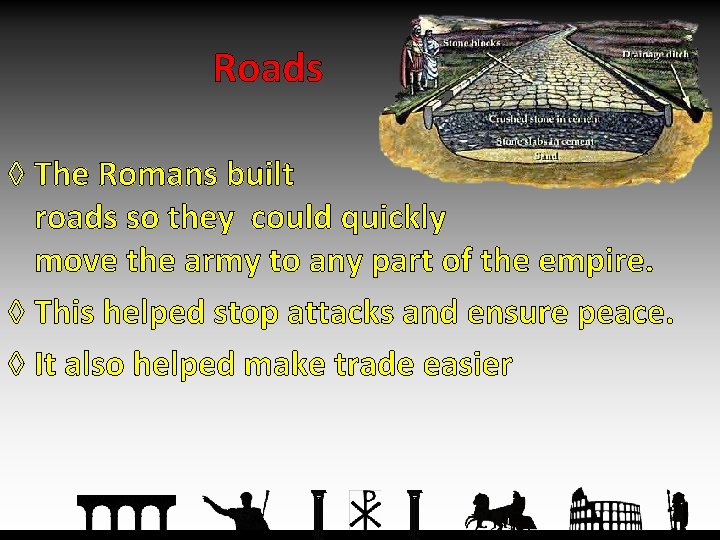
Roads ◊ The Romans built roads so they could quickly move the army to any part of the empire. ◊ This helped stop attacks and ensure peace. ◊ It also helped make trade easier
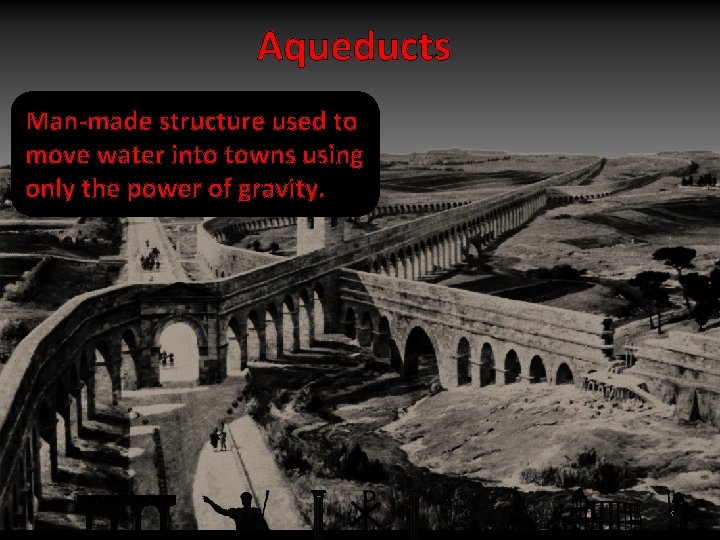
Aqueducts Man-made structure used to move water into towns using only the power of gravity. 8
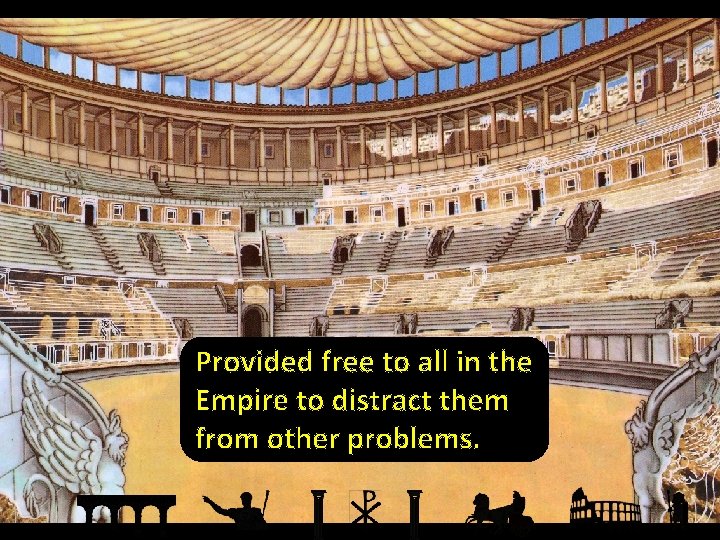
Provided free to all in the Empire to distract them from other problems. 9
Fun Facts About Ancient Rome Some Roman buildings smelled terrible because they were not regularly cleaned. Romans would burn bread in an attempt to remove the smell. Boudicca was said to ride in a horse-drawn chariot and would slice the heads off her victims as she rode past. The Romans invented camouflage - sailors in the Roman navy wore blue clothes to match the color of the sea
The Origins of Rome • Can anyone tell me the legend on how Rome was founded?
Roman Republic • How did geography affect the development of Rome • Which were the main groups that competed for power in the early Roman republic? • What were the causes of the first Punic War? • What tactic did Scipio use to defeat Hannibal? • What was the significance of the Punic Wars for Rome?
The Roman Republic • Colonized by Greece between 750 and 500 BCE – Brought olive trees – Brought grapes – Brought the alphabet • Greeks used Italy as a trade center • Farm land was better then Greece • Isolated from north by the Alps
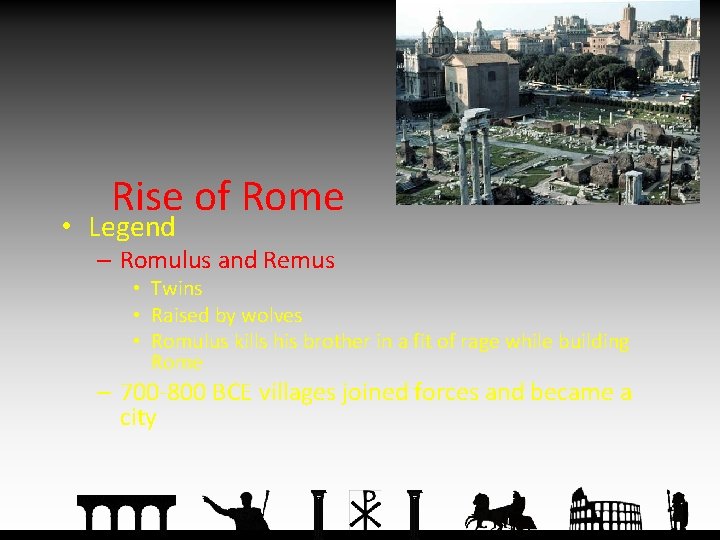
Rise of Rome • Legend – Romulus and Remus • Twins • Raised by wolves • Romulus kills his brother in a fit of rage while building Rome – 700 -800 BCE villages joined forces and became a city
The Roman Republic (509 B. C. – 27 B. C. ) STRUGGLE FOR POWER: CLASS CONFLICT • Patricians- wealthy landowners who held most of the power: inherited power and social status • Plebeians- (Plebs) common farmers, artisans and merchants who made up the majority of the population: can vote, but can’t rule – Tribunes- elected representatives who protect plebeians’ political rights.
The Roman Republic A “Balanced” Government • Rome elects two consuls– one to lead army, one to direct government • Senate- chosen from patricians (Roman upper class), make foreign and domestic policy • Popular assemblies elect tribunes, make laws for plebeians (commoners) • Dictators- leaders appointed briefly in times of crisis (appt. by consuls and senate)
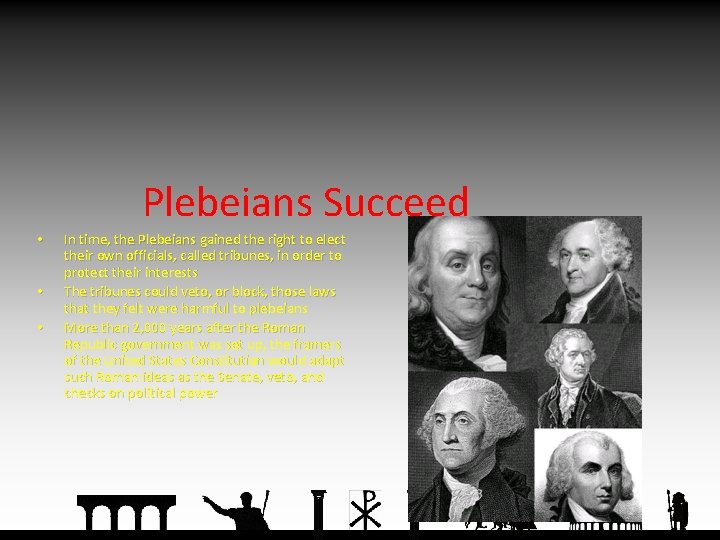
Plebeians Succeed • • • In time, the Plebeians gained the right to elect their own officials, called tribunes, in order to protect their interests The tribunes could veto, or block, those laws that they felt were harmful to plebeians More than 2, 000 years after the Roman Republic government was set up, the framers of the United States Constitution would adapt such Roman ideas as the Senate, veto, and checks on political power
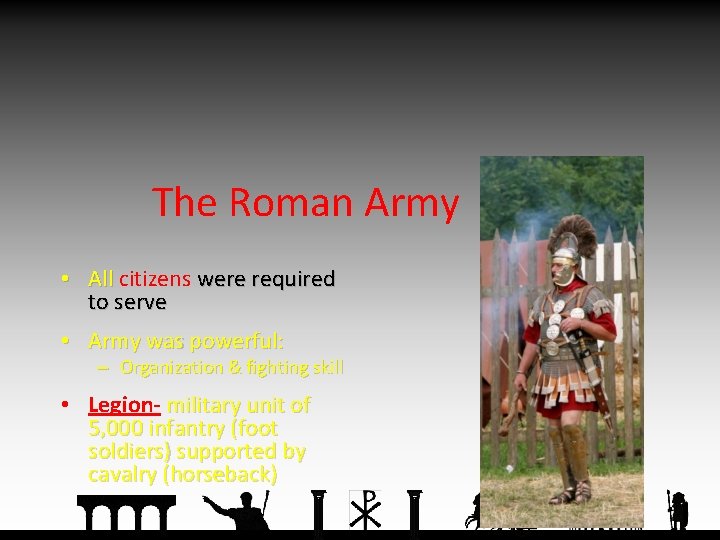
The Roman Army • All citizens were required to serve • Army was powerful: – Organization & fighting skill • Legion- military unit of 5, 000 infantry (foot soldiers) supported by cavalry (horseback)
The Roman Army • To ensure success, Roman commanders mixed rewards with harsh punishment • Young soldiers who showed courage in action won praise and gifts • If a unit fled from battle, however, 1 out of every 10 men from that unit was put to death
Religion • Nature worship • Adopted Greek gods and goddesses – Zeus – Jupiter – Ares- Mars – Aphrodite-Venus – Hades-Pluto – Poseidon-Neptune
Family • Basic social unit – All unmarried children – Slaves • Patriarchal-father head of the family – – Conducted religious ceremonies Controlled property Supervises education of sons Power to sell or kill family members
• Women – – – Family II Few legal rights More freedom than Greek Hostesses for parties Shopped and ran household Could own property • Children – Firmly disciplined – Reading, writing and morals
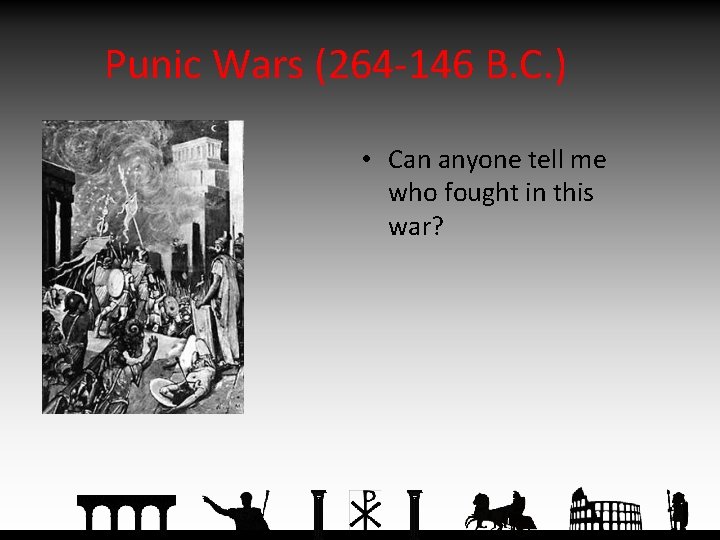
Punic Wars (264 -146 B. C. ) • Can anyone tell me who fought in this war?
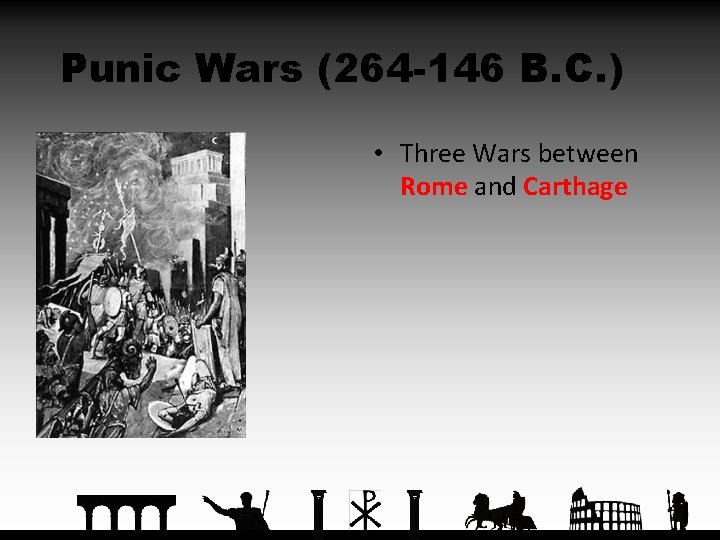
Punic Wars (264 -146 B. C. ) • Three Wars between Rome and Carthage
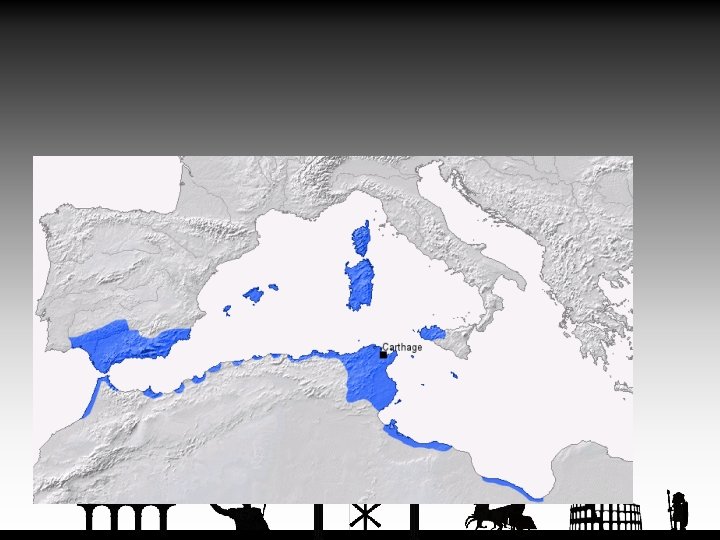
1 st Punic War • Rome gains control of Sicily & western Mediterranean Sea. • War lasted 23 years
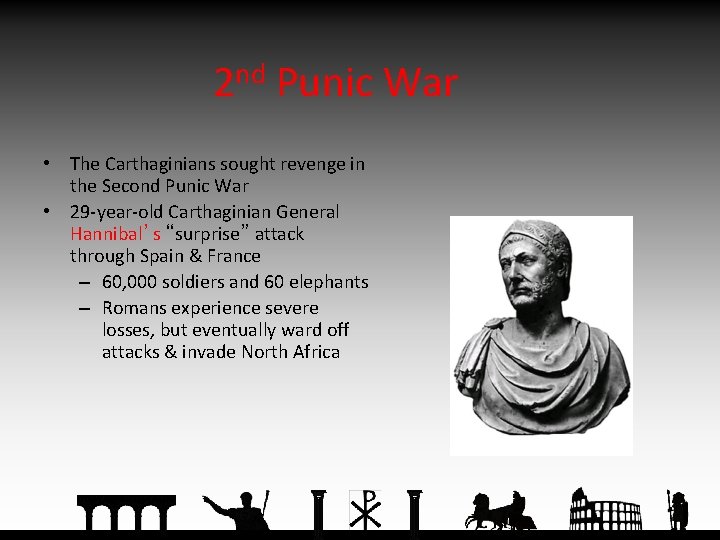
2 nd Punic War • The Carthaginians sought revenge in the Second Punic War • 29 -year-old Carthaginian General Hannibal’s “surprise” attack through Spain & France – 60, 000 soldiers and 60 elephants – Romans experience severe losses, but eventually ward off attacks & invade North Africa
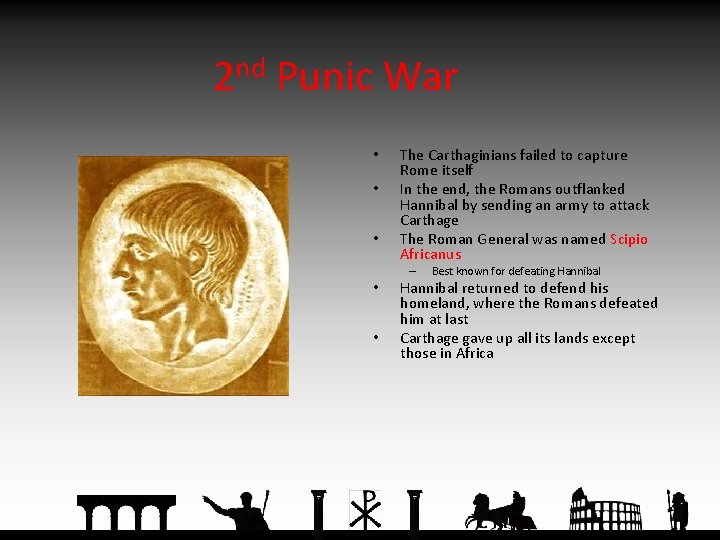
2 nd Punic War • • • The Carthaginians failed to capture Rome itself In the end, the Romans outflanked Hannibal by sending an army to attack Carthage The Roman General was named Scipio Africanus – • • Best known for defeating Hannibal returned to defend his homeland, where the Romans defeated him at last Carthage gave up all its lands except those in Africa
3 rd Punic War • • • Even though Carthage gave up most of its land, many Romans still saw Carthage as a rival and wanted revenge for the terrible destruction that Hannibal’s army had brought to Italy A popular saying was, “Carthage must be destroyed”. Finally, in the Third Punic War, Rome completely destroyed Carthage Survivors were killed or sold into slavery The Romans even poured salt over the earth so that nothing would grow in the city of Carthage again The Romans were now the masters of the Western Mediterranean