
What Makes a Good Activity Lessons from research



- Slides: 7
What Makes a Good Activity? Lessons from research and experience Cathy Manduca Science Education Resource Center Carleton College
In your experience what makes a good activity? • Students engaged and working hard - interesting, contextualized, relevant, something they think they can do • Scaffolded to the level of the students • Authentic or open ended freedom to explore, answer is not previously known, group working on different things • Clear objective/goal - start with a question • Passionate delivery • So what--learning has to contextulize in terms of what already know (individual/culture/history) • Addresses critical thinking and values • Understand policy impacts • Working (sometimes) in groups • They are responsible for learning/contributing/reporting/teac hing • Entertaining • Exploring real/complex problems-not black and white; multiple solutions • Visually engaging/supported • Structured Discussions • Comfortable/supportive environment • Writing-communicating • Quantitative reasoning • Clear understanding of success and mechanism for assessment • Encourages creativity and curiosity, • Relevant to curriculum • Build difficulty through course
Wisdom from Learning Science (How People Learn, NRC, 1999) • Learning is additive, it builds on current understanding • Understanding is actively constructed • This requires an engaged learner • Different people construct/learn most easily in different ways • Learning to learn (metacognition) is an important aspect of becoming an expert • Metacognition is context specific
Principles of Design 1) Students must be engaged to learn How does the activity engage them? 2) Students must construct new knowledge incrementally as a results of experience. What experiences will they have in this activity? 3) Students must refine and connect their knowledge to be able to use it further How will the activity promote reflection on and application of the new knowledge? Edelson, 2001, Learning for Use A Framework for the Design of Technology-Supported Inquiry Activities: Journal of Research in Science Teaching, vol 38, no 3, p 355 -385
Does the activity: • Encourage student interest and attention? • Include opportunities for students to reflect, discuss, and synthesize? • Engage students in data analysis and synthesis? • Help students visualize data relationships, geologic processes, or other relationships? • Provide opportunities for students to confirm their understanding? • Require students to integrate ideas/information from different sources?
A Design Strategy • Setting Goals: What do I want them to be able to do? • Measuring Success: How will I know that they can do this? • Designing for Success: How will they gain the skills, knowledge and experience they need to succeed?
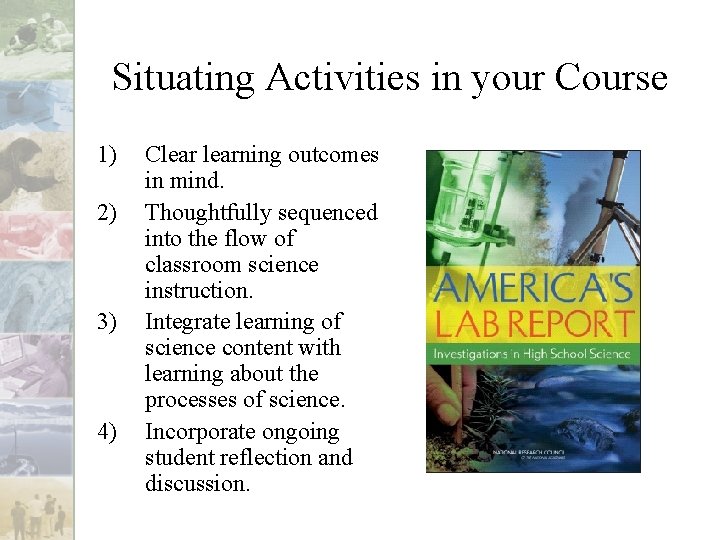
Situating Activities in your Course 1) 2) 3) 4) Clearning outcomes in mind. Thoughtfully sequenced into the flow of classroom science instruction. Integrate learning of science content with learning about the processes of science. Incorporate ongoing student reflection and discussion.