
What Makes a Crystal Structure Report Valid Ton
![Ellipsoids showing unresolved problem JACS (2000), 122, 3413 [P 1, Z’=2 => P-1, Z’=1]](https://slidetodoc.com/presentation_image_h2/f74c2cb0278f7f3d16eb5931cc88c163/image-10.jpg "Ellipsoids showing unresolved problem JACS (2000), 122, 3413 [P 1, Z’=2 => P-1, Z’=1]")

- Slides: 29
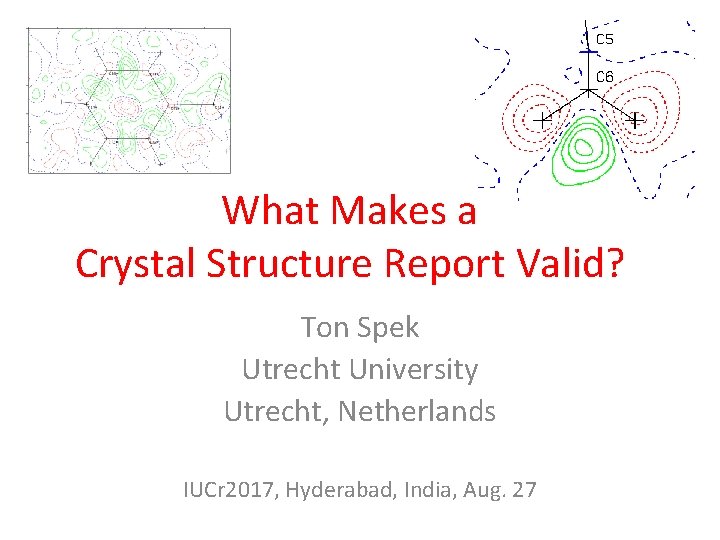
What Makes a Crystal Structure Report Valid? Ton Spek Utrecht University Utrecht, Netherlands IUCr 2017, Hyderabad, India, Aug. 27
The Central Message of this Talk A valid crystal structure report should not only present the authors interpretation of the experimental data but also include the experimental data on which the report is based. Sounds obvious, but not always done
A Valid Report should also include: § A discussion of all non-standard methods used in the data collection, data reduction and refinement procedure. • A discussion of major validation issues. The set of refined model parameter values is insufficient for proper validation.
WHY? • All published crystal structures are archived in the CSD. Their quality ranges from excellent to questionable, but sufficient for their purpose. • Analysis errors are difficult to detect, investigate and correct by referees and users of the data without access to the experimental data. • Note: Many ‘new’ and ‘unexpected’ results turn out to be artifacts and wrong. • Full documentation facilitates independent use of the (possibly unique) data for follow-up research.
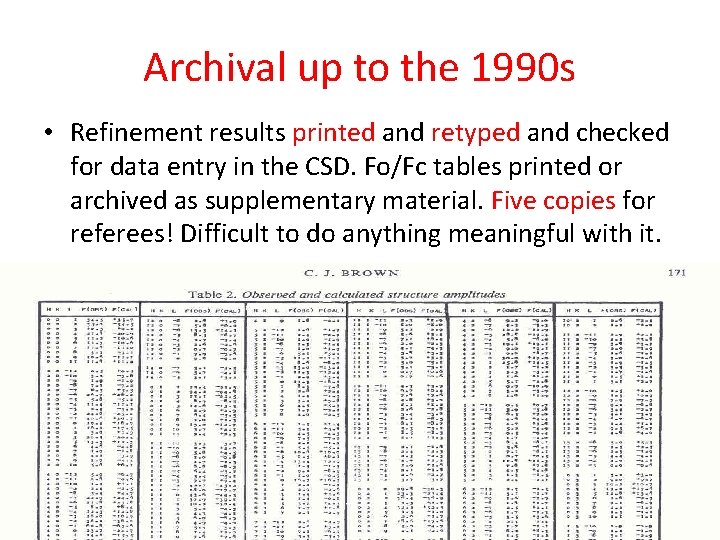
Archival up to the 1990 s • Refinement results printed and retyped and checked for data entry in the CSD. Fo/Fc tables printed or archived as supplementary material. Five copies for referees! Difficult to do anything meaningful with it.
Archival starting in the 1990 s • Computer readable CIF/FCF files introduced. CIF gradually required for publication and used for CSD archival. FCF deposition required for IUCr journals but rarely for chemical journals. CIF (parameter value) based validation introduced. • Starting around 2014: Embedding the refinement instructions and (unmerged) reflection data into the CIF. Fully archived with the CSD. Adopted now by major refinement programs, suitable for checking & reuse. Standard with IUCr journals.
‘res’ & ‘hkl’ file Embedding in CIF • SHELXL 201 x style: Include the res-file and hkl-file as value between ; ; for the datanames _shelx_res_file and _shelx_hkl_file. An FCF file can be calculated automatically with those data. • For Non=SHELXL Refinements: embed similar data with datanames _iucr_refine_instructions_detalls & _iucr_refine_reflections_details or as a CIF style reflection loop. _iucr_refine_fcf_details
Selected Validation Tools • • R-value checks for ‘quality’ ORTEP plot to check for unusual ellipsoids Analysis-of-Variance (based on CIF + FCF) CSD search & MOGUL for similar structures The VOID/SQUEEZE test for completeness Difference electron density map for ‘peaks’ IUCr-check. CIF Validation Report Experience with pitfalls and chemical insight
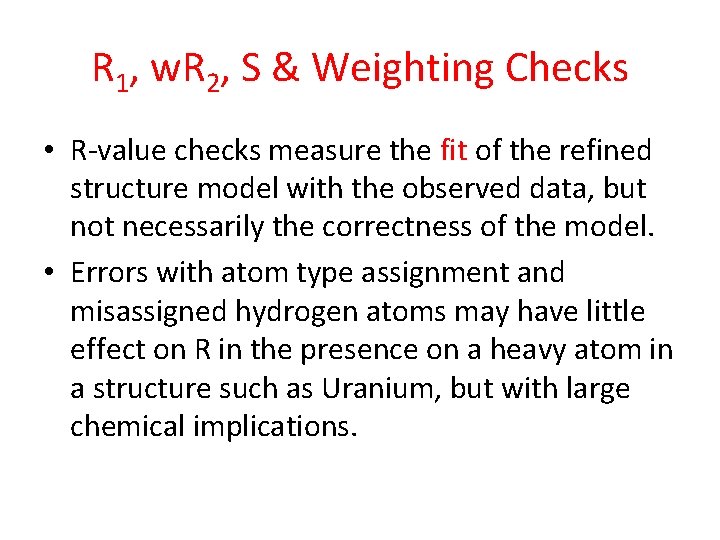
R 1, w. R 2, S & Weighting Checks • R-value checks measure the fit of the refined structure model with the observed data, but not necessarily the correctness of the model. • Errors with atom type assignment and misassigned hydrogen atoms may have little effect on R in the presence on a heavy atom in a structure such as Uranium, but with large chemical implications.
Ellipsoids showing unresolved problem JACS (2000), 122, 3413 [P 1, Z’=2 => P-1, Z’=1]
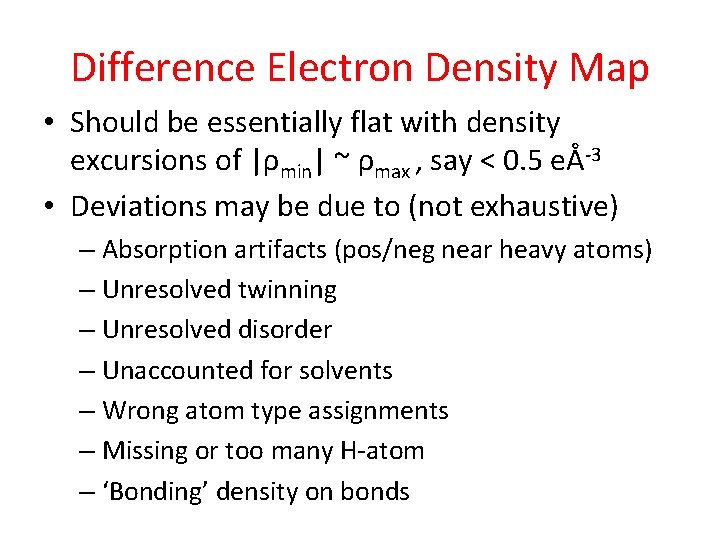
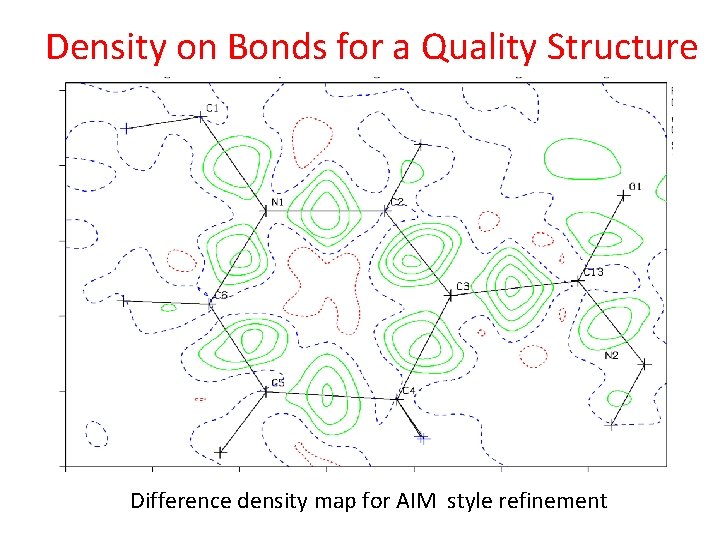
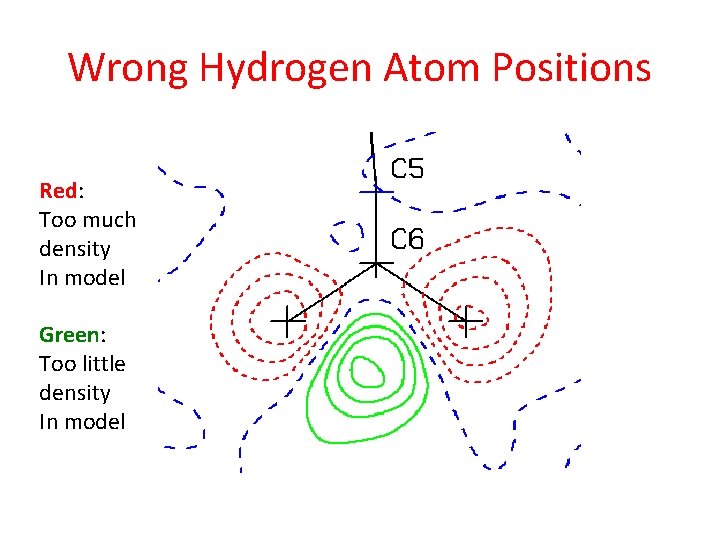
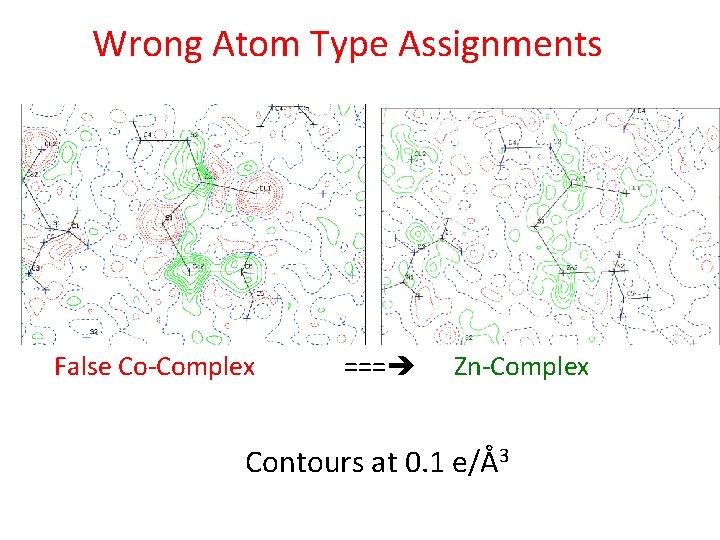
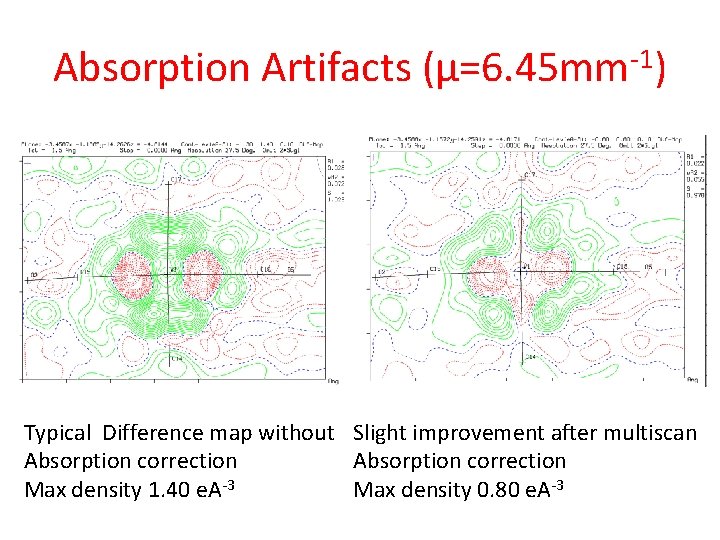
Difference Electron Density Map • Should be essentially flat with density excursions of |ρmin| ~ ρmax , say < 0. 5 eÅ-3 • Deviations may be due to (not exhaustive) – Absorption artifacts (pos/neg near heavy atoms) – Unresolved twinning – Unresolved disorder – Unaccounted for solvents – Wrong atom type assignments – Missing or too many H-atom – ‘Bonding’ density on bonds
Density on Bonds for a Quality Structure Difference density map for AIM style refinement
Wrong Hydrogen Atom Positions Red: Too much density In model Green: Too little density In model
Wrong Atom Type Assignments False Co-Complex === Zn-Complex Contours at 0. 1 e/Å3
Absorption Artifacts (μ=6. 45 mm-1) file: ///. file/id=657136 7. 25963400 Typical Difference map without Slight improvement after multiscan Absorption correction Max density 1. 40 e. A-3 Max density 0. 80 e. A-3
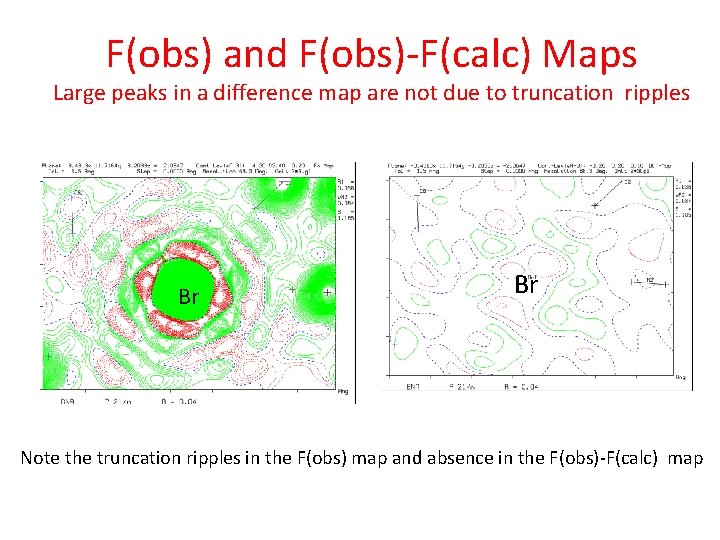
F(obs) and F(obs)-F(calc) Maps Large peaks in a difference map are not due to truncation ripples Br Br Note the truncation ripples in the F(obs) map and absence in the F(obs)-F(calc) map
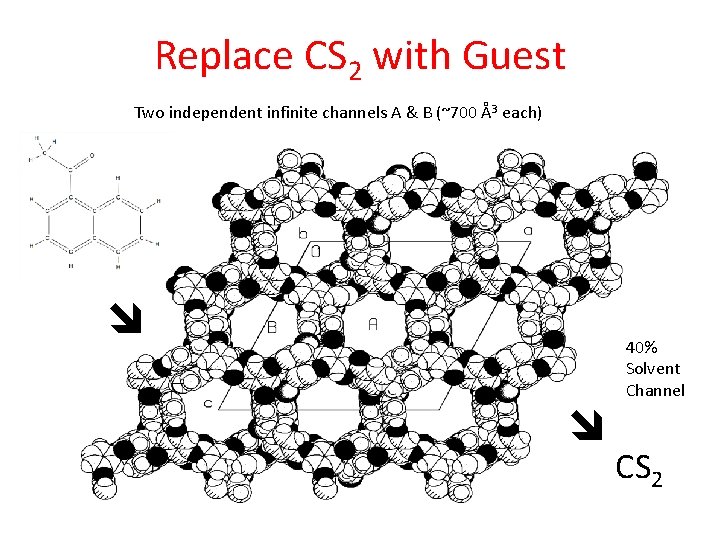
Example: Validation of a Crystalline Sponge Method based Structure • Fujita et al. (2013) introduced a potentially interesting new approach to obtain structural information for difficult to crystallize compounds • A MOF with suitable channels is used to soak in a molecule of interest for structure determination • Chem. Asian J. (2017), 12, 208 -211 provides a good example of a suitable MOF, [Cu. Br(benzene 1, 3, 5 -triyl-triisonicotinate)]n, soaked with 1 acetonaphthone as guest.
Replace CS 2 with Guest Two independent infinite channels A & B (~700 Å3 each) 40% Solvent Channel CS 2
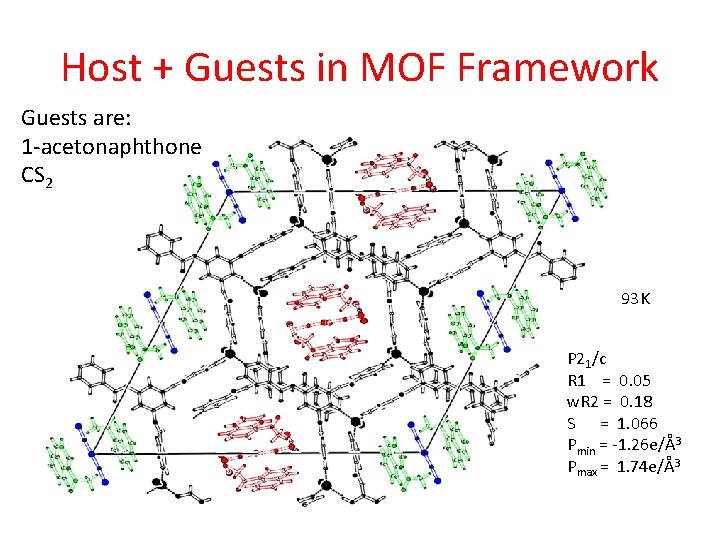
Host + Guests in MOF Framework Guests are: 1 -acetonaphthone CS 2 93 K P 21/c R 1 = 0. 05 w. R 2 = 0. 18 S = 1. 066 Ρmin = -1. 26 e/Å3 Ρmax = 1. 74 e/Å3
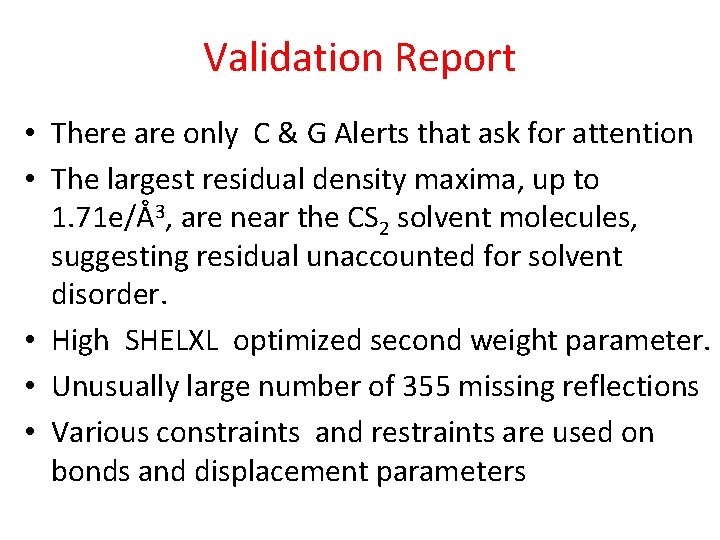
Validation Report • There are only C & G Alerts that ask for attention • The largest residual density maxima, up to 1. 71 e/Å3, are near the CS 2 solvent molecules, suggesting residual unaccounted for solvent disorder. • High SHELXL optimized second weight parameter. • Unusually large number of 355 missing reflections • Various constraints and restraints are used on bonds and displacement parameters
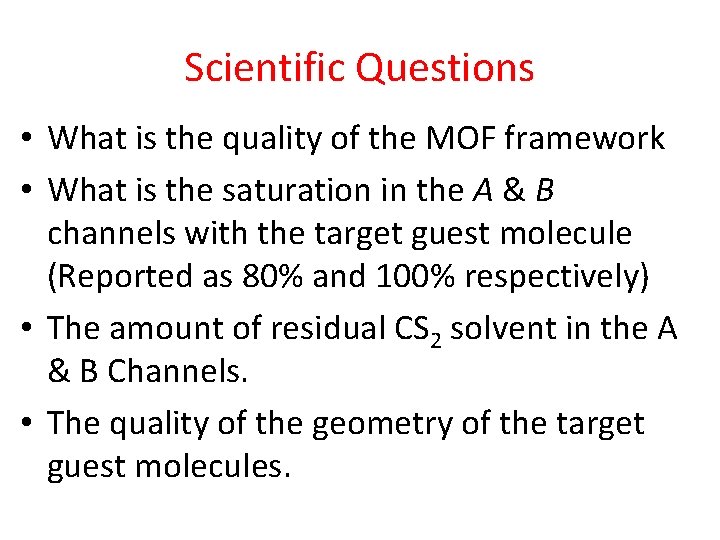
Scientific Questions • What is the quality of the MOF framework • What is the saturation in the A & B channels with the target guest molecule (Reported as 80% and 100% respectively) • The amount of residual CS 2 solvent in the A & B Channels. • The quality of the geometry of the target guest molecules.
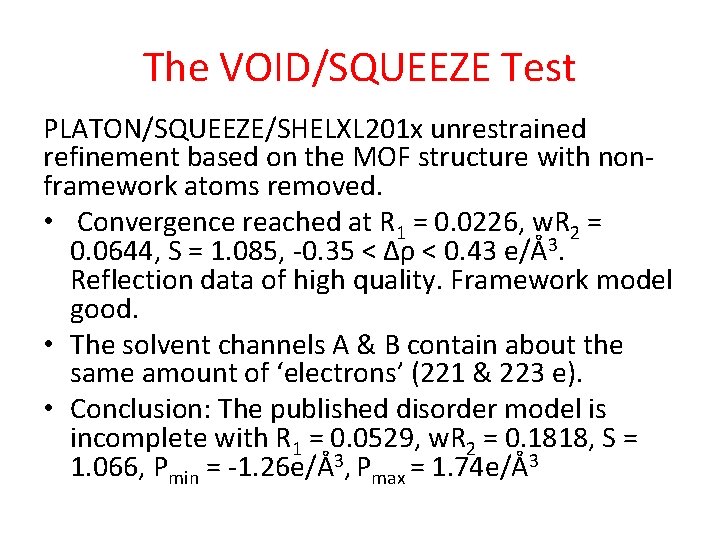
The VOID/SQUEEZE Test PLATON/SQUEEZE/SHELXL 201 x unrestrained refinement based on the MOF structure with nonframework atoms removed. • Convergence reached at R 1 = 0. 0226, w. R 2 = 0. 0644, S = 1. 085, -0. 35 < Δρ < 0. 43 e/Å3. Reflection data of high quality. Framework model good. • The solvent channels A & B contain about the same amount of ‘electrons’ (221 & 223 e). • Conclusion: The published disorder model is incomplete with R 1 = 0. 0529, w. R 2 = 0. 1818, S = 1. 066, Ρmin = -1. 26 e/Å3, Ρmax = 1. 74 e/Å3
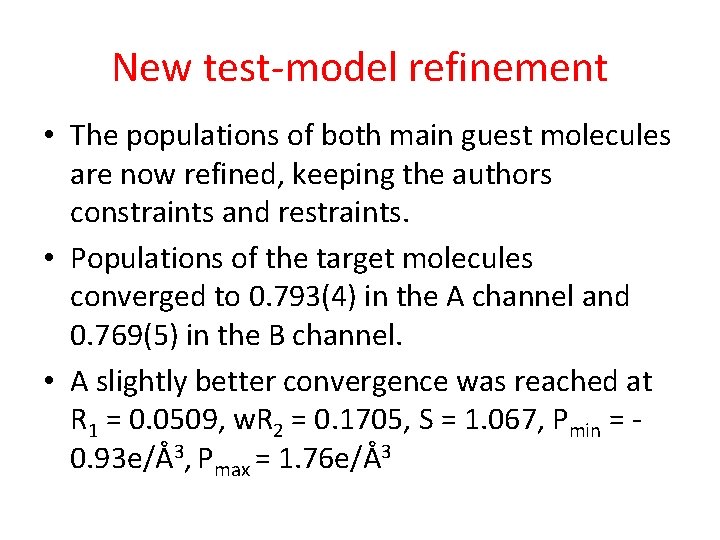
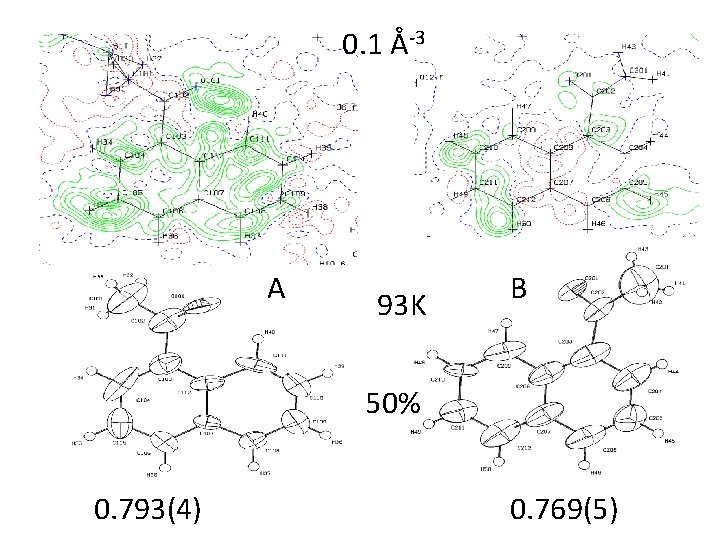
New test-model refinement • The populations of both main guest molecules are now refined, keeping the authors constraints and restraints. • Populations of the target molecules converged to 0. 793(4) in the A channel and 0. 769(5) in the B channel. • A slightly better convergence was reached at R 1 = 0. 0509, w. R 2 = 0. 1705, S = 1. 067, Ρmin = 0. 93 e/Å3, Ρmax = 1. 76 e/Å3
0. 1 Å-3 A 93 K B 50% 0. 793(4) 0. 769(5)
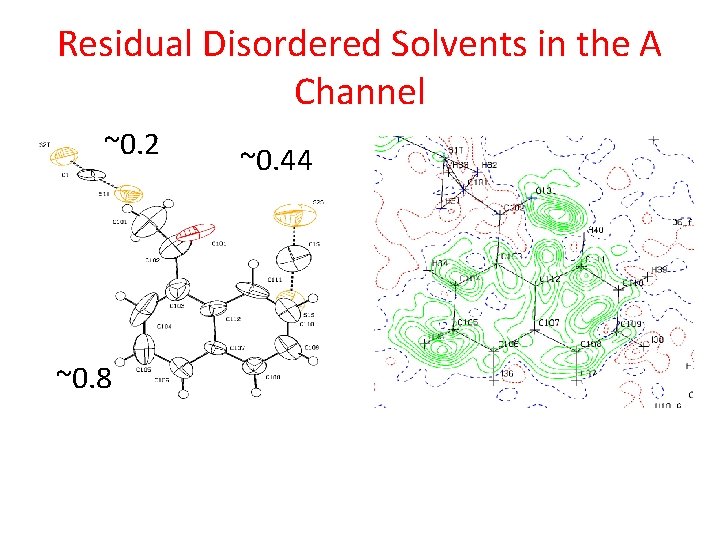
Residual Disordered Solvents in the A Channel ~0. 2 ~0. 8 ~0. 44
Evaluation • Residual solvent coinciding with the target guest may seriously effect the quality of the geometry of the guest. • C-C bonds in the A channel guest deviate by 0. 10 to 0. 06 Å from expected values • It might be difficult to distinguish between N, C or O in a particular site without prior information as might be the case with natural products.
Valid versus Value • A structure report is ‘valid’ when the reported results include the experimental data, the authors interpretation of the data, the way that those results were obtained and all non-standard issues discussed. • The value of the report depends on what new information is obtained, relevant for the related research. The value of heavily constrained and restrained structures might be limited.
Future • Not all issues with a reported structure can be resolved with the availability of the set of unmerged reflection data. • Eventually, the diffraction images may be needed for proper analysis of an analysis issue. An IUCr committee works on archival options of images. • Would be nice when image processing software provided a summary report of the images to be appended to a CIF, in particular about features not included in the integrated reflection data (streaks, additional spots etc. )
Thank you! Related Paper: A. L. Spek, Inorg. Chim. Acta (2017), December http: //dx. doi. org/10. 1016/j. ica. 2017. 04. 036 PLATON Workshop, 28/29 Sept. , Berlin, Germany Details: Dgk-home. de/aks/ak 6