
What lies between and beyond H P Williams
What lies between + and beyond? H. P. Williams London School of Economics
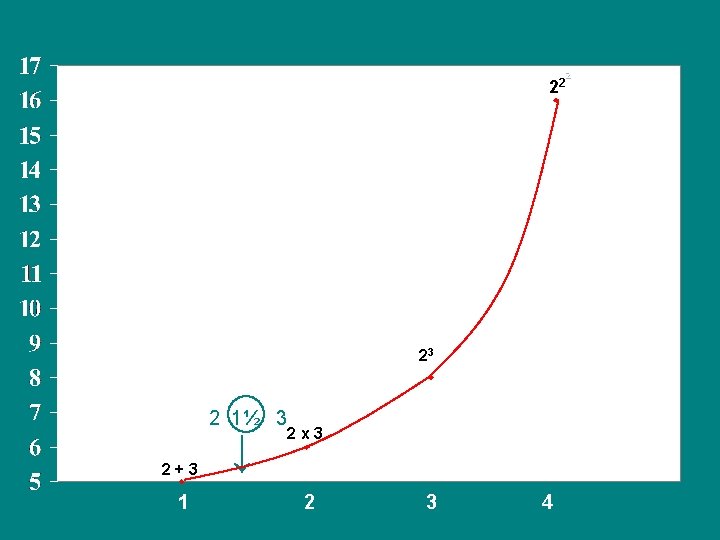
22 23 2 1½ 3 2+3 1 ↓ 2 x 3 2 3 4 2
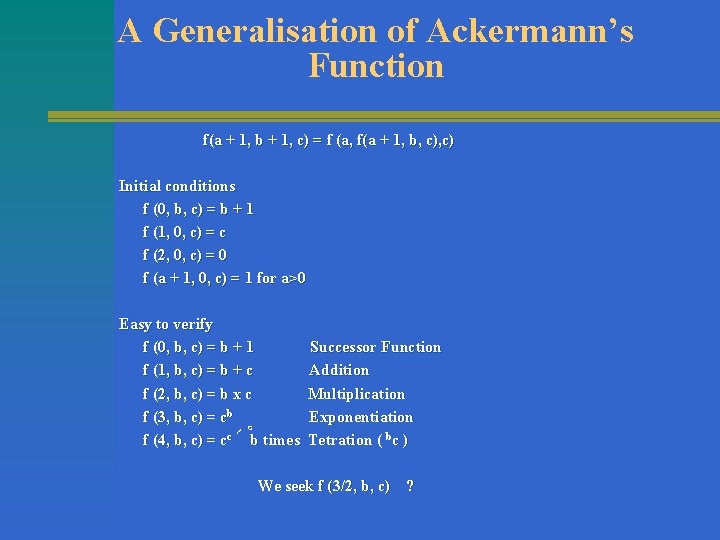
A Generalisation of Ackermann’s Function f(a + 1, b + 1, c) = f (a, f(a + 1, b, c) Initial conditions f (0, b, c) = b + 1 f (1, 0, c) = c f (2, 0, c) = 0 f (a + 1, 0, c) = 1 for a>0 Easy to verify f (0, b, c) = b + 1 f (1, b, c) = b + c f (2, b, c) = b x c f (3, b, c) = cb c ⋰ c f (4, b, c) = c b times Successor Function Addition Multiplication Exponentiation Tetration ( bc ) We seek f (3/2, b, c) ?
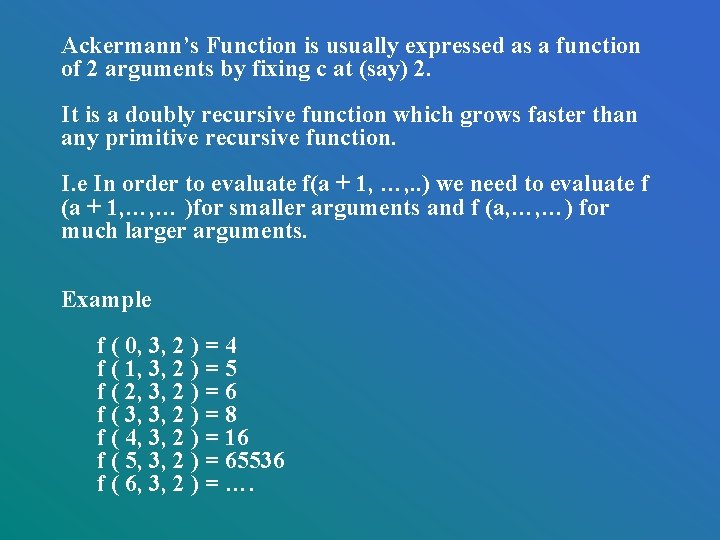
Ackermann’s Function is usually expressed as a function of 2 arguments by fixing c at (say) 2. It is a doubly recursive function which grows faster than any primitive recursive function. I. e In order to evaluate f(a + 1, …, . . ) we need to evaluate f (a + 1, …, … )for smaller arguments and f (a, …, …) for much larger arguments. Example f ( 0, 3, 2 ) = 4 f ( 1, 3, 2 ) = 5 f ( 2, 3, 2 ) = 6 f ( 3, 3, 2 ) = 8 f ( 4, 3, 2 ) = 16 f ( 5, 3, 2 ) = 65536 f ( 6, 3, 2 ) = ….

But: Inverse Ackerman Function - a function that grows very slowly used in Computational Complexity Taken further we get Goodstein Numbers which converge to zero more slowly then any finite recursive proof can show. I. e convergence not provable by Peano’s Axioms.
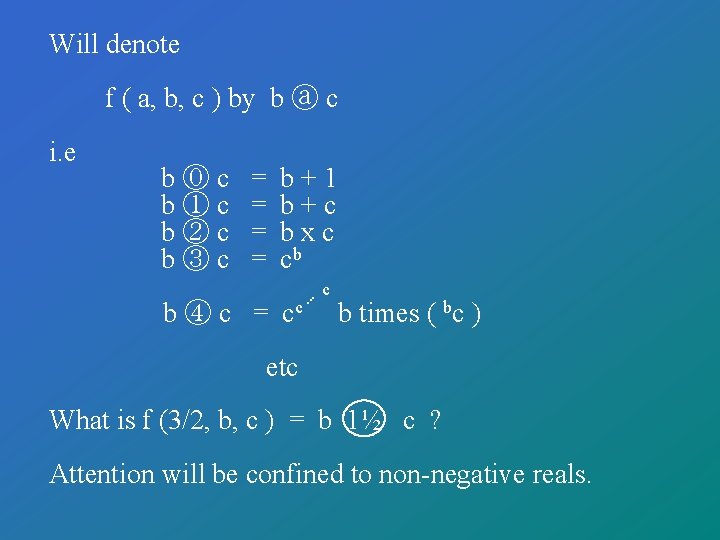
Will denote f ( a, b, c ) by b ⓐ c i. e b⓪c b①c b②c b③c = = b+1 b+c bxc cb b ④ c = cc ⋰ c b times ( bc ) etc What is f (3/2, b, c ) = b 1½ c ? Attention will be confined to non-negative reals.
Other Integer Functions definable for Real values. e. g n! by Gamma Function Fractional differentiation
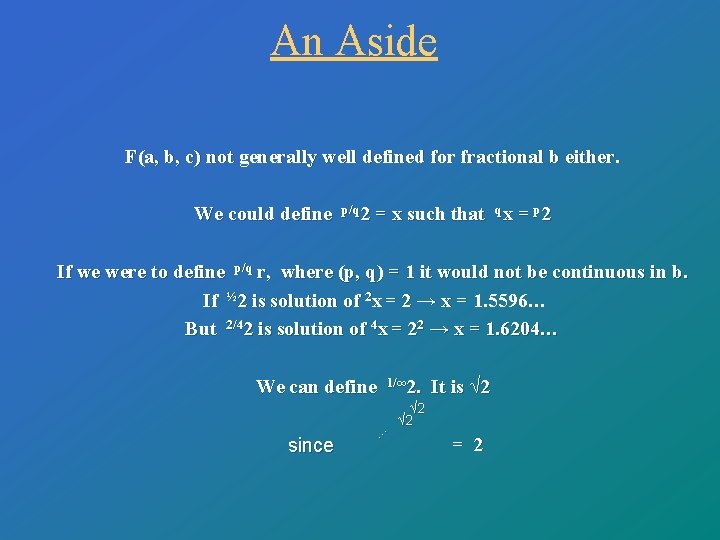
An Aside F(a, b, c) not generally well defined for fractional b either. We could define p/q 2 = x such that qx = p 2 If we were to define p/q r, where (p, q) = 1 it would not be continuous in b. If ½ 2 is solution of 2 x = 2 → x = 1. 5596… But 2/42 is solution of 4 x = 22 → x = 1. 6204… We can define since 1/∞ 2. ⋰ It is √ 2 √ 2 = 2
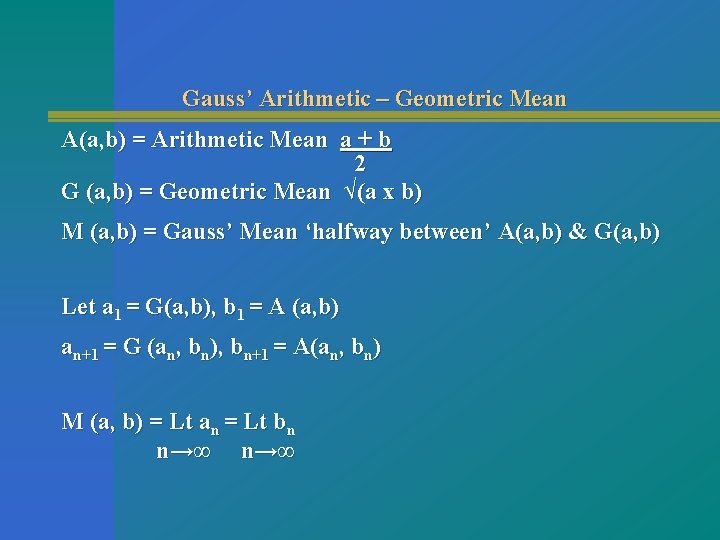
Gauss’ Arithmetic – Geometric Mean A(a, b) = Arithmetic Mean a + b 2 G (a, b) = Geometric Mean √(a x b) M (a, b) = Gauss’ Mean ‘halfway between’ A(a, b) & G(a, b) Let a 1 = G(a, b), b 1 = A (a, b) an+1 = G (an, bn), bn+1 = A(an, bn) M (a, b) = Lt an = Lt bn n→∞
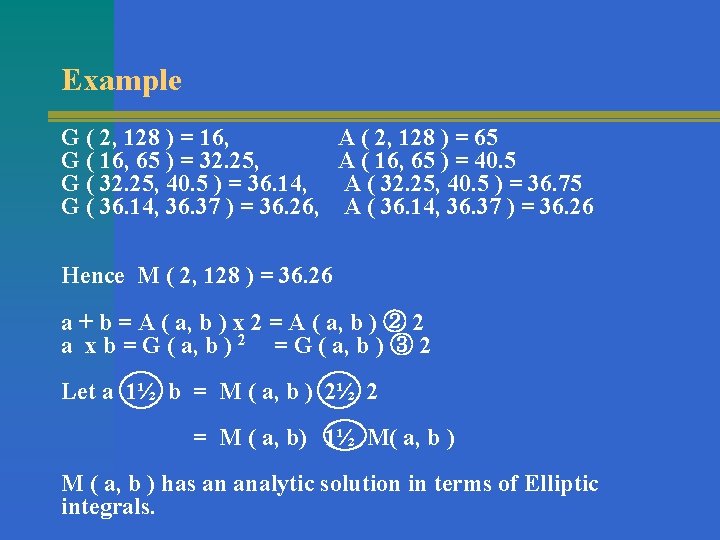
Example G ( 2, 128 ) = 16, A ( 2, 128 ) = 65 G ( 16, 65 ) = 32. 25, A ( 16, 65 ) = 40. 5 G ( 32. 25, 40. 5 ) = 36. 14, A ( 32. 25, 40. 5 ) = 36. 75 G ( 36. 14, 36. 37 ) = 36. 26, A ( 36. 14, 36. 37 ) = 36. 26 Hence M ( 2, 128 ) = 36. 26 a + b = A ( a, b ) x 2 = A ( a, b ) ② 2 a x b = G ( a, b ) 2 = G ( a, b ) ③ 2 Let a 1½ b = M ( a, b ) 2½ 2 = M ( a, b) 1½ M( a, b ) M ( a, b ) has an analytic solution in terms of Elliptic integrals.
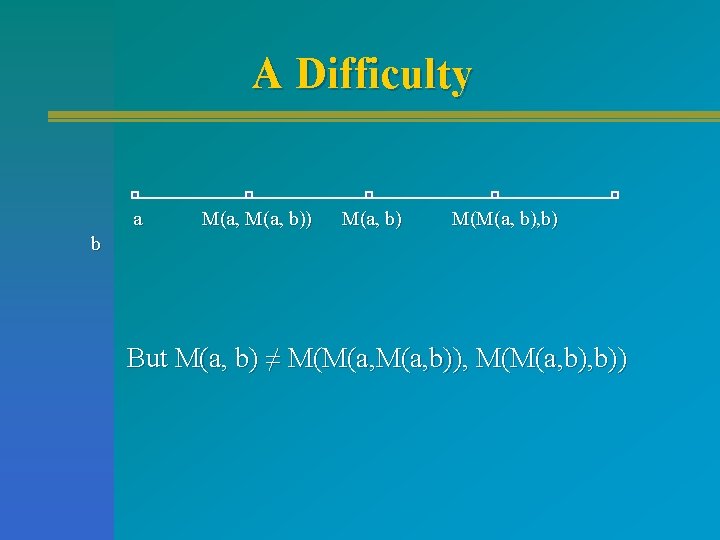
A Difficulty a M(a, b)) M(a, b) M(M(a, b) b But M(a, b) ≠ M(M(a, b)), M(M(a, b))
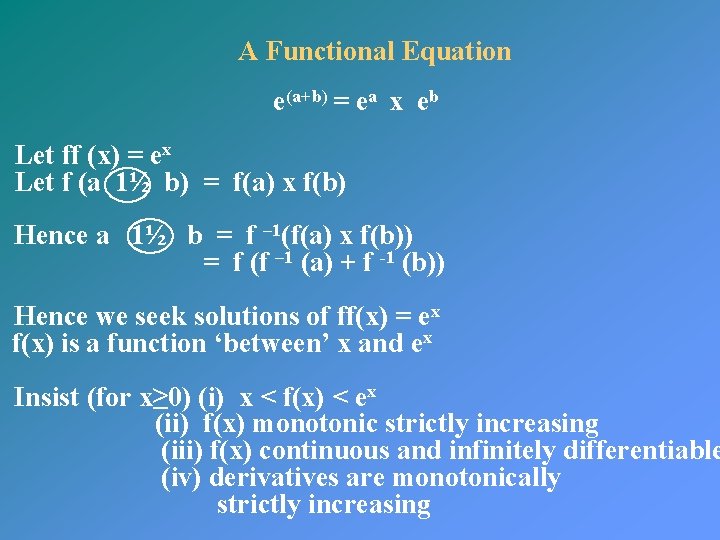
A Functional Equation e(a+b) = ea x eb Let ff (x) = ex Let f (a 1½ b) = f(a) x f(b) Hence a 1½ b = f – 1(f(a) x f(b)) = f (f – 1 (a) + f -1 (b)) Hence we seek solutions of ff(x) = ex f(x) is a function ‘between’ x and ex Insist (for x≥ 0) (i) x < f(x) < ex (ii) f(x) monotonic strictly increasing (iii) f(x) continuous and infinitely differentiable (iv) derivatives are monotonically strictly increasing
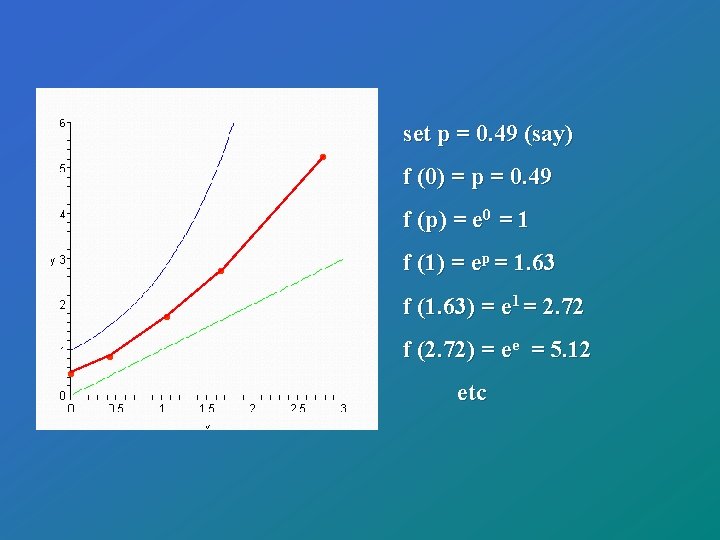
• set p = 0. 49 (say) f (0) = p = 0. 49 f (p) = e 0 = 1 • • f (1) = ep = 1. 63 f (1. 63) = e 1 = 2. 72 f (2. 72) = ee = 5. 12 etc
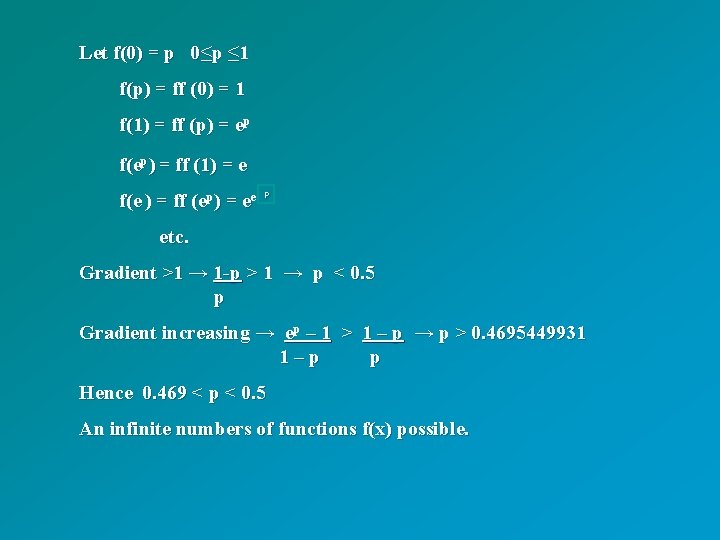
Let f(0) = p 0≤p ≤ 1 f(p) = ff (0) = 1 f(1) = ff (p) = ep f(ep) = ff (1) = e f(e ) = ff (ep) = ee p etc. Gradient >1 → 1 -p > 1 → p < 0. 5 p Gradient increasing → ep – 1 > 1 – p → p > 0. 4695449931 1–p p Hence 0. 469 < p < 0. 5 An infinite numbers of functions f(x) possible.
- Slides: 14