
WHAT LIES BENEATH DIVINE COMEDY Dante Alighieri SYNOPSIS
WHAT LIES BENEATH DIVINE COMEDY Dante Alighieri
SYNOPSIS • Dante has not been a good man. His dead love Beatrice asks the Virgin Mary to help him see the error of his ways. Mary accepts and Dante is sent on a three-day trip through Hell, and on up Mount Purgatory on the other side of the world, and finally to Heaven in the sky. • He is spiritually lost at the beginning of the story, so he needs guides to help him along the path. His first guide, through Hell and Purgatory is Virgil (author of the Aeneid). They encounter many interesting sinners on the way. Dante learns to hate sin. • His second guide is Beatrice, the woman he adored while she lived. His final guide is Saint Bernard (namesake of the loyal dog), who takes him to see God.
TYPE OF WORK The Divine Comedy is an epic poem on a vast scale, told by Dante himself in first-person point of view. The Divine Comedy is also an allegory, a work in which characters, objects, and events have figurative as well as literal meanings. For example, in The Divine Comedy, Virgil symbolizes human reason, and Beatrice stands for faith and supernatural truth. The three beasts Dante encounters in Canto 1 represent sin, and various personages in other cantos symbolize specific types of sin, such as envy, sloth, gluttony and lust. Some allegorical characters, objects, or events symbolize several things at the same time.
Verse Format and Structure of the Poem • The Divine Comedy contains 100 cantos (major divisions or "chapters" of the epic poem) written in terza rima, an Italian verse form invented by Dante. It consists of threeline stanzas in which Line 2 of one stanza rhymes with Lines 1 and 3 of the next stanza. The rhyme scheme progresses in the following pattern from the beginning of a canto: aba, bcb, cdc, ded, efe, ghg, and so on. The following English translation of the first lines from the Divine Comedy–with the original Dante lines on the right–demonstrate the rhyme scheme: • English translation: Dale, Peter. The Divine Comedy. London: Anvil Press, 1996.
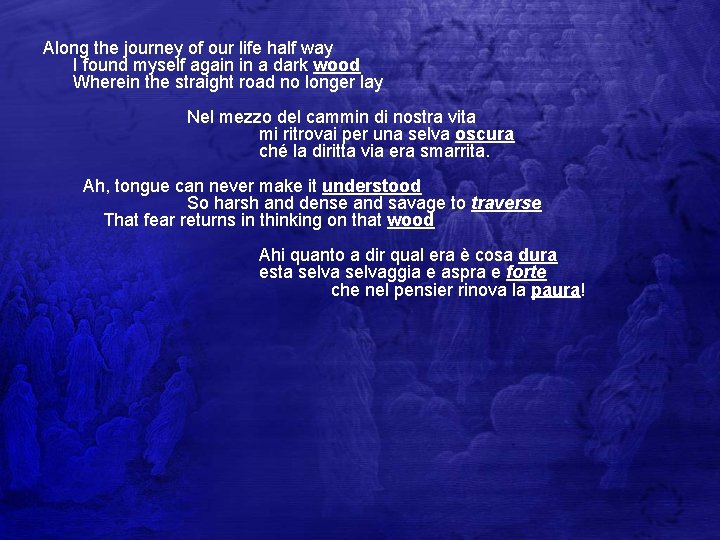
Along the journey of our life half way I found myself again in a dark wood Wherein the straight road no longer lay Nel mezzo del cammin di nostra vita mi ritrovai per una selva oscura ché la diritta via era smarrita. Ah, tongue can never make it understood So harsh and dense and savage to traverse That fear returns in thinking on that wood Ahi quanto a dir qual era è cosa dura esta selvaggia e aspra e forte che nel pensier rinova la paura!
Significance of the Number 3 Dante wrote The Divine Comedy in honor of the three persons who make up the one God: God the Father, God the Son, and God the Holy Spirit. Thus, throughout the poem, the Number 3 has special significance. Consider that the poem has the following: . . [1]. . Three main sections: Hell, Purgatory and Paradise. . [2]. . 33 cantos in each section. (The first section also has an introductory canto. ). . [3]. . Three-line rhyme scheme (terza rima) in which the second line of one stanza rhymes with the first and third lines of the next stanza. . [4]. . Three guides–Virgil, Beatrice and St. Bernard– who lead Dante through the realms of the afterlife. (See the next paragraph for more information on the guides. ). . . . [5]. . A division of sin into three types: (1) incontinence, involving lack of self-control over natural appetites (for sex, food, drink, etc. ). (2) violence, involving anger and brutality. (3) malice or fraud, including simony, hypocrisy, flattery and forgery. . [6} A leopard, a lion and a wolf symbolizing these sins in the opening canto.
THEMES • Life as a Journey The Divine Comedy presents life as a journey in which one man (representing all human beings) must overcome obstacles to achieve the ultimate goal, eternal bliss in the sight of God. Therefore--unlike epics such as The Odyssey, The Aeneid, and Beowulf--The Divine Comedy focuses mainly on life as a spiritual journey. The obstacles the traveler must overcome are temptation and sin.

THEMES Salvation Through Repentance • Even if a person sins, he is not lost. Sincere contrition and penitence will restore the soul to eligibility for entrance into heaven. • Every man has to undergo and renounce sin, then do penance for them before he is ready to meet God. This is what man’s life is all about.
THEMES Rehabilitation Although confession of sins and penance will restore a human being to a state of grace, after he dies must he must purge himself of the stains sin leaves on his soul if he has not done so in his lifetime. This purgation in the afterlife takes place in purgatory.
THEMES Love When he was a child of nine, Dante met Beatrice Portinari and loved her from that moment on. Although he married another woman and she married another man, he continued to love her from afar and dedicated many poems to her. She died when she was only 24.
PROBING DEEPER • Why are there popes, politicians, and other famous historical or mythological figures in Hell? • Why does Dante know them personally? Why do most of these figures come from Florence, Italy (Florentine)? What is their connection with Dante? What were the events ongoing in that place during that time? • Who is Dante Alighieri? Why was he able to write this epic poem? How was he able to write this epic with such details?
Historical Personages • • • • Virgil Homer, the great epic poet of ancient Greece Horace, Ovid, and Lucan, poets of ancient Rome Francesca da Rimini and Paolo Malatesta, illicit lovers killed by Francesca's husband Queen Cleopatra of Egypt Cato, a righteous government official of ancient Rome Venedico Caccianemico, an Italian politician accused of pimping Griffolino of Arezzo, who deceived Alberto of Siena by pretending that he could teach him to fly Pope Nicholas III, associated with simony, the practice of buying or selling ecclesiastical offices or benefices Pierre de la Brosse, chancellor of France who was executed in 1278 but was innocent of the charge against him, treachery Brutus and Cassius, ringleaders of the assassination plot against Julius Caesar Judas, betrayer of Christ St. Thomas Aquinas; St. Benedict; St. Peter; St. John.
About the Author Dante is called the Father Of Italian Literature. This is due to “Divine Comedy”, the first major work in the Italian language. He was, therefore very influential in establishing the dignity of Italian as a medium for great literature.
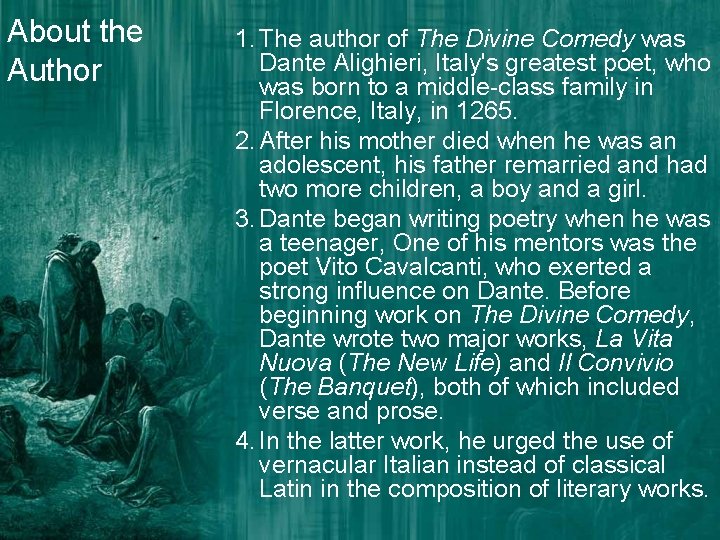
About the Author 1. The author of The Divine Comedy was Dante Alighieri, Italy's greatest poet, who was born to a middle-class family in Florence, Italy, in 1265. 2. After his mother died when he was an adolescent, his father remarried and had two more children, a boy and a girl. 3. Dante began writing poetry when he was a teenager, One of his mentors was the poet Vito Cavalcanti, who exerted a strong influence on Dante. Before beginning work on The Divine Comedy, Dante wrote two major works, La Vita Nuova (The New Life) and Il Convivio (The Banquet), both of which included verse and prose. 4. In the latter work, he urged the use of vernacular Italian instead of classical Latin in the composition of literary works.
About the Author 5. After becoming involved in rivalries between Florentine politicians and between Vatican and secular authorities vying for power, Dante was banished from Florence. 6. In exile, he wrote The Divine Comedy, incorporating in it commentary on the various factions competing for political control. 7. He wrote it in the Italian Tuscan dialect that favors a familiar, conversational style, thus breaking with the tradition that serious literary works had to be written in Latin and thereby helping to establish Italian as the language of literature. He died in Ravenna, Italy, in 1321.
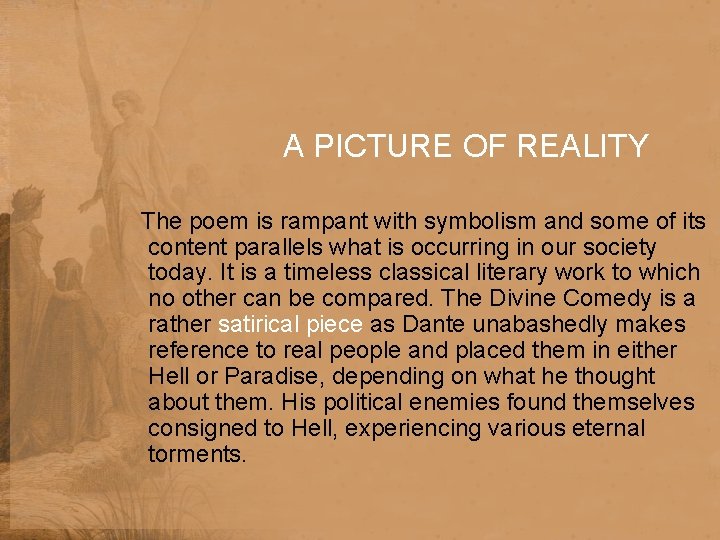
A PICTURE OF REALITY The poem is rampant with symbolism and some of its content parallels what is occurring in our society today. It is a timeless classical literary work to which no other can be compared. The Divine Comedy is a rather satirical piece as Dante unabashedly makes reference to real people and placed them in either Hell or Paradise, depending on what he thought about them. His political enemies found themselves consigned to Hell, experiencing various eternal torments.
HISTORICAL BACKGROUND OF THE STORY The decay and destruction of Florence through political strife forms an important theme of the poem. It is evident that Dante's long years of impoverished exile caused him to become embittered about his native town and its inhabitants.
ANALYZING THE LITERARY CLASSIC: NEW HISTORICISM APPROACH 1. Author’s background 2. Historical/ Social Background 3. Personal Background
Performance Task • You are going to design your own map of your own version of any of the ff: Inferno, Purgatorio and Paradiso. • Since it will be your own version, you are free to conceptualize your own. • You are going to choose one from the three regions that you will present. • You may have the ff. as medium: freehand, digital or computer- aided, or use pictures or cut outs for your map design. • You are going to place your work in a 1/8 illustration board. • You are going to submit your map on Monday, Nov. 19.
- Slides: 19