
What leads to changes in the global energy
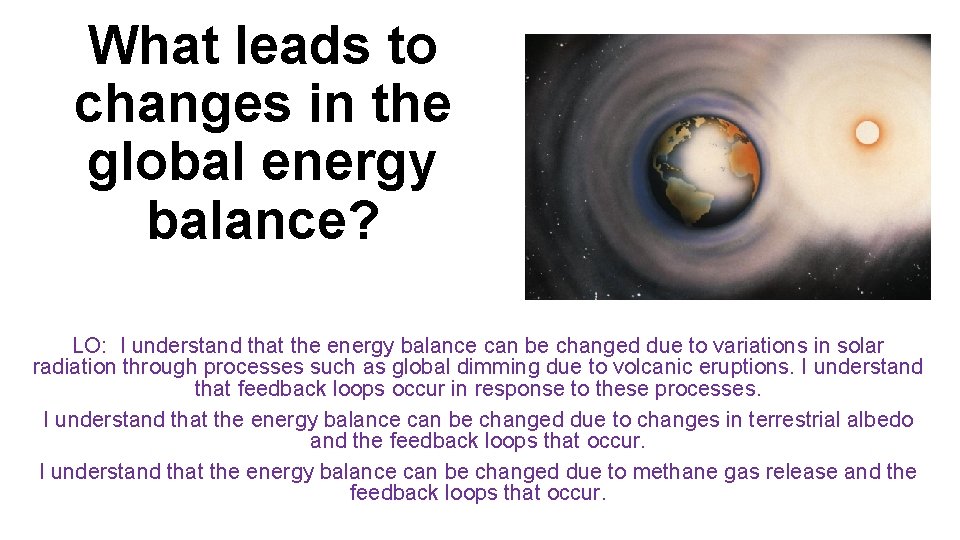
What leads to changes in the global energy balance? LO: I understand that the energy balance can be changed due to variations in solar radiation through processes such as global dimming due to volcanic eruptions. I understand that feedback loops occur in response to these processes. I understand that the energy balance can be changed due to changes in terrestrial albedo and the feedback loops that occur. I understand that the energy balance can be changed due to methane gas release and the feedback loops that occur.
Watch the video on Weebly explaining the natural causes of climate change, including variations in solar radiation as a result of global dimming and sunspots.

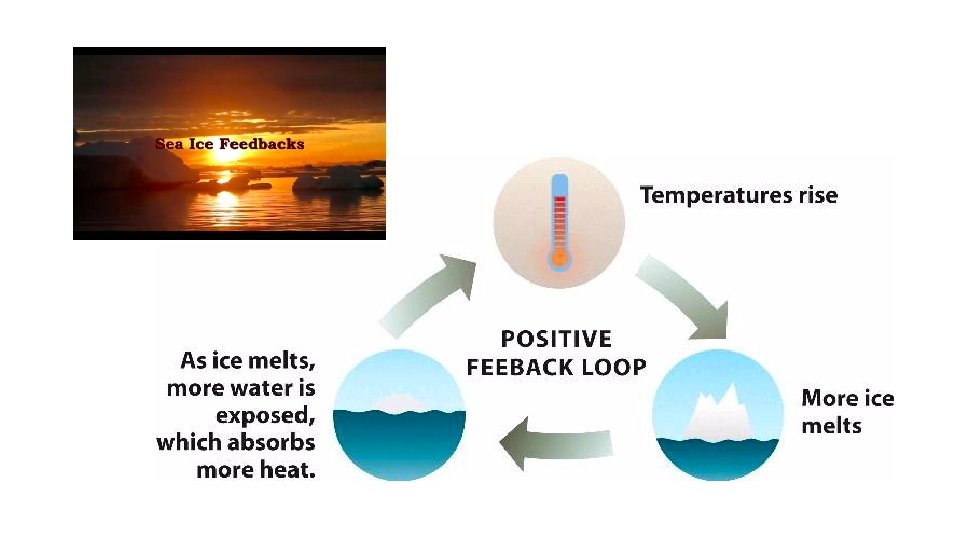
Feedback loops • Sometimes part of a system output re-enters the system as feedback and becomes a new input (Figure 2). In this case the system responds to a change (internal or external) and the feedback moves the system in the same direction (positive feedback) or the opposite direction (negative feedback).
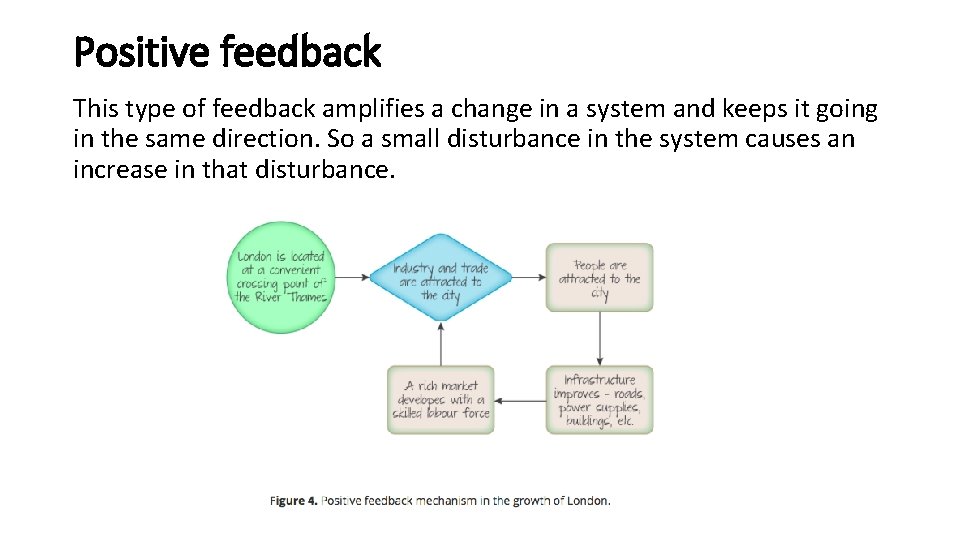
Positive feedback This type of feedback amplifies a change in a system and keeps it going in the same direction. So a small disturbance in the system causes an increase in that disturbance.
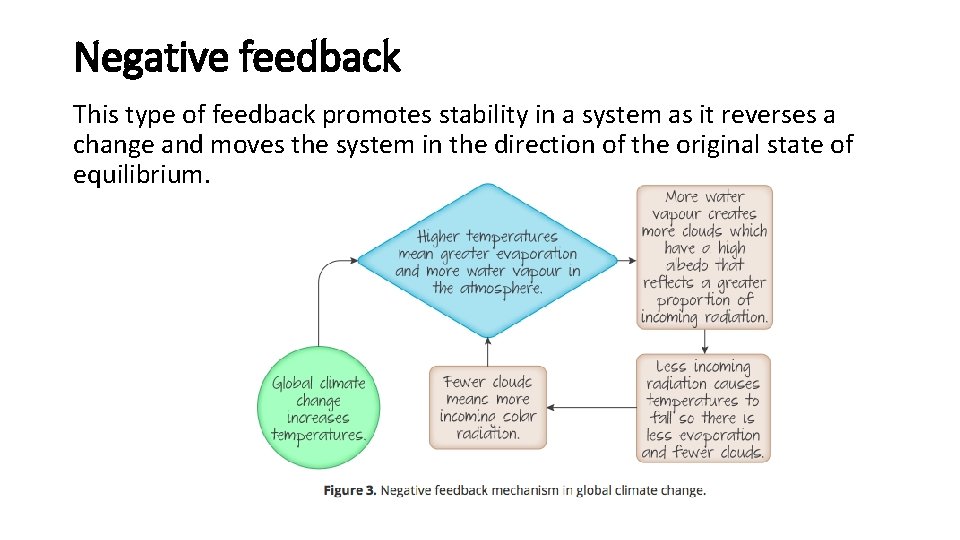
Negative feedback This type of feedback promotes stability in a system as it reverses a change and moves the system in the direction of the original state of equilibrium.

True or false…. The figure below shows a negative feedback cycles for global climate change. FALSE The figure shows a positive feedback cycle as it will push change in the same direction and increase climate change.
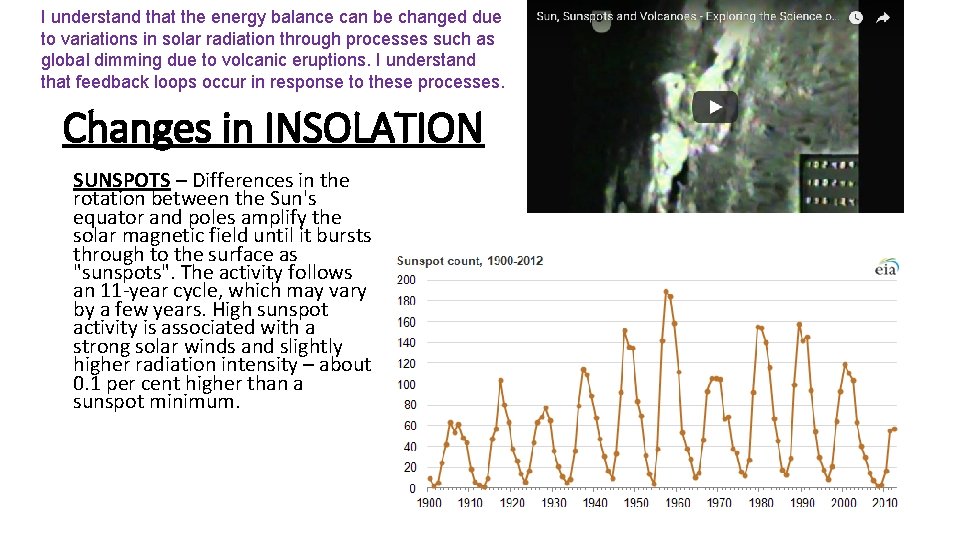
I understand that the energy balance can be changed due to variations in solar radiation through processes such as global dimming due to volcanic eruptions. I understand that feedback loops occur in response to these processes. Changes in INSOLATION SUNSPOTS – Differences in the rotation between the Sun's equator and poles amplify the solar magnetic field until it bursts through to the surface as "sunspots". The activity follows an 11 -year cycle, which may vary by a few years. High sunspot activity is associated with a strong solar winds and slightly higher radiation intensity – about 0. 1 per cent higher than a sunspot minimum.

Solar radiation variations. . 1. Using the graph (below right), describe the pattern of sunspot activity between 1960 and 2010. 2. Is there a relationship between sunspot activity and global temperatures (don't forget to use data look for anomalies)
The impacts of sunspots Click on this link from the BBC and print out and read the article carefully. i. What is the Maunder Minimum? ii. What is blocking? iii. Outline the impacts of sunspots on continental Europe and its populations.
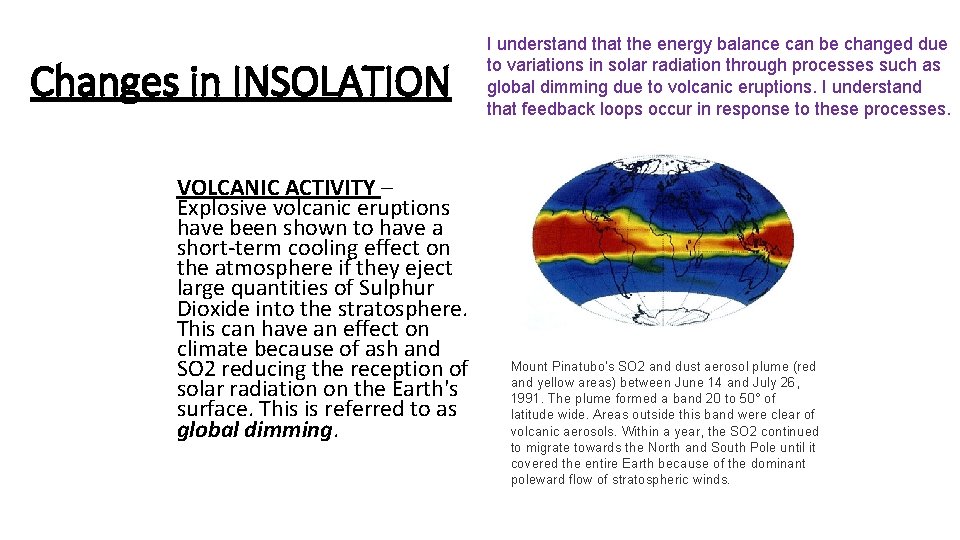
Changes in INSOLATION VOLCANIC ACTIVITY – Explosive volcanic eruptions have been shown to have a short-term cooling effect on the atmosphere if they eject large quantities of Sulphur Dioxide into the stratosphere. This can have an effect on climate because of ash and SO 2 reducing the reception of solar radiation on the Earth's surface. This is referred to as global dimming. I understand that the energy balance can be changed due to variations in solar radiation through processes such as global dimming due to volcanic eruptions. I understand that feedback loops occur in response to these processes. Mount Pinatubo's SO 2 and dust aerosol plume (red and yellow areas) between June 14 and July 26, 1991. The plume formed a band 20 to 50° of latitude wide. Areas outside this band were clear of volcanic aerosols. Within a year, the SO 2 continued to migrate towards the North and South Pole until it covered the entire Earth because of the dominant poleward flow of stratospheric winds.
What is global dimming? • Between the 1950 s and the 1990 s scientists observed that the amount of sunlight reaching the Earth’s surface was gradually falling. • The impact varied spatially but there was an overall decline of 1– 2% per decade. • The phenomenon was named global dimming and although greeted with skepticism in 2001 it is now an accepted phenomenon.
Global dimming I understand that the energy balance can be changed due to variations in solar radiation through processes such as global dimming due to volcanic eruptions. I understand that feedback loops occur in response to these processes. • This video provides a very brief introduction to explain global dimming, or this website provides maps with further information. • Another video explaining global dimming from the met office.
The causes of global dimming • Dimming is caused by an increase in particulates and sulfate aerosols, which reflect sunlight back out to space. • The particles also change the characteristics of clouds as they act as seeds for water droplets. Water coalesces around the particles and form larger droplets with a higher albedo, which reflect more solar radiation back to space. • The source of such particles may be natural (e. g. volcanic eruptions) or anthropogenic (caused by humans), generally through the combustion of fossil fuels (coal and oil) and wood. • Aircraft contrails (vapour trails) may also be responsible but it is difficult to prove, as air traffic is constant. • However, measurements taken during the almost total shut down of civil air traffic for 3 days after the 11 September 2001 terrorist attacks on the World Trade Center in New York showed that the diurnal temperature range increased by 1°C (higher daytime and lower nighttime temperatures resulted).
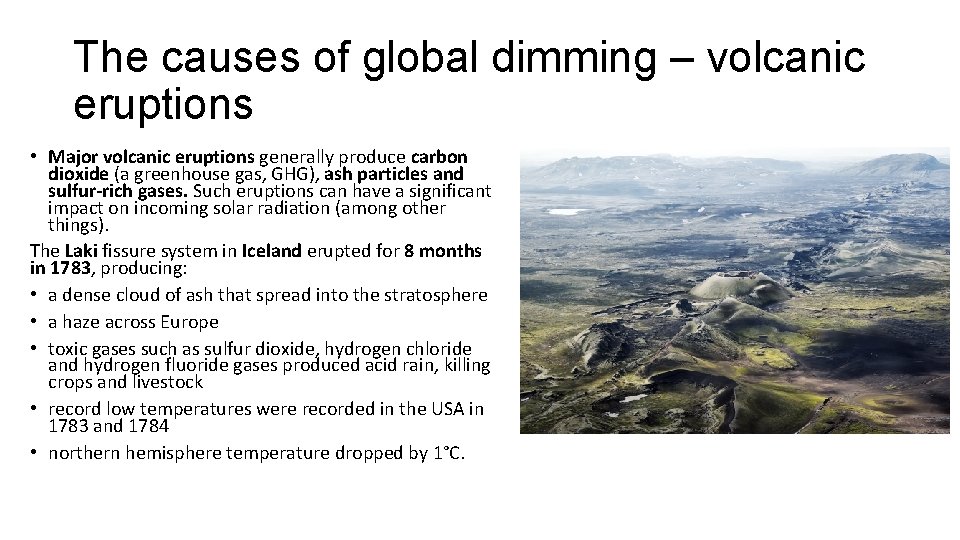
The causes of global dimming – volcanic eruptions • Major volcanic eruptions generally produce carbon dioxide (a greenhouse gas, GHG), ash particles and sulfur-rich gases. Such eruptions can have a significant impact on incoming solar radiation (among other things). The Laki fissure system in Iceland erupted for 8 months in 1783, producing: • a dense cloud of ash that spread into the stratosphere • a haze across Europe • toxic gases such as sulfur dioxide, hydrogen chloride and hydrogen fluoride gases produced acid rain, killing crops and livestock • record low temperatures were recorded in the USA in 1783 and 1784 • northern hemisphere temperature dropped by 1°C.
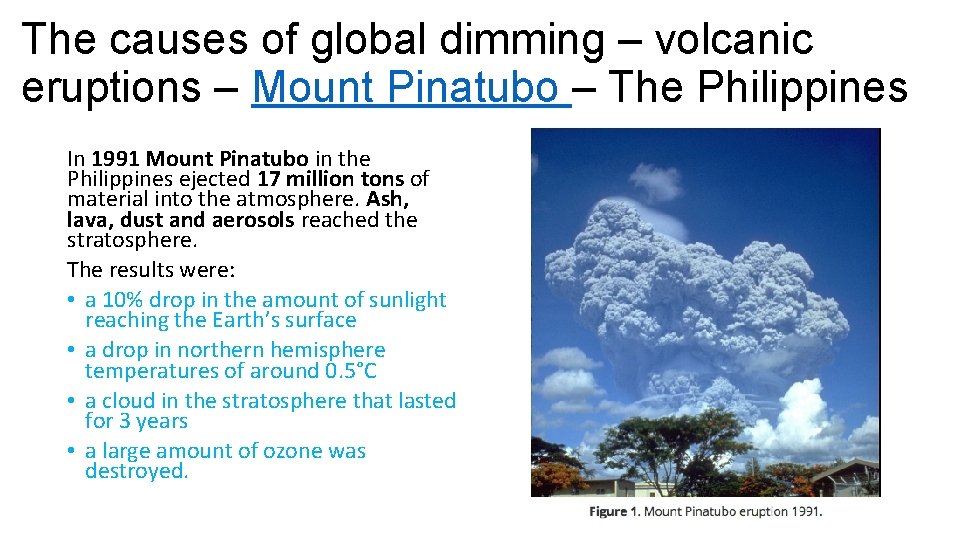
The causes of global dimming – volcanic eruptions – Mount Pinatubo – The Philippines In 1991 Mount Pinatubo in the Philippines ejected 17 million tons of material into the atmosphere. Ash, lava, dust and aerosols reached the stratosphere. The results were: • a 10% drop in the amount of sunlight reaching the Earth’s surface • a drop in northern hemisphere temperatures of around 0. 5°C • a cloud in the stratosphere that lasted for 3 years • a large amount of ozone was destroyed.
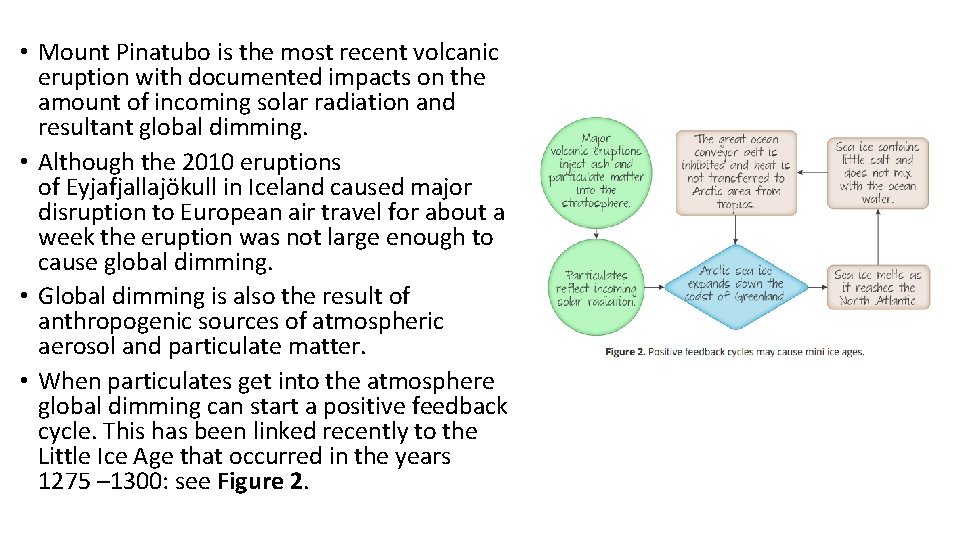
• Mount Pinatubo is the most recent volcanic eruption with documented impacts on the amount of incoming solar radiation and resultant global dimming. • Although the 2010 eruptions of Eyjafjallajökull in Iceland caused major disruption to European air travel for about a week the eruption was not large enough to cause global dimming. • Global dimming is also the result of anthropogenic sources of atmospheric aerosol and particulate matter. • When particulates get into the atmosphere global dimming can start a positive feedback cycle. This has been linked recently to the Little Ice Age that occurred in the years 1275 – 1300: see Figure 2.
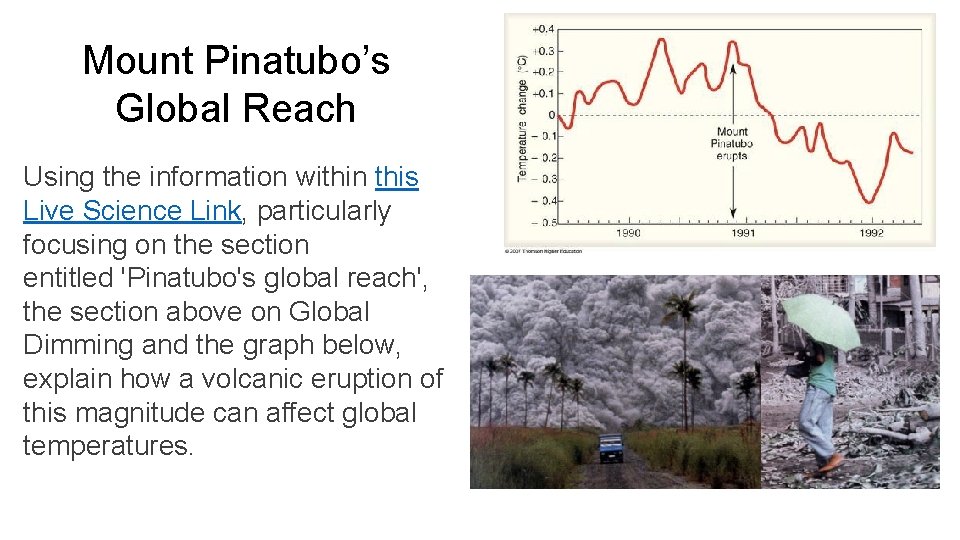
Mount Pinatubo’s Global Reach Using the information within this Live Science Link, particularly focusing on the section entitled 'Pinatubo's global reach', the section above on Global Dimming and the graph below, explain how a volcanic eruption of this magnitude can affect global temperatures.
Why should we be worried about global dimmimg? • One of the most worrying aspects of global dimming is that scientists think it masks the severity of global climate change. • Anthropogenic pollution is currently producing carbon dioxide (a GHG) and particulate matter, which cancel each other out. • Carbon dioxide drives warming while particulate matter drives cooling. • The problem is that although carbon dioxide levels are set to continue increasing, levels of particulate matter are not. This is because pollution control measures have been successful in targeting particulate matter and preventing it from entering the atmosphere. • It is interesting to note that trends and what is 'fashionable' may affect levels of pollution. • London saw a decrease in air quality when wood burning stoves became fashionable recently. How long this trend will last and the long-term impact is yet to be seen. • Check out the BBC news article from January 2017: 'Pollution in London from wood burning on the rise'.
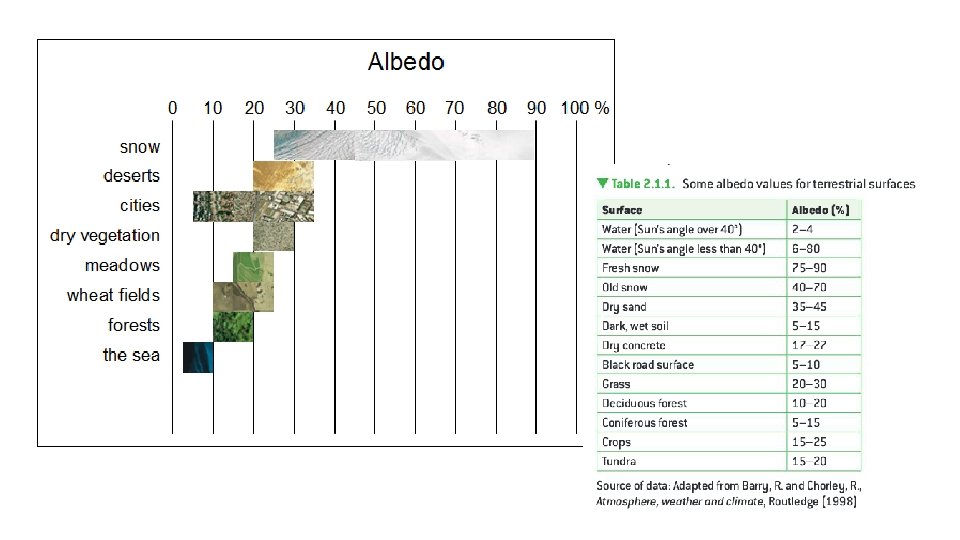
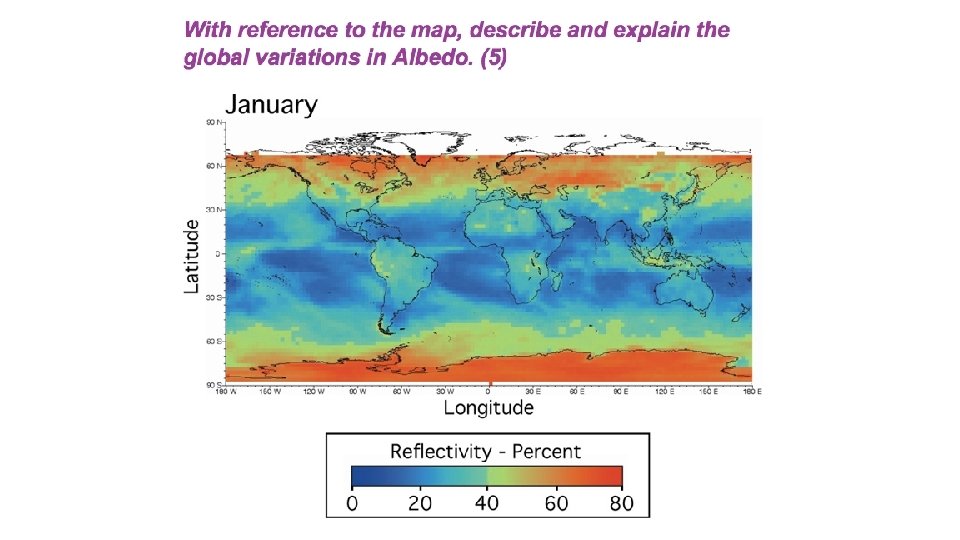
Changes in terrestrial albedo. . . I understand that the energy balance can be changed due to changes in terrestrial albedo and the feedback loops that occur. Albedo is the fraction of Sun’s radiation reflected from a surface. The term has its origins from the Latin word albus, meaning “white”. An average of 6. 7% of the sun's energy is reflected back into space but the actual amount reflected at different locations varies depending upon the surface.
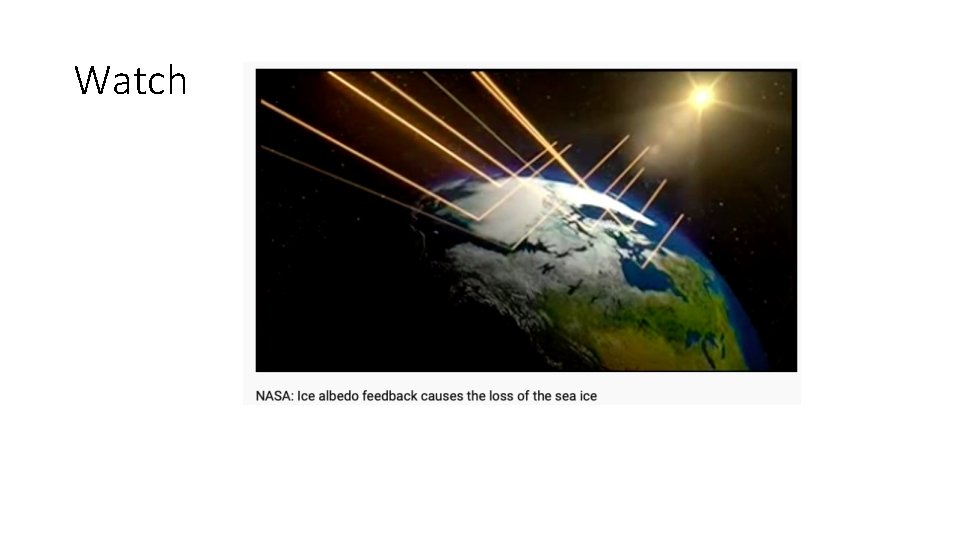
Watch

I understand that the energy balance can be changed due Changes in methane to methane gas release and the feedback loops that occur. • Methane is the major constituent in natural gas and according to the Intergovernmental Panel on Climate Change (IPCC) it has a much more significant global warming potential (GWP) than carbon dioxide. • Methane has been largely ignored as a GHG because of its short lifespan: it stays in the atmosphere for about 20 years before it decays and becomes harmless. • However, in those 20 years it 84– 86 times more effective than carbon dioxide at warming the planet. • The controversy is that when policy makers are compiling a nation's emissions inventory they look at methane potential over a 100 -year period. This approach makes it appear harmless, and environmentalists say that it's cheating!
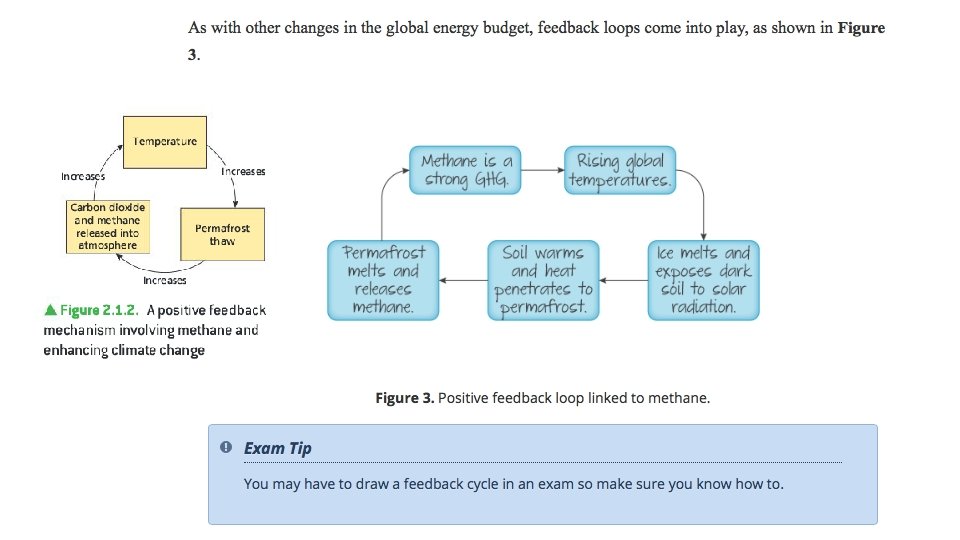
Changes in methane I understand that the energy balance can be changed due to methane gas release and the feedback loops that occur. Methane is a chemical compound with the chemical formula CH 4 (one atom of carbon and four atoms of hydrogen). It is a group-14 hydride and the simplest alkane, and is the main constituent of natural gas. The relative abundance of methane on Earth makes it an attractive fuel, though capturing and storing it poses challenges due to its gaseous state under normal conditions for temperature and pressure. Natural methane is found both below ground and under the sea floor. When it reaches the surface and the atmosphere, it is known as atmospheric methane. The Earth's atmospheric methane concentration has increased by about 150% since 1750, and it accounts for 20% of the total radiative forcing from all of the longlived and globally mixed greenhouse gases. (Wikipedia 2017) Task 1 - Read the information above and watch the video In your own words, explain how methane contributes to global warming via positive feedback. Pay particular attention to its links with ice melt as studied previously.
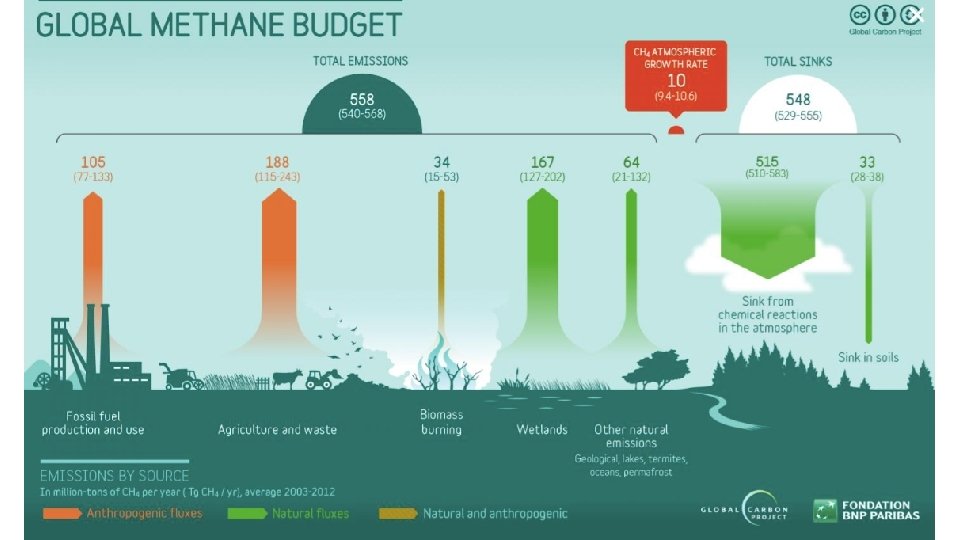
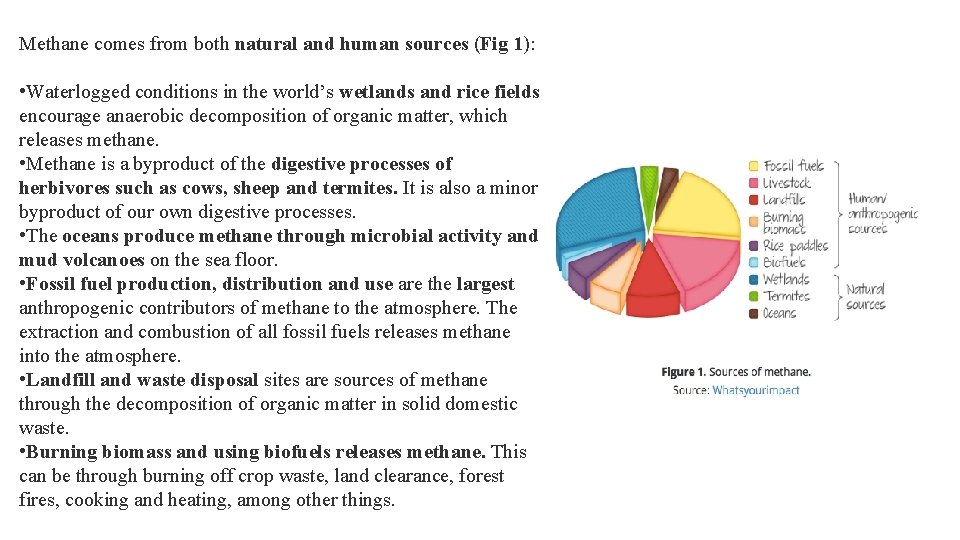
Methane comes from both natural and human sources (Fig 1): • Waterlogged conditions in the world’s wetlands and rice fields encourage anaerobic decomposition of organic matter, which releases methane. • Methane is a byproduct of the digestive processes of herbivores such as cows, sheep and termites. It is also a minor byproduct of our own digestive processes. • The oceans produce methane through microbial activity and mud volcanoes on the sea floor. • Fossil fuel production, distribution and use are the largest anthropogenic contributors of methane to the atmosphere. The extraction and combustion of all fossil fuels releases methane into the atmosphere. • Landfill and waste disposal sites are sources of methane through the decomposition of organic matter in solid domestic waste. • Burning biomass and using biofuels releases methane. This can be through burning off crop waste, land clearance, forest fires, cooking and heating, among other things.
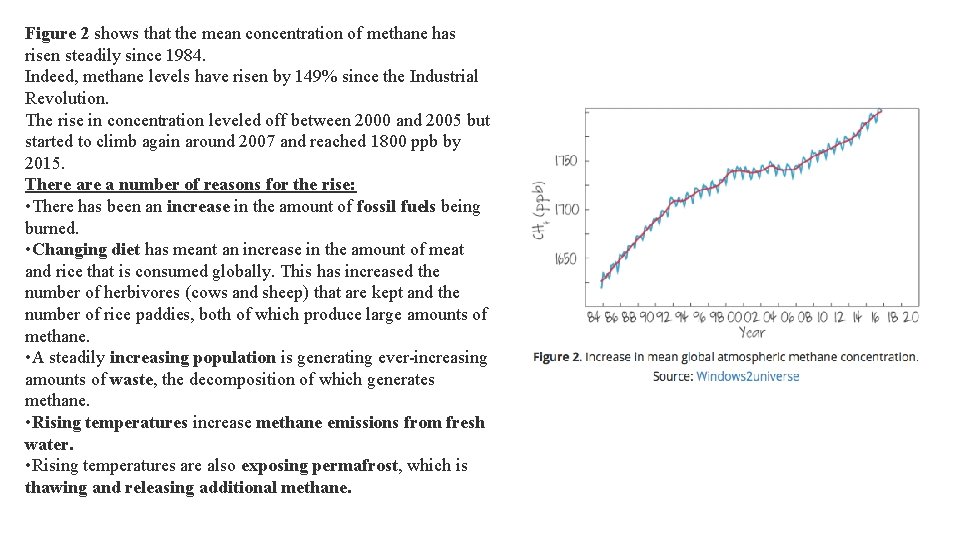
Figure 2 shows that the mean concentration of methane has risen steadily since 1984. Indeed, methane levels have risen by 149% since the Industrial Revolution. The rise in concentration leveled off between 2000 and 2005 but started to climb again around 2007 and reached 1800 ppb by 2015. There a number of reasons for the rise: • There has been an increase in the amount of fossil fuels being burned. • Changing diet has meant an increase in the amount of meat and rice that is consumed globally. This has increased the number of herbivores (cows and sheep) that are kept and the number of rice paddies, both of which produce large amounts of methane. • A steadily increasing population is generating ever-increasing amounts of waste, the decomposition of which generates methane. • Rising temperatures increase methane emissions from fresh water. • Rising temperatures are also exposing permafrost, which is thawing and releasing additional methane.

- Slides: 33