
What Landauer Limit Ultralow power electronics and the
- Slides: 27
What Landauer Limit? Ultra-low power electronics, and the minimum energy for computation Gregory Snider, Alexei Orlov, and Craig Lent Department of Electrical Engineering University of Notre Dame
Outline • The power dilemma and resulting limits • The Landauer Principle • A word about state variables • Experiments • Possible ways forward
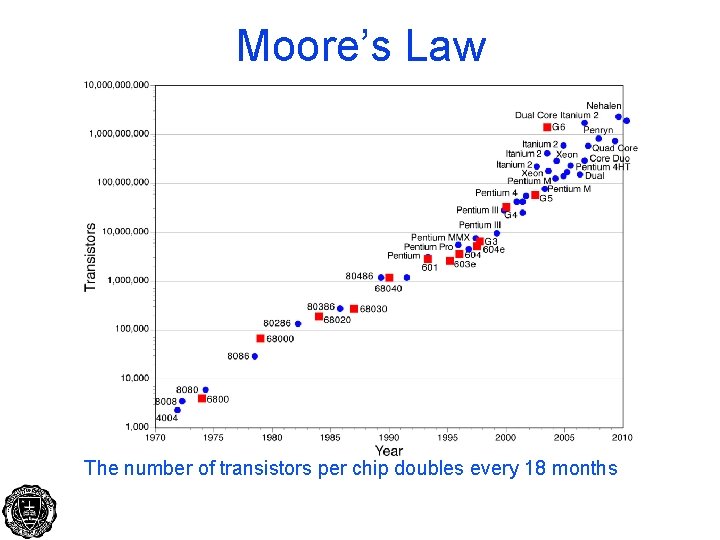
Moore’s Law The number of transistors per chip doubles every 18 months
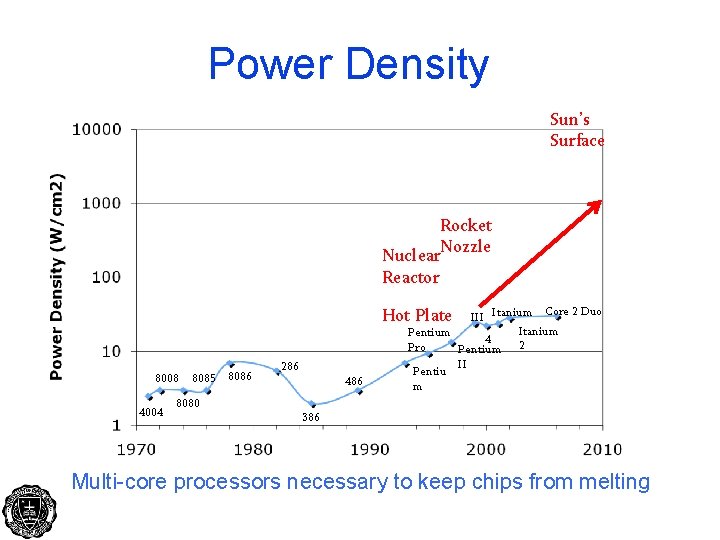
Power Density Sun’s Surface Rocket Nuclear. Nozzle Reactor Core 2 Duo III Itanium Pentium 4 Pro Pentium 2 II Pentiu m Hot Plate 8008 4004 8085 8080 8086 286 486 386 Multi-core processors necessary to keep chips from melting
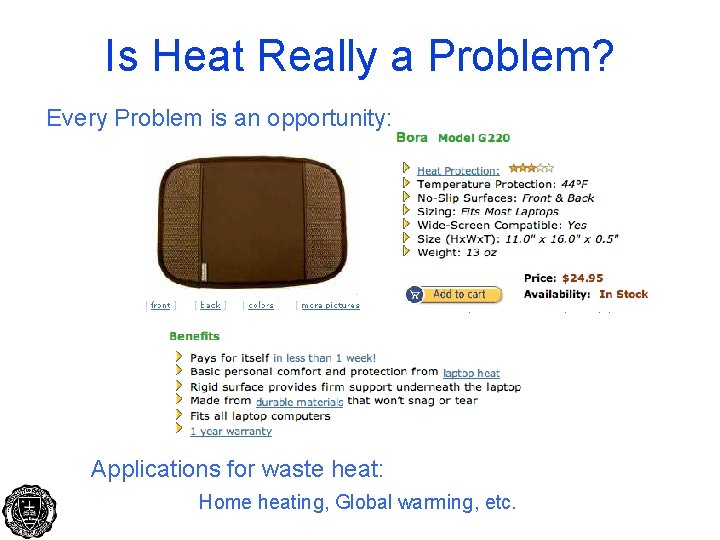
Is Heat Really a Problem? Every Problem is an opportunity: Applications for waste heat: Home heating, Global warming, etc.
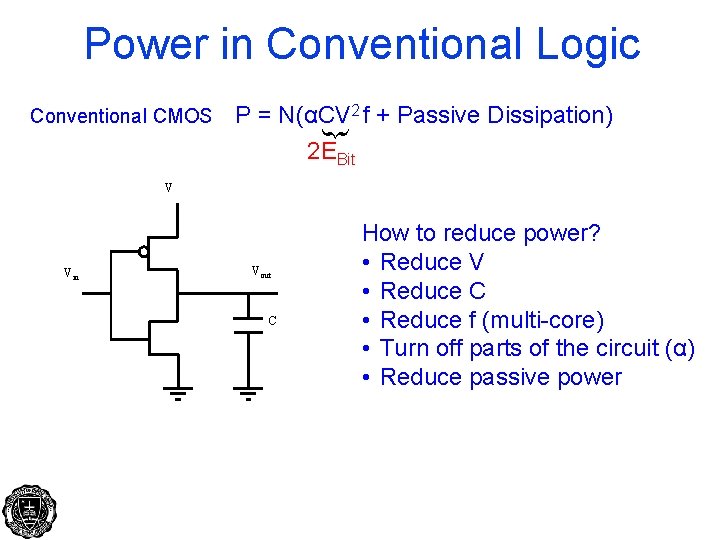
Power in Conventional Logic P = N(αCV 2 f + Passive Dissipation) 2 EBit { Conventional CMOS V Vin Vout C How to reduce power? • Reduce V • Reduce C • Reduce f (multi-core) • Turn off parts of the circuit (α) • Reduce passive power
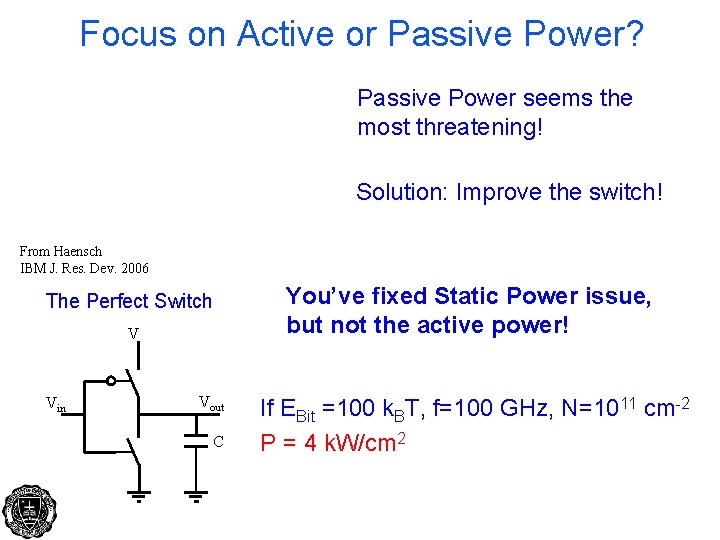
Focus on Active or Passive Power? Passive Power seems the most threatening! Solution: Improve the switch! From Haensch IBM J. Res. Dev. 2006 The Perfect Switch V Vin Vout C You’ve fixed Static Power issue, but not the active power! If EBit =100 k. BT, f=100 GHz, N=1011 cm-2 P = 4 k. W/cm 2
Fundamental limits for computation? Is there a fundamental lower limit on energy dissipation per bit? i. e. is there a minimum amount of heat that must be generated to compute a bit?
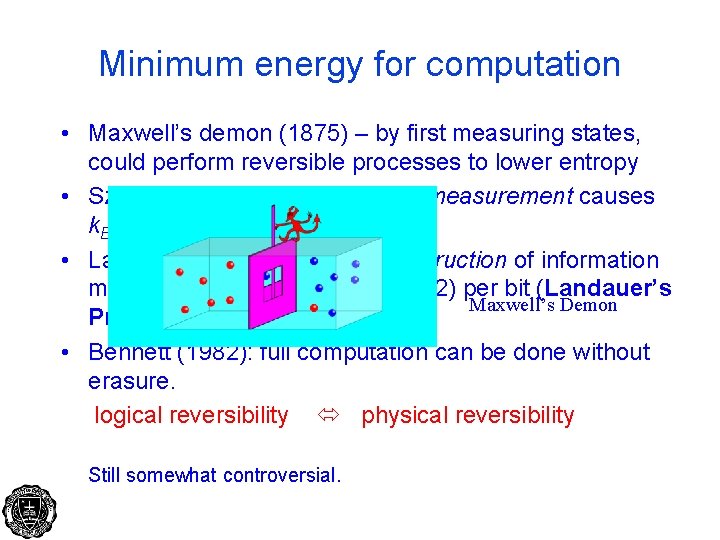
Minimum energy for computation • Maxwell’s demon (1875) – by first measuring states, could perform reversible processes to lower entropy • Szilard (1929), Brillouin (1962): measurement causes k. BT ln(2) dissipation per bit. • Landauer (1961, 1970): only destruction of information must cause dissipation of k. BT ln(2) per bit (Landauer’s Maxwell’s Demon Principle) • Bennett (1982): full computation can be done without erasure. logical reversibility physical reversibility Still somewhat controversial.
The Debate Exorcist XIV: The wrath of Maxwell’s demon. Part I: From Maxwell to Szilard, Earman, J. , & Norton, J. D. , Studies in History and Philosophy of Modern Physics, 29, 435 (1998). Exorcist XIV: The wrath of Maxwell’s demon. Part II: From Szilard to Landauer and beyond, Earman, J. , & Norton, J. D. , Studies in History and Philosophy of Modern Physics, 30, 1 (1999). Eaters of the lotus: Landauer’s principle and the return of Maxwell’s demon, Norton, J. D. , Studies in History and Philosophy of Modern Physics, 36, 375 (2005). The (absence of a) relationship between thermodynamic and logical reversibility, Maroney, O. J. E. Studies in History and Philosophy of Modern Physics, 36, 355 (2005) The connection between logical and thermodynamic irreversibility, James Ladyman, Stuart Presnell, Anthony J. Short, Berry Groisman, Studies in History and Philosophy of Modern Physics, 38, 58 (2007).
Analysis of erasure process Helpful to examine and contrast two cases: • Erasure with a copy – Reversible logical operation (No Data Destroyed) – Key feature: The copy biases the system toward the state it’s in • Erasure without a copy – Irreversible logical operation (Data Destroyed) – Key feature: The system cannot be biased toward the state it’s in, so there’s an uncontrolled step
What About State Variables? • Does the choice of a state variable affect this analysis? • Isn’t using charge as the state variable the real problem? • If we use a different state variable like spin, the problem goes away, right?
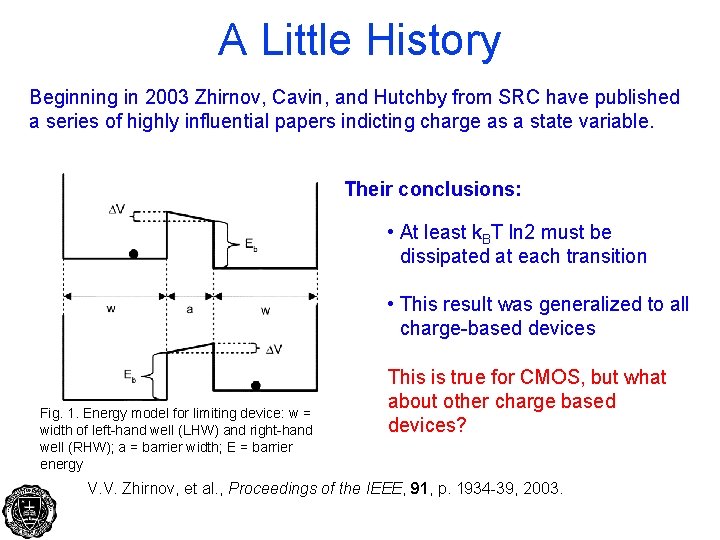
A Little History Beginning in 2003 Zhirnov, Cavin, and Hutchby from SRC have published a series of highly influential papers indicting charge as a state variable. Their conclusions: • At least k. BT ln 2 must be dissipated at each transition • This result was generalized to all charge-based devices Fig. 1. Energy model for limiting device: w = width of left-hand well (LHW) and right-hand well (RHW); a = barrier width; E = barrier energy This is true for CMOS, but what about other charge based devices? V. V. Zhirnov, et al. , Proceedings of the IEEE, 91, p. 1934 -39, 2003.
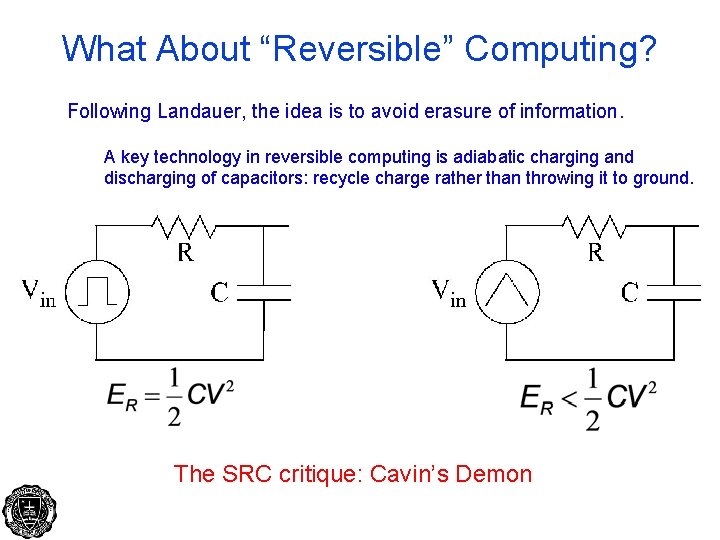
What About “Reversible” Computing? Following Landauer, the idea is to avoid erasure of information. A key technology in reversible computing is adiabatic charging and discharging of capacitors: recycle charge rather than throwing it to ground. The SRC critique: Cavin’s Demon
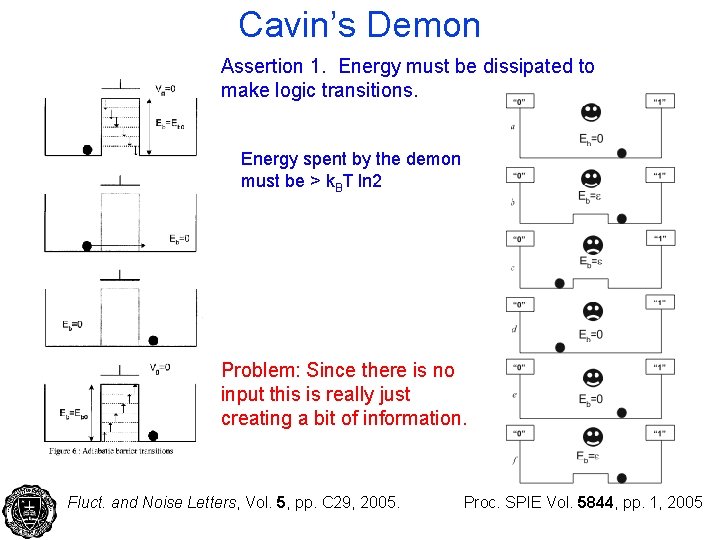
Cavin’s Demon Assertion 1. Energy must be dissipated to make logic transitions. Energy spent by the demon must be > k. BT ln 2 Problem: Since there is no input this is really just creating a bit of information. Fluct. and Noise Letters, Vol. 5, pp. C 29, 2005. Proc. SPIE Vol. 5844, pp. 1, 2005
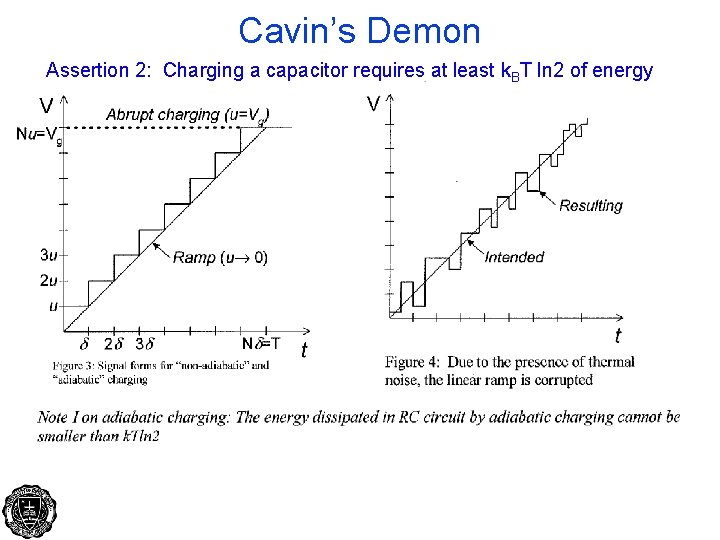
Cavin’s Demon Assertion 2: Charging a capacitor requires at least k. BT ln 2 of energy
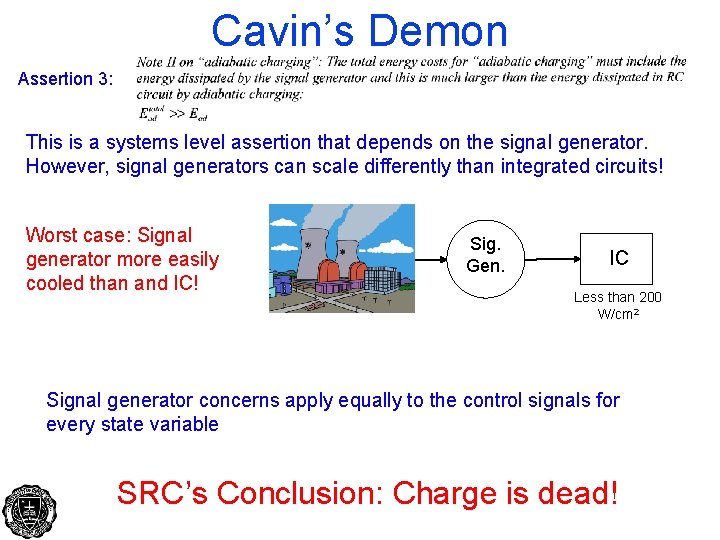
Cavin’s Demon Assertion 3: This is a systems level assertion that depends on the signal generator. However, signal generators can scale differently than integrated circuits! Worst case: Signal generator more easily cooled than and IC! Sig. Gen. IC Less than 200 W/cm 2 Signal generator concerns apply equally to the control signals for every state variable SRC’s Conclusion: Charge is dead!
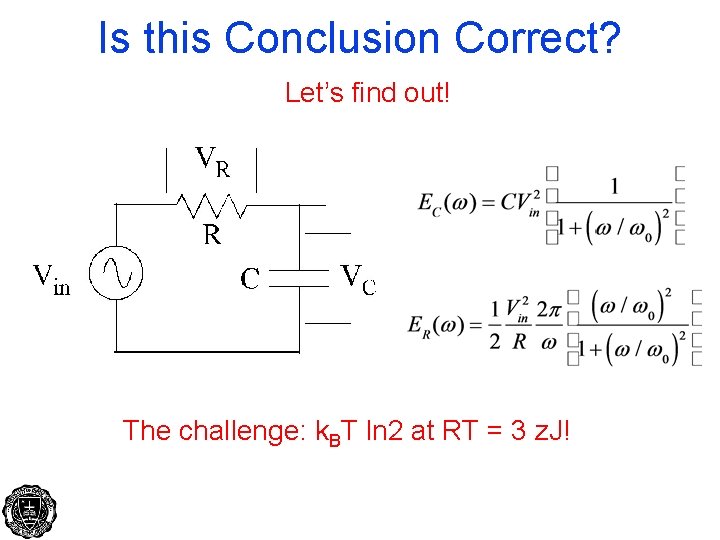
Is this Conclusion Correct? Let’s find out! The challenge: k. BT ln 2 at RT = 3 z. J!
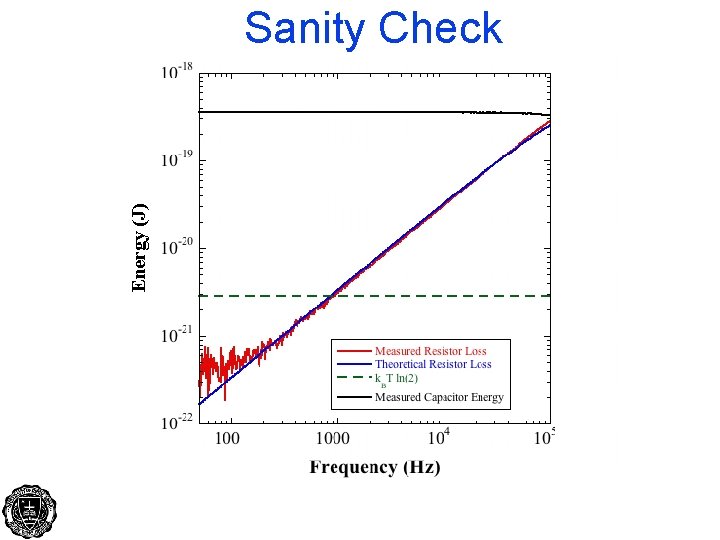
Sanity Check
The Landauer Principle Nature 483, p 189, 2012
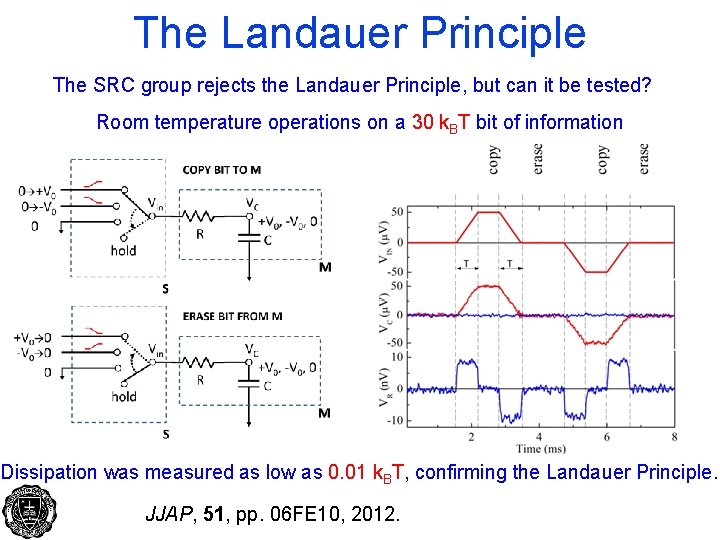
The Landauer Principle The SRC group rejects the Landauer Principle, but can it be tested? Room temperature operations on a 30 k. BT bit of information Dissipation was measured as low as 0. 01 k. BT, confirming the Landauer Principle. JJAP, 51, pp. 06 FE 10, 2012.
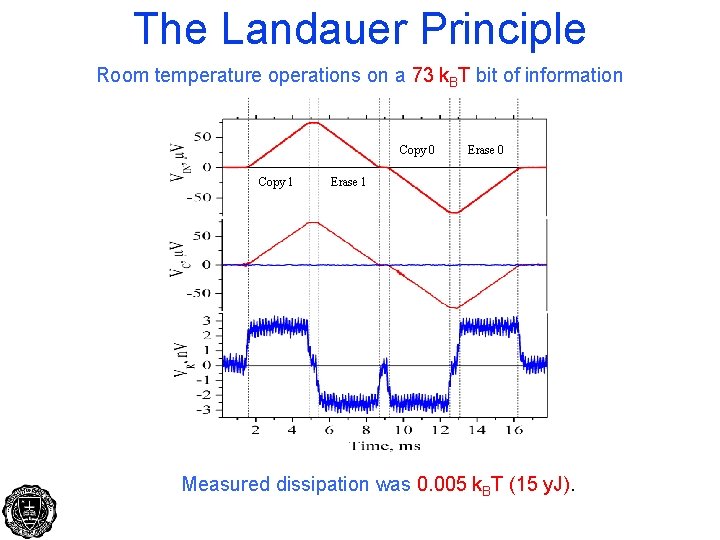
The Landauer Principle Room temperature operations on a 73 k. BT bit of information Copy 0 Copy 1 Erase 0 Erase 1 Measured dissipation was 0. 005 k. BT (15 y. J).
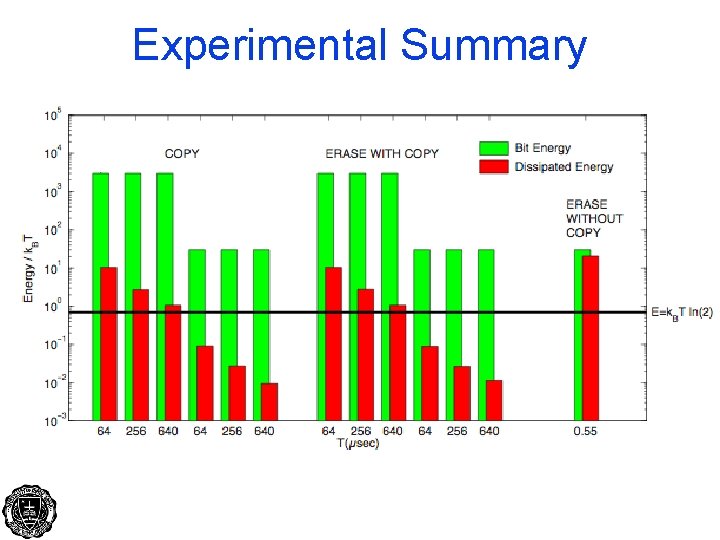
Experimental Summary
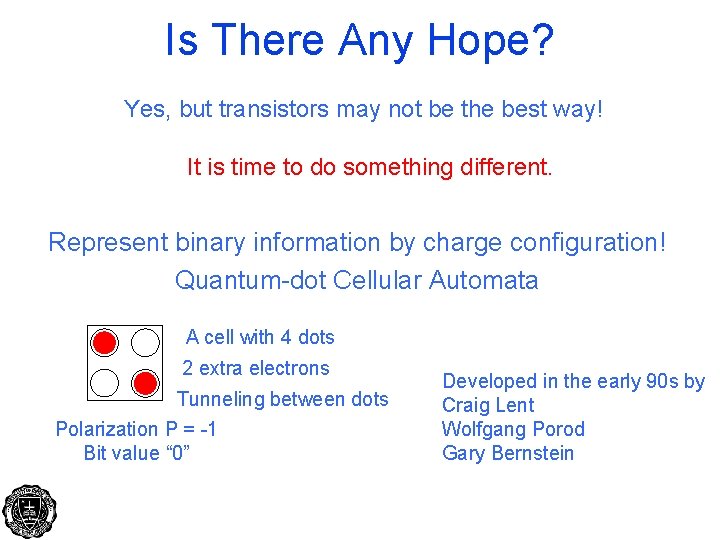
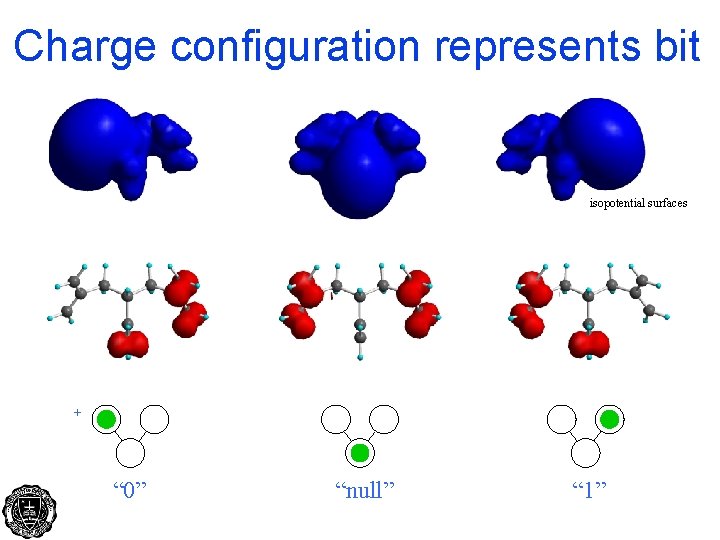
Is There Any Hope? Yes, but transistors may not be the best way! It is time to do something different. Represent binary information by charge configuration! Quantum-dot Cellular Automata A cell with 4 dots 2 extra electrons Tunneling between dots Polarization P = -1 Bit value “ 0” Developed in the early 90 s by Craig Lent Wolfgang Porod Gary Bernstein
Charge configuration represents bit isopotential surfaces + “ 0” “null” “ 1”
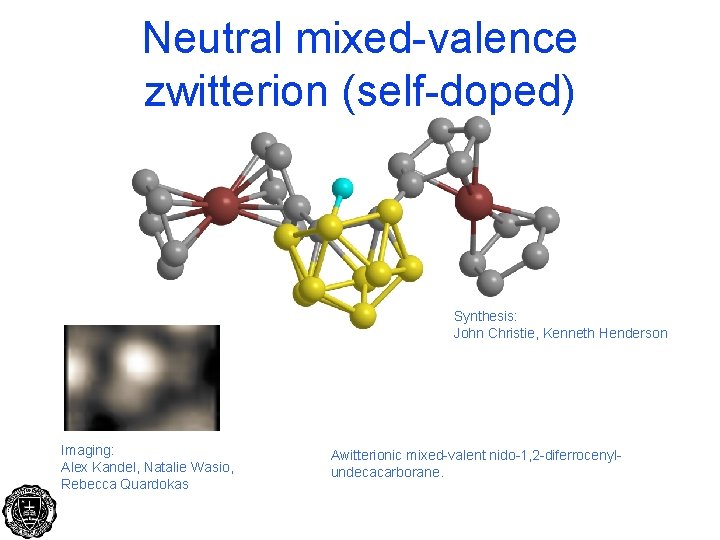
Neutral mixed-valence zwitterion (self-doped) Synthesis: John Christie, Kenneth Henderson Imaging: Alex Kandel, Natalie Wasio, Rebecca Quardokas Awitterionic mixed-valent nido-1, 2 -diferrocenylundecacarborane.
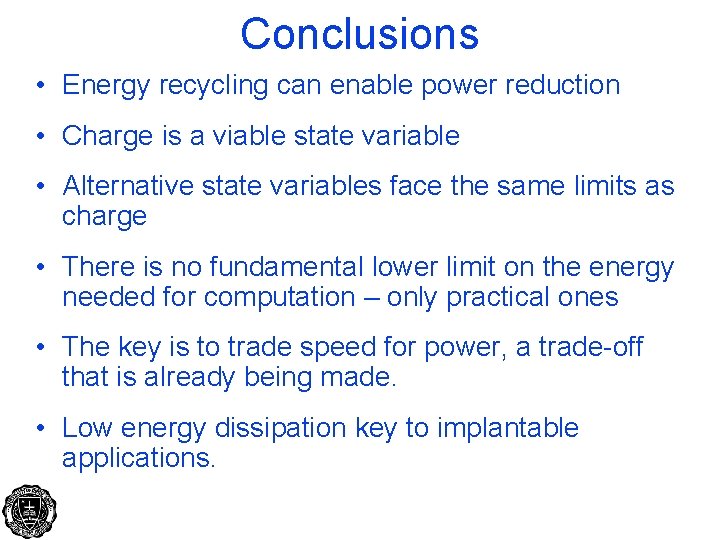
Conclusions • Energy recycling can enable power reduction • Charge is a viable state variable • Alternative state variables face the same limits as charge • There is no fundamental lower limit on the energy needed for computation – only practical ones • The key is to trade speed for power, a trade-off that is already being made. • Low energy dissipation key to implantable applications.