
What kinds of specimens Examples from literature Catalysts


- Slides: 13
What kinds of specimens? Examples from literature Catalysts - mask large pores by filling w/ medium of same electron density as catalyst support (ex: CH 2 I 2) - expect increase in absorption Vycor glass - surface area of internal voids need precise data, absolute intensities - specimens precisely ground sub-mm in thickness
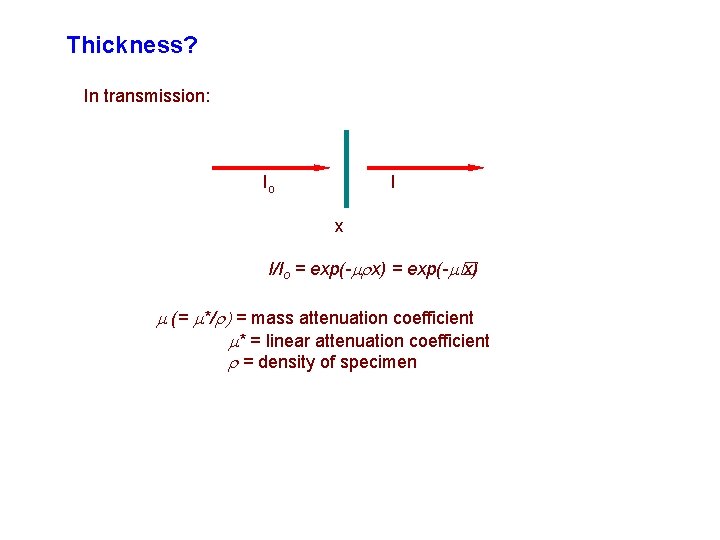
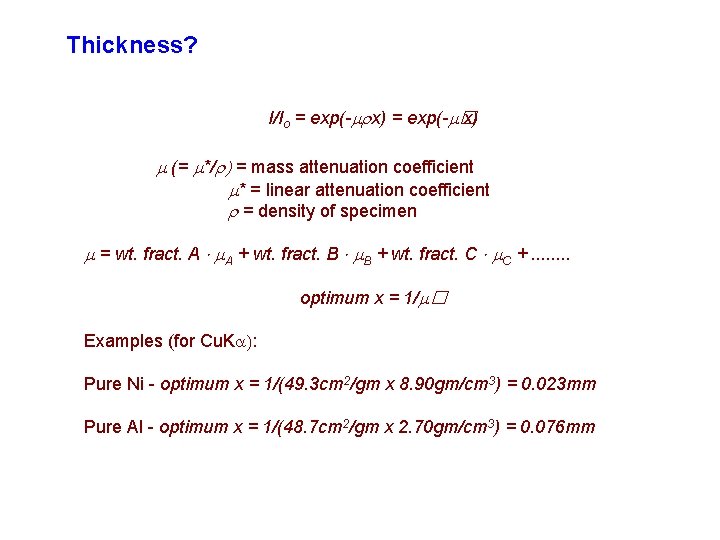
Thickness? In transmission: Io I x I/Io = exp(- x) = exp(- � x) (= */ = mass attenuation coefficient * = linear attenuation coefficient = density of specimen
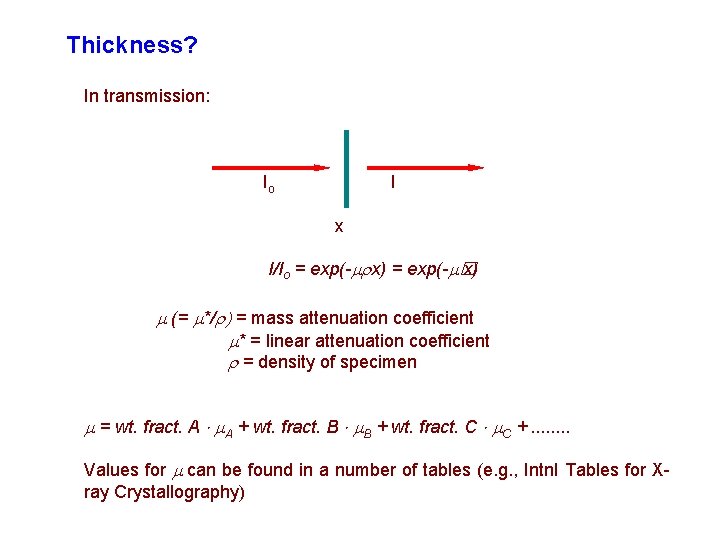
Thickness? In transmission: Io I x I/Io = exp(- x) = exp(- � x) (= */ = mass attenuation coefficient * = linear attenuation coefficient = density of specimen = wt. fract. A A + wt. fract. B B + wt. fract. C C +. . . . Values for can be found in a number of tables (e. g. , Intnl Tables for Xray Crystallography)
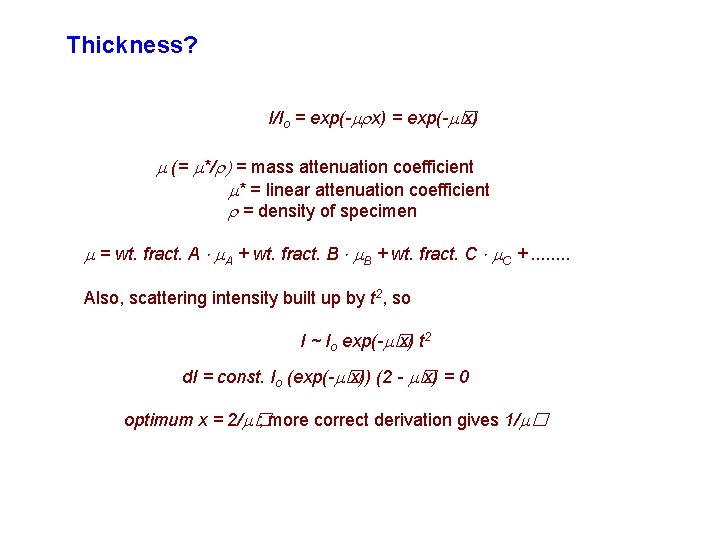
Thickness? I/Io = exp(- x) = exp(- � x) (= */ = mass attenuation coefficient * = linear attenuation coefficient = density of specimen = wt. fract. A A + wt. fract. B B + wt. fract. C C +. . . . Also, scattering intensity built up by t 2, so I ~ Io exp(- � x) t 2 d. I = const. Io (exp(- � x)) (2 - � x) = 0 optimum x = 2/ � ; more correct derivation gives 1/ �
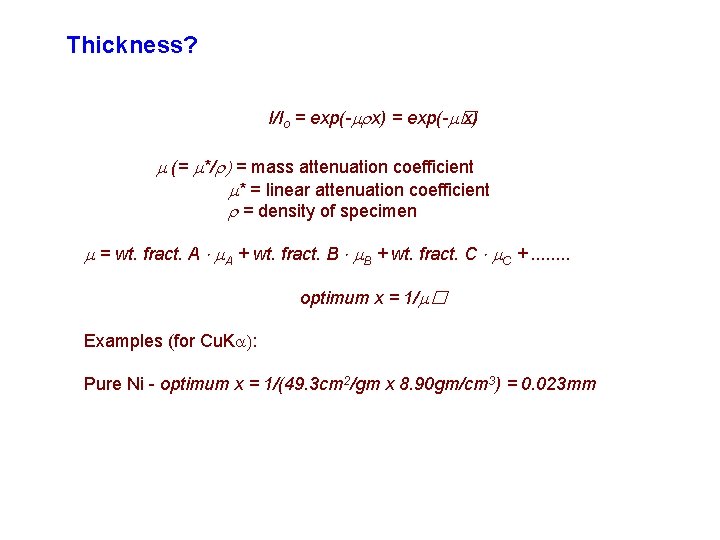
Thickness? I/Io = exp(- x) = exp(- � x) (= */ = mass attenuation coefficient * = linear attenuation coefficient = density of specimen = wt. fract. A A + wt. fract. B B + wt. fract. C C +. . . . optimum x = 1/ � Examples (for Cu. K : Pure Ni - optimum x = 1/(49. 3 cm 2/gm x 8. 90 gm/cm 3) = 0. 023 mm
Thickness? I/Io = exp(- x) = exp(- � x) (= */ = mass attenuation coefficient * = linear attenuation coefficient = density of specimen = wt. fract. A A + wt. fract. B B + wt. fract. C C +. . . . optimum x = 1/ � Examples (for Cu. K : Pure Ni - optimum x = 1/(49. 3 cm 2/gm x 8. 90 gm/cm 3) = 0. 023 mm Pure Al - optimum x = 1/(48. 7 cm 2/gm x 2. 70 gm/cm 3) = 0. 076 mm
Thickness? I/Io = exp(- x) = exp(- � x) (= */ = mass attenuation coefficient * = linear attenuation coefficient = density of specimen = wt. fract. A A + wt. fract. B B + wt. fract. C C +. . . . optimum x = 1/ � Examples (for Cu. K : Pure Ni - optimum x = 1/(49. 3 cm 2/gm x 8. 90 gm/cm 3) = 0. 023 mm Pure Al - optimum x = 1/(48. 7 cm 2/gm x 2. 70 gm/cm 3) = 0. 076 mm
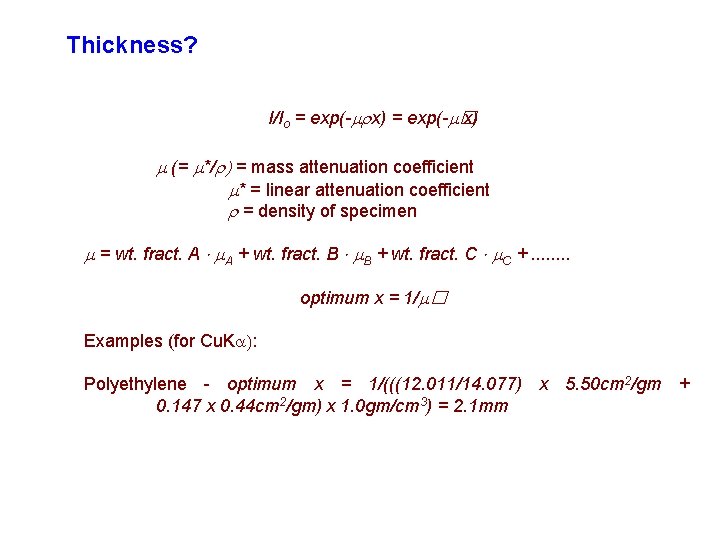
Thickness? I/Io = exp(- x) = exp(- � x) (= */ = mass attenuation coefficient * = linear attenuation coefficient = density of specimen = wt. fract. A A + wt. fract. B B + wt. fract. C C +. . . . optimum x = 1/ � Examples (for Cu. K : Polyethylene - optimum x = 1/(((12. 011/14. 077) x 5. 50 cm 2/gm + 0. 147 x 0. 44 cm 2/gm) x 1. 0 gm/cm 3) = 2. 1 mm
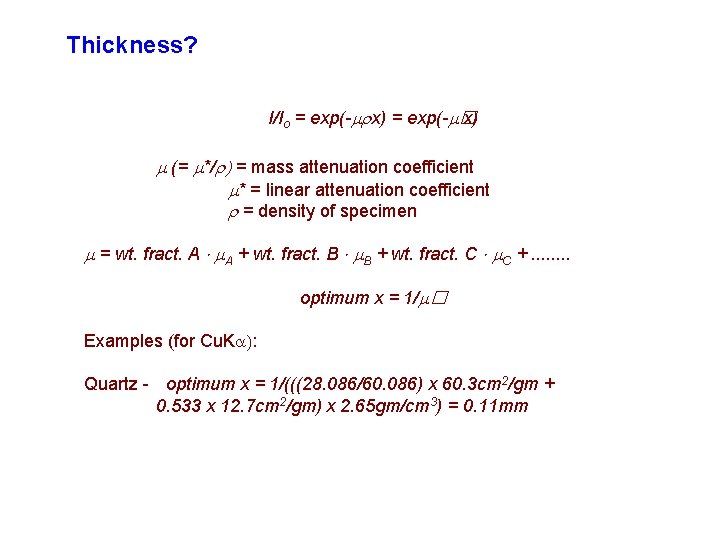
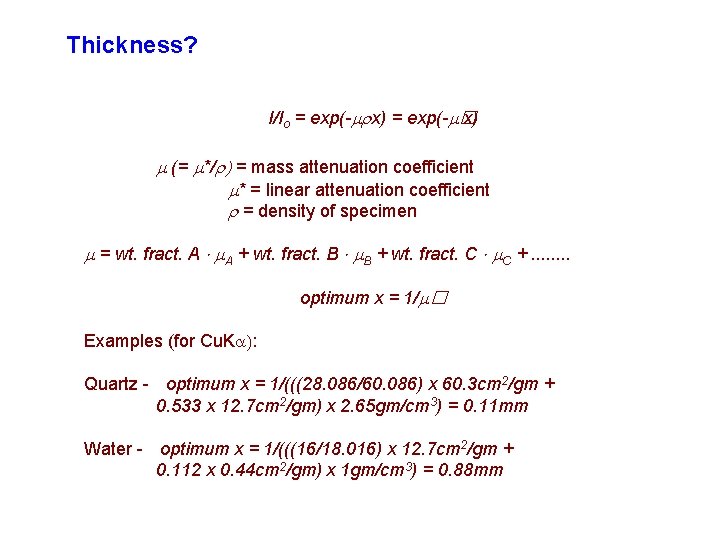
Thickness? I/Io = exp(- x) = exp(- � x) (= */ = mass attenuation coefficient * = linear attenuation coefficient = density of specimen = wt. fract. A A + wt. fract. B B + wt. fract. C C +. . . . optimum x = 1/ � Examples (for Cu. K : Quartz - optimum x = 1/(((28. 086/60. 086) x 60. 3 cm 2/gm + 0. 533 x 12. 7 cm 2/gm) x 2. 65 gm/cm 3) = 0. 11 mm
Thickness? I/Io = exp(- x) = exp(- � x) (= */ = mass attenuation coefficient * = linear attenuation coefficient = density of specimen = wt. fract. A A + wt. fract. B B + wt. fract. C C +. . . . optimum x = 1/ � Examples (for Cu. K : Quartz - optimum x = 1/(((28. 086/60. 086) x 60. 3 cm 2/gm + 0. 533 x 12. 7 cm 2/gm) x 2. 65 gm/cm 3) = 0. 11 mm Water - optimum x = 1/(((16/18. 016) x 12. 7 cm 2/gm + 0. 112 x 0. 44 cm 2/gm) x 1 gm/cm 3) = 0. 88 mm
Thickness? Metals & alloys optimum x = 10 -50 ��� 0. 01 -0. 05 mm generally cut, ground, & polished very carefully - avoid poor surface finish polycrystalline matls - grain size should be small
Thickness? Metals & alloys optimum x = 10 -50 ��� 0. 01 -0. 05 mm generally cut, ground, & polished very carefully - avoid poor surface finish polycrystalline matls - grain size should be small Polymers optimum x = 1 -2�� slice, microtome Water solutions ~ 1 mm thick
Thickness? Metals & alloys optimum x = 10 -50 ��� 0. 01 -0. 05 mm generally cut, ground, & polished very carefully - avoid poor surface finish polycrystalline matls - grain size should be small Polymers optimum x = 1 -2�� slice, microtome Water solutions ~ 1 mm thick Note: for sans, specimen prepn much easier…much larger specimens