
What kind of school do these children study

- Slides: 21
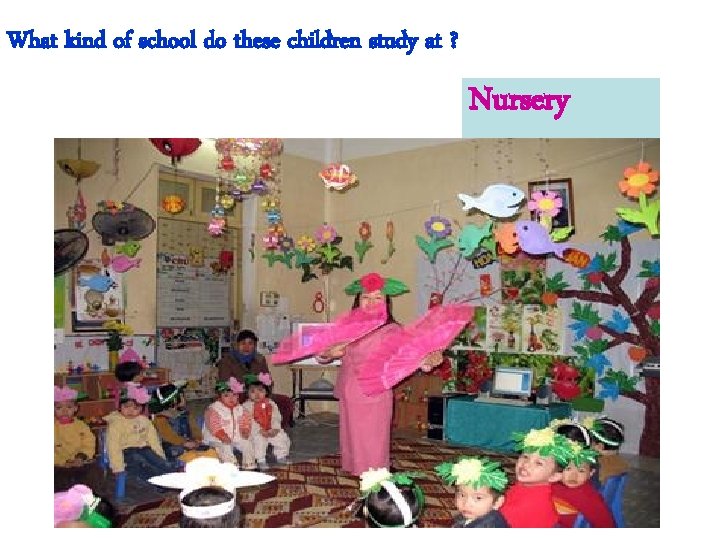
What kind of school do these children study at ? Nursery
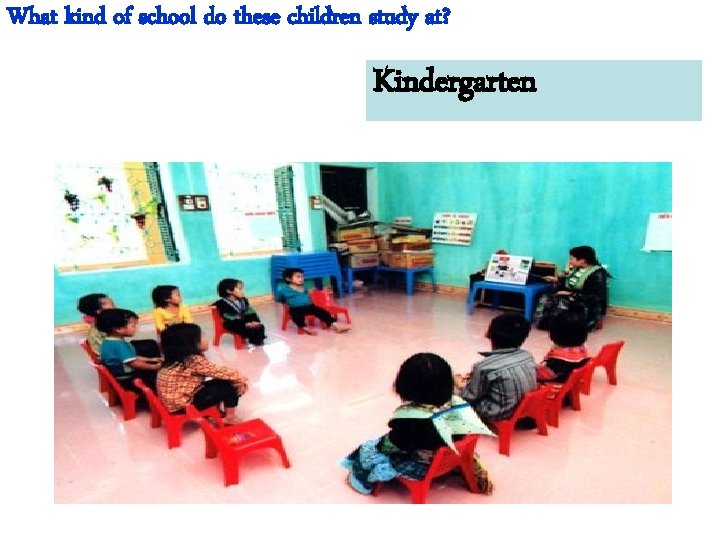
What kind of school do these children study at? Kindergarten
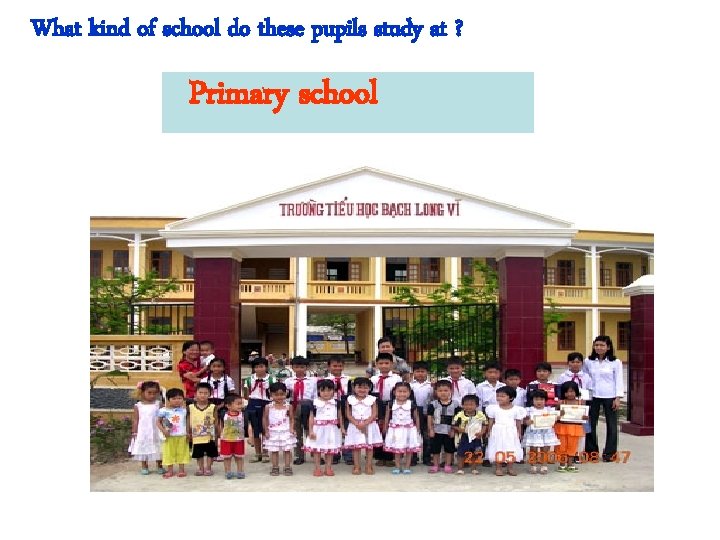
What kind of school do these pupils study at ? Primary school
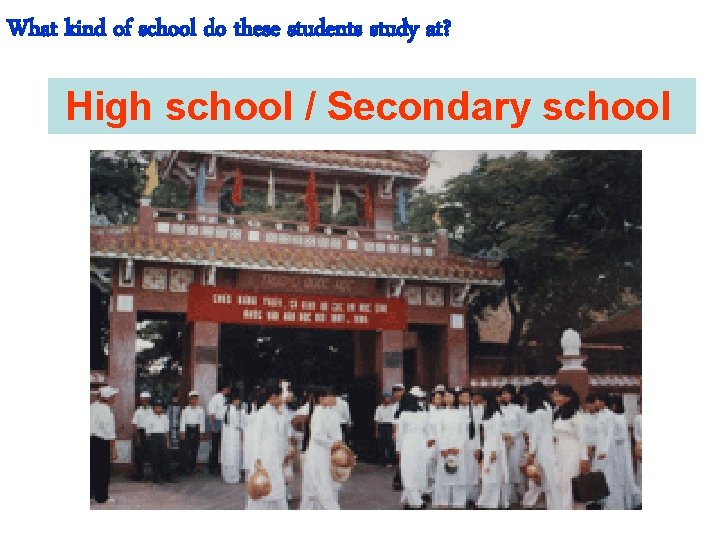
What kind of school do these students study at? High school / Secondary school
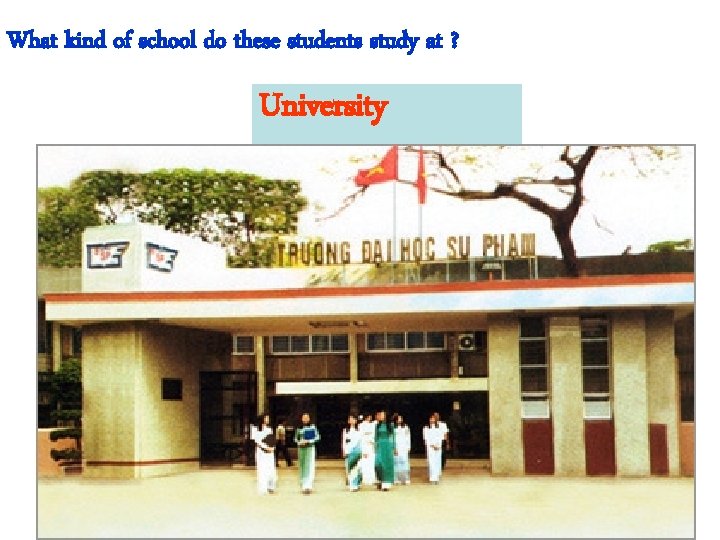
What kind of school do these students study at ? University
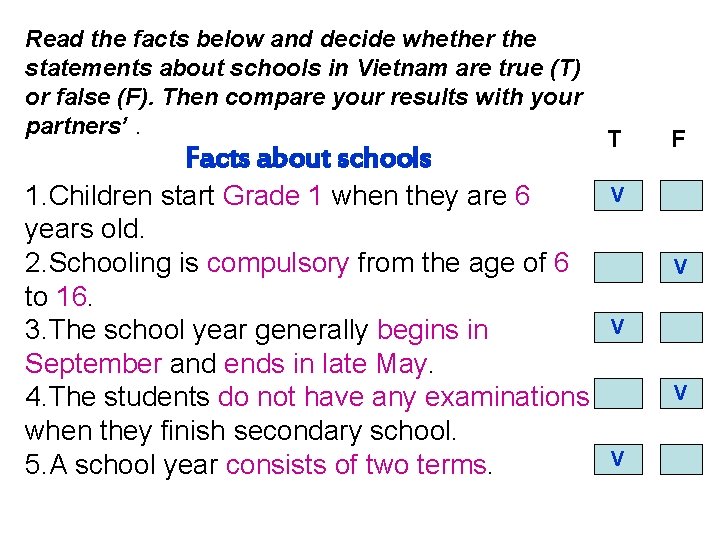
Read the facts below and decide whether the statements about schools in Vietnam are true (T) or false (F). Then compare your results with your partners’. Facts about schools 1. Children start Grade 1 when they are 6 years old. 2. Schooling is compulsory from the age of 6 to 16. 3. The school year generally begins in September and ends in late May. 4. The students do not have any examinations when they finish secondary school. 5. A school year consists of two terms. T F V V V
Unit 4: Lesson 1: READING
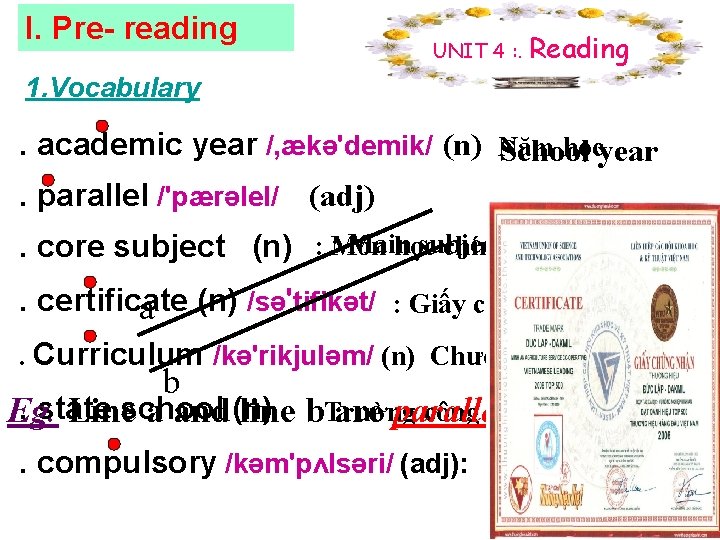
I. Pre- reading UNIT 4 : . Reading 1. Vocabulary . academic year /, ækə'demik/ (n) Năm họcyear School Song song. parallel /'pærəlel/ (adj) : Main subject học chính. core subject (n) : Môn . certificate a (n) /sə'tifikət/ : Giấy chứng nhận. Curriculum /kə'rikjuləm/ (n) Chương trình giảng dạy b. state công lậpto#each publicother. school Eg. Lineschool a and (n) line b: Trường are parallel. compulsory /kəm'pʌlsəri/ (adj): Bắt buộc
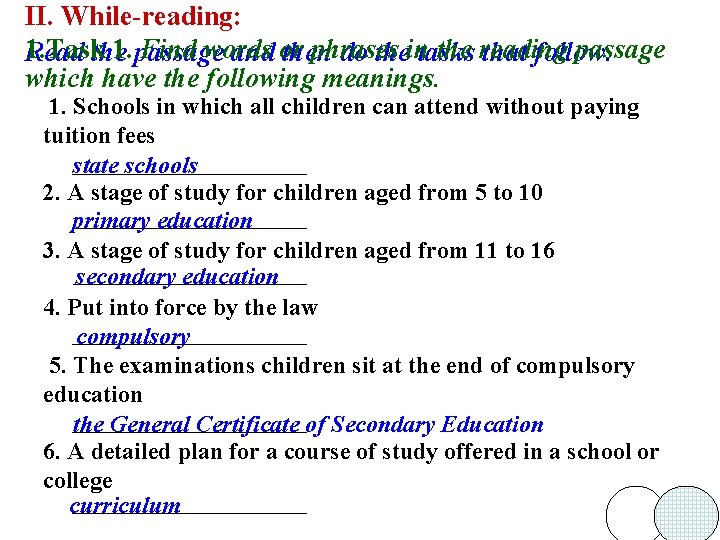
II. While-reading: 1. Task 1. passage Find words phrases the reading passage Read the and or then do theintasks that follow. which have the following meanings. 1. Schools in which all children can attend without paying tuition fees state schools 2. A stage of study for children aged from 5 to 10 primary education 3. A stage of study for children aged from 11 to 16 secondary education 4. Put into force by the law compulsory 5. The examinations children sit at the end of compulsory education the General Certificate of Secondary Education 6. A detailed plan for a course of study offered in a school or college curriculum
II. While you read: 2. Task 2. Answer the questions
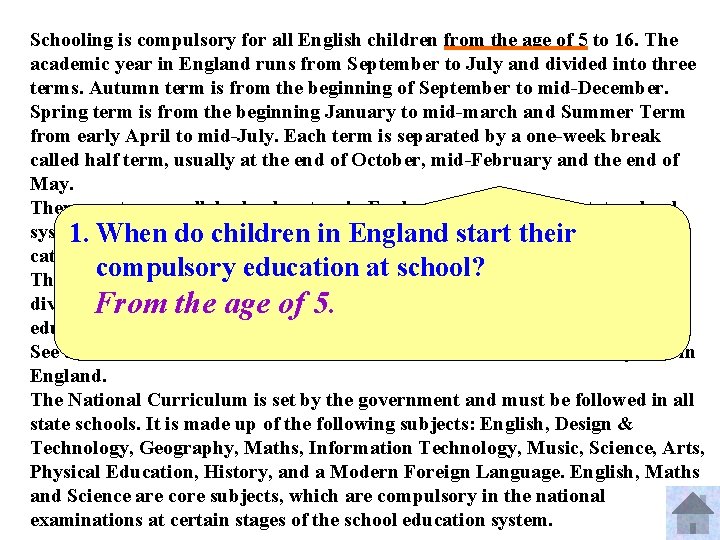
Schooling is compulsory for all English children from the age of 5 to 16. The academic year in England runs from September to July and divided into three terms. Autumn term is from the beginning of September to mid-December. Spring term is from the beginning January to mid-march and Summer Term from early April to mid-July. Each term is separated by a one-week break called half term, usually at the end of October, mid-February and the end of May. There are two parallel school system in England. The first is the state school system, which is free all Students paid by the state. The second 1. When do for children in and England start their category is the ‘independent’ or ‘public’ school system, which is fee-paying. compulsory education at school? The state school system, which educate 93% of the pupils in England, can be divided into two levels of education: Primary education and secondary education. See the table below for more information about the school education system in England. The National Curriculum is set by the government and must be followed in all state schools. It is made up of the following subjects: English, Design & Technology, Geography, Maths, Information Technology, Music, Science, Arts, Physical Education, History, and a Modern Foreign Language. English, Maths and Science are core subjects, which are compulsory in the national examinations at certain stages of the school education system. From the age of 5.
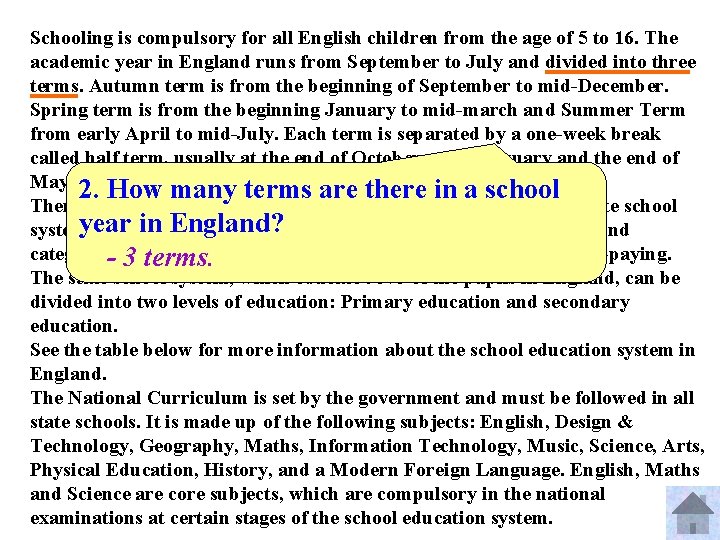
Schooling is compulsory for all English children from the age of 5 to 16. The academic year in England runs from September to July and divided into three terms. Autumn term is from the beginning of September to mid-December. Spring term is from the beginning January to mid-march and Summer Term from early April to mid-July. Each term is separated by a one-week break called half term, usually at the end of October, mid-February and the end of May. 2. How many terms are there in a school There are two parallel school system in England. The first is the state school year system, whichinis England? free for all Students and paid by the state. The second category -is 3 theterms. ‘independent’ or ‘public’ school system, which is fee-paying. The state school system, which educate 93% of the pupils in England, can be divided into two levels of education: Primary education and secondary education. See the table below for more information about the school education system in England. The National Curriculum is set by the government and must be followed in all state schools. It is made up of the following subjects: English, Design & Technology, Geography, Maths, Information Technology, Music, Science, Arts, Physical Education, History, and a Modern Foreign Language. English, Maths and Science are core subjects, which are compulsory in the national examinations at certain stages of the school education system.
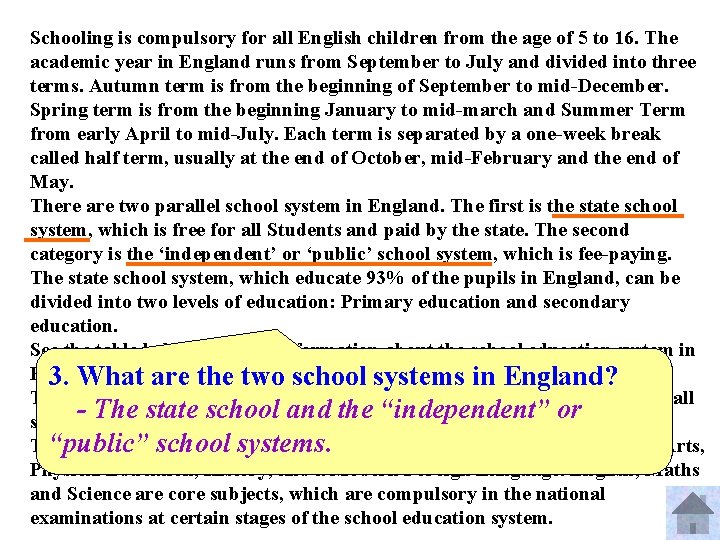
Schooling is compulsory for all English children from the age of 5 to 16. The academic year in England runs from September to July and divided into three terms. Autumn term is from the beginning of September to mid-December. Spring term is from the beginning January to mid-march and Summer Term from early April to mid-July. Each term is separated by a one-week break called half term, usually at the end of October, mid-February and the end of May. There are two parallel school system in England. The first is the state school system, which is free for all Students and paid by the state. The second category is the ‘independent’ or ‘public’ school system, which is fee-paying. The state school system, which educate 93% of the pupils in England, can be divided into two levels of education: Primary education and secondary education. See the table below for more information about the school education system in England. 3. What are the two school systems in England? The National Curriculum is set by the government and must be followed in all - The state school and the “independent” or & state schools. It is made up of the following subjects: English, Design Technology, Maths, Information Technology, Music, Science, Arts, “public”Geography, school systems. Physical Education, History, and a Modern Foreign Language. English, Maths and Science are core subjects, which are compulsory in the national examinations at certain stages of the school education system.
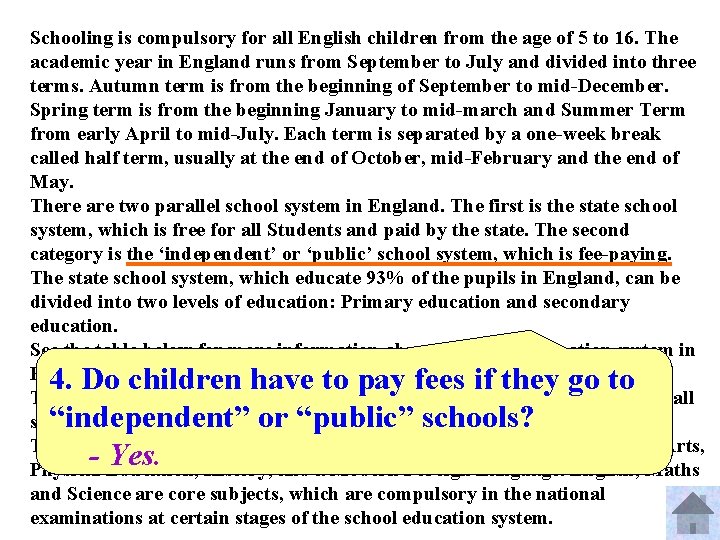
Schooling is compulsory for all English children from the age of 5 to 16. The academic year in England runs from September to July and divided into three terms. Autumn term is from the beginning of September to mid-December. Spring term is from the beginning January to mid-march and Summer Term from early April to mid-July. Each term is separated by a one-week break called half term, usually at the end of October, mid-February and the end of May. There are two parallel school system in England. The first is the state school system, which is free for all Students and paid by the state. The second category is the ‘independent’ or ‘public’ school system, which is fee-paying. The state school system, which educate 93% of the pupils in England, can be divided into two levels of education: Primary education and secondary education. See the table below for more information about the school education system in England. The National Curriculum is set by the government and must be followed in all state schools. It is made up of the following subjects: English, Design & Technology, Geography, Maths, Information Technology, Music, Science, Arts, Physical Education, History, and a Modern Foreign Language. English, Maths and Science are core subjects, which are compulsory in the national examinations at certain stages of the school education system. 4. Do children have to pay fees if they go to “independent” or “public” schools? - Yes.
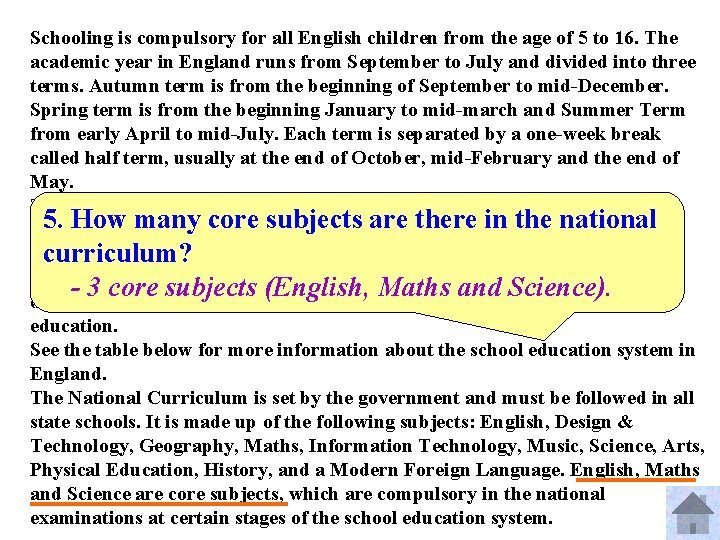
Schooling is compulsory for all English children from the age of 5 to 16. The academic year in England runs from September to July and divided into three terms. Autumn term is from the beginning of September to mid-December. Spring term is from the beginning January to mid-march and Summer Term from early April to mid-July. Each term is separated by a one-week break called half term, usually at the end of October, mid-February and the end of May. There are two parallel school system in England. The first is the state school 5. How many in the system, which is free core for all subjects Students andare paidthere by the state. Thenational second category is the ‘independent’ or ‘public’ school system, which is fee-paying. curriculum? The state school system, which educate 93% of the pupils in England, can be - 3 core subjects (English, Maths and Science). divided into two levels of education: Primary education and secondary education. See the table below for more information about the school education system in England. The National Curriculum is set by the government and must be followed in all state schools. It is made up of the following subjects: English, Design & Technology, Geography, Maths, Information Technology, Music, Science, Arts, Physical Education, History, and a Modern Foreign Language. English, Maths and Science are core subjects, which are compulsory in the national examinations at certain stages of the school education system.
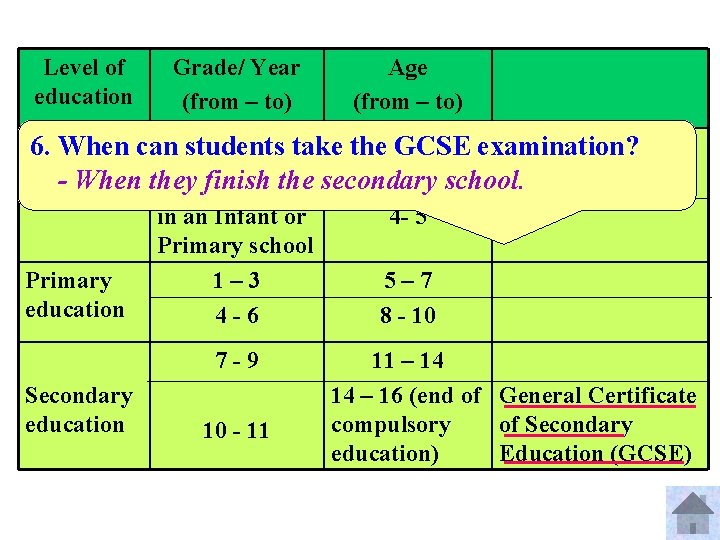
Level of education Grade/ Year (from – to) Age (from – to) childcare – 4 6. When can students take the 3 GCSE examination? - When they finish the secondary school. Pre-school environment Primary education in an Infant or Primary school 1– 3 4 -6 7 -9 Secondary education 10 - 11 4 - 5 5– 7 8 - 10 11 – 14 14 – 16 (end of General Certificate compulsory of Secondary education) Education (GCSE)
III. Post reading * Summarize the text using following chart.
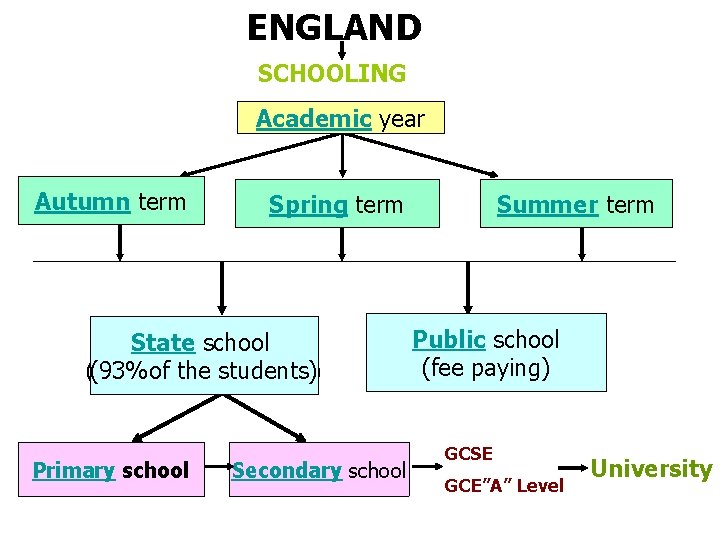
ENGLAND SCHOOLING Academic ---(1)--- year Autumn ---(2)--- term ---(3)--Spring term ---(5)--State school (93%of of the students) Primary school ---(7)--- Secondary school ---(8)--- school Summer ---(4)--- term ---(6)--Public school (fee paying) GCSE GCE”A” Level University
Homework - Learnt by heart the new words - Do these tasks above at home - Prepare for the next lesson