
What it Takes Scaling up the Implementation of



- Slides: 44
What it Takes: Scaling up the Implementation of Recommended Practices for Improving Child Outcomes Lise Fox, University of South Florida Barbara J. Smith, University of Colorado – Denver Lisa Backer, Minnesota Department of Education Michelle Dockter, Minnesota Department of Education
Intensive TA • Build the capacity of programs and practitioners to use DEC Recommended Practices to promote child engagement in learning opportunities • Build the capacity of the professional development system to provide ongoing training and support to programs to implement DEC Recommended Practices with fidelity.
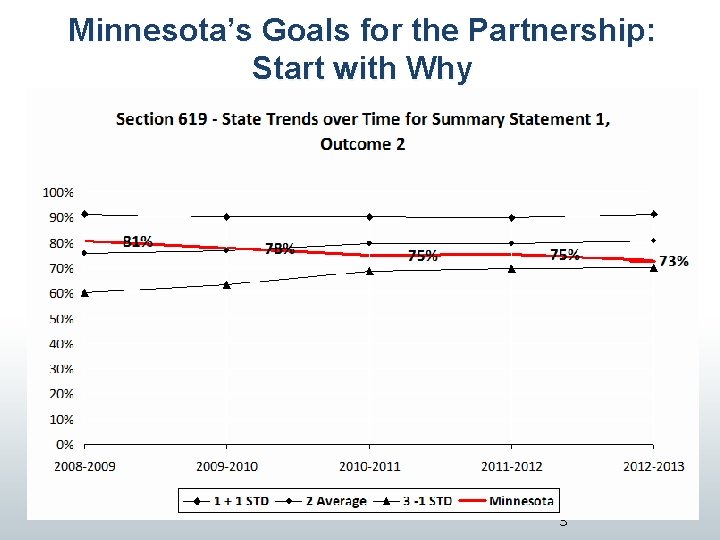
Minnesota’s Goals for the Partnership: Start with Why 3
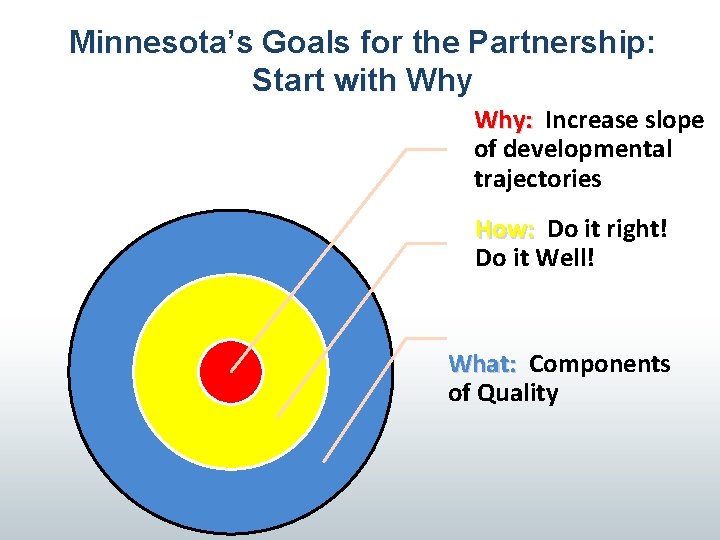
Minnesota’s Goals for the Partnership: Start with Why: Increase slope of developmental trajectories How: Do it right! Do it Well! What: Components of Quality
Systems Model for Early Childhood Professional Development • Incorporates best practice from: • Systems Thinking • Implementation Science • Cross-Agency Collaborative Planning
6 Implementation Process Interactive Guide http: //ectacenter. org/implementprocess/interactive/
RP²: Reaching Potentials through Recommended Practices Quality Program • Program uses implementation science to ensure the implementation of effective teaching practices Effective Practices • Using Recommended Practices to Promote Child Engagement Child Outcomes
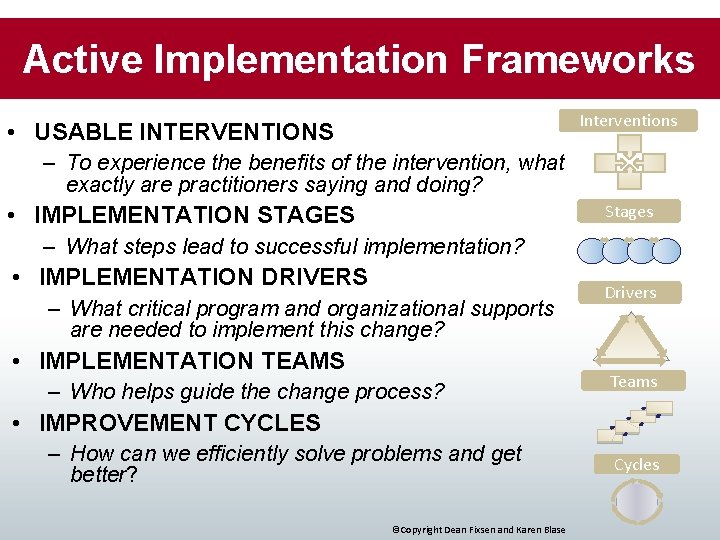
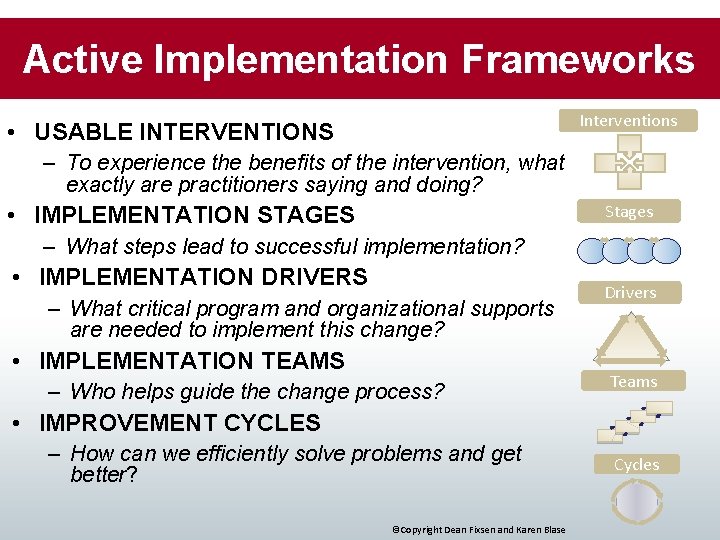
Making It Happen Active Implementation Frameworks Interventions • USABLE INTERVENTIONS – To experience the benefits of the intervention, what exactly are practitioners saying and doing? Stages • IMPLEMENTATION STAGES – What steps lead to successful implementation? • IMPLEMENTATION DRIVERS – What critical program and organizational supports are needed to implement this change? • IMPLEMENTATION TEAMS – Who helps guide the change process? Drivers Teams • IMPROVEMENT CYCLES – How can we efficiently solve problems and get better? ©Copyright Dean Fixsen and Karen Blase Cycles
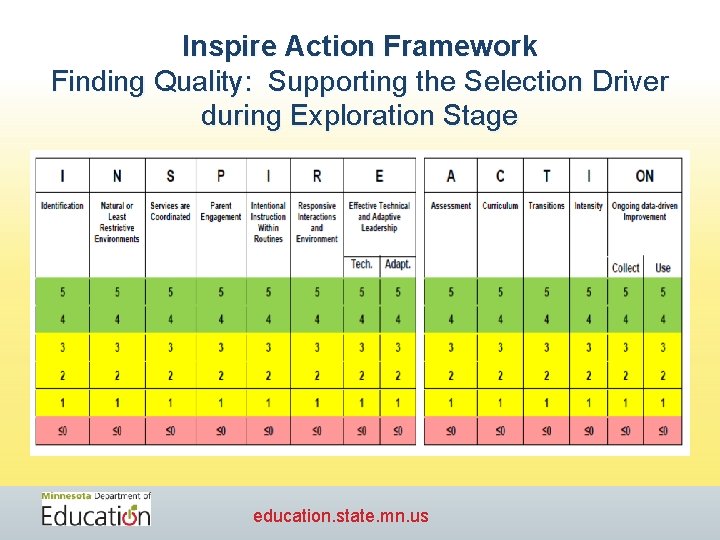
Inspire Action Framework Finding Quality: Supporting the Selection Driver during Exploration Stage education. state. mn. us
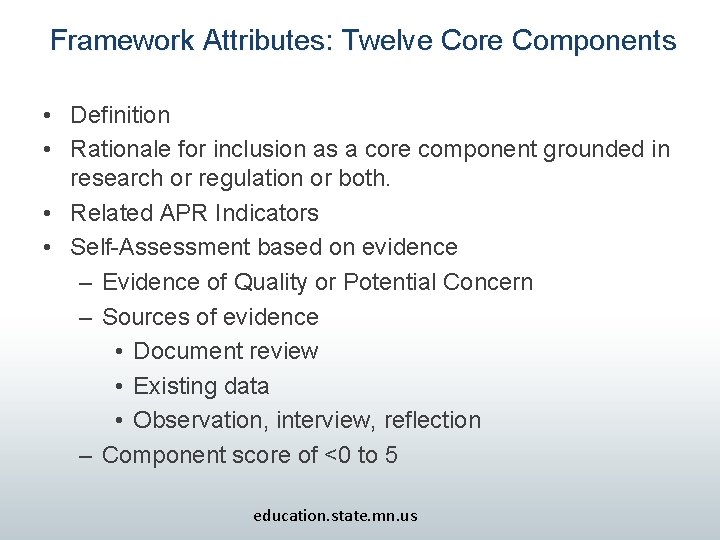
Framework Attributes: Twelve Core Components • Definition • Rationale for inclusion as a core component grounded in research or regulation or both. • Related APR Indicators • Self-Assessment based on evidence – Evidence of Quality or Potential Concern – Sources of evidence • Document review • Existing data • Observation, interview, reflection – Component score of <0 to 5 education. state. mn. us
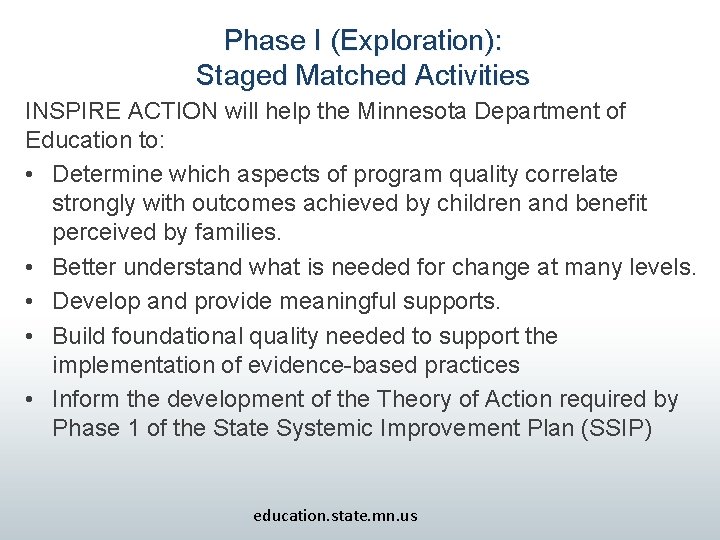
Phase I (Exploration): Staged Matched Activities INSPIRE ACTION will help the Minnesota Department of Education to: • Determine which aspects of program quality correlate strongly with outcomes achieved by children and benefit perceived by families. • Better understand what is needed for change at many levels. • Develop and provide meaningful supports. • Build foundational quality needed to support the implementation of evidence-based practices • Inform the development of the Theory of Action required by Phase 1 of the State Systemic Improvement Plan (SSIP) education. state. mn. us
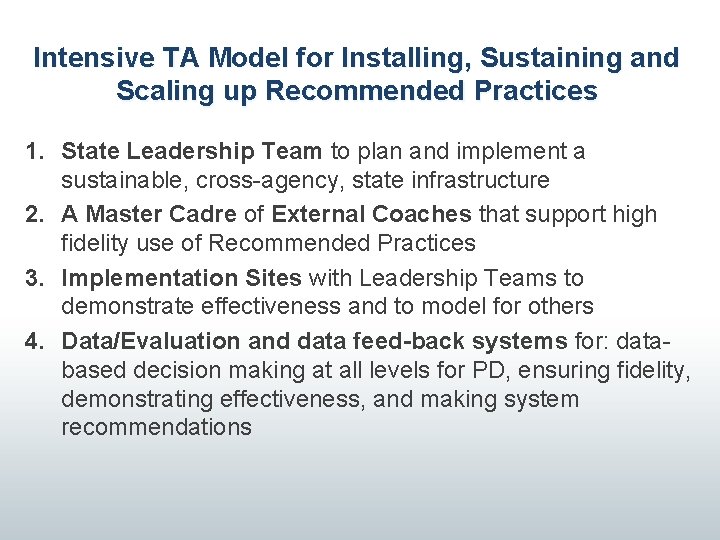
Intensive TA Model for Installing, Sustaining and Scaling up Recommended Practices 1. State Leadership Team to plan and implement a sustainable, cross-agency, state infrastructure 2. A Master Cadre of External Coaches that support high fidelity use of Recommended Practices 3. Implementation Sites with Leadership Teams to demonstrate effectiveness and to model for others 4. Data/Evaluation and data feed-back systems for: databased decision making at all levels for PD, ensuring fidelity, demonstrating effectiveness, and making system recommendations
http: //ectacenter. org/implement_ebp. asp
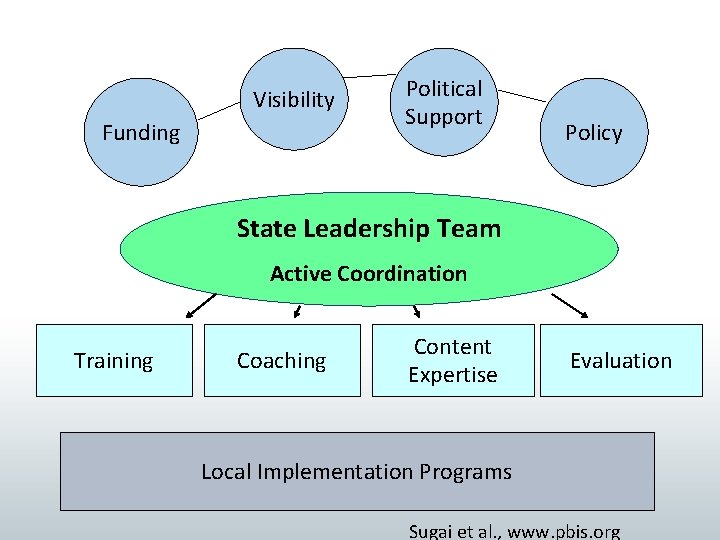
Visibility Funding Political Support Policy State Leadership Team Active Coordination Training Coaching Content Expertise Evaluation Local Implementation Programs Sugai et al. , www. pbis. org
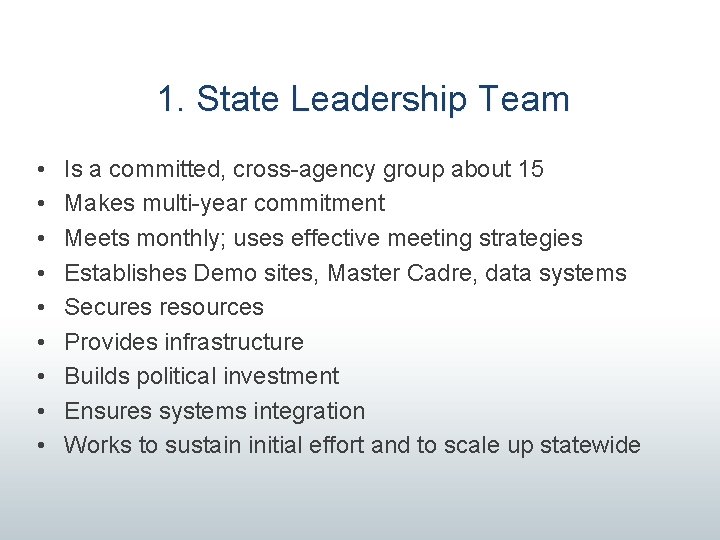
1. State Leadership Team • • • Is a committed, cross-agency group about 15 Makes multi-year commitment Meets monthly; uses effective meeting strategies Establishes Demo sites, Master Cadre, data systems Secures resources Provides infrastructure Builds political investment Ensures systems integration Works to sustain initial effort and to scale up statewide
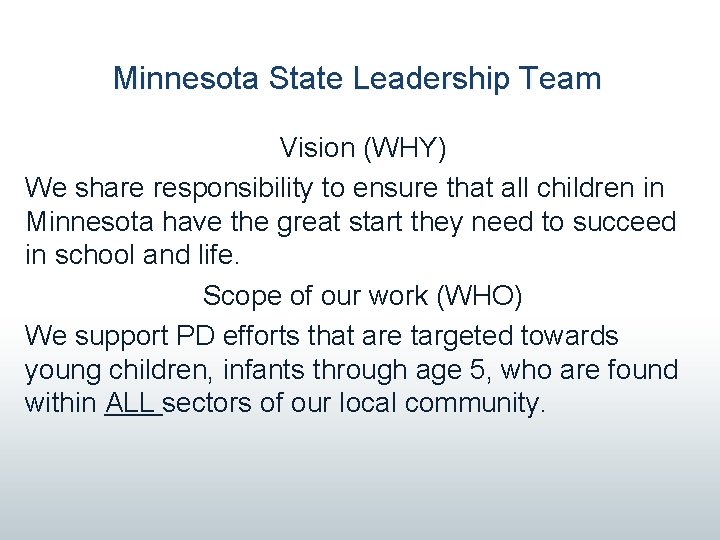
Minnesota State Leadership Team Vision (WHY) We share responsibility to ensure that all children in Minnesota have the great start they need to succeed in school and life. Scope of our work (WHO) We support PD efforts that are targeted towards young children, infants through age 5, who are found within ALL sectors of our local community.
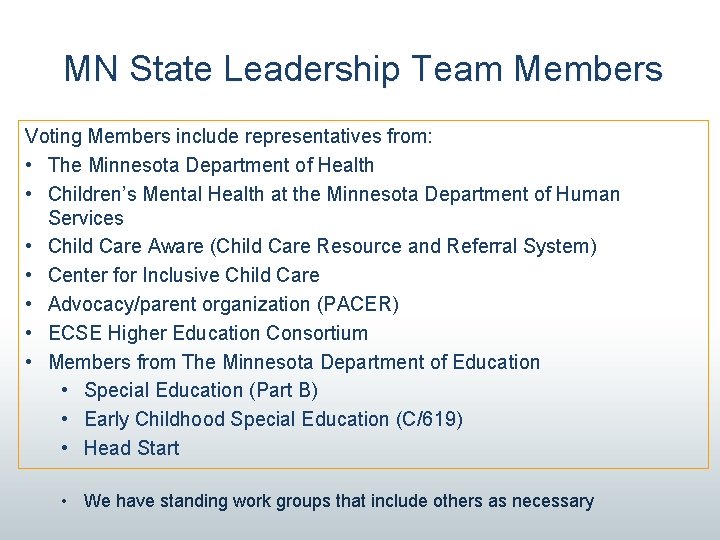
MN State Leadership Team Members Voting Members include representatives from: • The Minnesota Department of Health • Children’s Mental Health at the Minnesota Department of Human Services • Child Care Aware (Child Care Resource and Referral System) • Center for Inclusive Child Care • Advocacy/parent organization (PACER) • ECSE Higher Education Consortium • Members from The Minnesota Department of Education • Special Education (Part B) • Early Childhood Special Education (C/619) • Head Start • We have standing work groups that include others as necessary
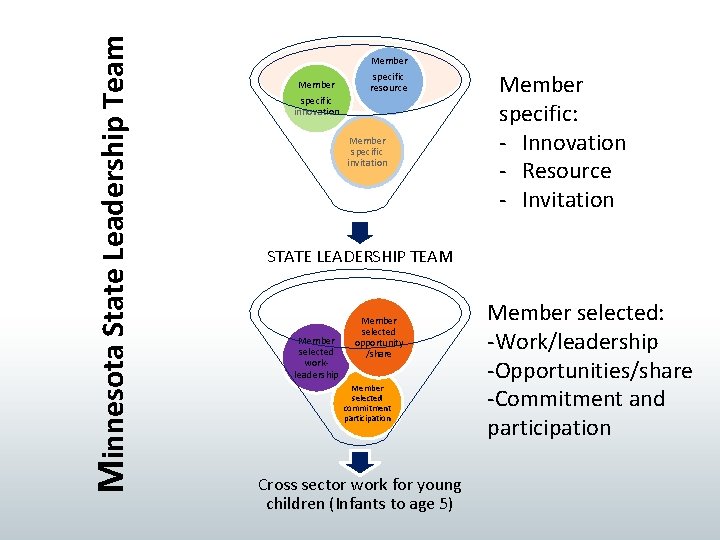
Minnesota State Leadership Team Member specific innovation Member specific resource Member specific invitation Member specific: - Innovation - Resource - Invitation STATE LEADERSHIP TEAM Member selected work- leadership Member selected opportunity /share Member selected commitment participation Cross sector work for young children (Infants to age 5) Member selected: -Work/leadership -Opportunities/share -Commitment and participation
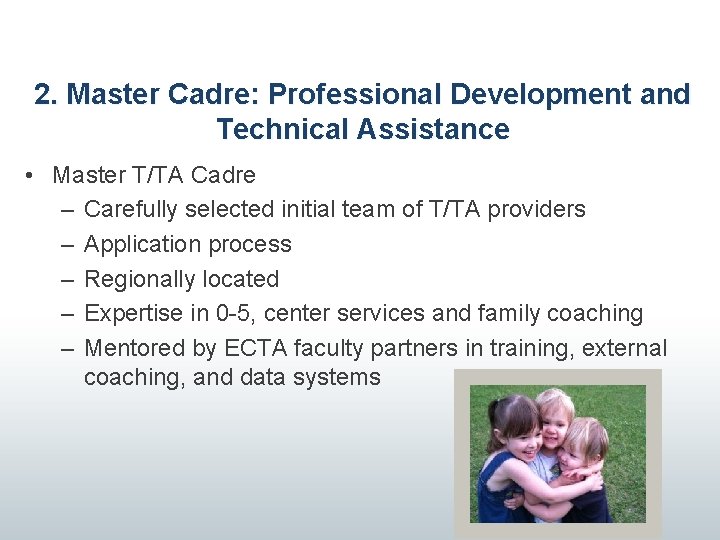
2. Master Cadre: Professional Development and Technical Assistance • Master T/TA Cadre – Carefully selected initial team of T/TA providers – Application process – Regionally located – Expertise in 0 -5, center services and family coaching – Mentored by ECTA faculty partners in training, external coaching, and data systems
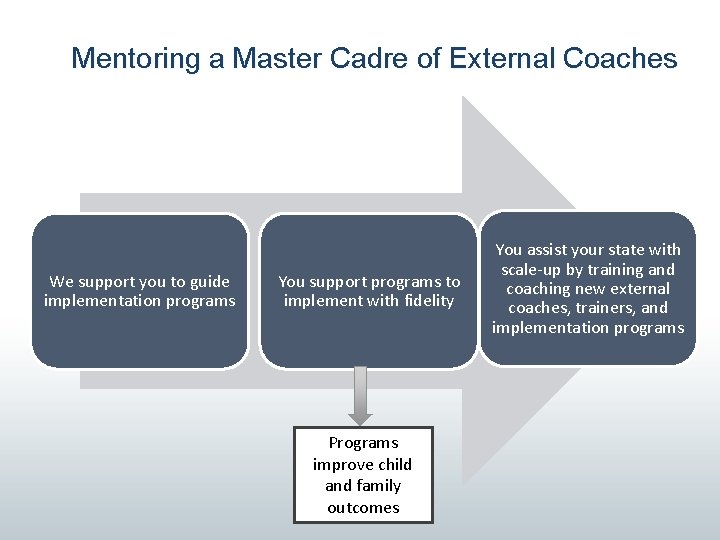
Mentoring a Master Cadre of External Coaches We support you to guide implementation programs You support programs to implement with fidelity Programs improve child and family outcomes You assist your state with scale-up by training and coaching new external coaches, trainers, and implementation programs
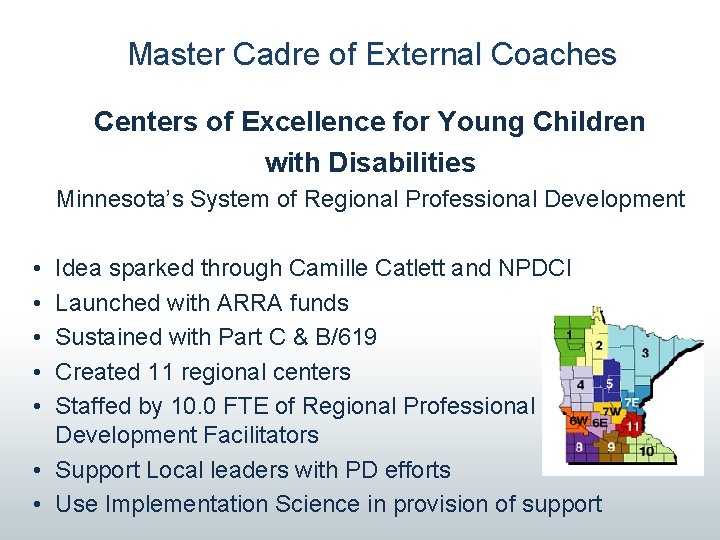
Master Cadre of External Coaches Centers of Excellence for Young Children with Disabilities Minnesota’s System of Regional Professional Development • • • Idea sparked through Camille Catlett and NPDCI Launched with ARRA funds Sustained with Part C & B/619 Created 11 regional centers Staffed by 10. 0 FTE of Regional Professional Development Facilitators • Support Local leaders with PD efforts • Use Implementation Science in provision of support
RP 2: Reaching Potentials through Recommended Practices • Professional Development Facilitator within region assigned to a local program who has committed to this work. • Will act as an External Coach • Meet with local Leadership team • Support the local internal coach • Provide additional training and content support to local professionals (using implementation science) • Help Local leadership team collect, disaggregate and act up data for quality program implementation.
3. Program-Wide Demonstrations of High Fidelity Implementation 1. High fidelity demonstrations that exemplify the value of the implementation of the Recommended Practices (RPs) 2. Demonstration programs help build the political will needed to scale-up and sustain the RPs 3. Demonstration programs provide a model for other programs and professionals, “seeing is believing” 4. Demonstration programs “ground” the work of the State Team in the realities and experiences of programs and professionals
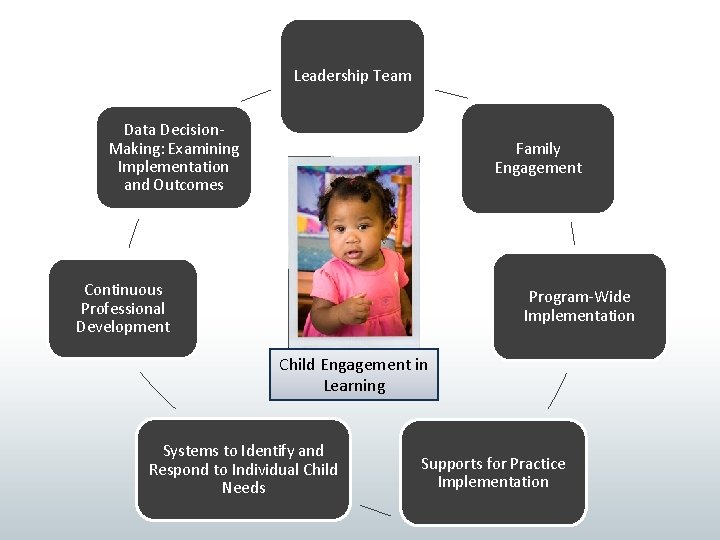
Leadership Team Data Decision. Making: Examining Implementation and Outcomes Family Engagement Continuous Professional Development Program-Wide Implementation Child Engagement in Learning Systems to Identify and Respond to Individual Child Needs Supports for Practice Implementation
Program-Wide Supports 1. 2. 3. 4. 5. 6. 7. 8. 9. Establish leadership team Recruit and promote staff buy-in Ensure family engagement Develop program-wide action plan Implement strategies for promoting program-wide implementation Support Recommended Practice implementation Identify and respond to individual children’s support needs Offer continuous professional development and staff support Monitor implementation and outcomes
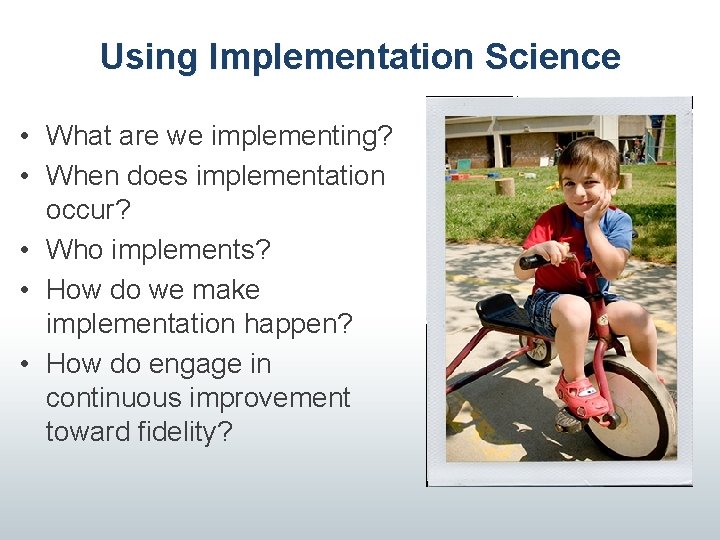
Using Implementation Science • What are we implementing? • When does implementation occur? • Who implements? • How do we make implementation happen? • How do engage in continuous improvement toward fidelity?
Why Program-Wide? Classroom by Classroom Program-Wide – All Classrooms Focus on individual teacher and establishing practices Across classroom focus in addition to within Coaching support for implementation fidelity; Reliance on expert coaching Coaching support as a part of program-wide systemic professional development; Multiple modes of coaching delivery Fidelity data to drive coaching effort Fidelity data for making decisions about individual teaching intervention and programmatic professional development Children receive individualized supports when problems are identified and children “fail” to be engaged Procedures across classrooms ensure efficient and effective individualized supports Teachers make connections and establish partnerships with families Programmatic effort to ensure all parents are connected to the program
Recommended Practices • Developed to help practitioners and families improve learning and developmental outcomes for children birth thru age 5 • Bridging the gap between research and practice • To support children’s participation and access to inclusive settings in their natural environments • Include key leadership responsibilities to implement practices • Based on empirical evidence, values, and experience • 8 key topic areas
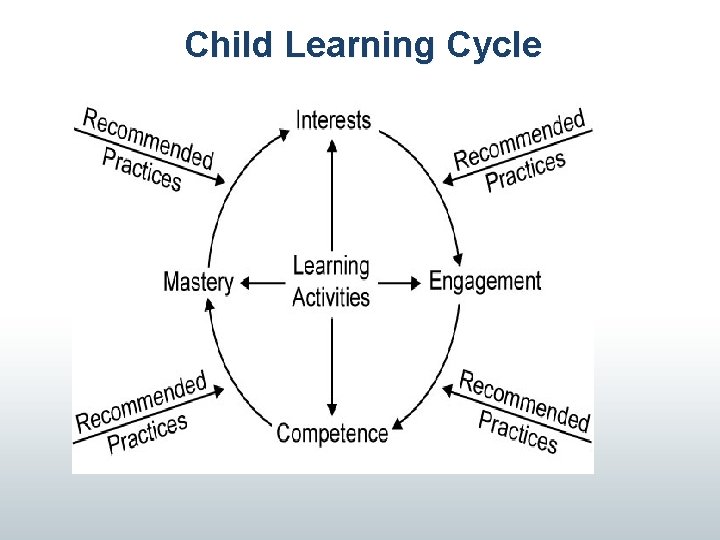
Child Learning Cycle
RP Topic Areas 1. Leadership 2. Assessment 3. Environment 4. Family 5. Instruction 6. Interaction 7. Teaming and Collaboration 8. Transition
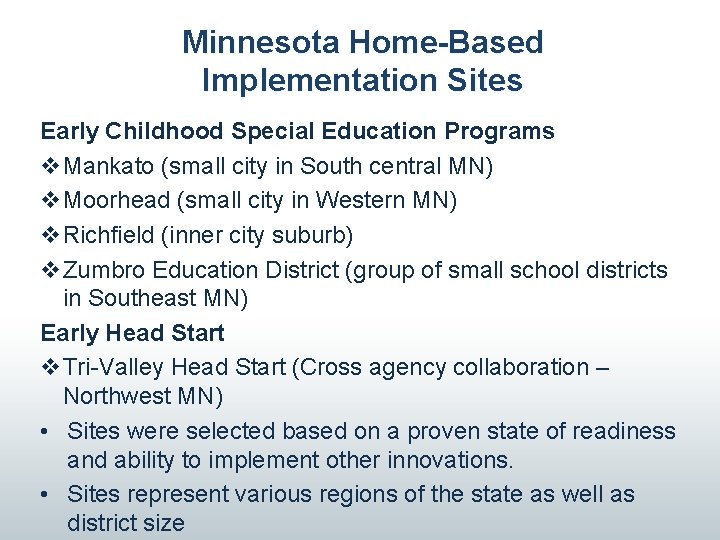
Minnesota Home-Based Implementation Sites Early Childhood Special Education Programs v. Mankato (small city in South central MN) v. Moorhead (small city in Western MN) v. Richfield (inner city suburb) v. Zumbro Education District (group of small school districts in Southeast MN) Early Head Start v. Tri-Valley Head Start (Cross agency collaboration – Northwest MN) • Sites were selected based on a proven state of readiness and ability to implement other innovations. • Sites represent various regions of the state as well as district size
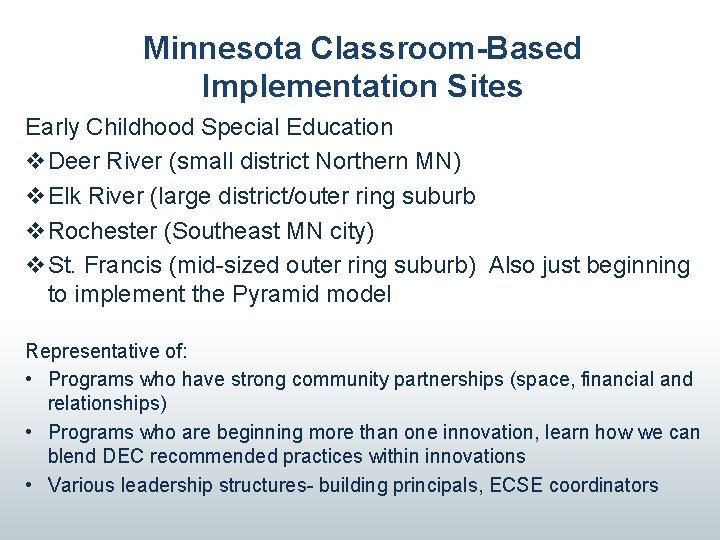
Minnesota Classroom-Based Implementation Sites Early Childhood Special Education v. Deer River (small district Northern MN) v. Elk River (large district/outer ring suburb v. Rochester (Southeast MN city) v. St. Francis (mid-sized outer ring suburb) Also just beginning to implement the Pyramid model Representative of: • Programs who have strong community partnerships (space, financial and relationships) • Programs who are beginning more than one innovation, learn how we can blend DEC recommended practices within innovations • Various leadership structures- building principals, ECSE coordinators
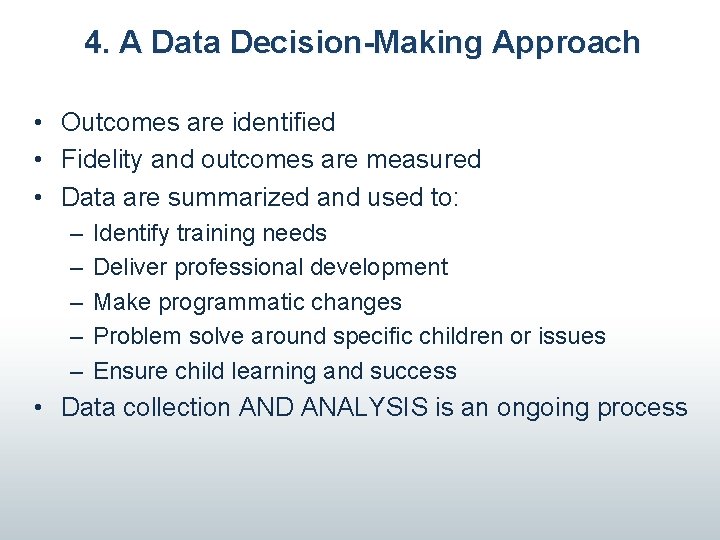
4. A Data Decision-Making Approach • Outcomes are identified • Fidelity and outcomes are measured • Data are summarized and used to: – – – Identify training needs Deliver professional development Make programmatic changes Problem solve around specific children or issues Ensure child learning and success • Data collection AND ANALYSIS is an ongoing process
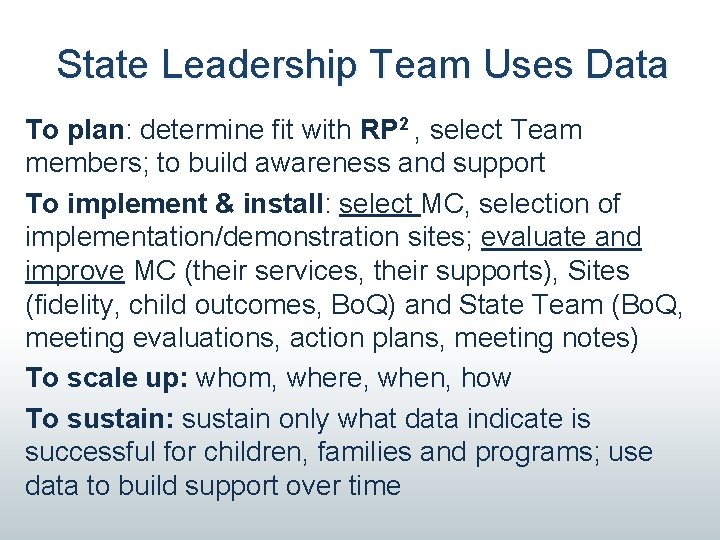
State Leadership Team Uses Data To plan: determine fit with RP 2 , select Team members; to build awareness and support To implement & install: select MC, selection of implementation/demonstration sites; evaluate and improve MC (their services, their supports), Sites (fidelity, child outcomes, Bo. Q) and State Team (Bo. Q, meeting evaluations, action plans, meeting notes) To scale up: whom, where, when, how To sustain: sustain only what data indicate is successful for children, families and programs; use data to build support over time
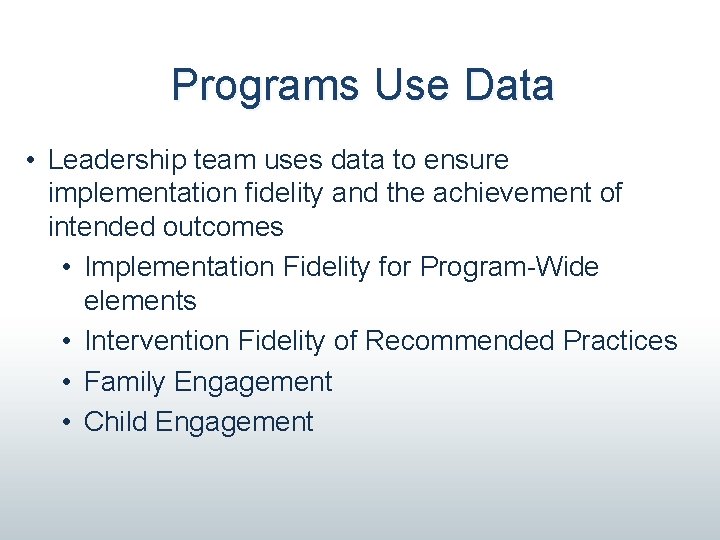
Programs Use Data • Leadership team uses data to ensure implementation fidelity and the achievement of intended outcomes • Implementation Fidelity for Program-Wide elements • Intervention Fidelity of Recommended Practices • Family Engagement • Child Engagement
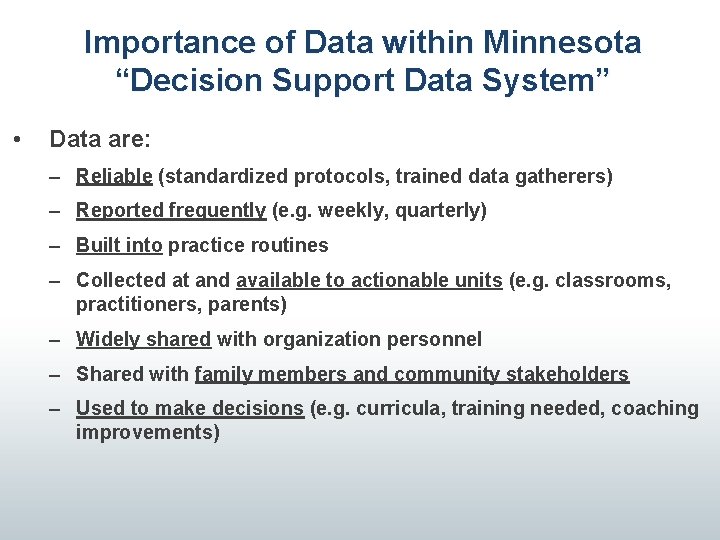
Importance of Data within Minnesota “Decision Support Data System” • Data are: – Reliable (standardized protocols, trained data gatherers) – Reported frequently (e. g. weekly, quarterly) – Built into practice routines – Collected at and available to actionable units (e. g. classrooms, practitioners, parents) – Widely shared with organization personnel – Shared with family members and community stakeholders – Used to make decisions (e. g. curricula, training needed, coaching improvements)
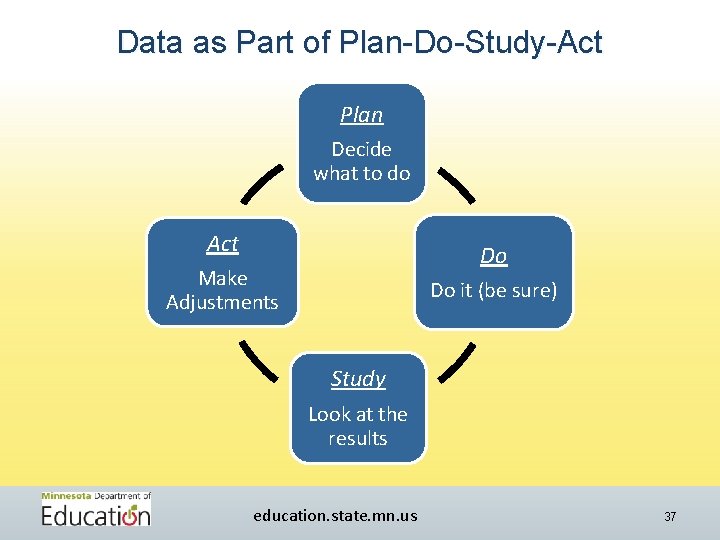
Data as Part of Plan-Do-Study-Act Plan Decide what to do Act Do Make Adjustments Do it (be sure) Study Look at the results education. state. mn. us 37
Reciprocity of Accountability must be a reciprocal process. – For every increment of performance I demand from you, I have an equal responsibility to provide you with the capacity to meet that expectation. Richard Elmore, 2000 Professor of Educational Leadership, Harvard University education. state. mn. us
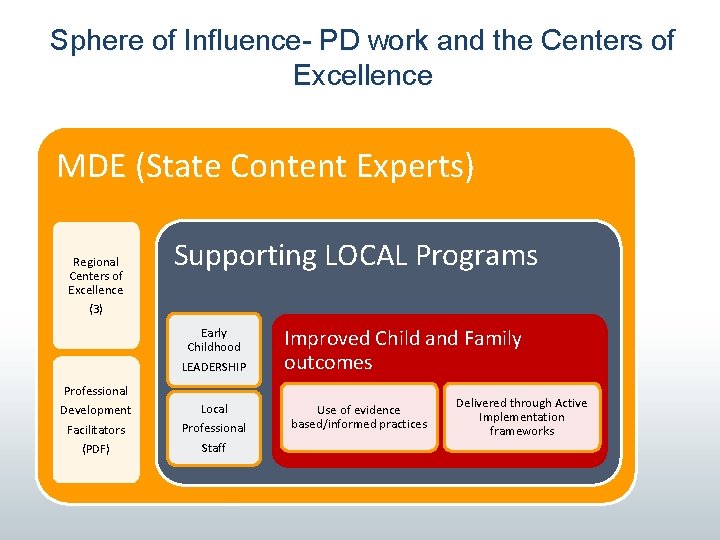
Sphere of Influence- PD work and the Centers of Excellence MDE (State Content Experts) Regional Centers of Excellence (3) Supporting LOCAL Programs Early Childhood LEADERSHIP Professional Development Facilitators (PDF) Local Professional Staff Improved Child and Family outcomes Use of evidence based/informed practices Delivered through Active Implementation frameworks
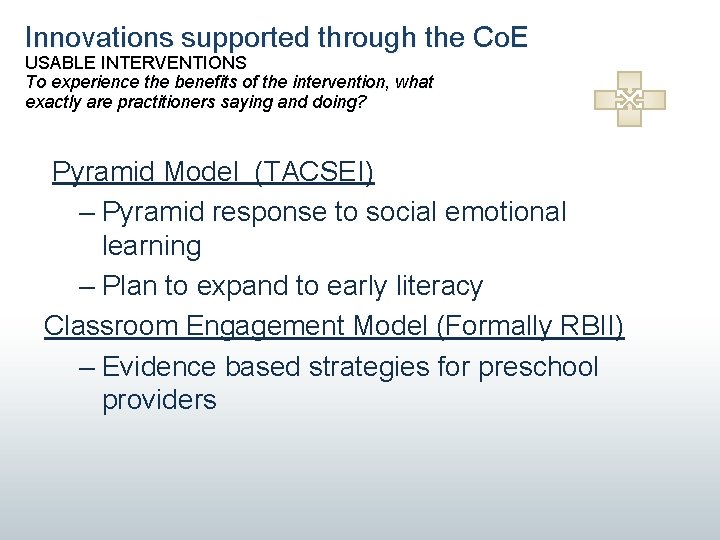
Innovations supported through the Co. E USABLE INTERVENTIONS To experience the benefits of the intervention, what exactly are practitioners saying and doing? Pyramid Model (TACSEI) – Pyramid response to social emotional learning – Plan to expand to early literacy Classroom Engagement Model (Formally RBII) – Evidence based strategies for preschool providers
Innovations Supported Through the Co. E Family Guided Routines Based Interventions – Evidence informed strategies for birth to 3 providers Locally Defined Innovation – Local leadership will be supported with Active Implementation frameworks
What is Next? • All ECSE programs will complete their own INSPIRE ACTION self assessment. • SOME ECSE programs will choose to begin to work on a selected: – Foundational skill – Innovation – District selected innovation Co. E staff will work with Local programs to determine appropriate Stage matched activities. Stages
Local ECSE Leadership will Lead the Way! This fall we will focus on helping local programs create teams – To create pathways for their work Teams – Collect data – Use of data and make/inform appropriate plans PDF will assume a role of external coach – help local programs use the drivers to ensure that professionals are equipped to implement selected work Drivers
Making It Happen Active Implementation Frameworks Interventions • USABLE INTERVENTIONS – To experience the benefits of the intervention, what exactly are practitioners saying and doing? Stages • IMPLEMENTATION STAGES – What steps lead to successful implementation? • IMPLEMENTATION DRIVERS – What critical program and organizational supports are needed to implement this change? • IMPLEMENTATION TEAMS – Who helps guide the change process? Drivers Teams • IMPROVEMENT CYCLES – How can we efficiently solve problems and get better? ©Copyright Dean Fixsen and Karen Blase Cycles