
What is your definition of waste WASTE Waste
- Slides: 48
What is your definition of waste? WASTE
Waste • Any discarded material for which no further sale or use is intended • examples: residue, chemical by-products, unused virgin material, spill absorbent material
WASTING RESOURCES • Solid waste: any unwanted or discarded material we produce that is not a liquid or gas. – Municipal solid waste (MSW): produce directly from homes. – Industrial solid waste: produced indirectly by industries that supply people with goods and services.
Solid Waste • Any garbage; refuse; sludge from a waste treatment plant or air pollution control facility; and other discarded material (including solid, liquid, semi-solid or contained gaseous material) generated from any industrial, commercial or community activities; mining or agricultural operations
Solid Waste Exclusions • Solid or dissolved materials in domestic sewage or irrigation return flows • Industrial discharges subject to CWA regulations, including POTW • Source, special nuclear or by-product material defined by the Atomic Energy Act of 1954
Ways to reduce waste that enters waste stream • Waste stream = flow of waste as it moves from its sources toward disposal destinations – More efficient use of materials, consume less, buy goods with less packaging, reusing goods • Recovery (recycling, composting) = next best strategy in waste management – Recycling = sends used goods to manufacture new goods – Composting = recovery of organic waste – All materials in nature are recycled
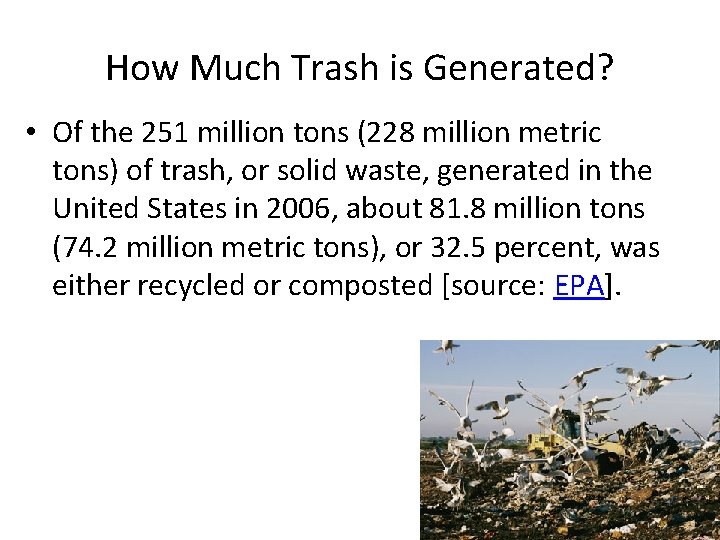
How Much Trash is Generated? • Of the 251 million tons (228 million metric tons) of trash, or solid waste, generated in the United States in 2006, about 81. 8 million tons (74. 2 million metric tons), or 32. 5 percent, was either recycled or composted [source: EPA].
Materials Discarded in a Municipal Landfill • • Paper and paperboard 41. 0% Yard waste 17. 9% Glass 8. 2% Metal 8. 7% Rubber, leather, textiles 8. 1% Food waste 7. 9% Plastic 6. 5% Miscellaneous inorganic 1. 6%
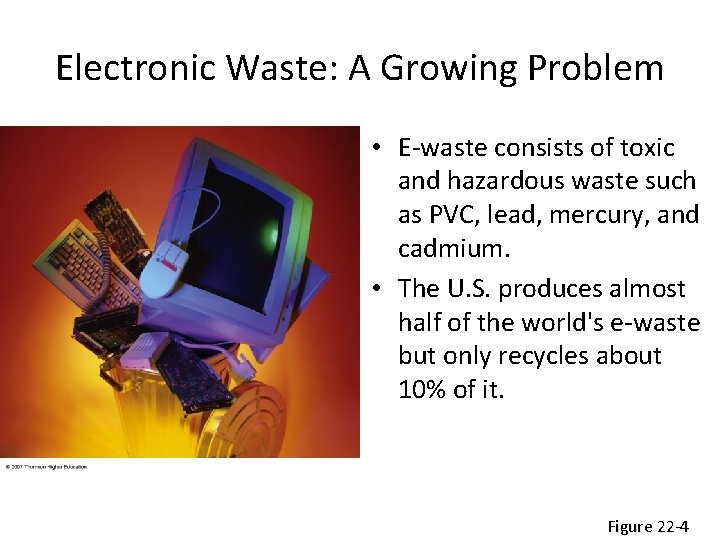
Electronic Waste: A Growing Problem • E-waste consists of toxic and hazardous waste such as PVC, lead, mercury, and cadmium. • The U. S. produces almost half of the world's e-waste but only recycles about 10% of it. Figure 22 -4
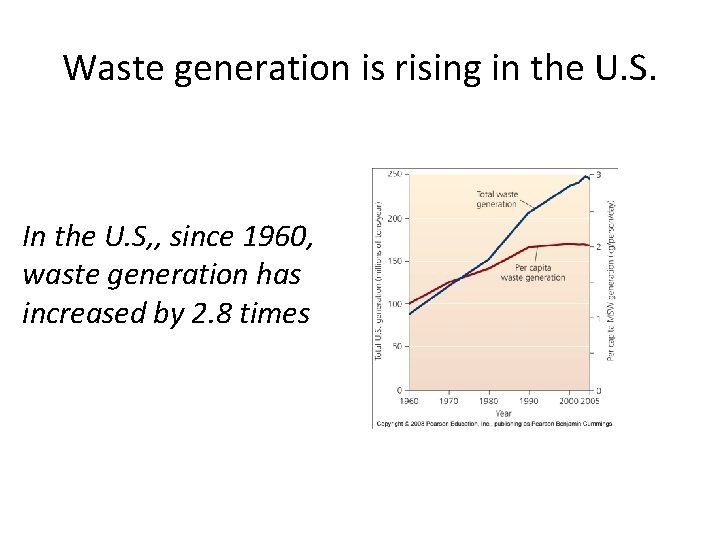
Waste generation is rising in the U. S. In the U. S, , since 1960, waste generation has increased by 2. 8 times
WASTE DISPOSAL
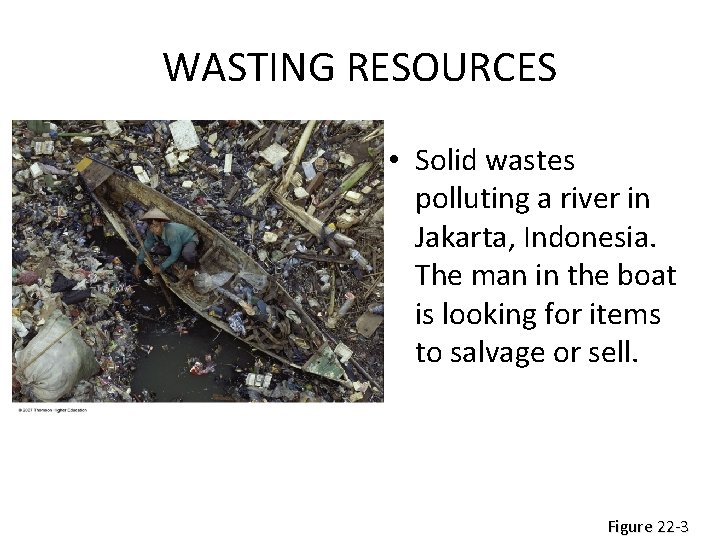
WASTING RESOURCES • Solid wastes polluting a river in Jakarta, Indonesia. The man in the boat is looking for items to salvage or sell. Figure 22 -3
Trash For Sale • The US sells it’s trash to China for recycling. – The turn in the economy has devalued the recycling industry
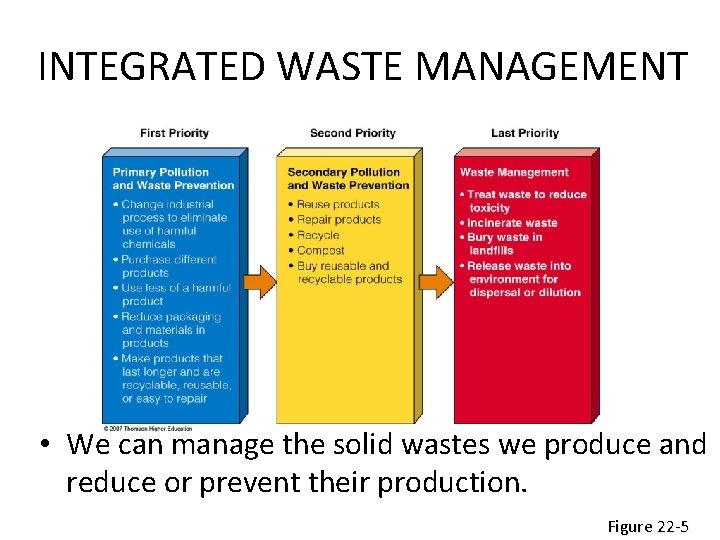
INTEGRATED WASTE MANAGEMENT • We can manage the solid wastes we produce and reduce or prevent their production. Figure 22 -5
WASTING RESOURCES • The United States produces about a third of the world’s solid waste and buries more than half of it in landfills. – About 98. 5% is industrial solid waste. – The remaining 1. 5% is MSW. • About 55% of U. S. MSW is dumped into landfills, 30% is recycled or composted, and 15% is burned in incinerators.
Burying Solid Waste • Most of the world’s MSW is buried in landfills that eventually are expected to leak toxic liquids into the soil and underlying aquifers. – Open dumps: are fields or holes in the ground where garbage is deposited and sometimes covered with soil. Mostly used in developing countries. – Sanitary landfills: solid wastes are spread out in thin layers, compacted and covered daily with a fresh layer of clay or plastic foam.
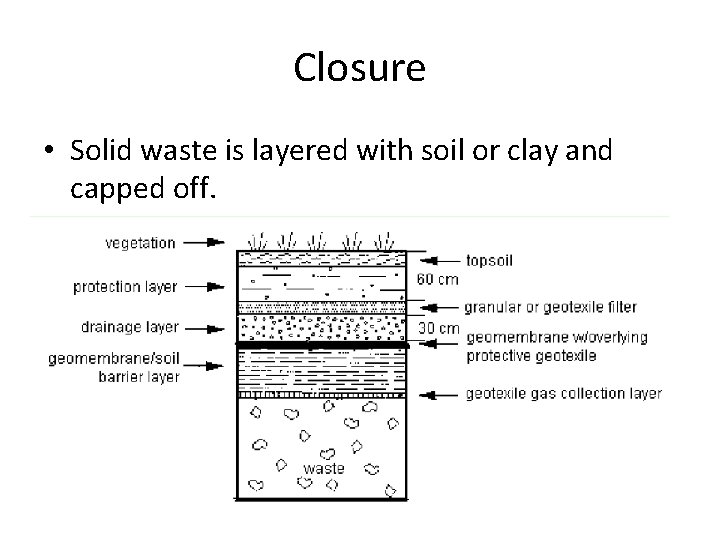
Sanitary landfills are regulated • Sanitary landfills = waste buried in the ground or piled in large, engineered mounds – Must meet national standards set by the EPA under the Resource Conservation and Recovery Act (RCRA) of 1976 – Waste is partially decomposed by bacteria and compresses under its own weight to make more space – Layered with soil to reduce odor, speed decomposition, reduce infestation by pets – When a landfill is closed, it must be capped and maintained
40 CFR Parts 239 -259 • The purpose of this part is to establish minimum national criteria under the Resource Conservation and Recovery Act (RCRA or the Act), as amended, for all municipal solid waste landfill (MSWLF) units and under the Clean Water Act, as amended, for municipal solid waste landfills that are used to dispose of sewage sludge. These minimum national criteria ensure the protection of human health and the environment.
Regulatory Guidelines • Subtitle D, of RCRA regulates non-hazardous waste – Siting – Design – Operation – Monitoring – Closure and post-closure – Financial assurance
Why do we have landfills? • • Protect groundwater Protect surface water Protect air quality Control pathogenic migration
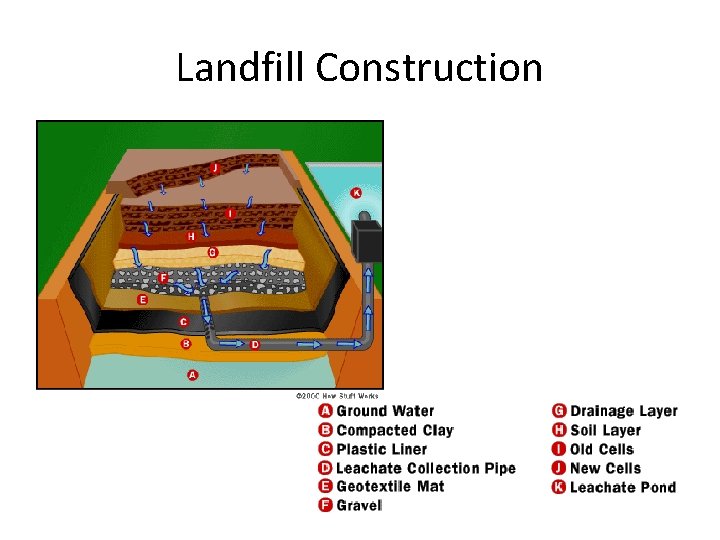
Landfill Design • The main waste contaminant features are – Underlying soils – Depth to groundwater – Landfill liner (triple liner) – Leachate collection system – Leachate prevention through infiltration and drainage control – Cover soil and final landfill cap
The Size of the Landfill • Limit of Refuse filing (LRF) determines the volume of waste that can be properly stored at the site – Determined by site characterization, proximity to surface and groundwater
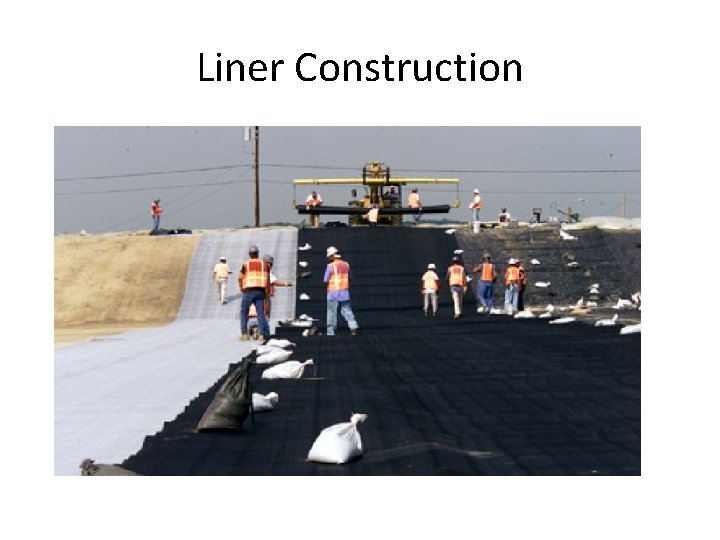
The Liner • A liner acts like a giant garbage bag – Clay liner – Synthetic liner – Additional liner
Liner Construction
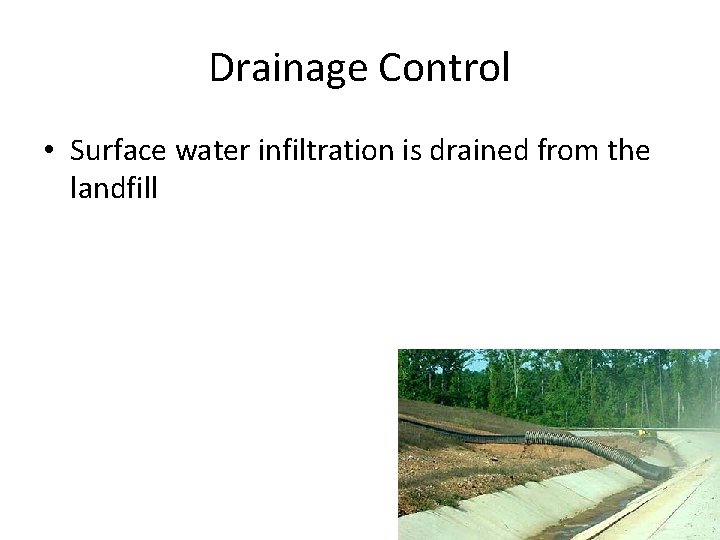
Drainage Control • Surface water infiltration is drained from the landfill
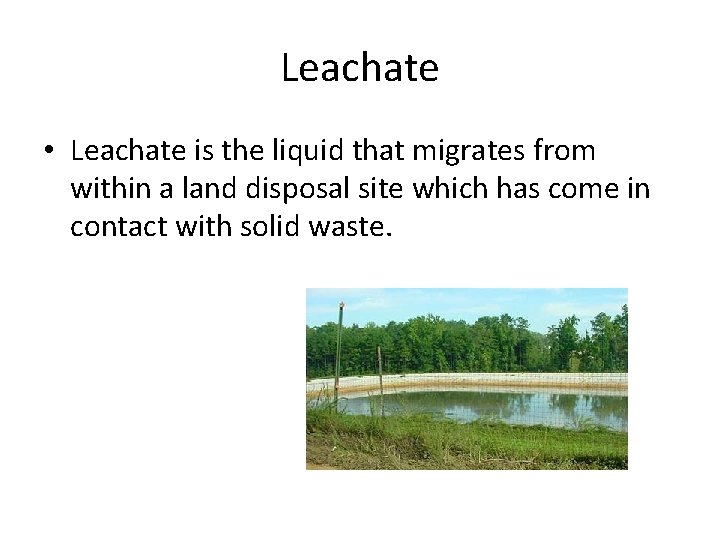
Leachate • Leachate is the liquid that migrates from within a land disposal site which has come in contact with solid waste.
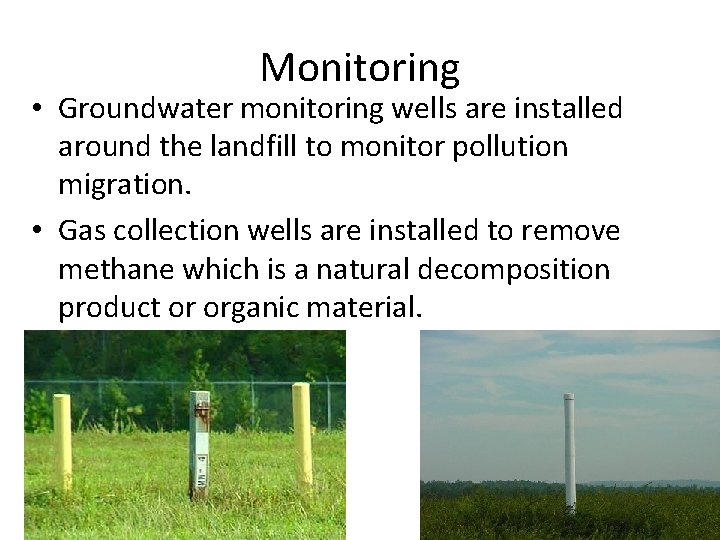
Monitoring • Groundwater monitoring wells are installed around the landfill to monitor pollution migration. • Gas collection wells are installed to remove methane which is a natural decomposition product or organic material.
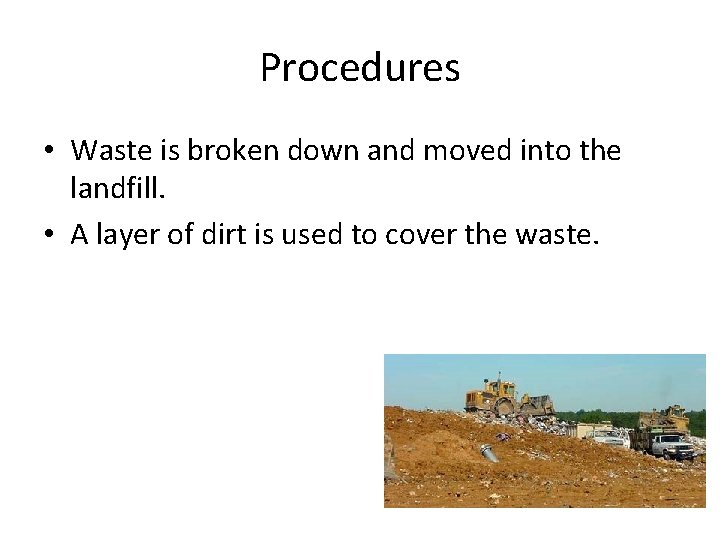
Procedures • Waste is broken down and moved into the landfill. • A layer of dirt is used to cover the waste.
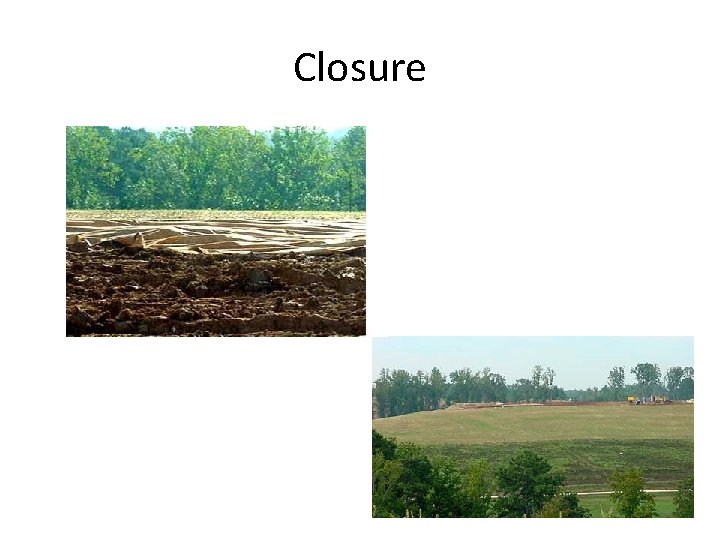
Closure • Solid waste is layered with soil or clay and capped off.
Closure
Landfill Construction
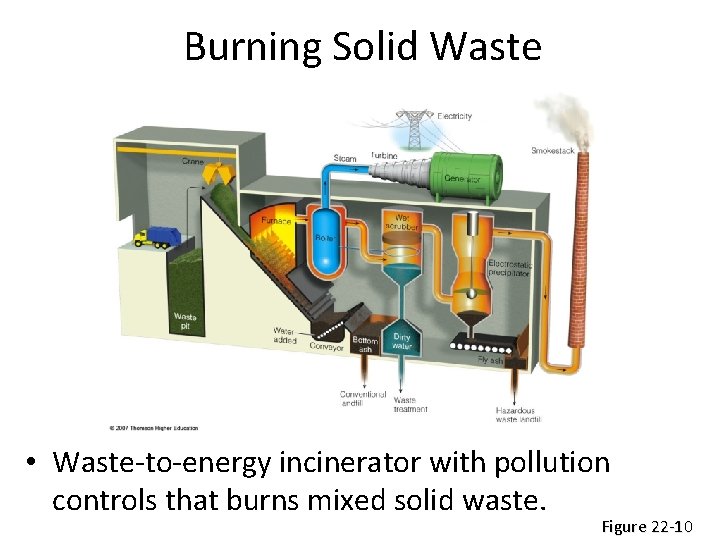
BURNING AND BURYING SOLID WASTE • Globally, MSW is burned in over 1, 000 large waste-to-energy incinerators, which boil water to make steam for heating water, or space, or for production of electricity. – Japan and a few European countries incinerate most of their MSW.
Burning Solid Waste • Waste-to-energy incinerator with pollution controls that burns mixed solid waste. Figure 22 -10
Landfills can produce gas for energy • Bacteria can decompose waste in an oxygendeficient environment • Landfill gas = a mix of gases that consists of roughly half methane – Can be collected, processed, and used like natural gas – When not used commercially, landfill gas is burned off in flares to reduce odors and greenhouse emissions
THE “R’S”
Solutions: Reducing Solid Waste • Refuse: to buy items that we really don’t need. • Reduce: consume less and live a simpler and less stressful life by practicing simplicity. • Reuse: rely more on items that can be used over and over. • Repurpose: use something for another purpose instead of throwing it away. • Recycle: paper, glass, cans, plastics…and buy items made from recycled materials.
REUSE • Reusing products is an important way to reduce resource use, waste, and pollution in developed countries. • Reusing can be hazardous in developing countries for poor who scavenge in open dumps. – They can be exposed to toxins or infectious diseases.
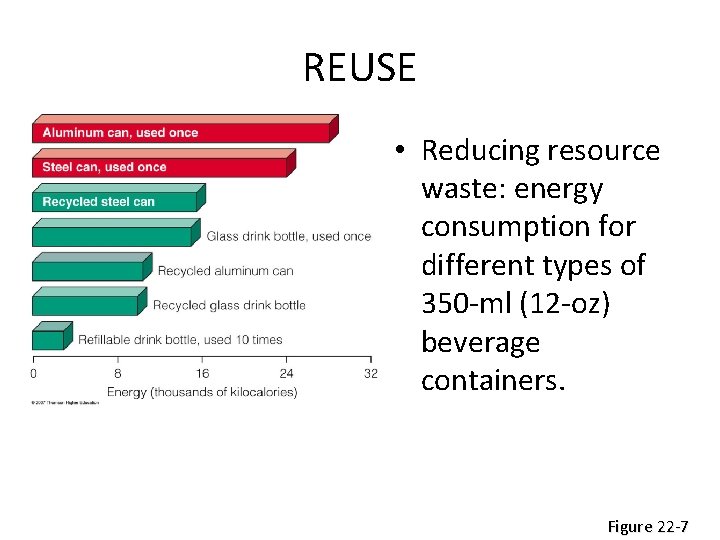
Case Study: Using Refillable Containers • Refilling and reusing containers uses fewer resources and less energy, produces less waste, saves money, and creates jobs. – In Denmark and Canada’s Price Edward’s Island there is a ban on all beverage containers that cannot be reused. – In Finland 95% of soft drink and alcoholic beverages are refillable (Germany 75%).
REUSE • Reducing resource waste: energy consumption for different types of 350 -ml (12 -oz) beverage containers. Figure 22 -7
Solutions: Other Ways to Reuse Things • We can use reusable shopping bags, food containers, and shipping pallets, and borrow tools from tool libraries. – Many countries in Europe and Asia charge shoppers for plastic bags.
RECYCLING • Primary (closed loop) recycling: materials are turned into new products of the same type. • Secondary recycling: materials are converted into different products. – Used tires shredded and converted into rubberized road surface. – Newspapers transformed into cellulose insulation.
RECYCLING • There is a disagreement over whether to mix urban wastes and send them to centralized resource recovery plants or to sort recyclables for collection and sale to manufacturers as raw materials. – To promote separation of wastes, 4, 000 communities in the U. S. have implemented pay-as -you-throw or fee-per-bag waste collection systems.
RECYCLING • Composting biodegradable organic waste mimics nature by recycling plant nutrients to the soil. • Recycling paper has a number of environmental (reduction in pollution and deforestation, less energy expenditure) and economic benefits and is easy to do.
RECYCLING • Recycling many plastics is chemically and economically difficult. – Many plastics are hard to isolate from other wastes. – Recovering individual plastic resins does not yield much material. – The cost of virgin plastic resins is lower than recycled resins due to low fossil fuel costs. – There are new technologies that are making plastics biodegradable.
RECYCLING • Reuse and recycling are hindered by prices of goods that do not reflect their harmful environmental impacts, too few government subsidies and tax breaks, and price fluctuations.
Alternatives • What can you do with waste other than landfilling it? – Compost piles – Biodegradable
Compost • Compost is a pile of organic debris. – Roughly half of household waste is made up of food and garden waste. Most of this material could be composted to save landfill, improve soil condition and provide fertiliser in the garden at no cost. – Composting is the method of breaking down waste organic materials in a large container or heap. The decomposition occurs because of the naturally occurring micro-organisms, such as bacteria and fungi.
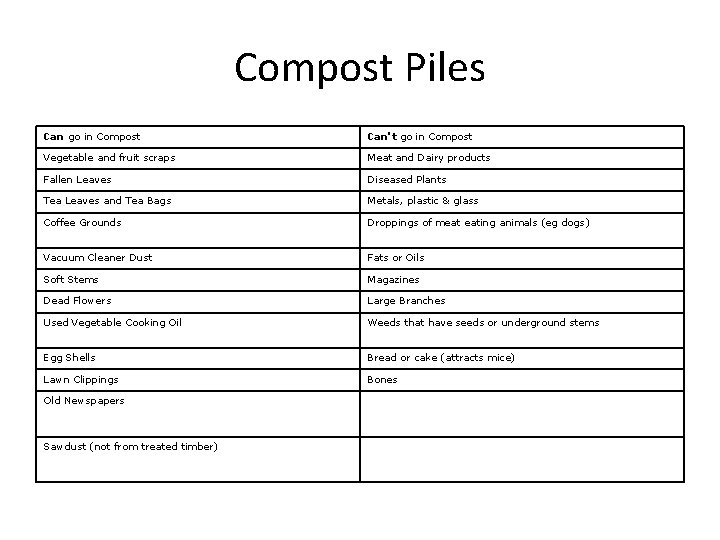
Compost Piles Can go in Compost Can't go in Compost Vegetable and fruit scraps Meat and Dairy products Fallen Leaves Diseased Plants Tea Leaves and Tea Bags Metals, plastic & glass Coffee Grounds Droppings of meat eating animals (eg dogs) Vacuum Cleaner Dust Fats or Oils Soft Stems Magazines Dead Flowers Large Branches Used Vegetable Cooking Oil Weeds that have seeds or underground stems Egg Shells Bread or cake (attracts mice) Lawn Clippings Bones Old Newspapers Sawdust (not from treated timber)