
What is Xylella Xylella fastidiosa Plant bacterium which
What is Xylella?

Xylella fastidiosa • Plant bacterium which colonises and blocks the plant’s waterconducting vessels (xylem) • Causes disease in almost 600 plant species, in c. 80 families 37 spp. added in 2020 • Wild flora, e. g. Capsella bursapastoris, Hedera helix • Herbaceous perennials, e. g. Lavandula, Polygala • Trees, e. g. Acer, Magnolia

Subspecies of Xylella • At least 4 subspecies – different host /environment range
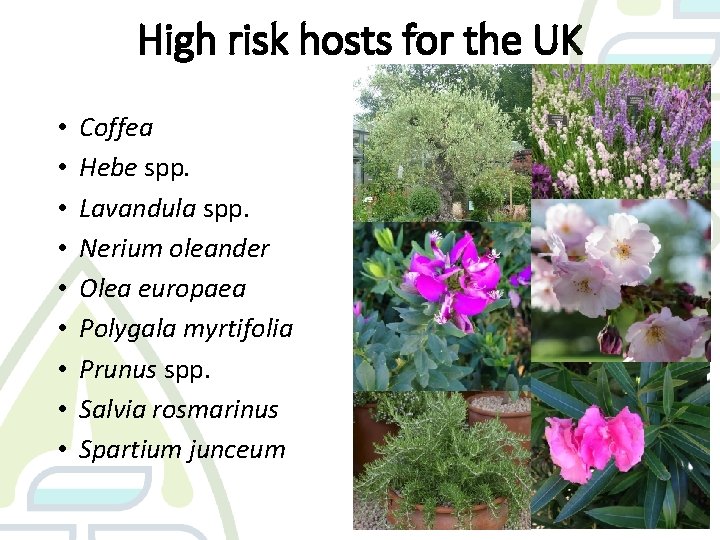
High risk hosts for the UK • • • Coffea Hebe spp. Lavandula spp. Nerium oleander Olea europaea Polygala myrtifolia Prunus spp. Salvia rosmarinus Spartium junceum
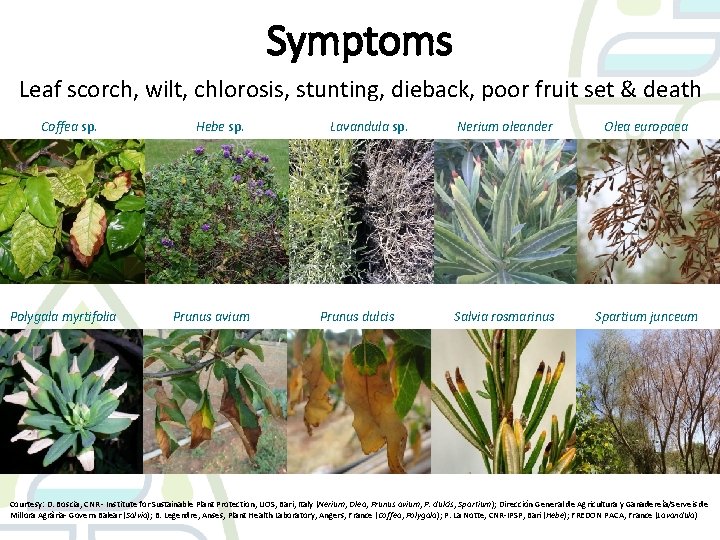
Symptoms Leaf scorch, wilt, chlorosis, stunting, dieback, poor fruit set & death Coffea sp. Polygala myrtifolia Hebe sp. Prunus avium Lavandula sp. Prunus dulcis Nerium oleander Olea europaea Salvia rosmarinus Spartium junceum . Courtesy: D. Boscia, CNR - Institute for Sustainable Plant Protection, UOS, Bari, Italy (Nerium, Olea, Prunus avium, P. dulcis, Spartium); Dirección General de Agricultura y Ganadereía/Serveis de Millora Agrària- Govern Balear (Salvia); B. Legendre, Anses, Plant Health Laboratory, Angers, France (Coffea, Polygala); P. La Notte, CNR-IPSP, Bari (Hebe); FREDON PACA, France (Lavandula)

Symptoms • Symptoms develop in midsummer and increase in severity towards autumn • Symptoms may appear in one branch or part of the crown • Many plant species are hosts of Xylella without expressing symptoms • Development of symptoms can occur months or years after infection • Similar symptoms can be caused by abiotic causes (drought, frost, sunburn, wind scorch…) or other diseases • Early detection and surveys for Xylella difficult
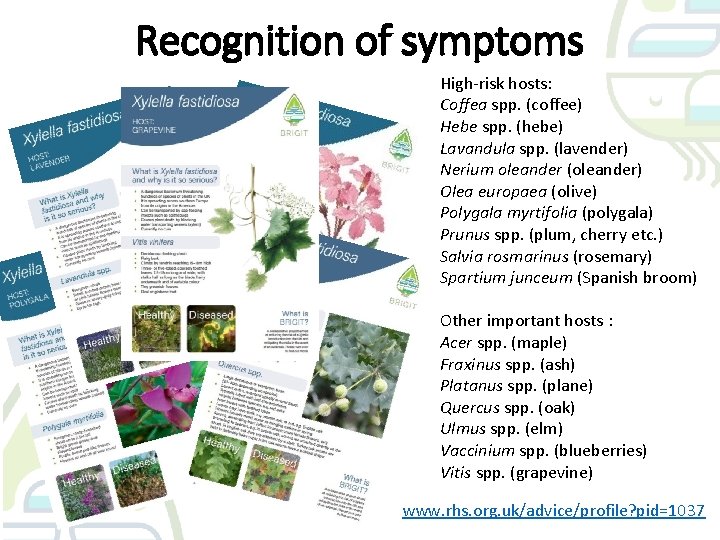
Recognition of symptoms High-risk hosts: Coffea spp. (coffee) Hebe spp. (hebe) Lavandula spp. (lavender) Nerium oleander (oleander) Olea europaea (olive) Polygala myrtifolia (polygala) Prunus spp. (plum, cherry etc. ) Salvia rosmarinus (rosemary) Spartium junceum (Spanish broom) Other important hosts : Acer spp. (maple) Fraxinus spp. (ash) Platanus spp. (plane) Quercus spp. (oak) Ulmus spp. (elm) Vaccinium spp. (blueberries) Vitis spp. (grapevine) www. rhs. org. uk/advice/profile? pid=1037
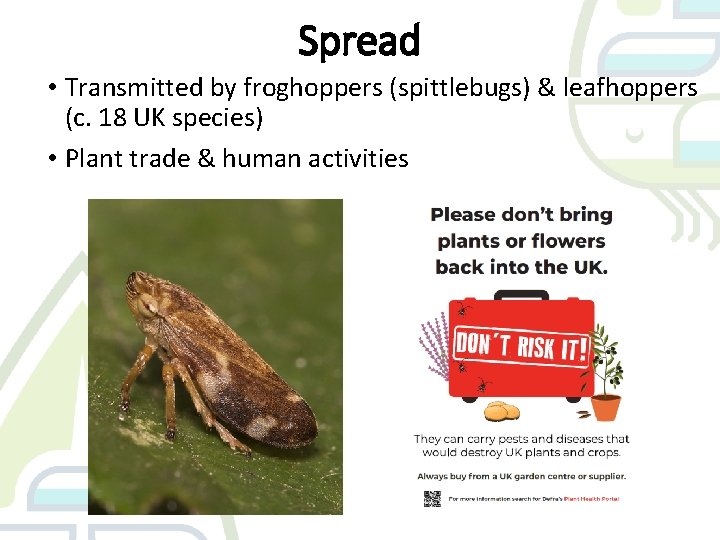
Spread • Transmitted by froghoppers (spittlebugs) & leafhoppers (c. 18 UK species) • Plant trade & human activities
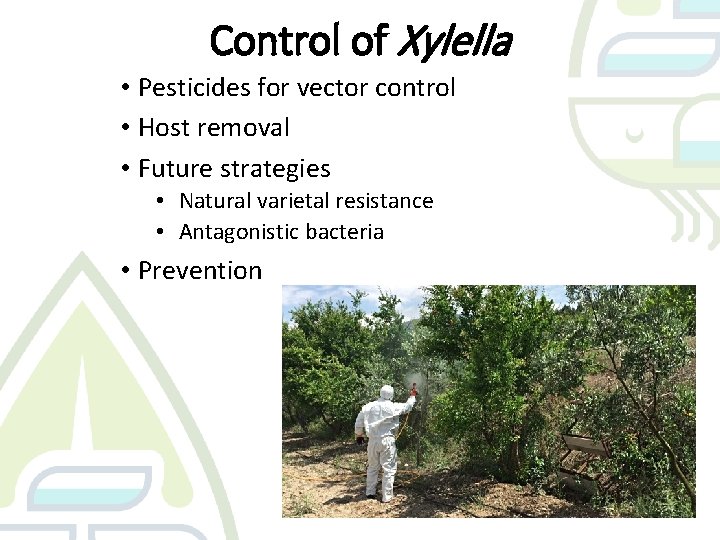
Control of Xylella • Pesticides for vector control • Host removal • Future strategies • Natural varietal resistance • Antagonistic bacteria • Prevention

Where is Xylella?
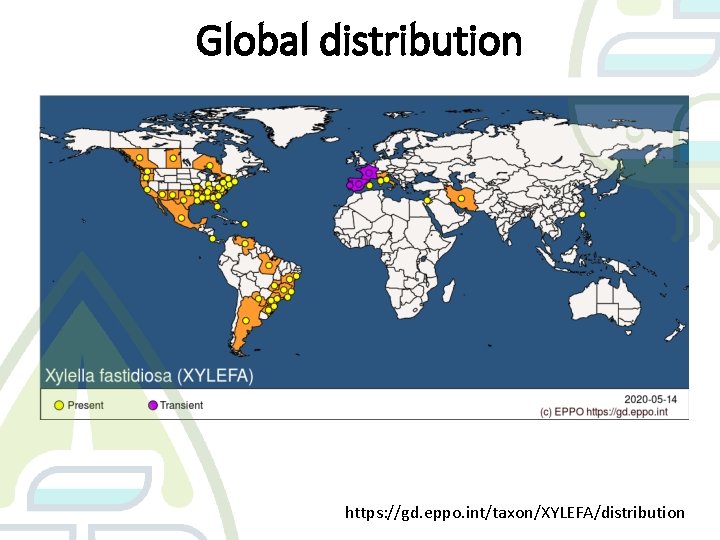
Global distribution https: //gd. eppo. int/taxon/XYLEFA/distribution
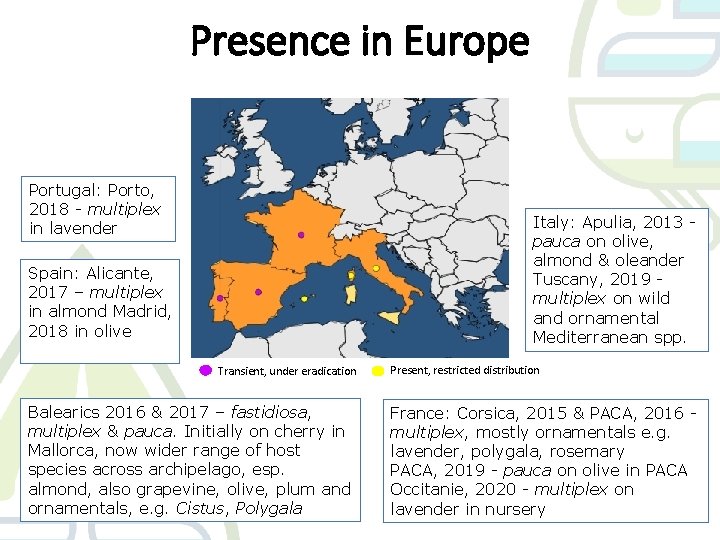
Presence in Europe Portugal: Porto, 2018 - multiplex in lavender Italy: Apulia, 2013 pauca on olive, almond & oleander Tuscany, 2019 multiplex on wild and ornamental Mediterranean spp. Spain: Alicante, 2017 – multiplex in almond Madrid, 2018 in olive Transient, under eradication Balearics 2016 & 2017 – fastidiosa, multiplex & pauca. Initially on cherry in Mallorca, now wider range of host species across archipelago, esp. almond, also grapevine, olive, plum and ornamentals, e. g. Cistus, Polygala Present, restricted distribution France: Corsica, 2015 & PACA, 2016 multiplex, mostly ornamentals e. g. lavender, polygala, rosemary PACA, 2019 - pauca on olive in PACA Occitanie, 2020 - multiplex on lavender in nursery

Diseases caused by Xylella Pierce’s disease Oleander leaf scorch Almond leaf scorch/ Plum leaf scald/ Phony peach disease Bacterial leaf scorch Citrus variegated chlorosis Olive quick decline Courtesy: P. Brannen, University of Georgia, USA (Vaccinium); D. Boscia, CNR - Institute for Sustainable Plant Protection-UOS, Bari, Italy (Olea); M. Scortichini, Istituto Sperimentale per la Frutticoltura, Rome, Italy (Citrus, Vitis); Chung-Jan Chang, University of Georgia (Prunus); M. Blua, from Schroth et al. eds. 2010. Plant Diseases Caused by Bacteria: An Image Database and Educational Resource CD-ROM. ©APS (Nerium)
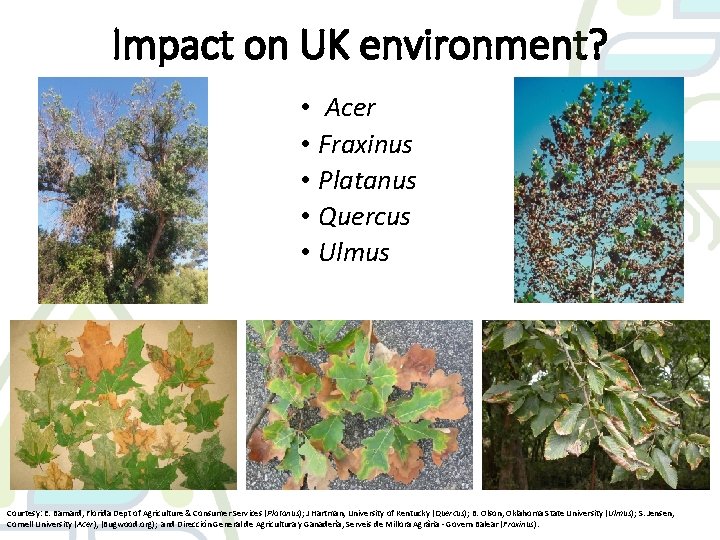
Impact on UK environment? • Acer • Fraxinus • Platanus • Quercus • Ulmus Courtesy: E. Barnard, Florida Dept of Agriculture & Consumer Services (Platanus); J Hartman, University of Kentucky (Quercus); B. Olson, Oklahoma State University (Ulmus); S. Jensen, Cornell University (Acer), (Bugwood. org); and Dirección General de Agricultura y Ganadería, Serveis de Millora Agrària - Govern Balear (Fraxinus).
Whether to report? • Xylella has not been detected in the UK • Therefore, before reporting ask yourself - Is the plant displaying symptoms which are typical for Xylella infection? - Where has the plant come from? - How was the plant imported? - How long ago was the plant imported? - Is the plant a known Xylella host plant in Europe?
Reporting If you are still concerned: • Do not collect or send any samples • Information on who to contact to report can be found on the UK Plant Health Information Portal: https: //planthealthportal. defra. gov. uk/pests-anddiseases/reporting-a-pestdisease/ • England & Wales: Animal and Plant Health Agency planthealth. info@apha. gov. uk • Scottish Government: SASA hort. marketing@gov. scot • Northern Ireland: DAERA planthealth@daera-ni. gov. uk • Tree symptoms can be reported on Tree. Alert: https: //treealert. forestresearch. gov. uk/
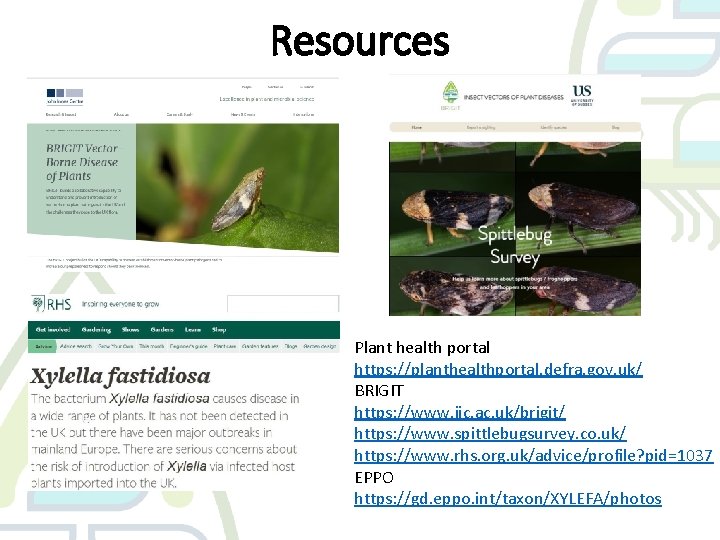
Resources Plant health portal https: //planthealthportal. defra. gov. uk/ BRIGIT https: //www. jic. ac. uk/brigit/ https: //www. spittlebugsurvey. co. uk/ https: //www. rhs. org. uk/advice/profile? pid=1037 EPPO https: //gd. eppo. int/taxon/XYLEFA/photos
- Slides: 17