
WHAT IS WRITING ACROSS THE CURRICULUM Writing to
![Testimonials Quoted during process: “The content of their journals is [also] improving. Whether or](https://slidetodoc.com/presentation_image_h2/955e0e5777ac6e8f8b671fb6619f0b35/image-28.jpg "Testimonials Quoted during process: “The content of their journals is [also] improving. Whether or")
- Slides: 33
WHAT IS WRITING ACROSS THE CURRICULUM? Writing to Learn: Learning to Write Ollie Pedersen Linda Nicholl Jennifer Andersen
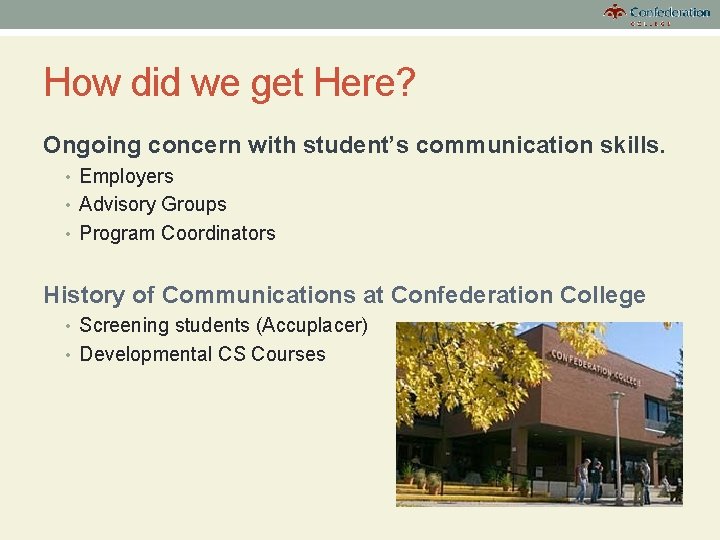
How did we get Here? Ongoing concern with student’s communication skills. • Employers • Advisory Groups • Program Coordinators History of Communications at Confederation College • Screening students (Accuplacer) • Developmental CS Courses
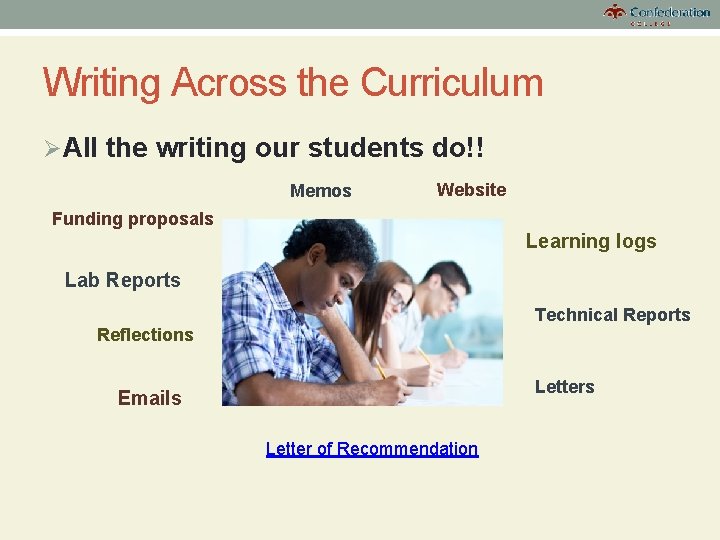
Writing Across the Curriculum ØAll the writing our students do!! Memos Website Funding proposals Learning logs Lab Reports Technical Reports Reflections Letters Emails Letter of Recommendation
Why do we need WAC? • Communication skills are essential for success at school, at work, and in our daily lives. Employers talk about communication skills. Oral communication, listening skills, written communication and presentation skills are the top four skills that companies demand in new graduates (GMAT 2014).
Writing Across the Curriculum Overview As a response to students' lack of writing practice throughout post-secondary education, Writing Across the Curriculum (WAC) programs emerged in the early 1980 s. WAC Today in Post Secondary Education • Entire journals devoted to WAC (Writing Across the Curriculum) • Volumes of books, conferences and websites dedicated to WAC (Writing Across the Curriculum conference at University of Michigan. June 2016)
Writing Across the Curriculum Overview WAC Centres at Canadian Institutions and around the world: • Humber College, Ontario College of Arts and Design, Durham College, Lakehead University, University of Waterloo, Queens, University of Calgary, University of Alberta, Wilfred Laurier, Stanford, Princeton, NYU, etc… University of Toronto (4 WAC Programs at 1 university!) • Writing Centres: in Arts and Science, St. George Campus • Writing Centres: Mississauga and Scarborough Campuses • Writing Centres: for Graduate Students • Writing Centres: in the Professional Faculties
Writing Across the Curriculum Overview The philosophies underlying these programs generally agree on certain basic principles: • that writing is the responsibility of the entire academic community. • that writing must be integrated across departmental boundaries. • that writing instruction must be continuous during all years of postsecondary education. • that writing promotes learning • that only by practicing the conventions of an academic discipline will students begin to communicate effectively within that discipline (WAC Clearinghouse, “Basic Principles of WAC”, 1992).
Writing Across the Curriculum Overview WAC involves writing in all disciplines. “WAC programs are not additive, but transformative—they aim not at adding more papers and tests of writing ability, but at changing the way both teachers and students use writing in the curriculum. Writing across the curriculum may be defined, then, as a comprehensive program that transforms the curriculum, encouraging writing to learn and learning to write in all disciplines” (Mc. Leod and Soven, 1992, p. 2).
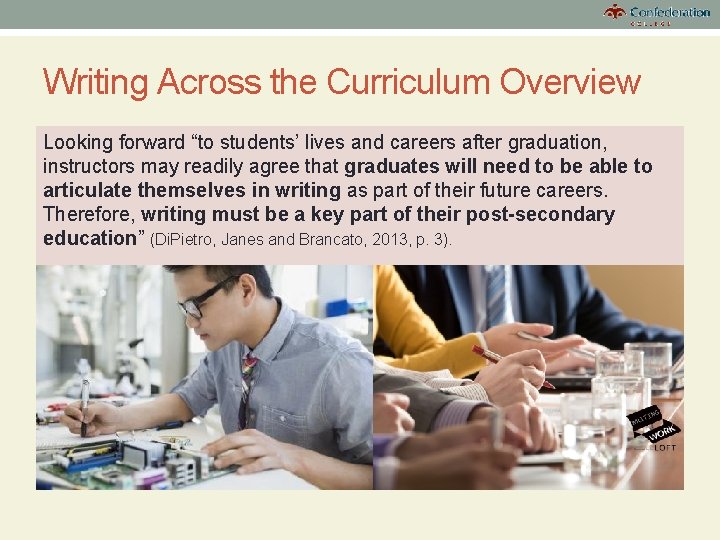
Writing Across the Curriculum Overview Looking forward “to students’ lives and careers after graduation, instructors may readily agree that graduates will need to be able to articulate themselves in writing as part of their future careers. Therefore, writing must be a key part of their post-secondary education” (Di. Pietro, Janes and Brancato, 2013, p. 3).
WAC Goals The Writing Across the Curriculum program at Confederation College pursues three goals: To work with faculty administrators, with individual faculty members, and with faculty groups in the creation and facilitation of assignments, programs and workshops to improve writing instruction for students. 1 Examples • Help incorporate writing assignments into the classroom • Help develop rubrics • Provide workshops and PD opportunities
WAC Goals The Writing Across the Curriculum program at Confederation College pursues three goals: To support students in the disciplines with a variety of interventions such as: online resources, lectures and individual and group tutoring. 2 Examples • • Meet one on one with students to offer feedback WAC website will have sample assignments and resources
WAC Goals The Writing Across the Curriculum program at Confederation College pursues three goals: 3 To reach out to the broader community, including secondary school systems, local and international campuses to build relationships and smooth the transition to College writing demands. Examples • Visit high schools • Provide resources online for international students
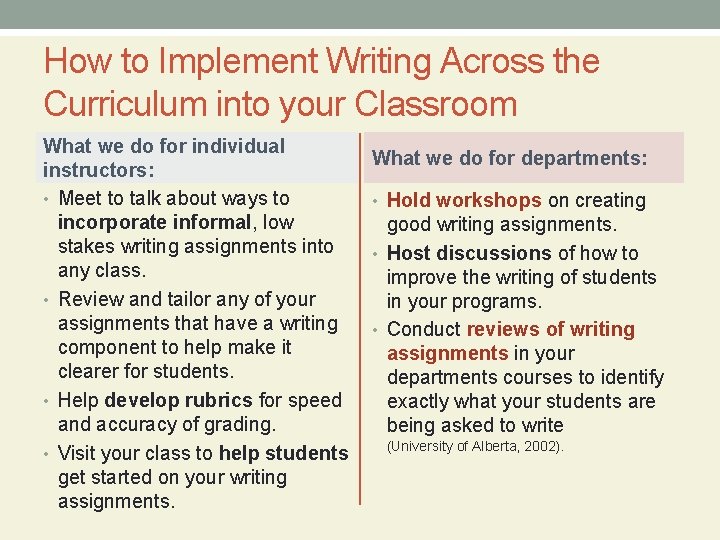
How to Implement Writing Across the Curriculum into your Classroom What we do for individual instructors: • Meet to talk about ways to incorporate informal, low stakes writing assignments into any class. • Review and tailor any of your assignments that have a writing component to help make it clearer for students. • Help develop rubrics for speed and accuracy of grading. • Visit your class to help students get started on your writing assignments. What we do for departments: • Hold workshops on creating good writing assignments. • Host discussions of how to improve the writing of students in your programs. • Conduct reviews of writing assignments in your departments courses to identify exactly what your students are being asked to write (University of Alberta, 2002).
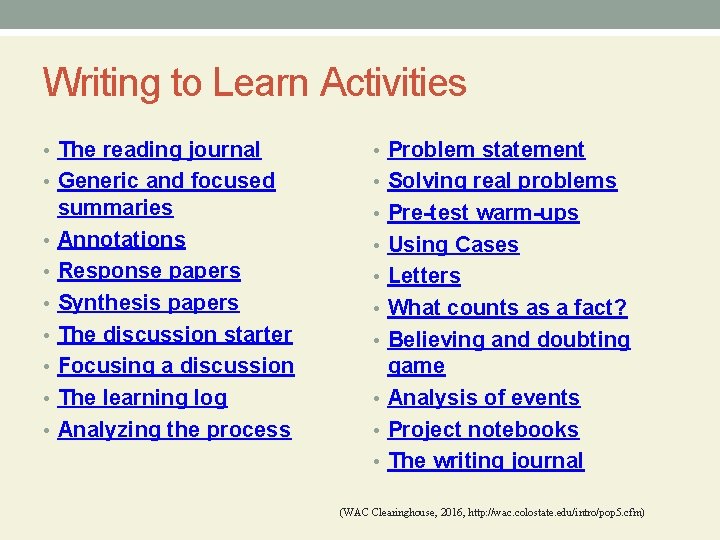
Writing to Learn Activities • The reading journal • Problem statement • Generic and focused • Solving real problems • • summaries Annotations Response papers Synthesis papers The discussion starter Focusing a discussion The learning log Analyzing the process • Pre-test warm-ups • Using Cases • Letters • What counts as a fact? • Believing and doubting game • Analysis of events • Project notebooks • The writing journal (WAC Clearinghouse, 2016, http: //wac. colostate. edu/intro/pop 5. cfm)
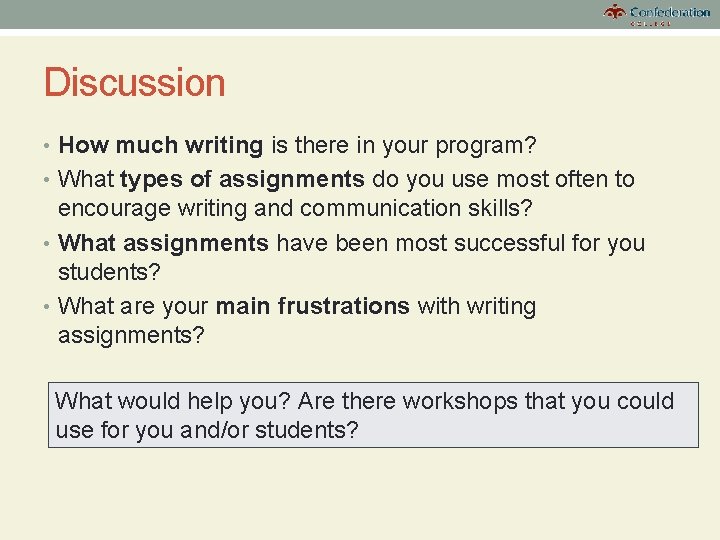
Discussion • How much writing is there in your program? • What types of assignments do you use most often to encourage writing and communication skills? • What assignments have been most successful for you students? • What are your main frustrations with writing assignments? What would help you? Are there workshops that you could use for you and/or students?
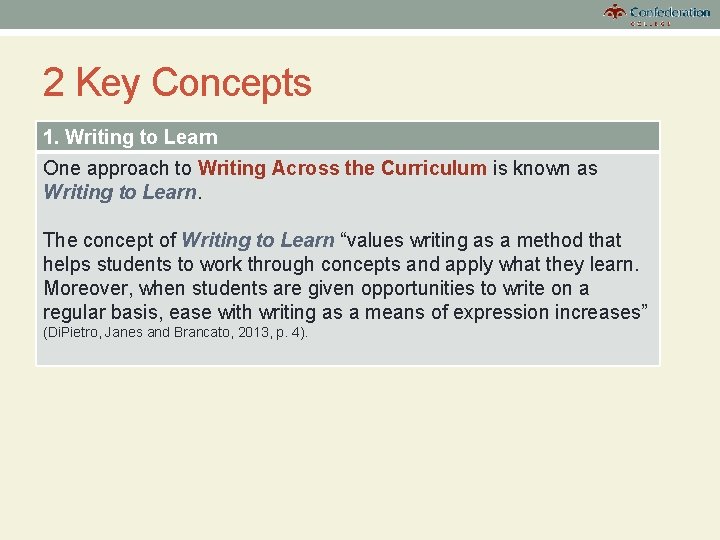
2 Key Concepts 1. Writing to Learn One approach to Writing Across the Curriculum is known as Writing to Learn. The concept of Writing to Learn “values writing as a method that helps students to work through concepts and apply what they learn. Moreover, when students are given opportunities to write on a regular basis, ease with writing as a means of expression increases” (Di. Pietro, Janes and Brancato, 2013, p. 4).
2 Key Concepts 1. Writing to Learn • Primarily focused on process and regularity. • Writing to Learn activities usually take the form of low-stakes or unassessed writing incorporated into day-to-day teaching. • Low- stakes activities typically involve writing assignments that are assessed, often just for completion, but that are not evaluated according to explicit disciplinary criteria. Such assignments include: • journals, • reading-response exercises, • take-home class preparation assignments • learning logs (Di. Pietro, Janes and Brancato, 2013, p. 4).
2 Key Concepts 2. Writing in the Disciplines is an additional approach to Writing Across the Curriculum in which, as with Writing to Learn, the emphasis is on giving students more opportunities to write, not only because students improve through repeated practice, but also because they improve as a result of formative instructor feedback that identifies writing strengths and weaknesses early on and adjusts teaching strategies and learning activities to address them.
2 Key Concepts 2. Writing in the Disciplines A writing assignment that includes formative assessment might, for example, be broken down into a multi-stage process of drafting and revising with instruction and feedback offered at different stages (staged writing), or one that breaks complicated tasks and content into manageable parts of gradually increasing complexity, building a scaffold from one component to the next (scaffolded writing) (Di. Pietro, Janes and Brancato, 2013, Chpt. 1, p. 2).
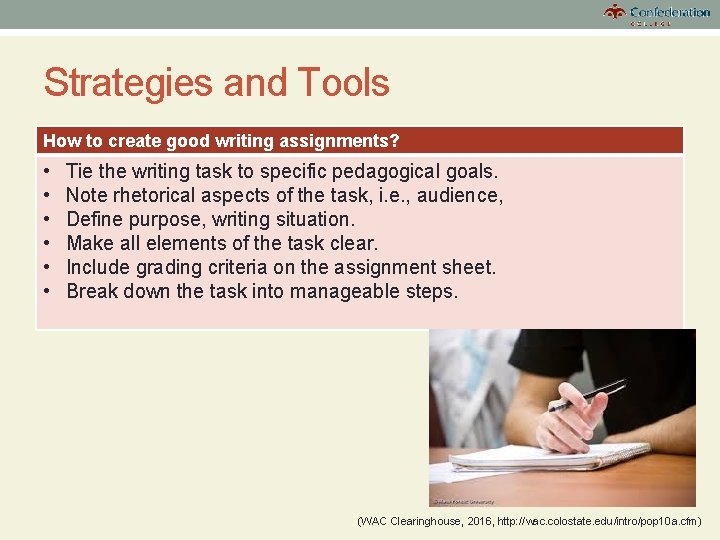
Strategies and Tools How to create good writing assignments? • • • Tie the writing task to specific pedagogical goals. Note rhetorical aspects of the task, i. e. , audience, Define purpose, writing situation. Make all elements of the task clear. Include grading criteria on the assignment sheet. Break down the task into manageable steps. (WAC Clearinghouse, 2016, http: //wac. colostate. edu/intro/pop 10 a. cfm)
Discussion • Could you share a good writing assignment that has worked for you? • What do you define as writing? • How did it work? Why was it successful?
Why use Grading Criteria? • “Few things are more frustrating for students than unexplained grades” (Livingston, 2012, p. 112). • “When students are aware of the expectations a teacher has of them and they understand what they must do in order to achieve a high score on a given assignment, they are then able to focus their attentional resources more on the task itself” (Martin, n. d. , p. 9). 1. Livingston, M. (2012). The infamy of grading rubrics. The English Journal, 102(2), 108 -113. 2. Martin, L. A. (n. d. ). Rubrics in Language Assessment. Retrieved from http: //lauramartinmafsledportfolio. weebly. com/uploads/2/3/4/4/23449244/rubrics_in_language_assessment_position_paper. pdf
Across The Drafts: Students and Teachers Talk about Feedback
Why use Grading Criteria? • Grading criteria set clear expectations students can achieve. • They communicate disciplinary or professional standards, making them explicit. • They demystify grading, both the process and the result. • Students compete with themselves rather than each other to do better. Criteria can be used as an instructional tool, especially in diagnostic and formative assessment, to help students meet expectations (Di. Pietro, Janes and Brancato, 2013, Chpt. 5, p. 6).
Examples of Rubrics and Peer Edits • Peer Edit Checklist
How we can help support you? Course-Based Writing Support for Your Classes Would you like to receive better written assignments from your students? Then consider signing up for Writing Across the Curriculum’s workshop to earn your badge under the Instructional Skills Workshop Certificate.
Contact Us Ollie Pedersen • pedersen@confederationc. on. ca
Testimonials Quoted during process: “The content of their journals is [also] improving. Whether or not there are noticeable improvements right now, I think this has been a beneficial (and challenging!) critical thinking and writing exercise for them. ” Quoted after last submission: “I think this was a valuable knowledge and skill development exercise for the students. As you know, I’m a big proponent of the importance of developing effective communication skills. I’m happy with how I designed the exercise and how you supported it, and it’s definitely something I want to continue” Brett Sharman- Professor, Business and Coordinator, International Business Management School of Business, Hospitality and Media Arts
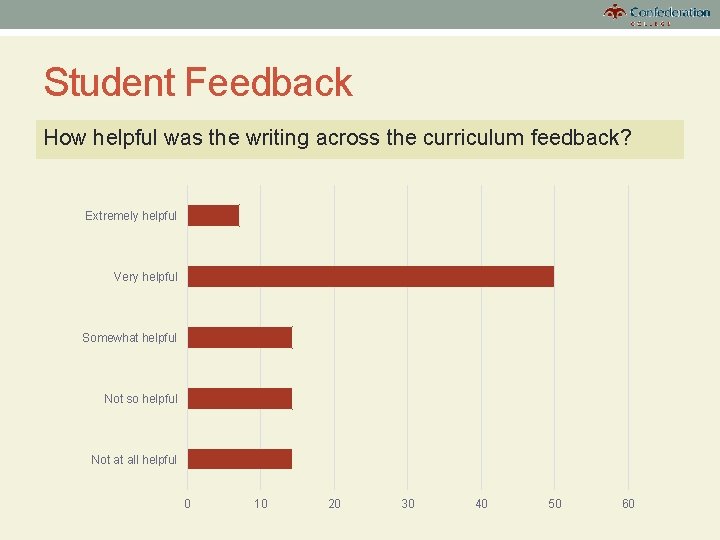
Student Feedback How helpful was the writing across the curriculum feedback? Extremely helpful Very helpful Somewhat helpful Not so helpful Not at all helpful 0 10 20 30 40 50 60
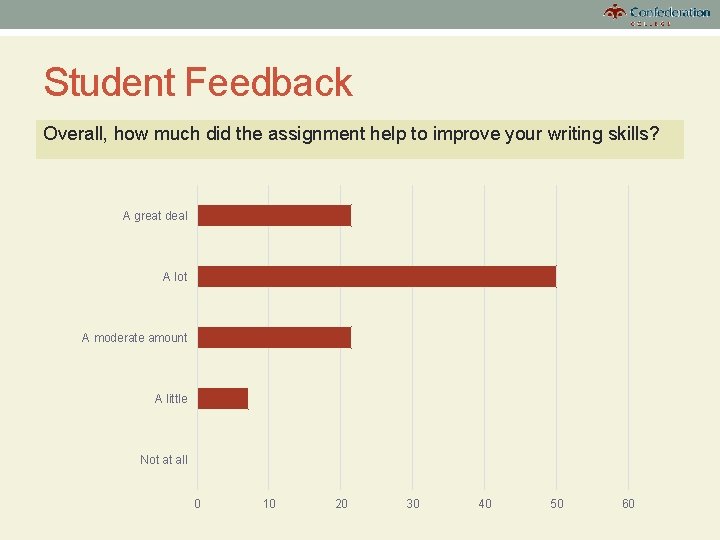
Student Feedback Overall, how much did the assignment help to improve your writing skills? A great deal A lot A moderate amount A little Not at all 0 10 20 30 40 50 60
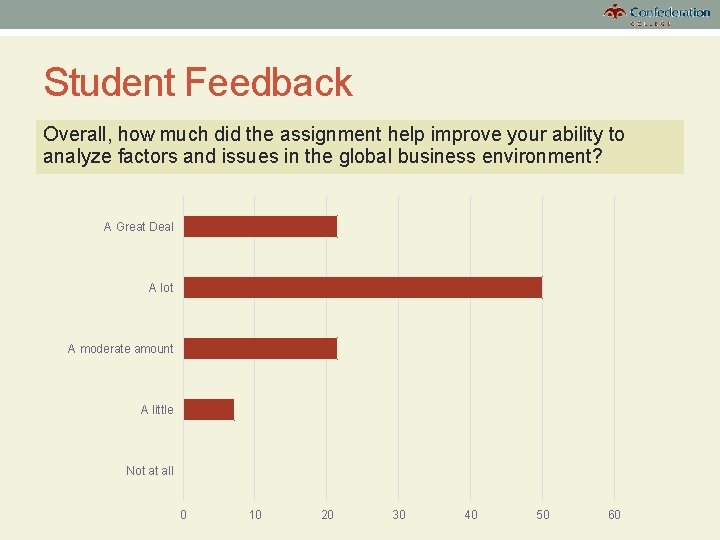
Student Feedback Overall, how much did the assignment help improve your ability to analyze factors and issues in the global business environment? A Great Deal A lot A moderate amount A little Not at all 0 10 20 30 40 50 60
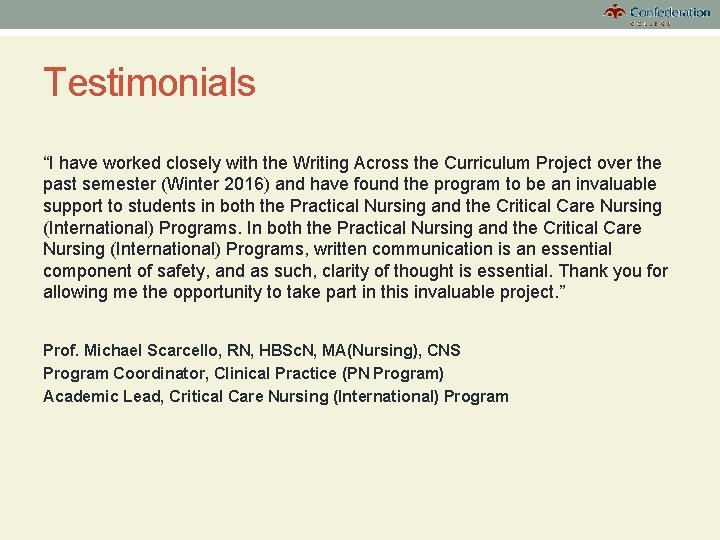
Testimonials “I have worked closely with the Writing Across the Curriculum Project over the past semester (Winter 2016) and have found the program to be an invaluable support to students in both the Practical Nursing and the Critical Care Nursing (International) Programs. In both the Practical Nursing and the Critical Care Nursing (International) Programs, written communication is an essential component of safety, and as such, clarity of thought is essential. Thank you for allowing me the opportunity to take part in this invaluable project. ” Prof. Michael Scarcello, RN, HBSc. N, MA(Nursing), CNS Program Coordinator, Clinical Practice (PN Program) Academic Lead, Critical Care Nursing (International) Program
Questions ?