
What is welfare states and welfare regimes Lecture
- Slides: 21
What is welfare states and welfare regimes? Lecture 2
What is a welfare state? • “A polity so organized that every member of the community is assured of his due maintenance with most advantageous conditions possible” (Oxford Dictionary, 1955). • “A welfare state is a state in which organized power is deliberately used in an effort to modify the play of market forces” (Briggs, 1961)
Continued • “By a welfare state is understood a institutionalized system where the actors the state, market and civil society interact in various relations with the purpose of maximizing society’s welfare function and where the degree of public involvement is sufficiently high to be able to counteract the consequences of market failure, including ensuring a guaranteed minimum income ”(Greve, 2002) • “The coordination of mutually dependent political or economic systems that are structurally differentiated” (Kaufmann, 2012)
Elements that can included when discussing whether a country is a welfare state • GDP • Degree of employment, including goal of full employment • Degree of equality – both in an economic sense and between sexes • Social security expenditures – either in narrow or a broader approach
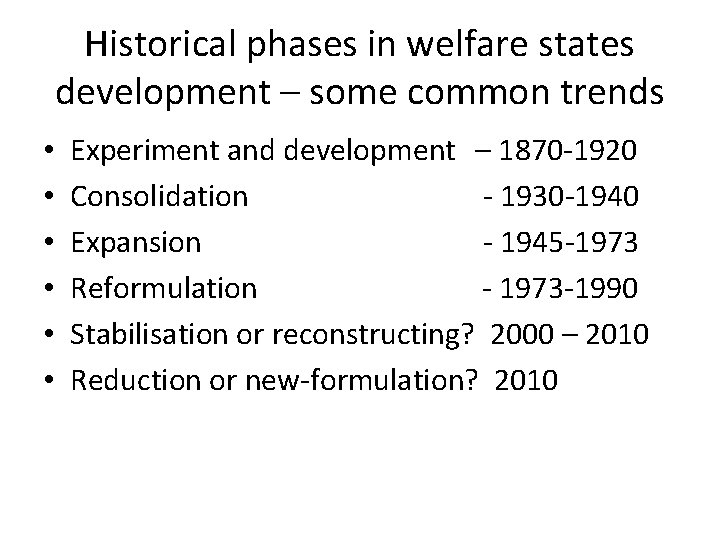
Historical phases in welfare states development – some common trends • • • Experiment and development – 1870 -1920 Consolidation - 1930 -1940 Expansion - 1945 -1973 Reformulation - 1973 -1990 Stabilisation or reconstructing? 2000 – 2010 Reduction or new-formulation? 2010
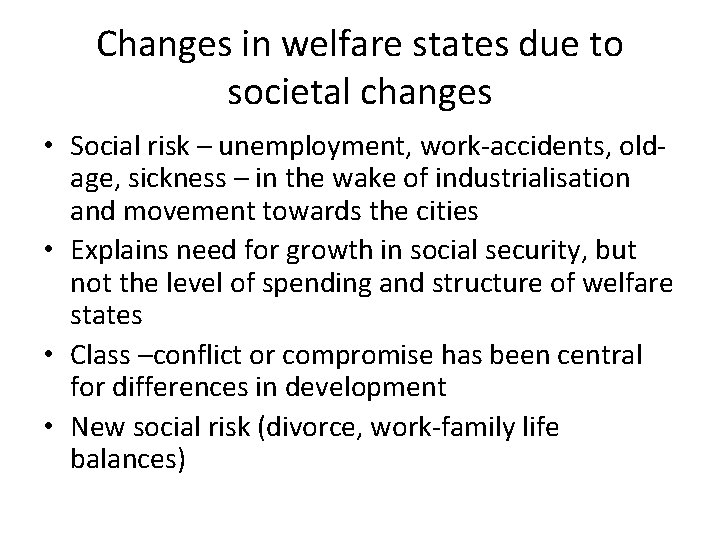
Changes in welfare states due to societal changes • Social risk – unemployment, work-accidents, oldage, sickness – in the wake of industrialisation and movement towards the cities • Explains need for growth in social security, but not the level of spending and structure of welfare states • Class –conflict or compromise has been central for differences in development • New social risk (divorce, work-family life balances)
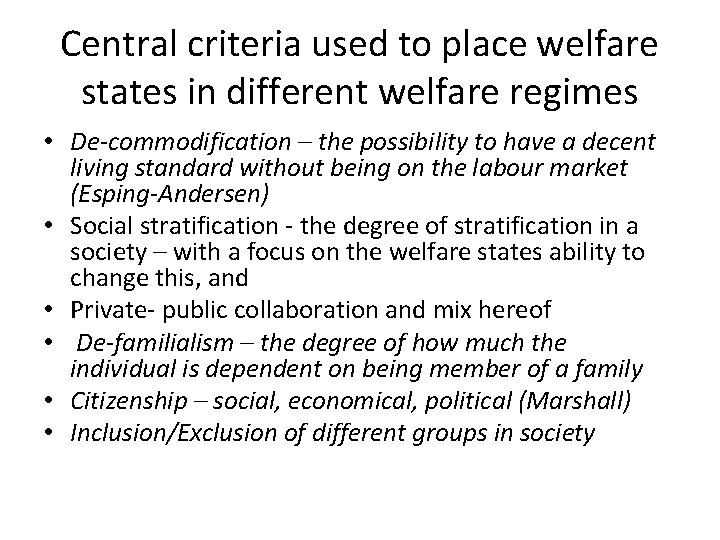
Central criteria used to place welfare states in different welfare regimes • De-commodification – the possibility to have a decent living standard without being on the labour market (Esping-Andersen) • Social stratification - the degree of stratification in a society – with a focus on the welfare states ability to change this, and • Private- public collaboration and mix hereof • De-familialism – the degree of how much the individual is dependent on being member of a family • Citizenship – social, economical, political (Marshall) • Inclusion/Exclusion of different groups in society
How has welfare regimes been labeled ? • Geography • Ideology • Central person behind the model (example, Beveridge) • Other approaches – religion, residual or not residual, comprehensive, targetted etc.
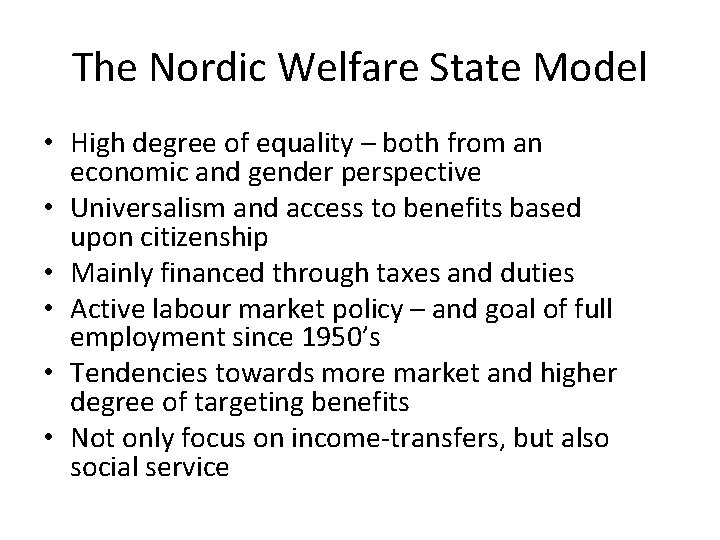
The Nordic Welfare State Model • High degree of equality – both from an economic and gender perspective • Universalism and access to benefits based upon citizenship • Mainly financed through taxes and duties • Active labour market policy – and goal of full employment since 1950’s • Tendencies towards more market and higher degree of targeting benefits • Not only focus on income-transfers, but also social service
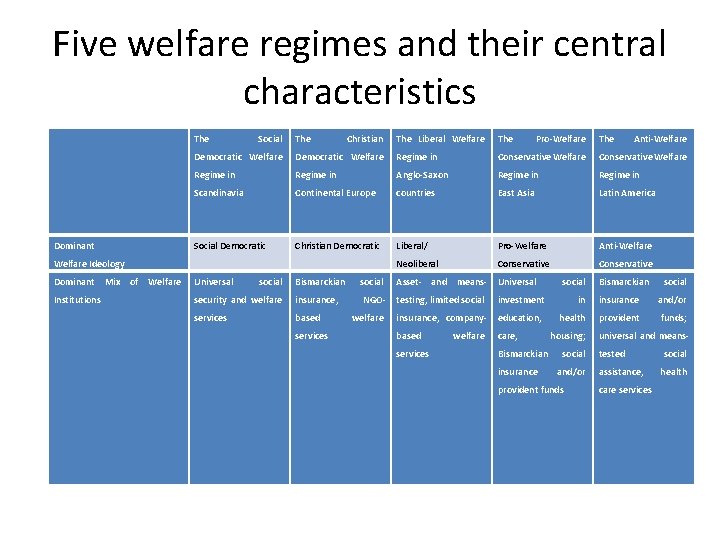
Five welfare regimes and their central characteristics Dominant The Social The Christian The Liberal Welfare The Pro-Welfare The Anti-Welfare Democratic Welfare Regime in Conservative Welfare Regime in Anglo-Saxon Regime in Scandinavia Continental Europe countries East Asia Latin America Social Democratic Christian Democratic Liberal/ Pro-Welfare Anti-Welfare Neoliberal Conservative Welfare Ideology Dominant Mix of Welfare Universal Institutions social Bismarckian social Asset- and means- Universal security and welfare insurance, NGO- testing, limited social investment insurance and/or services based welfare insurance, company- education, health provident funds; based care, services welfare Bismarckian insurance social housing; social and/or provident funds Bismarckian social universal and meanstested assistance, care services social health
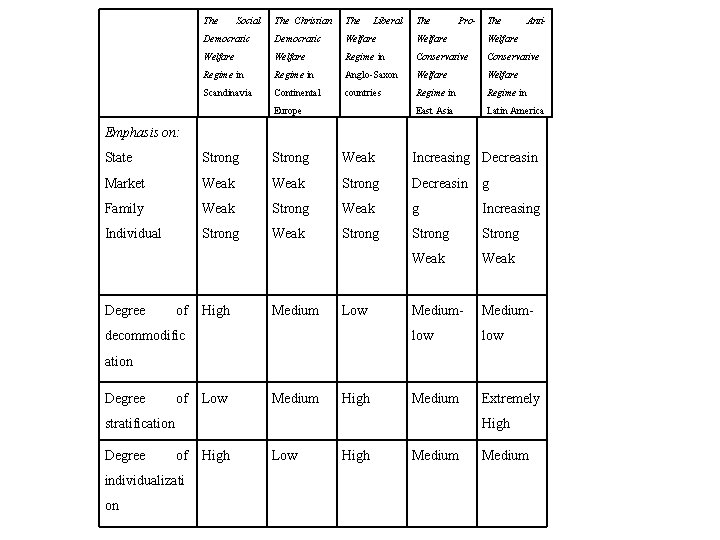
The Social The Christian The Liberal The Democratic Welfare Welfare Regime in Conservative Regime in Anglo-Saxon Welfare Scandinavia Continental countries Regime in East Asia Latin America Europe Pro- The Anti- Emphasis on: State Strong Weak Increasing Decreasin Market Weak Strong Decreasin g Family Weak Strong Weak g Increasing Individual Strong Weak Strong Weak Medium- low Medium Extremely Degree of High Medium Low decommodific ation Degree of Low Medium High stratification Degree High of High individualizati on Low High Medium
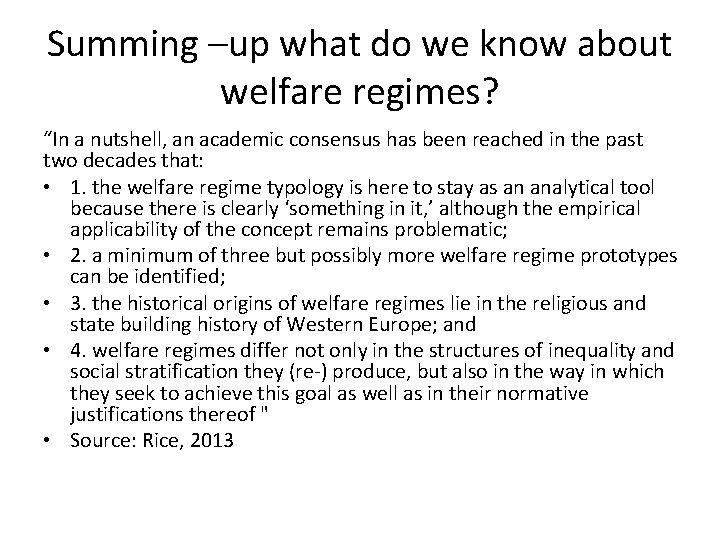
Summing –up what do we know about welfare regimes? “In a nutshell, an academic consensus has been reached in the past two decades that: • 1. the welfare regime typology is here to stay as an analytical tool because there is clearly ‘something in it, ’ although the empirical applicability of the concept remains problematic; • 2. a minimum of three but possibly more welfare regime prototypes can be identified; • 3. the historical origins of welfare regimes lie in the religious and state building history of Western Europe; and • 4. welfare regimes differ not only in the structures of inequality and social stratification they (re-) produce, but also in the way in which they seek to achieve this goal as well as in their normative justifications thereof " • Source: Rice, 2013
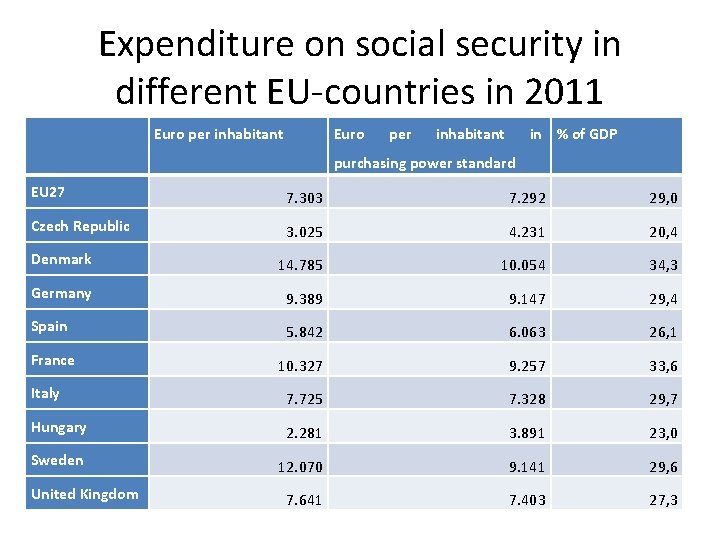
Expenditure on social security in different EU-countries in 2011 Euro per inhabitant Euro per inhabitant in % of GDP purchasing power standard EU 27 7. 303 7. 292 29, 0 Czech Republic 3. 025 4. 231 20, 4 Denmark 14. 785 10. 054 34, 3 Germany 9. 389 9. 147 29, 4 Spain 5. 842 6. 063 26, 1 France 10. 327 9. 257 33, 6 Italy 7. 725 7. 328 29, 7 Hungary 2. 281 3. 891 23, 0 Sweden 12. 070 9. 141 29, 6 7. 641 7. 403 27, 3 United Kingdom
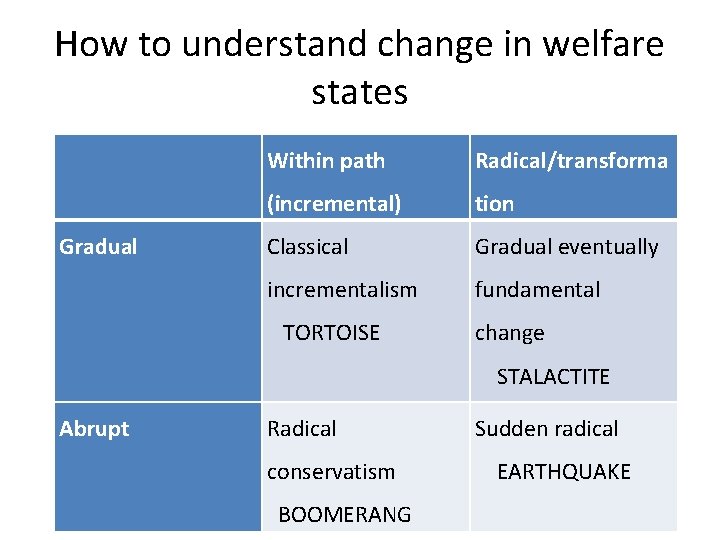
How to understand change in welfare states Gradual Within path Radical/transforma (incremental) tion Classical Gradual eventually incrementalism fundamental TORTOISE change STALACTITE Abrupt Radical Sudden radical conservatism EARTHQUAKE BOOMERANG
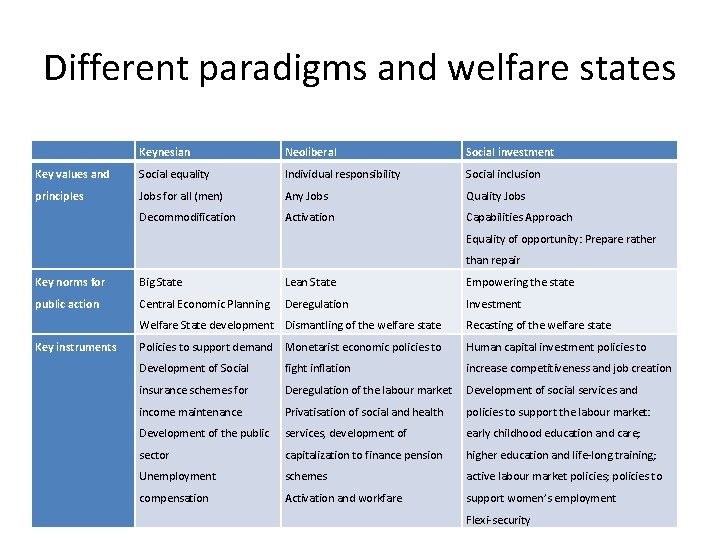
Different paradigms and welfare states Keynesian Neoliberal Social investment Key values and Social equality Individual responsibility Social inclusion principles Jobs for all (men) Any Jobs Quality Jobs Decommodification Activation Capabilities Approach Equality of opportunity: Prepare rather than repair Key norms for Big State Lean State Empowering the state public action Central Economic Planning Deregulation Investment Key instruments Welfare State development Dismantling of the welfare state Recasting of the welfare state Policies to support demand Monetarist economic policies to Human capital investment policies to Development of Social fight inflation increase competitiveness and job creation insurance schemes for Deregulation of the labour market Development of social services and income maintenance Privatisation of social and health policies to support the labour market: Development of the public services, development of early childhood education and care; sector capitalization to finance pension higher education and life-long training; Unemployment schemes active labour market policies; policies to compensation Activation and workfare support women’s employment Flexi-security
Different paradigms • Influence choice of solution and policies as they give different answers to the challenges for welfare states • At the same time economic restrictions influence choice – as this is sometimes also used as argument/excuse for the necessity of change.
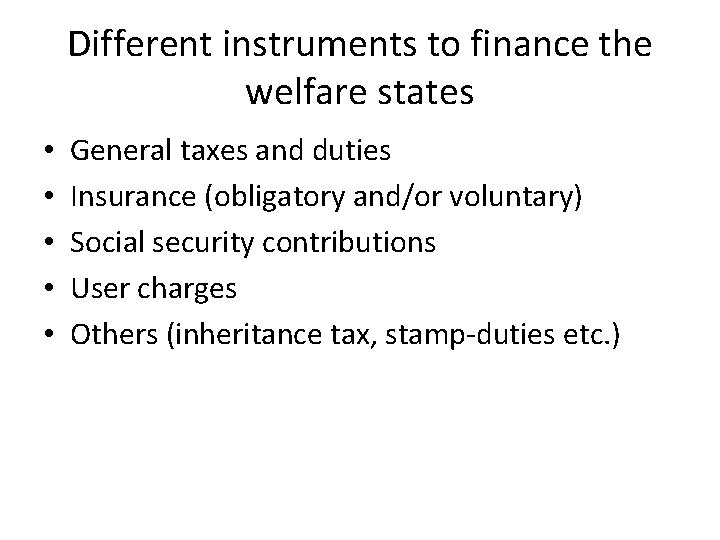
Different instruments to finance the welfare states • • • General taxes and duties Insurance (obligatory and/or voluntary) Social security contributions User charges Others (inheritance tax, stamp-duties etc. )
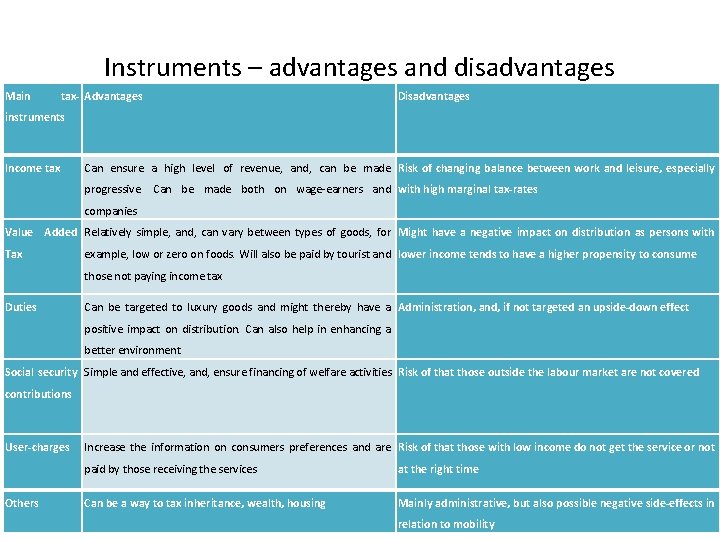
Instruments – advantages and disadvantages Main tax- Advantages Disadvantages instruments Income tax Can ensure a high level of revenue, and, can be made Risk of changing balance between work and leisure, especially progressive. Can be made both on wage-earners and with high marginal tax-rates companies Value Added Relatively simple, and, can vary between types of goods, for Might have a negative impact on distribution as persons with Tax example, low or zero on foods. Will also be paid by tourist and lower income tends to have a higher propensity to consume those not paying income tax Duties Can be targeted to luxury goods and might thereby have a Administration, and, if not targeted an upside-down effect positive impact on distribution. Can also help in enhancing a better environment Social security Simple and effective, and, ensure financing of welfare activities Risk of that those outside the labour market are not covered contributions User-charges Others Increase the information on consumers preferences and are Risk of that those with low income do not get the service or not paid by those receiving the services at the right time Can be a way to tax inheritance, wealth, housing Mainly administrative, but also possible negative side-effects in relation to mobility
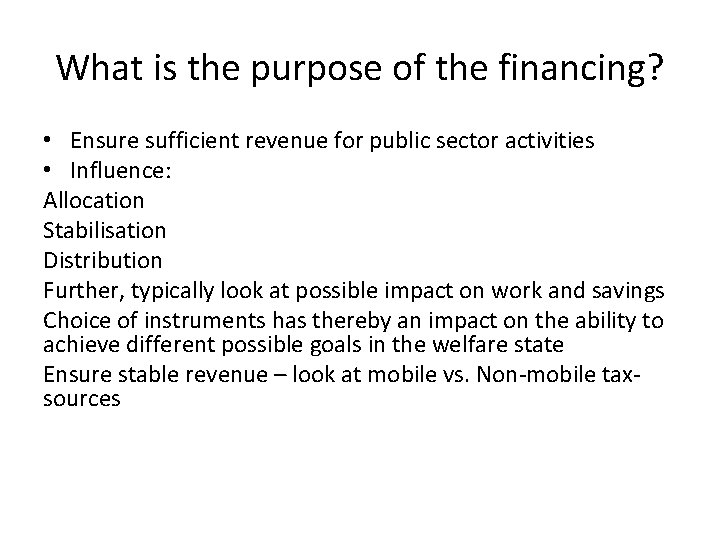
What is the purpose of the financing? • Ensure sufficient revenue for public sector activities • Influence: Allocation Stabilisation Distribution Further, typically look at possible impact on work and savings Choice of instruments has thereby an impact on the ability to achieve different possible goals in the welfare state Ensure stable revenue – look at mobile vs. Non-mobile taxsources
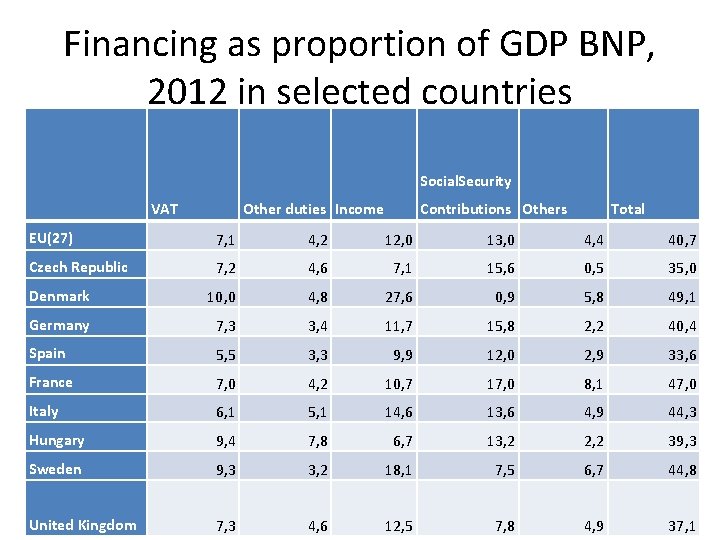
Financing as proportion of GDP BNP, 2012 in selected countries Social Security VAT Other duties Income Contributions Others Total EU(27) 7, 1 4, 2 12, 0 13, 0 4, 4 40, 7 Czech Republic 7, 2 4, 6 7, 1 15, 6 0, 5 35, 0 Denmark 10, 0 4, 8 27, 6 0, 9 5, 8 49, 1 Germany 7, 3 3, 4 11, 7 15, 8 2, 2 40, 4 Spain 5, 5 3, 3 9, 9 12, 0 2, 9 33, 6 France 7, 0 4, 2 10, 7 17, 0 8, 1 47, 0 Italy 6, 1 5, 1 14, 6 13, 6 4, 9 44, 3 Hungary 9, 4 7, 8 6, 7 13, 2 2, 2 39, 3 Sweden 9, 3 3, 2 18, 1 7, 5 6, 7 44, 8 United Kingdom 7, 3 4, 6 12, 5 7, 8 4, 9 37, 1
Summing -up • Different types of welfare regimes –and different understandings of what a welfare state is. Nordic, liberal and continental the three classical types of welfare regimes • Financing of welfare is central as this can influence allocation, stabilisation and distribution, but can also be used as a device for whom who has access to benefits