
What is Web 2 0 By Eunkyu Lee
What is Web 2. 0? By Eunkyu Lee, Alireza Bigdeli, and Rita Chiu Expert Topic Presentation Trends in Middleware Systems January 29, 2007
Agenda ¡ Understanding Web 2. 0 l l ¡ Origins and Concepts Compact Definition Design Patterns and Business Models l l Axes of Design Patterns and Business Models Four plus one in Hierarchy of Web 2. 0 ness Web 1. 0 vs. Web 2. 0 ¡ Mashups & Web 2. 0 + SOA ¡ Controversial Questions ¡ Web 2. 0, Jan. 29, 2007 2
Understanding Web 2. 0 - Agenda ¡ Web 2. 0? l l ¡ Origin What Web 2. 0 is and is not… Web 2. 0 Compact Definition l l Web 2. 0 Applications ¡ ¡ Four properties Web 2. 0 Revisit Web 2. 0, * From Jan. Prak’s 29, 2007 posts at http: //www. fortytwo. co. kr/ 3
Web 2. 0? ¡ Origins of Web 2. 0 l Coined by Dale Dougherty in 2004 ¡ l People ¡ ¡ Collaborate and share information in new ways such as social networking and wikis Web 2. 0 is not l ¡ VP of O’Reilly Media A specific technology or a standard It is said that l A set of principles and practices ¡ l Making existing web technologies more people-centric Something visible and tangible ¡ a collection of related tools, design patterns, and business models l that encourage collaboration and participation to work more efficiently Web 2. 0, * From Jan. lecture 29, 2007 notes of Prof. David Shrimpton at Kent Univ. 4
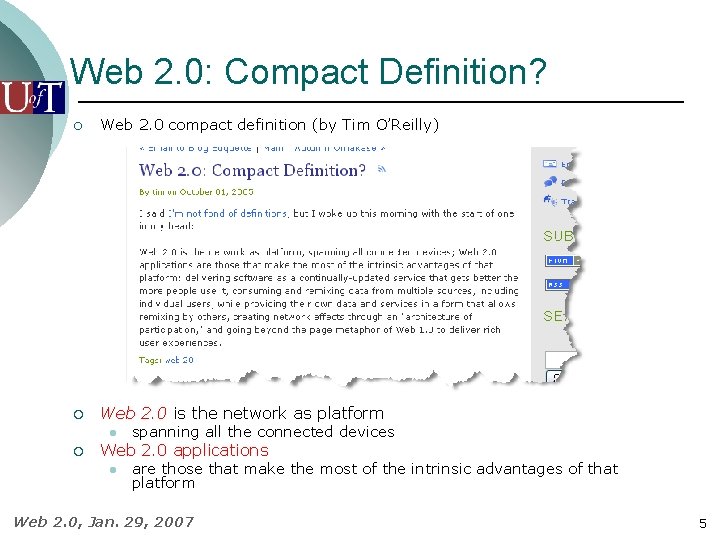
Web 2. 0: Compact Definition? ¡ Web 2. 0 compact definition (by Tim O’Reilly) ¡ Web 2. 0 is the network as platform l ¡ spanning all the connected devices Web 2. 0 applications l are those that make the most of the intrinsic advantages of that platform Web 2. 0, Jan. 29, 2007 5
Web 2. 0 is the network as platform, spanning all the connected devices ¡ “The Web as Platform” l The Web is the unique platform ¡ ¡ Hardware devices l + all the connected devices l Including mobile Internet ¡ ¡ OS or Web browser is not a platform any more UCC (User Created Contents) & Podcasting (i. Pod) Web 2. 0 l A collection of platforms which is interconnected by underlying network regardless of their hardware devices Web 2. 0, Jan. 29, 2007 6
Web 2. 0 Applications Web 2. 0 applications are those that make the most of the intrinsic advantages of that platform ¡ Four properties to use the intrinsic advantages of the platform Delivering software as a continually-updated service that gets better the more people use it, Consuming and remixing data from multiple sources, including individual users, while providing their own data and services in a form that allows remixing by others, Creating network effects through an "architecture of participation, " And going beyond the page metaphor of Web 1. 0 to deliver rich user experiences. Web 2. 0, Jan. 29, 2007 7
Web 2. 0 Applications (1) Delivering software as a continually-updated service that gets better the more people use it ¡ ¡ Continually-updated service l Perpetual beta l Continuous improvement Delivering software l Similar to Application Service Provider (ASP) l Software as a service (Saa. S) in web platform ¡ ¡ AJAX (Asynchronous Java and XML) Gets better the more people use it l UCC (User Created Contents) ¡ Decentralization of resources l Web 2. 0, Jan. 29, 2007 Such as Bit. Torrent and Napster 8
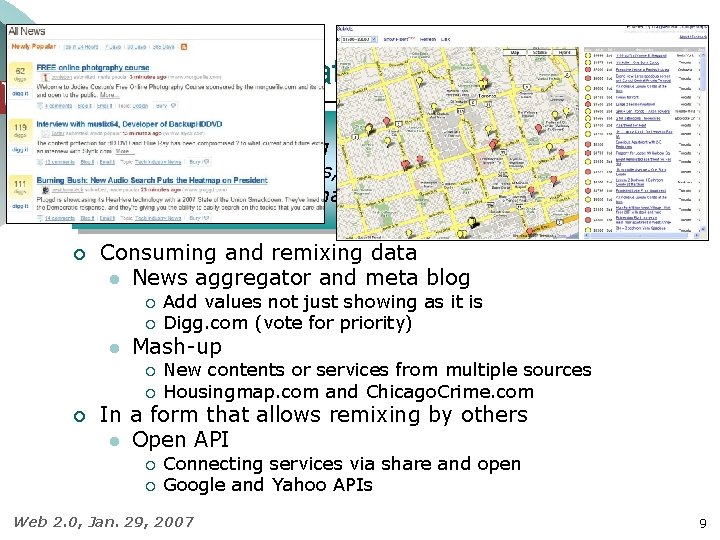
Web 2. 0 Applications (2) Consuming and remixing data from multiple sources, including individual users, while providing their own data and services in a form that allows remixing by others ¡ Consuming and remixing data l News aggregator and meta blog ¡ ¡ l Mash-up ¡ ¡ ¡ Add values not just showing as it is Digg. com (vote for priority) New contents or services from multiple sources Housingmap. com and Chicago. Crime. com In a form that allows remixing by others l Open API ¡ ¡ Connecting services via share and open Google and Yahoo APIs Web 2. 0, Jan. 29, 2007 9
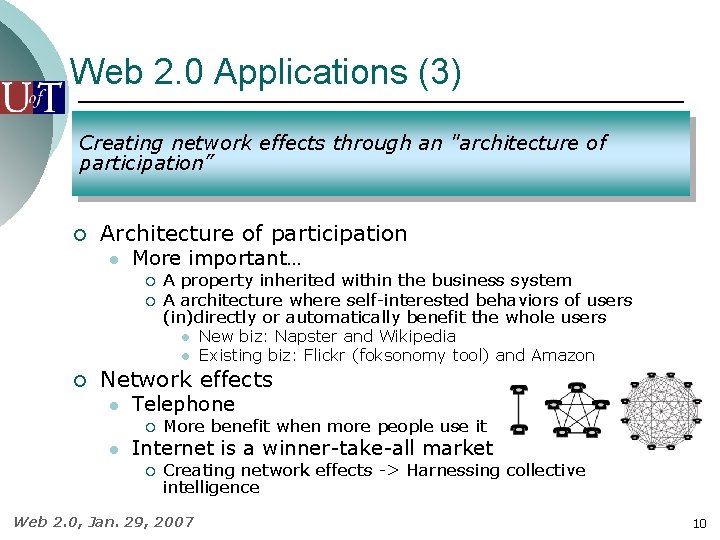
Web 2. 0 Applications (3) Creating network effects through an "architecture of participation” ¡ Architecture of participation l More important… ¡ ¡ A property inherited within the business system A architecture where self-interested behaviors of users (in)directly or automatically benefit the whole users l l ¡ New biz: Napster and Wikipedia Existing biz: Flickr (foksonomy tool) and Amazon Network effects l Telephone ¡ l More benefit when more people use it Internet is a winner-take-all market ¡ Creating network effects -> Harnessing collective intelligence Web 2. 0, Jan. 29, 2007 10
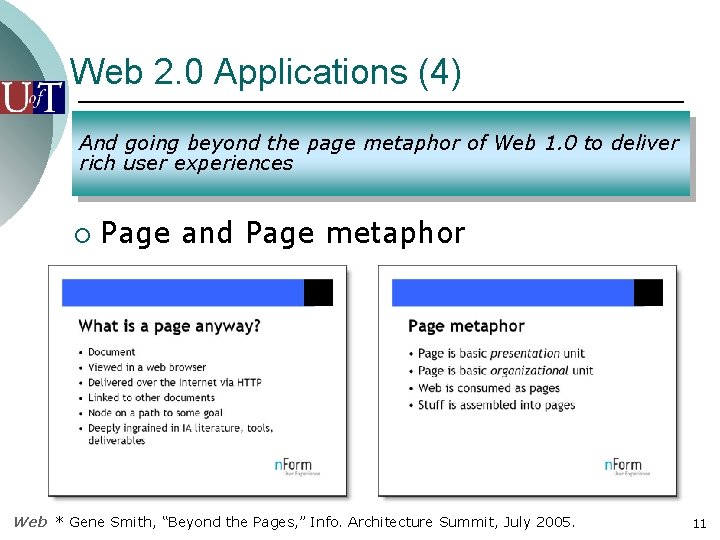
Web 2. 0 Applications (4) And going beyond the page metaphor of Web 1. 0 to deliver rich user experiences ¡ Page and Page metaphor Web 2. 0, * Gene Jan. Smith, 29, 2007 “Beyond the Pages, ” Info. Architecture Summit, July 2005. 11
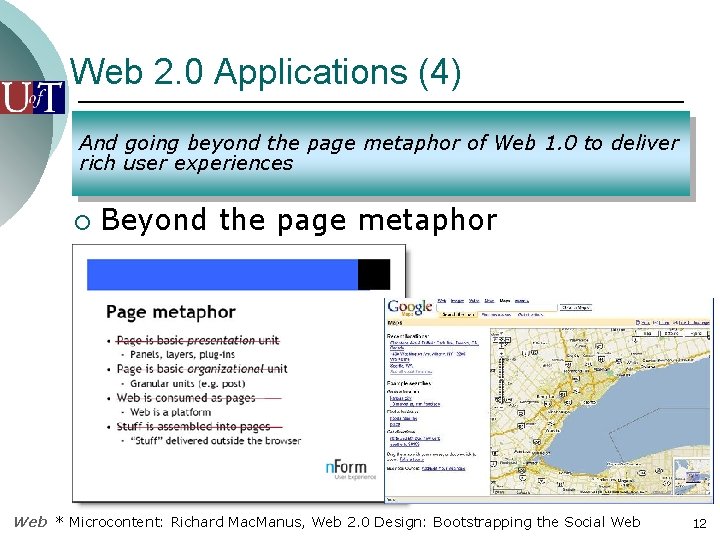
Web 2. 0 Applications (4) And going beyond the page metaphor of Web 1. 0 to deliver rich user experiences ¡ Beyond the page metaphor Web 2. 0, * Microcontent: Jan. 29, 2007 Richard Mac. Manus, Web 2. 0 Design: Bootstrapping the Social Web 12
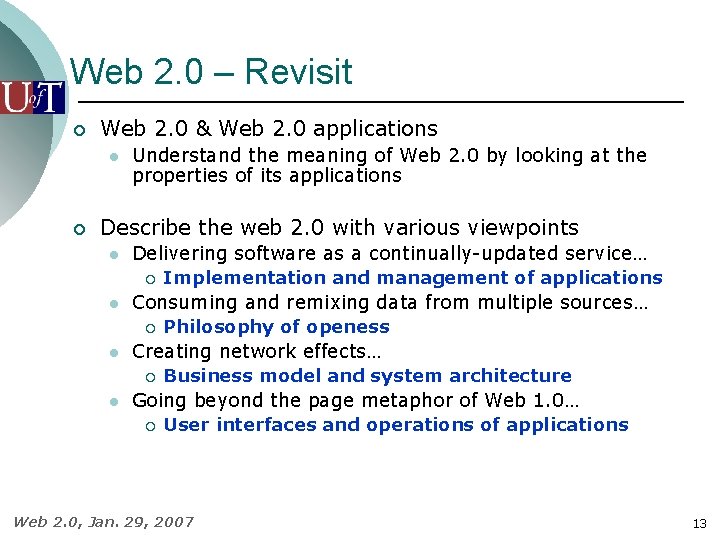
Web 2. 0 – Revisit ¡ Web 2. 0 & Web 2. 0 applications l ¡ Understand the meaning of Web 2. 0 by looking at the properties of its applications Describe the web 2. 0 with various viewpoints l Delivering software as a continually-updated service… ¡ l Consuming and remixing data from multiple sources… ¡ l Philosophy of openess Creating network effects… ¡ l Implementation and management of applications Business model and system architecture Going beyond the page metaphor of Web 1. 0… ¡ User interfaces and operations of applications Web 2. 0, Jan. 29, 2007 13
Agenda (2) ¡ Understanding Web 2. 0 l l ¡ Origins and Concepts Compact Definition Design Patterns and Business Models l l Axes of Design Patterns and Business Models Four plus one in Hierarchy of Web 2. 0 ness Web 1. 0 vs. Web 2. 0 ¡ Mashups & Web 2. 0 + SOA ¡ Controversial Questions ¡ Web 2. 0, Jan. 29, 2007 14
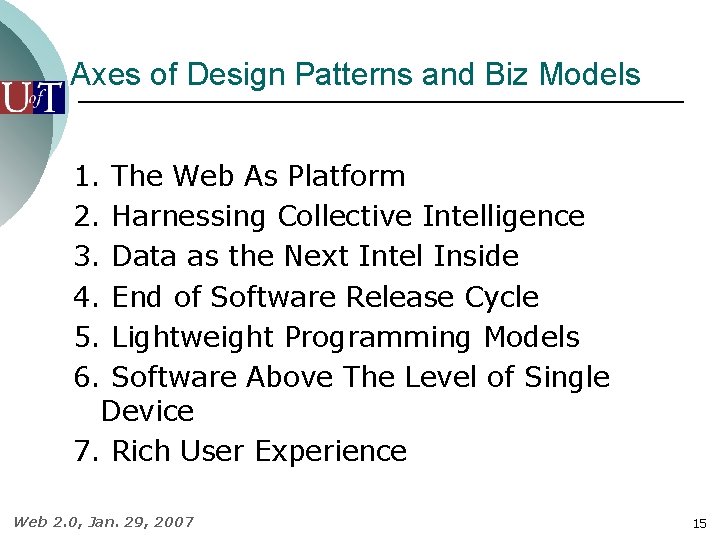
Axes of Design Patterns and Biz Models 1. The Web As Platform 2. Harnessing Collective Intelligence 3. Data as the Next Intel Inside 4. End of Software Release Cycle 5. Lightweight Programming Models 6. Software Above The Level of Single Device 7. Rich User Experience Web 2. 0, Jan. 29, 2007 15
The Web As Platform(1) ¡ Web 2. 0 as a set of principles l l Each web 2. 0 site has part of core principles Netscape vs. Google • Netscape picked old software paradigm l l l Web browser as flagship product use dominance in browser market to sell high-priced server products Try to control over standards for displaying content Both web browsers and web servers turned out to be commodities Value moved up stack to services Web 2. 0, Jan. 29, 2007 16
The Web As Platform(2) l Google delivered as a service ¡ ¡ ¡ ¡ A native web language; never sold or packaged No scheduled release; just continuous improvement Customers pay directly or indirectly for the use of that service Google is a specialized database Value of the software is proportional to the scale and dynamism of the data it helps to manage Google's service is not a server nor a browser It happens in the space between browser, search engine and destination content server Web 2. 0, Jan. 29, 2007 17
The Web As Platform(3) ¡ Akamai vs. Bit. Torrent l Akamai; easy access to high demand sites ¡ ¡ l Do business with the head not the tail Collect revenue from central sites Bit. Torrent, radical approach to internet decentralization ¡ ¡ ¡ More use gets the service better Every consumer brings his own resources to the party Architecture of participation Web 2. 0, Jan. 29, 2007 18
Harnessing Collective Intelligence(1) ¡ Embrace the power of web to harness collective intelligence secret of survive l l Google use Page. Rank instead of using only documents characteristics Yahoo! directory of best links 2 e. Bay’s advantage mass of buyers and sellers Amazon vs. Barnesandnoble. com ¡ ¡ An order of magnitude more user reviews Lead to most popular, based on “flow” around products (sales and other factors) Web 2. 0, Jan. 29, 2007 19
Harnessing Collective Intelligence(2) ¡ Newer apllications l Wikipedia a radical experiment in trust ¡ l Cloudmark Collaborative spam filtering ¡ l “With enough eyeballs, all bugs are shallow” Outperform products based on message analysis Peer-production methods of open source Much of the structure of web like Linux, Apache, My. SQL and Perl, PHP or Python ¡ More than 100, 000 open source software project on Source. Forge. net ¡ Web 2. 0, Jan. 29, 2007 20
Harnessing Collective Intelligence(3) l Blogging and wisdom of crowds RSS much stronger than link or bookmark ¡ Permalink brigde between blogs ¡ An important role in shaping search engine results ¡ Blogosphere a constant mental chatter of global brain ¡ A media in which former media’s audience decide what’s important ¡ Web 2. 0, Jan. 29, 2007 21
Data is Next Intel Inside ¡ ¡ ¡ Every significant internet application is backed by a specialized database Owning an application core data is very important Race in on to own certain classes of data Significant cost to create data Intel Inside play style In others, the winner is the company first reaches critical mass via user aggregation Web 2. 0, Jan. 29, 2007 22
Data is the Next Intel Inside ¡ Example: Map. Quset vs. Amazon l l l Nav. Teq Owner of maps data Map. Quest Pioneer in webmapping 1995 Google and yahoo licensed the same data from Nav. Teq Bowker Primary source of bibliographical data Amazon relentlessly enhanced the data ¡ Cover images, table of contents, index ¡ Harness users to annotate the data ¡ after ten years Amazon is the primary source for bibliographic data on books Web 2. 0, Jan. 29, 2007 23
End of Software Release Cycle ¡ ¡ software delivered as a service, not a product fundamental changes in the business model of companies l Operations must become a core competency ¡ ¡ l Google continuously crawl the web, update its indices, filter out link spam, respond to million user queries simultaneously matching them with contextappropriate advertisements Users must be treated as co-developers ¡ ¡ perpetual beta the product is developed in the open, with new features in a weekly, or even daily basis Real time monitoring of user behavior to see which new features are used Web 2. 0, Jan. 29, 2007 24
Lightweight Programming Models ¡ Support lightweight programming models that allow for loosely coupled systems l Use simple web services like RSS and REST ¡ Amazon 5% SOAP for B 2 B, 95% REST ¡ Think syndication, not coordination l syndicating data outwards, not controlling what happens when it gets to the other end of the connection Reflection of end-to-end principle ¡ Design for "hackability" and remixability l l l Google Maps using AJAX (Javascript and Xml) left the data for taking Barriers to reusability are low Innovation in assembly is the result of this principle mashups Web 2. 0, Jan. 29, 2007 25
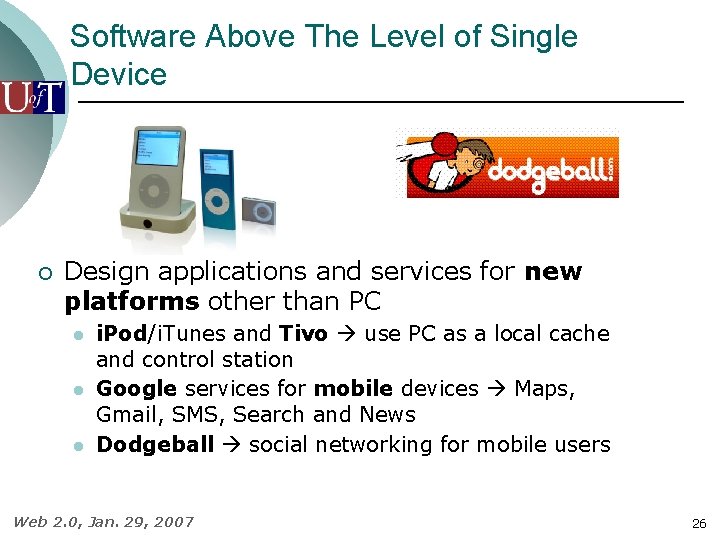
Software Above The Level of Single Device ¡ Design applications and services for new platforms other than PC l l l i. Pod/i. Tunes and Tivo use PC as a local cache and control station Google services for mobile devices Maps, Gmail, SMS, Search and News Dodgeball social networking for mobile users Web 2. 0, Jan. 29, 2007 26
Rich User Experience ¡ User interfaces and PC-equivalent interactivity l ¡ Gmail and Google Maps first web based applications with rich user interface AJAX a key component of Web 2. 0 l l standards-based presentation using XHTML and CSS dynamic display and interaction using the Document Object Model data interchange and manipulation using XML and XSLT asynchronous data retrieval using XMLHttp. Request and Java. Script binding everything together Web 2. 0, Jan. 29, 2007 27
Four plus one in Hierarchy of Web 2. 0 ness ¡ Level 3 Applications The most Web 2. 0 l l l ¡ Level 2 Applications l ¡ ¡ can operate offline but gain advantages from going online Flickr Level 1 Applications l ¡ deriving their power from the human connections and network effects growing in effectiveness the more people use them e. Bay, craigslist, Wikipedia, del. icio. us, Skype, dodgeball, and Adsense Available offline but gain features online writely, i. Tunes Level 0 Applications Google Maps, Map. Quest Non-web Applications l Communication Applications email, instant messaging Web 2. 0, Jan. 29, 2007 28
Core Competencies of Web 2. 0 Companies ¡ ¡ ¡ ¡ Services, not packaged software, with costeffective scalability Control over unique, hard-to-recreate data sources that get richer as more people use them Trusting users as co-developers Harnessing collective intelligence Leveraging the long tail through customer selfservice Software above the level of a single device Lightweight user interfaces, development models, AND business models Web 2. 0, Jan. 29, 2007 29
Agenda (3) ¡ Understanding Web 2. 0 l l ¡ Origins and Concepts Compact Definition Design Patterns and Business Models l l Axes of Design Patterns and Business Models Four plus one in Hierarchy of Web 2. 0 ness Web 1. 0 vs. Web 2. 0 ¡ Mashups & Web 2. 0 + SOA ¡ Controversial Questions ¡ Web 2. 0, Jan. 29, 2007 30
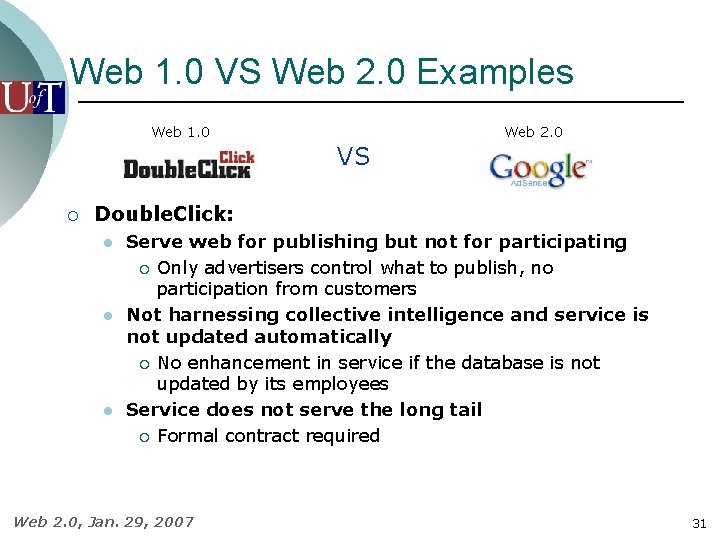
Web 1. 0 VS Web 2. 0 Examples Web 1. 0 Web 2. 0 VS ¡ Double. Click: l l l Serve web for publishing but not for participating ¡ Only advertisers control what to publish, no participation from customers Not harnessing collective intelligence and service is not updated automatically ¡ No enhancement in service if the database is not updated by its employees Service does not serve the long tail ¡ Formal contract required Web 2. 0, Jan. 29, 2007 31
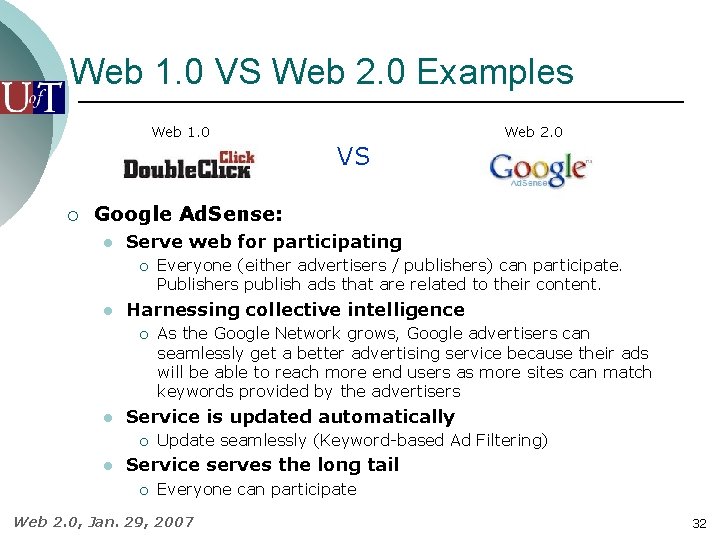
Web 1. 0 VS Web 2. 0 Examples Web 1. 0 Web 2. 0 VS ¡ Google Ad. Sense: l Serve web for participating ¡ l Harnessing collective intelligence ¡ l As the Google Network grows, Google advertisers can seamlessly get a better advertising service because their ads will be able to reach more end users as more sites can match keywords provided by the advertisers Service is updated automatically ¡ l Everyone (either advertisers / publishers) can participate. Publishers publish ads that are related to their content. Update seamlessly (Keyword-based Ad Filtering) Service serves the long tail ¡ Everyone can participate Web 2. 0, Jan. 29, 2007 32
Web 1. 0 VS Web 2. 0 Examples Web 1. 0 Web 2. 0 VS ¡ Ofoto (Kodak Gallery): l l l Serve web for publishing but not for participating ¡ Users upload pictures to web but visitors cannot “find” / “tag” individual pictures in an album Not harnessing collective intelligence ¡ Share albums cannot be viewed easily by search Static user experience ¡ Cannot integrate the creativities from publishers / visitors Web 2. 0, Jan. 29, 2007 33
Web 1. 0 VS Web 2. 0 Examples Web 1. 0 Web 2. 0 VS ¡ flickr l Serve web for participating ¡ Everyone can participate l l Harness collective intelligence ¡ ¡ Tags are used for searching New tag feature: machine tags l l l “Flickr is what butters the borders between your photos to the people you want to see them. ” – www. flickr. com namespace: predicate=value Able to query for wildcards in namespace, predicate, and value Rich user experiences ¡ ¡ Dynamic, encourage creativity Everyone is a developer Web 2. 0, Jan. 29, 2007 34
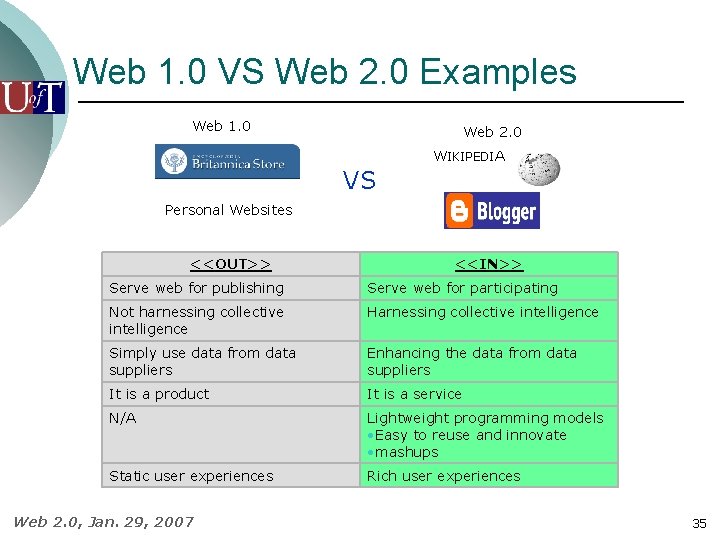
Web 1. 0 VS Web 2. 0 Examples Web 1. 0 Web 2. 0 WIKIPEDIA VS Personal Websites <<OUT>> <<IN>> Serve web for publishing Serve web for participating Not harnessing collective intelligence Harnessing collective intelligence Simply use data from data suppliers Enhancing the data from data suppliers It is a product It is a service N/A Lightweight programming models • Easy to reuse and innovate • mashups Static user experiences Rich user experiences Web 2. 0, Jan. 29, 2007 35
Web 2. 0 continues … (Mashups) ¡ Mashup l ¡ Idea l ¡ Content provider provides API to allow others to build and integrate its content Mashups gendres l l ¡ A website or application that integrates content from more than one source into an entirely new innovative experience Mapping Video and photo Search and shopping News Mashups examples l http: //www. programmableweb. com/ Web 2. 0, Jan. 29, 2007 36
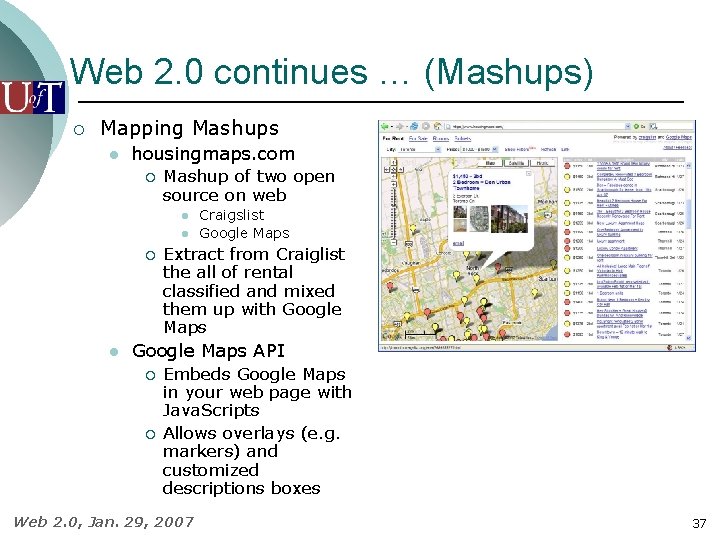
Web 2. 0 continues … (Mashups) ¡ Mapping Mashups l housingmaps. com ¡ Mashup of two open source on web l l ¡ l Craigslist Google Maps Extract from Craiglist the all of rental classified and mixed them up with Google Maps API ¡ ¡ Embeds Google Maps in your web page with Java. Scripts Allows overlays (e. g. markers) and customized descriptions boxes Web 2. 0, Jan. 29, 2007 37
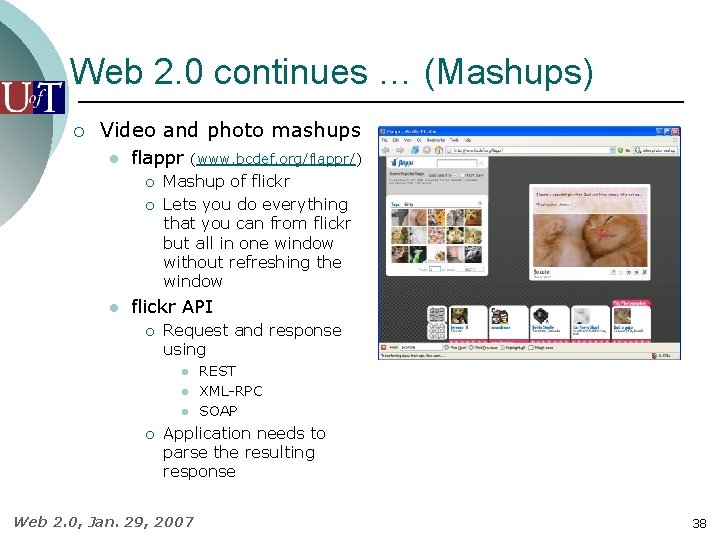
Web 2. 0 continues … (Mashups) ¡ Video and photo mashups l flappr ¡ ¡ l (www. bcdef. org/flappr/) Mashup of flickr Lets you do everything that you can from flickr but all in one window without refreshing the window flickr API ¡ Request and response using l l l ¡ REST XML-RPC SOAP Application needs to parse the resulting response Web 2. 0, Jan. 29, 2007 38
Web 2. 0 continues … (Mashups) ¡ Search and shopping mashups l Examples ¡ ¡ l e. Bay API ¡ l Mashups of e. Bay, Amazon Comparison of best prices, best coupons SOAP Amazon API (AWS) ¡ ¡ REST SOAP Web 2. 0, Jan. 29, 2007 39
Web 2. 0 continues … (Mashups) ¡ News mashups l l l Optevi News Tracker ¡ Mashups of news feeds and semantic web services RSS Feeds Clear. Forest Semantic Web Services ¡ Natural language processing such as text extraction and event detection in a standard web service ¡ Input to the web service is text ¡ Output format is XML or a formatted web page l Web 2. 0, Jan. 29, 2007 The result shows relationships from the input text can be integrated into another application or a web site 40
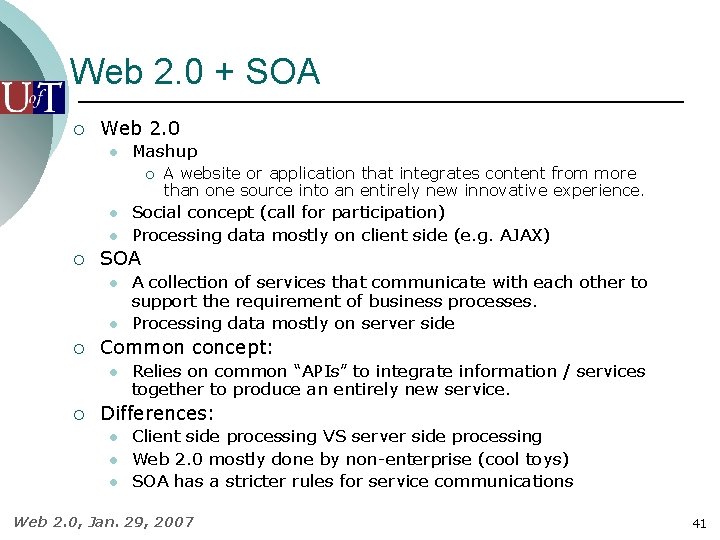
Web 2. 0 + SOA ¡ Web 2. 0 l Mashup ¡ l l ¡ l A collection of services that communicate with each other to support the requirement of business processes. Processing data mostly on server side Common concept: l ¡ Social concept (call for participation) Processing data mostly on client side (e. g. AJAX) SOA l ¡ A website or application that integrates content from more than one source into an entirely new innovative experience. Relies on common “APIs” to integrate information / services together to produce an entirely new service. Differences: l l l Client side processing VS server side processing Web 2. 0 mostly done by non-enterprise (cool toys) SOA has a stricter rules for service communications Web 2. 0, Jan. 29, 2007 41
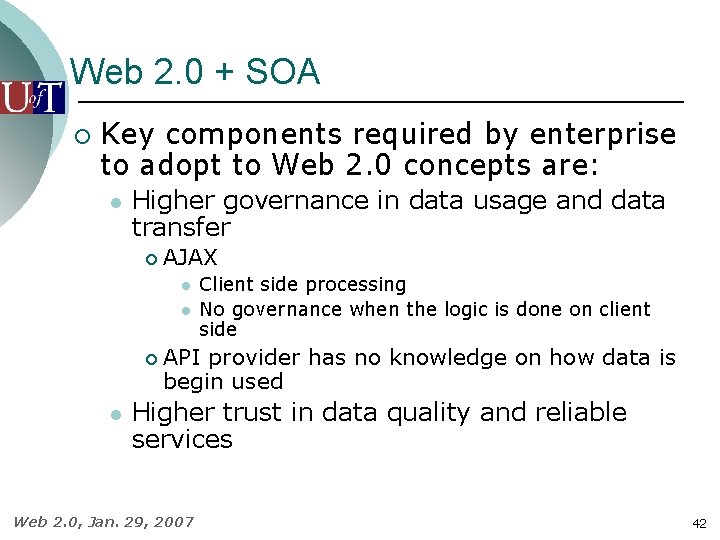
Web 2. 0 + SOA ¡ Key components required by enterprise to adopt to Web 2. 0 concepts are: l Higher governance in data usage and data transfer ¡ AJAX l l ¡ l Client side processing No governance when the logic is done on client side API provider has no knowledge on how data is begin used Higher trust in data quality and reliable services Web 2. 0, Jan. 29, 2007 42
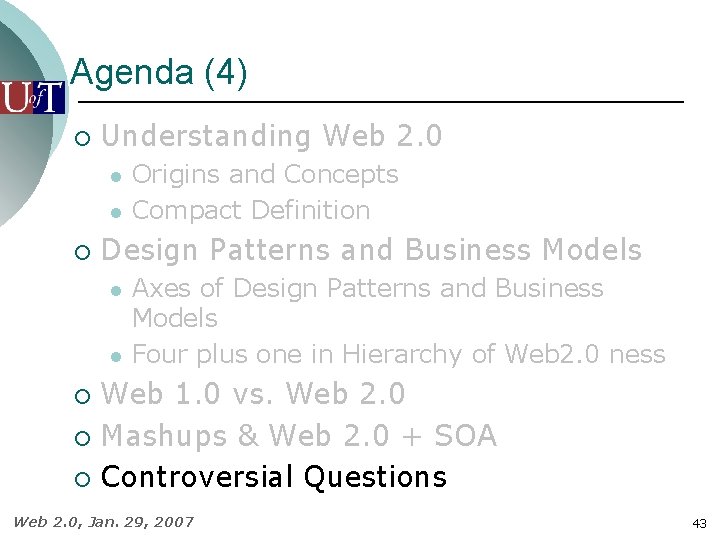
Agenda (4) ¡ Understanding Web 2. 0 l l ¡ Origins and Concepts Compact Definition Design Patterns and Business Models l l Axes of Design Patterns and Business Models Four plus one in Hierarchy of Web 2. 0 ness Web 1. 0 vs. Web 2. 0 ¡ Mashups & Web 2. 0 + SOA ¡ Controversial Questions ¡ Web 2. 0, Jan. 29, 2007 43
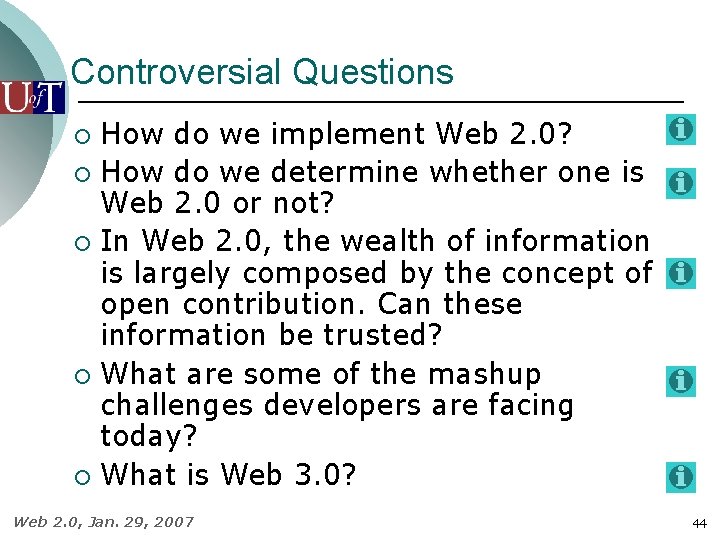
Controversial Questions How do we implement Web 2. 0? ¡ How do we determine whether one is Web 2. 0 or not? ¡ In Web 2. 0, the wealth of information is largely composed by the concept of open contribution. Can these information be trusted? ¡ What are some of the mashup challenges developers are facing today? ¡ What is Web 3. 0? ¡ Web 2. 0, Jan. 29, 2007 44
References ¡ Tim O’Reilly’s blog “Web 2. 0: Compact Definition? ” l ¡ http: //radar. oreilly. com/archives/2005/10/web_20_compact_definition. html Web 2. 0 Conference l http: //web 2 con. com ¡ Lecture “Mobile and Ubiquitous Computing”. Kent University. ¡ Merrill D. “Mashups: The new breed of Web app. ” Aug 2006. l l https: //www. cs. kent. ac. uk/teaching/06/modules/CO/8/31/index. html http: //www-128. ibm. com/developerworks/library/x-mashups. html? ca=dgr-lnxw 16 Mashup. Challenges ¡ Programmableweb. Available asl of Jan 2007 ¡ Chase D. “The ulitmate mashup – Web services and the semantic Web, Part 1: Use and combin Web services. ” Aug 2006. l l ¡ ¡ http: //www. nytimes. com/2006/11/12/business/12 web. html? ex=1320987600&en=254 d 697964 cedc 62&ei= 5088 Tim O’Reilly’s website “What Is Web 2. 0; Design Patterns and Business Models for the Next Generation of Software” l ¡ http: //ajax. sys-con. com/read/276358. htm Markoff, J. “Entrepreneurs See a Web Guided by Common Sense. ” The New York Times. Nov 2006. l ¡ http: //www-128. ibm. com/developerworks/edu/x-dw-x-ultimashup 1. html Crupi, J. “AJAX + SOA: The Next Killer App. ” AJAXWorld Magazine. Jan 2007. l ¡ http: //www. programmableweb. com/ http: //oreillynet. com/pub/a/oreilly/tim/news/2005/09/30/what-is-web-20. html Wikipedia, Web 2. 0 http: //en. wikipedia. org/wiki/Web_2 CTD Report “Rise of the Participation Culture” l http: //www. wsjb. com/RPC/V 1/Home. html Web 2. 0, Jan. 29, 2007 45
Controversial Question (1) ¡ How do we implement Web 2. 0? l l Implementation technology is not a big deal ! The problem is whether your page can encourage people to collaborate efficiently Web 2. 0, Jan. 29, 2007 46
Controversial Question (2) ¡ How do we determine whether one is Web 2. 0 or not? l l From Tim’s article, the properties are interconnected with ‘and’ command Only when your page meet the ALL requirements, it can be Web 2. 0 ¡ Delivering software as a continually-updated service… l ¡ Consuming and remixing data from multiple sources… l ¡ Philosophy of openess Creating network effects… l ¡ Implementation and management of applications Business model and system architecture Going beyond the page metaphor of Web 1. 0… l Web 2. 0, Jan. 29, 2007 User interfaces and operations of applications 47
Controversial Question (3) ¡ In Web 2. 0, the wealth of information is largely composed by the concept of open contribution. Can these information be trusted? l l l The level of integrity of data is “use at your own risk” Need to increase in alertness on the information retrieved from the web Example: ¡ Wikipedia l l Web 2. 0, Jan. 29, 2007 Information largely composed by unregulated anonymous contributors worldwide Only a good starting point for information 48
Controversial Question (4) ¡ What are some of the mashup challenges developers are facing today? l Use of AJAX leads to ¡ Browser compatibility issue l ¡ Java. Script enabled browser l ¡ DOM support on IE does not always conform to W 3 C Affects a minority number of users or automated tools (e. g. Web crawlers) Java. Script can update content asynchronously l l Web 2. 0, Jan. 29, 2007 Content does not link to a specific URL Same content might not be retrieved/viewed again with the BACK button or BOOKMARK feature 49
Controversial Question (5) ¡ What is Web 3. 0? l Semantic Web ¡ l Web 2. 0 + Semantic Web Services (or AI) ¡ ¡ l “The Semantic Web is a vision: the idea of having data on the web defined and linked in a way that it can be used by machines not just for display purposes, but for automation, integration and reuse of data across various applications. “ -Berners-Lee Web 2. 0 is the mashups which brings new and more useful service / service experience by combining two or more different services Semantic Web Services which machines can interconnect and combine services automatically and seamlessly Search engine should no longer return a long list of links that do no answer your question directly but rather gives you direct answer to your question. Web 2. 0, Jan. 29, 2007 50
- Slides: 50