
What Is Vibration It is the response of
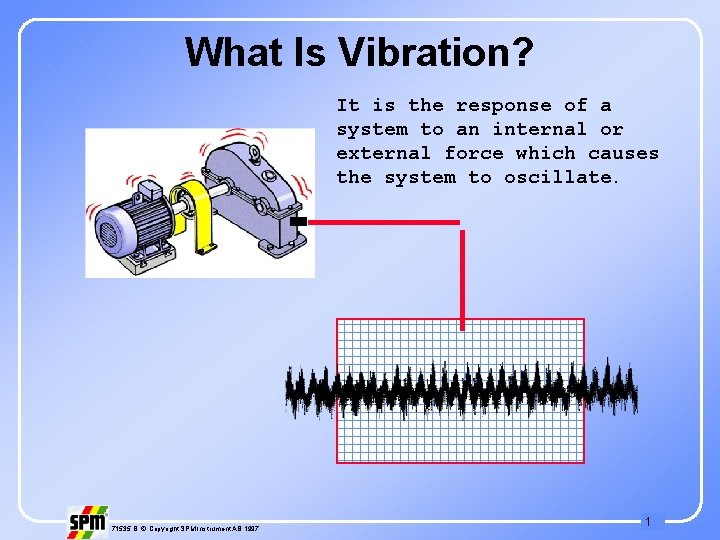
What Is Vibration? It is the response of a system to an internal or external force which causes the system to oscillate. 71535 B © Copyright SPM Instrument AB 1997 1
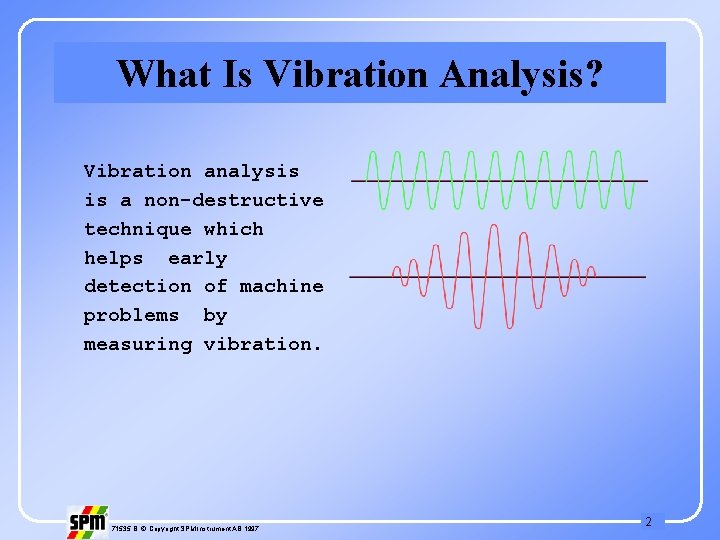
What Is Vibration Analysis? Vibration analysis is a non-destructive technique which helps early detection of machine problems by measuring vibration. 71535 B © Copyright SPM Instrument AB 1997 2

Detection By Vibration Analysis 1. Unbalance(Static, Couple, Quasi-Static), 2. Misalignment(Angular, Parallel, Combination) 3. Eccentric Rotor, Bent Shaft 4. Mechanical Looseness, Structural Weakness, Soft Foot 5. Resonance, Beat Vibration 6. Mechanical Rubbing 7. Problems Of Belt Driven Machines 8. Journal Bearing Defects 9. Antifriction Bearing Defects (Inner race, Outer race, Cage, Rolling Elements) 10. Problems of Hydrodynamic & Aerodynamic Machines (Blade Or Vane, Flow turbulence, Cavitation) 11. Gear Problems (Tooth wear, Tooth load, Gear eccentricity, Backlash, Gear misalignment, Cracked Or Broken Tooth) 12. Electrical Problems of AC & DC Motor ( Variable Air Gap, Rotor Bar Defect, Problems of SCRs) 71535 B © Copyright SPM Instrument AB 1997 3

Basic Theory Of Vibration Simple Spring Mass System Neutral Position Lower Position Max Vel Mim Acc Displacement Upper Limit Max Acc Mim Vel It follows sine curve. 71535 B © Copyright SPM Instrument AB 1997 4
Frequency & Amplitude Frequency: How many times oscillation is occurring for a given time period? Units: CPS(Hz), CPM Amplitude: It is the magnitude of vibration signal. Units: Micron, MM/Sec, M/Sec 2 71535 B © Copyright SPM Instrument AB 1997 5
Physical Significance Of Vibration Characteristics Frequency - What is vibrating? Source of the vibration. Amplitude - How much is it vibrating? Size (severity) of the problem. Phase Angle - How is it vibrating? Cause of the vibration. 71535 B © Copyright SPM Instrument AB 1997 6
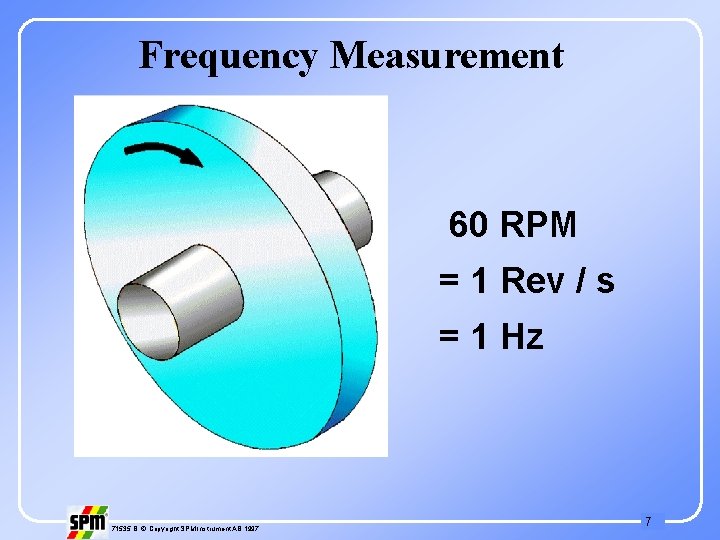
Frequency Measurement 60 RPM = 1 Rev / s = 1 Hz 71535 B © Copyright SPM Instrument AB 1997 7

Amplitude Measurement 1. Displacement : Total distance traveled by the mass. Unit : Microns 2. Velocity : Rate of change of displacement. It is the measure of the speed at which the mass is vibrating during its oscillation. Unit : MM/Sec, Inch/sec 3. Acceleration : It is the rate of change of velocity. The greater the rate of change of velocity the greater the forces (P=mf) on the machines. Unit : M/Sec 2, Inch/sec 2 71535 B © Copyright SPM Instrument AB 1997 8
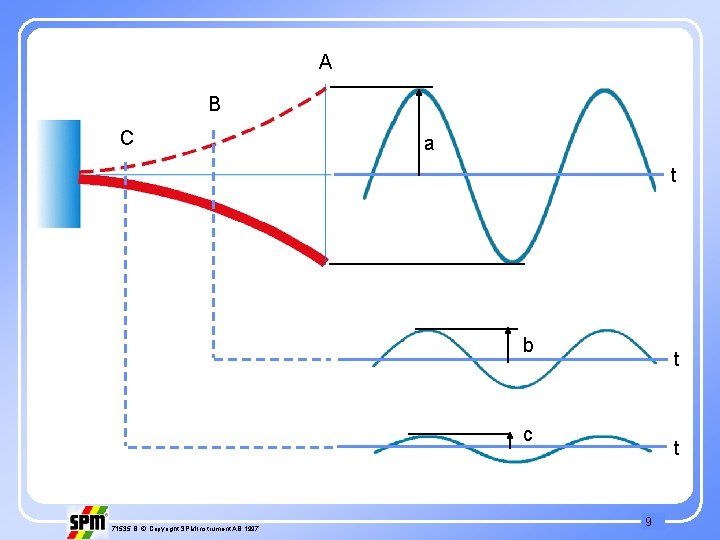
A B C a t b t c 71535 B © Copyright SPM Instrument AB 1997 t 9
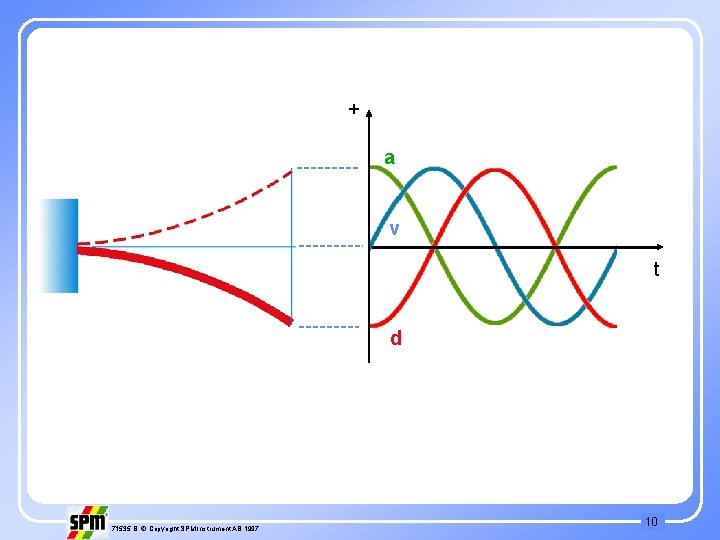
+ a v t d 71535 B © Copyright SPM Instrument AB 1997 10
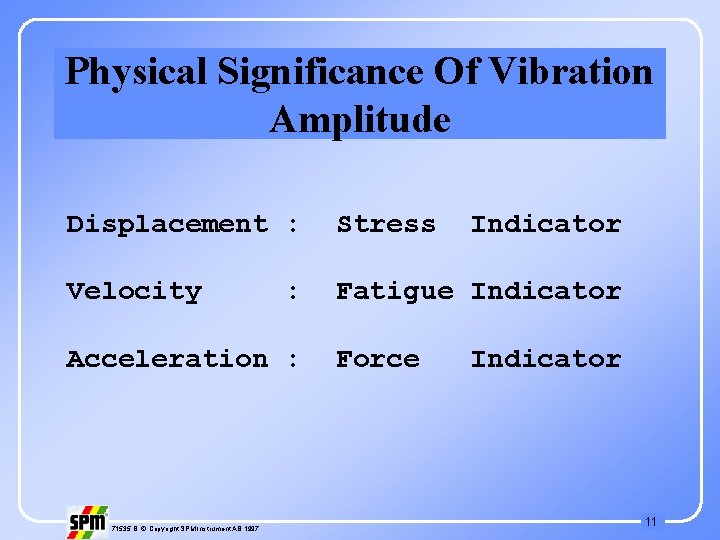
Physical Significance Of Vibration Amplitude Displacement : Stress Velocity Fatigue Indicator : Acceleration : 71535 B © Copyright SPM Instrument AB 1997 Force Indicator 11
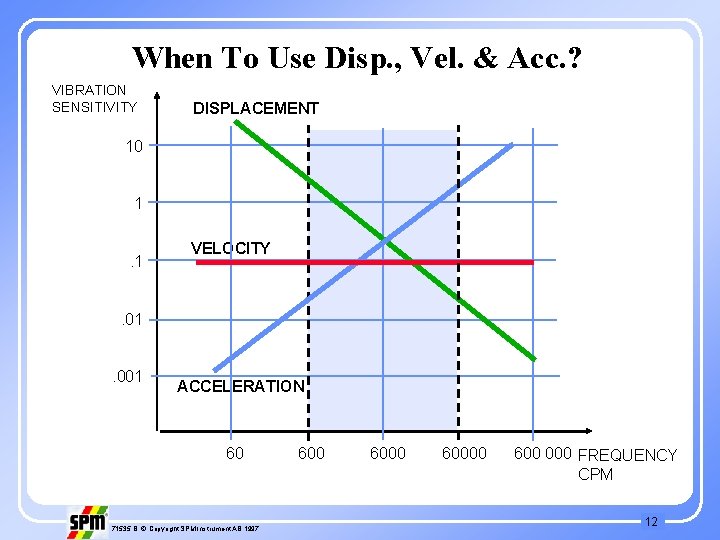
When To Use Disp. , Vel. & Acc. ? VIBRATION SENSITIVITY DISPLACEMENT 10 1. 1 VELOCITY . 01. 001 ACCELERATION 60 71535 B © Copyright SPM Instrument AB 1997 60000 600 000 FREQUENCY CPM 12
What Is The Advantage Of Using Velocity? • Flat frequency range compared to displacement & acceleration. • Almost all machines generate fault frequency between 600 CPM to 60 KCPM • Velocity indicates fatigue. • Velocity is the best indicator of vibration severity. 71535 B © Copyright SPM Instrument AB 1997 13
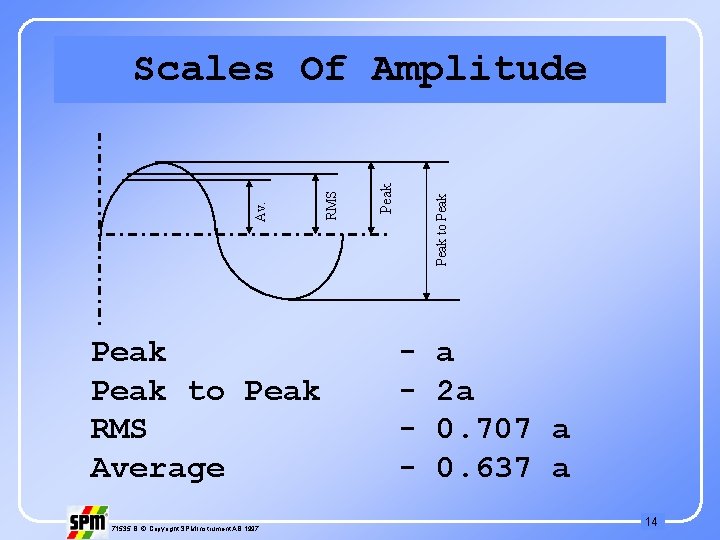
Peak to Peak RMS Average 71535 B © Copyright SPM Instrument AB 1997 Peak to Peak RMS Av. Scales Of Amplitude - a 2 a 0. 707 a 0. 637 a 14

Vibration Transducers Produces electrical signal of vibratory motion Proximity Probe - Displacement Velocity Probe - Velocity Accelerometer - Acceleration 71535 B © Copyright SPM Instrument AB 1997 15
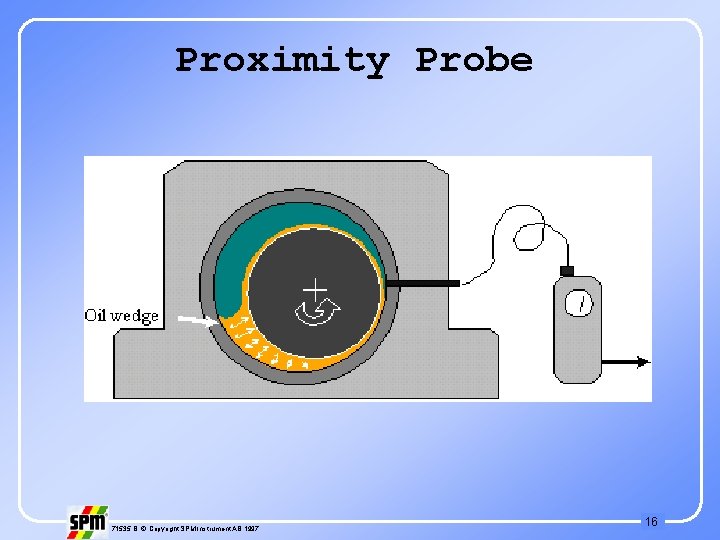
Proximity Probe 71535 B © Copyright SPM Instrument AB 1997 16
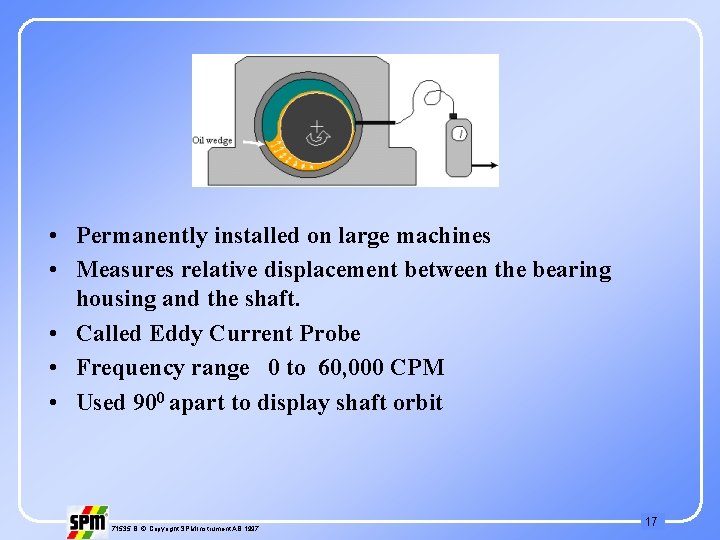
• Permanently installed on large machines • Measures relative displacement between the bearing housing and the shaft. • Called Eddy Current Probe • Frequency range 0 to 60, 000 CPM • Used 900 apart to display shaft orbit 71535 B © Copyright SPM Instrument AB 1997 17
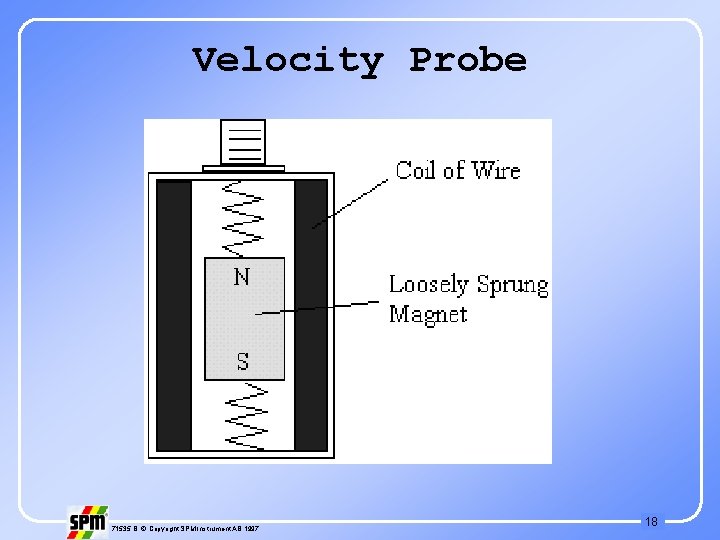
Velocity Probe 71535 B © Copyright SPM Instrument AB 1997 18
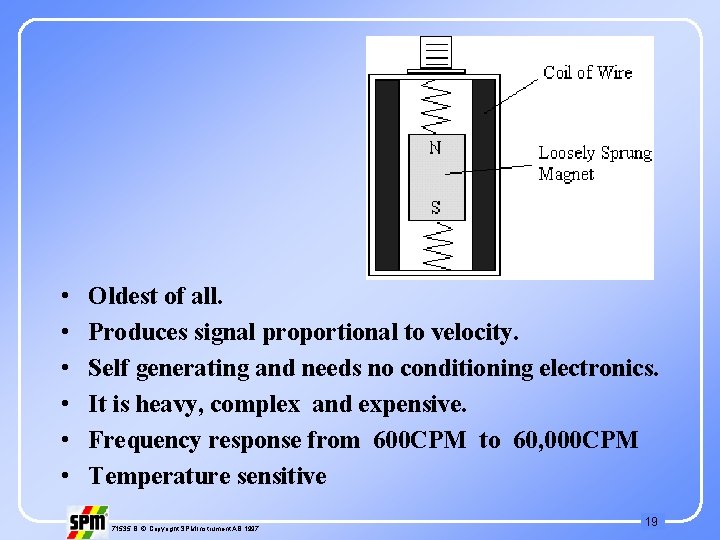
• • • Oldest of all. Produces signal proportional to velocity. Self generating and needs no conditioning electronics. It is heavy, complex and expensive. Frequency response from 600 CPM to 60, 000 CPM Temperature sensitive 71535 B © Copyright SPM Instrument AB 1997 19
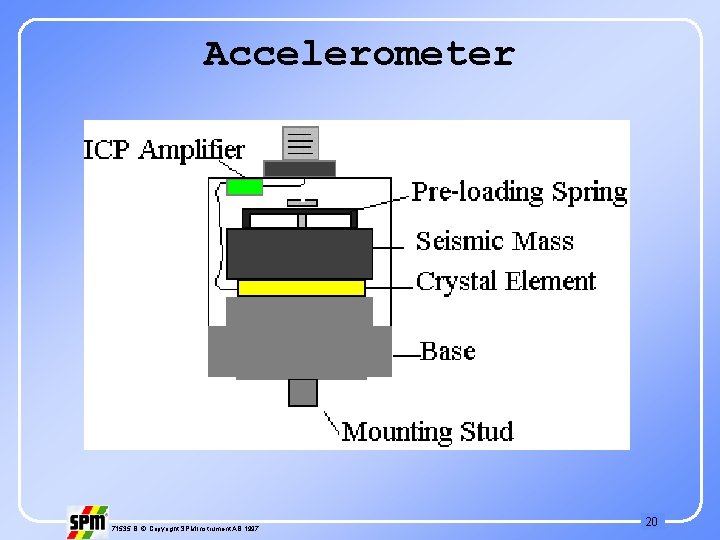
Accelerometer 71535 B © Copyright SPM Instrument AB 1997 20
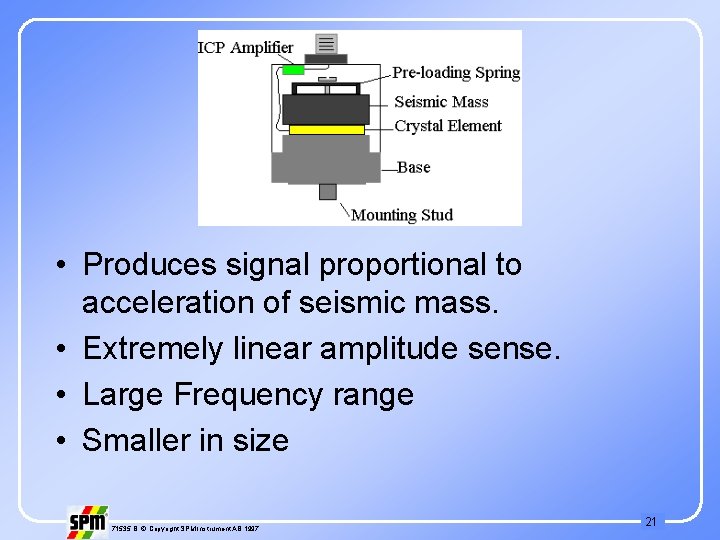
• Produces signal proportional to acceleration of seismic mass. • Extremely linear amplitude sense. • Large Frequency range • Smaller in size 71535 B © Copyright SPM Instrument AB 1997 21

Phase 71535 B © Copyright SPM Instrument AB 1997 22
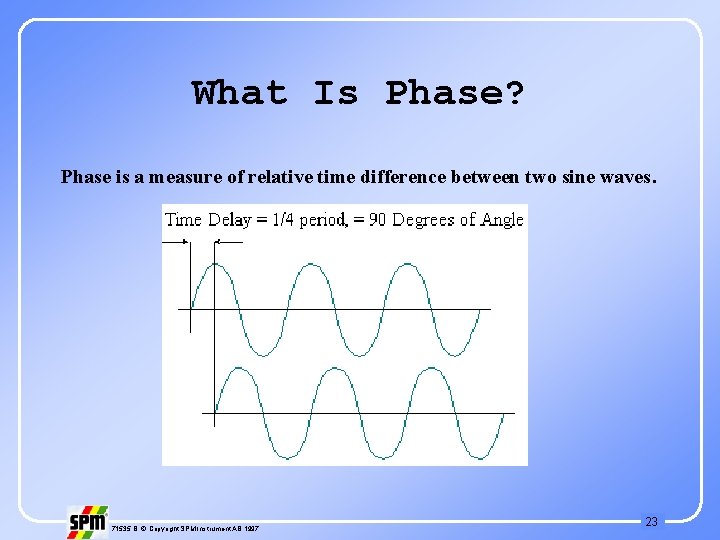
What Is Phase? Phase is a measure of relative time difference between two sine waves. 71535 B © Copyright SPM Instrument AB 1997 23
Importance Of Phase • Phase is a relative measurement. • Provides information how one part of a machine is vibrating compared to other. • Confirmatory tool for problems like 1. Unbalance(Static, Couple, Quasi-Static). 2. Misalignment(Angular, Parallel, Combination). 3. Eccentric Rotor, Bent Shaft. 4. Mechanical Looseness, Structural Weakness, Soft Foot. 5. Resonance. 6. Cocked bearing. • No correlation with Bearing defects, Gear defects, Electrical motor defect. 71535 B © Copyright SPM Instrument AB 1997 24
How Phase Angle Is Measured? The Phase Angle is the angle (in degrees) the shaft travels from the start of data collection to when the sensor experiences maximum positive force. For example, the phase angle is 90° if the sensor experiences its maximum positive force at 90° after data collection was initiated by the tachometer. 71535 B © Copyright SPM Instrument AB 1997 25
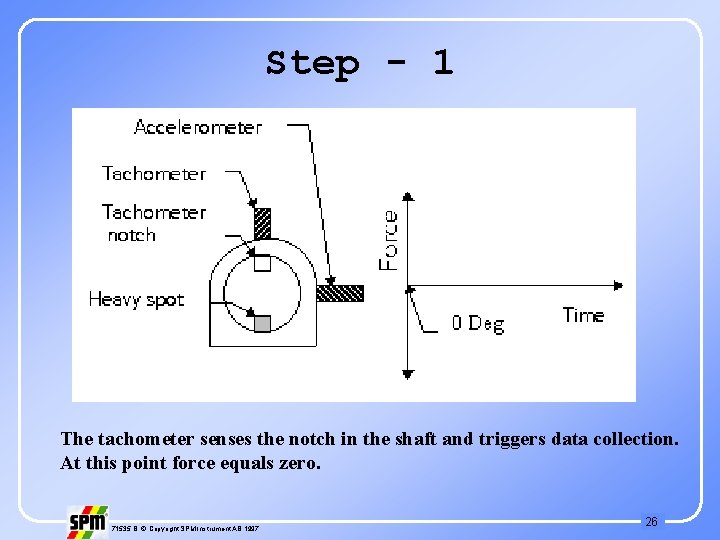
Step - 1 The tachometer senses the notch in the shaft and triggers data collection. At this point force equals zero. 71535 B © Copyright SPM Instrument AB 1997 26
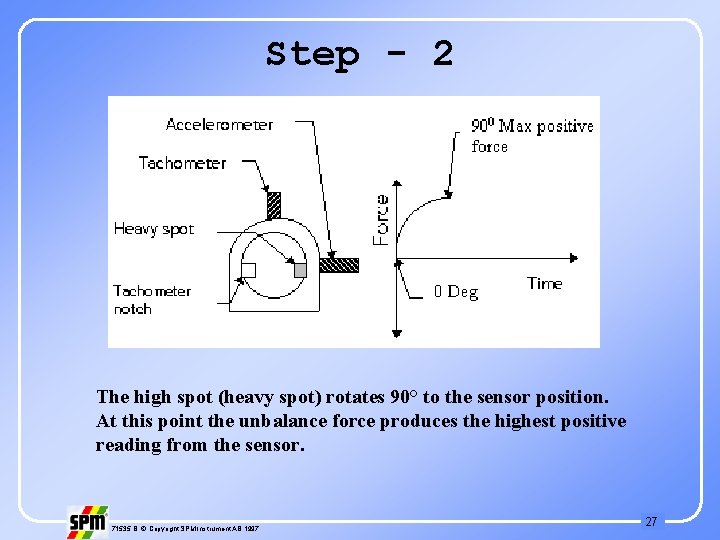
Step - 2 The high spot (heavy spot) rotates 90° to the sensor position. At this point the unbalance force produces the highest positive reading from the sensor. 71535 B © Copyright SPM Instrument AB 1997 27
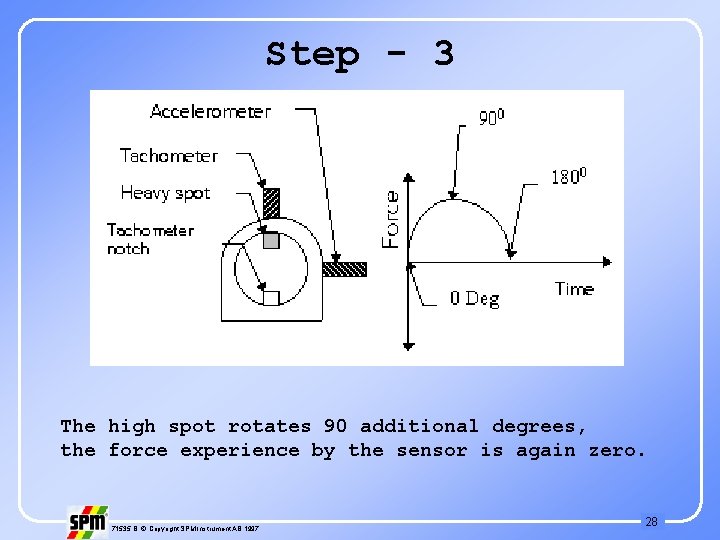
Step - 3 The high spot rotates 90 additional degrees, the force experience by the sensor is again zero. 71535 B © Copyright SPM Instrument AB 1997 28
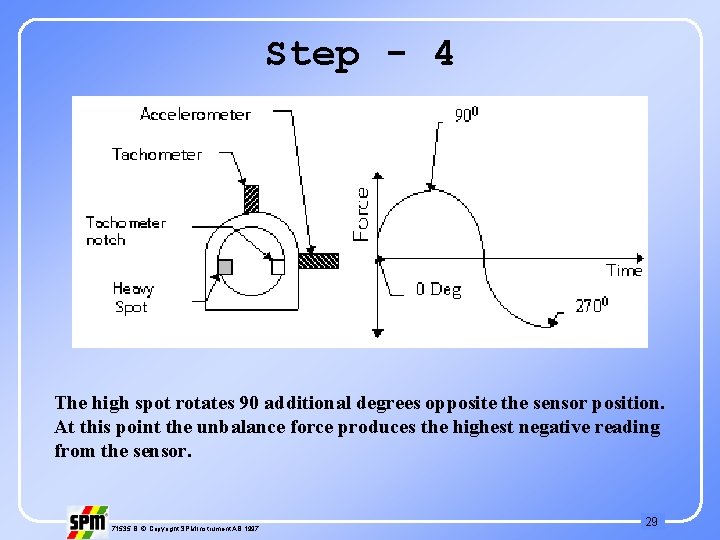
Step - 4 The high spot rotates 90 additional degrees opposite the sensor position. At this point the unbalance force produces the highest negative reading from the sensor. 71535 B © Copyright SPM Instrument AB 1997 29
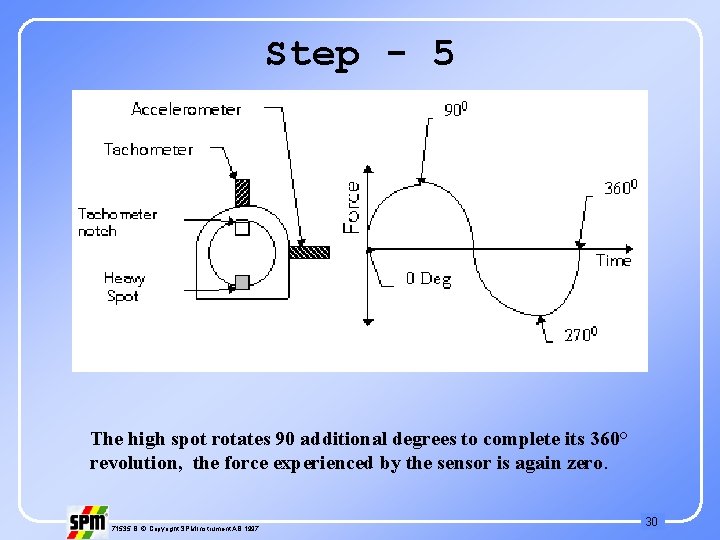
Step - 5 The high spot rotates 90 additional degrees to complete its 360° revolution, the force experienced by the sensor is again zero. 71535 B © Copyright SPM Instrument AB 1997 30
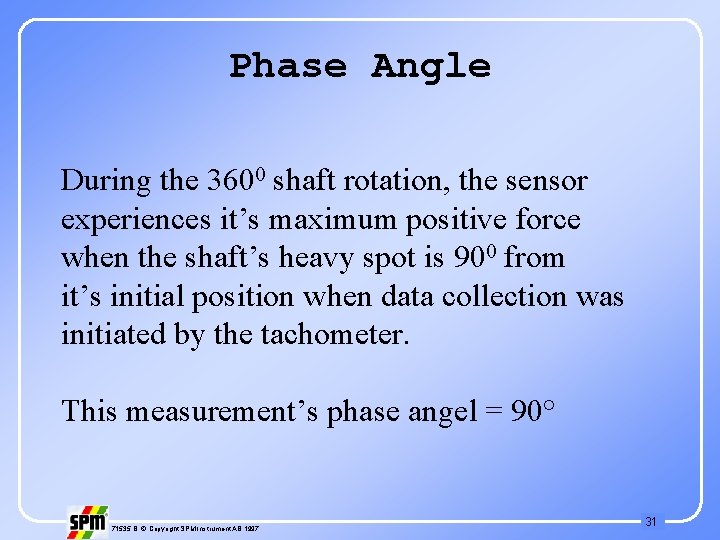
Phase Angle During the 3600 shaft rotation, the sensor experiences it’s maximum positive force when the shaft’s heavy spot is 900 from it’s initial position when data collection was initiated by the tachometer. This measurement’s phase angel = 90° 71535 B © Copyright SPM Instrument AB 1997 31

FFT Spectrum Analysis 71535 B © Copyright SPM Instrument AB 1997 32

What Is FFT? • Known as Fast Fourier Transformation. • Developed by J. B. Fourier in 1874. 71535 B © Copyright SPM Instrument AB 1997 33
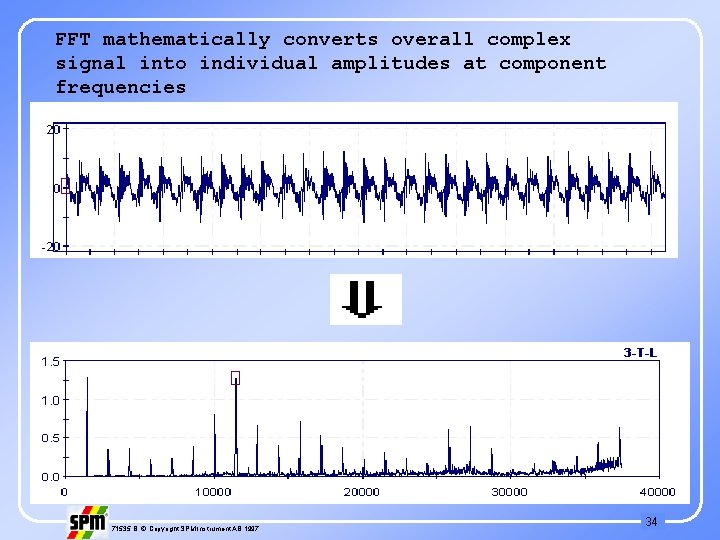
FFT mathematically converts overall complex signal into individual amplitudes at component frequencies 71535 B © Copyright SPM Instrument AB 1997 34
• Different machinery problems cause vibration at different frequencies. • Overall vibration coming out from machine is combination of many vibration signals form various machine parts and it’s structure. • FFT is a method of viewing the signal with respect to frequency. 71535 B © Copyright SPM Instrument AB 1997 35
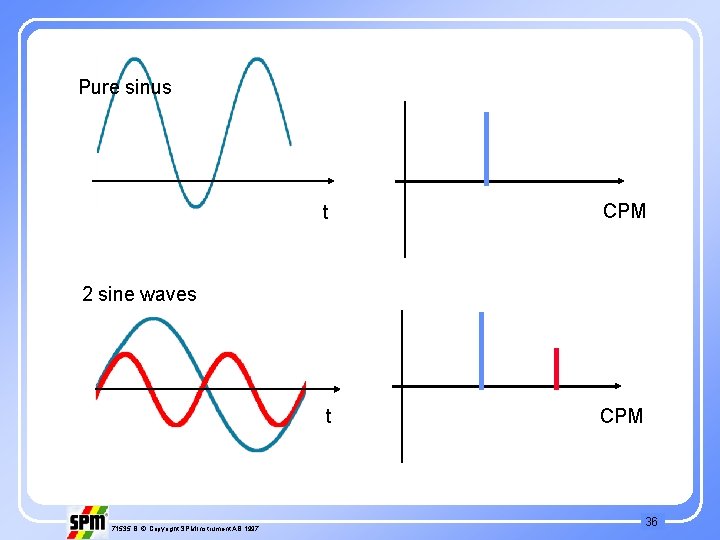
Pure sinus t CPM 2 sine waves 71535 B © Copyright SPM Instrument AB 1997 36
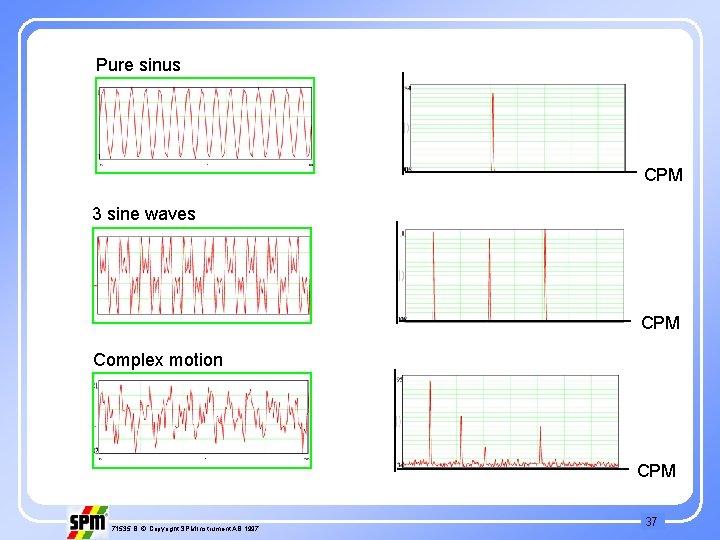
Pure sinus CPM 3 sine waves CPM Complex motion CPM 71535 B © Copyright SPM Instrument AB 1997 37

Spectrum Analysis Techniques 71535 B © Copyright SPM Instrument AB 1997 38
Step - 1 Collect useful information • History of machine. • Control room data - speed, feed, temperature, pressure etc. • Name plate details - bearing no, no of gear teeth etc. • Design operating parameters, critical speed. 71535 B © Copyright SPM Instrument AB 1997 39
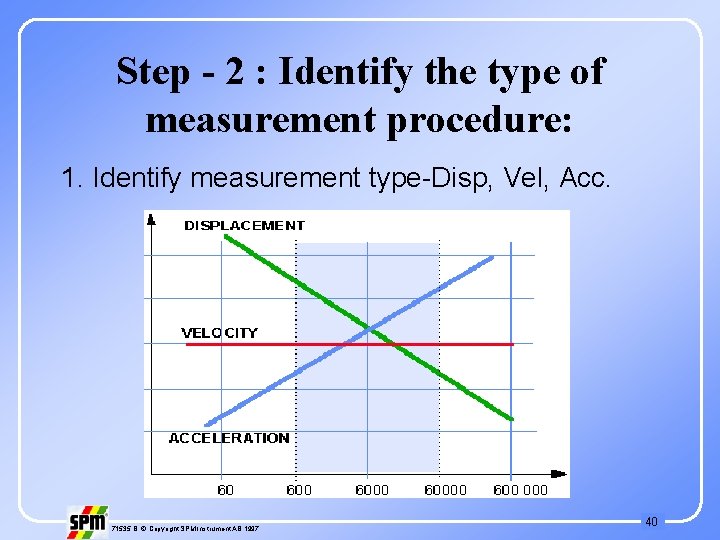
Step - 2 : Identify the type of measurement procedure: 1. Identify measurement type-Disp, Vel, Acc. 71535 B © Copyright SPM Instrument AB 1997 40
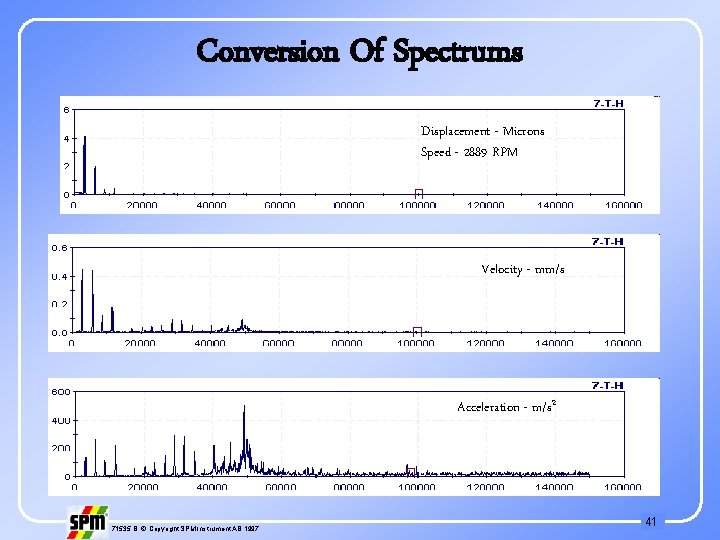
Conversion Of Spectrums Displacement- Microns Speed - 2889 RPM Velocity - mm/s Acceleration - m/s 2 71535 B © Copyright SPM Instrument AB 1997 41
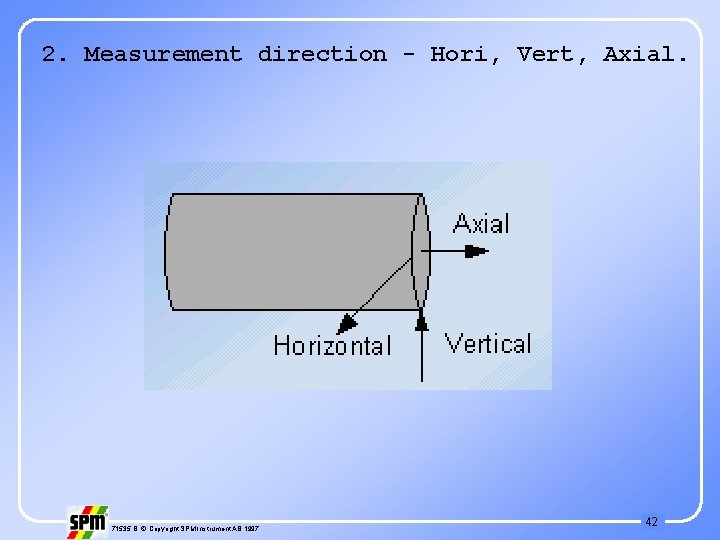
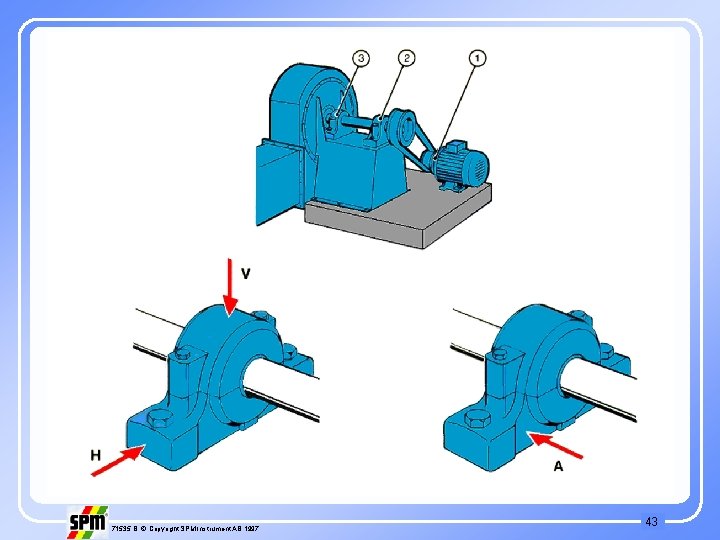
2. Measurement direction - Hori, Vert, Axial. 71535 B © Copyright SPM Instrument AB 1997 42
71535 B © Copyright SPM Instrument AB 1997 43
Step - 3 Analyze: 1. Evaluate overall vibration reading of the entire machine. (a) Identify 1 x RPM peak. (b) Locate highest amplitude. (c) What is the direction of the highest amplitude? (d) What is the frequency of the highest amplitude? 2. See the values of Shock pulse, HFD etc. 3. See the trend - in case of sudden increase the problem severity increases. 4. Analyze the frequency for possible defects. 5. Analyze the phase readings for confirmation if necessary. 71535 B © Copyright SPM Instrument AB 1997 44
Manual Vibration Analysis 71535 B © Copyright SPM Instrument AB 1997 45
Detection By Vibration Analysis 1. 2. 3. 4. 5. 6. 7. 8. 9. Unbalance(Static, Couple, Quasi-Static), Misalignment(Angular, Parallel, Combination) Eccentric Rotor, Bent Shaft Mechanical Looseness, Structural Weakness, Soft Foot Resonance, Beat Vibration Mechanical Rubbing Problems Of Belt Driven Machines Journal Bearing Defects Antifriction Bearing Defects (Inner race, Outer race, Cage, Rolling Elements) 10. Hydrodynamic & Aerodynamic Forces (Blade Or Vane, Flow turbulence, Cavitation) 11. Gear Problems (Tooth wear, Tooth load, Gear eccentricity, Backlash, Gear misalignment, Cracked Or Broken Tooth) 12. Electrical Problems of AC & DC Motor ( Variable Air Gap, Rotor Bar Defect, Problems of SCRs) 71535 B © Copyright SPM Instrument AB 1997 46

Unbalance 71535 B © Copyright SPM Instrument AB 1997 47
Causes Of Unbalance • • Uneven distribution of mass of rotor. Dirt accumulation on fan rotors. Rotor eccentricity Roller deflection, especially in paper machines Machining errors Uneven erosion and corrosion of pump impellers Missing balance weights 71535 B © Copyright SPM Instrument AB 1997 48
Types Of Unbalance • Static Unbalance • Couple Unbalance • Overhang Rotor Unbalance 71535 B © Copyright SPM Instrument AB 1997 49
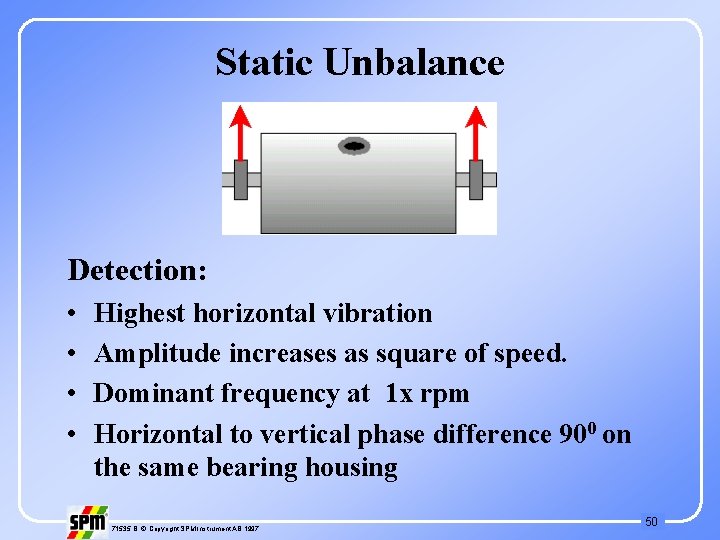
Static Unbalance Detection: • • Highest horizontal vibration Amplitude increases as square of speed. Dominant frequency at 1 x rpm Horizontal to vertical phase difference 900 on the same bearing housing 71535 B © Copyright SPM Instrument AB 1997 50
Correction Can be corrected by one balance weight 71535 B © Copyright SPM Instrument AB 1997 51
2. Vibration Phase Analysis: Angular - 1800 phase shift in the axial direction across the coupling. Offset - 1800 phase shift in the radial direction across the coupling. 00 to 1800 phase shift occur as the sensor moves from horizontal to the vertical direction of the same machine. Skew - 1800 phase shift in the axial or radial direction across the coupling. 71535 B © Copyright SPM Instrument AB 1997 52
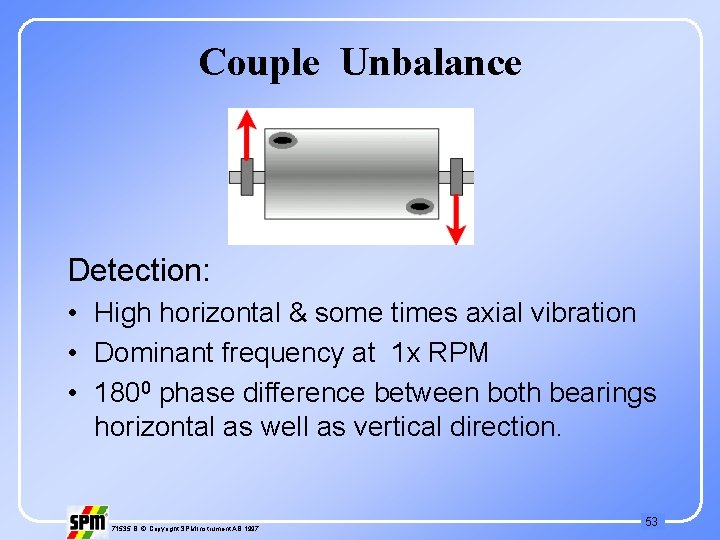
Couple Unbalance Detection: • High horizontal & some times axial vibration • Dominant frequency at 1 x RPM • 1800 phase difference between both bearings horizontal as well as vertical direction. 71535 B © Copyright SPM Instrument AB 1997 53
Correction It requires two plane balancing 71535 B © Copyright SPM Instrument AB 1997 54
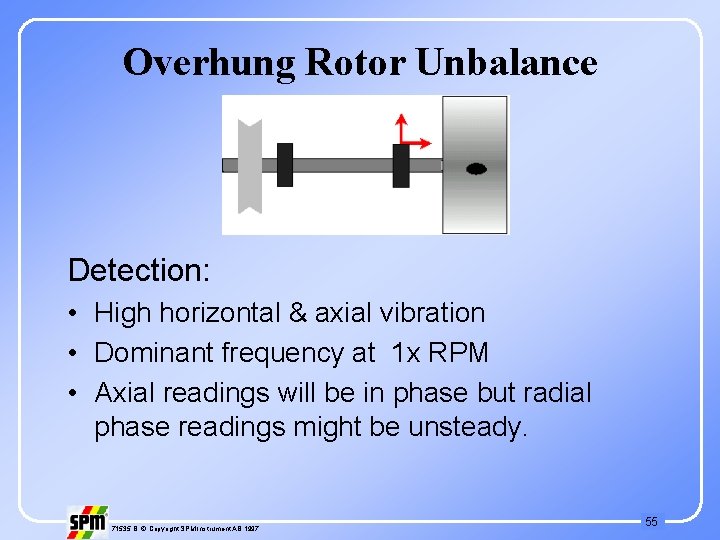
Overhung Rotor Unbalance Detection: • High horizontal & axial vibration • Dominant frequency at 1 x RPM • Axial readings will be in phase but radial phase readings might be unsteady. 71535 B © Copyright SPM Instrument AB 1997 55
Correction Overhung rotors might be having both static and couple unbalance and each of which requires correction. 71535 B © Copyright SPM Instrument AB 1997 56

Misalignment 71535 B © Copyright SPM Instrument AB 1997 57
Causes Of Misalignment • Thermal expansion - Most machines align cold. • Machine vibrations. • Forces transmitted to the machine by pipe or support structure. • Soft foot. • Direct coupled machined are not properly aligned. • Poor workmanship. 71535 B © Copyright SPM Instrument AB 1997 58
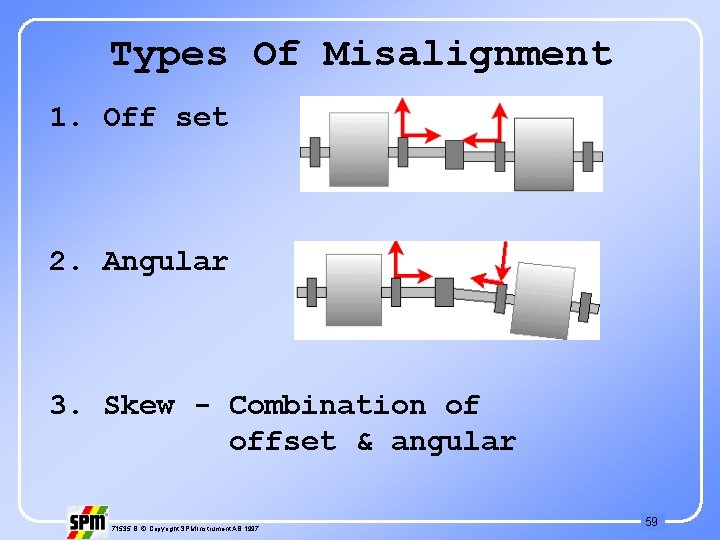
Types Of Misalignment 1. Off set 2. Angular 3. Skew - Combination of offset & angular 71535 B © Copyright SPM Instrument AB 1997 59

Diagnosis Of Misalignment 71535 B © Copyright SPM Instrument AB 1997 60
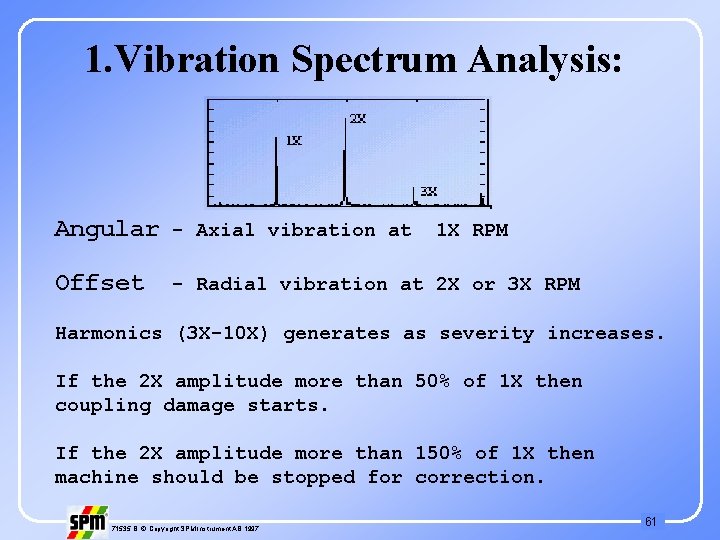
1. Vibration Spectrum Analysis: Angular - Axial vibration at Offset - Radial vibration at 2 X or 3 X RPM 1 X RPM Harmonics (3 X-10 X) generates as severity increases. If the 2 X amplitude more than 50% of 1 X then coupling damage starts. If the 2 X amplitude more than 150% of 1 X then machine should be stopped for correction. 71535 B © Copyright SPM Instrument AB 1997 61
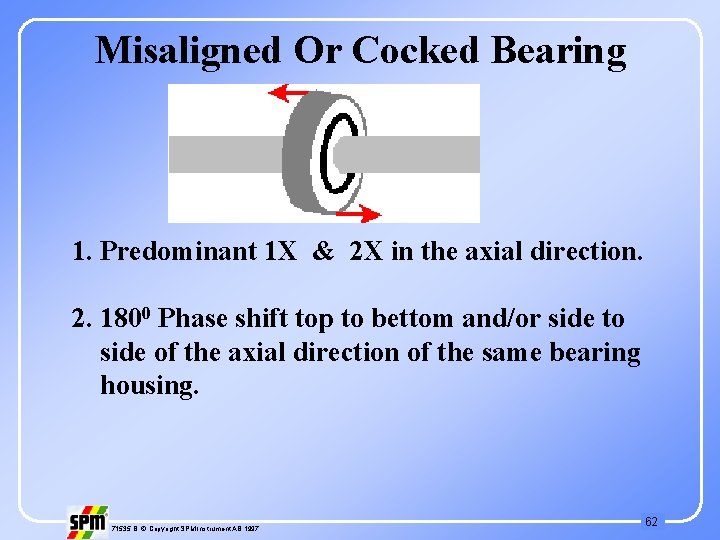
Misaligned Or Cocked Bearing 1. Predominant 1 X & 2 X in the axial direction. 2. 1800 Phase shift top to bettom and/or side to side of the axial direction of the same bearing housing. 71535 B © Copyright SPM Instrument AB 1997 62
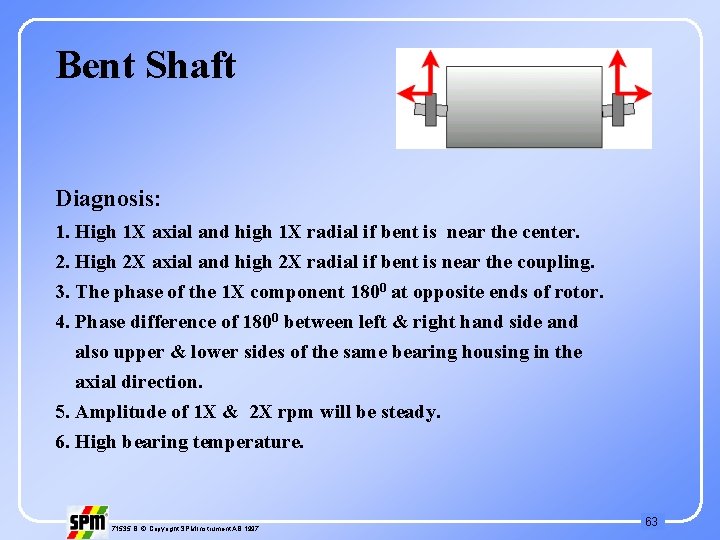
Bent Shaft Diagnosis: 1. High 1 X axial and high 1 X radial if bent is near the center. 2. High 2 X axial and high 2 X radial if bent is near the coupling. 3. The phase of the 1 X component 1800 at opposite ends of rotor. 4. Phase difference of 1800 between left & right hand side and also upper & lower sides of the same bearing housing in the axial direction. 5. Amplitude of 1 X & 2 X rpm will be steady. 6. High bearing temperature. 71535 B © Copyright SPM Instrument AB 1997 63
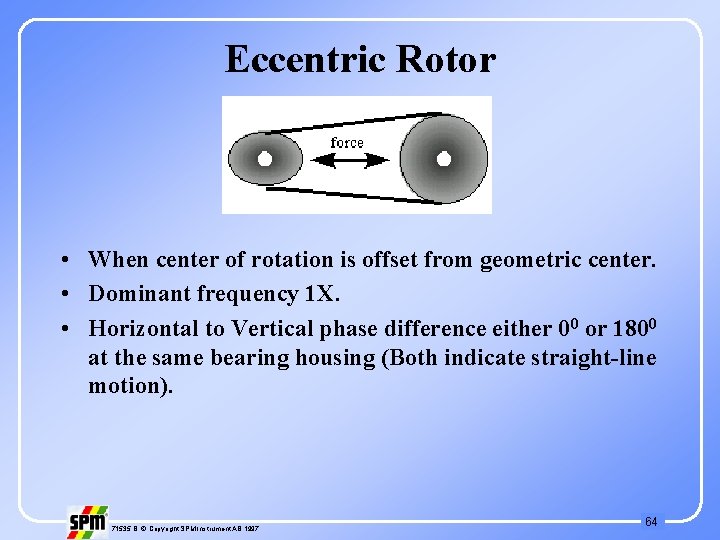
Eccentric Rotor • When center of rotation is offset from geometric center. • Dominant frequency 1 X. • Horizontal to Vertical phase difference either 00 or 1800 at the same bearing housing (Both indicate straight-line motion). 71535 B © Copyright SPM Instrument AB 1997 64
Resonance • Occurs when forcing frequency coincides with system natural frequency. • Causes amplitude amplification which results catastrophic failure. • Requires changing of natural frequency or change of operating speed. • Bode plot is used to identify resonance. 71535 B © Copyright SPM Instrument AB 1997 65
Beat Vibration • It is the result of two closely spaced frequencies going into and out of synchronization with one another. • The spectrum will show one peak pulsating up and down. • Low frequency vibration 5 to 100 CPM. • Beat frequencies are not normally a problem when the differences exceed 150 to 200 CPM. 71535 B © Copyright SPM Instrument AB 1997 66

Mechanical Looseness 71535 B © Copyright SPM Instrument AB 1997 67
Causes • It alone can not create vibration but in the influence of Unbalance, Misalignment, Bearing problems it amplify the amplitude. • It should be corrected first. 71535 B © Copyright SPM Instrument AB 1997 68
Types 1. Structural frame/base looseness (1 X) 2. Cracked structure/bearing pedestal (2 X) 3. Rotating looseness - Loose bearing/improper fit between component parts. (Multiple) 71535 B © Copyright SPM Instrument AB 1997 69
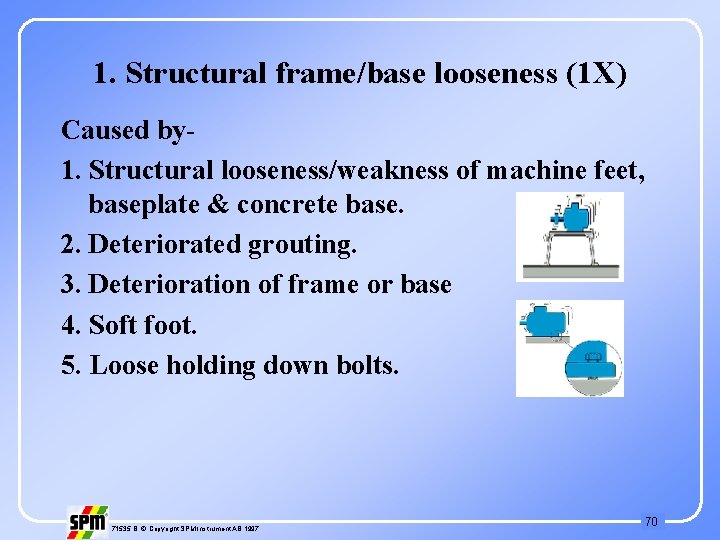
1. Structural frame/base looseness (1 X) Caused by 1. Structural looseness/weakness of machine feet, baseplate & concrete base. 2. Deteriorated grouting. 3. Deterioration of frame or base 4. Soft foot. 5. Loose holding down bolts. 71535 B © Copyright SPM Instrument AB 1997 70
Analysis • Dominant freq 1 X. Similar to unbalance & misalignment. • Horizontal to vertical phase diff 00 or 1800 at the same bearing housing. • 1800 phase diff in the vertical direction between two surfaces. 71535 B © Copyright SPM Instrument AB 1997 71
2. Cracked structure/bearing pedestal (2 X) Caused by 1. Crack in the structure or bearing pedestal. 2. Occasionally on some loose bearing housing bolts. 3. Loose bearing or improper component fit. Analysis 1. 2 X RPM amplitude is > 150% of 1 X RPM amplitude in radial direction. 2. Amplitudes are somewhat erratic. 3. 2 X RPM phase somewhat erratic. 71535 B © Copyright SPM Instrument AB 1997 72
3. Rotating looseness Caused by 1. Loose rotor. 2. Bearing loose in the housing. 3. Bearing loose in the shaft. 4. Excessive bearing internal clearance. 71535 B © Copyright SPM Instrument AB 1997 73
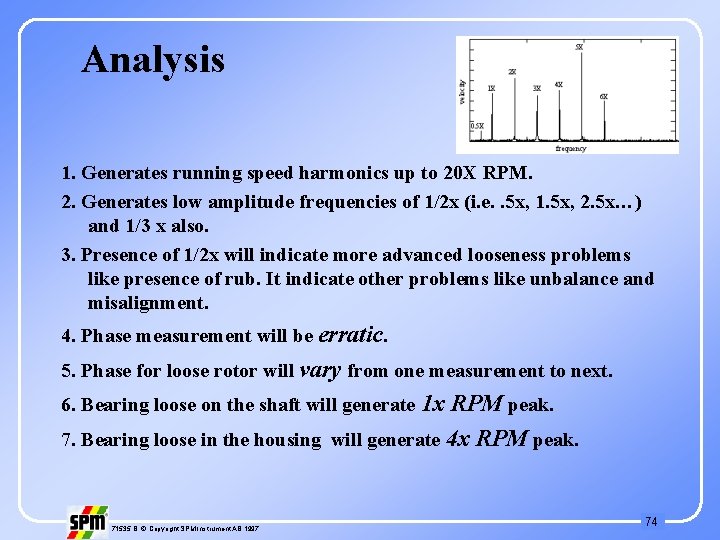
Analysis 1. Generates running speed harmonics up to 20 X RPM. 2. Generates low amplitude frequencies of 1/2 x (i. e. . 5 x, 1. 5 x, 2. 5 x…) and 1/3 x also. 3. Presence of 1/2 x will indicate more advanced looseness problems like presence of rub. It indicate other problems like unbalance and misalignment. 4. Phase measurement will be erratic. 5. Phase for loose rotor will vary from one measurement to next. 6. Bearing loose on the shaft will generate 1 x RPM peak. 7. Bearing loose in the housing will generate 4 x RPM peak. 71535 B © Copyright SPM Instrument AB 1997 74

Journal Bearing 71535 B © Copyright SPM Instrument AB 1997 75
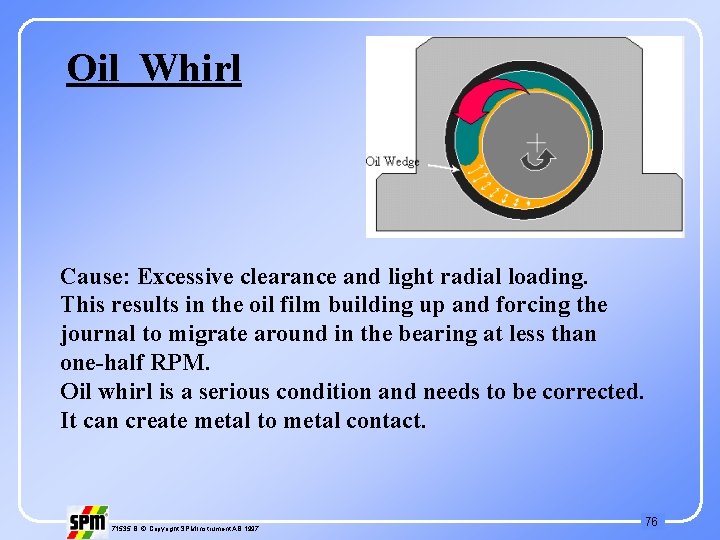
Oil Whirl Cause: Excessive clearance and light radial loading. This results in the oil film building up and forcing the journal to migrate around in the bearing at less than one-half RPM. Oil whirl is a serious condition and needs to be corrected. It can create metal to metal contact. 71535 B © Copyright SPM Instrument AB 1997 76
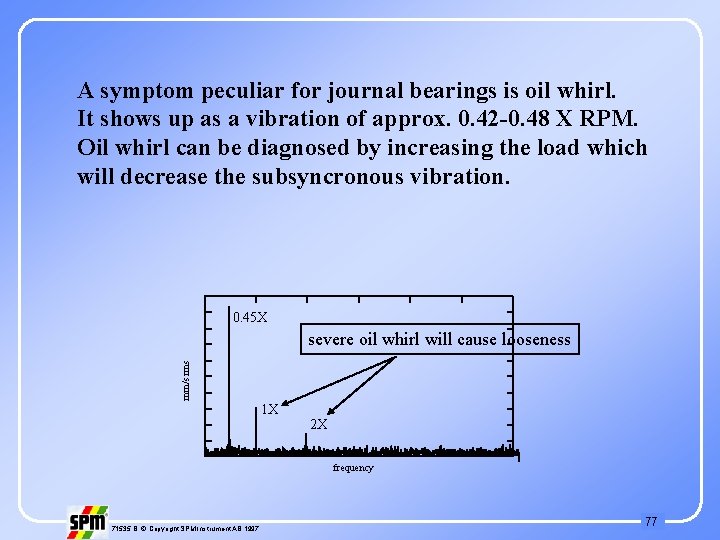
A symptom peculiar for journal bearings is oil whirl. It shows up as a vibration of approx. 0. 42 -0. 48 X RPM. Oil whirl can be diagnosed by increasing the load which will decrease the subsyncronous vibration. 0. 45 X mm/s rms severe oil whirl will cause looseness 1 X 2 X frequency 71535 B © Copyright SPM Instrument AB 1997 77
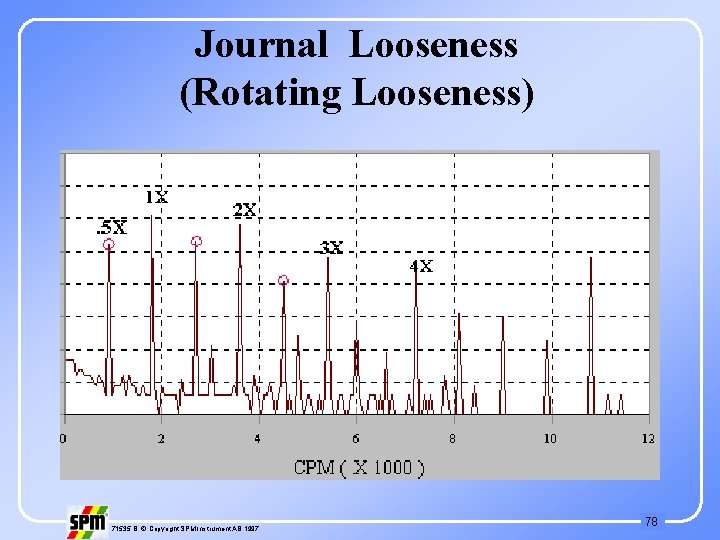
Journal Looseness (Rotating Looseness) 71535 B © Copyright SPM Instrument AB 1997 78
Rotor Rub • • • Spectra similar to mechanical looseness. It may be partial or full annular rub. Often excites one or more resonances. It can excites high frequencies. Cascade diagram and shaft orbit are very helpful in diagnosing rubs. 71535 B © Copyright SPM Instrument AB 1997 79

Rolling Element Bearing 71535 B © Copyright SPM Instrument AB 1997 80

Why Does Bearing Fail? 1. Improper lubrication 2. Contaminated lubrication 3. Heavier loading from unbalance, misalignment, bent shaft etc. 4. Improper handling or installation. 5. Old age (Surface fatigue). 71535 B © Copyright SPM Instrument AB 1997 81
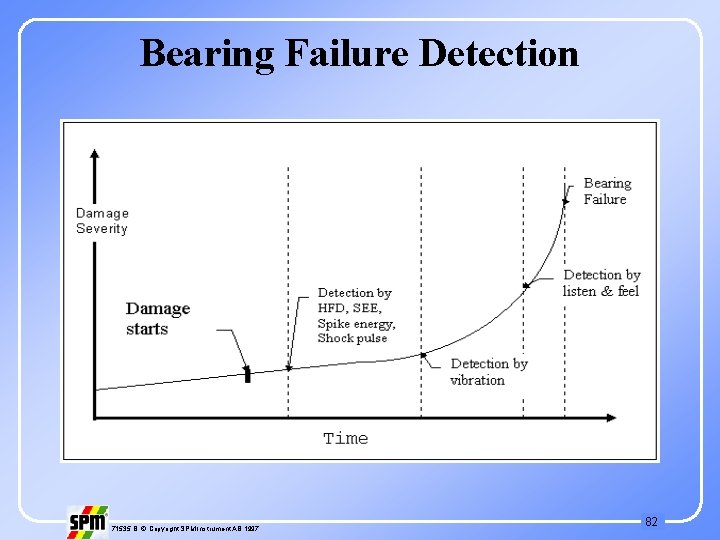
Bearing Failure Detection 71535 B © Copyright SPM Instrument AB 1997 82
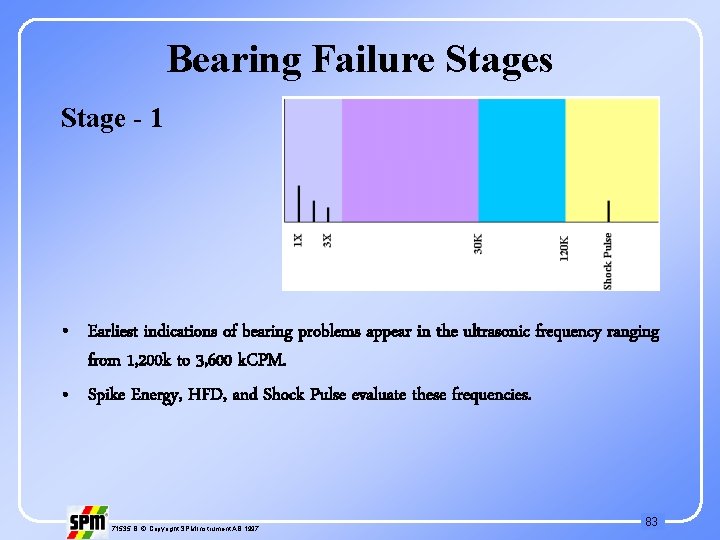
Bearing Failure Stages Stage - 1 • Earliest indications of bearing problems appear in the ultrasonic frequency ranging from 1, 200 k to 3, 600 k. CPM. • Spike Energy, HFD, and Shock Pulse evaluate these frequencies. 71535 B © Copyright SPM Instrument AB 1997 83
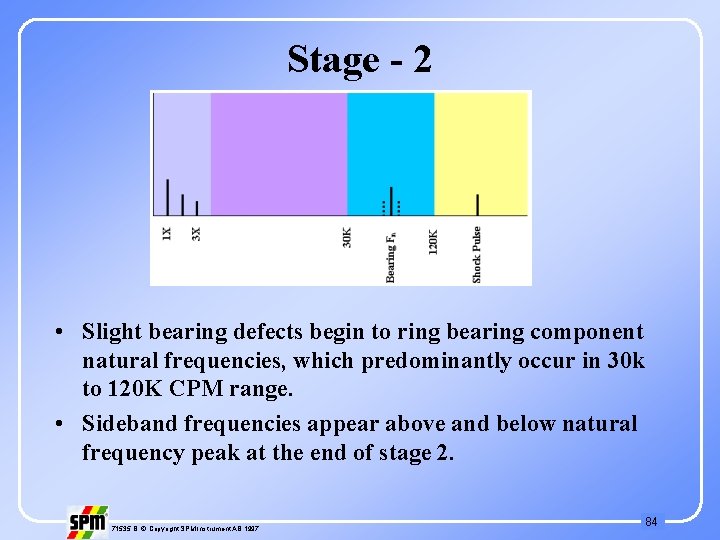
Stage - 2 • Slight bearing defects begin to ring bearing component natural frequencies, which predominantly occur in 30 k to 120 K CPM range. • Sideband frequencies appear above and below natural frequency peak at the end of stage 2. 71535 B © Copyright SPM Instrument AB 1997 84
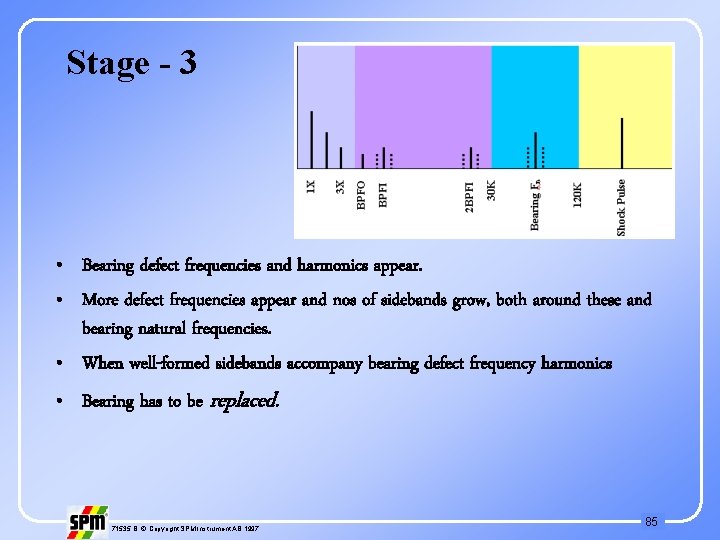
Stage - 3 • Bearing defect frequencies and harmonics appear. • More defect frequencies appear and nos of sidebands grow, both around these and bearing natural frequencies. • When well-formed sidebands accompany bearing defect frequency harmonics • Bearing has to be replaced. 71535 B © Copyright SPM Instrument AB 1997 85
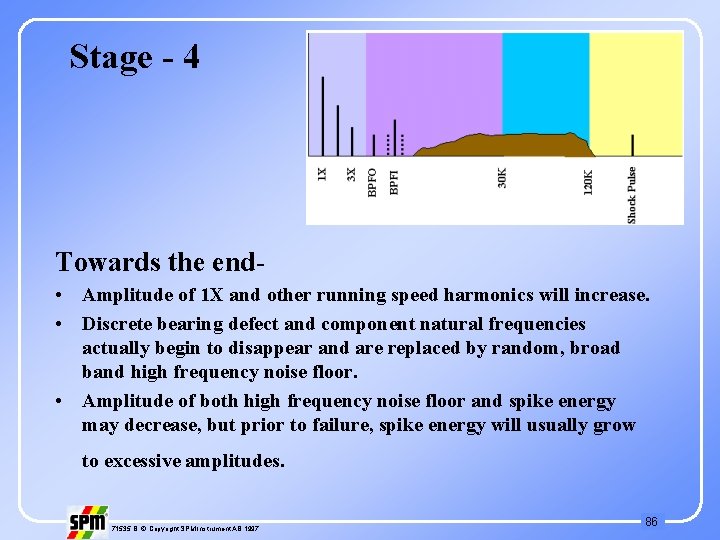
Stage - 4 Towards the end • Amplitude of 1 X and other running speed harmonics will increase. • Discrete bearing defect and component natural frequencies actually begin to disappear and are replaced by random, broad band high frequency noise floor. • Amplitude of both high frequency noise floor and spike energy may decrease, but prior to failure, spike energy will usually grow to excessive amplitudes. 71535 B © Copyright SPM Instrument AB 1997 86
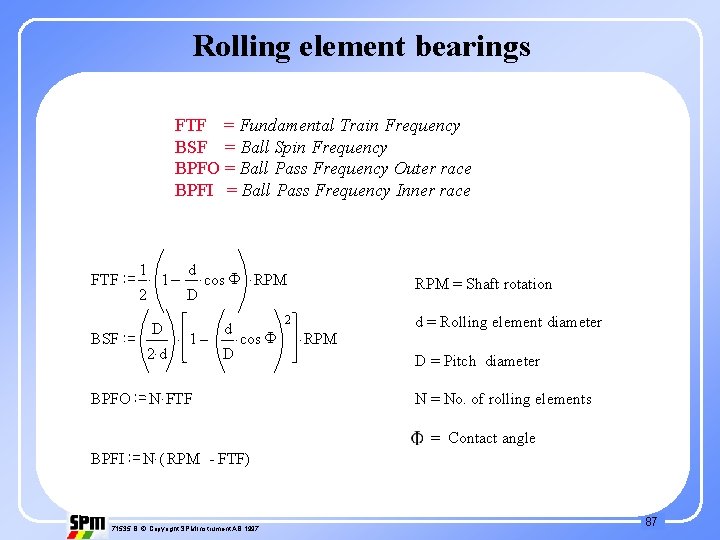
Rolling element bearings FTF = Fundamental Train Frequency BSF = Ball Spin Frequency BPFO = Ball Pass Frequency Outer race BPFI = Ball Pass Frequency Inner race FTF BSF BPFO BPFI 1. 2 1 d. D D. 1 2. d cos F. RPM d. D 2 cos F N. FTF N. ( RPM - FTF) 71535 B © Copyright SPM Instrument AB 1997 RPM = Shaft rotation. RPM d = Rolling element diameter D = Pitch diameter N = No. of rolling elements = Contact angle 87
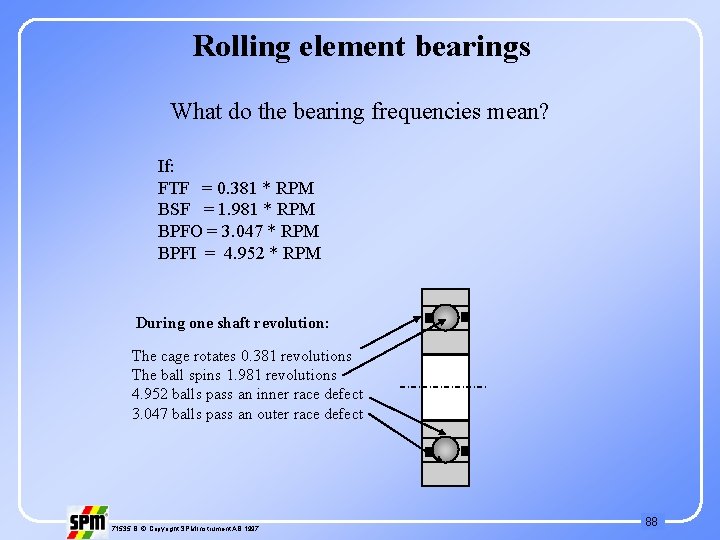
Rolling element bearings What do the bearing frequencies mean? If: FTF = 0. 381 * RPM BSF = 1. 981 * RPM BPFO = 3. 047 * RPM BPFI = 4. 952 * RPM During one shaft revolution: The cage rotates 0. 381 revolutions The ball spins 1. 981 revolutions 4. 952 balls pass an inner race defect 3. 047 balls pass an outer race defect 71535 B © Copyright SPM Instrument AB 1997 88

Gear Box 71535 B © Copyright SPM Instrument AB 1997 89
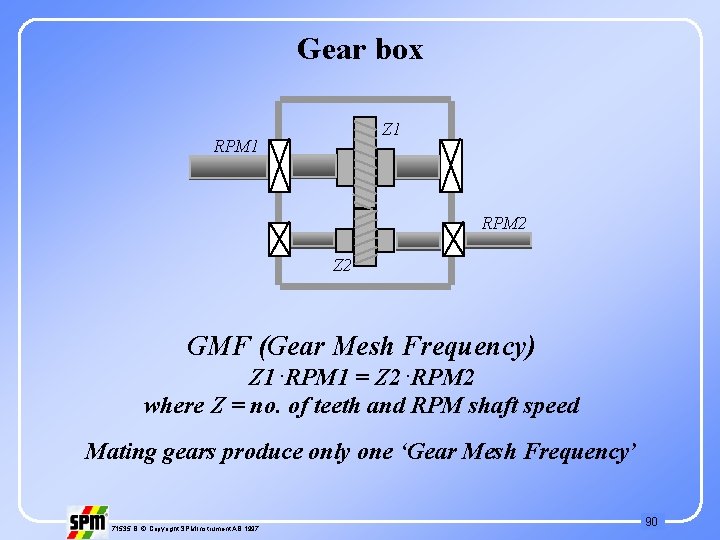
Gear box Z 1 RPM 2 Z 2 GMF (Gear Mesh Frequency) Z 1. RPM 1 = Z 2. RPM 2 where Z = no. of teeth and RPM shaft speed Mating gears produce only one ‘Gear Mesh Frequency’ 71535 B © Copyright SPM Instrument AB 1997 90
Gear Box Defects • • • Tooth wear Gear eccentricity & backlash Gear misalignment Cracked or broken tooth Hunting tooth 71535 B © Copyright SPM Instrument AB 1997 91
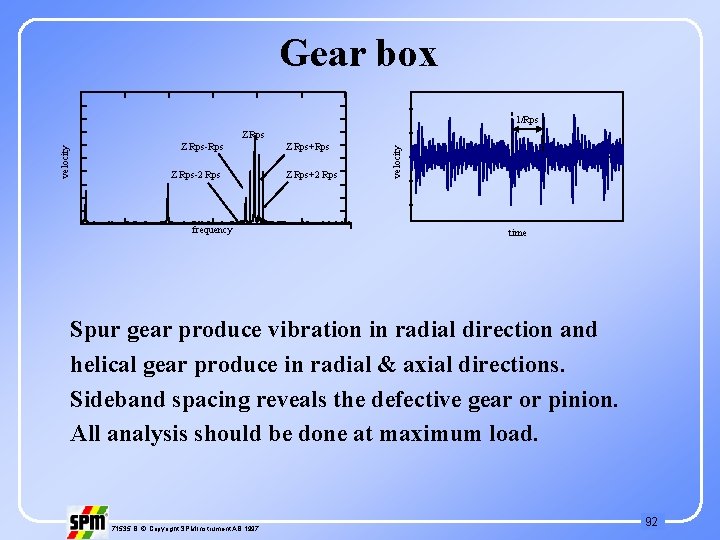
Gear box 1/Rps Z. Rps-2 Rps frequency Z. Rps+Rps Z. Rps+2 Rps velocity Z. Rps time Spur gear produce vibration in radial direction and helical gear produce in radial & axial directions. Sideband spacing reveals the defective gear or pinion. All analysis should be done at maximum load. 71535 B © Copyright SPM Instrument AB 1997 92
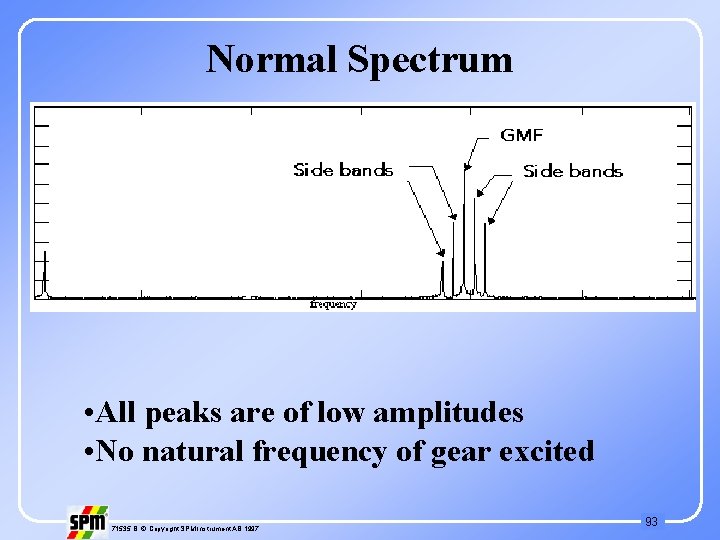
Normal Spectrum • All peaks are of low amplitudes • No natural frequency of gear excited 71535 B © Copyright SPM Instrument AB 1997 93
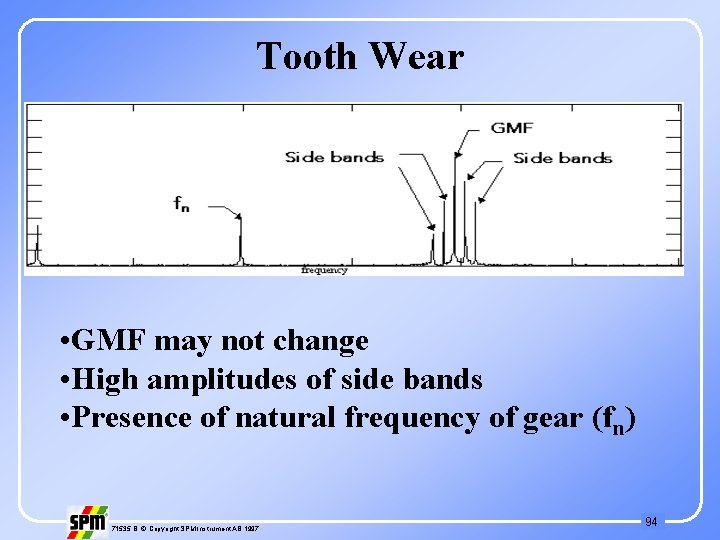
Tooth Wear • GMF may not change • High amplitudes of side bands • Presence of natural frequency of gear (fn) 71535 B © Copyright SPM Instrument AB 1997 94
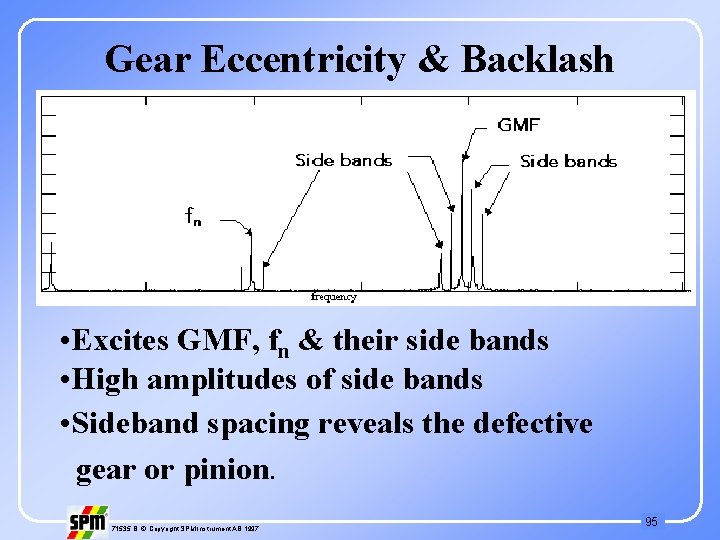
Gear Eccentricity & Backlash • Excites GMF, fn & their side bands • High amplitudes of side bands • Sideband spacing reveals the defective gear or pinion. 71535 B © Copyright SPM Instrument AB 1997 95
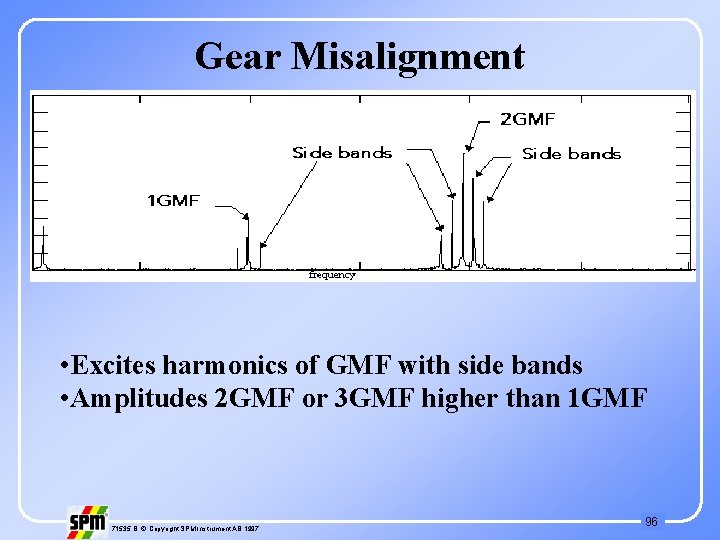
Gear Misalignment • Excites harmonics of GMF with side bands • Amplitudes 2 GMF or 3 GMF higher than 1 GMF 71535 B © Copyright SPM Instrument AB 1997 96
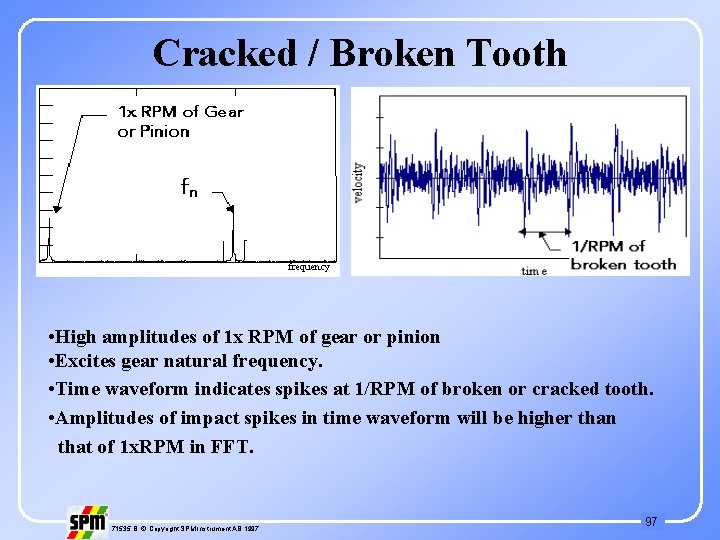
Cracked / Broken Tooth • High amplitudes of 1 x RPM of gear or pinion • Excites gear natural frequency. • Time waveform indicates spikes at 1/RPM of broken or cracked tooth. • Amplitudes of impact spikes in time waveform will be higher than that of 1 x. RPM in FFT. 71535 B © Copyright SPM Instrument AB 1997 97
Hunting Tooth 1. Faults on both gear & pinion occured during manufacturing. 2. Causes high vibration at low frequencies (less than 600 CPM) 3. Gear set emits growling sound. 71535 B © Copyright SPM Instrument AB 1997 98
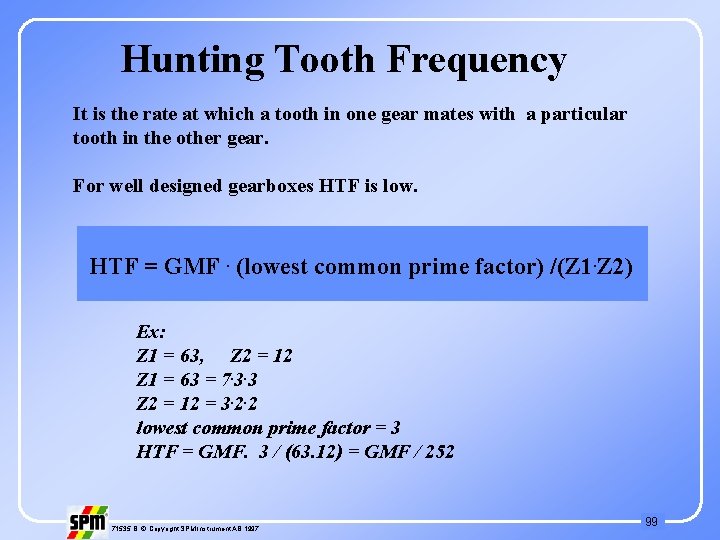
Hunting Tooth Frequency It is the rate at which a tooth in one gear mates with a particular tooth in the other gear. For well designed gearboxes HTF is low. HTF = GMF. (lowest common prime factor) /(Z 1. Z 2) Ex: Z 1 = 63, Z 2 = 12 Z 1 = 63 = 7. 3. 3 Z 2 = 12 = 3. 2. 2 lowest common prime factor = 3 HTF = GMF. 3 / (63. 12) = GMF / 252 71535 B © Copyright SPM Instrument AB 1997 99
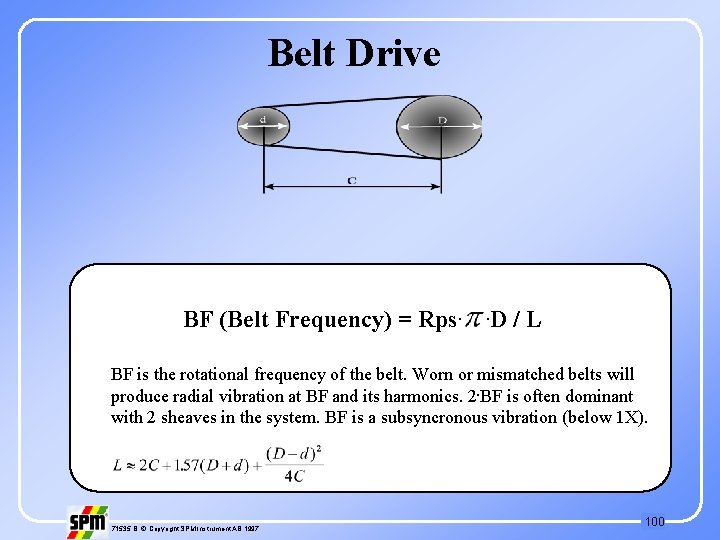
Belt Drive BF (Belt Frequency) = Rps. . D /L BF is the rotational frequency of the belt. Worn or mismatched belts will produce radial vibration at BF and its harmonics. 2. BF is often dominant with 2 sheaves in the system. BF is a subsyncronous vibration (below 1 X). 71535 B © Copyright SPM Instrument AB 1997 100
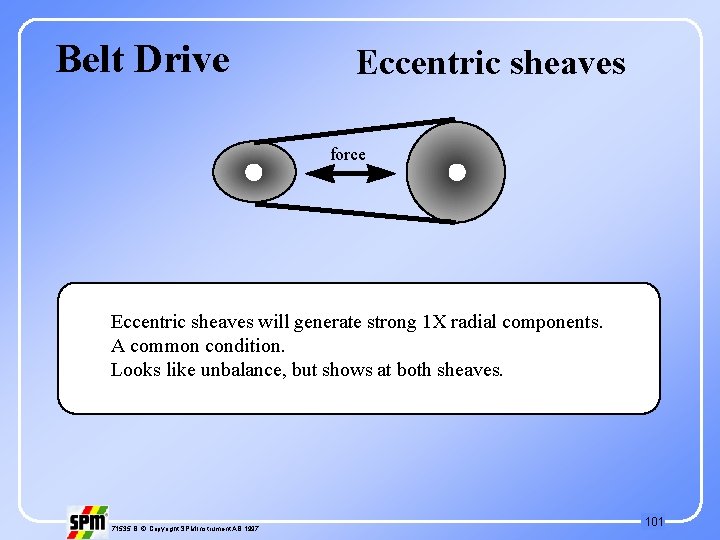
Belt Drive Eccentric sheaves force Eccentric sheaves will generate strong 1 X radial components. A common condition. Looks like unbalance, but shows at both sheaves. 71535 B © Copyright SPM Instrument AB 1997 101
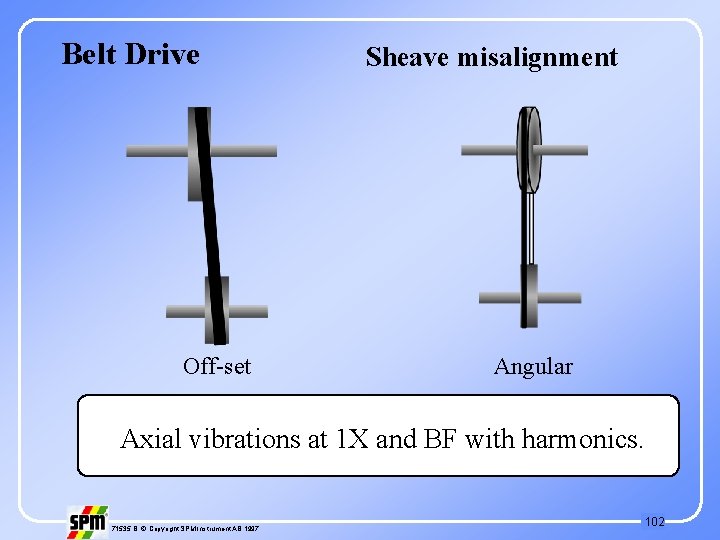
Belt Drive Off-set Sheave misalignment Angular Axial vibrations at 1 X and BF with harmonics. 71535 B © Copyright SPM Instrument AB 1997 102
Fans Fan Blade Pass Frequency = RPM x no. of fan blades (FBPF) Mainly radial vibrations FBPF with 1 X RPM sidebands. Unbalanced horizontal or axial vibrations. Inadequate blade clearance (at FBPF or RPM harmonics) Uneven velocity distribution across fan inlet gives FBPF vibrations 71535 B © Copyright SPM Instrument AB 1997 103
Pumps Vibration signature depends upon operating condition. pressure, temperature, speed, cavitation…. FCentrifugal pumps at Vane Pass Frequency = RPM. no. of impeller vanes and harmonics. FGear pumps at Gear Mesh Frequency and 1 X sidebands FScrew pumps at thread rate = RPM. number of threads and its harmonics. 71535 B © Copyright SPM Instrument AB 1997 104

Electrical Motors 71535 B © Copyright SPM Instrument AB 1997 105
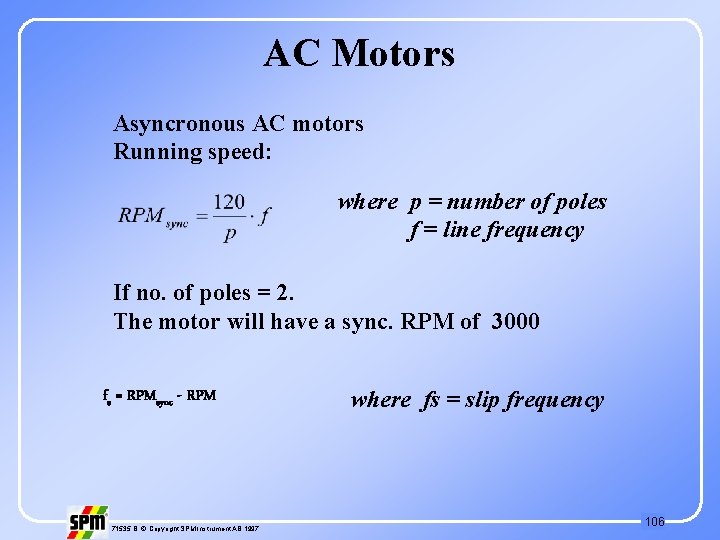
AC Motors Asyncronous AC motors Running speed: where p = number of poles f = line frequency If no. of poles = 2. The motor will have a sync. RPM of 3000 fs = RPMsync - RPM 71535 B © Copyright SPM Instrument AB 1997 where fs = slip frequency 106
AC Motors FAll electrical machines vibrates at 2. line frequency. FThe reasons are expanding and collapsing magnetic fields. FThis vibration is normal (to a degree). FThe amplitude is a measure of the quality of the construction. 71535 B © Copyright SPM Instrument AB 1997 107
AC Motors Coast Down Test Vibration suddenly drops down after switching off the power 71535 B © Copyright SPM Instrument AB 1997 108
AC Motors Faults possible to detect with vibration analysis: Rotor thermal bow Air gap eccentricity Loose rotor Eccentric rotor Loose windings Necessary data: No. of stator slots No. of rotor bars Line frequency Slip frequency 71535 B © Copyright SPM Instrument AB 1997 (SPF) (RBPF) (LF) (SF) 109
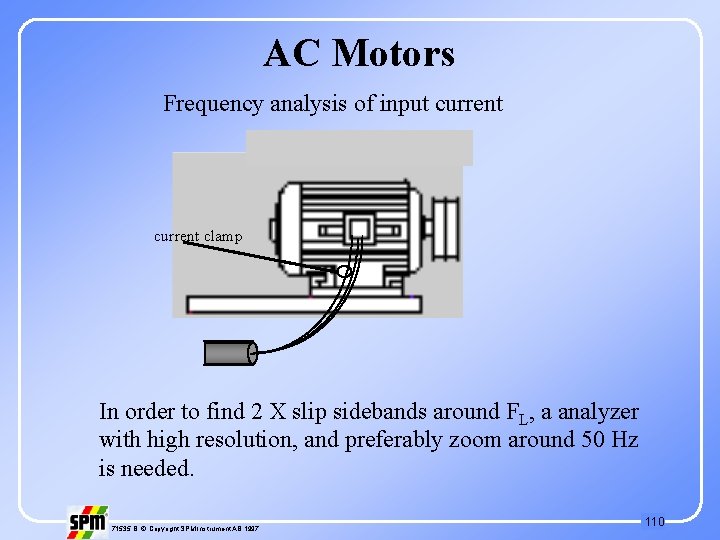
AC Motors Frequency analysis of input current clamp In order to find 2 X slip sidebands around FL, a analyzer with high resolution, and preferably zoom around 50 Hz is needed. 71535 B © Copyright SPM Instrument AB 1997 110
D. C. Motor Faults possible to detect with vibration analysis: • Broken field winding • Bad SCRs • Loose connections • Loose or blown fuses • Shorted control cards 71535 B © Copyright SPM Instrument AB 1997 111
Identification For 3 phase rectified D. C. motors • Broken field winding, Bad SCRs, Loose connections Peaks at 6. LF • Loose or blown fuses, Shorted control cards Peaks at 1. LF to 5. LF 71535 B © Copyright SPM Instrument AB 1997 112
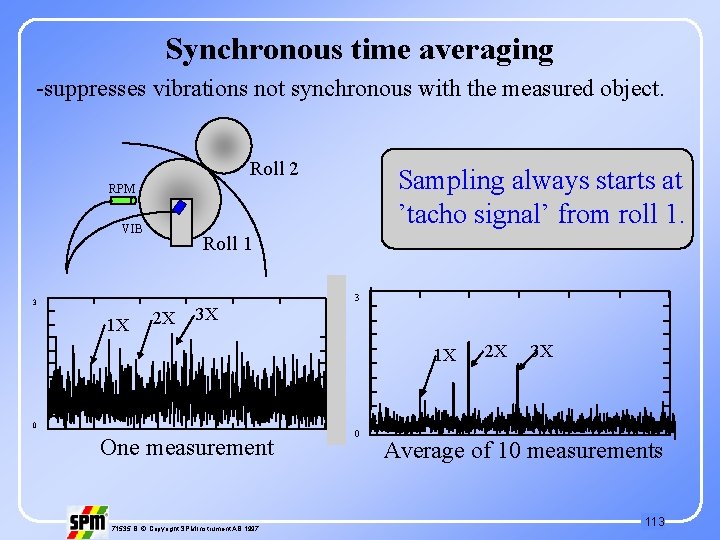
Synchronous time averaging -suppresses vibrations not synchronous with the measured object. Roll 2 Sampling always starts at ’tacho signal’ from roll 1. RPM VIB Roll 1 3 3 1 X 2 X 3 X 1 X 0 One measurement 71535 B © Copyright SPM Instrument AB 1997 0 2 X 3 X Average of 10 measurements 113
Enveloping Detects low amplitude high frequency repetitive bearing or gear mesh defects. These defects emit repetitive low energy impact signals that are highly pulse shaped and of very short duration. They generate harmonics in the very high frequency ranges. These techniques filter out low frequency vibration energies and therefore isolate & emphasize specific high frequency signals. 71535 B © Copyright SPM Instrument AB 1997 114
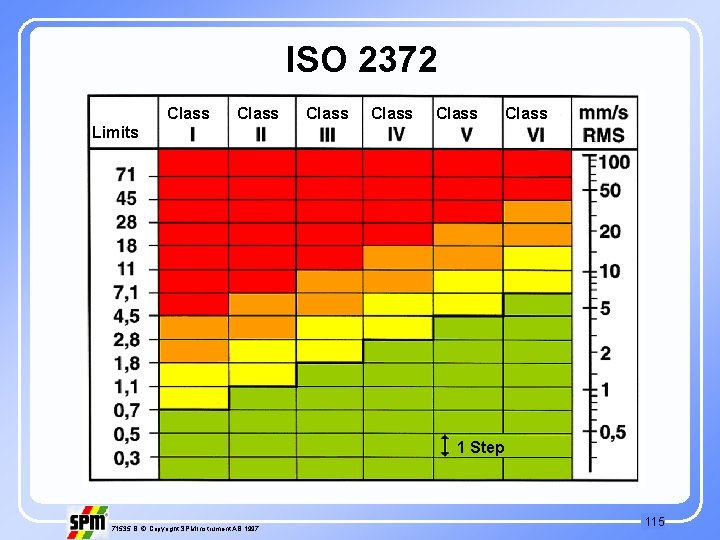
ISO 2372 Class Class Limits 1 Step 71535 B © Copyright SPM Instrument AB 1997 115
Case - 1 Pump Impeller Wear Summary This case documents a 100 hp monitored over a period of 2 years (1500 rpm). An increase of overall vibration levels and spectrum showed high vane pass levels of 3 x RPM. 71535 B © Copyright SPM Instrument AB 1997 116
The pump has – 3 vanes on the impeller and an internal inspection indicated impeller wears. Impeller changed and both the overall levels of vibration and the vane pass frequency returned to normal, acceptable levels. 71535 B © Copyright SPM Instrument AB 1997 117
Analysis Overall Vibration Levels: Overall vibration levels were on the boarder line of being in an alarm state for several months and remained stable, it was decided to monitor closely. Then suddenly overall vibration levels jumped to 0. 95 inch/sec ie 390 % change. 71535 B © Copyright SPM Instrument AB 1997 118
Vibration Spectrum : The frequency spectrum collected from the pump inboard bearing shows a predominant peak at a frequency of 3000 rpm. The spectral plot showing the historical growth in amplitude of this predominant peak. It is noted that the machine deterioration appears more severe on the basis of overall readings than on the basis of the frequency spectrums. 71535 B © Copyright SPM Instrument AB 1997 119
One possible explanation for the observation is that there was an increase in vibration amplitudes at frequencies beyond the range. 71535 B © Copyright SPM Instrument AB 1997 120
Theoretical Consideration: Problems with blades and vanes are usually characterized by high vibration or near the harmonic frequency corresponding to the rotation speed X No. of blades. Blade pass frequency usually exists in normal operating machines, but harmonics usually indicates problem. 71535 B © Copyright SPM Instrument AB 1997 121
Problem Diagnosis: The data collected pointed towards the pump impeller as the source of high vibrations because of dominant peaks at the blade pass frequency as well as growing side band harmonics. 71535 B © Copyright SPM Instrument AB 1997 122
Results Corrective Action: The pump impeller was removed and replaced. Findings: Overall vibration reading taken after repair amplitudes significantly reduced. 71535 B © Copyright SPM Instrument AB 1997 123
Conclusions The objective of this case was to demonstrate the concept that the blade pass frequency (No. of blades x shaft speed) and surrounding harmonics gives an indication of impeller condition. This case over all vibration increases trend stopped the machine and changed impeller. 71535 B © Copyright SPM Instrument AB 1997 124
Vibration signature of the pump took on a new shape without high amplitudes at blade pass frequency and the overall vibration levels returned to acceptable levels. 71535 B © Copyright SPM Instrument AB 1997 125
- Slides: 125