
What is UX Its all about people Focuses
What is UX? It’s all about people. § Focuses on Human Centered Design methodologies. § Demands rigorous measures on usefulness and usability. UX is a discipline of the digital world—one slice of the customer experience (CX)— § Considers the entire experience someone has and most often used when talking about when using a product or service, not just the final applications or websites. We use it to make transaction. things useful, usable, and desirable. § Demands that we place our “customer” in the center of our strategy, planning and implementation, forcing us to stand in the shoes of those we aim to serve.
It’s about solving the right problem. Have you ever spent hours (days, months, years) working on a project only to realize you’ve solved the wrong problem? At that point, you’re usually too tired and frustrated to start over, so you just dig in and ”make it work. ”
How do we get there? First, we start with research. § What does the user need to do or accomplish? § What does the user think about while doing that? What decisions are made and what data is used? How is it organized? § What mental structure, picture, or metaphor organizes those thoughts? § What terms are used and what is the hierarchy of terms? § What is the physical environment (light, sound, proximity, distraction) for the tasks? Will that affect the design? § Are there groups of users who would answer the above differently? We soak up everything we can when learning about a user’s behaviors, workarounds, motivations, and environment.
From there, we model our research to show our understanding. We walk in the user’s shoes—empathize with them—then tell their story. WHAT WE LEARN WHAT WE CREATE What does the user need to do or accomplish? Context Scenarios What does the user think about while doing that? What decisions are made and what data is used? How is it organized? Mental Model What mental structure, picture, or metaphor organizes those thoughts? User Model What terms are used and what is the hierarchy of terms? Information Architecture What is the physical environment (light, sound, proximity, distraction) for the tasks? Will that affect the design? Environmental Factors Are there groups of users who would answer the above differently? Personas

Behavior Mapping
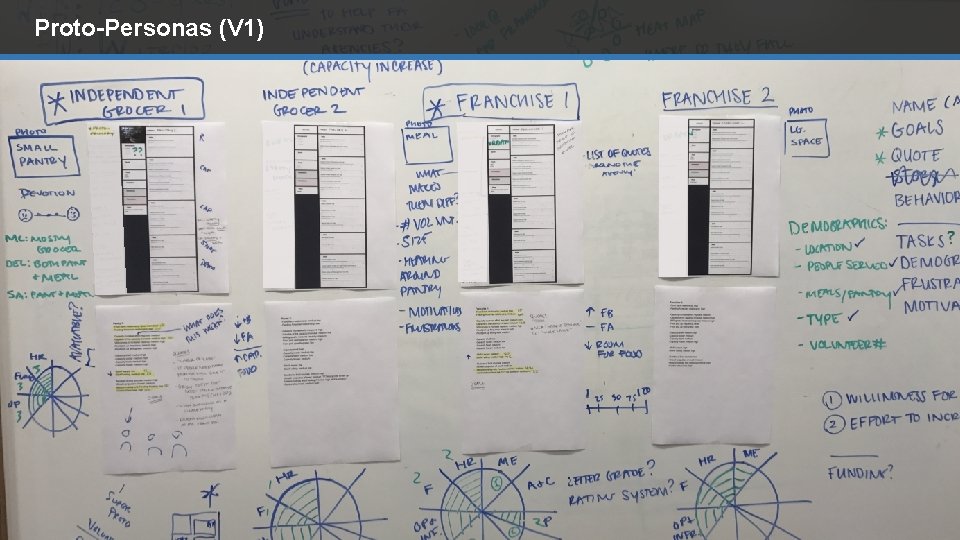
Proto-Personas (V 1)
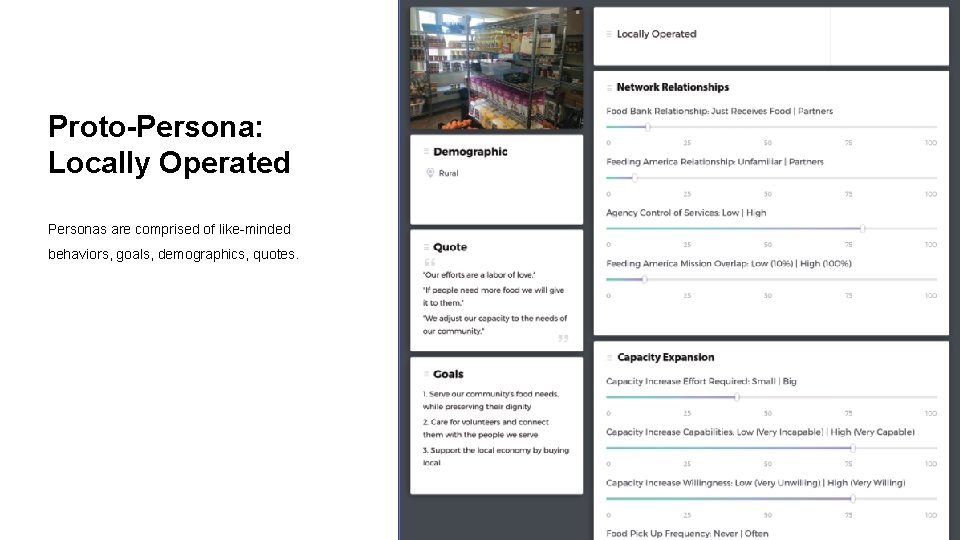
Proto-Persona: Locally Operated Personas are comprised of like-minded behaviors, goals, demographics, quotes.
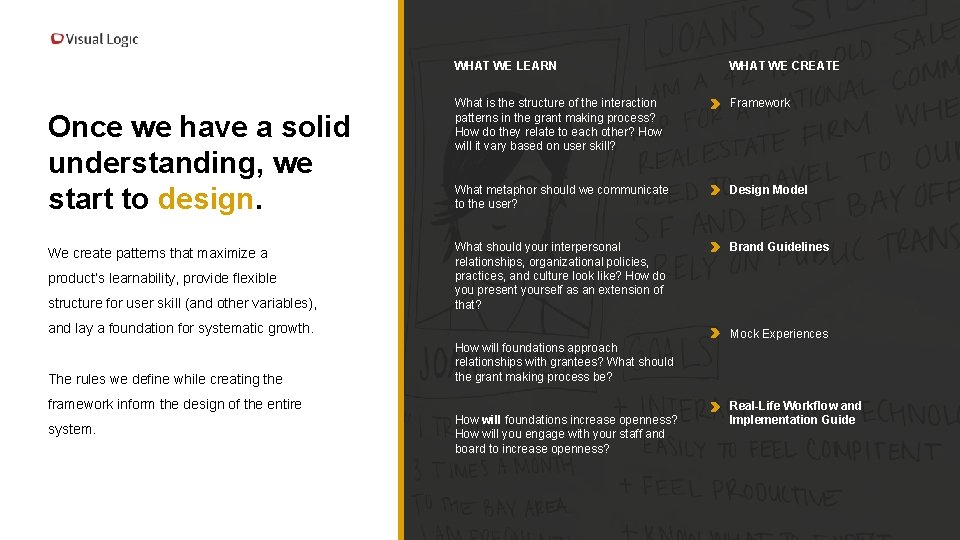
Once we have a solid understanding, we start to design. We create patterns that maximize a product’s learnability, provide flexible structure for user skill (and other variables), WHAT WE LEARN WHAT WE CREATE What is the structure of the interaction patterns in the grant making process? How do they relate to each other? How will it vary based on user skill? Framework What metaphor should we communicate to the user? Design Model What should your interpersonal relationships, organizational policies, practices, and culture look like? How do you present yourself as an extension of that? Brand Guidelines and lay a foundation for systematic growth. The rules we define while creating the Mock Experiences How will foundations approach relationships with grantees? What should the grant making process be? framework inform the design of the entire system. How will foundations increase openness? How will you engage with your staff and board to increase openness? Real-Life Workflow and Implementation Guide
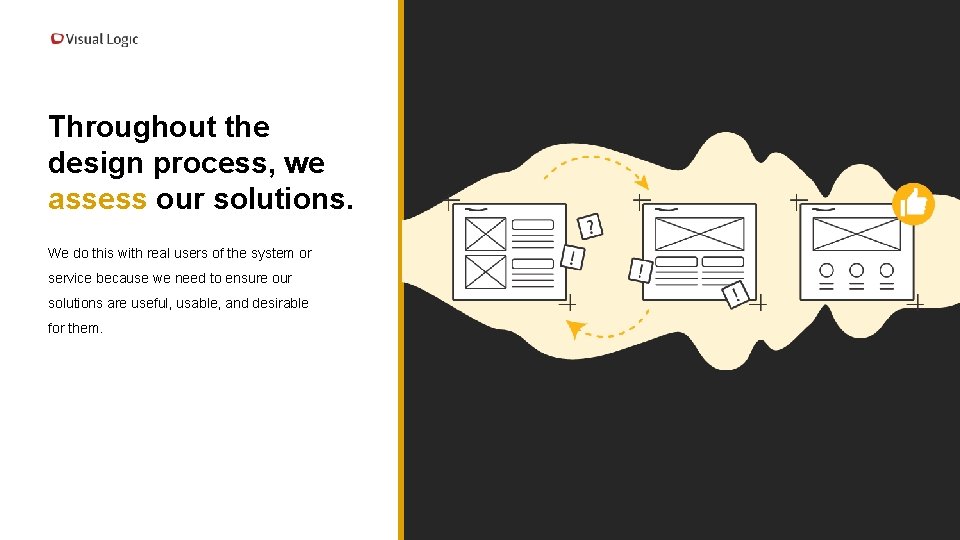
Throughout the design process, we assess our solutions. We do this with real users of the system or service because we need to ensure our solutions are useful, usable, and desirable for them.
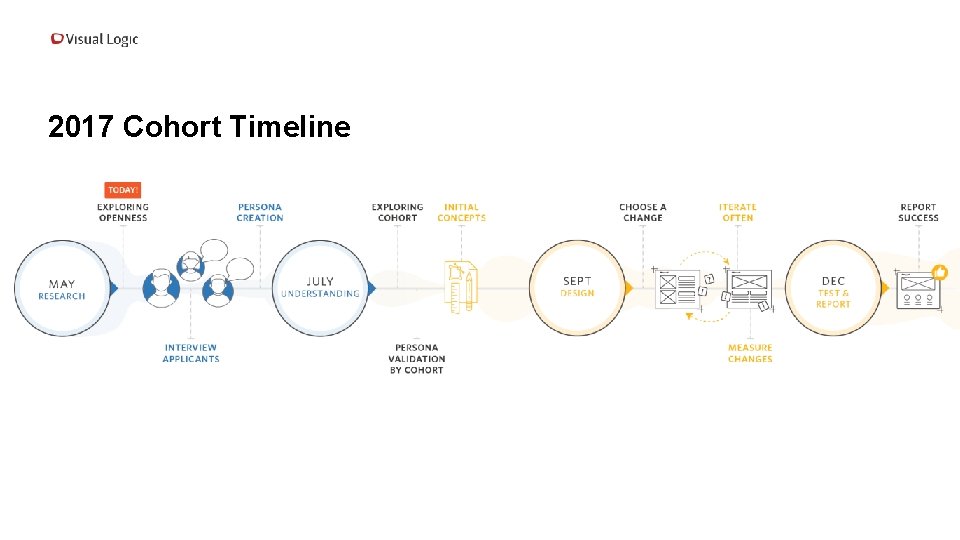
2017 Cohort Timeline
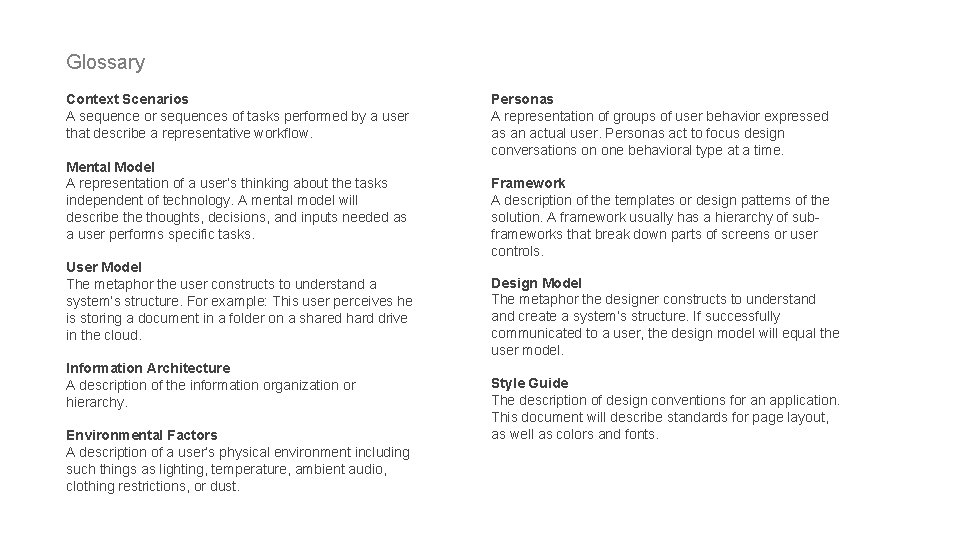
Glossary Context Scenarios A sequence or sequences of tasks performed by a user that describe a representative workflow. Mental Model A representation of a user’s thinking about the tasks independent of technology. A mental model will describe thoughts, decisions, and inputs needed as a user performs specific tasks. User Model The metaphor the user constructs to understand a system’s structure. For example: This user perceives he is storing a document in a folder on a shared hard drive in the cloud. Information Architecture A description of the information organization or hierarchy. Environmental Factors A description of a user’s physical environment including such things as lighting, temperature, ambient audio, clothing restrictions, or dust. Personas A representation of groups of user behavior expressed as an actual user. Personas act to focus design conversations on one behavioral type at a time. Framework A description of the templates or design patterns of the solution. A framework usually has a hierarchy of subframeworks that break down parts of screens or user controls. Design Model The metaphor the designer constructs to understand create a system’s structure. If successfully communicated to a user, the design model will equal the user model. Style Guide The description of design conventions for an application. This document will describe standards for page layout, as well as colors and fonts.
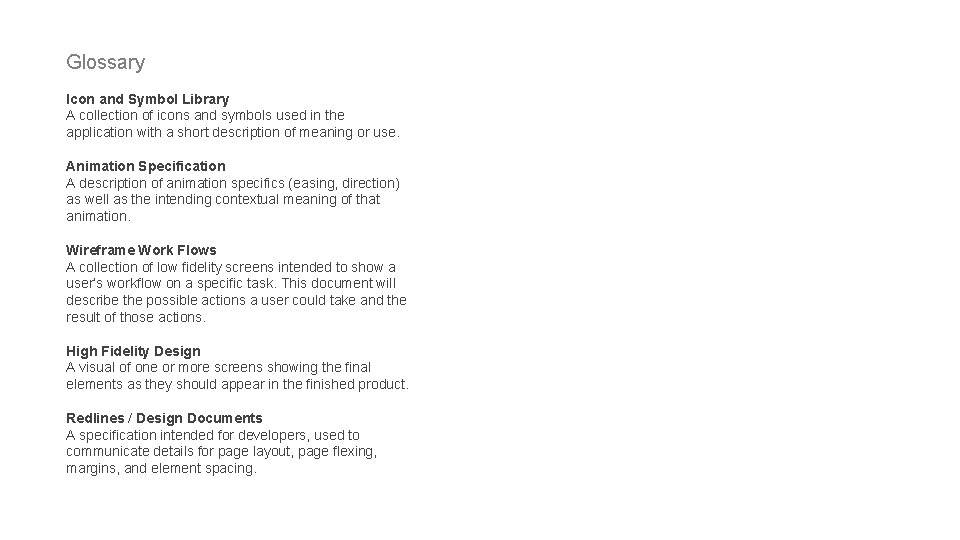
Glossary Icon and Symbol Library A collection of icons and symbols used in the application with a short description of meaning or use. Animation Specification A description of animation specifics (easing, direction) as well as the intending contextual meaning of that animation. Wireframe Work Flows A collection of low fidelity screens intended to show a user’s workflow on a specific task. This document will describe the possible actions a user could take and the result of those actions. High Fidelity Design A visual of one or more screens showing the final elements as they should appear in the finished product. Redlines / Design Documents A specification intended for developers, used to communicate details for page layout, page flexing, margins, and element spacing.
- Slides: 12