
What is TWP why is it important for
- Slides: 9
What is ‘TWP’ & why is it important for anti-corruption research and practice? Dr Heather Marquette Director, Developmental Leadership Program/GSDRC Steering Committee member, Thinking & Working Politically Community of Practice Joint British Academy/DFID Anti-Corruption Evidence Programme & Thinking and Working Politically Community of Practice meeting, London, 13 May 2016
Thinking & Working Politically Community of Practice • Started in November 2013 - 8 meetings so far • Next meetings – 8 September, Birmingham; late September, Washington; January, Jakarta; others being discussed for Singapore & Nairobi • Bringing together donors with leading thinkers (NGOs, academics, think tanks, implementers) • An informal community at this point but likely to become a bit more formal as we grow (e. g. , new steering committee) • Aims: • Promote TWP within organisations • Build up evidence base on what works, when & why • Agnostic about methods & approaches – no ‘right way’ to TWP • Provide ‘safe space’ to discuss challenges of TWP, working more flexibly etc. – openness, trust, honesty, camaraderie 1
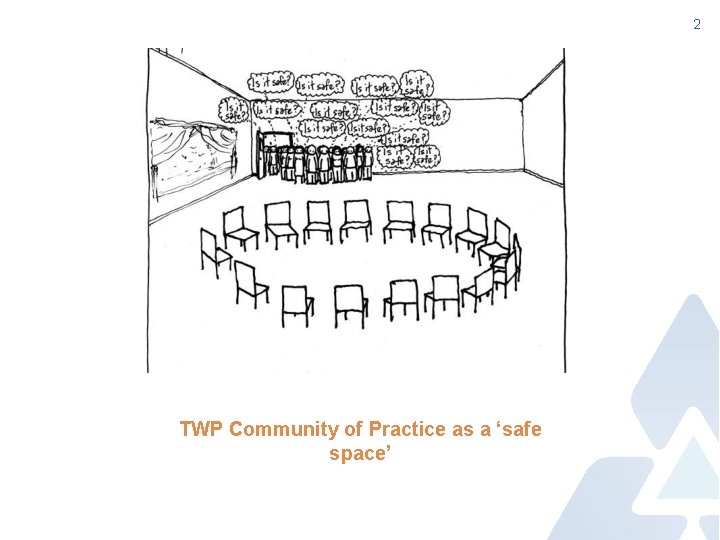
2 TWP Community of Practice as a ‘safe space’
What does it mean to ‘think & work politically’ (TWP)? Three core principles behind TWP: • Strong political analysis, insight & understanding • Detailed appreciation of, and response to, the local context • Flexibility and adaptability in programme design & implementation See https: //ejavenell. files. wordpress. com/2016/01/the-case-for-thinking-and-workingpolitically 1. pdf Plain English: – Don’t just say ‘there’s a lack of political will’…unpack this! – No ‘best practice’ but ‘best fit’ instead; work with the grain; be ready to act; don’t mess things up! – Don’t get stuck on one course of action; test, adapt, change – you may like your model in theory but kill it if it doesn’t work in practice! 3
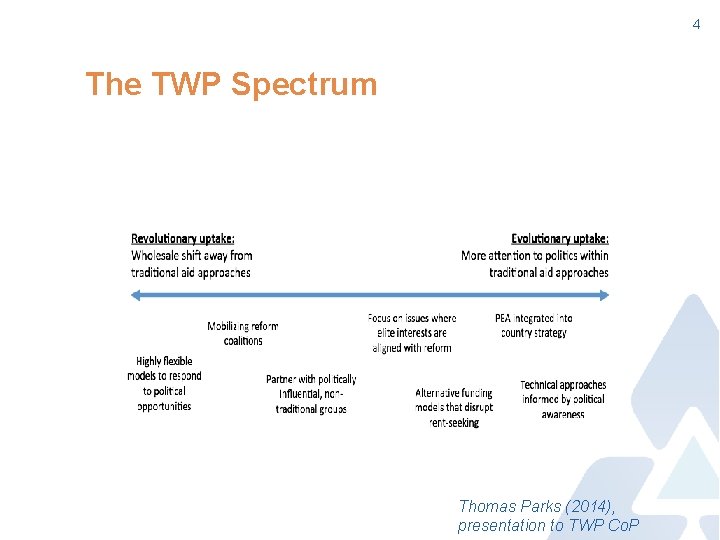
4 The TWP Spectrum Thomas Parks (2014), presentation to TWP Co. P
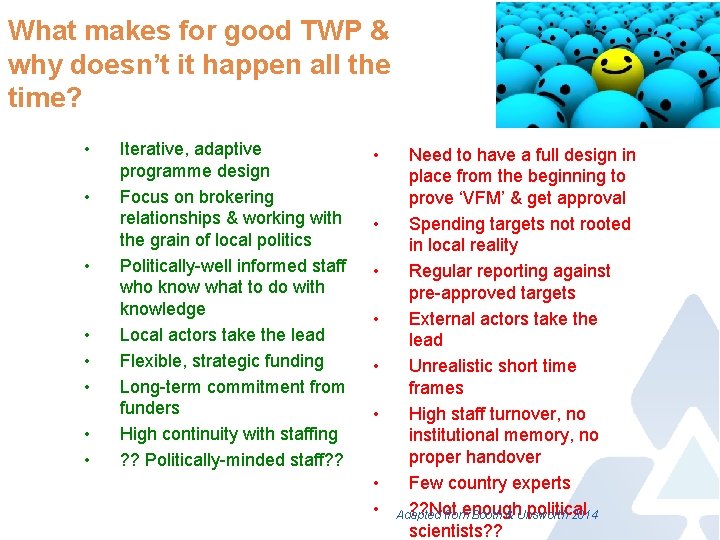
What makes for good TWP & why doesn’t it happen all the time? • • Iterative, adaptive programme design Focus on brokering relationships & working with the grain of local politics Politically-well informed staff who know what to do with knowledge Local actors take the lead Flexible, strategic funding Long-term commitment from funders High continuity with staffing ? ? Politically-minded staff? ? • • 5 Need to have a full design in place from the beginning to prove ‘VFM’ & get approval Spending targets not rooted in local reality Regular reporting against pre-approved targets External actors take the lead Unrealistic short time frames High staff turnover, no institutional memory, no proper handover Few country experts ? ? Not political Adapted fromenough Booth & Unsworth 2014 scientists? ?
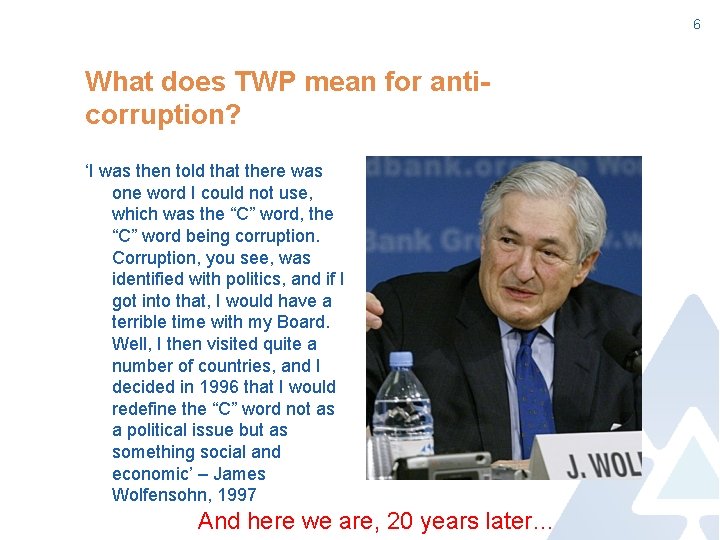
6 What does TWP mean for anticorruption? ‘I was then told that there was one word I could not use, which was the “C” word, the “C” word being corruption. Corruption, you see, was identified with politics, and if I got into that, I would have a terrible time with my Board. Well, I then visited quite a number of countries, and I decided in 1996 that I would redefine the “C” word not as a political issue but as something social and economic’ – James Wolfensohn, 1997 And here we are, 20 years later…
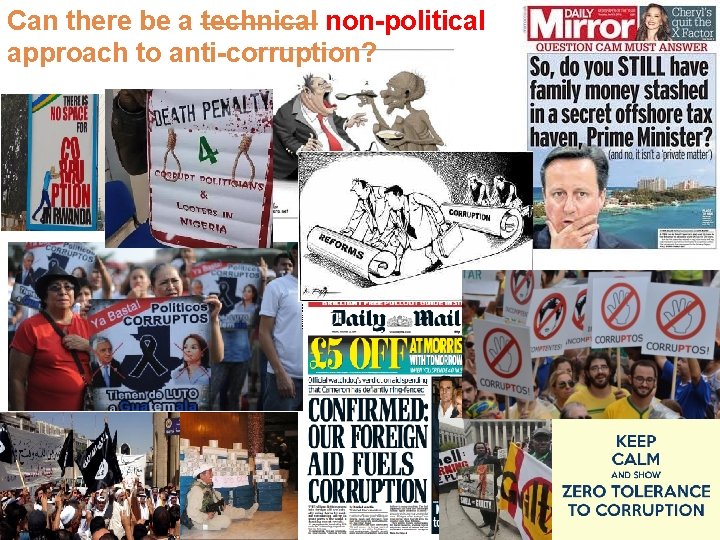
Can there be a technical non-political approach to anti-corruption? 7
8 http: //twpcommunity. org @TWP_Community #TWPCommunity