
What is trigonometry Angle measurement and tables If
What is trigonometry?
Angle measurement and tables If there is anything that distinguishes trigonometry from the rest of geometry, it is that trig depends on angle measurement and quantities determined by the measure of an angle.
Applications of trigonometry What can you do with trig? n Historically, it was developed for astronomy and geography, but scientists have been using it for centuries for other purposes, too. n Besides other fields of mathematics, trig is used in physics, engineering, and chemistry. n Within mathematics, trig is used in primarily in calculus (which is perhaps its greatest application), linear algebra, and statistics. n Since these fields are used throughout the natural and social sciences, trig is a very useful subject to know
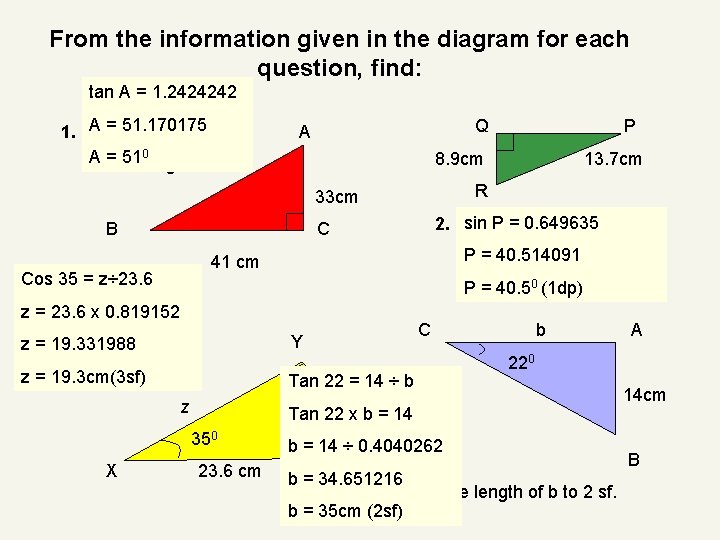
From the information given in the diagram for each question, find: tan A = 1. 2424242 A = 51. 170175 1. Angle A to the A = 510 degree nearest Q A 8. 9 cm B sin P =P 0. 649635 2. Angle to 1 dp C P = 40. 514091 41 cm P = 40. 50 (1 dp) z = 23. 6 x 0. 819152 3. The length of z = 19. 331988 Y side z to 3 sf z = 19. 3 cm(3 sf) Tan 22 = 14 ÷ b z Tan 22 x b = 14 350 X 13. 7 cm R 33 cm Cos 35 = z÷ 23. 6 P 23. 6 cm C b A 220 14 cm b = 14 ÷ 0. 4040262 B Z b = 34. 651216 4. The length of b to 2 sf. b = 35 cm (2 sf)
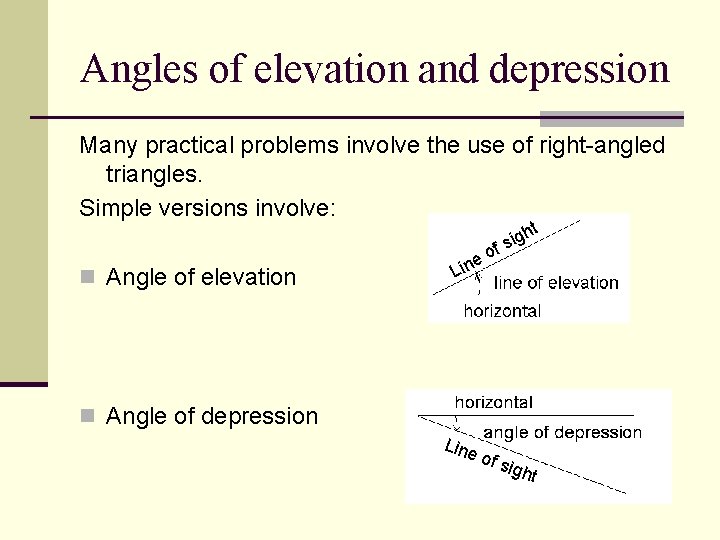
Angles of elevation and depression Many practical problems involve the use of right-angled triangles. Simple versions involve: n Angle of elevation o e n i f ht g i s L n Angle of depression Line of s ight
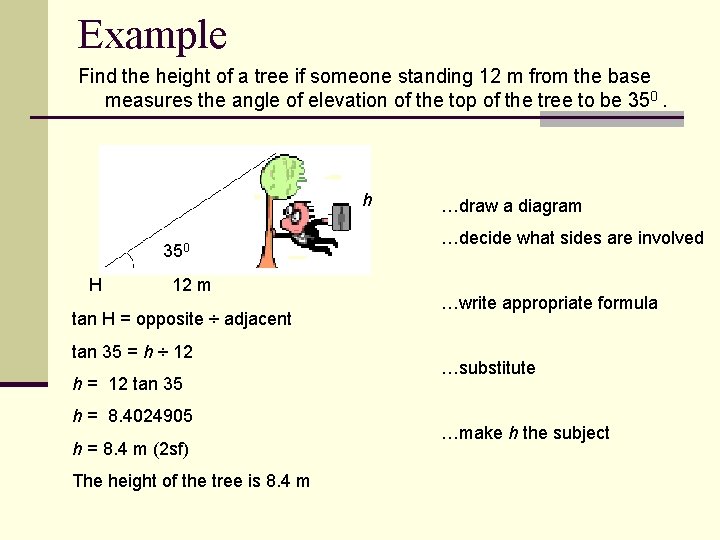
Example Find the height of a tree if someone standing 12 m from the base measures the angle of elevation of the top of the tree to be 350. h 350 H 12 m tan H = opposite ÷ adjacent tan 35 = h ÷ 12 h = 12 tan 35 h = 8. 4024905 h = 8. 4 m (2 sf) The height of the tree is 8. 4 m …draw a diagram …decide what sides are involved …write appropriate formula …substitute …make h the subject
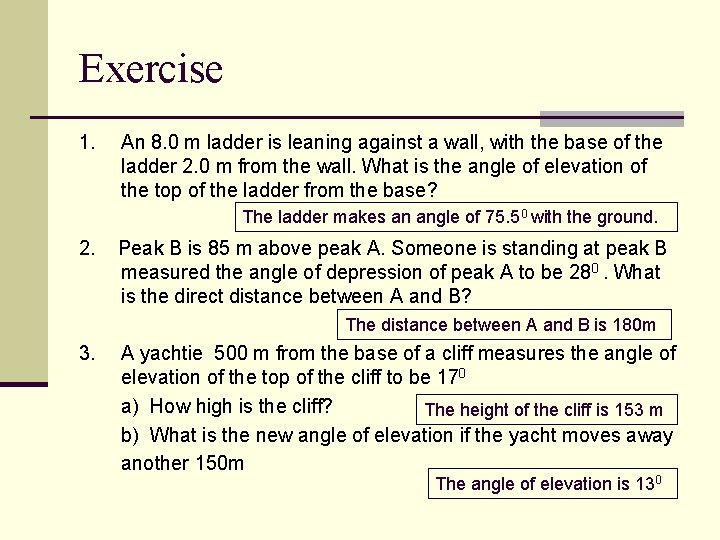
Exercise 1. An 8. 0 m ladder is leaning against a wall, with the base of the ladder 2. 0 m from the wall. What is the angle of elevation of the top of the ladder from the base? The ladder makes an angle of 75. 50 with the ground. 2. Peak B is 85 m above peak A. Someone is standing at peak B measured the angle of depression of peak A to be 280. What is the direct distance between A and B? The distance between A and B is 180 m 3. A yachtie 500 m from the base of a cliff measures the angle of elevation of the top of the cliff to be 170 a) How high is the cliff? The height of the cliff is 153 m b) What is the new angle of elevation if the yacht moves away another 150 m The angle of elevation is 130
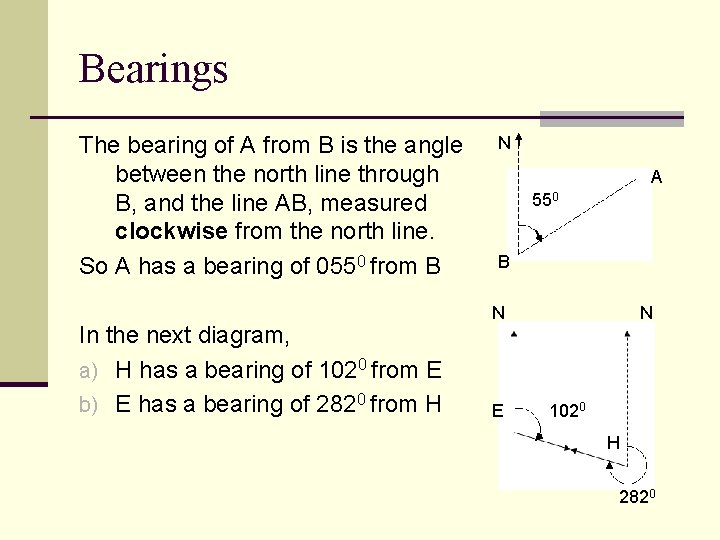
Bearings The bearing of A from B is the angle between the north line through B, and the line AB, measured clockwise from the north line. So A has a bearing of 0550 from B In the next diagram, a) H has a bearing of 1020 from E b) E has a bearing of 2820 from H N A 550 B N E N 1020 H 2820
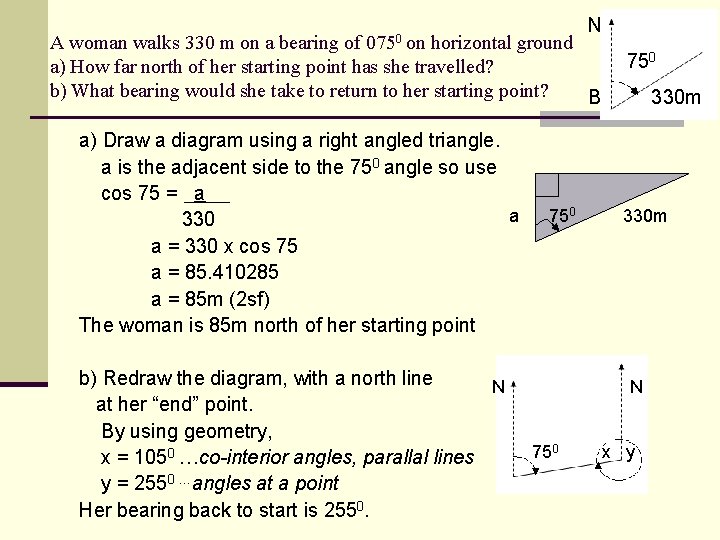
N 0750 on A woman walks 330 m on a bearing of horizontal ground a) How far north of her starting point has she travelled? b) What bearing would she take to return to her starting point? B a) Draw a diagram using a right angled triangle. a is the adjacent side to the 750 angle so use cos 75 = a a 330 a = 330 x cos 75 a = 85. 410285 a = 85 m (2 sf) The woman is 85 m north of her starting point b) Redraw the diagram, with a north line N at her “end” point. By using geometry, x = 1050 …co-interior angles, parallal lines y = 2550 …angles at a point Her bearing back to start is 2550. 750 330 m N 750 x y
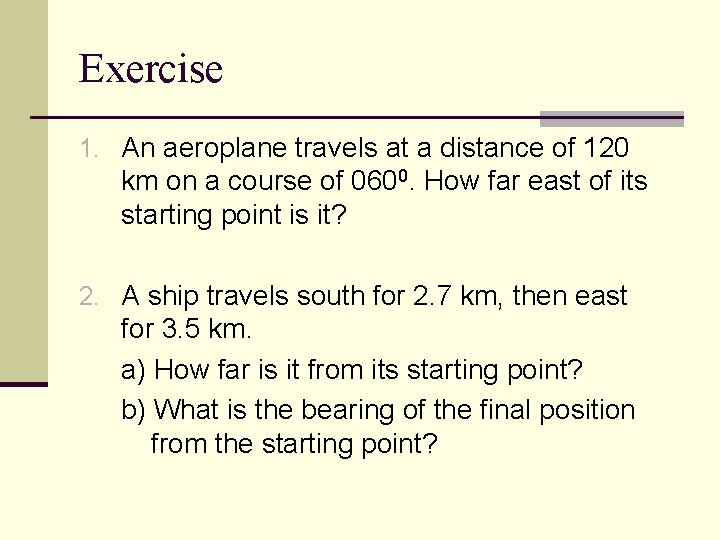
Exercise 1. An aeroplane travels at a distance of 120 km on a course of 0600. How far east of its starting point is it? 2. A ship travels south for 2. 7 km, then east for 3. 5 km. a) How far is it from its starting point? b) What is the bearing of the final position from the starting point?
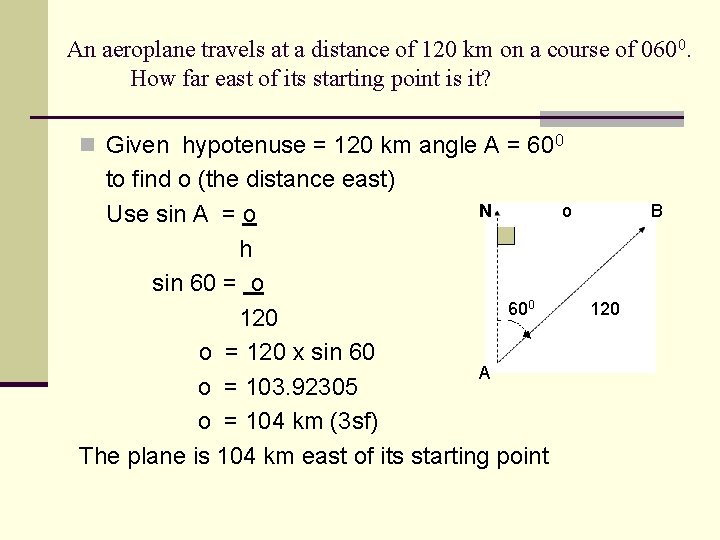
An aeroplane travels at a distance of 120 km on a course of 0600. How far east of its starting point is it? n Given hypotenuse = 120 km angle A = 600 to find o (the distance east) N Use sin A = o h sin 60 = o 600 120 o = 120 x sin 60 A o = 103. 92305 o = 104 km (3 sf) The plane is 104 km east of its starting point o B 120
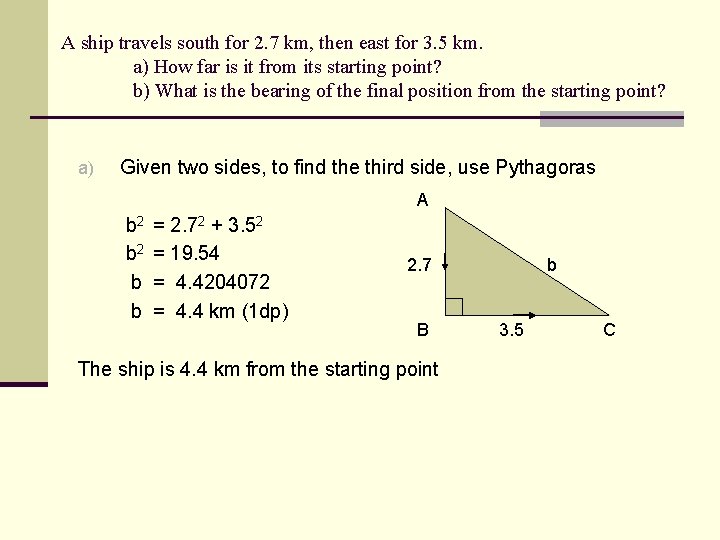
A ship travels south for 2. 7 km, then east for 3. 5 km. a) How far is it from its starting point? b) What is the bearing of the final position from the starting point? a) Given two sides, to find the third side, use Pythagoras A b 2 b b = 2. 72 + 3. 52 = 19. 54 = 4. 4204072 = 4. 4 km (1 dp) 2. 7 B The ship is 4. 4 km from the starting point b 3. 5 C
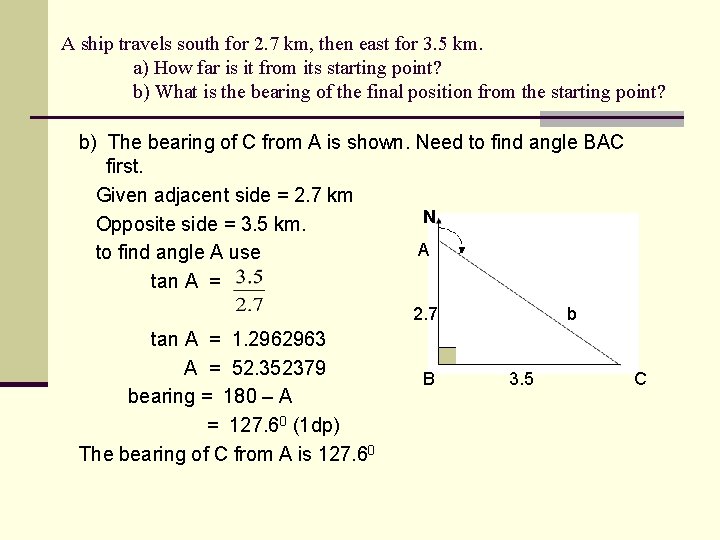
A ship travels south for 2. 7 km, then east for 3. 5 km. a) How far is it from its starting point? b) What is the bearing of the final position from the starting point? b) The bearing of C from A is shown. Need to find angle BAC first. Given adjacent side = 2. 7 km N Opposite side = 3. 5 km. A to find angle A use tan A = 2. 7 tan A = 1. 2962963 A = 52. 352379 bearing = 180 – A = 127. 60 (1 dp) The bearing of C from A is 127. 60 B b 3. 5 C
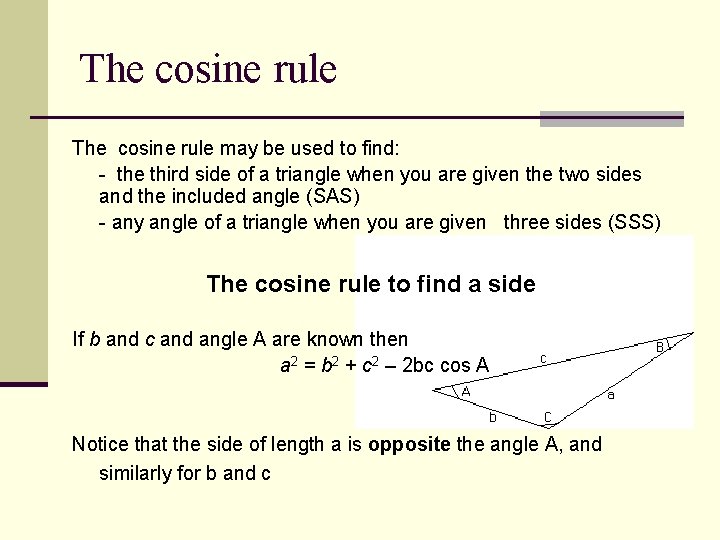
The cosine rule may be used to find: - the third side of a triangle when you are given the two sides and the included angle (SAS) - any angle of a triangle when you are given three sides (SSS) The cosine rule to find a side If b and c and angle A are known then a 2 = b 2 + c 2 – 2 bc cos A Notice that the side of length a is opposite the angle A, and similarly for b and c
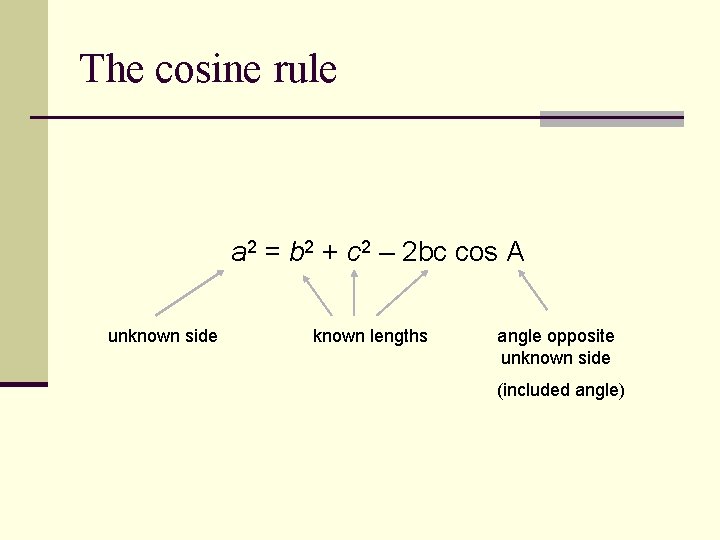
The cosine rule a 2 = b 2 + c 2 – 2 bc cos A unknown side known lengths angle opposite unknown side (included angle)
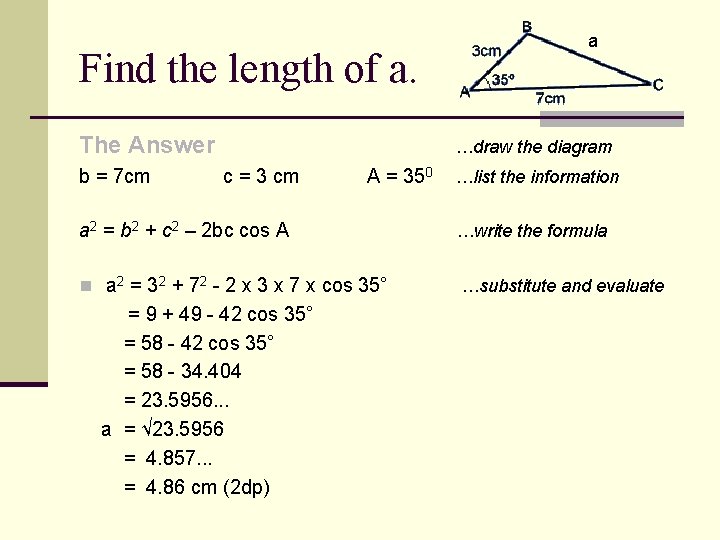
Find the length of a. The Answer b = 7 cm a …draw the diagram c = 3 cm A = 350 …list the information a 2 = b 2 + c 2 – 2 bc cos A …write the formula n a 2 = 32 + 72 - 2 x 3 x 7 x cos 35° …substitute and evaluate = 9 + 49 - 42 cos 35° = 58 - 34. 404 = 23. 5956. . . a = √ 23. 5956 = 4. 857. . . = 4. 86 cm (2 dp)
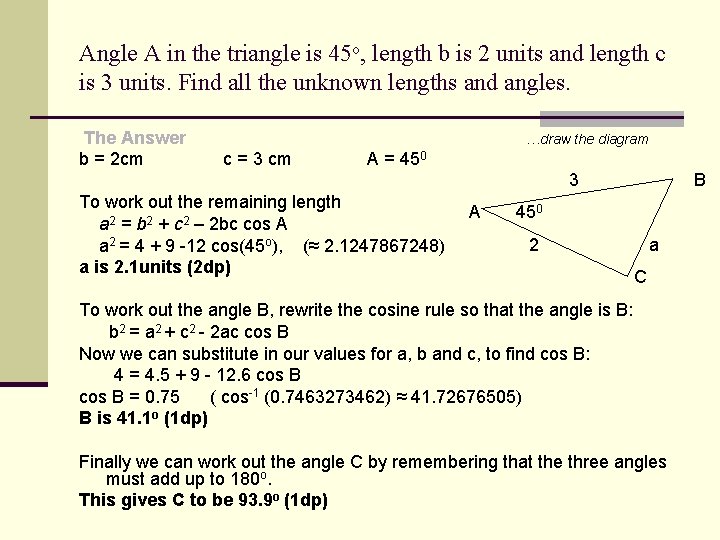
Angle A in the triangle is 45 o, length b is 2 units and length c is 3 units. Find all the unknown lengths and angles. The Answer b = 2 cm …draw the diagram c = 3 cm A = 450 3 To work out the remaining length a 2 = b 2 + c 2 – 2 bc cos A a 2 = 4 + 9 -12 cos(45 o), (≈ 2. 1247867248) a is 2. 1 units (2 dp) A B 450 2 a C To work out the angle B, rewrite the cosine rule so that the angle is B: b 2 = a 2 + c 2 - 2 ac cos B Now we can substitute in our values for a, b and c, to find cos B: 4 = 4. 5 + 9 - 12. 6 cos B = 0. 75 ( cos-1 (0. 7463273462) ≈ 41. 72676505) B is 41. 1 o (1 dp) Finally we can work out the angle C by remembering that the three angles must add up to 180 o. This gives C to be 93. 9 o (1 dp)
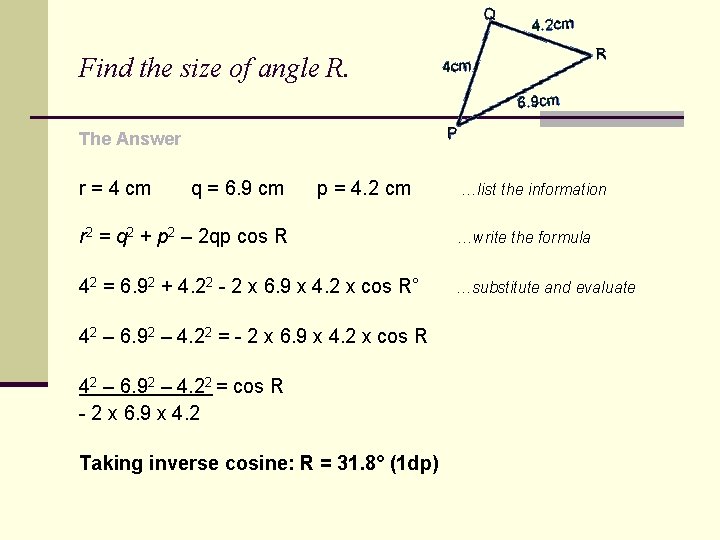
Find the size of angle R. The Answer r = 4 cm q = 6. 9 cm p = 4. 2 cm …list the information r 2 = q 2 + p 2 – 2 qp cos R …write the formula 42 = 6. 92 + 4. 22 - 2 x 6. 9 x 4. 2 x cos R° …substitute and evaluate 42 – 6. 92 – 4. 22 = - 2 x 6. 9 x 4. 2 x cos R 42 – 6. 92 – 4. 22 = cos R - 2 x 6. 9 x 4. 2 Taking inverse cosine: R = 31. 8° (1 dp)
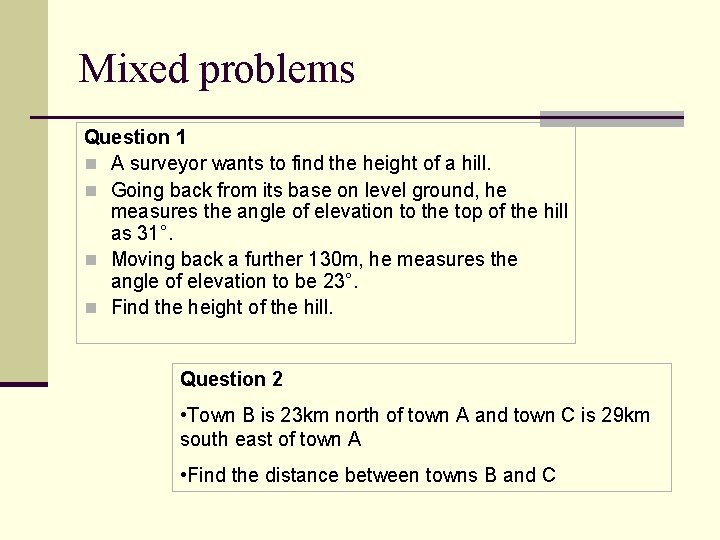
Mixed problems Question 1 n A surveyor wants to find the height of a hill. n Going back from its base on level ground, he measures the angle of elevation to the top of the hill as 31°. n Moving back a further 130 m, he measures the angle of elevation to be 23°. n Find the height of the hill. Question 2 • Town B is 23 km north of town A and town C is 29 km south east of town A • Find the distance between towns B and C
- Slides: 19